Introduction
Over the past decades, governments in many OECD countries have extended entitlements to childbirth-related leave for mothers and increasingly also for fathers. In 2011, postnatal federal statutory entitlements to job-protected leave varied from none in the United States to three years or more in Germany, Finland, Sweden, Norway, Croatia, Czech Republic, Hungary, Estonia, Poland, Portugal, Spain and Greece (International Network of Leave Policies and Research, 2011). The proportion of leave which is paid and the level of pay differ widely.
A growing body of cross-national studies has provided evidence of significant variations in men's and women's contributions to housework and child care by socio-political context (Craig and Mullan, Reference Craig and Mullan2011; Hook, Reference Hook2010). Hook (Reference Hook2006, Reference Hook2010) has argued that parental leave policies, day-care provision and working time regulations may have a more direct impact on time allocations to paid and unpaid work than most other contextual variations. She found that short parental leave and father entitlements to leave were associated with greater involvement of men in child care and with shorter housework hours for women. Fuwa and Cohen (Reference Fuwa and Cohen2007), reported lower levels of housework inequality in couples in countries with longer parental leave. Gershuny and Sullivan (Reference Gershuny and Sullivan2003) found stronger associations of public policy regimes with paid work time than with unpaid work, pointing to the importance of indirect effects. As these studies were based on one or more cross-sections in a diverse set of countries, they give us an idea of the broad associations between macro-level policies and micro-level domestic work behaviour, but do not allow a more detailed study of how these policies may impact on domestic work time in couples.
Longitudinal studies generally suggest that extensions to paid parental leave delay mothers’ return to the labour market during the period for which the leave is available, especially when combined with high compensation levels (e.g., Ondrich et al., Reference Ondrich, Spiess, Yang and Wagner2003; Pylkkaenen and Smith, Reference Pylkkaenen and Smith2004; Waldfogel, Reference Waldfogel1998; Waldfogel et al., Reference Waldfogel, Higuchi and Abe1999). Paid leave entitlements up to approximately one year after childbirth were positively associated with the probability of mothers’ returning at the end of the leave (Pronzato, Reference Pronzato2009; Ruhm, Reference Ruhm1998; Waldfogel et al., Reference Waldfogel, Higuchi and Abe1999). For leave extensions beyond the first year after childbirth, results have been mixed (Ondrich et al., Reference Ondrich, Spiess, Yang and Wagner2003; Schoenberg and Ludsteck, Reference Schoenberg and Ludsteck2007). Most of these studies assumed that longer periods out of the labour market would increase mothers’ time with their children. This is reasonable given that employed mothers, in particular those in full-time employment, tend to spend less time on child care and housework (e.g., Craig and Mullan, Reference Craig and Mullan2011; Hook, Reference Hook2010). One study showed that the introduction of paid family leave in California was associated with increased secondary child care time for mothers (Goodman, Reference Goodman2012).
A growing branch of research has investigated how different aspects of parental leave policies impact the take-up rate and the duration of leave taken by fathers. A cross-national comparison of twenty-four countries suggests that fathers’ use of statutory leave is greatest when high income replacement is combined with extended duration of job-protected leave, in particular when a certain proportion of leave is reserved for fathers (O'Brien, Reference O'Brien2009). Such policies, however, have mainly been found to increase the probability of paternal leave take-up, but not the leave duration beyond the proportion reserved for fathers (Ekberg et al., Reference Ekberg, Eriksson and Friebel2013; Trappe, Reference Trappe2013).
German fathers spend substantially more time with children when they are on leave (Wrohlich et al., Reference Wrohlich, Berger, Geyer, Haan, Sengül, Spieß and Thiemann2012). Sullivan et al. (Reference Sullivan, Coltrane, Mcannally and Altintas2009) also found that patterns of child care time among fathers with young children correspond to the respective leave entitlements in Britain, Norway and Sweden. Existing evidence is contradictory as to whether take-up of leave by fathers results in greater continued involvement in child care beyond the period of leave. Having taken any leave was positively related to paternal child care involvement in the US and the UK (Pleck, Reference Pleck and Hood1993; Tanaka and Waldfogel, Reference Tanaka and Waldfogel2007), whereas associations with weekday child care proved weak in Australia and Germany (Hosking et al., Reference Hosking, Whitehouse and Baxter2010; Wrohlich et al., Reference Wrohlich, Berger, Geyer, Haan, Sengül, Spieß and Thiemann2012). Fathers did not share leave days to care for sick children more equally with mothers after the introduction of the ‘daddy month’ in Sweden, despite significantly larger paternal leave take-up rates (Ekberg et al., Reference Ekberg, Eriksson and Friebel2013). Studies from Sweden and the US (Haas and Hwang, Reference Haas and Hwang2008; Nepomnyaschy and Waldfogel, Reference Nepomnyaschy and Waldfogel2007) found that it was not fathers’ take-up of leave but the length of leave taken that was positively associated with greater participation in child care. This research extends the literature by exploring whether and through what mechanisms parental leave policy reforms may impact on fathers’ sharing of child care and by also considering their contribution to housework. Specifically, I examine differences in maternal and paternal child care time among couples with young children born before and after two German parental leave reforms, which, according to previous studies, significantly impacted maternal labour market participation and paternal leave take-up.
Parental leave and other family-friendly provisions in Germany
In West Germany, the traditional male breadwinner family with mothers being expected to be at most second earners has been encouraged by employment protection legislation for part-time workers, a right to reduce working hours and by joint income taxation for couples (for an overview of recent family policy trends, see Lewis et al., Reference Lewis, Knijn, Martin and Ostner2008). It is only since 1996 that children have been entitled to a half-day place at a day-care centre from the age of three. The level of publicly subsidised childcare provision for children under the age of three has been low but growing as a result of two federal laws in 2005 and 2008 (Deutscher Bundestag, 2004, 2008b), which provided extra funding, granted prioritised access to children with employed parents and stipulated a legal right to a day-care place for children aged one year or over from August 2013, respectively. Between 1991 and 2009, the percentage of children under three years who attended state-subsidised day-care facilities increased from 2 to 12 per cent (Goldstein et al., Reference Goldstein, Kreyenfeld, Huinink, Konietzka and Trappe2010).
Since 1968, employed mothers in Germany have had the right to fully paid maternity leave for eight weeks after childbirth and to four months of additional leave with income-related reimbursement of up to €255 per month. In 1986, a job-protected parental leave of ten months was introduced. The job-protection period was extended from ten to twelve months in 1988, to fifteen months in July 1989, to eighteen months in July 1990 and to thirty-six months in 1992 (Ondrich et al., Reference Ondrich, Spiess, Yang and Wagner2003). After 1986, mothers or fathers on leave were entitled to a child-rearing benefit of about €300 per month for the first six months. After six months, benefits were reduced on a sliding scale based on household income. Families could receive the child-rearing benefit for the whole leave period before 1992 and for up to twenty-four months from 1992 to 2006. In 1987, 83 per cent of all families received the full benefit for the whole leave duration. The benefit was not linked to inflation; therefore the percentage of families that received the maximum amount for the whole leave period declined to 52 per cent by 1998 (Koch, Reference Koch2000). Relative to net median earnings of a couple with one earner and two children, the benefit's value was modest, never exceeding 20 per cent and declining over time. The main aim of the leave extensions between 1986 and 1992 was to enable parents to spend time with their children during the early years, while facilitating their labour market re-entry after the leave. Parental care during the early years was regarded as beneficial for children; how to divide up the leave period between fathers and mothers, however, was left up to the families (Deutscher Bundestag, 1994).
Two reforms in 1998 and 2001 introduced more flexibility in the take-up period and rate of reimbursement, and permitted leave take-up simultaneously with the other parent or with longer part-time work, respectively. As a response to low fertility rates, which were partly attributed to the lack of institutional support for mothers’ employment, the German government introduced the Parental Allowance and Parental Leave Act in 2007. It represented a paradigm shift and explicitly aimed at speeding up maternal labour market return and increasing take-up of leave by fathers (Deutscher Bundestag, 2008a). A reimbursement at 67 per cent of net earnings up to a maximum of €1,800 or a minimum of €300 was introduced which families could receive for a maximum of twelve months for one parent or for fourteen months if both parents took at least two months of leave. Parents remained entitled to job-protected leave up until the child's third birthday.
The analysis focuses on changes in domestic work after the parental leave reforms in 1992 and 2007, as these two reforms pursued contrasting policy objectives and the latter reform may be regarded as a critical juncture in German family policy. Several previous studies have documented that these reforms affected leave take-up by mothers and fathers (Geisler and Kreyenfeld, Reference Geisler and Kreyenfeld2012; Schoenberg and Ludsteck, Reference Schoenberg and Ludsteck2007; Wrohlich et al., Reference Wrohlich, Berger, Geyer, Haan, Sengül, Spieß and Thiemann2012).
The analysis focuses on West Germany, as the 1992 parental leave extension was implemented just after German re-unification, which gave rise to fundamental demographic and economic changes in East Germany, which are difficult to separate from policy changes. Furthermore, sample size limitations do not allow a separate analysis for East German couples. Around the time of these reforms, few other changes in relevant family and labour market policies took place in West Germany that would have strongly affected the domestic work time of parents with children under three years. An exception to this may be the expansion of formal day-care from 2005, the methodological implications of which will be discussed.
Theoretical framework for parental leave policy effects on domestic work in couples
I draw on economic theory (e.g., Becker, Reference Becker1981) and resource bargaining approaches (e.g., Lundberg and Pollak, Reference Lundberg and Pollak1996; Ott, Reference Ott1992) to consider how altered economic resources after the parental leave reforms may affect the division of housework and child care in couples after childbirth. I extend economic policy evaluation approaches by also considering sociological and social policy perspectives which suggest that policies simultaneously shape cultural images of gender and perceptions of moral appropriateness of work–care arrangements (Hochschild, Reference Hochschild1995; Kremer, Reference Kremer2007; Lewis, Reference Lewis2001; Pfau-Effinger, Reference Pfau-Effinger2005). These may impact the practised division of paid and unpaid work, for instance by influencing parents’ identities regarding gender, work and care (Risman, Reference Risman2004; Stewart and McDermott, Reference Stewart and McDermott2004).
According to neo-classical economic theory (Becker, Reference Becker1981), paid parental leave lowers parents’ opportunity costs of temporarily interrupting employment to care for the child. To maximise household income, it would be efficient for the partner with lower relative potential earnings to interrupt paid work and specialise in unpaid work for longer until the receipt of parental leave benefit or the period of job-protected leave expires or until external child care provision is available at costs which are lower than the second earners’ potential income.
Resource-bargaining approaches (e.g., Lundberg and Pollak, Reference Lundberg and Pollak1996) have argued that higher relative resources in the labour or marriage market or from transfers may be used to negotiate for lower participation in household labour, which people perceive as onerous or exhausting. The lower the level of compensation during the leave period compared to previous earnings, the greater will be the reduction in the bargaining power of the parent on leave.
Longer labour market time-outs of one partner may also have longer-term implications for the gender division of labour beyond the period of leave as a result of depreciating labour market skills, improved domestic work skills and lower bargaining power.
Following the ‘doing gender’ approach (West and Zimmerman, Reference West and Zimmerman1987) and identity theories (for an overview of different strands, see Stewart and McDermott, Reference Stewart and McDermott2004; Stryker and Burke, Reference Stryker and Burke2000), men and women continuously re-construct their gendered identities in interactions in paid and unpaid work. In addition to setting economic incentives, policies for reconciling paid and unpaid work also transport normative messages regarding appropriate work and care arrangements for families (Hochschild, Reference Hochschild1995; Kremer, Reference Kremer2007; Lewis, Reference Lewis2001), which may impact on parents’ identities and practices. Hochschild (Reference Hochschild1995) distinguished between traditional, post-modern, cold-modern and warm-modern cultural images of care. Kremer (Reference Kremer2007) categorised countries in terms of predominant culturally shaped moral care ideals of full-time mother care, parental sharing, intergenerational care, surrogate mother care or professional care, respectively. Changes in policies may impact cultural ideals, individual identities and the practised division of domestic work through ideas formulated in the policy discourse (Pfau-Effinger, Reference Pfau-Effinger2005) and through implicit assumptions regarding the moral appropriateness of specific work and care arrangements (Lewis, Reference Lewis2001). Cultural adaptations are less likely after individual policy reforms, as they are usually based on combinations of policies over longer periods (Neyer and Andersson, Reference Neyer and Andersson2008). However, individual policy reforms are more likely to be followed by altered behaviour within a short time, if they are ‘critical junctures’ in the sense that they represent a radical change in the institutional setting (Neyer and Andersson, Reference Neyer and Andersson2008; NíBhrolcháin and Dyson, Reference NíBhrolcháin and Dyson2007) and if they are consonant with existing identities at least among some population groups (Kremer, Reference Kremer2007; Lewis et al., Reference Lewis, Knijn, Martin and Ostner2008).
The 1992 parental leave reform extended the total period of job-protected maternity and parental leave from eighteen to thirty-six months, and parents could receive the childrearing benefit for a maximum of twenty-four instead of eighteen months. As the childrearing benefit was relatively low and dependent on household income, neo-classical economic theory predicts longer labour market interruptions after the reform for second earners with lower wages and those living in low-income households. By extending the job-protected leave further than the childrearing benefit entitlement, the reform may have reduced mothers’ bargaining power while on leave and also beyond. Schoenberg and Ludsteck (Reference Schoenberg and Ludsteck2007) found that after the reform 8 per cent of mothers delayed their labour market return and subsequently earned lower wages partly as a result. Longer maternal time-outs were also associated with a more traditional division of housework and child care in West German couples during the first years after childbirth (Schober, Reference Schober2012; Schulz and Rost, Reference Schulz and Rost2012).
Based on economic incentives, mothers’ longer unpaid or low-paid leaves after the 1992 reform presumably resulted in longer time spent on child care and housework from eighteen months after childbirth onwards, but should not have affected the division of domestic work in the first year. As for most mothers, the extended leave period will have been paid at below their wage rates, and fathers may have increased their work hours and reduced their participation in domestic work to compensate for the loss in household income.
Based on economic perspectives, maternal involvement in child care and housework at eighteen to thirty months after birth therefore would be predicted to be greater and fathers’ engagement smaller among couples with children born after the 1992 reform compared to before (Hypothesis 1).
Attitude data (Blohm, Reference Blohm2002; Braun et al., Reference Braun, Scott and Alwin1994) suggest that traditional ideals of the full-time mother and the breadwinning father prevailed in Western Germany in the early 1990s. As the declared aims in the policy discourse were to improve children's wellbeing by giving parents – in practice mothers – more time with them, the unpaid or low-paid leave extension in 1992 conformed with the implicit assumptions of preceding leave extensions and of the restricted access to day-care. They suggested that mother care was most appropriate for young children. The reform therefore was consonant with prevailing gender identities, which may have facilitated behavioural adaptations to altered economic incentives. However, it was hardly radical enough to alter cultural ideals within a short time frame.
The changes in maternal and paternal domestic work behaviour after the 1992 reform are therefore unlikely to go beyond those that can be accounted for by both parents’ labour market participation and relative wages (Hypothesis 2).
The 2007 parental leave reform introduced compensation of 67 per cent of previous net earnings up to a maximum of €1,800 or a minimum of €300 for fourteen months with two months being reserved for each parent. According to neo-classical economic theory, a higher compensation rate reduces the opportunity costs of taking leave during the paid leave period. The compensation rate increased most strongly for mothers with high earnings or household income. At the same time, however, this increased their bargaining power as a result of larger relative economic resources when taking leave. The higher compensation rate in combination with a leave quota provided incentives for fathers to take leave. Evaluation studies found an increase in maternal and paternal leave take-up by 6 and 3 per cent, respectively, during the first year after childbirth (Kluve and Tamm, Reference Kluve and Tamm2009; Wrohlich et al., Reference Wrohlich, Berger, Geyer, Haan, Sengül, Spieß and Thiemann2012).
Based on economic theory and bargaining models, I would expect that fathers performed more child care and housework in the first year after childbirth after the reform compared to before as a result of fathers’ increased leave take-up and mothers’ greater bargaining power (Hypothesis 3). The effects on maternal domestic work involvement during the first year after childbirth may be contradictory, as their reduced labour market participation may imply positive associations, whereas their greater bargaining power may limit such changes.
Compared to the previous income-tested childrearing benefit, the unpaid leave in the second year should increase the probability of labour market return mainly for mothers with low earnings or where household income was low, which is also what evaluations found (Wrohlich et al., Reference Wrohlich, Berger, Geyer, Haan, Sengül, Spieß and Thiemann2012). Beyond fourteen months after birth, economic theories predict only small general changes in maternal or paternal domestic work through increased maternal employment among subgroups. As German fathers tend to take short periods of leave at most (Trappe, Reference Trappe2013), these are unlikely to have longer-term effects through mechanisms captured in economic models, such as reduced labour market skills or bargaining power.
In the West German context, the 2007 parental leave reform in combination with the expansion of day-care facilities for young children may be considered a radical shift in the direction of family policy (Lewis et al., Reference Lewis, Knijn, Martin and Ostner2008). As the reform objectives were formulated as speeding up maternal labour market return and involving fathers in child care, it may have conveyed implicit assumptions of the ‘adult worker model’ and shared parenting responsibilities. Although cultural change may have been limited somewhat by contradictions with widespread traditional attitudes and practices (Blohm, Reference Blohm2002; Konietzka and Kreyenfeld, Reference Konietzka and Kreyenfeld2010; Lewis et al., Reference Lewis, Knijn, Martin and Ostner2008), recent studies (Kreyenfeld and Krapf, Reference Kreyenfeld, Krapf, Becker and Lauterbach2010) also point to stark increases in day-care use for children under three among highly educated mothers. The reform may therefore have facilitated greater paternal involvement in child care among a subgroup of highly educated parents, whose attitudes conformed to the changing policy context. Changes in parenting identities and practices beyond the period of paid leave may be particularly likely among fathers who chose to take some leave and had time to establish closer bonds with the child but may also apply to other groups.
Fathers would therefore be expected to perform more child care during the first and following years after childbirth after the 2007 reform compared to before (Hypothesis 4). As the reform objectives focused on paternal child care involvement and not on gender equality in the home more generally, the reform may have impacted sharing of child care more strongly than it did housework.
Larger post-reform child care involvement of fathers even after accounting for factors relating to economic and bargaining mechanisms may provide support for an effect through other mechanisms, such as the cultural influences of normative policy assumptions. A lack of supportive evidence, however, cannot be interpreted as a rejection of the normative influence of policies, as these may impact the gender division of domestic work indirectly through or simultaneously with time allocations to paid work or may have longer term effects.
Method and data
The data for the analysis are drawn from couple responses in the German Socio-Economic Panel (SOEP). The SOEP started with a probability sample of households from West Germany in 1984. It was extended to East Germany in 1989 and includes some refresher probability samples from 1998, 2000 and 2006 (for a detailed description, see Wagner et al., Reference Wagner, Frick and Schupp2007). The East German sample and oversamples of foreigners and high-income households are not used in this analysis. A great strength of this longitudinal survey is that all members of the household are interviewed annually. In addition to fertility and employment histories, the SOEP asked each respondent annually about time spent on housework and child care on a weekday.
As information on housework or child care time for a large enough sample of couples who had children just before and after the reforms is not available, I define wider time windows of eighteen or twenty-four months before and after the two reforms. This allows for sufficiently large samples, while reducing the risk of other confounding policy reforms or cohort trends taking place during the observation window. The time window for the 1992 reform is restricted to couples with children born after June 1990, as before that a shorter parental leave entitlement applied, and before July 1993. The latter limit allows me to observe couples until their child is thirty months old but makes sure these children are not yet affected by the right to a day-care place from age three which came into effect in 1996. For the 2007 reform, I include couples with children born from January 2005 until December 2008 to observe more fathers taking leave.
I apply pooled OLS regressions to compare the differences in mean child care and housework time before and after the respective reform, after accounting for cohort trends and other control variables (see Equation (1)). Robust standard errors are calculated to account for clustering of repeated births within couples, as some couples have more than one child within the observation window. I also tested random effects models, which in many cases provided inconsistent estimates according to Hausman tests. I estimate β2, the difference before and after the reform in terms of di , which represents the time mothers or fathers spend on housework or child care, respectively, after controlling for a vector xi , which includes cohort trends and other control variables. In extensions of this model, measures of mothers’ and fathers’ labour market participation, relative wages and leave taking are then added to explore possible mechanisms. Unfortunately, sample size limitations restricted further explorations of subgroup differences, which would also have been informative.
 \begin{equation}
d_i = \beta _1 + \beta _2 post_i + \beta _3 x_i + \varepsilon _i\end{equation}
For the 1992 reform, I also apply difference-in-difference estimates comparing parents who just had a child with parents whose youngest child is seven years old before and after January 1992, when the reform was implemented (see Equation (2)). β2 gives an estimate of the before–after reform difference averaged across both groups, β3 estimates the difference between couples who just had a baby and those with school-aged children across both periods and β4 indicates whether the reform had a different effect on new parents compared to couples with older children.
 \begin{equation}
d_i = \beta _1 + \beta _2 post_i + \beta _3 new\;{\textit parents}_i + \beta _4 \,post_i \;*\;new\;{\textit parents}_i + \beta _5 x_i + \varepsilon _i\end{equation}
This method assumes that parents with school-aged children were generally subject to the same changes over time due to period, cohort and age trends but have not been affected by the specific parental leave reform. I chose age seven because parents with younger children may have been affected by changing school entry policies across time and regions. For the 2007 reform, a comparison with couples with children of pre-school or school age may be problematic, as the German government passed an agreement to invest in after-school education and care in 2003 (Deutscher Bundestag, 2005) and two laws to expand day-care provision for under three-year olds in 2005 and 2008. Furthermore, full day provision in day-care centres has risen for children over three. Therefore, child care time may have decreased over time among mothers with pre-school and school-aged children as a result of institutional changes other than those which affected the time parents spend with newborns and infants. To test whether the changes in domestic work after the 2007 reform are likely to be driven by other trends, such as the expansion of day-care for under three year olds from 2005, I also compare domestic work time for couples with children born between January 2003 and December 2004 and those born between January 2005 and December 2007. For housework, I also tested difference-in-difference regressions using childless couples as the control group. These gave qualitatively the same results as the difference in means estimates, and therefore only the latter are subsequently shown.
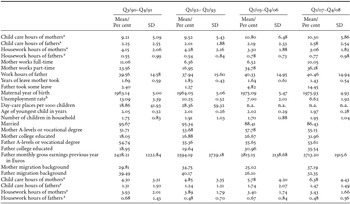
It is important to note that there is a risk of selection bias. Although the German government passed both of these reforms only a few months before they came into effect and newspaper articles about the reforms also appeared only a couple of months before (Kluve and Tamm, Reference Kluve and Tamm2009; Schoenberg and Ludsteck, Reference Schoenberg and Ludsteck2007), couples whose babies were born several months after the respective reforms will have known about the reform and might have considered it in planning the pregnancy. This is less likely for the 1992 reform than for the 2007 reform, which also aimed at increasing fertility. An evaluation survey after the 2007 reform, however, suggested that in the short term it altered couples’ decisions regarding leave taking and paid work but did not affect the decision on whether or not to have children (RWI, 2008). A comparison of the demographic characteristics of the pre- and post-reform samples shows hardly any significant differences except for migration background (see Table 1).
Descriptive statistics for West German couples who had a child in the respective periods and comparison groups, at child age 18–30 months

Notes: a Housework and child care hours refer to a typical weekday. b The unemployment rate for the 1992 reform period refers to whole of Western Germany, while the rate for the 2007 reform period is measured at the federal state level. Full descriptive statistics for the comparison groups are available from the author on request.
Source: SOEP v27, 1990–2010
Sample selection and non-response
The analysis sample includes 208 births between July 1990 and December 1991 and 236 children born between January 1992 and June 1993. The comparison group comprises 390 couples whose youngest child was seven years old at some point during the eighteen-month observation window before and after January 1992. In the sample of new parents with children born between January 2005 and December 2008, I observe 276 births before and 199 births after the 2007 reform. The sample to test for differences between children within two years born before and after 2005 consists of 623 births.
As several years of data are used, there is a risk of bias due to wave non-response. I examined correlations of wave non-response with the explanatory and control variables and found no significant differences. Sixty-six of the new parent sample for the 1992 reform and thirteen of the comparison group of parents with school-aged children had some item non-response in the dependent or independent variables. Among the 2007 reform sample, ninety-five couples had some missing items. The questions with the largest amount of missing information were housework and child care hours of men. Multiple imputations using chained equations gave substantively similar results. Subsequently, the models with complete responses are shown. The final analysis sample includes 154 and 186 births before and after the 1992 reform, respectively. The comparison group consists of 377 couples with children of school age observed within eighteen months before or after 1992. I observe 226 and 154 births with complete responses before and after the 2007 parental leave reform, respectively. The sample to explore change before and after January 2005 includes 459 births.
Measures
Domestic work time is conceptualised as time spent on traditionally female-type housework tasks and on child care on a typical weekday. The dependent variables are mothers’ and fathers’ weekday hours spent on housework and child care, respectively. Weekend estimates were not asked for every year in the SOEP and were therefore excluded. Although stylised estimates of domestic work time are generally more prone to overreporting than time diary questions, comparisons of both types of measures found the sign and statistical significance of parameters to be the same (Kan and Pudney, Reference Kan and Pudney2008). The SOEP measure of weekday housework hours may underestimate housework time for fathers who did less than half an hour of housework per day. I compared a sample of fathers in the SOEP 2009 with the SOEP Pretest 2010, which included a minute option, but the differences were not statistically significant.
I use two indicators of whether the child was born after December 1991 and 2006, respectively, to measure the difference before and after the two reforms. To explore possible mechanisms of change in post-reform domestic work time, I include mothers’ labour market status, distinguishing between: (i) full-time employed (over thirty hours per week), (ii) part-time employed or in education, (iii) on leave or not employed, fathers’ weekly work hours and mothers’ hourly wages relative to fathers’. I also consider the number of years and months the mother has been on maternity or parental leave and whether the father has taken at least one month of leave since the birth of the child. Unfortunately, the small sample of fathers taking some leave prevented further differentiation by length of leave.
To reduce the risk of bias due to selection into childbearing after a reform or wave non-response, I control for demographic factors which have been found to correlate with childbearing or non-response and with domestic work of men and women. I account for educational attainment and migration background of both partners. I differentiate between: (i) college or university degree, (ii) vocational or secondary degree and (iii) less than a secondary or vocational degree. Migration background is measured as belonging to the first or second generation of immigrants to Germany. Fathers’ earnings in the previous period are included as a proxy for the household's ability to afford mothers’ labour market interruptions and outsourcing of domestic work. As domestic work time has been found to be positively associated with the number of children and marital status and seems to decrease as the youngest child gets older, these factors are also controlled.
Furthermore, I control for birth year of the mother to capture possible cohort trends towards a more egalitarian division of domestic work. I tested a linear measure of the birth cohort as well as five-year categories. For the period from 1990 to 1993, I also consider the regional availability of places in day-care centres for children aged under three years collected by German youth welfare offices. Due to a break in the measurements in 2006, day-care availability cannot be considered for children born between 2005 and 2008 but I tested a variable of whether the youngest child attended day-care. To capture variations in the business cycle, I control for annual changes in the unemployment rate in West Germany in the early 1990s and in each federal state in the 2000s.
Results
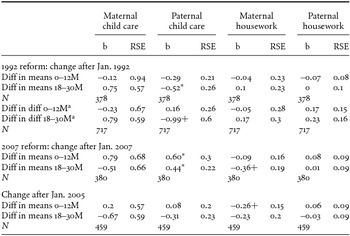
As expected based on economic and bargaining theories, domestic work time of mothers and fathers did not change significantly in the first year post-birth after the 1992 reform (see Table 2). In line with Hypothesis 1, fathers of children born after the reform spent about half an hour less on child care on a weekday between eighteen and thirty months after childbirth than those with pre-reform births. Mothers also spent longer on child care but the estimate does not reach statistical significance. Neither the housework hours of mothers nor that of fathers has been affected by the reform. The difference-in-differences estimates comparing the change among new parents to that among parents of school-aged children tell largely the same story. The effects of the reform on new fathers are estimated to be larger because child care time of fathers with school-aged children increased slightly over the period.
OLS difference in means and difference-in-difference estimates of changes in maternal and paternal housework and childcare hours on a weekday in West Germany after the 1992 and 2007 parental leave reforms

Notes: All models control for year of birth of the mother, number of children, educational level of mother and father, migration background of mother and father, natural log of previous earnings of father, marital status, regional unemployment rate and for the 1990 to 1993 period also for regional day-care availability.a The control group consists of parents with a youngest child aged seven years.
+ p<0.01, * p<0.05, ** p<0.01, *** p<0.001.
Source: SOEP v27, 1990–2010.
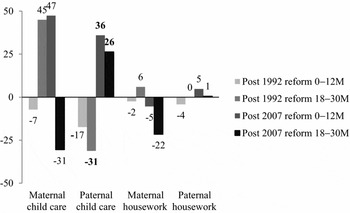
Consonant with Hypothesis 3, fathers of children born from January 2007 onwards reported spending on average thirty-six minutes more on child care on weekdays in the first year after childbirth compared to those whose children were born before. At eighteen to thirty months after the birth, this difference decreased slightly to twenty-six minutes (see Figure 1). No significant differences in paternal care were found when comparing parents with children born before and after January 2005, which suggests that most of the changes after the 2007 reform are likely to be attributable to the reform rather than general period trends or to the expansion in day-care coverage which started in 2005. Maternal child care seems to have increased in the first year after childbirth in line with previous results on small increases in mothers’ leave take-up, but the estimate does not reach statistical significance. I also found a marginally significant decrease in maternal housework time after the 2007 reform at eighteen to thirty months after a birth. However, this is not significantly different from the change after the 2005 reform, suggesting it is probably related to other period trends. Paternal housework time does not differ significantly between couples having children before and after January 2007.
Estimated differences in child care and housework minutes on a typical weekday of mothers and fathers in couples with children born after the respective parental leave reform compared to those born before the reform. Notes: All models control for age of the child in months, number of children, year of birth of the mother, educational level of mother and father, migration background of mother and father, natural log of previous earnings of father, marital status, regional unemployment rate and for the 1990 to 1993 period also for regional day-care availability. Values in bold indicate statistical significance. Source: SOEP v27, 1990–2010.

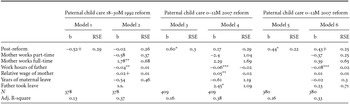
In Table 3, regression analyses are shown to explore possible mechanisms for the significant changes in paternal child care time after the two reforms. In a second modelling step (see Models 2,4, and 6), I add maternal labour market status, paternal work hours, relative wages, length of leave taken by the mother and paternal leave take-up (only for the 2007 reform) to the difference-in-means models. The variables are added simultaneously as they are in part jointly determined and strongly interrelated. Accounting for these factors reduces the post-1992 reform estimate to close to zero. In line with previous studies, maternal full-time employment, shorter paternal work hours and larger relative wages are positively associated with paternal child care involvement. These results support Hypothesis 2 which assumed that the changes in maternal and paternal labour market participation and relative wages when the child is eighteen to thirty months largely explain the reduction in paternal care involvement after the 1992 reform.
OLS regression models of paternal child care hours on a weekday before and after the 1992 and 2007 reforms, respectively

Notes: All models control for age of the youngest child, number of children, year of birth of the mother, educational level of mother and father, migration background of mother and father, natural log of previous earnings of father, marital status, regional unemployment rate and for the 1990 to 1993 period also for regional day-care availability. s.s. indicates that the sample in this cell was too small to be included.
+ p<0.01, * p<0.05, ** p<0.01, *** p<0.001.
Source: SOEP (2011).
The difference in paternal child care between children born before and after the 2007 reform ceases to be statistically significant for the first year after accounting for fathers’ work hours, mothers’ relative wages and fathers’ leave take-up in Model 4. Fathers who have taken some leave or are currently on leave contribute on average two and a half hours more to child care on a weekday during the first year after childbirth. This partially supports Hypothesis 3, which assumed that changes in paternal leave-taking and maternal bargaining power have been important mechanisms for paternal domestic work involvement during the first year after childbirth.
Interestingly, accounting for these factors reduces the significance of the post-2007 difference in paternal child care at eighteen to thirty months after the birth only slightly. Fathers who have taken some parental leave do not spend significantly more time on child care at this point. Further explorations (available on request from the author) showed that fathers’ hours in formal employment decreased after the 2007 reform in the first year after birth but remained unchanged at child age eighteen to thirty months. Fathers therefore reported longer child care time after the reform, while continuing to spend the same amount of time on market work. The post-reform difference in paternal child care time also remained unchanged after controlling for whether the youngest child attended formal day-care in Model 6 (results available on request). Formal day-care attendance was negatively rather than positively associated with paternal child care time. The associations with the reform indicator are stronger for child care than for housework of mothers and fathers. In combination, these results may provide tentative support for normative changes in terms of paternal child care involvement after the 2007 parental leave reform in line with Hypothesis 4.
Discussion
This research has investigated potential consequences of two specific parental leave policy reforms for the gender division of domestic work in West German couples with young children. The findings point to reduced paternal child care involvement after an extension of the job-protection period from eighteen to thirteen months after birth in 1992. The results also suggest that fathers performed more child care after the introduction of income-related compensation and of a use-it or lose-it leave entitlement of two months in 2007. The strength of these associations is moderate, amounting to approximately a quarter of a standard deviation.
This research confirms and extends previous evidence (e.g., O'Brien, Reference O'Brien2009; Schoenberg and Ludsteck, Reference Schoenberg and Ludsteck2007) that very long parental leave entitlements with low or no pay promote a traditional division of labour in couples not only in terms of paid work but also child care. This is of relevance for a number of European countries with such parental leave policies. I found that the reduction in full-time employment and relative wages of mothers eighteen to thirty months after childbirth largely accounted for the change in paternal child care after the 1992 reform. Fathers’ greater child care involvement in the first year after childbirth after the 2007 reform was also mostly explained by increased paternal leave take-up since the reform. The post-reform changes in maternal child care were consonant with previous results regarding effects on maternal leave duration (Schoenberg and Ludsteck, Reference Schoenberg and Ludsteck2007; Wrohlich et al., Reference Wrohlich, Berger, Geyer, Haan, Sengül, Spieß and Thiemann2012) but did not reach statistical significance. The imprecise estimates may be due to modest effects on maternal labour market participation, to the small sample size, which did not allow subgroup analyses, or to measurement error in the child care time questions.
My findings suggest that German fathers’ medium-term child care involvement increased after the introduction of income-related leave compensation and two ‘daddy months’ in 2007; however, the mechanisms may be more complex than assumed. In line with previous results for Germany and other countries (Ekberg et al., Reference Ekberg, Eriksson and Friebel2013; Haas and Hwang, Reference Haas and Hwang2008; Hosking et al., Reference Hosking, Whitehouse and Baxter2010; Nepomnyaschy and Waldfogel, Reference Nepomnyaschy and Waldfogel2007; Wrohlich et al., Reference Wrohlich, Berger, Geyer, Haan, Sengül, Spieß and Thiemann2012), I did not find that fathers who had taken some leave – possibly simultaneously with mothers – performed significantly more child care beyond the period of leave take-up after the birth. One explanation may be that parental leave policies can also influence child care time more directly, for instance by altering normative care ideals within a relatively short time, if a policy change constitutes a critical juncture in terms of the historical institutional context. As suitable longitudinal measures of attitudes were not available and given the lack of a valid control group, these results need to be interpreted with caution.
Remarkably, I find little evidence of changes in housework contributions by mothers and fathers with newborns after the two parental leave reforms. At first sight, this may appear contradictory to evidence on macro-level associations of parental leave policies with housework time of men and women (Hook, Reference Hook2006, Reference Hook2010). As parental leave policies, however, impact the probability of maternal and paternal leave take-up, the length of labour market interruption and subsequent wages, these may have longer-term economic and normative consequences for the division of housework in couples.
An important limitation of this study is the measure of domestic work time through retrospective survey questions rather than time diaries. As respondents’ estimates of child care time may be influenced by their gender and parenting identities, associations with policy reforms may be overestimated if these policies affected norms and attitudes more strongly than actual practice. Furthermore, the estimates cannot be interpreted as causal, as I could not observe a large sample of couples with a newborn child just before and after the respective reforms. To better understand the mechanisms, cross-national comparisons and longitudinal subgroup analyses of parental leave reforms and domestic work time within countries are needed, ideally including measures of attitudinal and behavioural changes.
Acknowledgements
This research was supported by a grant from the British Academy [PDF/pf1000159]. Previous versions of this paper have been presented at the SOEP User conference 2012 and at the 2012 Spring Meeting of the Family Sociology Section of the German Research Foundation.