Introduction
Southeast Asia is the world’s most disaster-prone region, and many of the region’s countries share the same natural hazards and vulnerabilities.Reference Trias and Cook 1 –Reference Thomas, Albert and Hepburn 3 Disasters that devastate health care infrastructure demand national and international surge support from Emergency Medical Teams (EMTs). Even developed nations may have to engage international assistance: the forecast Nankai Trough earthquake in Japan is predicted to cause over 300,000 deaths and 600,000 injuries, which would far exceed the country’s medical response capacity.Reference Anan, Kondo and Akasaka 4
Classified EMTs are groups of health professionals (doctors, nurses, paramedics, logisticians, etc.) that treat patients affected by an emergency or disaster and deploy under standards prescribed by the World Health Organization (WHO). 5
Australia hosts two WHO-classified EMT entities (including specialized cells). In this article, we use “EMTs” to encompass both the government-led and non-governmental capabilities; where relevant, we distinguish their different legal statuses.
The legal status and authority of EMTs are typically defined by a combination of the host nation’s sovereign laws, ad hoc or pre-existing bilateral agreements, and international guidelines. Under the UN Charter 6 and the overarching humanitarian coordination framework established by UNGA Resolution 7 46/182, affected states retain full sovereignty over relief activities within their borders, meaning that all EMTs must comply with the host country’s legislation, including medical licensing and liability laws. Yet, few countries have functioning, comprehensive domestic disaster preparedness laws to this effect. This often leads to improvised arrangements, confusion, bureaucratic bottlenecks, inconsistent application of regulations, and general uncertainty that can hinder timely medical relief.Reference Fatema, East and Islam 8 , Reference Jang, Ekyalongo and Kim 9
Jurisdictional arrangements for EMTs vary widely by deployment: some host countries expedite licensing or grant foreign providers immunity during deployment, others enforce local laws strictly or lack any clear policy, forcing negotiators to scramble for legal workarounds. 10 Legal pluralism—the coexistence of multiple legal systems within a single geopolitical spaceReference Berman 11—creates jurisdictional hybridity, where competing normative standards simultaneously govern medical practice and which EMTs must navigate.
Ethical obligations still govern the conduct of all medical personnel. This is particularly critical in areas with pre-existing political tensions or where health laws may not align with international standards. Ethical frameworks provided by WHO or regional health authorities can significantly guide practice standards, patient rights, and inter-professional collaboration.Reference Kita, Limpaporn and Silapunt 12 , 13 Thus, EMTs frequently operate in a legal gray area, facing questions about their authorization to practice, the extent of their clinical responsibilities, and their exposure to liability or prosecution in foreign jurisdictions.Reference El-Khani, Ashrafian and Rasheed 14
Existing international guidance (e.g., WHO EMT initiative, IFRC’s International Disaster Response Laws guidelines) acknowledges the importance of clear legal frameworks for foreign disaster assistance 5 , 15; however, these high-level frameworks have not yet resolved the on-the-ground inconsistencies in EMT governance.
Recent developments in response coordination frameworks, such as the 2022 Seville Agreement, 16 have shifted focus toward strengthening local leadership and capacity, and designate national Red Cross and Red Crescent Societies as “conveners” within their own countries during disaster responses. This paradigm change focuses on the sovereignty of the hosting country and the role of the locality, and forces EMTs to radically rethink their business model: to operate smoothly as a part of the national health systems and not in isolation; forging pre-disaster deployment partnerships with national Red Cross/Red Crescent Societies and the national authorities; incorporating deliberate elements of knowledge transfer in their operations; acting in support rather than in command roles; establishing advanced arrangements of their legal, political, and social character, which both respect the sovereignty of the host nation and observe humanitarian standards. This transition represents a decisive move away from traditional humanitarian approaches toward collaborative models that prioritize long-term capacity building and national ownership of disaster response efforts.
The changing landscape of disaster response coordination illustrates the tension between non-negotiable state sovereignty and practical necessities of humanitarian action: the affected governments tend to exercise a form of “graduated sovereignty”Reference Ong 17 by selectively loosening the regulations while they nonetheless exert de jure control of the relief actions.
Intersection of Humanitarian Principles and Medical Jurisdiction
EMT operations are founded on the four fundamental humanitarian principles of humanity, neutrality, impartiality, and independence. 5 , 18 Legal and jurisdictional disputes, however, at times delay the provision of medical care, particularly when EMTs are hindered by bureaucratic restrictions (Table 1).
Summary of core humanitarian principles and their practical application in EMT deployments: how each principle informs EMT conduct, engagement with host nations, and operational behavior during international disaster response, forming the ethical foundation of EMT coordination under the WHO framework

Abbreviations: EMT, Emergency Medical Team.
Objective
To date, there has been limited scholarly analysis focusing specifically on the legal and operational issues faced by Australian EMTs abroad, despite Australia’s active role in regional disaster response. This represents a critical gap in both the academic literature and practical policy for disaster health management. Without dedicated research, efforts to reform laws or develop bilateral agreements may remain ad hoc and reactive; thus, clarifying the jurisdictional ambiguities is not only a legal imperative but also essential for protecting health care workers and patients, ensuring rapid deployment capabilities, and upholding international humanitarian principles during disaster response.
This work systematically assesses the legal and jurisdictional arrangements covering the deployment of the Australian EMTs in the Asia-Pacific region, exploring:
-
1. the existing legal frameworks and jurisdictional arrangements when deployed in international disaster responses, and how they are different in different host nations;
-
2. the key legal and operational challenges arising from existing jurisdictional governance arrangements;
-
3. should existing laws, agreements, or international guidelines be improved or further harmonized to provide greater legal clarity and protection for Australian EMTs and their patients?
The answers aim to fill the knowledge gap and support the development of more robust legal frameworks governing the deployment. Strategies to improve governance uniformity are provided together with recommendations to address jurisdictional challenges.
Methodology
A scoping review-informedReference Westphaln, Regoeczi and Masotya 19 approach based on three interlinked components: thematic document analysis,Reference Clark, Foster and Sloan 20 comparative legal analysis,Reference Brand 21 , Reference Michaels, Reinman and Zimmermann 22 and jurisdictionally anchored case studies, was used (Table 2).
Classification of the primary and secondary sources used in the scoping review of legal frameworks affecting international EMT deployments. Primary sources include treaties, national legislation, and case law directly governing EMT operations. Secondary sources comprise academic literature, policy reports, and organizational guidelines that interpret, analyze, or apply these legal instruments

Abbreviations: AADMER, ASEAN Agreement on Disaster Management and Emergency Response; AAR: After Action Review; ASEAN, Association of Southeast Asian Nations; AUSMAT, Australian Medical Assistance Team; COVID-19, Coronavirus Pandemic 2019; EAS, East Asia Summit; EMT, Emergency Medical Team; IFRC, International Federation of Red Cross and Red Crescent Societies; MSF, Médecins Sand Frontières; NGO, Non-Governmental Organization; PNG, Papua New Guinea; SASOP, ASEAN Standard Operating Procedure for Regional Standby Arrangements and Coordination of Joint Disaster Relief and Emergency Response Operations; UN, United Nations; WHO, World Health Organization.
Document selection followed a structured and transparent process consistent with scoping review methodology.Reference Westphaln, Regoeczi and Masotya 19 Peer-reviewed and gray literature were assessed (Table 3) for their relevance to legal and jurisdictional issues affecting Australian EMTs operating internationally.
List of health and legal databases and repositories searched

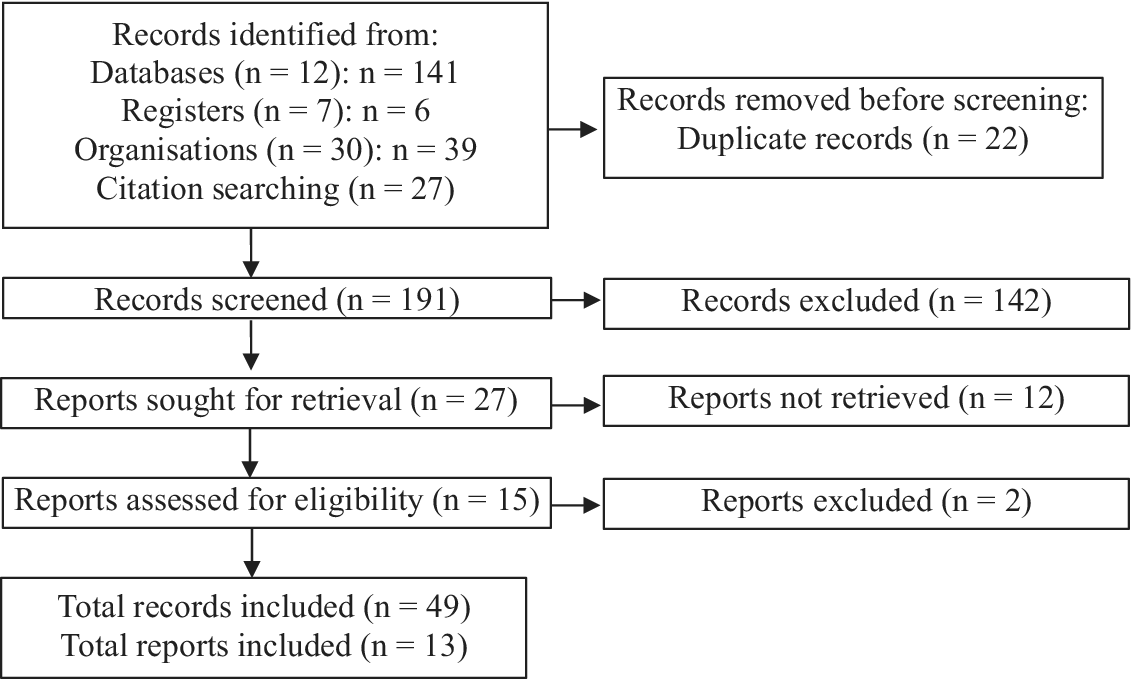
A total of 213 documents were initially retrieved through database, registers, organizations’ websites, citation, and gray literature searches. After de-duplication, 191 were screened by title, abstract, and full text for eligibility. A total of 61 sources met inclusion criteria (Table 4) and were incorporated into the final qualitative synthesis.Reference Haddaway, Page and Pritchard 23 (Figure 1). A structured comparison was conducted across selected Asia-Pacific jurisdictions to identify legal divergence and convergence.
Defined criteria for the inclusion and exclusion of publications in the scoping review examining legal challenges for EMTs

Abbreviations: AAR, After Action Review; ASEAN, Association of Southeast Asian Nations; AUSMAT, Australian Medical Assistance Team; COVID-19, Coronavirus Pandemic 2019; EMT, Emergency Medical Team; IFRC, International Federation of Red Cross and Red Crescent Societies; PNG, Papua New Guinea; SASOP, Standard Operating Procedure; WHO, World Health Organization.
PRISMA-ScR flow diagram showing the systematic search and selection process for included studies and reports.

For contextualization, EMT deployments—Philippines (Haiyan, 2013), Nepal (2015), Indonesia (Sulawesi, 2018), Myanmar (2008, 2022, 2025), Pakistan (2022-23), Vanuatu (2024), Papua New Guinea (COVID 2021–2022)—were analyzed using triangulated data from host-country legislation; operational reports from WHO, IFRC, and AUSMAT; peer-reviewed assessments and gray literature. Case selection prioritized operational diversity (natural disasters vs. pandemics), legal complexity, and relevance to WHO EMT standards.Reference Dy and Stephens 24 – 40 The availability of accurate and complete publicly available information on EMT deployments does limit the details that can be retrieved and analyzed.
No human participants were involved; thus, Ethics committee approval was not required.
See Online Data Supplements for additional information.
Results
Legal Frameworks Governing EMT Deployment: International Humanitarian and Disaster Laws, Jurisdictional Challenges, and Adaptations
International Legal Frameworks
EMT deployment continues to occur within an incohesive international legal framework, with legal authority primarily grounded in host country law, inconsistently supplemented by bilateral agreements, and selectively applicable international conventions. Geneva Convention (Art 59) mandates that parties in armed conflict must accept international aid and facilitate relief schemes by “all means at its disposal” if they cannot adequately support their population in occupied territories, allow the free entry and distribution of relief goods, enabling humanitarian organizations (e.g., Red Cross) to operate. However, these do not apply in peacetime.Reference Aderhold, Heintze and Thielbörger 41 , Reference Eburn 42 While fully ratified into domestic Australian law, the same cannot be said for many states in the Asia-Pacific region, which most commonly require international aid.Reference Linton 43
Myanmar’s assertion of sovereign authority overrode international EMT access to respond to natural disasters despite critical health needs, highlighting the legal tension between humanitarian necessity and national jurisdiction.Reference Ballantyne, Paton and Johnston 44 The ILC Draft Articles on the Protection of Persons in the Event of Disasters 45 provide a framework of rights and responsibilities during disasters. They impose a duty upon affected states to cooperate with assisting actors, specifically addressing humanitarian assistance and that consent to external assistance cannot be arbitrarily withheld, thus providing the balance between the concepts of state sovereignty and the duty on affected states to ensure the protection of persons and the provision of relief assistance in its jurisdiction. However, the Articles have not yet been formalized into a convention.
The Sendai Framework for Disaster Risk Reduction 46 reshaped the EMTs’ approach from reactive response to proactive risk reduction; EMTs must now prioritize capacity building in vulnerable regions before disasters strike, focusing on training local health care workers and strengthening existing health systems. They are expected to integrate with broader disaster risk governance systems rather than operating in isolation, thus coordinating with multiple sectors beyond health care. Additionally, the “Build Back Better” principle 47 compels EMTs to design interventions that contribute to long-term health system resilience, moving beyond immediate care to support sustainable recovery.
While the Tampere Convention on the Provision of Telecommunication Resources for Disaster Mitigation and Relief Operations 48 is underutilized (Australia is neither a signatory nor party), it remains significant for facilitating emergency telecommunications for EMT operations by removing regulatory barriers to telecommunications equipment use during humanitarian crises. It also establishes a framework for technical cooperation and coordination of communications with other responders and local, but requires EMTs to respect host state sovereignty by recognizing their right to direct and coordinate telecommunications deployment.
Regional Agreements
Legally binding frameworks (ASEAN Agreement on Disaster Management and Emergency Response—AADMER) 49 and the EAS Rapid Disaster Response Toolkit 49 , 50 (Tool 3: Country Disaster Response Arrangements) emphasize regional cooperation and the facilitation of assistance, urging member states to simplify procedures for the entry of relief personnel and materials while respecting national sovereignty. By streamlining entry and logistics for EMTs, these frameworks help mitigate bureaucratic delays.Reference Simm 51 Integrating this resource allows for a more comparative and regionally harmonized understanding of cross-border legal preparedness, aligning with the operational footprint of Australian EMT deployments.
National Laws
Some states’ disaster laws formalize sovereignty-based control over EMT deployments. Indonesia’s Law on Disaster Management 52 specifically mandates that international aid must be coordinated and implemented under the National Disaster Management Agency’s (BNPB) direction, the Government Regulation 21/2008 requires that foreign assistance must receive prior government approval, 53 and the Immigration Law 6/2011 specifies that individuals entering Indonesia for work (including humanitarian missions) must have the correct visa. 54 The broad wording of Art 250 of the new Health Law provides an entry point for the licensing of foreign health professionals, but does not mention temporary, expedited, or automatic processes. 55 , 56 The Philippines’ Disaster Risk Reduction and Management Act centralizes authority with the President and National Disaster Council to request international humanitarian assistance, and the medical practitioner requires securing “a previous authorization from the Board of Medical Examiners.” 57 , 58
WHO EMT Initiative
The initiative aims at enhancing the nations’ surge capacity by promoting the swift mobilization and effective coordination of both national and international medical teams, to “improve the timeliness and quality of health services … in the immediate aftermath of a disaster, outbreak and/or other emergency,” provides explicit guidance on the international recognition of EMT credentials, and recommends that host states accept the pre-verification of personnel conducted through the WHO classification process to expedite in-crisis licensing and reduce administrative barriers. 5
Immigration and Customs Procedures
Delays in entry visa issuance and restrictions on importing controlled substances frequently present operational bottlenecks for EMTs; thus, critical time is lost during the acute phase of response.Reference Karki, Pandey and Pandey 25 AUSMAT’s deployments to PNG operated under bilateral emergency health agreements, which enabled pre-cleared customs and immigration procedures, 59 – 61 and embedding health personnel. 62 During the Haiyan response, Philippine customs impounded essential medications due to discrepancies in controlled substance licensing.Reference Dy and Stephens 24 Similarly, the medications carried by AUSMAT during the deployment for the repatriation of Australian citizens from the MV Diamond Princess (2020) were impounded by customs under Standard Operating Procedures in which medicines and medical supplies needed by EMTs will be supplied by the local prefectures, and the expectation has been reconfirmed at a recent multinational exercise held in Japan. 63
Medical Licensing and Credentials Recognition
Most national legislations explicitly prohibit the provision of medical services without appropriate national licensure or specific exemption. These remain the most significant barriers to rapid deployments, 53 , 58 and EMTs frequently operate in a “legal gray area” in the absence of formal legal pathways for temporary authorization. Some jurisdictions have taken proactive steps: China and the Philippines have introduced temporary licensing procedures for emergency situations, while Japan has permitted EMT operations under circumventing and interpretive legal principles invoking Good Samaritan public necessity; however, there is no standard defined for “minimum necessary medical treatment” to ensure compliance with Art 35 of the Japanese Penal Code. 10 , 64
Data Governance and Patient Confidentiality
EMT operations engage a complex and often fragmented patient data management legal environment and are frequently compelled to navigate unclear data protection regimes and standards. The Philippines’ Surveillance in Post-Extreme Emergencies and Disasters (SPEED) 65 and the Japanese Joint Committee on the Ideal Way of Medical Records in the Event of a Disaster (J-SPEED) 66 serve as early alert mechanism that tracks a limited number of communicable diseases, non-communicable conditions, injuries, and overall health patterns following extreme emergencies and disasters, without replacing regular disease reporting. Together with the WHO Minimum Data Set 67 (MDS), these data platforms enable anonymized reporting across EMTs, facilitate real-time epidemiological monitoring, and align with ethical standards while respecting host country sovereignty. Importantly, these models reduce medico-legal exposure and administrative burden, streamlining data exchange without compromising privacy or operational tempo.
The ASEAN’s SASOP Part VII requires EMT to adopt a harmonized patient record format compatible with the WHO MDS and is a regional model of operational excellence. 68 Its design prioritizes interoperability and simplicity, allowing for both clinical documentation and public health reporting using a format that is ethically sound, operationally tested, and regionally endorsed.
Digital record systems have the potential to greatly enhance EMT performance; the fragmented regulatory environments, privacy concerns, and the need for comprehensive training and resources are on-going.Reference Draugelis, Brown and Donahue 69 – 73
Diplomatic Immunity, Liability, and Legal Recourse
Military EMTs typically operate under Status of Forces Agreements (SOFAs), which confer jurisdictional immunities governed by bilateral treaties. Civilian EMTs, however, seldom enjoy equivalent protections unless explicitly articulated in host nation authorization letters or bilateral agreements. 74
Ethical Consequences of Legal Gaps
Legal ambiguity not only obstructs logistics but may affect ethical decision-making for EMT personnel, may hesitate to act decisively, fearing liability or regulatory breach, thus eroding trust between EMTs and the communities. These can undermine the humanitarian mandate itself.
Discussion
While the deployment of EMTs remains a cornerstone of international disaster response architecture, our findings suggest that legal preparedness has not kept pace with deployment operational advancements, nor field requirements.
Rigid or outdated legal structures—designed for peacetime health care delivery—are ill-suited to the exigencies of sudden-onset or complex emergencies. A modernized legal approach must reflect the myriads of practical realities of disaster medicine, from the unpredictability and suddenness of disaster occurrence, passing through the ever-changing field circumstances, compound and cascading effects, and possible protracted evolution, down to long recovery durations.
Overall, sovereignty clauses in both international and national law mean that EMTs can only deploy with host country consent, creating a fundamental gatekeeping mechanism that can both enable and obstruct EMT response due to bureaucratic or political inertia.Reference Karki, Pandey and Pandey 25 , 28 , 75 UN Convention and UNGA resolution 46/182 affirms that humanitarian assistance must be provided with the consent of the affected state and under its direction and control. 6 , 7 Intended to apply universally, even in conflicts involving non-signatory states, in practice, these will only protect and facilitate EMT operations in non-signatory states to the extent that the parties accept and choose to adhere to their provisions. 76 They underscore the primacy of state sovereignty and the non-substitutive role of international responders, thus the limits of externally imposed EMT authority, even when international legal norms appear favorable. In this context, it is the nebulous and often shaky practice of customary international humanitarian law that must be relied on to protect and facilitate EMT operations.
Host nation sovereignty will always remain inalienable; however, regulatory frameworks should evolve to facilitate, not hinder, timely and lawful humanitarian medical assistance.
Through the WHO Initiative and EMT classification process, the legal, ethical, and operational paradigms of minimum standards for clinical care and operational conduct have changed, introducing significant implications for legal risk, indemnity, and insurance. These benchmarks elevate the expected duty of care and may increase liability exposure if teams deviate from them. They call for clear indemnity arrangements, as host nations often lack mechanisms to protect foreign EMTs, placing greater responsibility on donor governments or organizations. For insurers, compliance with standards becomes a prerequisite for coverage, influencing both malpractice and operational insurance terms. While this enhances accountability and legitimacy, it also raises costs and demands stronger governance, documentation, and legal preparedness from EMTs. Thus, despite benchmarking, EMT legal governance remains fragmented, reactive, and highly variable across jurisdictions.
EMTs are expected to integrate with broader disaster risk governance systems rather than operate in isolation, thus needing coordination with multiple sectors, beyond health care. This shift demands EMTs develop new competencies in disaster risk assessment, community engagement, and health system strengthening while forming partnerships with diverse stakeholders at local, national, and international levels. Legislative arrangements should empower these expectations.
The AADMER approach supports pre-agreed coordination mechanisms that mitigate the perception of foreign intrusion and legitimize EMT operations within Southeast Asia. Integrating this resource should allow for a more comparative and regionally harmonized understanding of cross-border legal preparedness, aligning with the operational footprint of EMT deployments. However, while these arrangements may be known through the corridors of ministries, the reality on the ground may be completely different.
For modern EMTs utilizing telehealth, the Tampere Convention’s principles become increasingly relevant for legally transmitting sensitive patient data across borders. Telehealth consultations during deployments pose additional legal ambiguities: consulting medical authority licensing in the host country; enforceability of cross-border clinical decisions; liability allocation for remote medical acts. Clarifying jurisdictional accountability for teleconsultations, especially when used for diagnostics, treatment planning, or specialist referral, is essential in operationalizing telemedicine within EMT deployments.
While WHO technical guidance outlines principles of confidentiality, consent, and data sharing, these frameworks remain aspirational in many settings and are rarely codified into domestic law. Although patient-level data collection aligns with clinical norms in peacetime health systems, its operational value in EMT contexts is often overstated. Most international EMT deployments focus on short-term acute care, with limited diagnostic complexity and minimal follow-up. In such scenarios, the utility of detailed individual patient records diminishes considerably. Thus, EMT data governance frameworks should recalibrate emphasis away from comprehensive digitalization toward the use of simplified, interoperable tools such as the MDS and ASEAN record templates. While legal and ethical considerations around patient data remain important, excessive focus on individualized data governance risks undermining field-level priorities.
Data systems must support, not obstruct, timely clinical care and coordination during disasters. Investment in digital health systems, translation support, and standardized templates for medical records will improve the defensibility of care delivered in high-pressure environments.
Policy Reforms
All-Encompassing and Pre-Emptive Legal Structures
Statutory measures pertaining to EMT deployment, including automatic temporary licensure, liability protection, data governance, consent, and patient rights, should be enacted and updated by governments on a regular basis. They should incorporate provisions for compound emergencies (e.g., concurrent natural disasters and pandemics) and support anticipatory deployment models.
Integrate Legal Expertise Within EMT Structures
Either embedding legal advisors within EMTs, or, as a minimum, immediate access to relevant legal advice to provide real-time interpretation of national laws, facilitate compliance, and ensure alignment with international humanitarian obligations is needed.
Their function would not be to challenge host-state sovereignty but to enhance legal situational awareness, ensure compliance with both international standards and local requirements, and reduce the risk of inadvertent legal breaches. In prolonged or complex missions, real-time legal input may assist in responding to evolving challenges (e.g., jurisdictional ambiguity when treating co-nationals, data sharing restrictions, or delayed medical evacuation approvals).
Institutionalize EMT Legal Briefings and Training
Pre-deployment legal training must become a standard component of any EMT preparedness, aiming at familiarization with the host country’s relevant health laws, liability standards, consent protocols, and reporting requirements. Refresher modules, including just-in-time, tailored to mission-specific legal environments, will improve compliance and reduce medico-legal exposure.
Harmonize Legal Content Within Bi- and Multilateral Agreements
Legal clarity must begin at the point of invitation. Host-donor agreements should explicitly define the legal status of EMTs, scopes of clinical practice, medication and equipment import, dispute resolution mechanisms, and exemptions from local licensure or liability laws. For example, the offer of locally sourced medications for the use by foreign medical practitioners is fraught with malpractice risks for lack of familiarity with such substances. Telehealth introduces complex legal uncertainties—cross-border medical licensure, data protection, clinical accountability—and providing remote consultations may inadvertently breach host-country laws if national regulations are not known, do not explicitly permit telemedicine, or recognize foreign credentials. A pre-deployment telehealth checklist confirming host-country licensure confirmation, data collection, transfer and storage governance, liability cover, and cross-border prescribing policies should be developed.
Throughout the deployment, legal and operational barriers should be documented and escalated; their review should inform regulatory reform, training priorities, and bilateral planning. Thus, the PNG-Australia CSEP could serve as a model for standardizing bilateral EMT governance.
The role of medical direction within EMT structures deserves clearer definition. Classified EMTs operate under structured command hierarchies and clinical governance under designated medical leadership. However, deployments by non-classified or hybrid teams may lack this clarity, raising issues of medical accountability, especially across jurisdictions.
Future frameworks should specify whether EMT medical leaders must be licensed in the host country or can retain regulatory authority from the donor country under bilateral arrangements.
Documentation Systems and Evidentiary Standards
Robust medical documentation remains essential for clinical continuity and legal accountability. Emerging modalities (e.g., telehealth consultations) raise additional legal ambiguities: medical authority licensing status in the host country; enforceability of cross-border clinical decisions; remote medical act liability and accountability. Clarifying these jurisdictional aspects is essential in operationalizing telemedicine within EMT deployments.
Investment in intelligent digital health systems, translation support, and standardized templates for medical records should aid the defensibility of care delivered in high-pressure environments.
Community-Level Legal Literacy and Trust
Trust between host communities and foreign responders is fundamental for effective EMTs’ integration and to allay suspicions of inequity. Peacetime public education campaigns should explain the function, legal need, and quality control systems that support EMT operations. This can lessen local opposition and reduce court cases brought on by miscommunication or false information.
Address Emerging Legal Challenges Following Displacement and Climate Migration
The rights of stateless people and populations displaced by climate change must be addressed by legal systems, as they may not neatly fit into current jurisdictional boundaries. International and regional agreements should give EMTs the authority to treat patients regardless of their country or legal status. Cross-border health care access mechanisms, including mobile border clinics and regional health compacts, must be developed in anticipation of increasing displacement driven by environmental stressors.
Same Nationality Jurisdictional Procedures
When EMTs treat patients of their own nationality during international deployments, distinct legal and ethical complexities arise. 77 Which country’s laws govern medical care, liability, and consent? Do repatriations require host country approval? What is the role and extent of consular assistance under the Vienna Convention on Consular Relations? 78
Without predefined bilateral protocols, such cases fall into a legal gray area, exposing EMT personnel and patients to dual or conflicting legal obligations. A co-national patient harmed during treatment, for example, may pursue legal redress under home country law, even while the host country asserts jurisdiction over the incident based on territorial authority. These ambiguities increase medico-legal risk and may delay critical decisions in triage, handover, or transfer.
Embedding these provisions ensures legal consistency, protects EMT staff from unintended exposure, and safeguards patient rights. Thus, they reinforce humanitarian neutrality while enabling legally coherent cross-border operations. As deployments become more frequent and complex across the Asia-Pacific, addressing the treatment of same-nationality patients through legal harmonization is an essential element of EMT legal readiness and operational integrity.
Study Limitations
The findings are directly informed by the systematic methodology employed. Challenges included access to non-English translations of legal documents, interpretation biases, and confidentiality constraints in reviewing policy documents. However, methodological consistency ensured the validity of conclusions regarding sovereignty, licensing, data protection, and the impact of the WHO EMT Initiative, while the integration of document analysis, comparative legal analysis, and jurisdictionally significant case studies ensured alignment between the analytical framework and the thematic findings. Ethical considerations ensured an accurate representation of case studies while balancing stakeholder interests. These limitations may constrain generalizability but do not undermine the study’s central findings on legal ambiguity and the need for improved EMT legal preparedness.
Conclusion
This study demonstrates that classified EMTs continue to operate within fragmented legal frameworks during international deployments, often facing delays and uncertainty due to gaps in host country recognition, licensing, and liability arrangements. Although the verification ensures clinical quality, it does not provide legal authorization. EMTs continue to navigate varying interpretations of sovereignty, regulatory discretion, and institutional capacity across the Asia-Pacific region.
The research questions were addressed by identifying key governance barriers and proposing legal and operational reforms to enhance deployment readiness. Findings support the development of pre-agreed, functional, bilateral arrangements, regionally harmonized licensing protocols, and targeted legal training for EMT personnel. The incorporation of formal legal support mechanisms within EMT structures should improve compliance and reduce field-level legal ambiguity.
Legal preparedness is not merely a procedural requirement; it is essential for safeguarding EMT personnel, maintaining ethical medical practice, and enabling timely, lawful assistance in disaster contexts. As Australia continues to lead humanitarian medical deployments in the region, a proactive, cooperative legal framework will be vital for operational effectiveness and the realization of humanitarian objectives.
Supplementary material
The supplementary material for this article can be found at http://doi.org/10.1017/dmp.2025.10278.
Acknowledgements
AI tools were used only for literature triage (Scite.ai) and language refinement (Anthropic/OpenAI). All outputs were independently verified against primary sources by the authors; legal analyses and conclusions were entirely author derived. We sincerely thank the reviewers for their thoughtful, constructive, and detailed feedback, which significantly strengthened the clarity, depth, and scholarly rigor of this manuscript.
Author contribution
Both authors contributed equally to the conceptualization, methodology, validation, formal analysis, data curation, write-up, and revision following reviewers’ comments.
Funding statement
This research did not receive any specific grant from funding agencies in the public, commercial, or not-for-profit sectors.