Pasture provides a natural environment for ruminants, and the access to pasture improves the animal welfare. However, many lactating dairy cows have no access to pasture in continental Western Europe. Lack of access to pasture has been linked with higher rates of lameness among other diseases (Hernandez-Mendo et al. Reference Hernandez-Mendo, von Keyserlingk, Veira and Weary2007). Increasing the proportion of grazed grass in the diet during the grazing season as part of the diet could reduce feed costs and increase herd health. Grazing has been proposed as an essential strategy for the efficient use of pastoral resources (Capper et al. Reference Capper, Cady and Bauman2009). However, grazing alone cannot meet the nutritional requirements of high yielding dairy cows, particularly in early lactation (Kennedy et al. Reference Kennedy, Curran, Mayes, McEvoy, Murphy and O'Donovan2011). Dairy cows permanently on pasture have more weight loss and produced less milk than dairy cows in free-stalls (Hernandez-Mendo et al. Reference Hernandez-Mendo, von Keyserlingk, Veira and Weary2007), due to lower dry matter intake than cows housed indoors. In addition, the lower nutrient density of grass than compound feeds provided indoors is likely to reduce milk production for pasture-kept animals (Soriano et al. Reference Soriano, Polan and Miller2001). Thus, supplementation is required to provide the energy requirements to fully reach the animal's genetic potential. The possibilities of using high-quality pastures and total mixed rations (TMR) feeding during the grazing season have been examined (Bargo et al. Reference Bargo, Muller, Delahoy and Cassidy2002). It could help to produce high yields of milk enhancing protein and fat contents (Morales-Almaráz et al. Reference Morales-Almaráz, Soldado, González, Martínez-Fernández, Domínguez-Vara, de la Roza-Delgado and Vicente2010), and save feeding costs (Vibart et al. Reference Vibart, Fellner, Burns, Huntington and Green2008). Grazing cows produce milk with a fatty acid (FA) profile more favourable to human health, with higher proportions of CLA and 18:3n-3 (Stockdale et al. Reference Stockdale, Waler, Wales, Dalley, Birkett, Shen and Doyle2003; Bargo et al. Reference Bargo, Delahoy, Schroeder and Muller2006; Dewhurst et al. Reference Dewhurst, Shingfield, Lee and Scollan2006; Morales-Almaráz et al. Reference Morales-Almaráz, de la Roza-Delgado, González, Soldado, Rodríguez, Peláez and Vicente2011), which have health benefits for consumers (Belury, Reference Belury2002). Similar results have been reported in cows feeding fresh cut forage (Ferlay et al. Reference Ferlay, Martin, Pradel, Coulon and Chilliard2006; Auldist et al. Reference Auldist, Marett, Greenwood, Hannah, Jacobs and Wales2013) and feeding fish and plant oils (AbuGhazaleh et al. Reference AbuGhazaleh, Felton and Ibrahim2007). Moreover, pasture feeding imparts grassy flavours that can be recognised by some consumers in milk (Bendall, Reference Bendall2001) and in cheese (Martin et al. Reference Martin, Hurtaud, Graulet, Ferlay, Chilliard and Coulon2009) and improves the softness and spreadability of butter (Couvreur et al. Reference Couvreur, Hurtaud, Lopez, Delaby and Peyraud2006) and the body texture cheese (Martin et al. Reference Martin, Hurtaud, Graulet, Ferlay, Chilliard and Coulon2009).
Previous studies have shown that herbage chemical composition varies throughout the day, with change in the fatty acid profile, crude protein, water soluble carbohydrates, starch and digestible organic matter (Avondo et al. Reference Avondo, Bonanno, Pagano, Valenti, Di Grigoli, Alicata, Galofaro and Pennisi2008; Gregorini et al. Reference Gregorini, Soder, Sanderson and Ziegler2009; Vasta et al. Reference Vasta, Pagano, Luciano, Scerra, Caparra, Foti, Cilione, Biondi, Priolo and Avondo2012). The 18:3n-3 represents the major component of herbage fatty acids (Elgersma et al. Reference Elgersma, Ellen, Bekker, van der Horst, Boer and Tamminga2003), and could play a key-role in photosynthesis (Browse et al. Reference Browse, Roughan and Slack1981), and therefore this would justify its greater content in leaf in the afternoon than in the morning. Other authors (Gregorini et al. Reference Gregorini, Soder and Sanderson2008) have found no differences in 18:3n-3 concentration in herbages sampled either in the morning or in the afternoon. However, the grazing time of day can affect the fatty acid composition of milk in goats (Avondo et al. Reference Avondo, Bonanno, Pagano, Valenti, Di Grigoli, Alicata, Galofaro and Pennisi2008). More than 80% of the total dry matter intake (DMI) by dairy cows continuously is consumed between 07·00 to 20·00 h (Huzzey et al. Reference Huzzey, Veira, Weary and von Keyserlingk2007), with a maximum intake rate occurring twice daily after both milkings (Cuadrado et al. Reference Cuadrado, Morales-Almaráz, de la Roza-Delgado, Martínez-Fernández and Vicente2011). Dairy cows with free access to pasture in damp temperate areas spend the night outdoors preferably (Legrand et al. Reference Legrand, von Keyserlingk and Weary2009), although they use the meadow more as resting area than feeding area (Chapinal et al. Reference Chapinal, Goldhawk, de Passillé, von Keyserlingk, Weary and Rushen2010).
Therefore, the objective was to study the effect on the dry matter intake, production and composition of milk, and fatty acid profile of milk fat of dairy cows in a regime involving different 12 h feeding periods. These periods were grazing for 12 h during day or night-time and the remaining 12 h spent indoors two different TMR, based on maize silage or Italian ryegrass silage.
Materials and methods
This work was undertaken between March and May of 2009 at the SERIDA experimental farm (43°28′50″N, 5°26′27″W, 10 masl). Daily average temperature was 12 °C (range: 04–22 °C) and the total rainfall was 262 mm on 51 rainy days. Sunrise ranged from 06·50 to 08·15 h and sunset from 19·10 to 21·55 h throughout the experimental period. All animals were cared for according to the standards of the European Union Animal Welfare Directive Number 86/609/EEC.
Sixteen Holstein-Frisian dairy cows were assigned to the assay, balancing for body weight (mean±sd; 631±81 kg), parity (1·9±0·9; range: 1–4) and days in milk (106±45). Daily average milk yield of these cows was 31·2±2·0 l/d in the week prior to the start of the experiment. Cows were kept in a free stall barn with rubber mat bedding and the exercise areas had concrete floor and a scraper system for manure removal. The animals were allocated into four groups and randomly assigned to four experimental treatments. Each trial period lasted 21 d, including 14 for adaptation and seven for data collection. The treatments were: (1) feeding a maize silage-based TMR and grazing after the morning milking (08·00 to 19·00 h); (2) feeding a ryegrass silage-based TMR and grazing after the morning milking (08·00 to 19·00 h); (3) feeding a maize silage-based TMR and grazing after the afternoon milking (20·00 to 07·00 h), and (4) feeding a ryegrass silage-based TMR and grazing after the afternoon milking (20·00 to 07·00 h). The animals were randomly assigned in a change-over design.
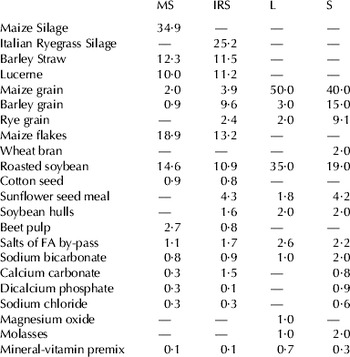
All cows were weighed on the first and last day of each period after morning milking. On the day prior to the start of data collection, pasture dry matter yield was measured to determine pasture availability. All cows were milked twice daily from 07·00–08·00 h and 19·00–20·00 h. Both TMR were formulated according to NRC (2001) requirements for dairy cattle including maize (MS) or Italian ryegrass (IRS) silages (Table 1). Fresh TMR were supplied twice daily at 08·00 and 20·00 h, so there was always enough fresh TMR available. All animals also received, during both milking sessions, two concentrates, L and S, as energy source and in order for the cows to remain calm during milking session. Table 1 shows the percentage ingredients of both concentrates. Concentrate L was provided at 2 kg/d per cow, and concentrate S was supplied at 0·2 kg by litre of milk produced above 30 l/d in the multiparous cows and above 25 l/d in the primiparous cows. A rotational grazing system was established on a multi-species grassland with a prevalence of gramineae, 77%, legumes, 19%, and other species in an area of 4·75 ha divided into 4 plots. The cows on treatments with grazing at day-time were moved to a fresh paddock after morning milking and kept indoors at night, while the cows on treatments with grazing at night-time were moved to a fresh paddock after evening milking and kept indoors between morning and evening milking. All animals had free access to water both in the barn and in the pasture plots.
Ingredients (% DM) included in the Total Mixed Rations based on maize silage (MS) or Italian ryegrass silage (IRS) and concentrates L and S

The TMR intake of individual animals was automatically recorded at each time by an electronic weighing system integrated to the scale pans using a computerised system and concentrates by an automatic feeder. Grass intake was estimated using NRC prediction equations (Macoon et al. Reference Macoon, Sollenberger, Moore, Staples, Fike and Portier2003). Briefly, energy requirements were recorded as net energy (NE Mcal/d) requirements for maintenance, lactation, body weight changes, walking and grazing. The NE from pasture intake was estimated as total NE requirements minus the NE supplied by the TMR and concentrate intakes.
TMR samples were taken daily during the data collection period in each experimental period. Concentrates and pasture were sampled at the beginning of each trial period. Pasture was sampled in both grazing times. Milk yield was recorded daily at both milking times over the 7 d of data collection. Milk samples were also taken daily from each individual animal throughout the 7 d of data collection in the four experimental periods. Morning and evening samples from individual cow were mixed according to its milk yield to get a representative sample for day and cow. Samples were divided into two subsamples: One of them for chemical analysis was preserved with 0·13 ml of a bacteriostatic agent, and the other one was immediately analysed for fatty acids.
TMR and forage samples were dried (60 °C, 24 h) and milled (0·75 mm); concentrate samples were milled through a 1 mm screen. Feed samples were analysed for dry matter (DM), ash, crude protein (CP), neutral detergent fibre (NDF), acid detergent fibre (ADF) and starch by near infra-red spectroscopy (FOSS NIRSystem 5000, Silver Springs, MD, USA). The water soluble carbohydrates (WSC) of grass samples were analysed according to Hoffman (Reference Hoffman1937) using a spectrophotometer Varian Cary 50 UV/Vis (Varian, Inc. Palo Alto, CA, USA). The FA content of the feeds was analysed according to Palmquist & Jenkins (Reference Palmquist and Jenkins2003), using a Varian 3800 GC- 4000 mass spectrometer (Varian, Inc., Palo Alto, CA, USA) with a CP-Sil 88 column (100 m×0·25 mm, 0·20 μm i.d.; Varian, Inc.). Helium was used as carrier gas at a flow rate of 1 ml/min. The temperature of injector and detector were 250 °C. The column temperature was held at 40 °C during 1·20 min; from 40 to 140 °C at 30°/min and held during 25 min; from 140 to 190 °C at 1 °C/min and held during 15 min; from 190 to 215 °C at 1 °C/min and held during 1 min and finally, from 215 to 240 °C at 30 °C/min and held during 1 min. Individual FA peaks were identified by comparison of their retention times and mass spectra between samples and pure methyl ester standards (52 fatty acid methyl esters mix, ref. GLC-463, and 18:2 trans10cis12, ref. UC-61-M of Nu-Chek Prep, Inc. (Elysian, MN,USA) and methyl 9(Z),11(E)-octadecadienoate, ref. 1245-10 of Matreya LLC (Pleasant Gap, PA, USA).
Milk samples were analysed for fat, protein, lactose and urea contents (MilkoScan FT 6000). For milk FA analysis, fat was isolated as described by Feng et al. (Reference Feng, Lock and Garnsworthy2004) and transesterified as described by Christie (Reference Christie1982) with the modifications of Chouinard et al. (Reference Chouinard, Corneau, Barbano, Metzger and Bauman1999). Peak quantification was performed in the same conditions as the feeds.
Statistical analyses were performed with SAS (1999) in a randomised block design with the animals considered as a random variable. Data were subjected to a split plot as follows. Main plot effects: Grazing time (G) and Silage (S); Sub-plot effects Period within every grazing time (P). Data were analysed using PROC MIXED and means were separated using the Tukey test.
Results
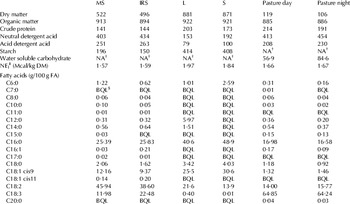
Chemical composition of the MS and IRS TMRs, the concentrates L and S and pasture, sampled at day and at night grazing times, used are shown in Table 2. Both TMR had similar protein and energy contents, around 143 g CP/kg DM and 1·58 Mcal NEl/kg DM respectively. The ratio 18:2n-6/18:3n-3 of MS was 4 : 1, and 2 : 1 in IRS. The grass was similar between pasture grazing at day and at night, except in WSC content. The pasture grazing at night had a higher content of WSC than pasture grazing at day (85 vs. 57 g WSC/kg DM, respectively). The average nutritive value of both grass was 203 g CP/kg DM, 434 g NDF/kg DM, and 1·67 Mcal ENl/kg DM.
Chemical composition (g/kg DM) of the Total Mixed Rations based on maize silage (MS) or Italian ryegrass silage (IRS), concentrates L and S, and pasture. Values are means for n=28

† NA, Not analysed
‡ NEl, Net energy of lactation
§ BQL, Below the limit of quantification
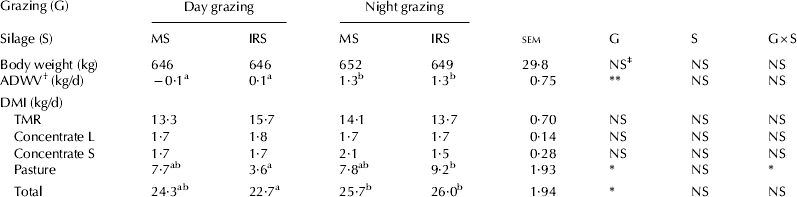
The animals remained in good health throughout the experiment. The diets were well accepted by the animals, the TMR refusals amounted to <10% of the feed offered. Table 3 shows the body weight and dry matter intake (DMI) results. The average body weight was 648 kg, and the average daily weight variation (ADWV) during the experiment were −0·02±0·304 and +1·27±0·382 kg/d for animals grazing at day-time or night-time respectively (P<0·01). Growth rates were 0·58±0·375 and 0·68±0·382 kg/d for animals feeding MS and IRS, respectively, and did not differ significantly between diets.
Body weight and dry matter intake (DMI) for the four treatments. Values are means for n=64 for body weight values, n=448 for the dry matter intake variables

† ADWV, Average daily weight variation
‡ NS, Not significant
a,bValues in the same row with different letters differ significantly
* P<0·05; **P<0·01
The DMI decreased significantly in the cows grazing at day-time (23·53 vs. 25·89 kg DM/d for day-time and night-time respectively, P<0·05). No significant differences in the DMI associated with TMR, concentrate L or concentrate S were observed between any treatments. The DMI from grazing was 51% higher in the night-time grazing treatments (8·53 kg DM/d) than in the day-time grazing treatments (5·65 kg DM/d, P<0·05). However, for cows feeding the TMR based on IRS and grazed during the day, the grass intake was lower than those of other treatments, whereas in cows feeding with TMR based on IRS and grazed during night, their intake of grass was higher than the other treatments.
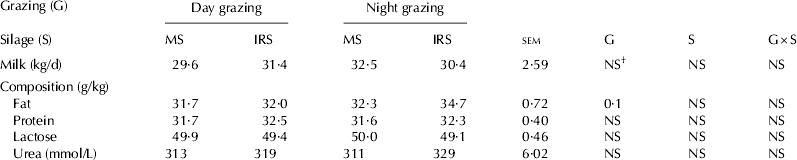
Table 4 shows the milk yield and composition for the four treatments. No differences were observed between treatments with respect to milk production, ranging from 29·6 kg/d until 32·5 kg/d. The milk fat content tended to be higher for the cows feeding TMR based on IRS and grazed at night-time (34·7 g/kg) than the others treatments (32·0 g/kg; P<0·1). No differences were found between treatments with respect to protein, lactose and urea contents.
Milk yield and composition of milk for the four treatments. Values are means for n=448

† NS, Not significant
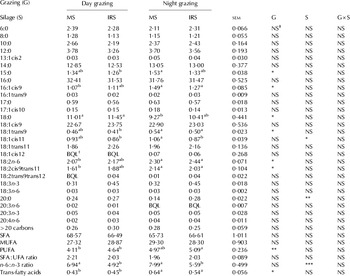
The fatty acid profiles of milk collected from cows under the experimental treatments are shown in Table 5. The 18:1cis11 content was higher (P<0·05), and the 20:0 concentration was lower (P<0·01) in MS than IRS. The n-6 : n-3 ratio in dairy cows feeding TMR based on MS was 30% higher than cows feeding TMR based on IRS (P<0·001), without differences between grazing pattern.
Milk FA profile (g/100 gFA) for the four treatments. Values are means for n=448

† BQL, below the limit of quantification
‡ NS, Not significant
a,bValues in the same row with different letters differ significantly
* P<0·05; **P<0·01; ***P<0·001
The content of polyunsaturated fatty acid (PUFA) was higher in milk of dairy cows grazing at night-time than dairy cows grazing at day-time (P<0·01). This higher proportion of PUFA is mainly due to the higher (P<0·05) proportion of 18:2cis9trans11 and 18:2n-6. The milk of dairy cows grazing at night-time had higher concentrations of 18:1trans9, 16:1cis9 and 15:0 than the milk of dairy cows grazing at day-time (P<0·05). The proportion of 18:0 was lower for dairy cows grazing during the night-time than for dairy cows were grazing at day-time (9·84 vs. 11·23 g/100 g FA respectively, P<0·05). The trans fatty acids content of the milk from dairy cows grazing at night-time was higher than that of cows grazing at day-time (0·59 vs. 0·44 g/100 g FA respectively, P<0·05), without differences between both silages.
Discussion
The food intake pattern is related to the photoperiod. Some authors have described patterns of behaviour in cattle where cows spend up to 75% of the time eating between 6·00 and 18·00 h (Ingvartsen, Reference Ingvartsen1994). When the cows have access to food throughout the day, the highest eating activity is during the day-time, and the early evening and the lowest eating activity is during the late evening and early morning hours (DeVries et al. Reference DeVries, von Keyserlingk and Beauchemin2003). There is an increase in the eating activity immediately following the delivery of fresh feed (DeVries et al. Reference DeVries, von Keyserlingk and Beauchemin2003) and fresh grass (Abrahamse et al. Reference Abrahamse, Tamminga and Dijkstra2009), and after milking sessions, especially after the afternoon milking event (Cuadrado et al. Reference Cuadrado, Morales-Almaráz, de la Roza-Delgado, Martínez-Fernández and Vicente2011). On average in our study, dairy cows ate more grass at the night-time grazing. Similar results were reported for dairy goats (Avondo et al. Reference Avondo, Bonanno, Pagano, Valenti, Di Grigoli, Alicata, Galofaro and Pennisi2008), lambs (Vasta et al. Reference Vasta, Pagano, Luciano, Scerra, Caparra, Foti, Cilione, Biondi, Priolo and Avondo2012), and beef heifers (Gregorini et al. Reference Gregorini, Eirin, Refi, Ursino, Ansin and Gunter2006). Abrahamse et al. (Reference Abrahamse, Tamminga and Dijkstra2009) did not find differences between grazing after morning or afternoon milking, while other authors (Loor et al. Reference Loor, Soriano, Lin, Hirbein and Polan2003) have observed a decrease in DMI at night in dairy cows. However, in the study of these authors, cows offset the lower intake of grass with an increased intake of TMR, while our animals consumed the same amount of TMR in all treatments. Traditionally, cattle have been thought to exhibit diurnal feeding patterns whereby they consume the majority of their daily DMI between dawn and dusk (Hafez & Boissou, Reference Hafez, Boissou and Hafez1975), and more specifically, with their largest and most extensive meals occurring at sunrise and sunset (Ruckebusch & Bueno, Reference Ruckebusch and Bueno1978). However, the longest and most intense grazing events occur at dusk, because the dairy cows are more motivated to access pasture at night (Charlton et al. Reference Charlton, Rutter, East and Sinclair2013), and are often associated with a greater intake rate at this time of the day (Orr et al. Reference Orr, Rutter, Penning and Rook2001). This may be due to the increase in WSC of the grass at night (Avondo et al. Reference Avondo, Bonanno, Pagano, Valenti, Di Grigoli, Alicata, Galofaro and Pennisi2008), making it more palatable to be sweeter the grass, as seen in the alfalfa hay (Burns et al. Reference Burns, Mayland and Fisher2005) and grass silage (Huntington & Burns, Reference Huntington and Burns2007). The higher DMI at night-time grazing also justifies the higher ADWV observed for this treatment compared with the day-time grazing.
Despite the higher DMI of the night-time grazing cows, the different treatments had no effect on milk yield and the proportions of protein, lactose and urea in milk. These results agree with those reported by other authors who examined the feeding of cows with TMR plus the grazing of pasture (Morales-Almaráz et al. Reference Morales-Almaráz, Soldado, González, Martínez-Fernández, Domínguez-Vara, de la Roza-Delgado and Vicente2010), and different grazing time (Abrahamse et al. Reference Abrahamse, Tamminga and Dijkstra2009). This absence of any difference in milk yield might be explained by the adequate net energy intake of the grazing cows. Differences in grass chemical composition within a single day have been recorded. These differences are due to the accumulation of simple sugars of photosynthetic origin (Orr et al. Reference Orr, Penning, Harvey and Champion1997), and thereby probably caused higher intake of sugar in night-time grazing than day-time grazing (Abrahamse et al. Reference Abrahamse, Tamminga and Dijkstra2009) resulting in a higher milk fat content. The slight reduction in milk fat content observed in cows grazing at day-time may also be related with the lower NDF content of grass at night than at day (Vasta et al. Reference Vasta, Pagano, Luciano, Scerra, Caparra, Foti, Cilione, Biondi, Priolo and Avondo2012).
The fat of grasses is dominated by 18:3n-3 (Van Ranst et al. Reference Van Ranst, Fievez, De Riek and Van Bockstaele2009), whereas lipids of maize are dominated by 18:2n-6 (Chilliard et al. Reference Chilliard, Ferlay and Doreau2001). According to these authors, in our study, the content of PUFA in milk did not differ due to the different proportions of 18:2n-6 and 18:3n-3 between both types of total mixed rations. Chilliard et al. (Reference Chilliard, Ferlay and Doreau2001) reported differences in milk fat from maize silage or grass silage diets, because maize silage diets are richer in short-chain FA and 18:2n-6 than grass silage diets. Nevertheless, the maize silage could change ruminal fermentation towards propionate production because of the presence of maize grain (Latham et al. Reference Latham, Sutton and Sharpe1974), and decreasing the proportion of acetate and β-hydroxybutyrate, that are necessary for the de novo synthesis of short chain FAs in the mammary gland (Bauman & Griinari, Reference Bauman and Griinari2003). However, we found no differences in the fatty acid profile between types of silages, except in 18:1cis11 and 20:0. Therefore, it is possible to speculate that FA of both silages could have had similar biohydrogenation pathways by microbial action in the rumen.
Fresh herbage is often the major source of 18:3n-3 and 18:2n-6 in grazing dairy cows, despite their relatively low FA content. Grazing dairy cows ingest higher quantities of these PUFA than cows feeding only TMR (Schroeder et al. Reference Schroeder, Delahoy, Vidaurret, Bargo, Gagliostro and Muller2003). A high content of PUFA in rumen could affect the biohydrogenation of 18:2n-6 (Troegeler-Meynadier et al. Reference Troegeler-Meynadier, Bret-Bennis and Enjalbert2006) and, therefore, could also affect the presence of intermediate products in milk, with higher content of 18:1trans11, 18:2cis9trans11 and 18:3n-3 in milk. Regardless of the type of silage, in the present study, the cows with access to pasture at night ate more grass on average than dairy cows grazing at day-time. Consequently, the milk fat from those cows had higher contents of PUFA, especially 18:2n-6 and 18:2cis9trans11, than the cows with access to pasture at day-time. When the animals are allowed to graze in the afternoon compared with those grazing in the morning, a lower degree of biohydrogenation of PUFA has been described (Avondo et al. Reference Avondo, Bonanno, Pagano, Valenti, Di Grigoli, Alicata, Galofaro and Pennisi2008). These authors attributed this effect to lower nitrogen availability, due to the higher ratio between water soluble carbohydrates and crude protein, in the pasture during the afternoon. However, the highest pasture intake was observed in cows grazing at night-time on IRS treatment, while the pasture DMI in cows on MS treatment was similar in both grazing sessions. This could be due to the higher degradation rate of IRS than MS (González et al. Reference González, Centeno, Moruji, Faria-Mármol and Martínez2009, Reference González, Faria-Mármol, Arroyo, Centeno and Martínez2010), which would increase the rumen passage rate, and hence, implies higher intake of grass. In spite of what has just been said, the lowest pasture intake was observed in cows on IRS treatment and grazing at day-time. A lower palatability due to less pasture sweetness because of the lower WSC content of grass sampled at day-time could explain these results (Avondo et al. Reference Avondo, Bonanno, Pagano, Valenti, Di Grigoli, Alicata, Galofaro and Pennisi2008).
Avondo et al. (Reference Avondo, Bonanno, Pagano, Valenti, Di Grigoli, Alicata, Galofaro and Pennisi2008) did not observe differences in PUFA and SFA in milk of goats grazing in the morning or in the afternoon, while in our study a higher content of PUFA in milk of cows grazing at night-time was observed. The increase of grass intake should also have led a higher response in concentrations of 18:3n-3 and 18:1trans11 in dairy cows grazing at night-time compared with grazing at day-time. However, milk fatty acid composition arises not only from the fatty acids ingested but also from the depletion of adipose tissues, and this could have masked or mitigated the effect of the different grazing times (day or night), in spite of our animals not being in negative balance energy, hence that contribution was very low.
In conclusion, cows grazing mixed pastures increased DMI during night. The milk yield was similar in both grazing time and type of silage used, however, an incomplete biohydrogenation of herbage fatty acids increases concentrations of 18:2n-6 and 18:2cis9trans11 in milk fat from cows grazing at night-time.
Work supported by Spanish Project INIA-RTA2007-0058-C02 co-financed with the European Union ERDF funds. The stay of Ms Hernández-Ortega was financed by CONACYT-Mexico.