


1. INTRODUCTION
Institutions have enjoyed an important, if perhaps somewhat undeserved, role in the explanation of long-term economic growth by economists and economic historians during the last two decades or so. In spite of this, human capital has remained widely accepted as one of the main explanatory variables of economic growth (Crayen and Baten Reference Crayen and Baten2010a, Reference Crayen and Baten2010b; Földvári et al. 2012). Thus, Glaeser et al. (Reference Glaeser, La Porta, López De Silanes and Shleiffer2004) offer a convincing answer to Acemoglu et al. (Reference Acemoglu, Johnson and Robinson2001, Reference Acemoglu, Johnson and Robinson2002), which is very relevant to our purposesFootnote 1. In turn, Engerman and Sokoloff (Reference Engerman and Sokoloff2005) attribute great importance to the differences in human capital between Europeans and Aboriginals for explaining inequality in the conquered territories. Additionally, a new scholarship is investigating the place of women in the process of human capital formation (De Moor and Luiten Van Zanden Reference De Moor and Van Zanden2010a, Reference De Moor and Van Zanden2010b; Baten and De Pleijt Reference Baten and de Pleijt2018; De Moor and Luiten Van Zanden 2010a).
Numeracy may be taken as a reliable proxy for human capital in historical populations (Crayen and Baten Reference Crayen and Baten2010a; Hippe Reference Hippe2012). Numeracy is defined as the «ability to count, keep records of these counts, and make rational calculations» by Manzel et al. (Reference Manzel, Baten and Stolz2012, p. 933). Crayen and Baten (Reference Crayen and Baten2010a) base their argument on several convincing key pointsFootnote 2. Among other advantages, numeracy can be measured. This is because humans do not always know their exact age when asked about it. Paradoxically, the absence of precision regarding their age by individuals in past and present societies makes it possible to estimate numeracy. As explained by A'Hearn et al. (Reference A'Hearn, Baten and Crayen2009, pp. 785-786):
«Approximation in age awareness manifests itself in the phenomenon of ‘heaping’ in self-reported age data. Individuals lacking certain knowledge of their age rarely state this openly but choose instead a figure they deem plausible. They do not choose randomly but have a systematic tendency to prefer ‘attractive’ numbers, such as those ending in 5 or 0, even numbers, or—in some societies—numbers with other specific terminal digits.»
Age heaping can be estimated using ad hoc techniques—see next section. Thus, age heaping becomes a convincing indicator of numeracy (Tollnek and Baten Reference Tollnek and Baten2017, p. 799). For these, and many other, authors: «The share of persons able to report an exact age is highly correlated with other indicators of human capital, such as literacy and schooling, across countries and over time.»
Additionally, as pointed out by A'Hearn et al. (Reference A'Hearn, Baten and Crayen2009), the historical sources allowing us to estimate age heaping are comparatively abundant (e.g. census returns, tombstones, necrologies, muster lists, legal records and tax data). This advantage over alternative proxies for human capital is relevant for economic historians of the Early Modern Era. All in all, a wide consensus exists regarding the causal relationship between age heaping, numeracy and human capital formationFootnote 3.
Although a contemporaneous positive correlation between living standards and human capital is not always found, it seems reasonable to assume that in the long or very long run these two dimensions of welfare interact reinforcing each other over timeFootnote 4.
Despite its interest, the literature on numeracy in the Hispanic world during the Early Modern era is rather scarce. To the best of our knowledge, only Baten and coworkers have studied the topic for Spanish American countries before independence (Baten and Mumme Reference Baten and Mumme2010; Manzel et al. Reference Manzel, Baten and Stolz2012; Juif and Baten Reference Juif and Baten2013). As for Spain, the scarcity of works is even more acute (Álvarez and Ramos Reference Álvarez and Ramos Palencia2018 for Castile; Gómez Aznar Reference Gómez Aznar2019 for Catalonia; Reference Juif, Baten and Pérez-ArtesJuif et al. forthcoming).
We contribute to the limited existing literature analysing numeracy in late 18th-century Central New Spain. Our research is relevant because of the sample size as well as the fact that all ethnic groups and females are included. The comparison with other societies is another asset of our work. The well-known age heaping methodology is used in this paper. Our micro approach allows us to explore a rich data set privileging focus over scope.
Our results partially contradict some of the usual assumptions (be they explicit or, more commonly, implicit), behind mainstream thinking on socioeconomic conditions prevailing in pre-independent Mexico. This is especially the case in terms of what can be described as the «inequality question». This issue was raised in the late 1990s and early 2000s in a series of widespread papers written by Engerman and Sokoloff (Reference Engerman and Sokoloff1994, Reference Engerman and Sokoloff2002, Reference Engerman and Sokoloff2005) and Acemoglu et al. (Reference Acemoglu, Johnson and Robinson2002). They depict New Spain, along with most Spanish American countries, as an extreme case of inequality. This «original sin» would continue to be rooted in the post-independence institutions and constitute the main cause of the development problems (low growth and high inequality) experienced by Spanish America. The enormous influence exerted by this institutionalist approach is somehow surprising since no empirical evidence on inequality is offered for the pre-independent periodFootnote 5.
On the contrary, Milanovic et al. (Reference Milanovic, Lindert and Williamson2010) deal with inequality in twenty-eight historical societies (ranging from the 1st-century Roman Empire to 1947 British-ruled India) in an empirical, although not unproblematic, way. They do so by using mainly social tables and tax censuses to estimate Gini coefficients. They found that inequality in New Spain circa 1790, derived from the Escritos that the bishop Abad y Queipo wrote between 1799 and 1813, was so high that it lay beyond the theoretical maximum represented by the inequality possibility frontier. In this respect, some Mexican historians (e.g. Tanck and Marichal Reference Tanck De Estrada and Marichal2010), based on qualitative evidence, claim that wealth was concentrated in the hands of the Spaniards born in America.
Thus, our results contribute to offer a more nuanced picture of Central New Spain's society in the late viceregal period. Numeracy, proxied by age heaping, is comparable to that of peripheral Europe and much lower than in the backward regions of the world (most of Asia and Africa). Spatial differences within our region are observed, as occurs across EuropeFootnote 6. Inequalities based on ethnicity existed. As could be expected, españoles were at the top of the distribution, indios and mulatos (also classified as negros) at the bottom, while other castas (castizos and mestizos) generally fell in betweenFootnote 7. However, these disparities were not significantly larger than those found between the upper and lower strata of core countries in Early Modern Europe, not to mention the Cape Colony around the same time. Nevertheless, geographical heterogeneity is more significant than that caused by ethnicity. A sexual gap is found, but it is not higher than in the European samples for different periods and sometimes it even favours females (as in the city of Oaxaca). Finally, we point out that the comparatively high numeracy levels found in late viceregal times did not lead to a higher GDP per capita in Mexico by 1870Footnote 8. Thus, we consider that the explanation for the poor results shown by the Mexican economy after independence is to be found rather after 1810 than before.
The rest of this article is organised as follows. After this introduction, it comprises four sections: the first one introduces the concepts of numeracy and age heaping and presents the sources used; the levels of age heaping estimated for three samples belonging to late 18th-century Central New Spain (Oaxaca, Mexico City and twenty-four localities in Central Mexico, including Guanajuato, Queretaro and Tlaxcala) are presented in the following section; the next section focuses on the international comparison of numeracy, including a brief examination of the relationship between age heaping and GDP per capita for a number of countries; the last section presents some final remarks.
2. ESTIMATING AGE HEAPING IN CENTRAL NEW SPAIN: OUR SOURCES AND THEIR RELIABILITY
A unit of measure is needed to estimate and compare age heaping of groups across time and space. The Whipple Index has been used by demographers and other social scientists for many years. To the best of our knowledge, this technique for estimating age heaping was popularised among economic historians by A'Hearn et al. (2006). They also proposed a linear transformation of the Whipple Index, which is known as the ABCC Index. In order to make comparisons with other studies easier, both indices are used in this article. More details about them can be found in Appendix 1.
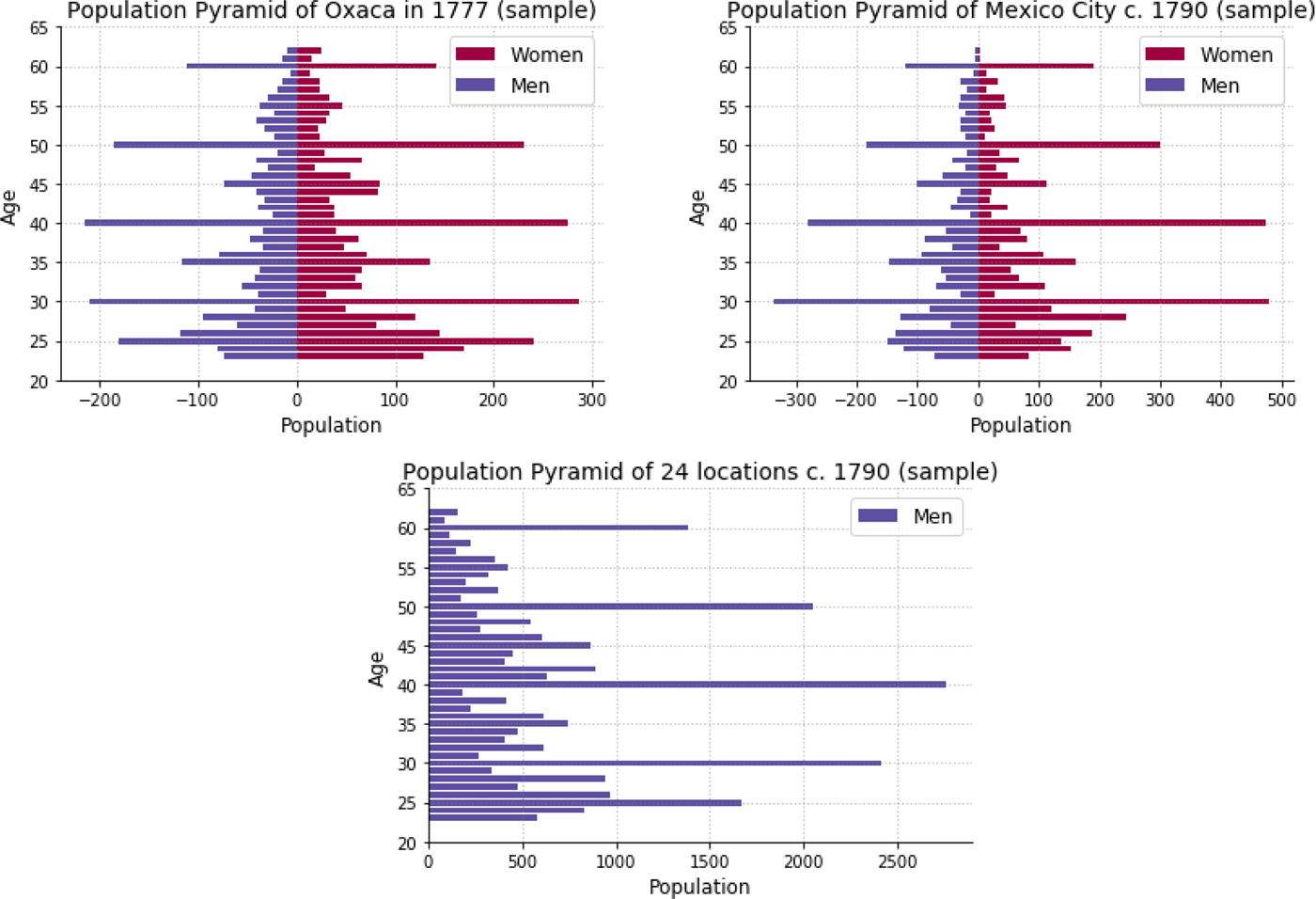
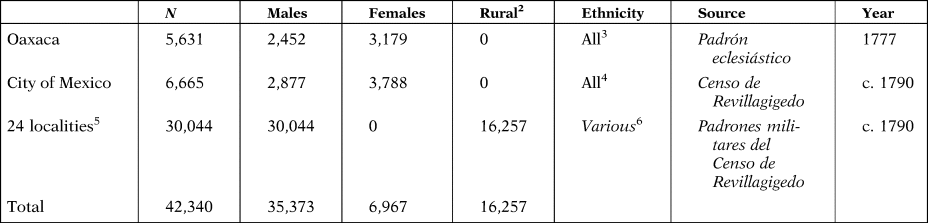
An illustration of age heaping in our sample is shown in Figure 1. Ages cluster at numbers ending in 5 and, especially, 0. This tendency is especially visible, in this case, at ages 30, 40, 50 and 60. Studies of historical age heaping conventionally use the range 23-62 years of age, which is presented in Figure 1. Age heaping is clearly perceptible across Central New Spain in both females and males. The sources of our research are shown in Table 1.
AGE HEAPING IN CENTRAL NEW SPAIN (SECOND HALF OF THE 18TH CENTURY).

SAMPLE AND SOURCES1

1 Age range for the three samples: 23-62.
2 Rural: Locations labelled in the Padrones as villages, estates, ranches, glens and other terms suggesting rurality.
3 Españoles, indios, mestizos and mulatos and unclassified.
4 Castizos, españoles de México, españoles peninsulares, indios, mestizos, negros and calidades no especificadas.
5 Acámbaro, Atlixco, Celaya, Charo, Chicontepec, Cholula, Dolores, Guanajuato, Huamelula, Huejotzingo, Otumba, Pénjamo, Querétaro, San Cristobal Ecatepec, San Felipe, San Juan del Río, San Miguel el Grande, Silao, Tacuba, Tepeaca, Tlaxcala, Tochimilco and Tula.
6 Útiles and exentos (castizos, españoles, mestizos and mulatos) for military purposes.
All sources report ages. The workable samples appear in the column headed N. The original documents also include the population younger/older than 23-62 years of age and/or that does not report sex or ethnicity. Therefore, they have been excluded from our sample. In some cases (e.g. Padrón Eclesiástico de Oaxaca and Censo de Revillagigedo), the information provided includes Indians and females. Both human groups have not been commonly present in the literature on age heaping in the pre-industrial era. Quantitative information regarding these groups turns out to be very useful for discussing the extent of capital formation among unprivileged groups of the late viceregal society and quantitatively determining the degree of inequality along the social ladder in this respect. In Table 1, we distinguish between rural and urban populations.
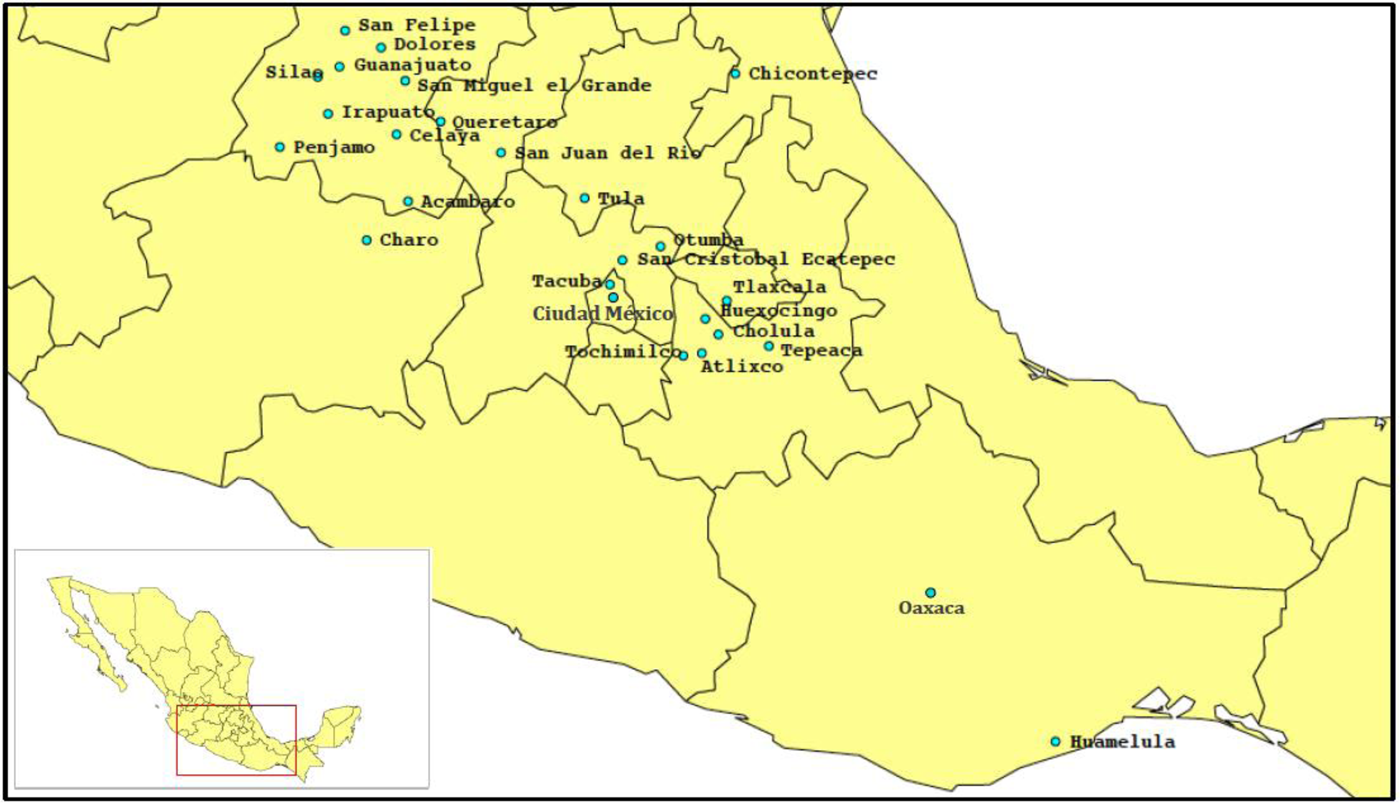
What we consider Central New Spain comprises those areas of the high plateaus that concentrated most of the population of the Viceroyalty, consisting of the intendancies of Guanajuato, Puebla, Mexico, Valladolid and Oaxaca, and the government of Tlaxcala, all of them represented in our sample—see Figure 2Footnote 9. The land area and the population of this region were, respectively, more than 500,000 km and nearly four million people around 1790Footnote 10. It was not only the most populated region of New Spain, but also the most densely occupied, having a rather high urbanisation rate.
GEOGRAPHY OF OUR SAMPLE.

In order to determine the reliability of the sources shown in Table 1, some discussion is needed. It is our contention that there are good reasons to be confident in the quality of the sources used as well as in the representativeness of our sample. All sources presented in Table 1 have been previously used by other researchers in several historical fields. Thus, the Padrón eclesiástico de Oaxaca and the Censo de Revillagigedo were employed, and praised, by Manzel et al. (Reference Manzel, Baten and Stolz2012) in their pioneer examination of age heaping in Iberian America from the 17th to the 20th centuryFootnote 11. According to these authors, Hispanic America was unique among non-European countries because of the availability of ecclesiastical and official sources (padrones and censos). The trust in the reliability of the sources of the pre-independent period was first pointed out by Cook and Borah (Reference Cook and Borah1977–1980); the census was carefully collected following a precise and standardised questionnaire printed in Mexico City and sent to all corners of the kingdom. Sánchez Santiró (Reference Sánchez Santiró2004a, Reference Sánchez Santiró2004b) based his studies of the population of the City of Mexico and its «new parochial order» on the Padrón del Arzobispo de México (1777)Footnote 12. Pérez Toledo and Klein (Reference Pérez Toledo, Klein, Miño and Pérez Toledo2004) also rely, as other authors in Miño-Grijalva (Reference Miño and Pérez2004), upon the Censo de Revillagigedo in their contribution to a collective book on the population of the City of Mexico in 1790. The military padrones of the Censo de Revillagigedo have been used by Grajales and López (Reference Grajales-Porras and López-Aloso2011) and Dobado and García-Hiernaux (Reference Dobado and García Hiernaux2017) in their studies of heights. Besides, to the best of our knowledge, no well-founded criticism of the quality of the sources used in this work exists. Marichal (Reference Marichal2007, p. 56) has acknowledged «the high quality of the Bourbon accounting records of taxes and expenditures from 1760 on.» After a long time working with our sources, it is difficult not to reach the same conclusion.
Our approach to studying age heaping in late 18th-century Central New Spain differs from that of Manzel et al. (Reference Manzel, Baten and Stolz2012), since we have opted for an in-depth analysis of our sources due to the vast array of information that they provide. Therefore, we can only conduct a synchronic analysis (1777 for Oaxaca and c. 1790 for Mexico City and the other twenty-four localities), although using a much larger sample and a broader set of data (ethnicity, sex and marital status) than previous studies. Fortunately though, the richness of the censuses offers a strong argument in defence of their reliability: if the data were not self-reported by those being registered, why do we find differences in age heaping between ethnic groups, sexes and other possible segments (i.e. married vs. unmarried women) of the whole population in our sample? These differences are significant (see Section 3). If the officials in charge of the Padrón eclesiástico de Oaxaca and the Censo of Revillagigedo had fabricated the answers, we would find a lower variance between age heaping across subsamples (e.g. between indios and españoles). Moreover, some counterintuitive findings (see Section 3) support this argument.
In spite of the consensus among specialists regarding the quality of our sources, some flaws have been observed by Manzel et al. (Reference Manzel, Baten and Stolz2012). The most important of them is evident in Table 1: the overrepresentation of females in urban localities. The aforesaid authors suggest that the attempt at avoiding the military draft might be the cause of the underrepresentation of males in Spanish American censuses. Sánchez Santiró (Reference Sánchez Santiró2004a) proposes another explanation for the underrepresentation of single males (slightly more than 60 per cent of single females) in all the parishes of Mexico City in 1777: the immigration of young women to find employment as servants. If there is a bias in our estimates of age heaping due to the overrepresentation of females, it would presumably be downwards. Nevertheless, as discussed below, the reality in New Spain might be more complicated than that. In any case, since «Latin America is the only continent in the developing world for which such early population counts are widely available», the temptation to use them carefully is difficult to resist, while the advantages of doing so clearly exceed those of its alternativesFootnote 13.
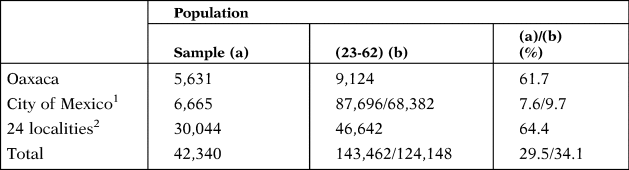
As to the representativeness of our sample, it is certainly a small share of Central New Spain's total population of nearly four million according to the estimates by Sánchez Santiró (Reference Sánchez Santiró, Dobado, Gómez and Márquez2007). It was by far the most populated region of New Spain, either absolutely or in terms of density. Urban life was especially vibrant in this region. Our sample represents around 1.1 per cent of the total population. This percentage increases to 2.1 when we use as the denominator the population of 23-62 years of ageFootnote 14. This new percentage might be viewed as small all the same. However, this is not the case at all. Working with «small samples» is the rule rather than the exception in studies of age heaping for the preindustrial era (e.g. Manzel et al. Reference Manzel, Baten and Stolz2012; Juif and Baten Reference Juif and Baten2013; Tollnek and Baten Reference Tollnek and Baten2017). Recent studies of age heaping for the Spanish case share this peculiarity (Álvarez and Ramos Reference Álvarez and Ramos Palencia2018; Gómez Aznar Reference Gómez Aznar2019). All types of practical obstacles conspire against the attempt to build «large databases» when doing research on the Early Modern EraFootnote 15. Therefore, our sample is unprecedented in this respect. The representativeness of our sample for studying numeracy in late pre-independent Central Mexico is unusually rich, and not just because of the size, but also due to the inclusion of all significant subsamples in a society for which no specific age heaping estimates had been calculated before (e.g. villagers, indios and castas, single women, etc.). Moreover, the representativeness becomes much more satisfactory in quantitative terms if we substitute Central New Spain for the population aged 23-62 (females and males in Oaxaca and Mexico City; just males in the twenty-four localities) in the villages, towns and cities included in our sample. In this case, depending on the estimates of Mexico City's population (between 168,000 and 131,000)Footnote 16, the share of our sample rises to 25-29 per cent (see Table 2)Footnote 17.
REPRESENTATIVENESS OF OUR SAMPLE

1 See explanations in the text.
2 Estimated with City of Mexico ratios. Only males. See text.
Source: See Table 1.
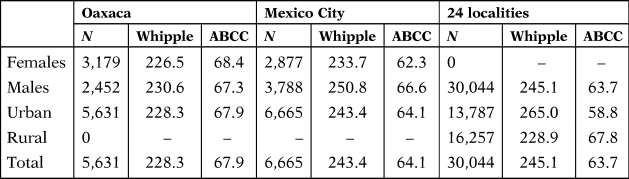
Table 2 shows that the representativeness of our sample is unusually large with respect to Oaxaca and the twenty-four localities (respectively, almost two-thirds of both females and males and more than half of the male population aged 23-62 and somewhat less so in the case of the City of Mexico). However, as argued below, its relatively small size does not affect its representativeness (see Figure 3).
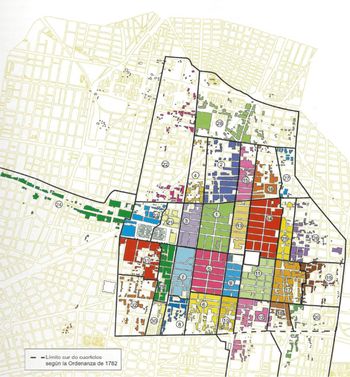
MEXICO CITY IN 1790, DIVIDED IN THIRTY-TWO CUARTELES MENORES.

Our subsample for the City of Mexico consists of the whole population of three cuarteles menores (1, 20 and 23). Pérez Toledo and Klein (Reference Pérez Toledo, Klein, Miño and Pérez Toledo2004) clearly explain why this selection of cuarteles menores is a good representation of Mexico City as a whole: the first cuartel menor (olive green) comprises the very core of the city, while the other two (twenty, bottom right in green, and twenty-three, centre left in blue) represent the outskirts, which covered well areas of the repúblicas de indios of Santiago Tlatelolco and San Juan Tenochtitlán (see Figure 3). Thus, while the first cuartel menor occupied a central location and was relatively rich, although not without a significant number of commoners among its inhabitants, the twentieth and twenty-third cuarteles menores were peripheral and comparatively poor. The share of españoles and negros was above the average in the relatively rich cuartel menor 1. The opposite happened in the other two, poorer, areas. Indios were found in similar proportions in all three areas.
3. AGE HEAPING IN CENTRAL NEW SPAIN IN THE SECOND HALF OF THE 18TH CENTURY
In this section, we show our estimates of age heaping measured with the Whipple and ABCC indices (see Appendix 1).
As expected, numeracy—proxied by age heaping—in Central New Spain was certainly not high, but it was not so low either when compared with historical or even contemporary populations. Central New Spain lagged behind Scandinavia and Western Europe. However, it was not far from Italy and Portugal and exceeded Ireland c. 1800 and most of Eastern Europe by 1820 (Hippe and Baten Reference Hippe and Baten2011)Footnote 18. Moreover, age heaping was also significantly lower than in the Cape Colony, in particular if only the non-European part of the sample is taken into account (Baten and Fourie Reference Baten and Fourie2015). Besides, it was lower than in most of the rest of the underdeveloped world as late as 1900 and even later (Crayen y Baten Reference Crayen and Baten2010a; Hippe Reference Hippe2012). However, China and East Asia were more numerate than Central New Spain (Baten et al. Reference Baten, Mab, Morgan and Wanga2010; Baten and Sohn Reference Baten and Sohn2017). Thus, we share the conclusion expressed by Manzel et al. (Reference Manzel, Baten and Stolz2012, p. 958): «It is safe to say that until the late eighteenth century numeracy levels in Latin American countries were quite good.»
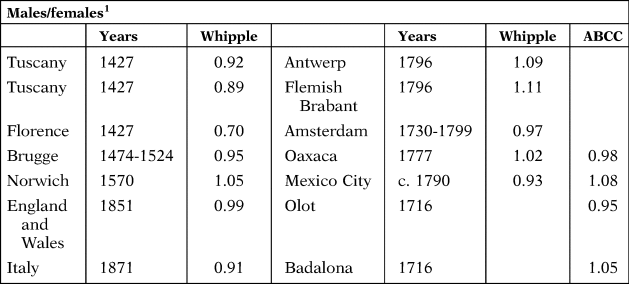
Values of the Whipple and ABCC indices in the three subsamples are basically similar. We can probably assume that age heaping in the twenty-four localities would be lower if indios and females were included in that subsample. We advance that this presumption might be accurate as far as indios are concerned. On the contrary, it is not necessarily so regarding females, given the estimates for Oaxaca (see Table 3) where female numeracy is slightly higher than that of men. Finding that females are more numerate than males is not an exceptional result (see Table 4) but it is not the most common one either.

RATIO MALES OVER FEMALES HEAPING, LATE MEDIEVAL AND EARLY MODERN PERIODS

1 If the quotient is higher than 1 in the Whipple column, the numeracy of women exceeds that of males. The opposite happens when we look at the column showing the ABCC males/females ratio.
Source: Padrón eclesiástico de Oaxaca, Censo de Revillagigedo, Földváry et al. (2012), Gómez Aznar (Reference Gómez Aznar2019), and De Moor and Luiten Van Zanden 2010a.
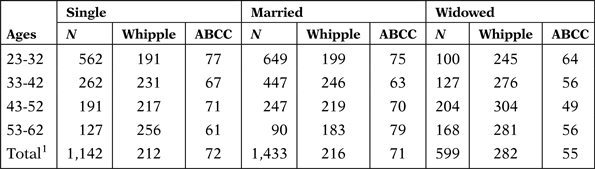
While in New Spain, age heaping among females was high if compared with Western Europe in the Late Medieval and Early Modern times, the gap between males and females is similar. These results are probably unexpected. This dimension of inequality in New Spain was not more acute than in other allegedly less patriarchal societies. We also try to test whether the objection raised by Földvári et al. (2012, p. 312) to the conventional estimates of age heaping among women (i.e. all female individuals aged 23-62) makes sense in our case. For these authors, «to calculate actual age heaping among women reliably, it is preferable to use data on non-married women.» Therefore, we have also calculated the Whipple and ABCC indices of the female population of Oaxaca—the only subsample for which it is possible—for the three marital-status categories (see Table 5).
FEMALE AGE HEAPING IN OAXACA, 1777

1 The total of single, married and widowed women amounts to 3,174 as five observations lack this information.
Source: Padrón eclesiástico de Oaxaca.
Our estimates show that widows heap ages more than married women in all ranges of ages. This evidence supports the claim of Földvári et al. (2012) that the numeracy of married women is overestimated because married women adjust their age to that of their husbands. By doing so, they reduce their age heaping and, consequently, that of the whole female population in the sample. However, single women heap ages less than married women, which is evidence against the alternative proposed by Földváry et al. (2012). In sum, we find mixed evidence regarding the objection raised by these authors. Two issues arise here. First, since widows tend to be older, it is possible that they had more difficulties remembering their precise age. Second, it is also possible that numeracy had progressed during the 18th century in Oaxaca and that younger, unmarried women were better educated than older generations.
Our results regarding women might have another and more complex explanation. On the one hand, in the cities and major towns, feminine convents played a major role in the education of women. Nuns taught the Catholic faith, as well as reading, writing and various crafts to young girls. Since nunneries were plentiful—even in small towns like Villa de Carrión (nowadays Atlixco) in the Puebla region or Salamanca in Guanajuato—and hundreds of girls spent at least a couple of years within the convent walls, the fact that we find relatively high numeracy rates among women in both Mexico City and Oaxaca, especially among those of Spanish descent (Table 6), does not seem surprising. In the 18th century, because of the enlightened ideas which promoted the improvement of the instruction of all human beings, female education received even more attention in New Spain. The most important institution for women opened in that century was the Colegio de San Ignacio de Loyola de los Señores Vizcaínos in Mexico City. It started its operations in 1767 and had 260 intern colegialas by 1795Footnote 19. In 1793, in the same, impressive building—it covers an area of more than 17,000 m2—a public school for girls not residing in the Colegio opened its doors, and soon afterwards, it was serving almost 500 students. The teachers of this school were chosen among the best intern colegialas. According to Tanck (Reference Tanck1999), Indian girls were not excluded from the increase in the number of schools during the second half of the 18th century.
DIFFERENCES IN AGE HEAPING C. 1790

Source: Padrones militares del Censo de Revillagigedo, AGN, Mexico City.
The Padrón eclesiástico de Oaxaca reports a high number of nuns among the population. Four nunneries housed 146 nuns along with fifteen novicesFootnote 20. The presence of this well-educated—at least relatively—female population and its influence on other women contribute to explain the comparatively low age heaping of single women in Oaxaca. Something similar probably happened in Mexico City and other locationsFootnote 21. Additionally, the overrepresentation of women in petty commerce—an activity for which some arithmetic skills are needed—in urban and rural markets ought to be taken into account. The iconography of the period reflects the presence of women in the open-air commercial space and the studies available also point in this direction (Arrom Reference Arrom1988). The improvement in the education of women in Spanish America since the third decade of the 18th century is also acknowledged by Lavrin (Reference Lavrin and Bethell1984). It was part of a wider «educational growth» (Newland Reference Newland1991).
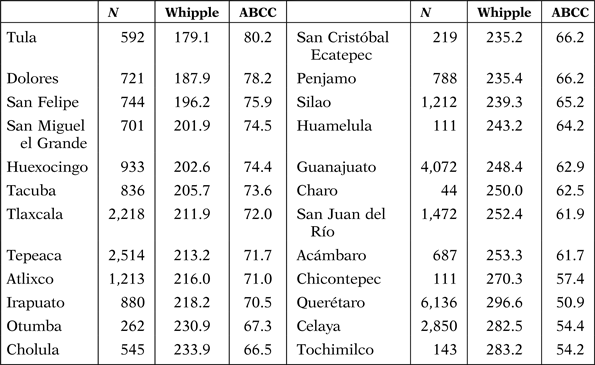
Estimates shown in Table 3 depict an image of a certain heterogeneity either between sexes or across space in New Spain. Our micro-approach allows us to delve more deeply into the analysis of the rich dataset extracted from the original sources used. By doing so, new perspectives emerge: spatial heterogeneity and ethnic inequalities. Significant differences in age heaping are observed within the subsample constituted by the twenty-four localities (Table 6). Finding a high geographical heterogeneity in Central New Spain is not new. Heights also present a significant variability (Dobado and García-Hiernaux Reference Dobado and García Hiernaux2017). Thus, while some localities exhibit less age heaping than Oaxaca and Mexico City, in others the opposite happens. Curiously enough, relatively high and low levels of numeracy might coexist at a short distance from each other (e.g. Atlixco and Tochimilco or Dolores and Silao)Footnote 22. Conversely, clustering of both high age heaping (e.g. Dolores and San Felipe) and low age heaping (e.g. Querétaro and Celaya) may be observed.
This diversity in terms of numeracy was probably due to a variable combination of factors operating at the local (promotion of schooling by the elites) and supra-local (regional or sub-regional resource endowment, institutional framework, market integration and economic specialisation) scale. What seems clear to us is: (1) micro-approaches to the economic history of pre-independent Hispanic America offer interesting new perspectives; (2) empirically unsupported generalisations tend to be more and more unjustified with respect to relevant aspects—see belowFootnote 23. Further evidence in favour of a «low-profile methodology» will be presented further in this article.
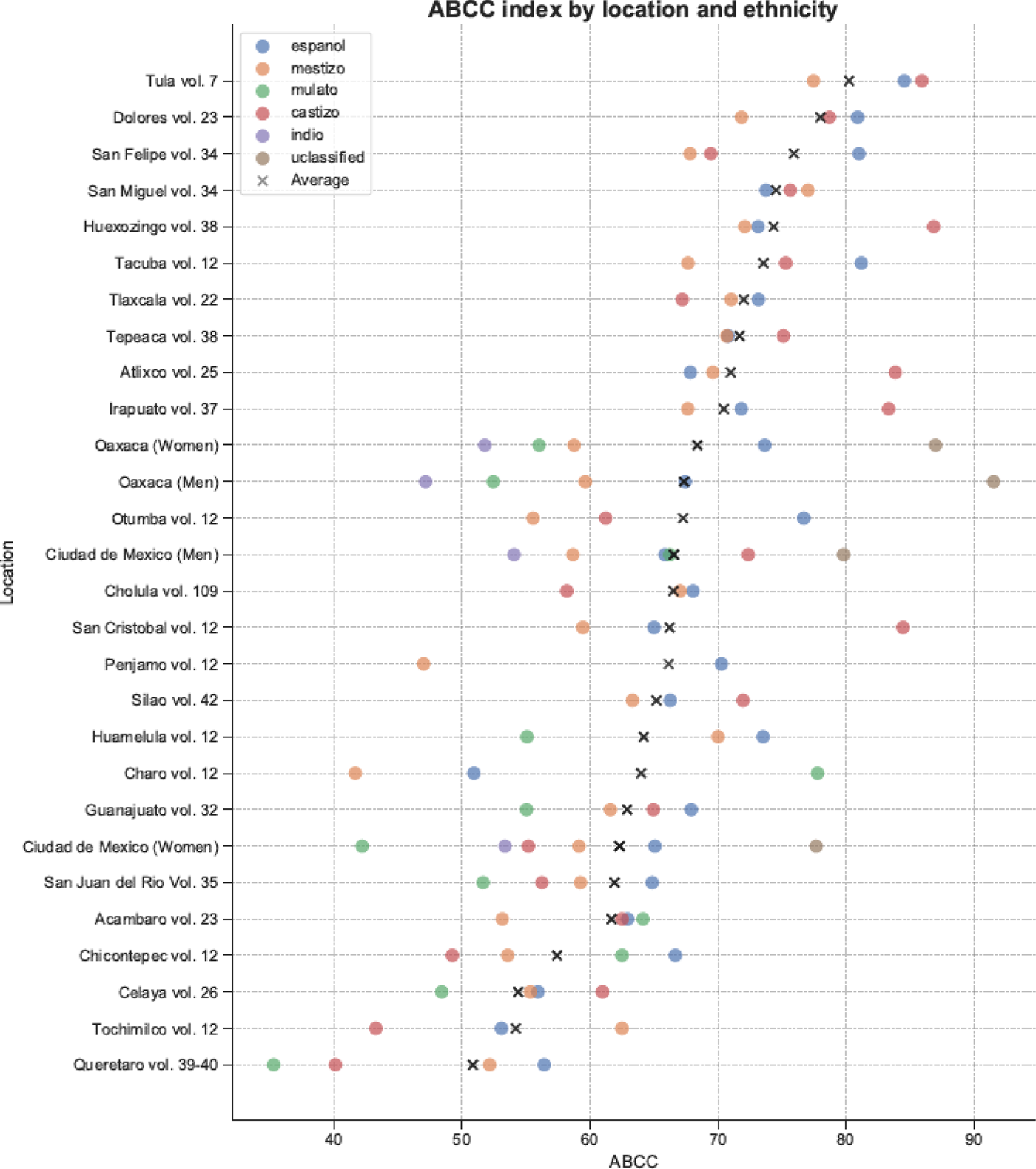
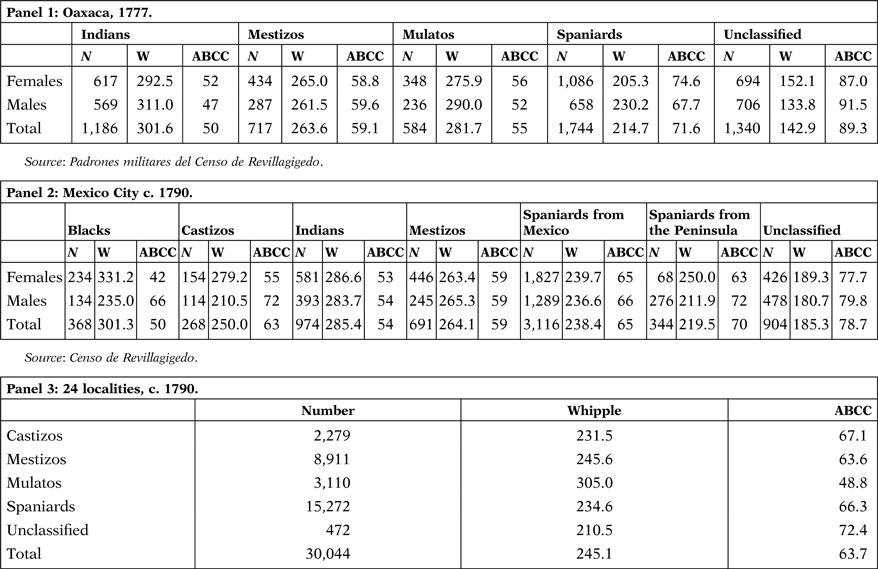
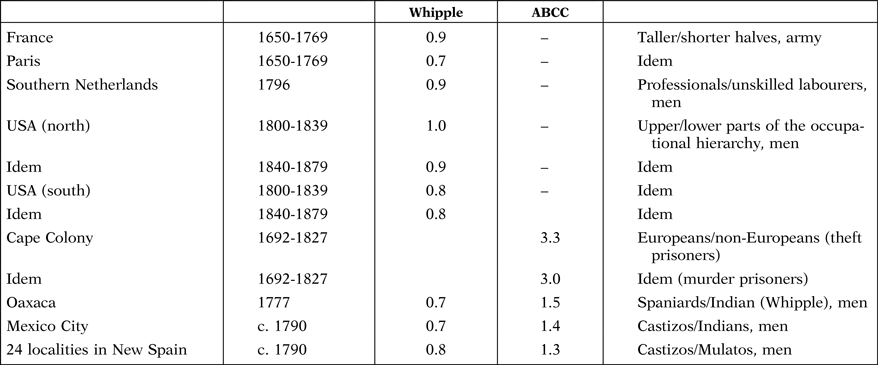
One such generalisation, as successful in the literature as empirically flawed, emphasises the «original sin» of inequality in pre-independent Hispanic America. Numeracy offers the opportunity to test the hypothesis that New Spain was an extreme case of inequality. In order to do so, we use a two-step procedure. First, we present information on age heaping for all ethnic groups in our subsamples (see Table 7 and Figure 4) including females and males for Oaxaca and Mexico City. Second, we estimate some comparative indicators of inequality in terms of numeracy (see Table 8).
AGE HEAPING AND ETHNICITY IN THE WHOLE SAMPLE.

AGE HEAPING BY ETHNIC GROUPS

Source: Padrones militares del Censo de Revillagigedo.
INEQUALITY IN NUMERACY

Source: Crayen and Baten (Reference Crayen and Baten2010a, Reference Crayen and Baten2010b), Baten and Fourie (Reference Baten and Fourie2015), Padrón eclesiástico de Oaxaca, Censo de Revillagigedo and Padrones militares del Censo de Revillagigedo.
As expected, the ethnic division permeated nearly all aspects of life in New Spain, numeracy not being an exception. In Oaxaca, only Spaniards, both males and, especially, females, heaped less than the average, whereas the opposite happens to the rest of ethnic groups. Female age heaping of all groups, except mestizos, is lower than that of males. The estimates for negros in Mexico show an unusual gap between men and women, mainly because of the especially low numeracy of the latter. Spaniards from the Peninsula, men in particular, heaped less than the other ethnic groups, Spaniards of Mexico included. Overall, estimates for Oaxaca seem basically consistent with those from Mexico City and the twenty-four localities. Somewhat surprising is the fact that in the latter subsample age heaping is higher in urban locations than in the rural ones (see Table 3), although this finding is consistent with the idea of heterogeneity based on geography and the importance of local factors (i.e. the existence or not of a «municipal education policy») at explaining the level of numeracy of the inhabitants.
Available estimates for all ethnic groups in our three subsamples (Oaxaca, Mexico City and the twenty-four localities) are plotted together in Figure 4. It offers an interesting new perspective on ethnic inequality and spatial diversity in Central New Spain. The ABCC indices of the non-specified ethnic groups are presented. They add complexity to the diverse panorama of numeracy. In some locations, several ethnic groups (unclassified men and, in particular, women from Oaxaca, along with, more generally, españoles and castizos) reach ABCC values comparable to those of the European periphery; that is, a high level for the world standard of the period. These two groups are usually at the top of the ranking and above the rest of the ethnic groups. Mulatos and indios from Oaxaca and Mexico City are at the bottom. Thus, the ethnic division is clearly visible. However, the role played by ethnicity was influenced by local and supra-local factors; indios from Oaxaca and Mexico City do not have lower levels of numeracy than other ethnic groups from the localities placed in the bottom part of Figure 4, including in some cases españoles (e.g. Charo and Tochimilco). It is likely that indios from the localities situated in the upper part of Figure 4, for whom we do not have information, would also be in a similar or better situation than those from Oaxaca and Mexico City. This inference is based on the additional information provided by Tanck (Reference Tanck and Tanck2011)Footnote 24. Besides the incentive represented by an easier access to becoming part of the clergy, there might have been more mundane ambitions as well (e.g. an active participation in the expanding market economy). It is quite interesting to observe that, as a general rule—that is, excluding ethnically unclassified individuals—there is a tendency to present higher dispersion in localities in which the average age heaping is also higher.
Demand factors for education were reinforced by supply factors. According to Tanck (Reference Tanck1999), Visitor General José de Gálvez established in 1766 the Contaduría General de Propios, Arbitrios y Bienes de Comunidad (General Accounting Office of Customs, Excise and Community Assets), which limited the autonomy of the municipalities and supervised how money was spent. More than 1,600 towns in New Spain adopted the new system between 1773 and 1785. The intention was to avoid municipalities' indebtedness that could compete with the Crown in the search for loans within the Viceroyalty. Besides, it would generate surpluses that could be used by the Crown when needed, basically to finance the costly wars against Britain. In the Repúblicas de indios, expenses for religious activities were severely limited, but certain outlays were permitted or even encouraged. This was the case of public schools. After contemplating the sequestration of the surplus resources that they had saved during the war against the British (1778-1783), most Indian councils decided to spend nearly all available resources on «useful works» within their jurisdiction, among which schools were the most favoured. For instance, in Mexico City, free public schools were established in the Indian areas before the city council opened a school in 1786. In 1803, 1,104 schools were operating in 4,271 pueblos de indios. They were entirely financed by the cajas de comunidad. Thus, 26 per cent of the Repúblicas de indios of New Spain had a school of elementary education. This percentage rises to 43 and 32 per cent in the intendencies of, respectively, Mexico and Michoacán and to nearly 50 per cent in Guanajuato (Tanck Reference Tanck1999, p. 286).
Numeracy among New Spain indios may be considered low, if only by the standards of the most advanced parts of the world. In any case, the fact is that numeracy, not to mention literacy, in pre-Hispanic America seems to have been much lower. Following Juif and Baten (Reference Juif and Baten2013, p. 241), the long-term negative impact of «pre-colonial legacies» ought not to be underestimated and not only as far as numeracy and human capital accumulation are considered:
«Given the low educational level and the high inequality reigning before the Spanish conquest in the Andean region, we argue that more attention should be paid to the pre-colonial legacies when assessing the genesis of the long-term path of only modest economic growth in the countries of Latin America.»
As recognised by Engerman and Sokoloff (Reference Engerman and Sokoloff2002) themselves, the «preexisting Native American organizations in those areas» [Mexico and Peru] «significantly influenced Spanish practices» that led to extreme inequality. We believe that the pre-Hispanic institutional legacy was certainly important, but not exactly in the way thought by Engerman and Sokoloff. Thus, according to Coatsworth (Reference Coatsworth2005, p. 139):
«Unlike Western Europe, Latin America's colonial elites did not monopolize land ownership. Throughout Mesoamerica and the Andes, indigenous villages and villagers occupied most of the arable lands. European estates clustered in the commercially more profitable areas near cities and towns and along major trade routes but left vast areas of the landscape in indigenous hands.»
There is no good reason to believe that pre-Hispanic New Spain was any different from the Andean region regarding the scarce education of commoners. There is abundant evidence of progress in this domain throughout the Early Modern Era in New Spain. Shortly after the Conquest of Tenochtitlan (1521), the authorities of the new Viceroyalty encouraged the establishment of educational facilities for both the small but growing Spanish population, as well as for the large Indian groups. This was not a gracious concession but a legal requirement; the Pope's cession of American lands to the Crown of Castile demanded the incorporation of Indians to Christianity. The Colegio Imperial de la Santa Cruz de Tlatelolco, founded in 1536, is the best-known and most important educational institution dedicated to the instruction of the Indian elite. In 1539, a printing press was introduced in Mexico City to help the friars teach the new faith to the Indians. By 1553, the Royal and Pontifical University of Mexico opened its first courses. Therefore, we do sense that the statement that «with the slightest research on the life of New Spain, the very liberal and 19th century prejudice that during colonial times public education was neglected, shatters and falls to earth» is basically correct (Gonzalbo Reference Gonzalbo Aizpuru2000, p. 14. Our translation).
Although in the cities and among the Spanish population, education continued to progress in the 17th century—for instance, the Jesuits, established in New Spain in 1572 and opened dozens of schools—among the Indians, the initial thrust was lost, and in the aforesaid century, education seems to have made little progress. In the 1680s, the energetic Archbishop of Mexico, Francisco de Aguiar y Seixas, visited most of his jurisdiction and found that although there were no traces of paganism among the Indians, their knowledge of Christian doctrine was rather sketchy due to their superficial knowledge of Spanish. Aguiar obtained from the Crown a series of royal charters that demanded the establishment of schools in parishes that should basically teach Spanish and religion. These regulations led to the creation of dozens of schools and many of them also taught how to read and write. Many towns remained nevertheless without schools. This would explain why Viceroy Marques of Valero insisted on applying the royal decrees in the 1710s.
When the enlightened Manuel José de Rubio y Salinas assumed the archiepiscopal throne of Mexico, he commissioned a census of the existing schools in the territory of his see. The reports he received informed of the existence of 287 schools in 281 localities in 1754 (Tanck Reference Tanck1999). Rubio y Salinas encouraged the opening of more facilities; this policy was also pursued by his successor, Francisco Antonio de Lorenzana, and extended to the other bishoprics by the regalist bishops appointed by Charles III—such as Francisco Fabián y Fuero in Puebla.
The promotion of education was not only left to the Church during the reign of Charles III. Private education also played a role of some importance in New Spain. In 1779, there were thirty paying schools for boys and ninety-one for girls in Mexico City (Tanck Reference Tanck1998, p. 161). Some teachers were teaching more than a hundred pupils, but the majority taught between fifteen and twenty-five. After the decree of Viceroy Gálvez, dating from 1786, which obliged convents and parishes to open free elementary schools, new educational facilities flourished, diminishing thus the demand for private teachers.
The extension of education during the 18th century paid off in New Spain. The extension of literacy allowed the diffusion of the technical advances of the Enlightenment. For example, several priests enrolled in the Real Sociedad Bascongada de Amigos del País—an enlightened network of Basque origin with subscribers in four continents—ordered hundreds of copies of the agricultural manuals written by the members of the society to distribute them in the Indian communities in which they preached, sometimes at the request of the local caciques (Torales Reference Torales Pacheco2001). This shows a population able to read and also to take advantage of the enlightened advances. Undoubtedly, this formation of human capital is part of the explanation of the general prosperity of the viceroyalty at the end of the 18th century.
Thus, abundant evidence suggests that the Enlightenment was not alien to New Spain's education history. However, its outcomes were neither spectacular nor equally distributed. Some regions (Central New Spain) did better than others (Peripheral New Spain) but this was common elsewhere. No minor regional differences in numeracy may be observed in European countries (e.g. Austria-Hungary, France, Italy, Norway, Spain and the United Kingdom) around the early 19th century (Hippe and Baten Reference Hippe and Baten2011). Inequalities between ethnic groups existed and were significant. Therefore, since the distinction between ethnicity and socioeconomic status was not so clear-cut, the international comparison of inequality in numeracy shown in Table 7 is revealing.
The tentative indicators depicted above allow us to conclude tentatively, that New Spain was not an extremely unequal society in terms of numeracyFootnote 25. The estimated ratios for New Spain are not very different from those available for advanced countriesFootnote 26. In contrast, the inequality in Cape Colony was of a different order of magnitude.
In view of this evidence, together with that presented above, we do not think that New Spain was a case of extreme inequality in terms of numeracy and hence human capital formation as Engerman and Sokoloff (Reference Engerman and Sokoloff2005) maintained. It rather confirms the conclusion that much more empirical evidence is needed to support the view of viceregal Spanish America as the epitome of extreme inequality (Dobado Reference Dobado, Llopis and Marichal2009; Dobado and García-Montero Reference Dobado and García-Montero2010). In this regard, neither Coatsworth (Reference Coatsworth2005, Reference Coatsworth2008) nor Williamson (Reference Williamson2009) shares that pessimistic view. In fact, at least in urban environments, ethnic educational discrimination was not as strong as usually assumed:
«In cities like Puebla or Mexico, and probably in the rest of the urban centers, most students attended public schools, financed by either the councils, philantropical groups, the Church, or the Indian towns. Children of all ethnic and economic groups coexisted in the same classroom, without legislation or customs that could prevent this practice.» (Tanck Reference Tanck and Tanck2011, p. 91. Our translation).
This view, at least with respect to the Academy of Noble Arts of Mexico City at the beginning of the 19th century, is shared by Humboldt in several passages of his famous Ensayo politico del reino de la Nueva España (Humboldt, Reference Humboldt1822–1991, pp. 79–80 and 457). The institution, co-financed by the administration and civil society, is presented as a model of socioeconomic and racial, and even gender inclusivenessFootnote 27. Its teachings pursued the enlightened ideal of combining the search for—classical—beauty and the practical application of knowledge.
We agree that numeracy increased during the 18th century in New Spain—as well as in other Iberian American countries—and also that this allowed convergence in numeracy—if only partial—with the most advanced countries. This trend forcibly reduced inequality in heaping and therefore in human capital formation. We also concur in that the improvement stopped by the early 19th century and especially—we add—after 1810. Evidence shown by these two authors and others (e.g. Staples Reference Staples and Tanck2011) suggests that, as in other aspects of the Mexican socioeconomic conditions, the notion of «lost decades» after independence makes sense. This view of the long-term evolution of education in Iberian America is also consistent with Newland (Reference Newland1991, p. 92) since he claims that the «growth in the supply and demand of education in the last part of the eighteenth century» was discontinued until the «next significant expansion of education» which occurred «during the second half of the next century».
Some Indian communities seem to have been the major losers due to the institutional and economic changes after independence and this situation negatively affected their education (Tanck Reference Tanck1999; Staples Reference Staples and Tanck2011). As to the Church's educational activities, many of the free public schools sustained by ecclesiastical institutions were closed as a consequence of the depletion of the resources of the Church produced by the Consolidación de Vales Reales decree (1804) and the war of independence (1810-1821).
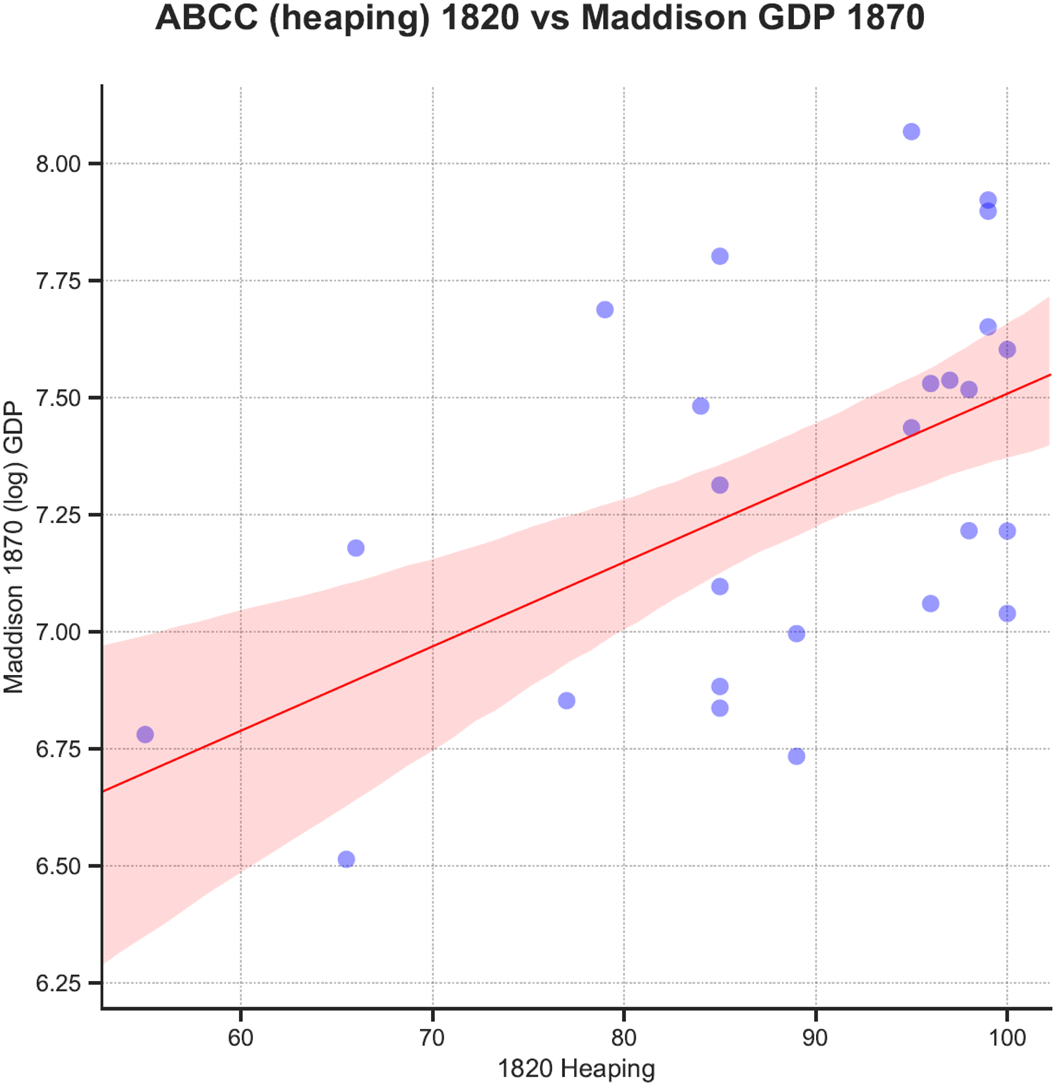
Finally, a preliminary assessment of the relationship between human capital—proxied by basic numeracy skills—and GDP per capita can be presented. According to the specialised literature, a positive correlation exists between numeracy—measured by age heaping—and economic growth (e.g. Crayen and Baten Reference Crayen and Baten2010a) while causality is usually assumed to go from the latter to the former. In Figure 5, the (log) GDP per capita estimated by Maddison for 1870 is plotted against age heaping circa 1820 taken from Tollnek and Baten (Reference Tollnek and Baten2017). The sample includes twenty-six countries from Europe and America (see Figure 5)Footnote 28. Mexican age heaping is the weighted average of our three subsamples.
HEAPING (1820) AS EXPLANATORY VARIABLE OF GDP PER CAPITA (1870).

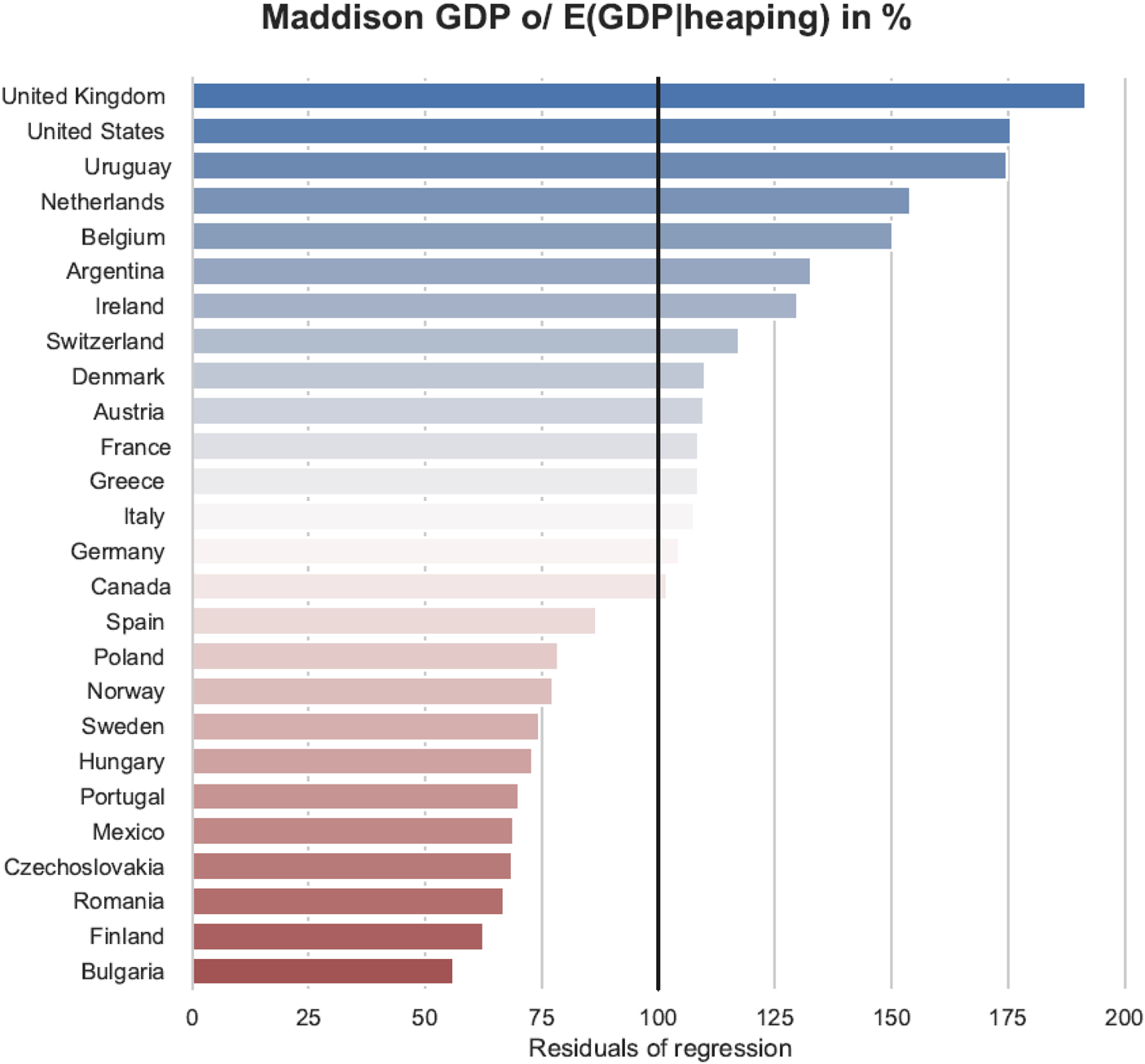
A positive and significant relationship between age heaping in 1820 and (log) GDP per capita exists for 1820. The linear relation is slightly stronger (in terms of R 2 and significance) if we regress (log) GDP per capita for 1870 on age heaping circa 1820Footnote 29. We interpret this result as evidence suggesting that Granger causality (Granger Reference Granger1980) goes from human capital to economic growth rather than the other way around. Building on the results of this model, the residuals offer useful insights into Mexico's comparative situation (see Figure 6).
RESIDUALS OF GDP PER CAPITA (1870) EXPLAINED BY HEAPING (1820).

Mexico belongs to the group of countries whose 1870 (log) GDP per capita was significantly lower than those conditional to heaping in the 1820s. Along with Mexico, all sorts of European countries (Catholic as well as Protestant and Orthodox) show up in this group of underperformers. By 1870, Mexican GDP per capita was clearly lower than the level that can be predicted in accordance with its numeracy 50 years beforeFootnote 30. Can Mexico be considered a proper case of a literate poor country? This possibility will be explored in depth in further research.
4. FINAL REMARKS
The main results from our quantitative empirical research on numeracy in late pre-independent Mexico may be summarised as follows. Numeracy, proxied by age heaping, is similar to that of peripheral Europe and much lower than in most backward countries from other continents. Spatial differences in numeracy may be observed, as is the case across European regions. As we had previously assumed, ethnicity was highly significant. Thus, inequalities based on ethnicity are found. Españoles were at the top of the distribution, indios and mulatos (or negros) at the bottom and other castas in between. However, these disparities, which may also be viewed from a socioeconomic perspective, were not significantly larger than those found in developed countries from the 17th to the 19th centuries, not to mention the Cape Colony. Geographical heterogeneity might counterbalance ethnicity as an explanatory factor of inequalities. A sexual divide may be seen, but no higher than in European samples for different periods and even sometimes favouring some female communities (e.g. Oaxaca). Circa 1870, Mexican GDP per capita was below the level that might be expected from the numeracy reached before independence.
The types and intensity of the inequalities in numeracy do not convert New Spain into an outlier in terms of human capital formation and its distribution in the preindustrial era. Clear progress, and hence convergence with the leaders, was achieved through the 18th century by increasing schooling in both the república de indios and the república de españoles. This progress was interrupted in 1804-1810, when the effects of the Consolidación of Vales Reales were reinforced by the beginning of the Insurgencia war. The improvement of human capital formation did not resume until the last quarter of the 19th century.
Our results have implications regarding the (dominant) pessimistic view of the Spanish «colonial legacy» in terms of backwardness and inequality. Our findings show a society with better levels of human capital formation than those probably assumed by the mainstream historiography; taking numeracy as an indicator, late 18th-century New Spain was clearly closer to the most advanced countries than to the rest of the world. This is particularly true for some locations of the central regions of the Viceroyalty.
Initial and persistent differences in human capital seem to have a significant explanatory potential of the diverse economic performance of individuals, ethnic groups, sexes, social classes and territories throughout Spanish America.
The pre-Hispanic legacy should not be disregarded as one of the factors explaining the comparatively low level of numeracy among indios to which the isolation of many of their pueblos probably also contributed significantly.
Inequality in numeracy was, as in almost every preindustrial society, a reality; a fact which is more often than not forgotten. In this respect, empirically unfounded generalisations are particularly mistaken. Studying numeracy allows us to conclude that New Spain had little or nothing to do with the dual vision presented by the dominant scholarship (a few rich, exploitative Spaniards vs. innumerable, poor, exploited Indians). The actual society of New Spain was much more complex. In the words of a reputed specialist:
«The reality of the [Spanish] American colonial world differs, thus, of the prevailing image of a society composed by a few dominators and a lot of dominated ones.» (Carmagnani Reference Carmagnani2004, p. 87. Our translation).
ACKNOWLEDGEMENTS
The authors thank three anonymous referees and the editors for their comments and suggestions. Andrés Calderón-Fernández thanks the postdoctoral research fellowship programme of Mexico's National University (Programa de Becas Posdoctorales UNAM—DGAPA) that has funded his research since August 2018. Rafael Dobado-González has received financial support from the Spanish Ministry of Economy and Competitiveness (ECO2014-58250-P). Alfredo Garcia-Hiernaux acknowledges funding from UCM-Santander PR75/18-21570. We also thank our research assistants in this project: Violeta Barrientos Nieto, Gerardo Saldaña Domínguez and, in particular, María Luisa Domínguez (Universidad de Sevilla).
Appendix
The Whipple Index (W) is a statistical measure that proxies for numeracy based on the accuracy of the age reported by a population. Mathematically, it is formulated as:
 $$W = \; 500\left( {\displaystyle{{n_{25} + n_{30} + \cdots + \; n_{60}} \over {n_{23} + n_{24} + \cdots + n_{61} + n_{62}}}} \right)$$
where n a is the number of people declaring age a.
In broad terms, an index value of 0 indicates that nobody in the population reported an age multiple of 5, a value of 100 means no heaping (the proportion of multiples of 5 are those expected) and a value of 500 means perfect heaping (only ages multiples of 5 were reported). So, Whipple values sufficiently greater than 100 evidence heaping and lack of numeracy.
The Whipple Index is probably the most common indicator for numeracy as it does not depend on the size of the population and can then be used for comparison purposes. However, some researchers also used the so-called, ABCC Index, named after A'Hearn et al. (Reference A'Hearn, Baten and Crayen2009) and Gregory Clark. The ABCC formula is based on the Whipple Index and is calculated as:
 $$ABCC = \; 100\left( {1-\displaystyle{{W-100} \over {400}}} \right)$$
for W ≥ 100 and ABCC = 100 in any other case.
The aim of the ABCC is to offer an index bounded between 0 and 100, which can then be interpreted as the share of individuals that correctly report their age as a percentage.
The relation between both indices is depicted in the following figure showing that Whipple values of 100, 300 and 500 correspond to 100, 50 and 0 per cent of individuals that correctly report their age (ABCC interpretation), respectively.

One index is a linear transformation of the other and so they have the same properties, while the interpretation is slightly different. In this paper, both indices are used in order to make the results comparable with all studies of the subject.