Implications
Additional solid feeding of suckling rabbits in an early stage is a new area of the rabbit science which has never been researched before. By feeding the kits with additional pellets, the following positive effects could be expected: survival of small suckling kits (higher survival rate), earlier weaning age (increased BW gain) and less digestive problems of kits (getting used to solid feed in a less rapid way).
Introduction
Rabbit does usually nurse the kits once a day (Zarrow et al., Reference Zarrow, Denenberg and Anderson1965; Drewett et al., Reference Drewett, Kendrick, Sanders and Trew1982; Jilge et al., Reference Jilge, Kuhnt and Landerer2000; González-Mariscal, Reference González-Mariscal2007; Morgado et al., Reference Morgado, Gordon, Minana-Solis, Meza, Levine, Escobar and Caba2008). The kits have to consume their daily feed intake in a short nursing time, which is about 3 to 4 min. It means that they are able to consume milk equal to 15% to 20% (Lebas, Reference Lebas1975), or even the 35% of their BW (Morgado et al., Reference Morgado, Gordon, Minana-Solis, Meza, Levine, Escobar and Caba2008) in a short period. That is why they are able to double their birth weight till the age of 6 days (Davies et al., Reference Davies, Widdowson and McCane1964).
Compared with other domesticated animal species the fat (12.9 g/100 g), protein (12.3 g/100 g) and energy content (8.4 MJ/kg) of the rabbit milk is quite high (Maertens et al., Reference Maertens, Lebas and Szendrő2006). It was proven by Spencer and Hull (Reference Spencer and Hull1984), Spencer et al. (Reference Spencer, Small and Hull1985) and McNitt and Moody (Reference McNitt and Moody1988) that kits were able to reach high growth rate nursing by two does. To achieve the maximal growth potential of the suckling kits, in the experiment of Gyarmati et al. (Reference Gyarmati, Szendrő, Maertens, Biró-Németh, Radnai, Milisits and Matics2000) one litter was nursed by two does (kindled at the same day). The kits were able to consume almost double amount of milk (+89%) during the first 3 weeks of lactation compared with the control group, which led to a 69% higher BW of kits at the age of 21 days. The kits were also able to maintain higher BW during the growing period, and they reached the slaughter weight (2.5 kg) 9 days earlier than the control group. Szendrő et al. (Reference Szendrő, Gyarmati, Maertens, Biró-Németh, Radnai, Milisits and Matics2002) published similar results. Milk production of rabbit does declines from the 3rd week of lactation (Maertens et al., Reference Maertens, Lebas and Szendrő2006), whereas nutrient requirements are logically increasing. At this age the hungry kits start to consume solid feed.
During the first 1.5 to 2 weeks of the lactation the does excrete faecal pellets in the nest during nursing (Hudson and Distel, Reference Hudson and Distel1982). According to Kovács et al. (Reference Kovács, Szendrő, Milisits, Biró-Németh, Radnai, Pósa, Bónai, Kovács and Horn2006) and Combes et al. (Reference Combes, Gidenne, Cauquil, Bouchez and Fortun-Lamothe2014) the maternal faecal pellets were consumed by the kits, and were involved in caecal microbiota implantation. These results demonstrate that suckling kits are able to consume solid material from very early age, when they are still unable to leave the nest. Thus, the nutrient requirement of the suckling kits in the early stage could be satisfied in a more explicit way by providing extra feed source. Along with this method the utilisation of the maximal growth potential and the minimisation of the survival of the kits are achievable. Moreover, the creep feeding of suckling kits in early age could have a potential ‘positive’ impact on the doe: if the kits consume solid feed, it should reduce the ‘pressure’ on the milking, thus the doe may give less milk (if kits are less hungry) and thus the doe would have a better health status and perhaps a longer career.
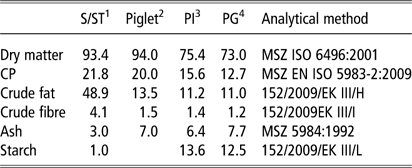
The hypothesis of the study is that the nutrient requirements of suckling kits are not fully satisfied and that extra feed source provided in the nest could be a solution to meet these requirements. There are no commercially available feed for suckling kits in early age. In experiment 1, due to the high protein and energy need of the kits, the additional creep feed was based on soya bean powder (protein) and coconut oil (high melting point; fat). The aim of thyme supplementation was based on the experiment of Altbäcker et al. (Reference Altbäcker, Hudson and Bilkó1995) who observed the preference of kits on some herbs, which were consumed by does during pregnancy and lactating period. By adding thyme powder to the doe’s feed and to the additional pellet an improved feed intake on the kits’ side was expected. In experiment 2, the reason of the choice of piglet feed powder is due to its highly digestible protein content and the fact of being especially made for suckling animals (Table 1). To examine the effect of an additional feed with higher energy level, glycerin powder (Retore et al., Reference Retore, Scapinello, Murakami, Araujo, Neto, Felssner, Sato and Oliveira2012) as pellet adhesive was added to the pellet of one group. The aim of the experiments was to look over the possibilities of additional feeding of suckling kits using solid feed, based on soya bean powder or commercial piglet feed with thyme or glycerin supplementation, and to observe the effect of the additional feeding on BW, BW gain and survival of kits. Moreover, to examine the qualitative effect of additional thyme (in doe’s feed and in additional pellet) on the feed consumption of kits.
Composition (%) of the supplemental suckling rabbit creep feed in experiment 1 (additional feeding of kits with soya bean powder-based creep feed) and in experiment 2 (additional feeding of kits with piglet feed-based pellets)

1 S/ST=soya bean powder-based pellet/soya bean powder-based pellet with thyme supplementation.
2 Piglet=commercially available piglet feed (quoted on packaging).
3 PI=piglet feed-based pellet.
4 PG=piglet feed-based pellet with glycerin supplementation.
Materials and methods
Experimental design
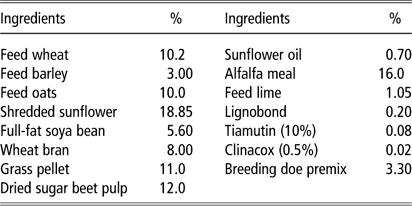
Two experiments were conducted at Kaposvár University with does and kits of Pannon Rabbit Breeding Program. Forty-nine-day reproduction rhythm and controlled nursing was applied till 16 days of age. According to Zarrow et al. (Reference Zarrow, Denenberg and Anderson1965) and Gidenne et al. (Reference Gidenne, Lebas and Fortun-Lamothe2010) suckling rabbits begin to leave the nest box and start to eat significant quantities of solid feed at around 16 to 18 days of age. The does were housed in flat deck cages (86×38×30 cm, included the nest box: 28.5×38 cm). The temperature varied between 20°C and 25°C. The daily lighting was 16 h (0700 to 2300 h). In experiment 1, the pregnant multiparous does (3rd to 5th parturition; BW: 4 to 4.5 kg; n=77) were randomly divided into two dietary groups at pregnancy diagnosis 11 days after artificial insemination. Half of the does received control diet (C) (Table 2) the other half received CT diet (C feed with 0.2 g powdered thyme supplementation/kg feed) ad libitum till weaning. Chemical composition of C feed: 11.3 MJ digestible energy/kg, 18.2% CP, 4.4% crude fat, 14.4% crude fibre and 6.7% ash. Cross-fostering within groups was applied after kindling. Newborn kits (n=734) were identified with ear tags. In order to examine the possible effect of thyme supplementation on the milk production of does per milk consumption of kits, maintaining of the litter size during the whole experiment was applied, died kits were replaced from extra litters (consuming the same diet). The litters of the two maternal dietary groups were randomly divided into three subgroups: no additional solid creep feeding (N), soya bean powder-based pellet (S) (soya bean powder : coconut oil : gelatine sheets in 5 : 1 : 0.06 weight ratio), S pellet supplemented with 1% added powdered thyme (ST). Chemical compositions of the supplemental creep feed are shown in Table 1. The main components of additional pellets are soya bean powder (protein source) and coconut oil (energy source). In groups S and ST, cylinder-shaped solid pellets (20-mm length and 8-mm of diameter; 3 g/piece) – made with baitmaker (Carp Expert Mega Bojliroller 8 mm®, Haldorado Centrum, Kiskunhalas, H-6400) – were scattered into the nest box near to the kits. The additional feeding lasted from the age of 3 till 15 days. Based on pre-experimental results, at the beginning of the experiment two pieces of pellets were placed on the top of the nest material after each nursing. Later on it was increased gradually to six pellets till 15 days of age (+one pieces averagely every 2nd day).
Composition of rabbit doe’s feed used in experiment 1 (additional feeding of kits with soya bean powder-based creep feed) and in experiment 2 (additional feeding of kits with piglet feed-based pellets)

In experiment 2, each doe received commercial diet ad libitum with the same composition as C diet in experiment 1. After kindling, the multiparous does (3rd to 5th parturition; BW: 4 to 4.5 kg) and litters were randomly divided into three groups (n=10 does/group, 9 kits/litter, cross-fostering within groups was applied, dead kits were not replaced). The kits in control group (K) did not receive additional pellets. In group PI, the kits were additionally fed with pellets made of piglet feed powder (Bonni-M Forte®; Sano, Modern Takarmányozás Kft., Csem, H-2949) : pellet adhesive : water in 4 : 0.03 : 1 weight ratio. The composition of pellet of the group PG is piglet feed powder : powdered glycerin : water in 4.2 : 0.7 : 1 weight ratio. Chemical compositions of the supplemental creep feed are shown in Table 1. The ball-shaped additional feed were made with a baitmaker, the size of the pellets (8 mm; 1 g/piece) were the size of the does’ faeces. The experiment lasted from the age of 3 till 21 days. Based on pre-experimental results, at the beginning (3 days of age) six pellets were inserted into the nest box after nursing. Later on, the amount was gradually increased to 24 pellets till 15 days of age (+two pieces every day from 3rd to 9th days of age; +two pieces every second day from 10th to 15th days of age). Kits did not have access to creep feed after 16 days of age. They had free access to the commercial rabbit feed outside of the nest box.
Measurements and analytical methods
In both experiments the pellet hardness was measured (10 pieces/group) at 18oC by using Zwick Roell/Z005 (ProLine table-top testing machine, 30152 Kennesaw, GA, USA). The speed of the cutting was 500 mm/min, and the thickness of the blade was 1 mm. Chemical compositions of the supplemental creep feed are shown in Table 1. Visual inspection was performed and video records were made in both experiments to observe the pellet intake of kits. In experiment 1, litter weights were measured at 2, 5, 9, 12 and 16 days of age before and immediately after nursing (before urination) to calculate the milk production. Individual BW of kits was measured at 3, 10 and 16 days of age, 1 h after nursing. Although in experiment 2, the BW of the kits before nursing, and the litter weight immediately after nursing (to calculate the milk production) were measured at 2, 5, 9, 12 and 16 days of age. At 19 and 21 days of the lactation the does had free access to the nest for nursing, and the kits’ weight was measured at 0800 h.
Statistical analysis
The differences in statistical methods used in experiment 1 and experiment 2 were due to the differences in experimental designs, differences in applied measurement methods and the lack of identification of kits in experiment 2. In experiment 1, data on pellet’s hardness were analysed by one-way ANOVA (Tukey’s test). Data of milk production were analysed according to GLM (PROC GLM) including diet of the does, diet of the kits, their interactions (diet of the doe×diet of the kits) as fixed effects. Data of individual BW were analysed according a mixed model (PROC MIXED) including diet of the does, diet of the kits, age, their interactions (diet of the doe×diet of the kits; diet of the doe×age of the kits; diet of the kits×age of the kits; diet of the doe×diet of the kits×age of the kits) as fixed effects, rabbit doe (diet of the does×diet of the kits) and kit (nested to rabbit doe) as random effect. In order to take into account the possible effect of heteroscedasticity unstructured variance-covariance structures were used. Data of individual weight gain in three periods were analysed (3 to 10 days, 10 to 16 days and 3 to 16 days) separately according to GLM (PROC GLM) including diet of the does, diet of the kits, their interaction (diet of the doe×diet of the kits) as fixed effects. The survival of the kits was analysed by likelihood ratio test.
In experiment 2, data on pellet’s hardness were analysed by one-way ANOVA (Tukey’s test). Data on milk production were analysed all together according to GLM (PROC GLM) including diet of the kits, day of lactation, their interaction (diet of the kits×day of lactation) as fixed effects. Data on average BW of kits in each litter were analysed separately according to GLM (PROC GLM) including diet of the kits as fixed effect, number of kits reared in the litter as covariate. Data on individual weight gain in the five periods (2 to 5 days, 5 to 9 days, 9 to 12 days, 12 to 16 days and 2 to 16 days) were analysed separately according to GLM (PROC GLM) including diet of the kits as fixed effect, number of kits reared in the litter as covariate. The survival of the kits was analysed by likelihood ratio test. All statistical analyses were performed using SAS 9.1. software package.
Results
The suckling kits consumed the additional solid feed in both experiments, which was visually observed (bitemarks and missing pieces of the additional pellets) daily (0900 h) and in some cases they were recorded by camera.
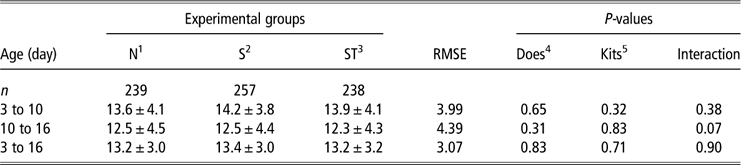
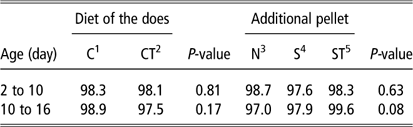
In experiment 1, the added thyme powder did not affect the hardness of the creep feed which was the same in groups S and ST (18.4±5.8 N). Milk production was only affected by the day of lactation (P<0.001) (overall milk production of group C: 238±33.9 g/day and group CT: 234±28.6 g/day). All other effects considered in the statistical analysis were not significant. No significant differences were observed in BW (P>0.05) and in BW gain of kits depending on the diet of the does, the diet of the kits and their interaction (Table 3). Neither the diet of the does nor the additional feeding of the kits affected the survival of suckling kits (Table 4).
Effect of the diet of rabbit does and diet of the kits on the weight gain (g/day) of suckling kits in experiment 1 (additional feeding of kits with soya bean powder-based pellet and with 1% powdered thyme supplementation)

1 N=Least-squares (LS)-means±SD of no pellet for kits.
2 S=LS-means±SD of soya bean powder-based pellet for kits.
3 ST=LS-means±SD of soya bean powder-based pellet with 1% added powdered thyme for kits.
4 Does=diet of does.
5 Kits=pellets of kits.
Survival of suckling rabbit kits (%) in experiment 1 (additional feeding of kits with soya bean powder-based pellet and with 1% powdered thyme supplementation)

1 C=control diet of does.
2 CT=C diet of does with added powdered thyme.
3 N=no additional pellet for kits.
4 S=soya bean powder-based pellet for kits.
5 ST=soya bean powder-based pellet with 1% added powdered thyme for kits.
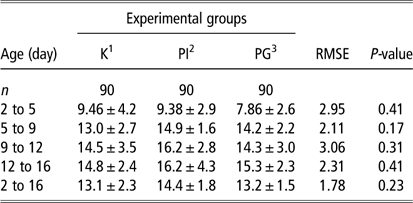
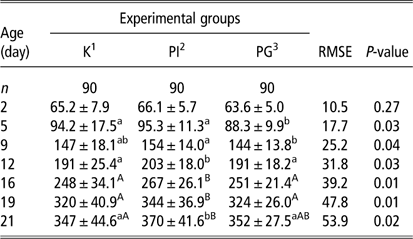
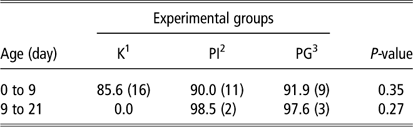
In experiment 2, the hardness value of PI pellets (5.9±0.9 N) was significantly different (P<0.001) from that of PG pellets (12.2±2.1 N). The additional feeding did not affect the milk production of does (P>0.05) (overall milk production of group K: 232±55.6 g/day, group PI: 231±50.9 g/day and group PG: 239±47.7 g/day). All other effects considered in the statistical analysis were not significant. The additional feeding did not affect the weight gain of the kits (Table 5). Despite of the moderately higher weight gains of the PI kits, the differences were not statistically proved. There was a difference in BW at age of 5 days in favour of groups K and PI (P<0.05). At 9 days of age the difference was refined, and at 12 days of age group PI differed (higher BW) from group PG and even group K (P<0.05). Later on the differences increased, and at 16 and 19 days of age group PI showed higher BWs compared with the other groups (P<0.01). At 21 days of age the BW was still significantly higher in favour of the group PI (K, P<0.01; PG, P<0.05) (Table 6). The additional feeding did not affect the survival of kits (Table 7).
Effect of piglet feed-based creep feed of rabbit kits on the weight gain (g/day) of suckling kits in experiment 2 (additional feeding of kits with piglet feed-based pellets and with glycerin supplementation)

1 K=LS-means±SD of no additional pellet for kits.
2 PI=LS-means±SD of piglet feed-based pellet for kits.
3 PG=LS-means±SD of piglet feed-based pellet with glycerin supplementation for kits.
Effect of piglet feed-based creep feed of rabbit kits on the BW (g) of suckling kits in experiment 2 (additional feeding of kits with piglet feed-based pellets and with glycerin supplementation)

1 K-=LS-means±SD of no additional pellet for kits.
2 PI=LS-means±SD of piglet feed-based pellet for kits.
3 PG=LS-means±SD of piglet feed-based pellet with glycerin supplementation for kits.
a,bValues within a row with different superscripts differ significantly at P<0.05.
ABValues within a row with different superscripts differ significantly at P<0.01.
Survival of suckling rabbit kits (%; number of dead kits in brackets) in experiment 2 (additional feeding of suckling rabbits with piglet feed-based pellets and with glycerin supplementation)

1 K=no additional pellet for kits.
2 PI=Piglet feed-based pellet for kits.
3 PG=piglet feed-based pellet with glycerin supplementation for kits.
Discussion
In our experiments an original method was used for additional feeding of suckling kits. The sources of the idea using solid feed were based on the experiments of Kovács et al. (Reference Kovács, Szendrő, Milisits, Biró-Németh, Radnai, Pósa, Bónai, Kovács and Horn2006) and Combes et al. (Reference Combes, Gidenne, Cauquil, Bouchez and Fortun-Lamothe2014), where they described the consumption of maternal faecal pellets as solid material by the kits.
Visual observation and videotapes prove, that the kits consumed from the pellets. Suckling kits are mostly covered with the mixture of hair and nest material during the day, evaluation and comparison of videotapes is not possible. The amount of consumed feed could not be measured due to the consistency of the creep feed (evaporation and water-binding capacity) and their disappearance in the nest material. The difference in hardness could be caused by the different substitution of the materials (glycerin was added in powder form/not cream/and functioned as pellet adhesive), but the exact reason is unknown.
At the beginning of the experiment 1, the amount of pellet was 6 g/day per litter, which equals 3% of the milk consumption/litter. Due to the increasement it was 6.9% at 12 days of age. As an additional feeding the pellet : consumed milk ratio seemed optimal, however, the kits did not consume all of the pieces. By adding thyme powder to the creep feed we could not prove the positive effect of thyme supplementation (odour/flavour) on feed preference of kits as it was observed by Altbäcker et al. (Reference Altbäcker, Hudson and Bilkó1995). In that study pregnant does were fed with dried thyme (10% of daily diet). After weaning the kits had free access to three different feed supplementation (lab chow, juniper berries, dried thyme) and showed a statistically proved preference of dried thyme (58%). The survival of the kits was not affected by the thyme supplementation of does’ diet or any of the applied creep feed. In experiment 2, at the 2nd day of lactation 6 g of creep feed was placed into the nest/day, which equals 3.5% of the milk consumption/litter and at 12 days of age, it was 9%. Compared with the first experiment the creep feed : milk consumption ratio was higher, but in this case, the kits consumed most of the pieces. The reason is still been searched for, however, it seemed, that the preference of the additional feed depends on the components of pellet. The hardness of the additional pellet of suckling kits’ were not comparable with other creep feed of young rabbit due to the lack of researches, thus our results are considered as reference data. The group of the piglet feed-based pellet (PI) had higher BW compared with K and PG groups at age of 5, 9, 12, 16, 19 and 21 days (P<0.05). The difference could be caused by the different composition (glycerin) or the different consistency of the creep feed, however, the hardness could be changed in the nest because of the higher temperature in it. The positive effect of the piglet feed powder may be attributed to its highly digestible protein content, which is free from harmful anti-nutritive substances, the high nitrogen-free extract content, which was partly lactose and partly starch. The soya bean powder-based supplementation was less effective in spite of the high CP and crude fat content, which was presumably less digestible to the kits compared with the piglet feed powder. The survival of the kits was not affected by the applied creep feeds in experiment 2.
Conclusions
Suckling kits were able to consume additional solid feed made of soya bean powder and piglet feed. There were no differences in milk production, weight gain, survival rate of kits fed or not with pellet. In case of piglet feed-based pellet for kits a clear interaction was observed between the age and the diet of the suckling kits, which indicates a difference in BW in favour of the piglet feed-based group mostly at all observed age (P<0.05). To find a practical method, further studies (involving larger number of does and kits) are needed to examine other components and techniques to improve the additional feed intake and growth of the kits. Our results highlight the importance of investigating changes in the activity of the different digestive enzymes and also the digestibility of the supplementations in suckling rabbits.
Acknowledgements
Supported through the New National Excellence Program of the Ministry of Human Capacities. The authors would like to thank the colleges of the Department of Nutritional Science and Production Technology of Kaposvár University for their help and support.