Introduction
Parasitism caused by Haemonchus contortus and other gastrointestinal nematodes (GIN) is responsible for significant economic losses in the production of grazing sheep due to stunted growth, mortality and the expense of anthelmintic treatments for their control. However, the great genetic diversity of these parasites has allowed them to develop resistance to anthelmintics through mutations established in the population, causing the phenomenon of anthelmintic resistance (AR) (Hodgkinson et al., Reference Hodgkinson, Kaplan and Kenyon2019). Given this scenario, one alternative to avoid AR is the breeding of animals selected for their high resistance or low susceptibility to GIN. Genetic resistance to GIN has a heritability between 0.2 and 0.4 (Sréter et al., Reference Sréter, Kassai and Takács1994). It represents the genetic capacity of the immune response to infections and produces in each generation a segregation of low- and high-resistant lambs with different abilities to develop the parasitic infection (Emery et al., Reference Emery, Hunt and Le Jambre2016). This resistance to GIN is an individual characteristic that depends mainly with age and previous exposure to the parasite, which allows the animal to express innate immunity and develop acquired immunity that protects the host from infection (Greer & Hamie, Reference Greer and Hamie2016). The selection of individuals for their GIN resistance results in a reduction in the number of eggs in the environment, resulting in a decrease in the pasture – the source of parasitic infection (Sweeney et al., Reference Sweeney, Hanrahan, Ryan and Good2016). The feasibility of selecting sheep resistant to GIN has been widely demonstrated in various breeds and environments (Woolaston et al., Reference Woolaston, Barger and Piper1990; Zvinorova et al., Reference Zvinorova, Halimani, Muchadeyi, Matika, Riggio and Dzama2016; Moreno et al., Reference Moreno, Sallé and Jacquiet2017). In commercial flocks and experimental stations, GIN-resistant individuals have been selected using phenotypic markers such as faecal egg count (FEC) to assess resistance status and packed cell volume (PCV) as a measure of natural infection impact. Some breeds of hair sheep have been shown to have developed natural resistance to GIN infections, such as Blackbelly, St Croix, Florida Native, Gulf Cost Native, Thin Tail, Garole and Red Masai (Miller & Horohov, Reference Miller and Horohov2006; Shakya et al., Reference Shakya, Miller and Horohov2009; Saddiqi et al., Reference Saddiqi, Iqbal, Khan and Muhammad2010; Karrow et al., Reference Karrow, Goliboski, Stonos, Schenkel and Peregrine2014). In these breeds, a genetic variation of resistance to H. contortus has also been confirmed; therefore, the selection of resistant (RES) individuals represents an option for the control of parasitic infections in tropical and subtropical environments where high prevalence of AR is reported (Torres-Acosta et al., Reference Torres-Acosta, Mendoza-de-Gives, Aguilar-Caballero and Cuéllar-Ordaz2012). In Mexico, the Pelibuey breed has been reported to have resistance to GIN, with significant variations within the breed (Morteo-Gómez et al., Reference Morteo-Gómez, González-Garduño, Torres-Hernández, Nuncio-Ochoa, Becerril-Pérez, Gallegos-Sánchez and Aranda-Ibañez2004; Castillo et al., Reference Castillo, Medina, Villalobos, Gayosso-Vázquez, Ulloa-Arvízu, Rodríguez, Ramírez and Morales2011; González-Garduño et al., Reference González-Garduño, Gives and Torres-Hernández2013; Zaragoza-Vera et al., Reference Zaragoza-Vera, Aguilar-Caballero, González-Garduño, Arjona-Jiménez, Zaragoza-Vera, Torres-Acosta, Medina-Reynés and Berumen-Alatorre2019), which makes it a candidate for selection to genetically improve this trait in this breed. In order to select RES individuals, it is necessary to generate the infection and to monitor the development of the corresponding immunity. With many variants, oral challenge of lambs with infective larvae (L3) and their subsequent challenge with either artificial or natural infection is the most widely used protocol (Saccareau et al., Reference Saccareau, Sallé, Robert-Granié, Duchemin, Jacquiet, Blanchard, Cabaret and Moreno2017), where the level of antigenic stimulus is an important event in the speed of acquisition of acquired immunity. In a previous study, it is reported that in Pelibuey lambs initially infected orally with 7500 L3 of H. contortus, it was possible to successfully segregate RES and susceptible (SUS) individuals at the end of that infection according to their average FEC (Ojeda-Robertos et al., Reference Ojeda-Robertos, Torres-Acosta, González-Garduño and Notter2017).
The objective of the present study was to determine the impact on FEC due to the natural resistance presented by Pelibuey lambs segregated as RES, SUS and intermediate (INT) during two consecutive infections with GIN.
Materials and methods
Location of area of study
The study was conducted from February 4 to June 10, 2017, in the municipality of Salto de Agua, Chiapas, Mexico, which has a humid tropical climate (Kottek et al., Reference Kottek, Grieser, Beck, Rudolf and Rubel2006); the average annual temperature there is 26.6°C and the precipitation is 3298 mm (CONAGUA, 2019).
Animal handling
The procedures were carried out in accordance with the normative terms of the ‘Regulations for the use and care of animals intended for research in the Postgraduate College’, approved by the General Academic Council (CGA) on November 18, 2016.
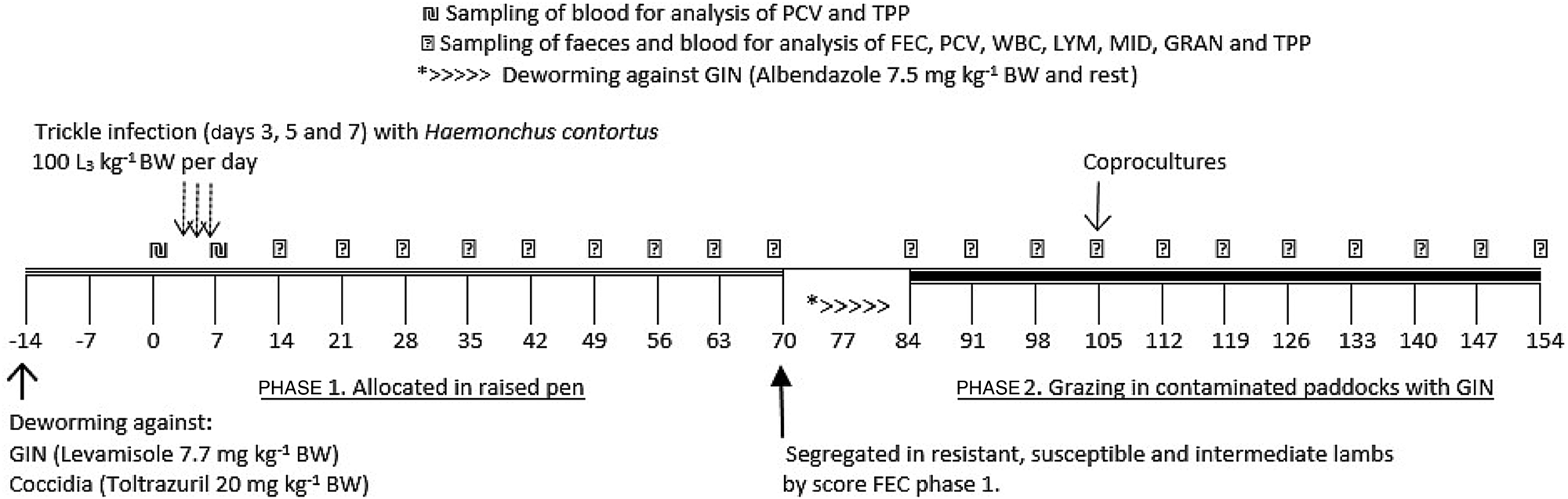
From a group of 140 Pelibuey lambs born subsequent to a 30-day breeding season at the Centre for Training and Reproduction of Minor Species (CECAREM) in Villahermosa, Tabasco, Mexico, 29 lambs were acquired after weaning. The age difference between them did not exceed 30 days. The lambs during lactation remained housed until weaning, which occurred after 60 days, so they did not present infection with GIN, which was confirmed with a coproparasitoscopic examination. The lambs were identified with a numbered collar and kept in elevated floor cages to keep them free of GIN infection. When they were approximately five months old (14 days before the start of the experiment) they were dewormed (levamisole 7.7 mg kg–1 body weight (BW)) and treated for coccidia (toltrazuril 20 mg kg–1 BW). The study consisted of two phases: Phase 1 (day 0–day 70) and Phase 2 (day 84–day 154). In Phase 1 the lambs remained in the elevated-floor cages, where they received ad libitum an integral balanced food with 14% crude protein and water. At the end of Phase 1 (day 70) the lambs were dewormed (albendazole 10 mg kg–1 BW) and kept in the cages until the beginning of Phase 2 (day 84), at which time they were introduced to grasslands of African star grass (Cynodon plectostachyus). They grazed approximately ten hours per day, and were housed in a galley in the afternoon where they received a dietary supplement with 14% crude protein at a rate of 300 g day−1.
Artificial and natural infection
L3 were obtained by coproculture (Corticelli & Lai, Reference Corticelli and Lai1963) from two donor lambs previously infected with an oral dose of 300 L3 from a local strain of H. contortus. The 29 lambs were trickle infected on days three, five and seven orally with 100 L3 of H. contortus per kg BW, receiving, in total, approximately 6000 L3 per lamb. The natural infection (Phase 2) began on day 84 when the lambs were withdrawn from the cages and placed in grassland of C. plectostachyus that was being used by a herd of Blackbelly sheep infected with GIN kept in the meadows.
Measurements
Eleven measurements were made in each phase (fig. 1): each week, faecal samples were taken directly from the rectum of the lambs and blood from the jugular vein, using vacuum tubes containing ethylene diamine tetra acetate (EDTA) as anticoagulant (Vacutainer, Becton Dickinson, USA). All samples were processed in the Animal Parasitology Laboratory of the South-East University Regional Unit (URUSSE) of the Chapingo Autonomous University (UACh) in Teapa, Tabasco, Mexico.
Experimental design for gastrointestinal nematode resistant, susceptible and intermediate Pelibuey lambs under artificial Haemonchus contortus infection and natural pasture infection.

Parasitology
The FEC was determined in faeces by the McMaster method (Thienpont et al., Reference Thienpont, Rochette and Vanparijs2003) with sensitivity of 50 eggs per gram of faeces (EPG). In Phase 1, the presence of H. contortus was confirmed by L3 obtained by coprocultures, while the identification of GIN L3 genera during grazing (Phase 2) was performed according to available keys (van Wyk & Mayhew, Reference van Wyk and Mayhew2013) after coproculture according to the methodology described by Corticelli & Lai (Reference Corticelli and Lai1963) of faecal samples on day 105.
Haematology
The PCV, total white blood cell count (WBC) and the differential count of three leukocyte fractions, consisting of lymphocytes (LYM), basophils, monocytes and eosinophils (MID) and neutrophils (GRAN), were determined by an automated haematological analyser based on electronic impedance (Medonic CA-620, Boule Medical AB, Stockholm, Sweden). Total plasma protein (TPP) was quantified by a manual refractometer (Atago, Tokio, Japan).
Lamb segregation model
At the end of Phase 1, the lambs were segregated into three groups based on the FEC results: RES lambs selected from mean EPG – three times the standard error; SUS from mean EPG + three times the EE; and INT, formed by the lambs not included in the other groups (Morteo-Gómez et al., Reference Morteo-Gómez, González-Garduño, Torres-Hernández, Nuncio-Ochoa, Becerril-Pérez, Gallegos-Sánchez and Aranda-Ibañez2004). According to the segregation model, the RES group was composed of nine lambs, the SUS group of six and the INT group of 14.
Equation to calculate FEC reduction
In Phase 1, the maximum value of FEC (FECmax) was recorded together with the day this value occurred by each lamb. With the FECmax as a reference value, the reduction of the FEC was determined at the end of Phase 1 and at the end of Phase 2. The following formula was used for each lamb:

where FECx is the FEC at the end of Phase 1 (x = 1, day 70) and at the end of Phase 2 (x = 2, day 154).
Statistical analysis
Data were analysed between groups of segregated lambs such as RES, SUS and INT with a model of repeated measures over time using the MIXED procedure of the statistical package, and the means were compared by the Tukey test (SAS, 2004). To eliminate asymmetry and to approximate the data to a normal distribution, the EPG values were transformed (log EPG + 1). The following model was used:

where Yijkl = variable response (EPG, PCV, WBC, LYM, MID, GRAN and TPP); μ = general mean; ρi = fixed effect of the type of animal (i = RES, SUS, INT); ζj = fixed effect of the phase (j = 1, 2); γk(i) = random effect of lambs nested in the type of lamb, δ(ζ) jl = fixed effect of the sampling day nested in phase; ρ*ζij = interaction of type of animal with phase; ρ*δ(ζ)ijl = interaction of the type of animal with the sampling day nested in phase; and ɛijkl = random error associated with the l-th repeated measurement in the k-th lamb.
Results
Parasitology
FEC
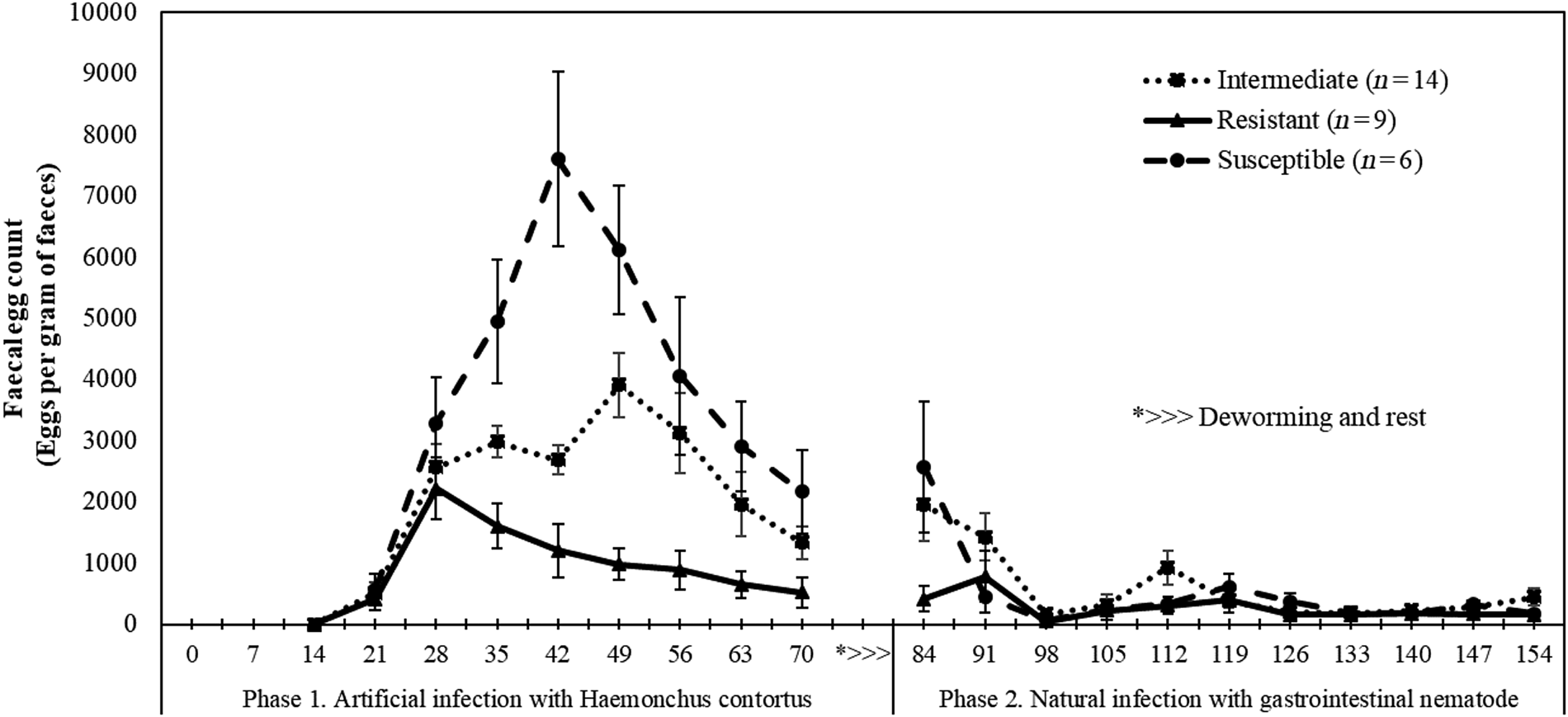
During Phase 1, the RES lambs presented the lowest FEC (1061 ± 1053 EPG) with respect to the other groups (P < 0.05), but the INT and SUS (INT: 2385 ± 1794; and SUS: 3958 ± 3037) were no different (P > 0.05). However, in Phase 2, no significant differences (p > 0.05) were observed between the groups of lambs (RES: 275 ± 498; SUS: 504 ± 1036; and INT: 603 ± 1061). Figure 2 shows the dynamics of the FEC in the two phases of infection. It is noteworthy that the FEC reduction started from day 28 in the RES group, two weeks before the SUS group (day 42) and three weeks before the INT group (day 49). During Phase 2, the anthelmintic was not effective and, therefore, the FEC remained high until day 91 and subsequently decreased 14 days after grazing began.
Faecal egg count (least squares means ± standard error) for gastrointestinal nematode resistant, susceptible and intermediate Pelibuey lambs under artificial Haemonchus contortus infection and natural pasture infection.

FEC reduction
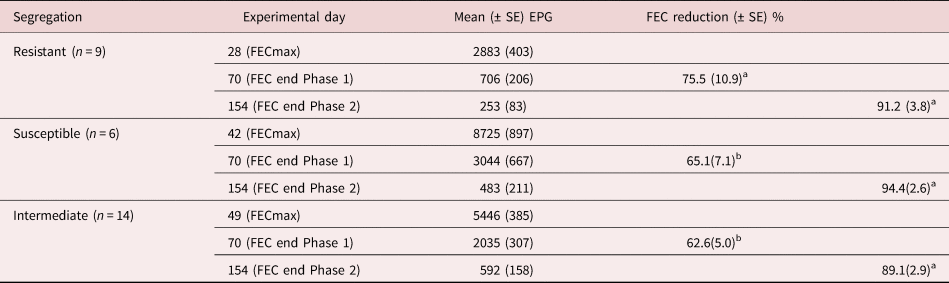
Significant differences (p < 0.05) were observed in the FECmax between the segregated lambs in Phase 1, being 2883 EPG for the RES lambs on day 28, 8725 EPG for SUS lambs on day 42 and 5446 EPG for INT lambs on day 49. Table 1 shows the percentage reduction in FEC from the FECmax at the end of Phase 1 (day 70) and Phase 2 (day 154).
Faecal egg count (FEC) and FEC reduction with respect to the maximum FEC (FECmax) exhibited during artificial infection (Phase 1) and natural infection (Phase 2) in Pelibuey lambs segregated into resistant, susceptible and intermediate groups in each infection phase.

a,bDifferent letters in the same column indicate significant differences (p < 0.05). SE, standard error; EPG, eggs per gram of faeces.
Significant differences were found in the reduction in FEC at the end of Phase 1 (p < 0.05), where the FEC of RES lambs was reduced by 75.5%, compared to 65.1% for SUS and 62.6% for INT lambs. No significant differences (p > 0.05) were found in the reduction in FEC at the end of Phase 2; the reduction in FEC as a response to acquired resistance provoked the highest reduction value in all groups of lambs.
Coprocultures
The GIN genera found in the coprocultures in the grazing period (day 105) were Haemonchus (72.0%), Trichostrongylus (13.8%), Cooperia (12.3%) and Oesophagostomum (1.9%).
Haematology
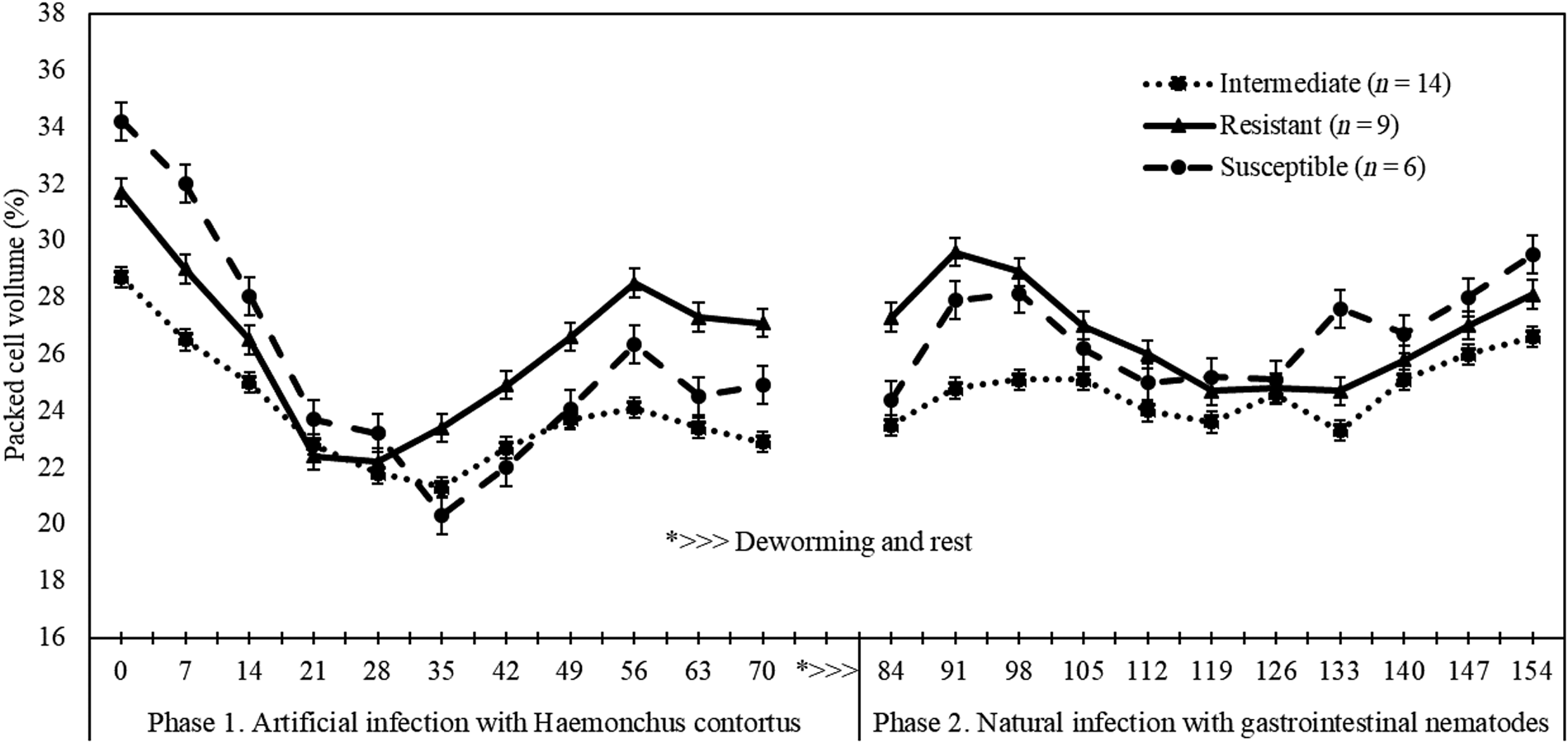
The RES group presented the highest values (p < 0.05) of PCV with 26.2 ± 4.0% in Phase 1 compared to the other groups (SUS 25.1 ± 4.8%; and INT 23.6 ± 3.6%). In Phase 2, significant differences were observed (p < 0.05) where the RES (27.0 ± 3.0%) and SUS lambs (26.7 ± 3.2%) presented higher values than the INT group (24.6 ± 3.4%).
Figure 3 shows the changes in the PCV of segregated SUS, RES and INT lambs in the two phases of infection. In Phase 1, the decrease in PCV in all groups of lambs was evident from infection with the hematophagous parasite H. contortus. However, RES lambs showed their lowest PCV value on day 21 (two weeks post-infection) with 22.0%. The lowest PCV values for SUS and INT lambs were recorded on day 35 (four weeks post-infection) with 20.0% and 21.3%, respectively. Subsequently, the PCV values increased in all groups until day 91. After the natural infection, there was a slight gradual decrease until day 126 and, again, a recovery until the end of Phase 2.
Blood packed cell volume (least squares means ± standard error) for gastrointestinal nematode resistant, susceptible and intermediate Pelibuey lambs under artificial infection and natural pasture infection.

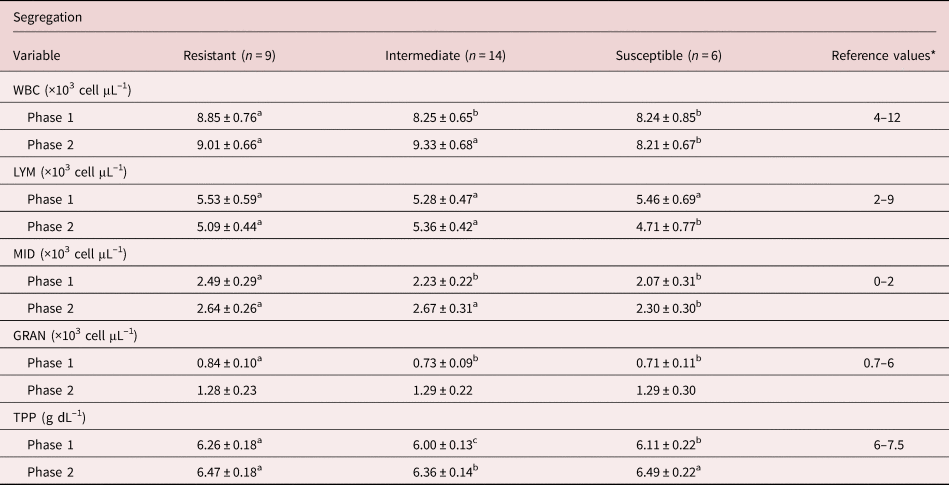
In Phase 1, the RES lambs showed the highest values (p < 0.05) for WBC, LYM, MID, GRAN and TPP. In Phase 2, the highest values (p < 0.05) for WBC, LYM, MID and GRAN were for INT lambs, and RES and SUS lambs presented higher TPP values (p < 0.05) than those of the INT group (table 2).
Means (± standard error) of haematological values in Pelibuey lambs that are resistant, susceptible and intermediate to gastrointestinal nematode infection.

a,b Different letters in the same row indicate significant differences (p < 0.05). *Byers & Kramer (Reference Byers, Kramer, Weiss and Wardrop2010). WBC, blood cell count; LYM, lymphocytes; MID, medium cells (monocytes; basophils and eosinophils); GRAN, neutrophils; TPP, total plasma protein.
Discussion
Phase 1
In Phase 1, artificial infection with L3 of H. contortus over four weeks allowed the RES lambs to demonstrate their ability to control the establishment of this parasite in the abomasum by mounting a rapid immune response, which was reflected in the lowest FEC values (Stear et al., Reference Stear, Strain and Bishop1999), compared to the INT and SUS lambs. In addition, the FECmax in the RES group occurred two weeks before the other lambs (28 days post-infection).
The high FEC during the GIN infection of Phase 1 has also long been observed in wool breeds (Stear et al., Reference Stear, Bairden, Duncan and Murray1995) and it has been indicated that after the prepatent period (without the expulsion of nematode eggs), a peak occurs in the FEC around 6–8 weeks post-infection. However, in hair breeds the FEC peak occurs around the fourth week post-infection, as observed in the present study and as reported in an artificial infection with 10,000 L3 of H. contortus in the crossbred Barbados Blackbell and Virgin Islands White sheep (Notter et al., Reference Notter, Andrew and Zajac2003) and St Croix lambs (Jacobs et al., Reference Jacobs, Greiner and Bowdridge2015). However, in this study a different response was observed, and only the RES lambs showed a peak at four weeks, while the SUS and INT lambs showed a FEC peak at the sixth week, reflecting a late response, similar to that observed in wool sheep. In a previous study with Pelibuey sheep, FEC peaks were also affected by the dose used in the artificial infection. The FEC peak was observed at 35 days when the animals had resistance against GIN, while other groups showed the FEC peak on days 42 and 56, which was observed in SUS animals (González-Garduño et al., Reference González Garduño, López-Arellano, Torres-Hernández, Oliva-Hernández and Hinojosa-Cuéllar2019).
The percentage of FEC reduction in RES lambs at the end of the artificial infection was 75.5% with a 706 EPG, while the other two groups (SUS and INT) reached the end of Phase 1 with FECs more than three times that of the RES lambs (3044 and 2035, respectively). However, the percentage reductions in FEC measured as the difference from FECmax were similar (65.1% and 57.6%, respectively) between the INT and SUS groups (P > 0.05). This indicates that these lambs had the same capacity to mount an immune response. The differences observed were from the day in which the peak of infection was observed, attributed to immune reaction in the host, and in the value of the FEC.
There is a report of St Croix lambs being re-infected with 10,000 L3 of H. contortus that indicates the development of an acquired immune response on day seven post-infection by presenting high levels of LYM, production of immunoglobulin A and the infiltration of immune cells into the mucosa of the abomasum (Bowdridge et al., Reference Bowdridge, Zajac and Notter2015). After an earlier infection, the immune response may limit the establishment of adult parasites and induce morphological changes that reduce their fertility and, therefore, shorten the duration and severity of the infection (Bowdridge et al., Reference Bowdridge, Zajac and Notter2015; McRae et al., Reference McRae, Stear, Good and Keane2015).
During Phase 1, higher cell counts of WBC, MID and GRAN were observed in RES lambs compared to the other two groups. This supports what has been observed in the immune response of mammals to infection with helminths, which is characterized by an increase in cellular immune responses such as in eosinophils, basophils, cell mast cells and macrophages in response to tissue damage. These immune cells respond, in turn, with an increase in cytokine production (Karrow et al., Reference Karrow, Goliboski, Stonos, Schenkel and Peregrine2014). The rapid response of RES lambs may be due to an early increase in circulating CD4+ T LYM in response to the infiltration of H. contortus larvae into the abomasum. This release and excretion/secretion of products induces a combination of humoral immunity, eosinophilia and mast cell hyperplasia that leads to changes in the abomasum mucosa causing expulsion of L3 and length reduction of L4, which may be related to the decrease in fertility in the adult stage (Karanu et al., Reference Karanu, McGuire, Davis, Besser and Jasmer1997; Bowdridge et al., Reference Bowdridge, Zajac and Notter2015). This early response to primary infection is genetically controlled and has been reported for RES sheep breeds in gene expression studies related to T LYM proliferation (Terefe et al., Reference Terefe, Lacroux and Andreoletti2007; Yang et al., Reference Yang, Zhou, Chen, Yan, Guo, Zhang and Du2015) with complementary activation. Both are the first events in the host's immune responses to infection (Lee et al., Reference Lee, Munyard, Gregg, Wetherall, Stear and Groth2011; Valilou et al., Reference Valilou, Rafat, Notter, Shojda, Moghaddam and Nematollahi2015; Guo et al., Reference Guo, González, Hernandez, McNelly, Corripio-Miyar, Frew, Morrison, Yu and Li2016). The same response occurs in the SUS and INT lambs, but at a later day, which results in the establishment of a greater number of adult parasites and, of course, a higher FEC.
The reduction in PCV associated with increasing FEC after infection with H. contortus is a reflection of infection with this parasite, whose hematophagous feeding habits directly affect the health of animals by reducing PCV; this negative relationship is reported in numerous studies (MacKinnon et al., Reference MacKinnon, Zajac, Kooyman and Notter2010; Castillo et al., Reference Castillo, Medina, Villalobos, Gayosso-Vázquez, Ulloa-Arvízu, Rodríguez, Ramírez and Morales2011). RES lambs showed the highest PCV values during Phase 1, which agrees with other studies, where higher levels of PCV have been found in RES compared to SUS sheep when infected with H. contortus (Mugambi et al., Reference Mugambi, Bain, Wanyangu, Ihiga, Duncan, Murray and Stear1997; Shakya et al., Reference Shakya, Miller and Horohov2009).
The TPP values of the SUS and INT lambs were significantly lower than those of the RES lambs. Decreased values of TPP in the SUS and INT lambs could be an important indicator because this reduction in TPP has been reported in sheep with clinical conditions such as hypoproteinaemia, diarrhoea, lack of appetite and malnutrition after infection with H. contortus, so this parameter might be considered for selecting animals with greater resistance to GIN (Zaros et al., Reference Zaros, Neves, Benvenuti, Navarro, Sider, Coutinho and Vieira2014).
Phase 2
At the beginning of Phase 2 (day 84), FEC were similar to day 70 of Phase 1, indicating that the anthelmintic was not effective. Thus, a second true prepatent period may not have occurred. The FEC reduction in Phase 2 may have been a continued response carried out from Phase 1 or could be attributed to an acquired immunological development by lambs leading to a FEC of almost 0. This latter explanation has occurred in RES breeds (Zaragoza-Vera et al., Reference Zaragoza-Vera, Aguilar-Caballero, González-Garduño, Arjona-Jiménez, Zaragoza-Vera, Torres-Acosta, Medina-Reynés and Berumen-Alatorre2019). In response to the continued infection, the development of acquired immunity was seen. The FEC reduction in Phase 2 was similar among resistance classifications of lambs (RES = 91.2%; SUS = 94.4%; and INT = 89.1%) with respect to the maximum value recorded in Phase 1.
A strong acquired immune response would not allow a new infection to establish. The specific acquired immunity mechanism is characterized by an increase in TH2 cytokines, the recruitment of eosinophils, mast cells and globular leukocytes, and an increase in the production of specific IgA (Balic et al., Reference Balic, Bowles and Meeusen2002; Shakya et al., Reference Shakya, Miller and Horohov2009; Jacobs, Reference Jacobs2013). This immune response intervenes in mechanisms to control the number of parasites either by reducing the establishment of larvae, inducing hypobiosis, stunting morphology or decreasing the fecundity of adult nematodes (Rowe et al., Reference Rowe, McMaster, Emery and Sangster2008; Ortolani et al., Reference Ortolani, do Rego Leal, Minervino, Aires, Coop, Jackson and Suttle2013).
Other studies indicate a reduction in FEC (Eady et al., Reference Eady, Woolaston and Barger2003) by acquired immunity, but also depend on the degree of acquired response (González-Garduño et al., Reference González Garduño, López-Arellano, Torres-Hernández, Oliva-Hernández and Hinojosa-Cuéllar2019). This represents an important alternative, especially when the nematodes in the flocks show AR, when the persistence of infection can be very long and the lambs have insufficient immune stimulation to achieve self-cure (González-Garduño et al., Reference González-Garduño, López-Arellano, Mendoza-De-Gives, Ojeda-Robertos and Chay-Canul2016).
Acquired resistance has been characterized by a local and blood eosinophilia response, as well as an increase in T cells (CR+ γδ) in the first three days after challenge (Robinson et al., Reference Robinson, PIedrafita, Snibson, Harrison and Meeusen2010). In addition, a very rapid increase in CD4+ T cells occurs. All subpopulations of LYM and tissue and blood eosinophils are reduced on day seven, and subsequently increase at 28 days post-infection, suggesting a different immune response against larvae and adults (Robinson et al., Reference Robinson, PIedrafita, Snibson, Harrison and Meeusen2010).
During Phase 2, all groups of lambs showed similarities in cell values, PCV and TPP. At the same time that FEC was reduced, improvement in the haematological value was observed, keeping the average within the normal values for the breed (Byers & Kramer, Reference Byers, Kramer, Weiss and Wardrop2010).
Conclusion
An artificial trickle infection of Pelibuey lambs with a dose of 6000 L3 of H. contortus induced a rapid immune response in the most RES animals, which could be identified and selected to develop a flock genetically resistant to GIN in the future.
Acknowledgements
The author Alvar Alonzo Cruz-Tamayo is a PhD student of the Program of Genetic Resources and Productivity – Livestock at the Graduate College (RGP-COLPOS), and thanks the Professional Teacher Development Program for the scholarship (PRODEP-DSA/103.5/16/5957 UNACAM-118).
Financial support
This work was supported by the Academic Body Strengthening Program (PRODEP-DSA/103.5/15/14473).
Conflicts of interest
None.
Ethical standards
The procedures were carried out in accordance with the normative terms of the ‘Regulations for the use and care of animals intended for research in the Postgraduate College’, approved by the CGA on November 18, 2016, in which the Mexican Official Laws, Regulations and Standards and other legal provisions are considered.