It is commonly accepted that Old English (OE), a West Germanic language, is the immediate ancestor of Middle English (ME), which, in turn, is the immediate ancestor of Modern English (ModE). However, Emonds and Faarlund (Reference Emonds and Faarlund2014) have made the bold claim that ME is directly descended from Old Norse (ON) rather than OE. We call this claim the ‘Viking Hypothesis.’ Emonds and Faarlund's evidence is mainly morphosyntactic in nature: they examined a wide range of syntactic characteristics and claimed that the historic evidence shows that ME patterns syntactically with North Germanic languages (both historic and modern) rather than with West Germanic languages; in particular, that ME does not pattern with OE. According to Emonds and Faarlund, the many syntactic innovations of ME are not innovations at all if ME is descended from ON rather than OE. Their conclusion was that ME evolved directly from ON and that OE simply died out after the Norman Conquest. In other words, ME and ModE are North Germanic rather than West Germanic languages.
The response to Emonds and Faarlund and the Viking Hypothesis was immediate and, for the most part, strongly critical. Nevertheless, Bech and Walkden (Reference Bech and Walkden2016:66) noted that “The proposal, like any other, should be evaluated based on the evidence and argumentation provided.” Similarly, Lightfoot (Reference Lightfoot2016:476) stated that, “Their hypothesis is intrinsically interesting and is certainly an empirical claim. Consequently, it will stimulate productive research as scholars seek to build on what [Emonds and Faarlund] have done or to refute the basic claim.” Arguing that Emonds and Faarlund often misinterpreted the literature and the data, and using empirical evidence that, for the most part, has already been published, the responses to Emonds and Faarlund in Barnes (Reference Barnes2016), Bech and Walkden (Reference Bech and Walkden2016), Stenbrenden (Reference Stenbrenden2016), and the various contributions to the 2016 special issue (6.1) of Language Dynamics and Change (by Font-Santiago and Salmons, van Gelderen, Holmberg, van Kemenade, Kortmann, Los, McWhorter, Thomason, Trudgill), collectively demonstrated that the evidence presented by Emonds and Faarlund fails to support the claim that ME descends from ON.
This paper is to be understood as a test of Emonds and Faarlund's hypothesis on their own grounds rather than as a review of their work. Thus, for example, we do not discuss their basic tenet that syntax is not easily borrowed (Reference Emonds and Faarlund2014:60–61). We posit that to refute the Viking Hypothesis on empirical grounds, it is not sufficient to show that Emonds and Faarlund's descriptions and analyses of OE syntax are incorrect and/or misinterpreted: in many cases, as in the much-discussed change from OV to VO order, this simply means that the syntactic property appears in both OE and ON, and, thus, either language could be the ancestor of ME. Instead, the focus should be on the syntactic properties of ME that are continuations of those in OE but different from those of the dialect of ON spoken in England before the Norman Conquest; this is the only evidence that can falsify the Viking Hypothesis.
We find that noun phrase syntax provides precisely such evidence, because it demonstrates continuity from OE to ME in various distinct areas, all of which have analogous trajectories of change in some old Nordic languages, but, crucially, not at the relevant time.
BACKGROUND: POLITICAL AND LINGUISTIC HISTORY
According to the Anglo-Saxon Chronicle, the Danish invasions of England began in 787, and, for more than two centuries, there were periods of military confrontations (attacks, plundering, battles, with victories on both sides) but also peaceful meetings and agreements (pledges, oaths, treaties). In 1016, King Cnut became king of all of England, and the land was divided between the Danes (King Cnut in the north, in the area that became known as the Danelaw) and the English (King Edmund in Wessex). This situation ended with the Norman Conquest in 1066. According to Townend (Reference Townend2002:2), the Scandinavians and the Anglo-Saxons before the Norman Conquest were not separated geographically, particularly in the Danelaw. He contends that the Anglo-Saxon-Scandinavian communities were bilingual, even though individual speakers were not. In other words, while there were no (or very few) bilingual speakers, the two languages were mutually intelligible. This view is supported, at least to some extent, by many other scholars (e.g., Björkman, Reference Björkman1900–02; Blake, Reference Blake and Blake1992; Fellows-Jensen, Reference Fellows-Jensen1975; Hogg, Reference Hogg and Hogg1992; Jespersen, Reference Jespersen1956; Strang, Reference Strang1970; Warner, Reference Warner2017:337–339). Various types of evidence are provided for Townend's claim, of which we present two here: first, Townend (Reference Townend2002:4–9) described situations, documented in extant texts from the period, that require mutual intelligibility. It could be argued that interpreters may have been used to facilitate these communications. However, Townend found no mention of interpreters in the described episodes, in contrast to other situations where interpreters are needed and explicitly included.
As the second type of evidence, Townend (Reference Townend2002:200) pointed out that, as frequently noted in the literature, some loanwords have been borrowed from Norse into English with their inflections intact. This shows that the English were not able to parse Norse inflectional morphology.
It is clear that the political, sociological, and linguistic situation during this period was complex with effects that are not yet understood. In the sections that follow, we begin to investigate the linguistic development that occurs during and after this contact period.
MATERIALS
We start by abandoning the assumption that, if the empirical evidence fails to support Emonds and Faarlund's claim, the traditional view of a direct descent of ME from OE remains valid. We assume instead that the traditional account and the Viking Hypothesis are equally plausible,Footnote 1 and the only interesting data are those which support one but not the other. Therefore, any evidence that fails to support Emonds and Faarlund but is not overt evidence in favor of the traditional account is considered irrelevant to our argument.
Using this approach, we compare the syntax of the noun phrase in ME to that of the noun phrase in OE and in the available sources of old Scandinavian languages. It must be noted that the quantity and the quality of the available materials are not equivalent. In fact, while there is an abundance of sources for OE from the eighth century on, with a gap of about 100 years immediately following the Norman invasion, there are no surviving documents written in the variety of Scandinavian spoken in the Danelaw (which we call Danelaw Scandinavian, DScand), apart from a few runic inscriptions. Therefore, the two possible immediate ancestors of ME, namely OE and DScand, cannot simply be compared to evaluate their respective syntactic distance from ME. Rather, OE must be compared to what can be reconstructed based on the attested Scandinavian varieties. Emonds and Faarlund refer to the Scandinavian spoken in England as “Norse,” and to the direct ancestor of ME as “Anglicized Norse”; they use the term “Old Norse” for syntactic comparisons. However, ON is West Nordic (Icelandic and NorwegianFootnote 2), while the language spoken by the Danes that colonized the Danelaw belongs to the East Nordic branch (Danish and Swedish); hence, Old Danish (ODan) and Old Swedish (OSw) are more relevant for the reconstruction than ON. Note that it is possible that Danish and Swedish had not yet separated in the twelfth century, as argued, for example, in Ottosson (Reference Ottosson, Bandle, Braunmüller, Jahr, Karker, Naumann, Teleman, Elmevik and Widmark2002:789), even if ODan is characterized by an advanced morphological simplification witnessed in its earliest manuscripts, which sets it apart from all the other Old Nordic languages (see in particular the detailed comparison of Nordic languages at various stages in Mørck [Reference Mørck, Bandle, Braunmüller, Jahr, Karker, Naumann, Teleman, Elmevik and Widmark2005]).
For this study, the evidence for OE and ME was collected from the available literature and from the York-Toronto-Helsinki Parsed Corpus of Old English Prose (YCOE - Taylor, Warner, Pintzuk, & Beths, Reference Taylor, Warner, Pintzuk and Beths2003) and the Penn-Helsinki Parsed Corpus of Middle English, second edition (PPCME2 - Kroch & Taylor, Reference Kroch and Taylor2000). For Scandinavian, we used literature on ODan, where available. However, more research relevant for our purposes has been conducted on OSw, which will therefore have a prominent role as the representative of the East Nordic branch in our reconstructions of DScand. The data were also compared to the available descriptions of the relevant phenomena in Old Icelandic (OIcel) or ON and, where possible, searches were conducted on the Icelandic Parsed Historical Corpus (IcePaHC - Wallenberg, Ingason, Sigurðsson, & Rögnvaldsson, Reference Wallenberg, Ingason, Sigurðsson and Rögnvaldsson2010). Where relevant, we also used the evidence provided by the corpus of Scandinavian runic inscriptions found in BritainFootnote 3 (Barnes & Page, Reference Barnes and Page2006), even though they are sparse, formulaic, and sometimes of dubious interpretation.
THE ORIGIN OF ME NOUN PHRASE SYNTAX
The morphological realization of the definite article
If ME is, in fact, a Scandinavian language, as proposed by Emonds and Faarlund, it is peculiar in one respect: in almost all the Scandinavian languages, the definite article is realized as a postnominal affix,Footnote 4 while it is a prenominal independent morpheme in ME, with no exceptions. The Scandinavian definiteness affix has been the subject of much debate, starting with the Neogrammarians, points of disagreement being the dating of its origin and the path and structural changes leading to its reanalysis as an affix. Nevertheless, there seems to be a consensus that the definiteness affix originates from the free demonstrative (h)inn, which could appear in prenominal position but is also found postnominally where it was probably an enclitic on the noun; the enclitic was eventually reduced to a suffix.Footnote 5
Although it may be tempting to assume that the absence of the definiteness suffix in MEFootnote 6 may be due to contact with OE, Emonds and Faarlund were explicitly skeptical about this possibility (Emonds & Faarlund, Reference Emonds and Faarlund2014:153). Their proposal, instead, was to treat the absence of the definiteness affix as a case of loss of inflectional morphology, explained together with the general simplification and loss of inflections that affected many Western European languages at the time, Scandinavian among them (Emonds & Faarlund, Reference Emonds and Faarlund2014:150). There are two problems with this account. First, since in this kind of process conservative and innovative forms often co-exist for some time, one would expect to find at least a few cases of postnominal articles in ME, but this is not the case. Second, there is evidence that the definiteness marker in Old Scandinavian languages was still a clitic at the relevant time, and not an inflectional affix. In fact, in contrast to what is observable in modern Scandinavian languages, in ON, OSw, and ODan, the definiteness marker agrees in gender and number with the head noun (see Delsing, Reference Delsing, Bandle, Braunmüller, Jahr, Karker, Naumann, Teleman, Elmevik and Widmark2002:930, Table 104.10; Faarlund, Reference Faarlund2009:620, Table 1). The ability to carry their own inflection is considered by Faarlund (Reference Bošković2009:626) a characteristic of clitics as opposed to affixes. Further evidence may come from the establishment of the modern tonal system of Swedish and Norwegian (see Faarlund, Reference Faarlund, Bandle, Braunmüller, Jahr, Karker, Naumann, Teleman, Elmevik and Widmark2002:730; Riad, Reference Riad1998:65–66), which is characterized by the existence of two word accents, accent 1 and accent 2. The latter is the marked member of the tonal opposition, and requires a disyllable stressed on the first syllable, which can be a monosyllabic root with an added inflectional affix. One-syllable words with the definiteness suffix are now disyllables, but were treated as monosyllables (i.e., N + article) by the tonal rule creating accent 2 contours, and therefore have accent 1.Footnote 7 Riad (Reference Riad1998:55) dated the establishment of the tonal system between 1000 and 1200.Footnote 8
The absence of a definiteness suffix in ME is therefore difficult to explain in Emonds and Faarlund's framework, while it is naturally predicted by the traditional hypothesis that ME is a continuation of OE.
The establishment of the definite article
It is generally accepted that the oldest English text exhibiting the modern definite article, the invariant form þe, is the Peterborough Chronicle (Peterb), dated about 1150. This is certainly true only if a specialized morpheme that is phonologically—or at least graphically—distinct from the distal demonstrative, as in (1), is considered an article:
(1) Þa com Henri abbot & uureide þe muneces of Burch to þe king forþi ðat he uuolde underþeden ðat mynstre to Clunie, (CMPETERB, 54.371)
‘Then Abbot Henry came, and betrayed the monks of Peterborough to the king, because he would subject that minster to Clugny’
It is the absence of such a specialized morpheme that lies behind the traditional assumption that “OE did not have a definite article” (Mitchell, Reference Mitchell1985:133, fn. 87). However, in OE, prose definiteness is generally obligatorily marked on subjects and objects, with the exception of a few well-defined contexts as, for example, inalienable possession, coordinations, kind-referring nouns (see, Allen, Reference Allen2008:98–100; Crisma, Reference Crisma, Sleeman and Perridon2011:186–189; Traugott, Reference Traugott and Hogg1992:171–172). Things are different in early OE poetry, which witnesses an older stage of the language: in poetic texts, arguments not overtly marked for definiteness could be interpreted as definite, even when anaphoric, as shown in (2):
(2)
[…] Sigemunde gesprong (Beow. 884)
Sigemund-dat rose
æfter deaðdæge dom unlytel
after death-day glory great
syþðan wiges heard wyrm acwealde, (Beow. 886)
since war-gen hard-nom serpent-acc killed
hordes hyrde […]
treasure-gen guardian
hwæþre him gesælde ðæt þæt swurd þurhwod (Beow. 890)
yet him-dat happened that sesword went-through
wrætlicne wyrm þæt hit on wealle ætstod
wondrous-acc serpent-acc that it on wall stayed
dryhtlic iren; draca morðre swealt.
lordly iron; dragon murder-dat died.
Hæfde aglæca elne gegongen (Beow. 893)
Had fierce-warrior strife/courage-dat gained
þæt he beahhordes brucan moste
that he ring-hoard-gen enjoy was-able
selfes dome;
self-gen choice
[…] Wyrm hat gemealt (Beow. 897)
Serpent hot melted
‘no little fame arose for Sigemund after his death, since the brave-in-battle had killed a dragon, the keeper of a hoard; […] however it was granted to him that the sword pierced the wondrous serpent, so that the noble iron stood fixed in the wall; the dragon died in the slaughter; the fearsome one had earned by courage that he might enjoy the ring-hoard at will; […] the serpent melted in its heat’
In this passage, a dragon is first mentioned in line 886 (underlined wyrm), and then mentioned again in lines 891, 892, and 897 (boldface [wrætlicne] wyrm or draca), where the interpretation is [+definite] ‘the dragon,’ but the nouns appear bare. Note also the bare singular aglæca in line 893, which refers to Sigmund, mentioned a few lines above. This is precisely the kind of usage of bare nouns that is basically absent from OE prose texts.Footnote 9 This means that, while a dedicated definite article is established in English in 1150, obligatory definiteness marking already characterized earlier stages of the language, namely OE prose.
If ME is a continuation of OE, the establishment of the definite article would reduce to the morphological split of se, seo, þæt, into the two specialized morphemes þe and þat. Since OE se, seo, þæt covered the domain of both, there would not be any dramatic syntactic change apart from the extension of contexts requiring the obligatory presence of overt marking.
Conversely, if ME is considered (a continuation of) DScand, the article in Peterb would appear as an abrupt innovation. In fact, on the one hand, it has been argued that the Scandinavian suffixed definite article originates around the same time as the invariant þe of Peterb: “[…] One may […] assume that by 1100 the practice of formally marking definiteness in nouns had spread to all parts of the Scandinavian language area” (Perridon, Reference Perridon, Bandle, Braunmüller, Jahr, Karker, Naumann, Teleman, Elmevik and Widmark2002:1019). On the other hand, Old Nordic languages show obligatory marking of definiteness at a much later time, as we will show directly.
According to Jensen (Reference Jensen, Vikner, Jørgensen and van Gelderen2016:263–267), the Nordic variety presumably closer to DScand, namely ODan, still shows optional definiteness marking in the fourteenth century. Her study does not present any quantitative data, but we are told that bare nouns could appear as arguments, and, in particular, that the article was only optional with nominals interpreted as definite.
(3)
Varthær kunu døth. oc lifwær barn æftær. oc (…) um them
becomes woman dead and lives child after. and (…) if them
skil um. ath barn fic cristindom (SL)
divides about that child got christianity
‘If a woman dies and a child survives her, and (…) there is a disagreement as to whether the child was christened’ (Jensen, Reference Jensen, Vikner, Jørgensen and van Gelderen2016:264)
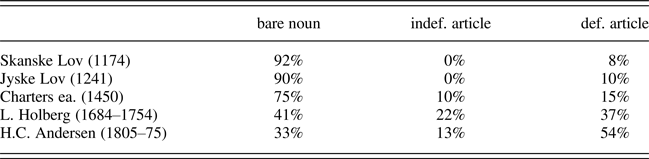
Commenting on the example in (3), Jensen stated that, in ODan, bare nouns “represent the prototypical way of introducing and continuing discourse referents—no determiner is needed” (Reference Jensen, Vikner, Jørgensen and van Gelderen2016:264). Although some examples are provided of post- and prenominal definite articles, the latter only occurring before adjectives, Jensen reported that the use remains “sporadic” (266), with “examples of nouns with enclitic articles […] few and far between” (267). Some quantitative evidence for a steady increase in the overall use of articles in the history of Danish is provided by Norde (Reference Norde1997:106, fn 14), quoting Skautrup (Reference Skautrup1944:269) and reported here in Table 1.
Overall increase in the use of articles in Danish (Norde, Reference Norde1997:106; Skautrup, Reference Skautrup1944:269)

The same figures from Skautrup are also cited in Delsing (Reference Delsing, Bandle, Braunmüller, Jahr, Karker, Naumann, Teleman, Elmevik and Widmark2002:938) and compared to analogous data from Larm (Reference Larm1936:24) for three OSw manuscripts: AVL, where 0.5% of the nouns bear the suffixed definite article; UL, where the rate is 5%; ÖgL, where it is 7.5%. Delsing commented that such low figures cannot be due to style or register, because similar patterns are found in texts of different genres, and Delsing concluded that in OSw and ODan “the article developed as an innovation in the 13th c.” (Reference Delsing, Bandle, Braunmüller, Jahr, Karker, Naumann, Teleman, Elmevik and Widmark2002:939).
For OSw, similar observations are presented in Skrzypek (Reference Skrzypek2012). Although Skrzypek's study does not provide quantitative data, some of her observations make it possible to date the various stages of development of the definite article and to compare them with English.Footnote 10 The situation described for OSw seems to be analogous to Jensen's description of ODan: in the earliest texts, for example, AVL and Bur, there are instances of the definiteness suffix, but it is not obligatory even in anaphoric contexts (Skrzypek, Reference Skrzypek2012:82, 93). An example of inconsistent use is presented in (4), where the angel introduced in the first line is then mentioned again twice, the first mention unmarked, the second marked:
(4)
guz ængel teþes andree ok baþ han fara tel burgundiam
god's angel shown Andreas and bade him travel to Burgundy
ok hialpa maþeo andreas sagþe sik eigh vita væghen en
and help Matthew Andreas said self not know way-def but
ængel baþ han ganga tel strand ok fara i førsta skip han
angel bade him go to beach and travel in first ship he
funne
 var hans leþsaghare
find Angel-def was his guide (Bur 133)
‘God's angel has appeared to Andreas and asked him to travel to Burgundy and help Matthew. Andreas said he did not know the way but the angel asked him to go to the beach and take the first ship he would find there. The angel was his guide’. (Skrzypek, Reference Skrzypek2012:93–94)
 var hans leþsaghare
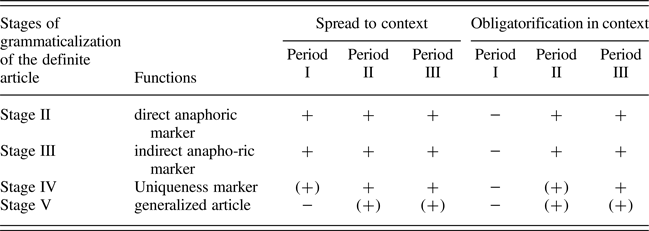
Table 2 reproduces Skrzypek's Table 31 with her summary of the development of the definite article in Swedish (Skrzypek, Reference Skrzypek2012:154). In Period I (1225–1375; see fn. 10), the suffixed definite article is encountered in anaphoric contexts, only marginally as a uniqueness marker and never with generics (first +/− column); it is never obligatory in any context (fourth +/− column). It becomes obligatory in anaphoric contexts only in Period II (1375–1450, fifth +/− column), and it is only in Period III (1450–1526) that it is generalized as an obligatory uniqueness marker (sixth +/− column).
Skrzypek's summary of the development of the definite article in Swedish

In addition, Skrzypek (Reference Skrzypek2012:95–97) suggested that ON in the thirteenth century was not different from OSw. This is also the position of Faarlund (Reference Faarlund2004:55; Reference Faarlund, Bandle, Braunmüller, Jahr, Karker, Naumann, Teleman, Elmevik and Widmark2005:1159), who claimed that the unmarked form for a unique specific referent in ON was a bare noun, as in the following example:
(5) jarl var vinsæll við búendr
earl.n was friendly.m.n with farmers.a
‘The earl was popular among the farmers’ (Hkr I.343.9) (Faarlund, Reference Faarlund2004:59)
Lander and Haegeman (Reference Lander and Haegeman2014) confirmed this observation: they tested ON against a series of properties that define DP languages (languages with articles such as Present-Day English, PDE) and NP languages (languages without articles, such as Latin and most Slavic languages).Footnote 11 They showed that ON patterns with the latter; therefore, the definiteness marking that sometimes appears in ON (and in other old Nordic varieties) cannot be considered an article.
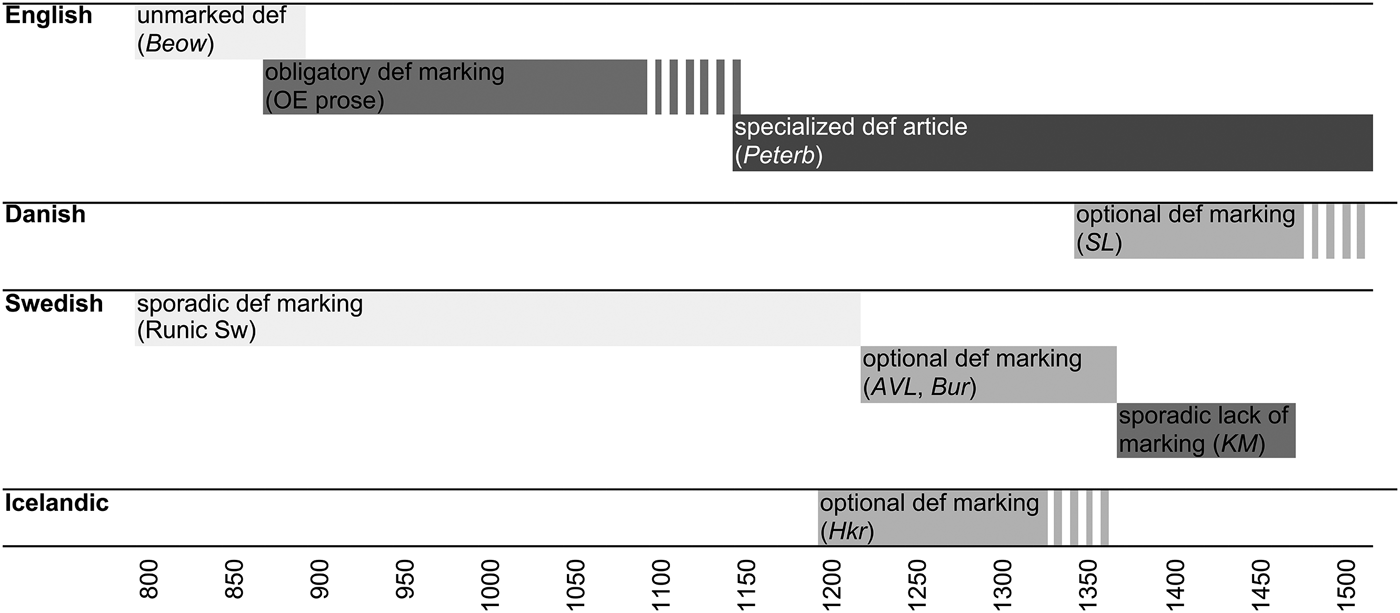
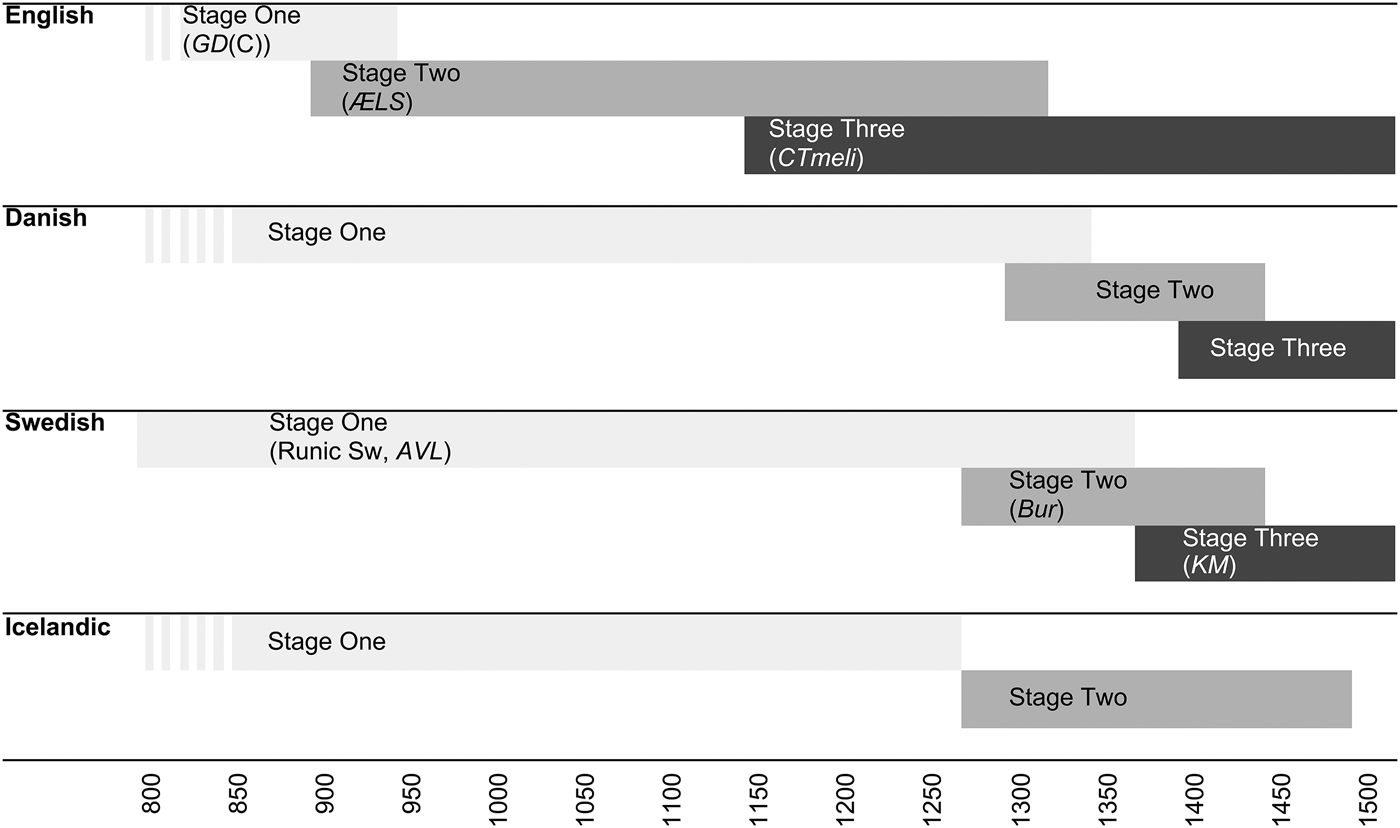
Figure 1 summarizes the parallel development of the definite article in English and the three Nordic languages discussed in this section.
Establishment of the definite article in English and Nordic.
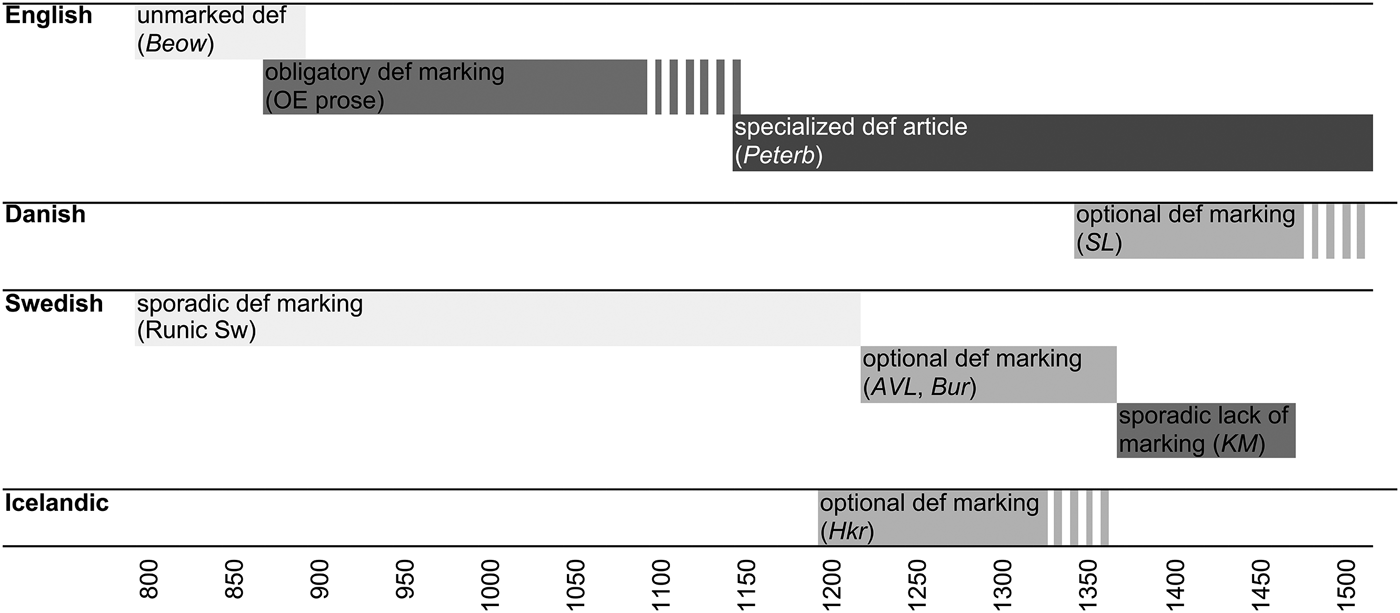
Even with the obvious limits imposed by reliance on medieval manuscripts, the relative chronology of the establishment of the definite article in English and Nordic offers one clear piece of evidence: obligatory definiteness marking is a syntactic property that is present in the earliest attestation of ME, Peterb, but is absent in ODan, OSw, and ON, even though the earliest witnesses for these languages are at least a century later than Peterb. Thus, it contradicts the claim of Emonds and Faarlund (Reference Emonds and Faarlund2014:61) that ME exhibits no OE characteristics not shared by Norse.
Obligatory definiteness marking is not a property that can be reconstructed for DScand, therefore the definite article in Peterb and later ME texts cannot be considered a Scandinavian trait. Rather, the sparseness or virtual absence in OE prose of bare subjects and objects with a definite (and even anaphoric) interpretation, such as the ODan, OSw, and ON in (3)-(5), make it plausible that the definite article in ME is a continuation of OE.
The indefinite article
Similar evidence comes from the establishment of the indefinite article. In OE, bare singulars with an indefinite interpretation are commonly attested:
(6) & bær hæt on his heafde,
and bore hat on his head
‘and bore a hat on his head’ (coorosiu,Or_4:10.107.27.2243)
Crisma (Reference Crisma, Gianollo, Jäger and Penka2015:142) argued that one can identify (at least) three stages in the development of the indefinite article in English:
• Stage One (essentially analogous to modern Icelandic): an is used only as the number ‘one’, and indefinite singulars typically occur bare.
• Stage Two (similar to modern spoken Hebrew): an acts as an existential operator which marks specificity; indefinite singulars taking wide scope or interpreted as specific are obligatorily introduced by an, while nonspecific nominals still occur bare.
• Stage Three (the grammar of PDE): a(n) is established as the “indefinite article.” At this stage, bare singular count nouns become ungrammatical regardless of their specific/non-specific/generic interpretation.
According to Crisma (Reference Crisma, Gianollo, Jäger and Penka2015:134–136), in OE the first two stages are attested, and they are distinguished by the presence/absence of an with specific indefinites, or indefinites taking wide scope:
(7) a. Stage One:
þeos hæfde geongne sunu, se wæs næmned Eumorfius.
this had young son who was named E.
‘He had a young son called Eumorfius’ (cogregdC,GDPref_and_4_[C]:36.313.28.4690)
se cynincg sende sona ænne þegen, Heliodorus gehaten, to
the king sent soon a servant H. named to
ðam halgan temple
the holy temple (coaelive,ÆLS_[Maccabees]:760.5327)
‘the king immediately sent a servant named Heliodorus to the holy temple’
At both stages, the use of an with NPs taking narrow scope is disfavored, while it is categorically excluded with generics:Footnote 12
(8) Stage One and Two:
a. narrow scope reading
Þa nolde Basilla brydguman geceosan nænne butan Crist
then neg-wanted B. husband choose none but C.
þe heo gecoren hæfde
that she chosen had (coaelive,ÆLS_[Eugenia]:365.409)
‘Then Basilla did not want to choose a husband, none but Christ that she had chosen’
b. generic reading
and forcuðlic hit bið þæt cyning beo unrihtwis
and despicable it is that king be-subj unjust
‘It is despicable that a king be unjust’ (coaelive,ÆLS[Pr_Moses]:123.2933)
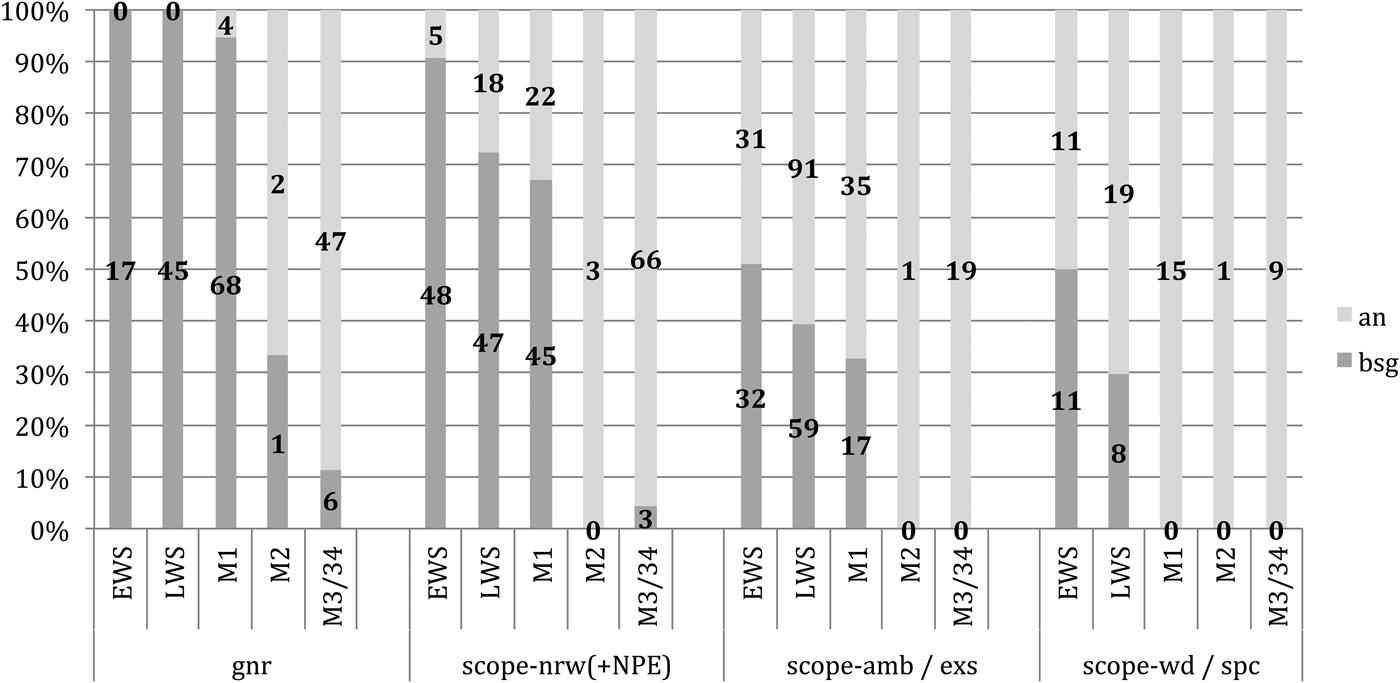
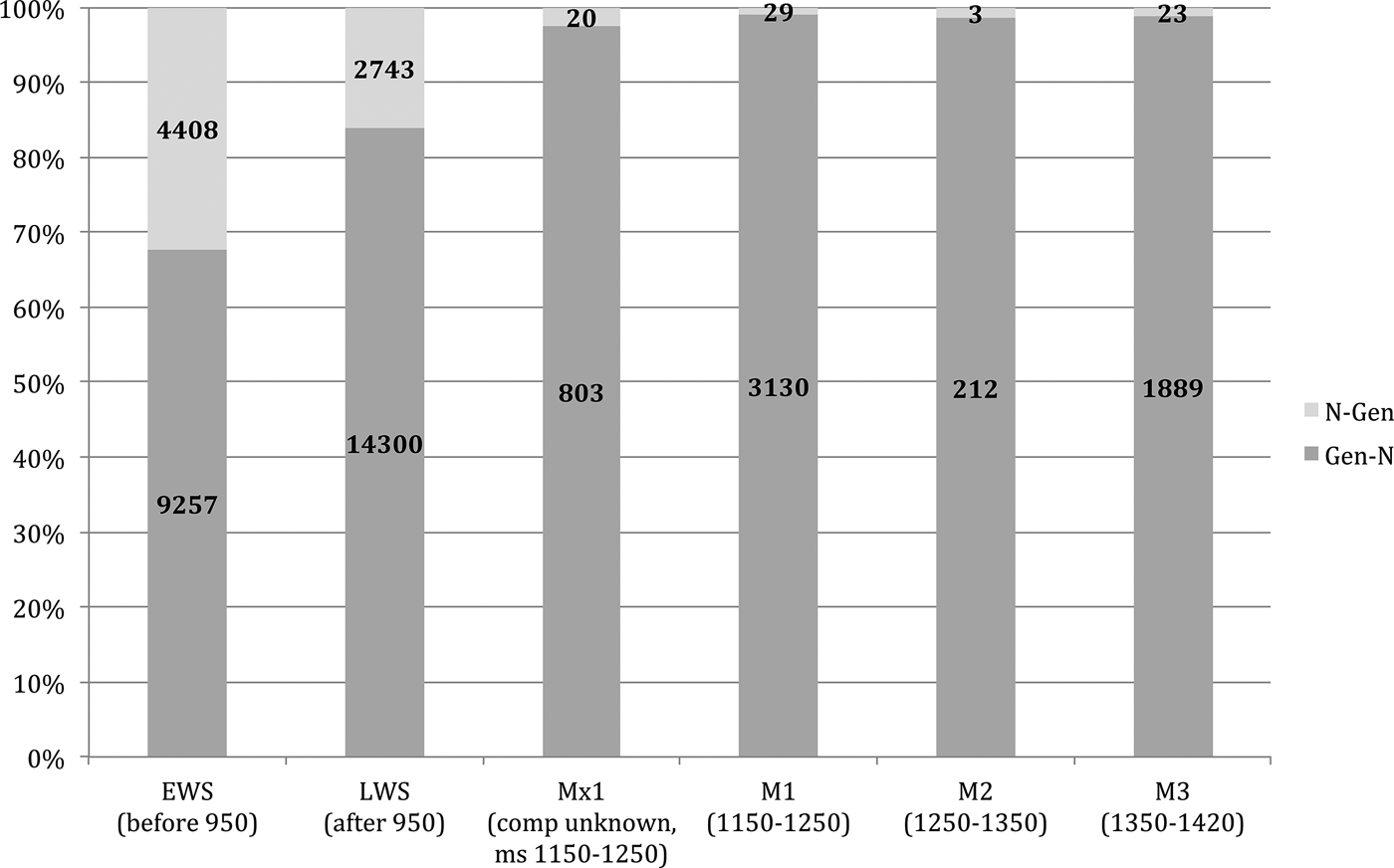
The relevance of the type of nominal in the use of an, as well as its diachronic development, is presented in Figure 2. Note that, already in OE, from Early West Saxon (EWS, before 950) to Late West Saxon (LWS, after 950), there is a visible quantitative change in the use of an with all types of nominals but generics.
Frequency of bare singulars and nominals with a(n) in OE and ME (data extracted from Crisma [Reference Crisma, Gianollo, Jäger and Penka2015:133] and Crisma & Pintzuk [Reference Crisma, Pintzuk, Vikner, Jørgensen and van Gelderen2016:170]).Footnote 13
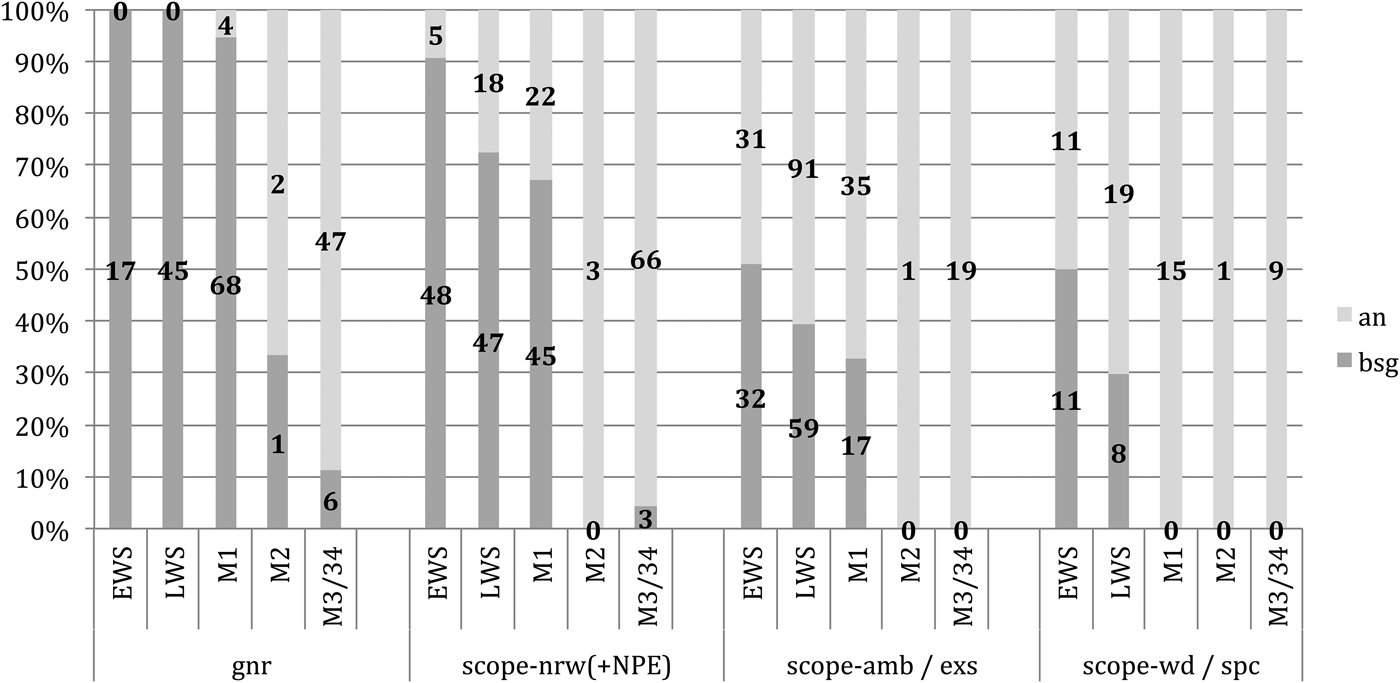
The first sporadic cases of an with generics are observed in ME at M1 (1150–1250) and become the norm at M3 (1350–1420), with M2 (1250–1350) being unusable because of the paucity of data for this period. At M3, then, the situation is essentially Stage Three, that of PDE:
(9) Stage Three
a. generic reading
he seith that a trewe freend is a strong deffense
‘he says that a true friend is a strong defence’ (CMCTMELI,223.C1.230)
b. narrow scope reading
And everi man oghte to doon his diligence and his bisynesse to geten hym a good name
‘and every man should make it his commitment and his care to have a good name’ (CMCTMELI,238.C2.835)
c. No Presupposition of Existence (NPE)
if thou hast power to parfourne a werk of which thou shalt repente […]
‘if you have the power to perform a work of which you shall repent’ (CMCTMELI,224.C2.306)
The aggregated data in Figure 2 are extracted from Crisma (Reference Crisma, Gianollo, Jäger and Penka2015:133) and Crisma and Pintzuk (Reference Crisma, Pintzuk, Vikner, Jørgensen and van Gelderen2016:170), which presented data for individual texts. The impression of optional use of an is the result of different texts having Stage One, Stage Two, or Stage Three grammar, or texts where two grammars coexist, as is usual during periods of syntactic variation and change. Most important for the present purposes is the fact that the data show a smooth transition from OE to ME: the data in the M1 period are exactly what one expects to find given the OE development if ME is a continuation of OE. While these data empirically support the traditionalist hypothesis of ME being a continuation of OE, they do not automatically falsify the Viking Hypothesis: if DScand were at Stage Two as well, this particular piece of syntactic evidence would turn out to be irrelevant in deciding between the two hypotheses, for ME could follow either from OE or from DScand.
Again, DScand must be reconstructed. For ODan, we once more rely on the description by Jensen (Reference Jensen, Vikner, Jørgensen and van Gelderen2016:268–271). Although she did not provide quantitative evidence, she reported that the first sporadic occurrences of en used as the indefinite article rather than as a numerical appear at around 1300:
(10) Swa com en røst af himæn (SC, from Jensen, Reference Jensen, Vikner, Jørgensen and van Gelderen2016:269)
so came a voice of heaven
‘Then came a voice from Heaven’
This means that, around 1300, ODan was basically at Stage One with incipient Stage Two. Jensen further wrote that, by the fifteenth century, the modern usage is established (269).
Skrzypek (Reference Skrzypek2012) presented solid evidence for the development of the indefinite article in OSw. Her focus was exclusively on the interpretation and the syntactic distribution of nominals with en, and she did not provide quantitative data comparing bare singulars with indefinites introduced by en. Nevertheless, some of her observations make it possible to date the various stages of development of the indefinite article and to compare it with what takes place in English. She showed that Swedish followed a path of development of the indefinite article that is analogous to the one described for English in Crisma (Reference Crisma, Gianollo, Jäger and Penka2015) and Crisma and Pintzuk (Reference Crisma, Pintzuk, Vikner, Jørgensen and van Gelderen2016), but we will show once more that the chronology provides crucial evidence for our purposes.
According to Skrzypek (Reference Skrzypek2012:76, 158), in runic materials and in the oldest OSw text of Period I (AVL), en is used exclusively as a numerical; in other words, Swedish was at Stage One at least until 1225. Skrzypek found the earliest attestation of non-numerical en in Bur (dated 1276–1307):
(11) En vælburin ungar suen forlæt værudena ok folgþe andream
EN well-born young boy left world-def and followed Andreas
‘A well-born young man left the world and followed Andreas’ (Bur 133, from Skrzypek, Reference Skrzypek2012:164)
At this stage, however, “more often than not it is only the bare noun that can be found” (Skrzypek, Reference Skrzypek2012:162). This indicates that Bur was basically at Stage One with incipient Stage Two, analogous to the coeval ODan in (10). In later texts (Period II, 1375–1450), en becomes the norm with presentative and specificFootnote 14 nominals and is only sporadic in nonspecific contexts (Skrzypek, Reference Skrzypek2012:175), as in (12). That is, Period II texts are at Stage Two with sporadic Stage Three.
(12) Fae keysarin mik i morghin spiwt thz som
give-cond emperor-def me in morning javelin det which
manz byrdhe är
man-gen burden is
‘If the emperor would give me tomorrow a javelin that is a burden to carry for any man’ (KM 257, from Skrzypek, Reference Skrzypek2012:180)
In sum, we see again that English and Swedish develop along similar trajectories, but when we compare the two languages at any point in time, we find that English is consistently more advanced than Swedish.
The status of West Nordic is less clear. On the one hand, Faarlund (Reference Faarlund, Bandle, Braunmüller, Jahr, Karker, Naumann, Teleman, Elmevik and Widmark2005:1159) wrote: “The indefinite article is missing altogether in Old Norse.” On the other hand, in an earlier publication, Faarlund (Reference Faarlund2004:74) suggested that einn ‘one’ is used as a marker of specificity in ON “meaning ‘a certain’ or ‘some.’” The two examples he provided are from Barlaams ok Josaphats saga, dated 1275, and from Gunnlaugs saga ormstungu, dated 1300, that is, they are coeval with the earliest nonnumerical examples of en found in ODan and OSw, quoted in Jensen (Reference Jensen, Vikner, Jørgensen and van Gelderen2016:269) and Skrzypek (Reference Skrzypek2012:164). However, since Faarlund does not comment on the frequency of examples with einn as opposed to bare singulars, it cannot be established whether ON was solid Stage Two like certain Late OE texts, or incipient Stage Two, like East Nordic. He provided a further example from Barlaams ok Josaphats saga to show that, in ON, einn was not used with nonspecific reference; in our terms, at the end of the thirteenth century, no inception of Stage Three was observable in ON.
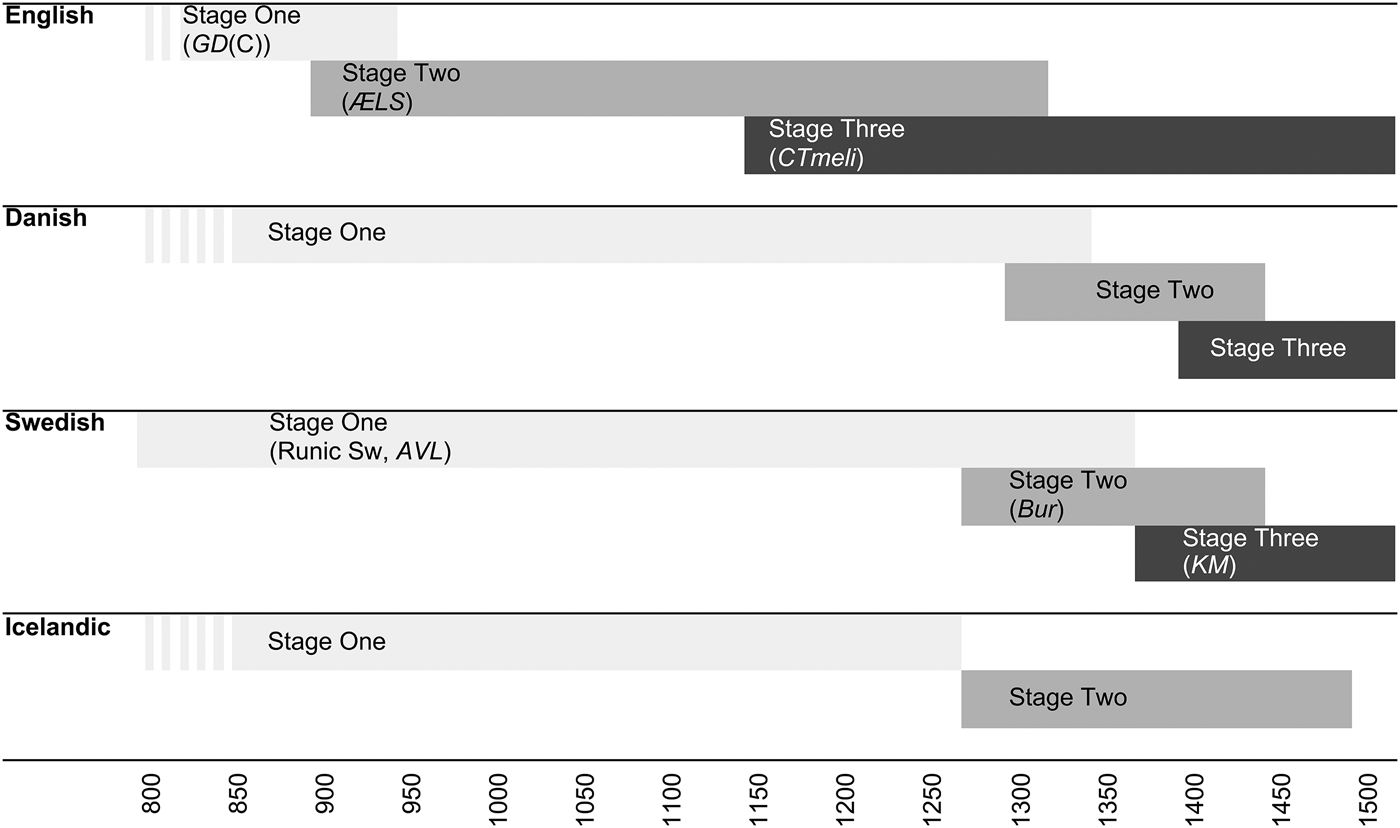
Figure 3 presents the relative chronology of the establishment of the indefinite article in English and the three Nordic varieties discussed in this section. It shows that the earliest attested varieties of Nordic are at a stage of development of the indefinite article that is less advanced, not only of coeval ME texts, but also of LWS. In fact, the precursor of the indefinite article informally describable as a mark of specificity was already used in English at the end of the tenth century but only appears in ODan, OSw, and maybe ON at the end of the thirteenth century. Since it is reasonable to assume that DScand lacked this mark of specificity as well,Footnote 15 we conclude that the indefinite article that was eventually established in ME in the fourteenth century is a continuation from OE and cannot be a continuation from DScand.
Establishment of the indefinite article in English and Nordic.
Demonstratives
We saw in the section discussing the morphological realization of the definite article that the suffixed definite article of many modern Scandinavian languages originates from a postnominal demonstrative, which cliticized onto the noun and was then reanalyzed as a suffix. However, in Ancient and Old Nordic, the possibility of demonstratives following the noun is not limited to the precursor of the definiteness suffix, but is shared by other demonstratives, for example, sási/þessi ‘this.’
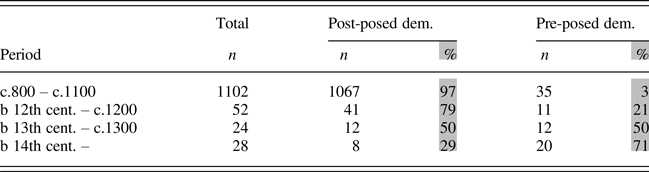
In the runic inscriptions of the Viking age, the order N-demonstrative was vastly predominant, while, already in OIcel and OSw, there is an evolution towards the modern situation,Footnote 16 with N-demonstrative orders becoming less common.
Some diachronic evidence showing this trend is provided in Stroh-Wollin (Reference Stroh-Wollin2015:15) from data on the distribution of demonstratives in Scandinavian runic inscriptions, reproduced in Table 3.Footnote 17 Note that, according to Stroh-Wollin's survey, the rate of postnominal demonstratives in runic inscriptions decreases over time, but N-demonstrative sequences are still relatively frequent in the thirteenth century.
Noun phrases with post- and preposed demonstratives in Scandinavian runic inscriptions from the Viking Age and the Middle Ages (Stroh-Wollin, Reference Stroh-Wollin2015:15, Table 2)

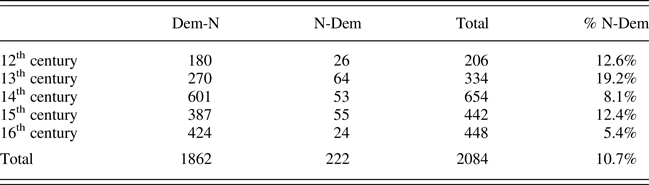
Roehrs and Sapp (Reference Roehrs, Sapp, Martínez, Alcázar and Hernández2006:291) (quoting Perridon Reference Perridon, Ottoson, Fjeld and Torp1996:252) cited a rate of 98% of N-dem sequences of sási/þessi ‘this’ in the Viking age. According to them, the order is then reversed in OIcel (292). A search we ran on the IcePaHC for the position of sási/þessi ‘this’ with respect to the head noun shows that, during the twelfth to the sixteenth centuries, the frequency of postnominal demonstratives does indeed decrease in Icelandic compared to Runic inscriptions,Footnote 18 but it does not disappear altogether: it is attested at a rate of about 11% over the period, as shown in Table 4.
Pre- and postnominal demonstratives in the history of Icelandic, data from IcePaHC

A similar development is observable in Swedish, according to the description provided in Wessen (Reference Wessen1970:127–128, §74). At the earliest stages of runic Swedish, the demonstrative sa (OSw þän) is normally postnominal. When, in the Viking era, the reinforced demonstrative sasi (OSw þänni) is introduced in the language, sa (þän) is instead found in prenominal position, while sasi (þänni) is normally postnominal. Wessen, however, acknowledged a large number of exceptions (“eine große Zahl von Ausnahmen”) (Reference Wessen1970:127), where the reinforced demonstrative appears prenominally. Later, in literary OSw, the order demonstrative-N becomes the rule, but, in some old texts, the use is fluctuating (“In einigen alteren Texten ist der Gebrauch jedoch schwankend”) (Reference Wessen1970:128). The author provided examples of this fluctuating use from the AVL and UL.
The apparent freedom of word order in the Old Nordic noun phraseFootnote 19 has received different accounts: Faarlund (Reference Faarlund, Bandle, Braunmüller, Jahr, Karker, Naumann, Teleman, Elmevik and Widmark2002:730) suggested that Old Nordic could have been at a ‘transitional stage’ between Ancient Nordic, which has head-initial noun phrases with demonstratives and all modifiers following the noun, and modern Scandinavian, where these elements mostly appear prenominally. Börjars, Harries, and Vincent (Reference Börjars, Harries and Nigel2016) proposed an alternative analysis, whereby the pre- or postnominal position of demonstratives in ON is constrained by information-structure factors (see also, Harries, Reference Harries2014:86–87): they argued that in ON, demonstratives are interpreted as anaphoric or cataphoric deictics, depending on their position relative to the head N.
Whatever the account, the Viking Hypothesis predicts that some postnominal demonstratives in ME should be attested, but this prediction is not borne out: a search on the PPCME2 produced only one token of NP containing a postnominal demonstrative for ‘this,’ out of a total of 8732 NPs headed by N or a proper name modified by the demonstrative ‘this’/‘these’:
(13) Þe fox of ȝiscunge haueð hwelpes þeose. tricherie & gile þeofðe & reauelake […]
‘The fox of covetousness has these whelps: treachery and guile, theft and rapine, […].’ (CMANCRIW-1,II.151.2054)
An analogous search of the YCOE retrieved 5275 noun phrases modified by the demonstrative þes/þeos/þis, ‘this’; none of the demonstratives was postnominal. Thus, the ME pattern seems to be just a continuation of the OE one with no change taking place. This is one more piece of evidence against a Scandinavian derivation of the ME noun phrase. The scanty evidence provided by runic inscriptions in Britain goes in the same direction, for both N-demonstrative and demonstrative-N orders are attested, the former being possible also in England, although less common:
(14) British runes showing N-demonstrative order (exhaustive list from Barnes & Page, Reference Barnes and Page2006)
OR 14 Þorsteinn Einarssonr reist rúnar þessar ‘Þ. E. carved this stone’
SC 8 [?Eft]ir Þorgerðu ?Steinar[sdóttu]r er kross sjá reistr ‘After Þ. S. is this cross raised’
(SC 10 … kross þenna til … ‘this cross ?for’)
SC 14 Kali Ǫlvissonr lagði stein þensi yfir Fugl, bróður [sinn] ‘Kali Ǫlvisson laid this stone over Fugl, [his] brother’
E 2 ?Ginna lét leggja stein þensi ok Tóki ‘?Ginna let lay this stone and Tóki (i.e. had this stone laid down, together with Tóki)’
(15) British runes showing demonstrative-N order (exhaustive list from Barnes & Page, Reference Barnes and Page2006)
SH 6 Þenna stein ‘this stone’
OR 15 [?… þe]tta bein var ‘[?this] bone was…’
E 1 Rikarð he me iwrocte And to ðis merið ȝer… me brocte ‘Rikarð he made me And to this splendour … brought me’
E 3 Dólfinn wreit þessa(r) rúnr á þessa stein ‘Dolfin scratched these runes on this stone’
E 9 ?Gamall ?léta þenna kirk […] ‘?Gamall … this church […]’
Possessive pronouns
Possessive pronouns modifying a head N provide analogous evidence.Footnote 20 According to the standard descriptions, possessive pronouns could precede or follow the head noun in both OSw and ON. For Swedish, the reference is Wessen (Reference Wessen1970:123–127, §73). He stated that, in Runic Swedish, possessive pronouns conform to the rule that unstressed attributes are realized as clitics coming after the word they refer to; in contrast, when stressed they precede it. This pattern continues unchanged in legal codices, with various examples from AVL, ÖgL, Vidh, and UL. However, in texts of other genres, the prenominal position for possessive pronouns becomes predominant, and the old pattern becomes a rare exception (“ist zu einer seltenen Ausnahme geworden”) (Reference Wessen1970:126), with sporadic cases from Bur, Bir, and Did.
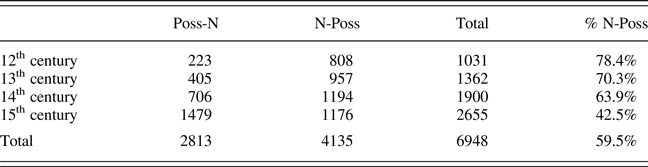
In Icelandic, both in older stages and in the modern language, possessive pronouns frequently occur postnominally (see Börjars et al., Reference Börjars, Harries and Nigel2016:e12; Faarlund, Reference Faarlund2004:59; Harries, Reference Harries2014:79–82). We confirmed this observation with quantitative evidence from the IcePaHC, presented in Table 5. Although the frequency of postnominal possessive pronouns decreases from the twelfth through the fifteenth century, N-Poss order remains robustly attested.
Pre- and postnominal possessive pronouns in the history of Icelandic, data from IcePaHC

The few extant British runic inscriptions fit the description provided so far. Barnes and Page (Reference Barnes and Page2006) listed three inscriptions where a nominal is modified by a possessive pronoun. In all three cases, the pronoun follows the head noun:
(16) British runes showing N-possessive pronoun order (from Barnes & Page, Reference Barnes and Page2006)
SH 3 eftir fǫður sinn, Þorbjǫrn ‘after his/her father, Þorbjǫrn.’
SC 11 aft Ingólf, fǫður sinn ‘after Ingólf, his/her father’
SC 15 konu sín[a] ‘his wife’.
Combining the data from all of these sources, it is reasonable to assume that postnominal possessives were at least possible and maybe common in DScand. In contrast, in ME postnominal possessive pronouns are virtually nonexistent. Our search on the PPCME2 retrieved 32,125 nominals containing a possessive pronoun, with 3 post-N occurrence of the possessive (0.01%).Footnote 21 This pattern corresponds exactly to the OE pattern: in the YCOE, there are 32,110 nominals modified by a possessive pronoun, with only 10 cases (0.03%)Footnote 22 of postnominal pronouns. Therefore, OE and ME are identical: the prenominal position of possessives can be considered obligatory in both periods.
Thus, this case again qualifies as a syntactic property of ME (obligatory prenominal possessive pronouns) that is identical to OE but different from what one can reconstruct for DScand.
Genitive position
In contrast to the adnominal possessive pronouns discussed in the previous section, there is a series of changes from OE to ME that affects the syntax of nonpronominal genitive modifiers: the loss of the postnominal genitive, the rise of of-phrases, and the reanalysis of genitive inflection as a phrasal affix. This last feature is shared with some Scandinavian languages and is in fact used by Emonds and Faarlund as evidence to support their hypothesis (Reference Emonds and Faarlund2014:118–19). Although the similarity of English and Scandinavian in this respect is intriguing, the chronology of its establishment makes it questionable as evidence for Emonds and Faarlund's proposal, as argued in Bech and Walkden (Reference Bech and Walkden2016:89–91).Footnote 23 They also noticed a further problem for Emonds and Faarlund's hypothesis, namely genitive position. Quoting Allen (Reference Allen2008:162, 38), and providing evidence collected from the IcePaHC, Bech and Walkden argued that, while in English inflected genitives are essentially prenominal by the end of the twelfth century, they are typically postnominal in OIcel. They claimed that “[i]f Middle English syntax is inherited from Norse, the switch from postnominal to prenominal position [of the genitive modifier] requires an explanation” (Bech & Walkden, Reference Bech and Walkden2016:90). They strengthened their point by adding that the loss of postnominal genitives in English had begun in the OE period, as shown in Allen (Reference Allen2008:112–18), and therefore ME is the predictable outcome of OE. However, although Bech and Walkden's line of reasoning is correct, their choice of empirical material is not, as we will show directly.
The loss of postnominal inflected genitives in English is widely described and discussed in relation to the various factors that seem to play a role in (dis)favoring the post-nominal position for a genitive modifier: weight, animacy, type (e.g., partitive) (see, in particular, Allen [Reference Allen2008:95–98]). Allen (Reference Allen2008) based her discussion on a wealth of first-hand data collected from the YCOE and the PPCME2 and textual evidence: she showed that branching postnominal inflected genitives are already declining in OE, going from 53% in EWS to 17% in LWS (Reference Allen2008:114, Tables 3.1 and 3.2). As for Early ME, Allen established a correlation between the loss of case marking and agreement and the loss of postnominal genitives (Reference Allen2008:166, Table 4.4) but did not provide the frequency of postnominal genitives in the texts she considered. We therefore conducted a search on the YCOE and the PPCME2 in order to quantify the ME development. Our search, whose results are presented in Figure 4, takes into account the different annotations used in the PPCME2 for different types of NP complements of nouns, and it had to be manually sorted. However, it was not restricted by weight or genitive type, which may account for the difference in the proportion of postnominal genitives between our data and Allen's.
Frequency of pre- and postnominal genitives, by OE and ME period.
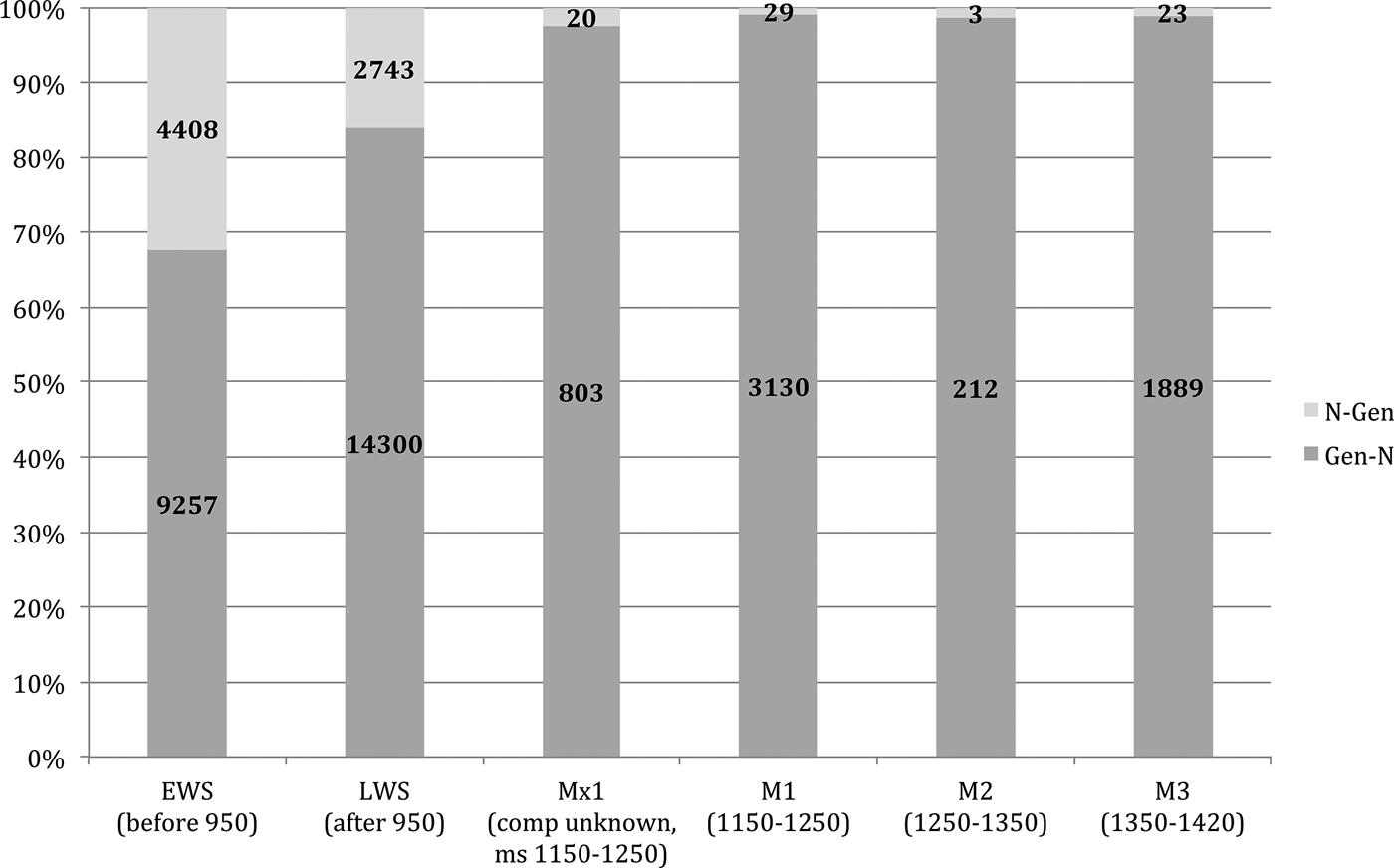
Figure 4 confirms Bech and Walkden's observation of a “straightforward” (Reference Bech and Walkden2016:90) development from OE to ME: the frequency of postnominal inflected genitives decreases from 32% in EWS to 16% in LWS to an average of about 1% for the ME period.
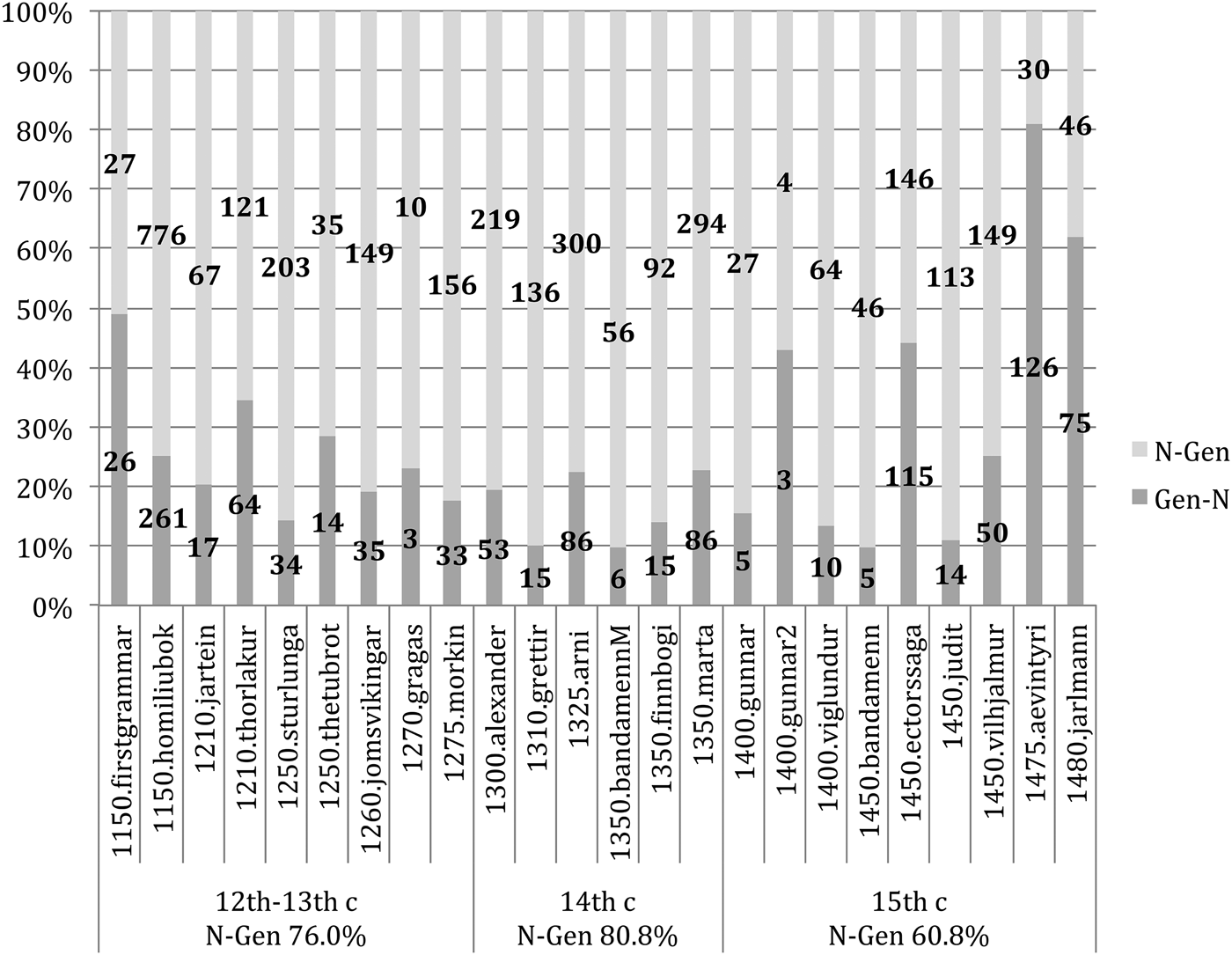
Again, to show that the ME pattern cannot be a continuation of DScand, one must show that DScand was not similar to LWS. We first searched the IcePaHC to replicate Bech and Walkden's argument, albeit covering a longer period. The Icelandic data are presented in Figure 5.Footnote 24
Frequency of pre- vs. postnominal genitives in IcePaHC.

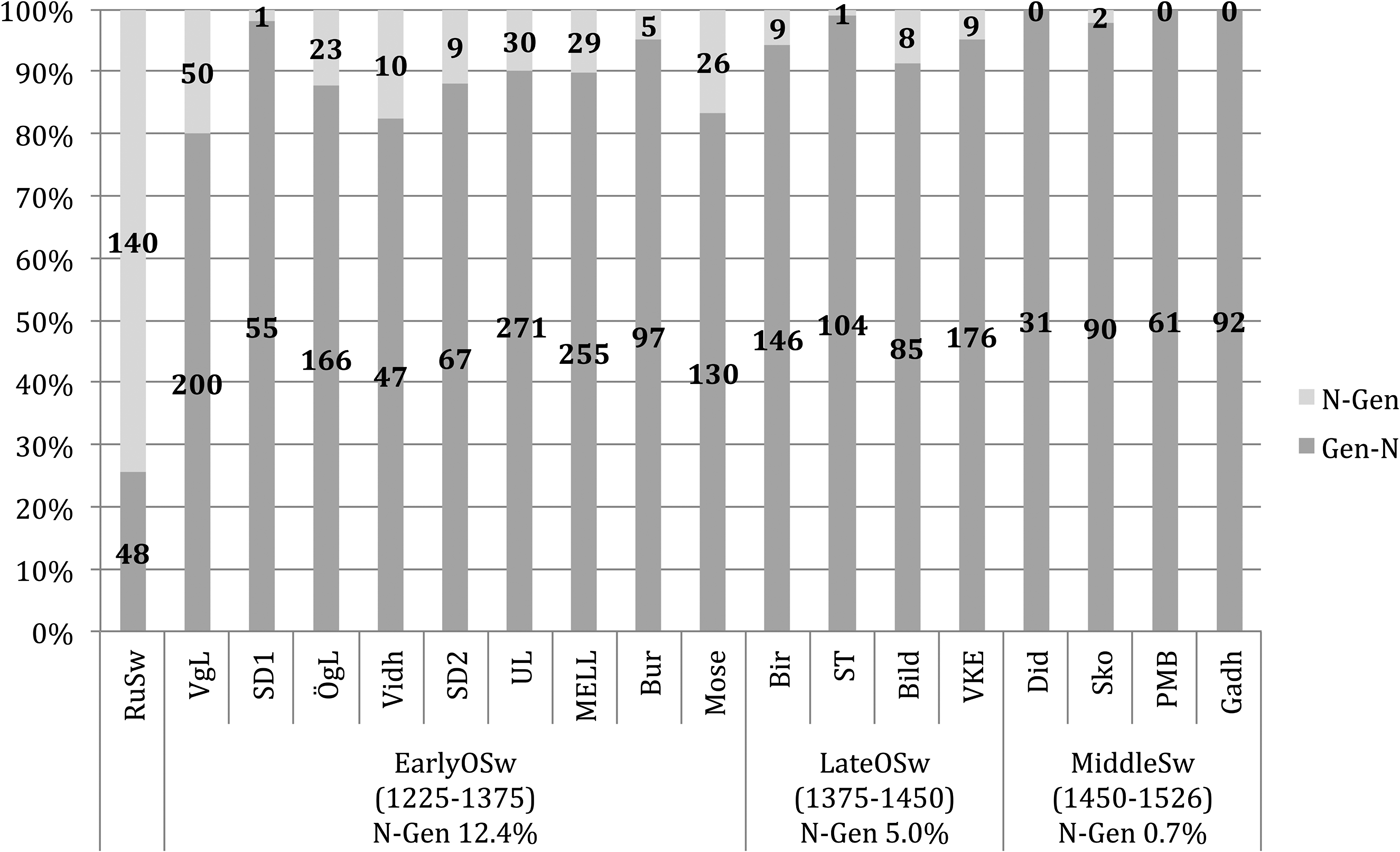
Figure 5 shows that OIcel was indeed very different from LWS, but it would be wrong to conclude that this is evidence against the Viking Hypothesis: DScand must be reconstructed, and for the reasons mentioned in the section presenting the materials we use, ODan and OSw are more directly relevant. The available literature on the topic essentially focuses on the history of Swedish, and we will therefore base our argument on it. Our source for OSw and MSw data is Norde (Reference Norde1997), a study of the development of the genitive inflection into a phrasal affix. In Figure 6, we present a graph of data extracted from her tables, selecting only the relevant information, namely pre- and postnominal nonpartitiveFootnote 25 genitives, and omitting all other genitive constructions. For consistency, we divide her material according to the periodization used in the sections discussing the establishment of the definite and the indefinite articles.
Frequency of pre- and postnominal genitives in the history of Swedish (data extracted from Norde [Reference Norde1997:187 Table 4.30, 190 Table 4.31, 199 Table 4.35]).
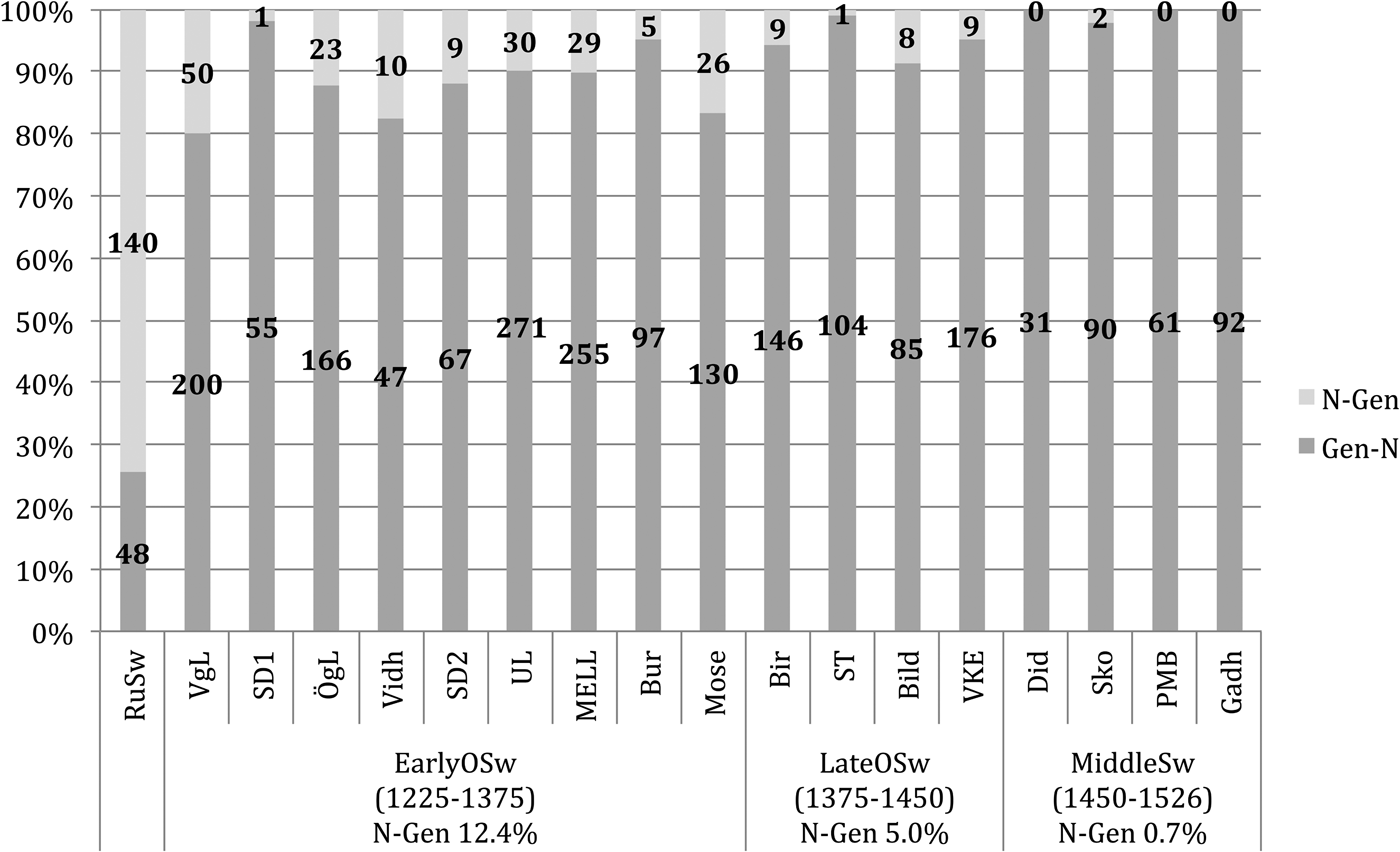
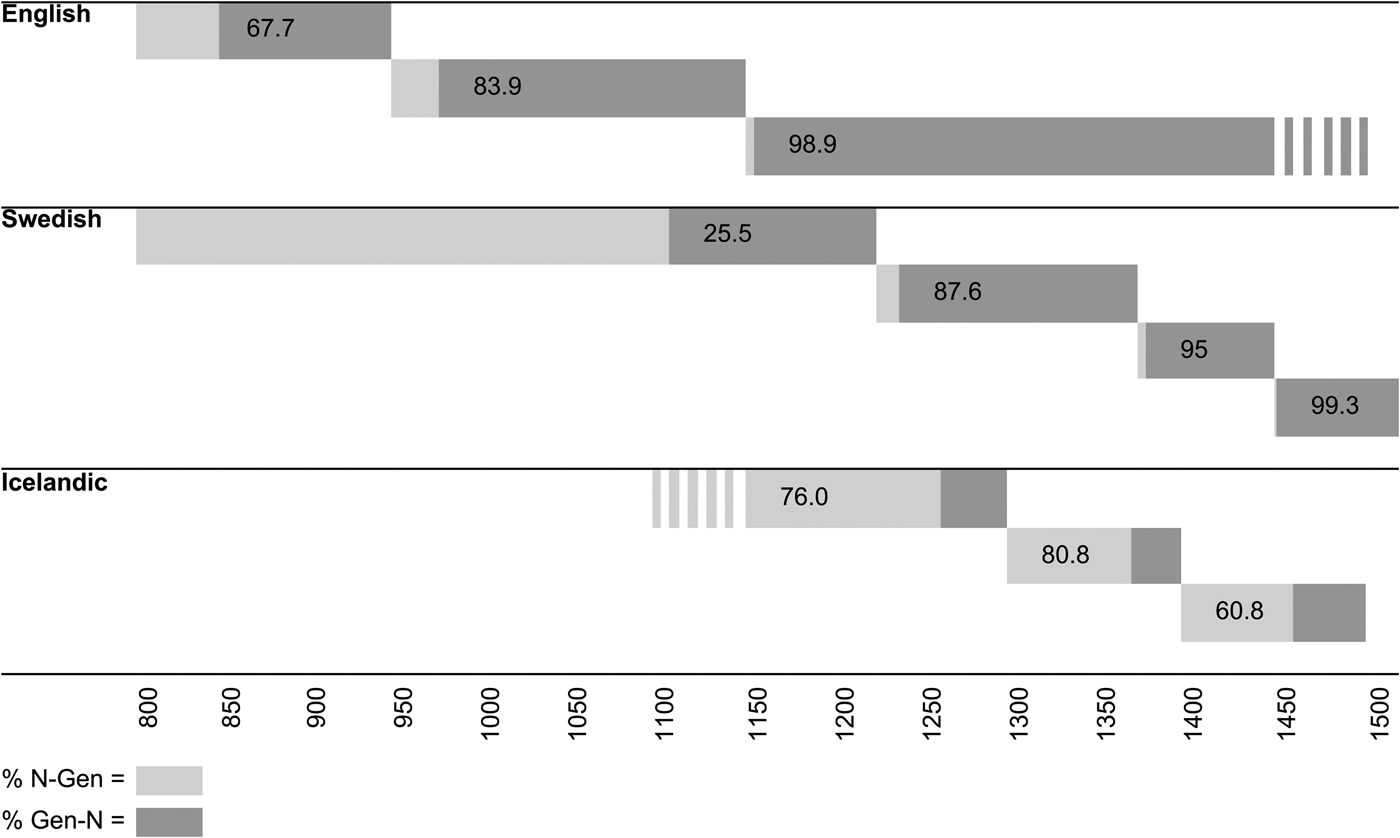
Figure 6 shows that, in runic Swedish, the genitive is postnominal in almost 75% of the tokens. In Early OSw, the frequency of postnominal genitives dropsFootnote 26 to 12% and is further reduced to 5% in Late OSw until it basically disappears in Middle Swedish. Thus, Swedish proves to be very different from Icelandic with respect to this property, as may be expected given the modern varieties. On the other hand, the development of Swedish mirrors that of English, but once again its timing provides crucial evidence that ME is unlikely to be a continuation of DScand: comparing Figure 6 with Figure 4, we see that the establishment of prenominal genitives takes place more than two centuries later in Swedish than in English. The asynchronous developments are summarized in Figure 7, which also makes it obvious that the comparison with Icelandic is irrelevant in this case.
Postnominal genitives in the history of English and Nordic.
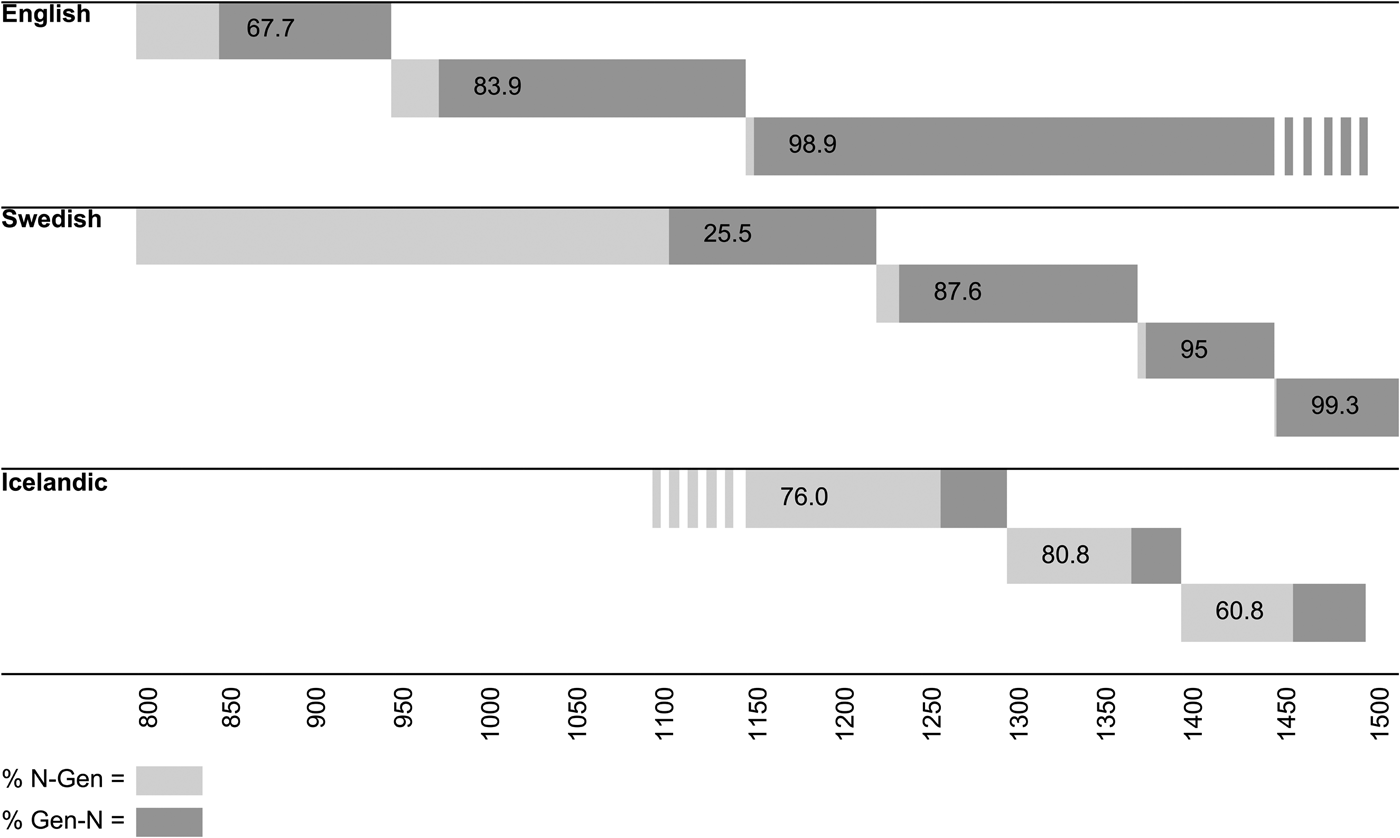
In sum, the data presented in this section show that genitive position is, in fact, evidence against the Viking HypothesisFootnote 27 as already argued in Bech and Walkden, but the argument is much stronger if English is compared to Swedish rather than Icelandic.
DISCUSSION AND CONCLUSIONS
As noted by Lightfoot (Reference Lightfoot2016:476), the Viking Hypothesis is an empirical claim; it can be refuted only by empirical evidence. Therefore, in this paper, we do not review Emonds and Faarlund's work and their coverage of the relevant literature and data. Rather, we use the syntax of the noun phrase as our empirical evidence to test the Viking Hypothesis. We discuss six morphosyntactic features, and they all converge in supporting the traditional account and refuting the Viking Hypothesis.
We are not the first to provide empirical evidence to support the traditional account, but our work is distinguished from that of others in three ways:
• First, while many of the previous responses to Emonds and Faarlund demonstrated only that OE and ON syntax were similar in various respects, and, therefore, that ME could be the descendant of either language, we show that the various characteristics of ME nominal syntax that we consider can only be derived from OE and, crucially, not from ON.
• Second, given that the variety of Scandinavian spoken in the Danelaw is not attested and must be reconstructed, we claim that OE should not be compared to (a broad notion of) Norse but rather to the extant different varieties of Old Nordic, favoring East Nordic where possible.
• Third, we show that timing is crucial: by establishing when a given change takes place in a given variety, we are able to determine the most likely origin for each of the observed properties in ME. Since the written language may be more conservative than the spoken language, it is possible that linguistic changes already established in speech are not immediately attested in the written texts, but this should generally affect all the different languages we take into consideration. Therefore, it is the relative chronology of the development(s) that matters here.
All of the six syntactic properties we examined using this methodology turned out to qualify as evidence against the Viking Hypothesis. Note, in addition, that they do not offer any support for the Creolization Hypothesis either: what we have shown is that the noun phrase syntactic patterns observed in ME evolve from the OE ones without apparent influence from Scandinavian (or, for that matter, from any other language).
It is important to recognize that we make no claims here about sentential syntax in the history of English or, indeed, about other characteristics of the noun phrase that we have not yet investigated. It is possible to imagine that some aspects of ME syntax are derived from OE and some from ON, and, in particular, that nominal syntax and clausal syntax evolve independently. A better understanding of the relationship between English and Scandinavian in Britain can only be achieved with additional empirical investigation along the lines we present here, which can then constitute the base for a formal analysis of linguistic change(s).