Introduction
Tinnitus is a sensation of noise in the absence of external sound. In many instances no definite aetiology can be found.Reference McKenna, Hallam and Hinchcliffe1 It is a widespread condition with 20–30 per cent of the population experiencing tinnitus at some stage during their lives. For approximately 6 per cent the perceived noises are the cause of some distress while 0.5–1 per cent of adults are severely affected.Reference Stephens and Hallam2–Reference Coles4
The majority of people who have tinnitus report minimal distressReference Shailer, Tyler and Coles5 as habituation is the most common outcome.Reference Stephens, Hallam and Jakes6 Those who fail to habituate complain of a wide variety of somatic and psychological problems including insomnia, depression, anxiety, sensitivity to noise, irritability and feelings of helplessness.Reference House and Brackmann7 However, it is not only its high prevalence, but also its unresponsiveness to treatment that requires that the management of persistent tinnitus be subject to further investigation. Tinnitus is thus a symptom which is not only less amenable to treatment than its associated symptom of hearing difficulties, but one which may have much greater psychological effects on the patient. These psychological factors increase the number of complaints about other physical and psychological symptoms and lead to a high cost for general practitioners. Tyler et al., in their study of 72 members of a tinnitus self-help group, showed that 93 per cent of their patients had curtailed their lifestyle and in 56 per cent of cases tinnitus had a marked effect on their general health.Reference Tyler and Baker8
Discrepancy between complaint behaviour and the nature and extent of a disorder has long been appreciated.Reference Weisenberg9 Evidence emerging within the past few decades suggests that psychosocial factors, e.g. emotional states, such as depression, and behavioural dispositions, such as hostility, avoidance behaviour, reassurance seeking and psychosocial stress can directly influence both physiological dysfunction and health outcomes.Reference Rozanski, Blumenthal and Kaplan10–Reference Baum and Posluszny13 Furthermore, the influences of cognitive processes on physical function, performance and exhaustion is echoed by Noakes and colleagues in their study on athletes. Here they hypothesised that physical activity and the recruitment of skeletal muscle units is controlled by a continuous pacing strategy within the central nervous system based on its feedback from physiological as well as psychological systems. According to the model, exercise can terminate before there is any evidence of a catastrophic failure of either metabolic or thermoregulatory regulation. Thus, according to this definition, the sensations of fatigue can be present at rest when no work is being performed, as is found in chronic fatigue syndrome.Reference Noakes, St Clair Gibson and Lambert14 Tinnitus loudness and intrusiveness can therefore no longer be considered uni-dimensional.
Given that the patient's model of tinnitus as well as their psychological response and coping mechanisms can lead to either a dampening or amplification of tinnitus,Reference House15 methods of treatment are normally aimed at relieving the distress caused by tinnitus.Reference Stephens, Hallam and Jakes16 Londero et al. echo the philosophy of this approach when referring to the possible contribution of the central auditory pathway and its multiple functional connections between auditory system and limbic system in the development of predisposing and perpetuating variables of tinnitus.Reference Londero, Peignard, Malinvaud, Nicolas-Puel, Avan and Bonfils17
A variety of psychological interventions have been used in the management of tinnitus including hypnosis, relaxation training and biofeedback as well as cognitive behavioural approaches combining relaxation techniques and cognitive coping strategies.Reference Andersson, Melin, Hägnebo, Scott and Lindberg18 The similarities between patients with chronic severe tinnitus and those with chronic pain are striking in that both groups suffer from intractable sensory symptoms and demonstrate problems with aspects of focus/attention, perceived lack of control over symptoms, life events, catastrophic thinking and maladaptive coping strategies.Reference Tonndorf19 Cognitive behavioural therapy, which has been used successfully in the treatment of chronic pain, is now positively contributing to the successful treatment of tinnitus patients.Reference Andersson20
Treatment in the present study blends cognitive behavioural therapy and mindfulness meditation in a seamless way. The cognitive behavioural therapy aspect explores the patient's model of tinnitus along with predisposing, precipitating and exacerbating factors in order to change unhelpful beliefs and thoughts. It also looks at the thinking and emotional processes associated with tinnitus exacerbation.Reference Folmer21
Mindfulness meditation is a major classification of meditation practices, known as Vipassana Bhavana, or insight meditation. It is a process of purposefully paying attention to what is happening at the present moment without being distracted by the associations attached to those thoughts or sensations. In the practice of mindfulness, thoughts, sensations or feelings which come to mind are not ignored or suppressed. Nor are they analysed or judged for their content. Rather, they are observed intentionally but non-judgmentally, moment by moment, as the events in the field of awareness. It is a skill that can be learned and when practised in a disciplined manner, can reduce suffering associated with physical, somatic and psychiatric disorders.Reference Kabat-Zinn, Lipworth and Burney22–Reference Carlson, Speca, Patel and Goodey26
The mindfulness meditation approach follows the work of Jon Kabat-Zinn, who has used this form of therapy in conditions associated with, among other things, pain.Reference Kabat-Zinn27 Møller, in drawing comparisons with tinnitus, taught patients to see the intrusiveness of tinnitus as a neutral event without the attributes of distress.Reference Møller28 Andersson, in his approach to tinnitus treatment, also used aspects of mindfulness as part of a concentration technique.Reference Andersson, Stromgren, Strom and Lyttkens29
In the present study the treatment of the patient with intrusive tinnitus involved a blend of approaches using cognitive behavioural therapy and mindfulness meditation tailoring the therapy to the individual needs of each patient. The combination of the two techniques facilitates the neuroplastic uncoupling of the sensory dimension of the tinnitus experience from the affective/evaluative alarm reaction, thereby reducing the experience of suffering via cognitive reappraisal.Reference Lazar, Bush, Gollub, Fricchione, Khalsa and Benson30 Patients are also taught how to anchor this response into various repeatable points of the day, including times associated with heightened tinnitus awareness. The same technique is used for reducing the intrusiveness of thought patterns at night time in order to facilitate letting go into sleep.Reference Grossman, Niemann, Schmidt and Walach25
Patients and methods
Twenty-five consecutive patients complaining of tinnitus, who were deemed would benefit from psychological input, attending the Welsh Hearing Institute in Cardiff, were invited to participate in the trial. Each patient had received a medical examination. Those who had a treatable cause to their tinnitus such as otitis media or merely needed reassurance that there was no sinister cause to their tinnitus had been excluded from the study.
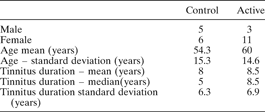
A waiting list control design was used to look at the effect of cognitive behavioural therapy/mindfulness meditation in chronic tinnitus sufferers. The patients were selected from those attending the designated tinnitus clinic for the first time. Those patients reporting intrusiveness of tinnitus and who were felt could benefit from a psychological as well as audiological management approach were invited to enter the study. The patients were then divided into two groups on a consecutive basis. The first group was treated following the consultation with the audiological physician. The second group waited three months before treatment and therefore acted as their own control. It was hypothesised, based on previous work by Sadlier and Stephens,Reference Sadlier and Stephens31 that both groups would show significant improvement. The patients were allocated to either the active or control group on a strictly consecutive basis. The demographic details are illustrated in Table I.
Demographic details
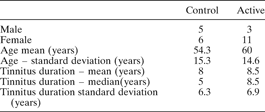
Group one (active), included those patients who were assessed both at the time of the consultation and post-treatment while group two (control) were assessed at the time of consultation as well as pre- and post-treatment with a three month planned waiting period prior to starting treatment. Statistical comparisons were based on these periods. In addition to this, at four to six months post-trial, patients were sent a questionnaire asking to rate their tinnitus at that time in comparison to how they remembered it to be immediately post-treatment. They were also asked to fill in their hospital anxiety depression score for how they felt they were pre-therapy and at the present time. The study was approved by the local ethics committee.
Six measures were used to assess different aspects of tinnitus, including the perceived severity and impact of tinnitus as well as the patients' general perception of their life and mood. These measures are outlined below.
(1) Tinnitus questionnaire
The Hallam tinnitus questionnaire is a 33-item scale developed to measure the subjective severity of tinnitus. The items within the scale can be subdivided into six subscales; pessimism/helplessness (most revealing), relaxation, effect on hearing, capacity to ignore tinnitus, emotional effects of tinnitus, and acceptance of tinnitus.Reference Hallam, Jakes and Hinchcliffe32 Each of the 33 questions were presented with a visual analogue scale (10 cm) ranging from not true to true.
(2) Hospital anxiety and depression scale
The hospital anxiety and depression scale is a 14-item scale developed to measure anxiety and depression in physically ill patients. Scores on both subscales range from 0 to 21. Scores above 10–12 are regarded as problematical.Reference Snaith33
(3) Tinnitus visual analogue scale (VAS)
A VAS was constructed which ranged from 0, being no problem, to 100, having an extreme problem, in answer to the question ‘What is the overall effect your tinnitus is having at present’.
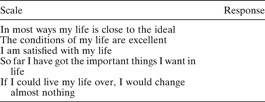
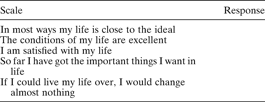
(4) The satisfaction with life scaleReference Pavot, Diener, Colvin and Sandvik34
This five-item scale (Table II) was used to assess the general perception of patients' view of their lives and whether modification of tinnitus had an influence on it. The choices of answer ranged over a seven point scale from strongly disagree to strongly agree.
(5) Tinnitus triggers questionnaire
Patients were asked whether there were specific life events/stressors associated with the onset or exacerbation of their tinnitus.
(6) All patients were also sent a questionnaire four to six months post-therapy asking them to recall how they felt post-treatment and to compare this to how they now felt with the provided options of ‘better’, ‘no change’ or ‘worse’.
The satisfaction with life scale
All patients were given four training sessions which lasted 40 minutes each. The format of the sessions is outlined in Table III. Data were analysed using SPSS 11.5 using student t-tests.
Session format

Results
Tinnitus questionnaire
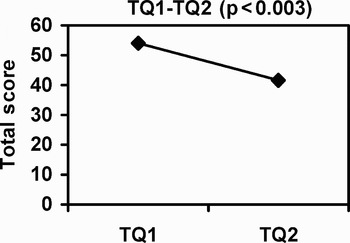
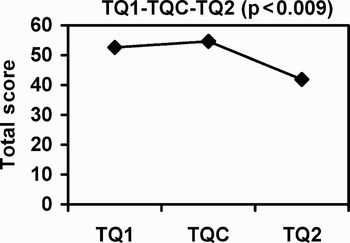
Figure 1 shows the results from the Hallam tinnitus questionnaire at the beginning and end of the study for the active group. Figure 2 shows the results from the control group at the beginning, prior to treatment and at the end of treatment.
Tinnitus questionnaire active group. TQ1 = before assessment; TQ2 = post-assessment

Tinnitus questionnaire control group. TQ1 = before assessment; TQ2 = post-assessment; TQC = control assessment

Figure 1 shows that there was a highly significant change in the active group from beginning to end. The control group (Figure 2) showed no significant change while awaiting treatment but highly significant improvement post-treatment.
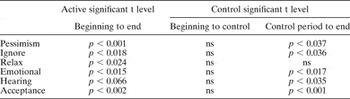
Table IV shows the changes in the six subscales of the Hallam questionnaire. The active group made significant positive changes across all variables of the subscales except for the effects of tinnitus on hearing. The control group showed no significant improvements while awaiting therapy but significantly improved post-therapy apart from the relaxation response.
Hallam tinnitus questionnaire subscales

ns = not significant
Hospital anxiety depression scale
There were no significant changes to the anxiety (pre treatment mean 9.4 to post-treatment mean 7.9) or depression (pre-treatment mean 4.8 to post-treatment mean 3.9) scores. (Lower scores indicate an improvement.)
Tinnitus visual analogue scale
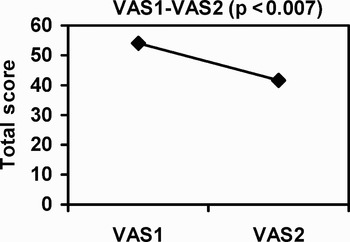
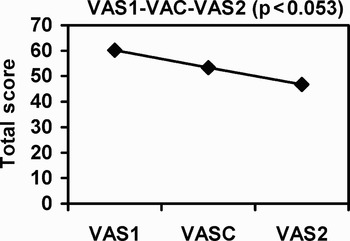
Figures 3 and 4 show the results of the visual analogue scale for tinnitus for the active group and the control group. The active group showed highly significant changes from pre- to post-treatment (p < 0.007) while the control group showed borderline changes while awaiting treatment only (p < 0.053).
Visual Analogue Scale active group. VAS1 = before assessment; VAS2 = post-assessment

Visual Analogue Scale control group. VAS1 = before assessment; VAS2 = post-assessment; VASC = control assessment

The satisfaction with life questionnaire
The satisfaction with life questionnaire showed significant changes only in the control group over two of the five variables, namely ‘conditions of life excellent’ (p = 0.035) and ‘satisfied with life’ (p = 0.023) with borderline results in ‘life as ideal’ (p = 0.053). The active group showed no significant change.
The tinnitus trigger questionnaire
This showed that 77 per cent of patients highlighted stressful life events associated with the onset or exacerbation of their tinnitus. The most commonly cited factors were illness or death in the family and occupational change, mainly retirement.
Four to six month follow up
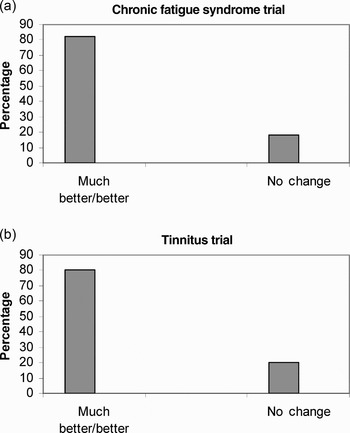
Patients were contacted four to six months after therapy and asked how they were post-treatment and at the present moment. The return rate was 60 per cent. Eighty per cent (12 patients) of the patients regarded themselves as better or much better immediately post-treatment, while 20 per cent (three) felt there was no change. At the four to six month period, of the 12 who improved originally, seven continued to make improvements, three maintained their improvement and two reported that the condition had worsened. The patients who showed a worsening in their perception of tinnitus had all suffered major stressors subsequent to therapy. Of the three who showed no change originally-one had become worse while the other two had remained the same during therapy. These scores fit well with the total Hallam scores pre- and post-treatment which showed that 17 per cent gave worse scores, 29 per cent showed 0–20 per cent improvement, 33 per cent showed a 20–40 per cent improvement and 21 per cent showed greater than a 40 per cent improvement.
Discussion
The aim of this study was to explore the usefulness of cognitive behavioural therapy/mindfulness meditation in the treatment of chronic tinnitus sufferers. This study consisted of a waiting list and control design where the therapeutic procedure was evaluated by two groups of patients, one of which acted as their own control by waiting three months before the commencement of treatment. The main outcome measures used were the modified Hallam questionnaire and its subdivisions as well as the visual analogue tinnitus distress questionnaire. The highly significant changes in the pessimism (p = 0.001) and acceptance (p = 0.002) variables of the modified Hallam questionnaire as well as the tinnitus VAS (p = 0.007) reflected the ability and confidence that patients had, to make a real difference to their tinnitus on both the psychological and physiological levels. It was also a reflection of their motivation as well as the value they placed in their capacity for change and the cognitive shift that took place during treatment. The correlation between the change in the Hallam scale and the VAS for tinnitus was significant (p = 0.05 level).
At the four to six month follow up 80 per cent of patients reported that they were better or much better. There was some drop off but by and large these outcomes were in line with other studies.Reference Folmer21, Reference Lindberg, Scott, Melin and Lyttkens35
The treatment philosophy outlined in this paper reflects Engel's biopsychosocial approach to health outcome, which takes into account the genetic vulnerability, personality, environmental inputs, psychological factors such as stress, lifestyle, attitudes, behaviour and social factors such as supportive relationships, economic well being, and family.Reference Engel36 This approach holds that the distress caused by tinnitus as well as other factors, is intimately connected by way of the input from the limbic system and the neurophysiological adaptation which is constantly taking place within the neuromatrix system. This hypothesis is supported by the high number of patients who reported psychosocial stressors as associated with the onset or the exacerbation of their tinnitus in this study as well as in those by other authors.Reference Holgers, Zoger and Svedlund37, Reference Falkenberg, Tungland and Skollerud38
Using this model, treatment is designed to facilitate habituation to both the tinnitus signal and to the tinnitus reaction. The use of mindfulness meditation coupled with concepts such as ‘remembered wellness’,Reference Benson39 provides behavioural techniques which patients can use on a daily basis to develop a sense of ownership and a higher sense of internal locus of control. This model has been successfully used in the treatment of irritable bowel syndrome, chronic fatigue syndrome and depression.Reference Sadlier and Stephens31, Reference Shaw, Srivastava, Sadlier, Swann, James and Rhodes40, Reference Teasdale, Segal, Williams, Ridgeway, Soulsby and Lau41 It is of note that the clinical outcomes of this trial are very similar to those achieved in our chronic fatigue syndrome trial using a similar approachReference Thomas, Sadlier and Smith42 (Figures 5a and b).
Clinical outcomes in (a) chronic fatigue syndrome trial and (b) tinnitus trial.

In a study by Ma and Teasdale on mindfulness-based cognitive therapy to reduce recurrence of depression, participants reported being able to develop a different (‘decentred’) relationship to their experience, so that their depression-inducing thoughts could be viewed from a wider perspective as they were occurring.Reference Ma and Teasdale43 As mindfulness-based cognitive therapy helps break the link between a negative experience and the negative thinking it would normally have triggered, it allows the individual to develop the capacity to allow distressing mood, thoughts and sensations to come and go, without having to battle with them. The use of mindfulness meditation, therefore, is a strategy that once learned, an individual can apply to other stressful or anxiety-related situations of which tinnitus is a case in hand.
Limitations of the study
The study is limited in the fact that the numbers were small and therefore can only act as a preliminary study. Another weakness is that the patients were not randomised prior to the commencement of the study but were allocated to the active or control group on a consecutive basis. The external validity of this study may be limited due to the fact that these patients represented tertiary referrals and therefore may not be applicable in general to other tinnitus sufferers.
• Cognitive behavioural therapy has been shown to help chronic tinnitus sufferers
• In this paper cognitive therapy and meditation were used successfully in a group of patients with tinnitus
• The paper concludes that meditation is a technique that can blend well with cognitive therapy and facilitates the habituation process
However, it must be remembered that tinnitus is a common experience and that most individuals who report tinnitus do not complain or seek treatment for it. This approach is designed for those distressed by their tinnitus. There was a predominance of women in the active group. While this does not reflect general trends which show an even distribution, there are trials which show a higher percentage of women.Reference Falkenberg, Tungland and Skollerud38, Reference Heller44, Reference Henry, Schechter, Loovis, Zaugg, Kaelin and Montero45
Using the waiting list control eliminated possible placebo effects from reassurance resulting from the clinical consultation. It is difficult to control further for a specific therapist effect, given the nature of the intervention, although, theoretically, some unrelated counselling could be provided. This, however, would raise a number of ethical problems.
Conclusion
Successful management of tinnitus involves providing the tinnitus complainant with strategies that allow both habituation to the presence of tinnitus as well as management of the impact of tinnitus. As the mindfulness meditation and cognitive behavioural approach attempts to uncouple the awareness of tinnitus from the experienced reaction, it can reduce the experience of suffering and can be employed at times associated with heightened tinnitus awareness. As the reaction to tinnitus is an individual one, this combination can be successfully tailored to the individual in order to address the particular needs and problems of a tinnitus complainant. This study, although limited, has shown itself to be effective in the treatment of chronic tinnitus sufferers. It has also proved successful in other areas of medically unexplained symptoms.