


Non-technical Summary
New records of two species of obruchevodid petalodont chondrichthyans are described from the Middle Mississippian Joppa Member of the Ste. Genevieve Formation from Mammoth Cave National Park, Kentucky. The two species are Clavusodens mcginnisi new genus new species, which had more robust crushing-type teeth for its kind, and ?Netsepoye sp., which is based on a partial tooth. These two records represent the oldest known obruchevodid petalodonts, which previously were known from younger Mississippian-age rocks in Montana and Alabama. Obruchevodid petalodonts were among the most specialized cartilaginous fishes during the Mississippian, potentially adapted to live in complex reef and reef-like habitats.
Introduction
The Carboniferous–Permian chondrichthyan order Petalodontiformes, or “petal-toothed sharks,” was a globally distributed and diverse group of cartilaginous fishes. Most early work on petalodonts was restricted to isolated or partial associated dentitions (Newberry and Worthen, Reference Newberry and Worthen1866; St. John and Worthen, Reference St. John and Worthen1875; Davis, Reference Davis1883; Hansen, Reference Hansen, Dutro and Pfefferkorn1985; Ginter et al., Reference Ginter, Hampe, Duffin and Schultze2010). More complete skeletal materials of the Late Mississippian petalodonts Belantsea montana Lund, Reference Lund1989, Netsepoye hawesi Lund, Reference Lund1989, and Siksika ottae, and the Permian petalodont Janassa bituminosa (Schlotheim, Reference Schlotheim1820) added better resolution on the diversity of body forms within Petalodontiformes (Jaekel, Reference Jaekel1899; Schaumberg, Reference Schaumberg1979; Lund, Reference Lund1989). Early work on petalodonts proposed that this order had close relationship ties with either elasmobranchs or holocephalans (Patterson, Reference Patterson1965; Zangerl, Reference Zangerl and Schultze1981; Hansen, Reference Hansen, Dutro and Pfefferkorn1985; Lund, Reference Lund1989; Ginter et al., Reference Ginter, Hampe, Duffin and Schultze2010). Recent work on more complete skeletal specimens suggested petalodonts may have had a sister relationship with crown holocephalans, united under the larger Euchondrocephali with eugenodonts, orodonts, and paraselachians (Grogan et al., Reference Grogan, Lund and Fath2014; Lund et al., Reference Lund, Grogan and Fath2014).
According to Lund et al. (Reference Lund, Grogan and Fath2014) the Petalodontiformes is divided into two distinct groups characterized by either homodont dentitions or heterodont dentitions. The homodont petalodonts include two families, Belantseidae (Belantsea) and Petalodontidae (Petalodus and Polyrhizodus), which have more simplified triangular-shaped crowns that only vary in size based on tooth-family position (Lund, Reference Lund1983, Reference Lund1989; Lund et al., Reference Lund, Grogan and Fath2014). The heterodont petalodonts are currently known from three families: Janassidae (Janassa, Strigilodus, Cholodus, Cypripediodens, and Cavusodus), Petalorhynchidae (Petalorhynchus), and Obruchevodidae (Lund et al., Reference Lund, Grogan and Fath2014; Hodnett et al., Reference Hodnett, Toomey, Olson, Tweet and Santucci2023). The obruchevodid petalodonts are of interest here, as they are considered to be the most heterodont petalodonts currently known.
Mississippian obruchevodid petalodonts
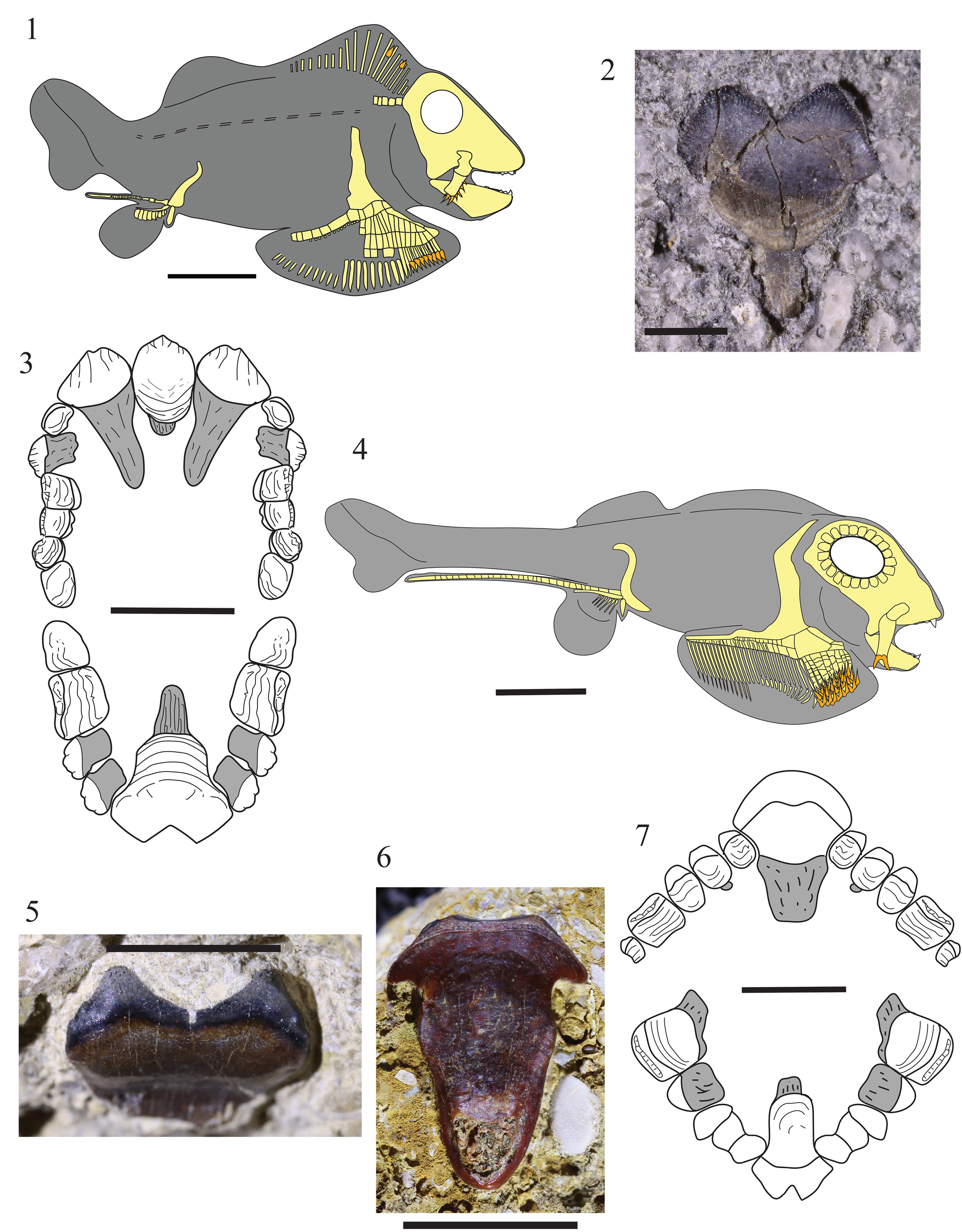
Obruchevodidae was recognized by Lund et al. (Reference Lund, Grogan and Fath2014) as a unique group of small dignathic heterodont petalodonts that included the taxa Obruchevodus griffithi Grogan, Lund, and Fath, Reference Grogan, Lund and Fath2014, Netsepoye hawesi, and Fissodopsis robustus Lund, Grogan, and Fath, Reference Grogan, Lund and Fath2014 (Fig. 1). These taxa share dentitions with a bifid Fissodus-like lower symphyseal tooth, a single-cusped upper symphyseal tooth, Ctenoptychius-like anterolateral teeth, and Janassa-like posterolateral teeth (Grogan et al., Reference Grogan, Lund and Fath2014; Lund et al., Reference Lund, Grogan and Fath2014; Fig. 1.3, 1.7). Both Netsepoye and Obruchevodus are represented by nearly complete body fossils showing they had relatively dorsoventrally deep and laterally compressed bodies, triangular heads with anteroventral mouths, males with large barbed denticles on the labial cartilage, enlarged pectoral fins with anterior barbed denticles, small dorsal fins, and males with relatively small pelvic fins with elongate claspers (Lund, Reference Lund1989; Grogan et al., Reference Grogan, Lund and Fath2014; Fig. 1.1, 1.4). All three taxa were initially only known from the Late Mississippian (Serpukhovian) Bear Gulch Limestone of the Heath Formation in central Montana. However, recently N. hawesi (Fig. 1.2) and F. robustus (Fig. 1.5, 1.6) have been identified from isolated symphyseal teeth from the Late Mississippian Bangor Limestone in northern Alabama (Egli et al., Reference Egli, Hodnett, Hodge and Ward2024). Here we report a new record of Middle Mississippian (Viséan) obruchevodid petalodonts from Mammoth Cave National Park, Kentucky found during National Park Service paleontological resource inventory work.
Late Mississippian obruchevodid petalodonts. (1–3) Netsepoye hawesi; (1) Reconstruction of the skeleton of Netsepoye hawesi based on holotype CM 46092 from the Heath Formation of Montana; (2) ALMNH:Paleo:20553, a lower symphyseal tooth of N. hawesi from the Bangor Limestone of northern Alabama; (3) revised reconstruction of the upper and lower dentition of N. hawesi. (4) Reconstruction of Obruchevodus griffithi, based on holotype CM 48833 from the Heath Formation of Montana. (5–7) Fissodopsis robustus: (5) ALMNH:Paleo:20556, upper symphyseal tooth; (6) ALMNH:Paleo:9774, partial lower symphyseal tooth; (7) revised reconstruction of the upper and lower dentition of F. robustus based on holotype CM 62710 from the Heath Formation of Montana. Scale bars: (1, 4) = 10 mm; (2, 5, 6) = 5 mm; (3) = 4 mm; (7) = 20 mm.

Geologic setting
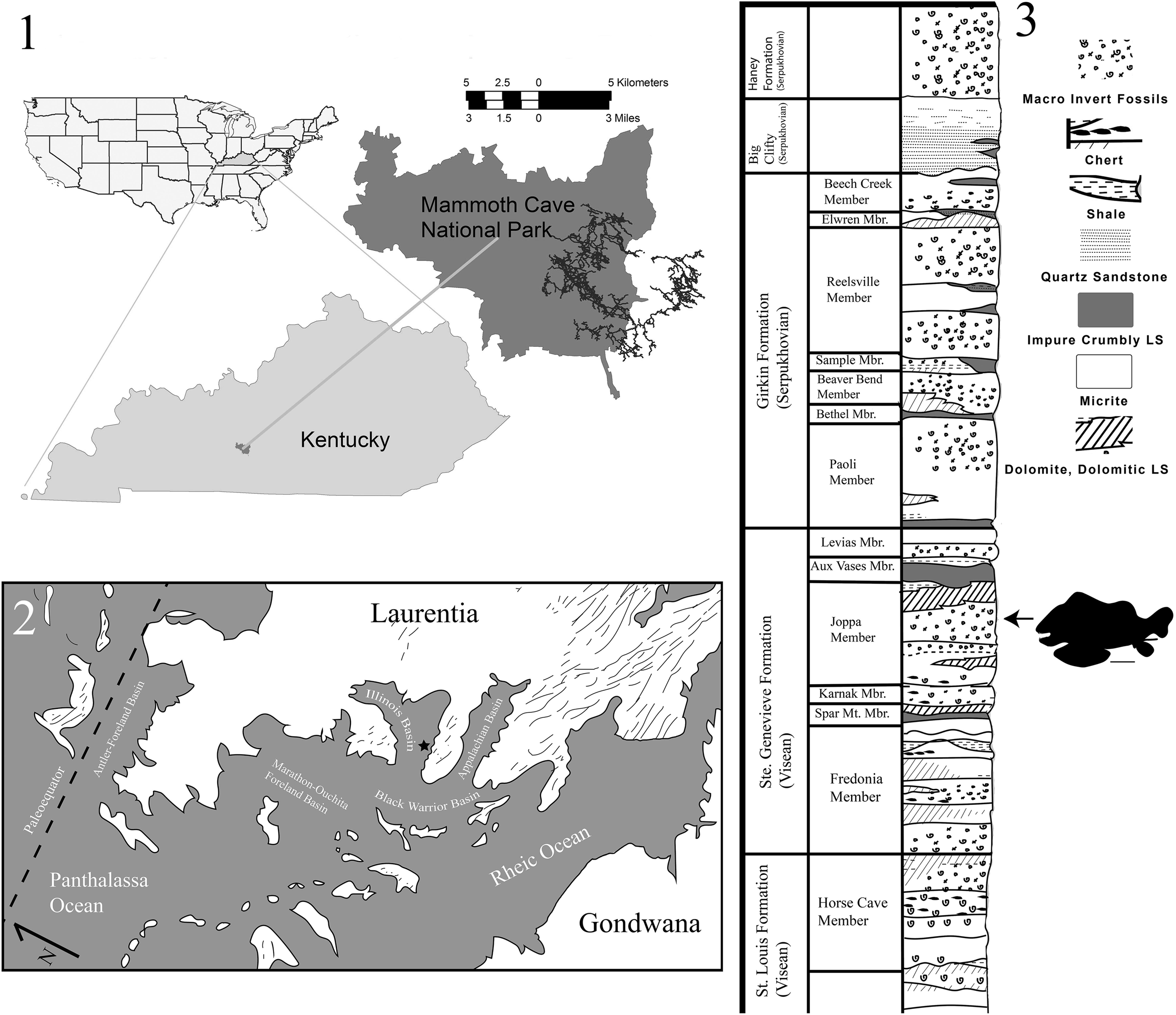
The Mississippian strata found at Mammoth Cave National Park in central Kentucky (Fig. 2.1) represent one of the southeasternmost portions of the ancient marine Illinois Basin (Fig. 2.2) (Palmer, Reference Palmer1981). The Illinois Basin is historically significant to early American paleoichthyology because a large number of middle to late Paleozoic fish fossils were collected and described from this basin in states such as Missouri, Illinois, Iowa, and Indiana (Newberry and Worthen, Reference Newberry and Worthen1866, Reference Newberry and Worthen1870; St. John and Worthen, Reference St. John and Worthen1875, Reference St. John and Worthen1883). At the time, these early collections were widely compared with similar fossils from Europe, which formed the basis for modern Paleozoic chondrichthyan paleoichthyology. The petalodont fossils presented here were collected from passageways within Mammoth Cave National Park, Kentucky that cut through the Middle Mississippian Joppa Member of the Ste. Genevieve Formation.
Location and stratigraphy of Mammoth Cave National Park, Kentucky. (1) Location of Mammoth Cave National Park in Kentucky; (2) relative paleogeographic position of Mammoth Cave National Park in the Illinois Marine Basin during the Middle Mississippian (Viséan) of Laurentia; (3) stratigraphic position of the obruchevodid petalodonts from the Joppa Member of the Ste. Genevieve Formation at Mammoth Cave National Park, Kentucky.

The Ste. Genevieve Formation stratigraphically overlies the St. Louis Formation and is recognized as Viséan/lower Chesterian (Thompson, Reference Thompson2001). The Ste. Genevieve Formation is locally 360–394 m thick and the majority of the passages of the Mammoth Cave System are developed in this formation (Palmer, Reference Palmer1981). This horizon consists primarily of light gray limestones and dolomitic limestones, with alternating thin dark, silty, granular limestones in the upper beds (Palmer, Reference Palmer1981). The large number of cave passages cutting through the Ste. Genevieve Formation has led to well-exposed fossils and fossil-bearing beds containing a prolific fossil record.
The Joppa Member of the Ste. Genevieve Formation at Mammoth Cave contains several biostrome beds rich with corals, bryozoans, brachiopods, and echinoderms (mainly crinoids and blastoids), separated by somewhat less fossiliferous zones (Fig. 2.3). These biostrome deposits are interpreted as a crinoidal “forest” that would have supported trophic feeding niches for a variety of Middle Mississippian fishes (Hodnett et al., Reference Hodnett, Toomey, Olson, Tolleson, Boldon, Wood, Tweet and Santucci2024a). Isolated chondrichthyan teeth, dermal spines, and denticles are common within multiple horizons of the Joppa Member at Mammoth Cave and isolated to partially articulated skeletal cartilage occurs as well. At present, more than 70 fish taxa have been identified from this geologic horizon (Hodnett et al., Reference Hodnett, Toomey, Olson, Tolleson, Boldon, Wood, Tweet and Santucci2024a), including the type specimens of the ctenacanths Troglocladodus trimblei Hodnett et al., Reference Hodnett, Toomey, Egli, Ward, Wood, Olson, Tolleson, Tweet and Santucci2024b, and Glikmanius careforum Hodnett et al., Reference Hodnett, Toomey, Egli, Ward, Wood, Olson, Tolleson, Tweet and Santucci2024b, and the janassid petalodont Strigilodus tollesonae Hodnett et al., Reference Hodnett, Toomey, Olson, Tweet and Santucci2023.
Materials and methods
Field work for the Mammoth Cave National Park Paleontological Resource Inventory (PRI) commenced in November 2019. At present, more than 25 caves and cave passages have been surveyed fully or in part as part of a concentrated effort to document, collect, and identify Mississippian vertebrate fossils. Space in field packs limits the amount of collecting gear to what can be safely carried through cave passages. That limitation and cave passage size and shape make collecting a challenge in some passages. Some sites require a rock saw or hammer and chisel to remove specimens while limiting breakage; in other passages, specimens can easily be teased out of the cave surfaces with a pointed tool such as a dental pick. Many of these sites have low ceilings requiring crawling for long distances on hands and knees, and at times belly crawling. The fish fossils are frequently encountered in the cave ceilings or walls.
To protect the fossils for transport to the surface, each fossil is wrapped either in paper towel or toilet paper and placed in a hard-sided container. Screw-capped sampling tubes lined with cotton balls are used for collecting smaller fossil teeth. The primary method is to remove all but one cotton ball, carefully tease the fossil from the cave surface (often the cave ceiling) into the tube, place a cotton ball on top, and continue to the next specimen. This is repeated until the tube is full, and locality information is recorded on the tube. This method is extremely useful in areas where there is a high concentration of vertebrate fossils in a small area. All Mammoth Cave specimens are housed in the Mammoth Cave National Park Museum Collections.
Scanning electron microscopy was conducted at the Western Kentucky University Biology Department Electron Microscopy lab using a JEOL6510 LV scanning electron microscope. Photographs of the fossils presented here were captured with an AmScope camera mounted on a stereoscope microscope with a metric scale bar. Figures were created with Adobe Illustrator 2023 and Photoshop 2023.
Repositories and institutional abbreviations
ALMNH: Paleo: Alabama Museum of Natural History, Tuscaloosa, Alabama; CM: Carnegie Museum of Natural History, Pittsburgh, Pennsylvania; MACA: Mammoth Cave National Park, Kentucky.
Systematic paleontology
Class Chondrichthyes Huxley, Reference Huxley1880
Subclass Euchondrocephali Lund and Grogan, Reference Lund and Grogan1997
Order Petalodontiformes Patterson, Reference Patterson1965
Family Obruchevodidae Lund, Grogan, and Fath, Reference Lund, Grogan and Fath2014
Genus Clavusodens new genus
Type species
Clavusodens mcginnisi n. gen. n. sp., this work.
Diagnosis
As for type species by monotypy.
Occurrence
Mammoth Cave National Park, Kentucky, Middle Mississippian (upper Viséan) Joppa Member, Ste. Genevieve Formation.
Etymology
Latin, clavus (nail), and dents (tooth); in recognition of the nail-like shape of the distal lateral teeth.
Life Science Identifier
urn:lsid:zoobank.org:act:2A61340B-A18A-4422-9919-823A6FA98BA2.
Remarks
See Comparison and remarks for Clavusodens mcginnisi n. gen. n. sp., below.
Clavusodens mcginnisi new species
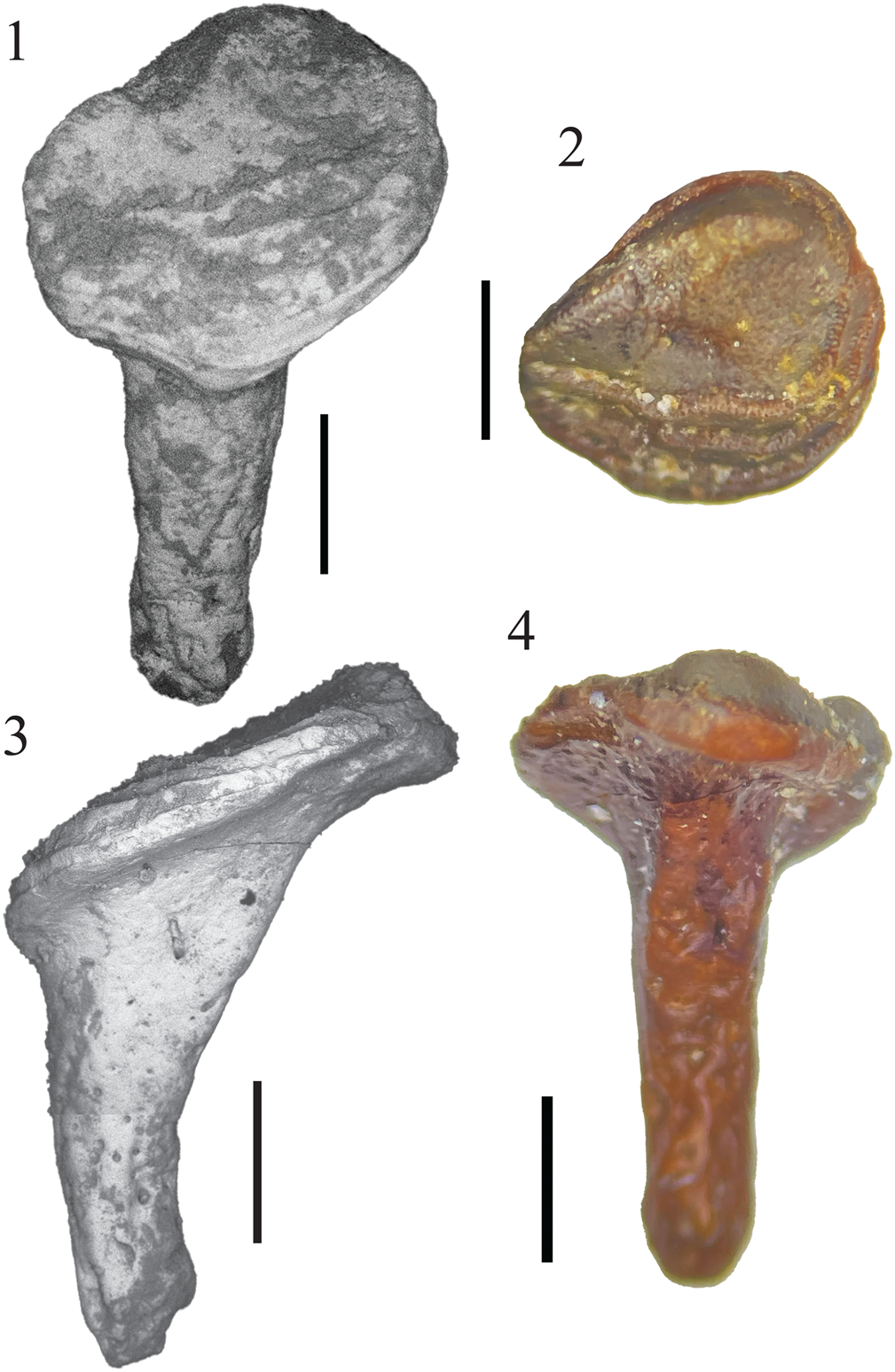
MACA 62284, the holotype (a complete distolateral tooth) of Clavusodens mcginnisi n. gen. n. sp. (1) Lingual view, (2) oral view, (3) mesial view, (4) labial view. Scale = 2 mm.

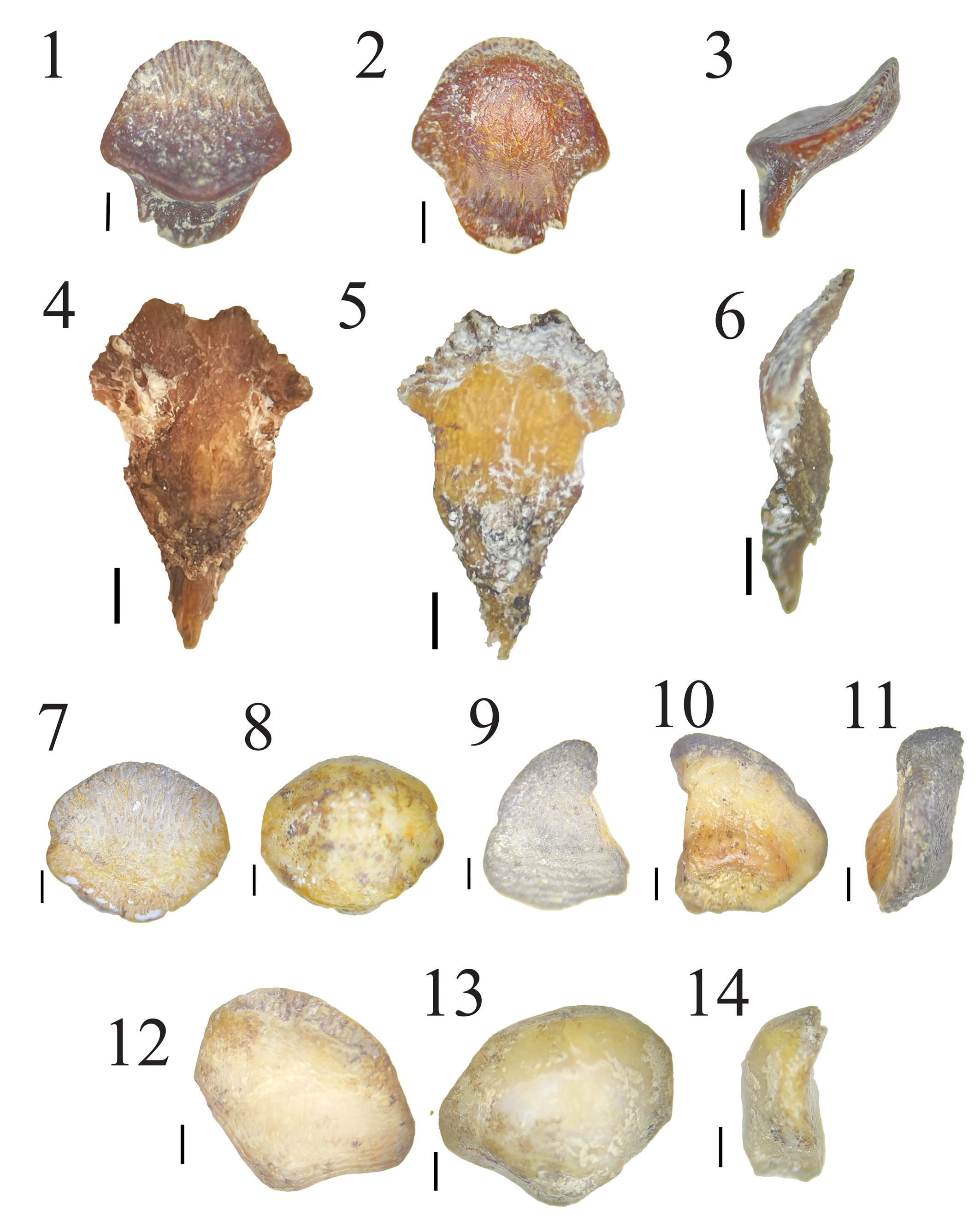
Referred specimens of Clavusodens mcginnisi n. gen. n. sp. (1–3) MACA 62285, an upper symphyseal tooth in (1) lingual, (2) labial, and (3) distal views. (4–6) MACA 62339, a lower symphyseal tooth in (4) lingual, (5) labial, and (6) distal views. (7, 8) MACA 62018, an anterolateral tooth in (7) lingual, (8) labial views. (9–11) MACA 62264, an anterolateral tooth in (9) lingual, (10) aboral, and (11) distal views. (12–14) MACA 62763, a distolateral tooth in (12) orolingual, (13) aboral, and (14) mesial views. Scale = 1 mm.

Holotype
MACA 62284, a complete distolateral tooth (Fig. 3).
Diagnosis
Small obruchevodid petalodont shark with heterodont dentition bearing pointed mesiodistal and lingual margins on the crown. The upper symphyseal tooth is relatively tall, with rounded chisel-like cusp, lingual side with two minor lower lingual plications, and tooth base flat labiolingually and wide mesiodistally. The lower symphyseal tooth is relatively tall, the trenchant crown bifid with narrow pointed mesiodistal margins, the lingual surface with two slight mesiodistal basins between the crown and the lingual heel, the lingual heel bearing four slight shallowly u-shaped and well-spaced plications, and the tooth base long and narrow. Anterolateral teeth wider mesiodistally than tall, with relatively rounded shallow chisel-like cusps and lingual surface with two to six plications. Distolateral teeth wider mesiodistally than tall, crown bearing two short cusps or a single notched cusp, a small labial ridge present, lingual surface relatively flat with three to four lingual plications, and tooth base long and narrow.
Occurrence
Mammoth Cave National Park, Kentucky, Middle Mississippian (upper Viséan) Joppa Member, Ste. Genevieve Formation.
Description
Teeth range in labiolingual crown height from 6 to 7 millimeters. All teeth share relatively pointed mesiodistal and lingual margins of the crown over a tooth base that originates labially and is positioned above the lingual heel.
The upper symphyseal tooth (MACA 62285; Fig. 4.1–4.3) has a broad rhomboidal crown and an almost chisel-like cusp with a rounded carina. The lingual surface does not bear any evidence of a basin and has two slight plications near the lingual margin. The tooth base of the upper symphyseal tooth is flattened labiolingually and relatively broad mesiodistally with a number of small foramina on the labial and lingual surfaces.
The relatively sigmoidal lower symphyseal tooth (MACA 62339; Fig. 4.4–4.6) has a relatively tall crown with a trenchant bifid cusp. The small notch between the two short cuspids is u-shaped. The lateral margins of the cusp are steeply angled and expanded mesiodistally. Two small lingual basins are present on the distal margins between the cusp and beginnings of the lingual heel. The lingual surface bears four slightly pronounced shallowly u-shaped plications that end at the pointed lingual heel. The long and narrow tooth base originates on the lower labial side of the tooth, positioned above the lingual heel.
The anterolateral teeth (MACA 62018 and 62264; Fig. 4.7–4.11) are mesiolaterally wider than tall and have a less expanded lingual heel. The crown is relatively ovate in shape and has a mesiodistally broad chisel-like cusp. Both samples show the lingual surface of the crown was relatively flat between the cusp and the lingual margin. We propose that MACA 62018 was most likely positioned closer to the symphyseal tooth position due to its higher cusp height and two lingual plications, compared to MACA 62264, which has a lower crown and six lingual plications.
The crowns of the distolateral teeth, MACA 62284 (holotype, Fig. 3) and MACA 62763 (Fig. 4.12–4.14), are generally ovate in shape, with a pointed lingual margin. There are two low cusps or a single low cusp with a distinct notch, with the mesial side being longer and more prominent than the distal side. A distinct labial ridge is present just below the cusp. The lingual surface is relatively flat between the cusp and three to four u-shaped plications. The peg-like tooth base is long and narrow, with a number of small foramina present on all sides of the base.
Etymology
In honor of retired National Park Service superintendent and naturalist David McGinnis for his leadership in paleontological resource stewardship during his 39-year career beginning at Mammoth Cave National Park.
Additional material
MACA 62018, anterolateral tooth; MACA 62264, anterolateral tooth; MACA 62285, upper symphyseal tooth; MACA 62339, lower symphyseal tooth; MACA 62763, distolateral tooth (Fig. 4).
Life Science Identifier
urn:lsid:zoobank.org:act:A0D08023-C905-402E-8C00-1C8F0CE75FE2.
Comparison and remarks
The teeth referred here to Clavusodens mcginnisi n. gen. n. sp. were found as isolated elements distributed throughout the Joppa Member of the Ste. Genevieve Formation at Mammoth Cave National Park. However, these teeth are united as a distinct new taxon because all the teeth bear pointed mesiodistal and lingual margins on the crowns, while sharing the obruchevodid traits of a lower bifid symphyseal tooth with an elongated lingual heel, upper symphyseal tooth with a broad singular cusp, posterolateral teeth with broad crowns with low cusps, and a few u-shaped lingual plications (Lund, Reference Lund1989; Grogan et al., Reference Grogan, Lund and Fath2014; Lund et al., Reference Lund, Grogan and Fath2014).
Clavusodens n. gen. shares a lower bifid symphyseal tooth with a relatively elongated lingual heel with obruchevodid petalodont genera such as Netsepoye and Fissodopsis (Lund, Reference Lund1989; Grogan et al., Reference Grogan, Lund and Fath2014; Lund et al., Reference Lund, Grogan and Fath2014). The lower symphyseal tooth of the type specimen of Obruchevodus griffithi (CM 48833) is obscured by the upper symphyseal tooth and not available for comparison (Grogan et al., Reference Grogan, Lund and Fath2014). The lower symphyseal teeth of Clavusodens n. gen. and Fissodopsis differ from Netsepoye in having the crown, bifid notch, and lingual heel less expanded mesiodistally. In comparison, Clavusodens n. gen. differs from Fissodopsis in having a shallow u-shaped bifid notch, more prominent pointed distal margins of the cusp, and a more expanded lingual heel with a pointed lingual margin. Other petalodonts with a bifid lower symphyseal tooth include Siksika ottae, “Ctenoptychius” (Janassa) korni (Weigelt, Reference Weigelt1930), Petalorhynchus beargulchensis Lund, Reference Lund1989, and Fissodus bifidus St. John and Worthen, Reference St. John and Worthen1875 (St. John and Worthen, Reference St. John and Worthen1875 Lund, Reference Lund1989; Brandt, Reference Brandt1996; Lund et al., Reference Lund, Grogan and Fath2014). Clavusodens n. gen. differs from Siksika in lacking prominent cusplets on the carina. The lower symphyseal teeth of Petalorhynchus beargulchensis and Fissodus bifidus are similar in having a more expanded upper portion to the lingual heel, forming a wedge-like shape, which is straight in this region in Clavusodens n. gen., Netsepoye, and Fissodopsis. In “Ctenoptychius” (Janassa) korni, the crown of the lower symphyseal tooth appears to be more rectangular in overall shape and bears an additional lateral cuspid with a less labiolingually expanded lingual heel (Brandt, Reference Brandt1996, Reference Brandt2009; Lund et al., Reference Lund, Grogan and Fath2014).
The upper symphyseal tooth of Clavusodens n. gen. is similar to Fissodopsis in being more spoon-like in shape with a smooth carina, compared to the “blade-like” with cusplets morphology seen in Netsepoye and Obruchevodus (Lund, Reference Lund1989; Grogan et al., Reference Grogan, Lund and Fath2014; Lund et al., Reference Lund, Grogan and Fath2014). However, Fissodopsis lacks the pointed lingual heel seen in Clavusodens n. gen. The anterolateral teeth of Clavusodens n. gen. have more robust and thicker chisel-like carinae and lack cusplets, whereas the crowns are more blade-like and have prominent cusplets in Netsepoye, Fissodopsis, and Obruchevodus (Lund, Reference Lund1989; Grogan et al., Reference Grogan, Lund and Fath2014; Lund et al., Reference Lund, Grogan and Fath2014). The posterolateral teeth of Clavusodens n. gen. also share broad crowns with low cusps and a few u-shaped lingual plications with Netsepoye, Fissodopsis, and Obruchevodus (Lund, Reference Lund1989; Grogan et al., Reference Grogan, Lund and Fath2014; Lund et al., Reference Lund, Grogan and Fath2014). Clavusodens n. gen. is unique in having thicker chisel-like cusps lacking cusplets and a pointed lingual heel on the posterolateral teeth.
Clavusodens n. gen. and other obruchevodid petalodonts differ from members of the Petalodontidae (e.g., Petalodus, Antilodus, Polyrhizodus, etc.) and Belantseidae (Belantsea) in having heterodont dentitions consisting of a bifid lower symphyseal tooth and upper and lower molariform-like posterior teeth (Grogan et al., Reference Grogan, Lund and Fath2014; Lund et al., Reference Lund, Grogan and Fath2014). The lingual plications in Petalodontidae and Belantseidae tend to consist of thin closely spaced straight to u-shaped ridges, while in Clavusodens n. gen. and other obruchevodids the lingual plications are more widely spaced apart. Petalodontids, Siksika, and Belantsea all lack a well-defined lingual heel on the dentition, unlike what is seen in obruchevodids, janassids, and petalorhynchids, in which the lingual heel is prominent (Lund et al., Reference Lund, Grogan and Fath2014). Janassid and petalorhynchid petalodonts have elongated lingual heels, with janassids having more numerous and closely spaced lingual plications and petalorhynchids having fewer and more widely spaced plications (Hodnett et al., Reference Hodnett, Toomey, Olson, Tweet and Santucci2023). Clavusodens n. gen. and other obruchevodids have less elongate lingual heels and a smaller number of lingual plications.
Genus Netsepoye Lund, Reference Lund1989
Type species
CM 46092 (holotype), Netsepoye hawesi, small nearly complete individual preserving jaws, body, and fins, in part and counterpart from the Upper Mississippian (Serpukhovian) Bear Gulch Limestone Member of the Heath Formation, Big Snowy Group, south of Becket, Fergus County, Montana (Lund, Reference Lund1989).
?Netsepoye sp.
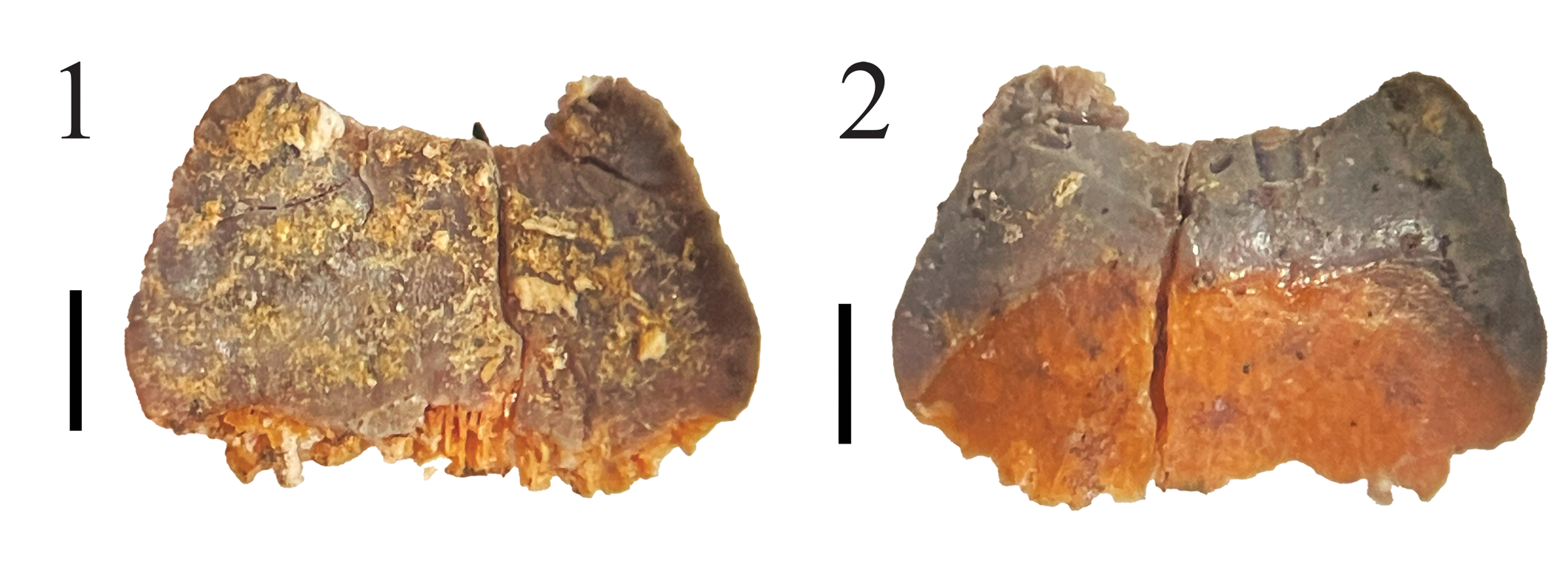
MACA 65110, the partial lower symphyseal of ?Netsepoye sp., in (1) lingual and (2) labial views. Scale = 1 mm.

Description
A partial bifid lower symphyseal tooth missing the lingual shelf and tooth base, measuring approximately 5 mm mesiodistally wide and 3 mm tall as preserved (Fig. 5.). The two cuspids are low, divided by a relatively deep u-shape notch. The distal margins have small cusplets that extend up from the widest point of the crown to the cuspid point. The labial margin is recurved, and the lingual surface is convex.
Materials
MACA 65110, a partial lower symphyseal tooth.
Remarks
Netsepoye hawesi is based on a nearly complete skeleton with a damaged cranium, dentition, and much of the body and fins (Lund, Reference Lund1989; Grogan et al., Reference Grogan, Lund and Fath2014; Fig. 1.1). The lower symphyseal tooth of N. hawesi has a mesiodistally broad bifid cusp with a deep v-shaped notch between two triangular cuspids, and the lingual shelf is relatively broad with four to five u-shaped plications. The tooth base is long and narrow (Grogan et al., Reference Grogan, Lund and Fath2014; Lund et al., Reference Lund, Grogan and Fath2014). A similar symphyseal tooth (ALMNH:Paleo:20553; Fig. 1.2) has been uncovered from the Late Mississippian Bangor Limestone in northern Alabama, marking the first record of N. hawesi outside of the Bear Gulch Limestone in Montana (Egli et al., Reference Egli, Hodnett, Hodge and Ward2024).
We tentatively refer MACA 65110 to the genus Netsepoye due to its similarly mesiodistally wide bifid cusp (Lund et al., Reference Lund, Grogan and Fath2014). Like Netsepoye, this specimen also has relatively broad cuspids and a broad notch between the two (Grogan et al., Reference Grogan, Lund and Fath2014; Lund et al., Reference Lund, Grogan and Fath2014). However, the presence of small cusplets along the distal margins of the crown and the low u-shaped form of the notch between the two cuspids differ from the type specimen and the Bangor specimen, both of which lack distal cusplets and have a deep v-shaped notch between the cuspids. Small cusplets are also present on the symphyseal and lateral dentition of the petalodonts Siksika ottae, Belantsea montana, Obruchevodus griffithi, and Fissodopsis robustus (Lund, Reference Lund1989; Grogan et al., Reference Grogan, Lund and Fath2014; Lund et al., Reference Lund, Grogan and Fath2014); however, the general morphology of the crown in the Mammoth Cave specimen is most similar to Netsepoye.
Discussion and conclusions
The presence of the small obruchevodid petalodonts Clavusodens mcginnisi n. gen. n. sp. and ?Netsepoye sp. within the Joppa Member of the Ste. Genevieve Formation at Mammoth Cave National Park, Kentucky, previously known only from the Late Mississippian (Serpukhovian) (Lund, Reference Lund1989; Grogan et al., Reference Grogan, Lund and Fath2014; Lund et al., Reference Lund, Grogan and Fath2014; Egli et al., Reference Egli, Hodnett, Hodge and Ward2024), extends the temporal record of obruchevodid petalodonts into the Middle Mississippian (Viséan). These taxa also add to the growing chondrichthyan assemblage of the Joppa Member of the Ste. Genevieve Formation, which already shows a high degree of diversity with at least 70 taxa reported (Hodnett et al., Reference Hodnett, Toomey, Olson, Tweet and Santucci2023, Reference Hodnett, Toomey, Olson, Tolleson, Boldon, Wood, Tweet and Santucci2024a, Reference Hodnett, Toomey, Egli, Ward, Wood, Olson, Tolleson, Tweet and Santuccib). At Mammoth Cave, petalodont teeth are generally common, with Hodnett et al. (Reference Hodnett, Toomey, Olson, Tweet and Santucci2023, Reference Hodnett, Toomey, Olson, Tolleson, Boldon, Wood, Tweet and Santucci2024a) reporting at least 11 species of petalodontiforms from the Joppa Member of the Ste. Genevieve Formation: Petalodus hastingsii Owen, Reference Owen1840, P. linguifer Newberry and Worthen, Reference Newberry and Worthen1866, “Petalodus sp. nov.”, “? Petalodus sp.,” Antilodus sp., “?Lisgodus sp.,” Harpacodus sp., Strigilodus tollesonae, Janassa sp., Petalorhynchus cf. P. spatulatus St. John and Worthen, Reference St. John and Worthen1875, and Petalorhynchus sp. Of these 11 petalodont taxa, Petalodus linguifer, “?Lisgodus sp.,” Strigilodus tollesonae, and Petalorhynchus cf. P. spatulatus are common (10 or more specimens per passage locality) throughout the Joppa Member, with the other taxa represented by a few or a single specimen. The obruchevodid petalodonts Clavusodens mcginnisi n. gen. n. sp. and Netsepoye sp. are rare within the Joppa Member interval in Mammoth Cave, which reflects their rarity in the Late Mississippian Bear Gulch and northern Alabama localities as well. Although there are at least three genera of obruchevodid petalodonts, two of which (Netsepoye and Obruchevodus) are known from significant body fossils, all are known only from single specimens within the Bear Gulch Limestone (Grogan et al., Reference Grogan, Lund and Fath2014; Lund et al., Reference Lund, Grogan and Fath2014). This rarity is also seen in the Bangor Limestone localities in northern Alabama, where only a few isolated teeth of Fissodopsis robustus are known from one locality and a single Netsepoye hawesi tooth is known from another (Egli et al., Reference Egli, Hodnett, Hodge and Ward2024).
One explanation for this rarity is that obruchevodid petalodonts were highly specialized to live in complex environments and potentially did not have large population numbers in a given locality. Lund et al. (Reference Lund, Greenfest-Allen and Grogan2015) noted this in their overview of chondrichthyans and osteichthyans from the Bear Gulch Limestone in which they classified fishes with compressed deep bodies and sub-terminal mouths in their E6 ecomorphotype, which includes the obruchevodids and other petalodonts and some types of actinopterygians. These taxa had plucking–crushing dentitions interpreted as having been used to feed within the dynamic environments of tropical reefs (Sale, Reference Sale1977). Lund et al. (Reference Lund, Greenfest-Allen and Grogan2015) further suggested that obruchevodid petalodonts had dentitions analogous to extant triggerfish (Tetradontiformes, Balistidae), which are non-gregarious actinopterygians that live in shallow waters (sea surface to 50 m depth), particularly around tropical reefs, and are known to feed on echinoderms, crustaceans, and mollusks (Wainwright and Richard, Reference Wainwright and Richard1995; Matsuura, Reference Matsuura2015; McCord and Westneat, Reference McCord and Westneat2016). Lund et al. (Reference Lund, Greenfest-Allen and Grogan2015) noted that the environment in which the majority of petalodonts were collected from the Bear Gulch Limestone represented the lower reaches of the muddy Bear Gulch Bay. This has been interpreted as the most complex of habitats within the Bear Gulch Bay system, with a high number of E6 ecomorphotype fishes (Grogan and Lund, Reference Grogan and Lund2002; Lund et al., Reference Lund, Greenfest-Allen and Grogan2015). Although obruchevodid petalodonts appear to be rare, the invertebrate-dominated biostrome and bioherm reef beds of the Joppa Member of the Ste. Genevieve Formation and Bangor Limestone may have been more favorable environments for obruchevodid petalodonts, based on the greater number of individual specimens collected in these geologic horizons. As noted above, the Joppa Member of the Ste. Genevieve Formation is a biostrome deposit formed from skeletal fragments derived from horn corals, tabulate corals, brachiopods, blastoids, and crinoids, contributing to the crinoidal “forest” habitat for the Joppa petalodonts.
Petalodonts are often described and depicted as feeding on hard-shelled invertebrates (Janvier, Reference Janvier1996; Ginter et al., Reference Ginter, Hampe, Duffin and Schultze2010). Unfortunately, little work has been done on tooth biomechanics in relation to prey choice in petalodonts. Most current work on the relationship of chondrichthyan teeth to prey selection has been focused on the biomechanics of elasmobranch and elasmobranch-like shark teeth in relation to prey types (Whitenack et al., Reference Whitenack, Simkins and Motta2011; Cooper et al., Reference Cooper, Griffin, Kindlimann and Pimiento2023). The variation in the heterodont and homodont dentitions seen in obruchevodid petalodonts and Belantsea is most likely a result of niche partitioning to feed on specific hard- and soft-bodied invertebrate prey, algae, and larval and small fish. Similar niche partitions are also observed in extant triggerfish, which have been classified into generalist feeders, algae/plankton eaters, and durophagous predators (McCord and Westneat, Reference McCord and Westneat2016). The most direct evidence of prey choice by heterodont petalodonts is seen in the type specimen of N. hawesi, which preserves a digestive bolus in the abdominal cavity with valves of the brachiopod Lingula and indeterminate crustacean fragments (Lund, Reference Lund1989).
Lastly, as a comment on the potential ecomorphology of petalodonts, the obruchevodid and belantseid petalodonts appear to have had uniquely adapted body morphologies not seen in other contemporaneous or extant chondrichthyans. Compagno (Reference Compagno1990) reviewed life-history styles within chondrichthyans in time and space and derived 27 unique ecomorphotypes for extinct and extant taxa. In this review, the only petalodont group to fit within these classifications was the janassids (typified by Janassa bituminosa) in the rhinobenthic habitus (Compagno, Reference Compagno1990). The rhinobenthic habitus includes chondrichthyans that evolved flattened bodies, enlarged paired fins, crushing dentitions, and enlarged snouts in front of the jaws to probe benthic substrates for invertebrate prey (Compagno, Reference Compagno1990).
In contrast, Compagno (Reference Compagno1990) did not establish an ecomorphotype for hyperbenthic chondrichthyans that had specializations for complex environments such as reefs. The dignathic heterodont obruchevodids and the homodont Belantsea shared similar body traits: dorsoventrally deep and laterally compressed bodies with enlarged pectoral fins for maneuverability that would aid in moving through tropical crinoidal forest reefs typical of the Mississippian (Lund et al., Reference Lund, Greenfest-Allen and Grogan2015).
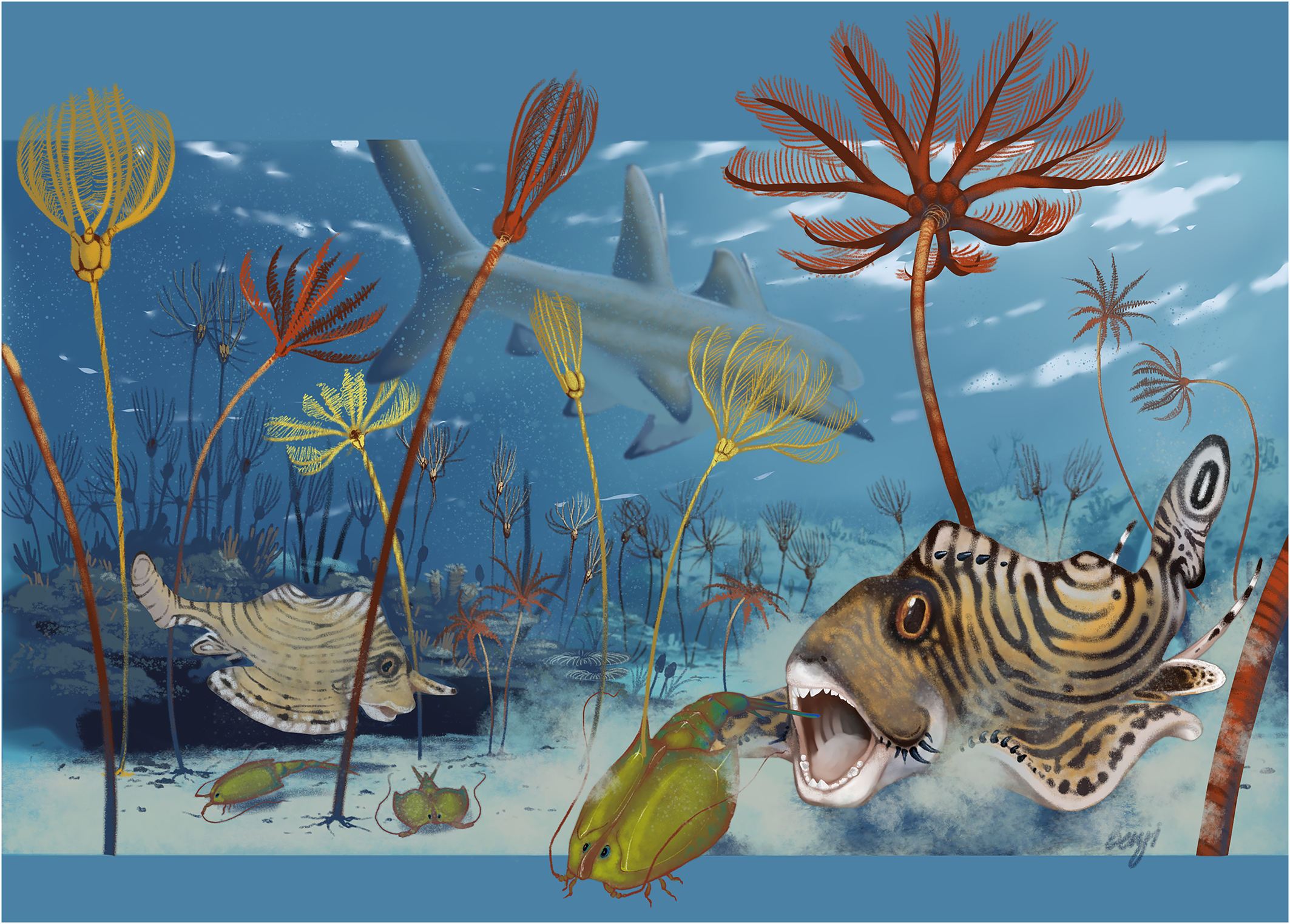
Until further work on modeling the body and dental mechanics of petalodonts is available, we tentatively follow Lund et al.'s (Reference Lund, Greenfest-Allen and Grogan2015) suggestion that the obruchevodid petalodonts and Belantsea were most likely adapted to inhabit the complex environments of reefs, crinoidal forests, and other shallow near shore habitats, with a feeding ecology analogous to extant members of the bony fish order Tetradontiformes (Fig. 6.). It should be noted, however, that the petalodont body form has not yet been modeled to determine how it would perform in hydrostatic and hydrodynamic conditions, and the above suggested habitus model for obruchevodid and belantseid petalodonts is currently speculative.
Tentative reconstruction of Clavusodens mcginnisi n. gen. n. sp. (modeled after Netsepoye) feeding on phyllocarid crustaceans on the sea floor of a crinoidal forest from the Joppa Member of the Ste. Genevieve Formation, with the ctenacanth Glikmanius careforum swimming overhead. Art by Benji Paysnoe.

Acknowledgments
We are greatly indebted to Mammoth Cave National Park (MACA) Superintendent B. Trimble and former head of the MACA Science and Resource Management unit, T. Pinion, for their support of our paleontological resource inventory and research into the Mississippian fish assemblages. The success of our Mammoth Cave PRI project is due to a dedicated group of staff and volunteers who have helped us document new fossil localities and spot new fossils within the passages of Mammoth Cave. We thank K. Alessi, B. Belanger, K. Bobo, J.M. Bovis, M. Cecil, M. Cleveland, J. Douglas, A.R. Flowers, C. Groves, M. Harris, J. Honaker, E. Jakaitis, P. Kambesis, N. Leies, M. May, K. Mikowski, M. Schorr, S. South, B. Trimble, and E. Winkler for their assistance in the field. We thank J. Aldersland, F. Johnson, and B. Hale at Western Kentucky University's Biology Electron Microscopy lab for their assistance in imaging our microvertebrate fossils used in this study. We thank G. Ward and C. Hodge for their work in collecting specimens from the Bangor Limestone in northern Alabama. We thank A. Klompmaker and S. Ebersole of the Alabama Museum of Natural History at the University of Alabama and Alabama Geological Survey for their assistance and support with this project. Special thanks to B. Paysnoe for creating the environmental scene for Figure 6. We sincerely thank W. Itano and an anonymous reviewer for reviewing this manuscript and providing important feedback and edits.
Competing interests
No potential conflict of interest was reported by the author(s).