1. INTRODUCTION
Children's acquisition of verb placement is an important object of study for both generativist and constructivist language acquisition researchers. A major theoretical dispute between generativists and constructivists concerns whether young children have access to syntactic structure and grammatical rules. According to generativist approaches, Universal Grammar (UG) provides children with syntactic structure, grammatical operations, constraints, etc. (Chomsky Reference Chomsky1965 and later). Children simply have to learn how to employ these grammatical operations and constraints in a language-specific manner. For example, whereas the movement operation is innate, the child has to learn how to use movement in the language to be learned. A rule-based account predicts that the presence of syntactic structure, grammatical rules and constraints is evident in young children's production (Poeppel & Wexler Reference Poeppel and Wexler1993; Santelmann Reference Santelmann1995; Westergaard Reference Westergaard2009b). Constructivist approaches, on the other hand, assert that young children's production does not reflect any syntactic structure or grammatical rules. Language acquisition is a distributional analysis of the input, and children's early utterances consist of chunks of word combinations extracted from the input. The frequency of word combinations in the input is of vital importance when accounting for children's early target forms, as well as for non-target-consistent utterances (Akhtar Reference Akhtar1999; Rowland & Pine Reference Rowland and Pine2000, Reference Rowland and Pine2003; Tomasello Reference Tomasello2003; Ambridge et al. Reference Ambridge, Rowland, Theakston and Tomasello2006). An item-based account predicts that highly frequent word combinations in the input are more likely to be extracted early by children than low frequent ones.
This paper discusses rule-based and item-based learning in relation to the acquisition of verb second (V2) in Swedish. In Swedish, V2 means that the finite verb is the second constituent in declarative main clauses and wh-questions. Subject–verb inversion occurs in non-subject-initial clauses. The sentences in (1) provide some Swedish examples with V2 word order. Verb third (V3) is generally not accepted, as shown by the corresponding ungrammatical examples in (2).
(1)


(2)
By contrast, Swedish subordinate clauses are not characterized by V2. The finite verb appears after sentence adverbials and negation, a word order which will be referred to as non-V2. An example with non-V2 is provided in the sentence in (3).
(3)
The position of the finite verb in main clauses has attracted much attention in the language acquisition literature. For example, studies of children acquiring a wide range of V2 languages, e.g. Dutch, German, Icelandic, Norwegian and Swedish, report that finite verbs typically occur in second position already at an early age (Clahsen Reference Clahsen1990/1991; Santelmann Reference Santelmann1995; Bohnacker Reference Bohnacker1999; Blom Reference Blom2003; Westergaard Reference Westergaard2009a). A rule-based account of children's target forms asserts that young children have access to the relevant syntactic structure and operations, placing the finite verb in second position (e.g. Santelmann Reference Santelmann1995), whereas an item-based account attributes target forms to highly frequent word combinations in children's input (e.g. Rowland & Pine Reference Rowland and Pine2000, Reference Rowland and Pine2003).
This paper presents new and important empirical data on the acquisition of V2 word order. The data are taken from one Swedish child named Tea during the age period 1;6–4;0 (i.e. from one year and six months to four years), and it challenges the notion of an early and nearly flawless acquisition of V2, showing that the acquisition of V2 may not always be as straightforward as previously reported in the literature. The data also challenge item-based learning, concluding that the acquisition of verb placement must be the result of a rule-based process.
The article is organized as follows: the next section provides the theoretical framework of the study and presents a generative analysis of verb second. Section 3 reviews previous research on child acquisition of V2. The methods and the material are discussed in Section 4, and the results are presented in Section 5. A discussion follows in Section 6.
2. THEORETICAL BACKGROUND: VERB SECOND IN SWEDISH
In transformational generative grammar, word order differences are the result of an operation which moves constituents from one position in the clause to another. V2 and non-V2 word orders have traditionally been related to verb movement (see e.g. den Besten Reference den Besten and Abraham1983; Holmberg & Platzack Reference Holmberg and Platzack1995; Schwartz & Vikner Reference Schwartz, Vikner, Belletti and Rizzi1996). Within this view, verbs are assumed to merge in V, and, if finite, move (via I) to C to satisfy the V2 constraint in main clauses, as shown for sentence (1b) in structure (4a) below.Footnote 1 In declarative main clauses and wh-questions, a constituent moves to Spec-CP to establish linear V2, see (4a). Non-V2 is the result of absence of verb movement, due to the presence of a complementizer in C, as shown for the subordinate clause of sentence (3) in structure (4b). The position of negation is typically between the I- and V-domain in Swedish (Teleman et al. Reference Teleman, Hellberg, Andersson and Christensen1999b:90–92), which means that a finite verb following negation occurs in V, and a finite verb preceding negation has moved out of the V-domain.Footnote 2
Verb movement to C is unambiguous only if the subject has moved to Spec-IP, acting as a boundary between the C- and the I-domain. A finite verb preceding a subject in Spec-IP (subject–verb inversion) has unambiguously moved to C, as shown in (4a). Subject-initial clauses are thus characterized by ambiguous verb placement, as multiple heads are possible landing sites for the finite verb, e.g. C, as argued by Schwartz & Vikner (1996) and van Craenenbroeck & Haegeman (Reference van Craenenbroeck and Haegeman2007), or I, as argued by Travis (Reference Lisa deMena and Freidin1991) and Zwart (Reference Zwart1993). The ambiguous verb placement in subject-initial clauses is illustrated in structure (4c–c′) by the two analyses of the subject-initial declarative in example (1a).
(4)
From an acquisition perspective, children need to master subject and verb movement to produce V2 word order. Focusing on verb placement in this study, I will not discuss movement to initial position further. However, I will discuss subject as well as verb movement when reporting the results of the study.
3. ACQUISITION BACKGROUND: VERB SECOND IN CHILD LANGUAGE
The acquisition of V2 has been discussed thoroughly in the generative acquisition literature, including languages such as Dutch (Schlichting Reference Schlichting1996; Blom Reference Blom2003), German (Fritzenschaft et al. Reference Fritzenschaft, Gawlitzek-Maiwald, Tracy and Winkler1990; Clahsen Reference Clahsen1990/1991), Icelandic (Bohnacker Reference Bohnacker1999; Sigurjónsdóttir Reference Sigurjónsdóttir, Greenhill, Littlefield and Tano1999), Norwegian (Westergaard Reference Westergaard2009a), and Swedish (Santelmann Reference Santelmann1995; Waldmann Reference Waldmann2008).
Generativist approaches to V2 in child language have largely focused on the placement of the finite verb in C, concentrating on issues relating to Universal Grammar and typically paying little attention to children's input. For example, some scholars have argued that V2 word order is the result of the emergence of functional syntactic structure (I- and C-domain) in child grammars and of the mastery of verbal morphology (see e.g. Platzack Reference Platzack1990; Radford Reference Radford1990; Clahsen Reference Clahsen1990/1991; Guilfoyle & Noonan Reference Guilfoyle and Noonan1992; Clahsen, Eisenbeiss & Penke Reference Clahsen, Eisenbeiss and Penke1996). Clahsen & Penkexs (Reference Clahsen and Penke1992) found that the use of V2 among German-speaking children increased from 40% to 90% when children had acquired the subject–verb agreement paradigm. They argued that the second person singular ending -st, which is the last ending to be acquired, together with the identification of complementizers, allows German children to add the C-domain and to specify V2 as verb movement to C. However, other studies show that neither verbal morphology nor complementizers are crucial for the acquisition of V2, since children acquiring languages with poor verbal morphology, e.g. Norwegian and Swedish, master V2 as early as German children (e.g. Santelmann Reference Santelmann1995; Josefsson Reference Josefsson2003a; Westergaard Reference Westergaard2009a) and since utterances with V2 word order appear before complementizers (e.g. Fritzenschaft et al. Reference Fritzenschaft, Gawlitzek-Maiwald, Tracy and Winkler1990:79f.; Müller Reference Müller and Meisel1994:241f.). For example, Waldmann (Reference Waldmann2008:207f.) investigated four Swedish children and found that they used V2 word order earlier than subordinate clauses and complementizers.
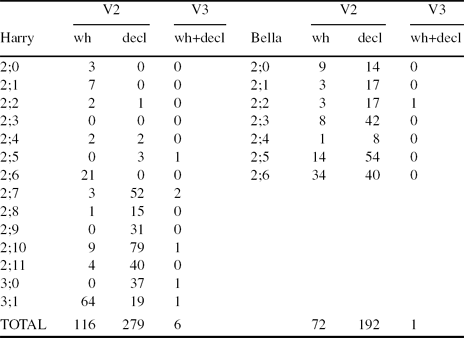
Poeppel & Wexler (1993) have argued that the acquisition of V2 depends on the finiteness of the verb. Studies of many verb movement languages (e.g. Dutch, French, German, Icelandic, Norwegian and Swedish) have shown that young children consistently move finite verbs across negation (Vfin–Neg), whereas non-finite verbs are left following negation (Neg–Vnon-fin) (Jordens Reference Jordens1990:1417; Pierce Reference Pierce1992; Poeppel & Wexler Reference Poeppel and Wexler1993:6; Santelmann Reference Santelmann1995:139; Sigurjónsdóttir Reference Sigurjónsdóttir, Greenhill, Littlefield and Tano1999; Westergaard Reference Westergaard2009a:114). In addition, children acquiring V2 languages move finite verbs to second position in main clauses from early on. Verb placement errors are quite rare and scattered across the whole period of investigation (see also Santelmann Reference Santelmann1995:200–212; Westergaard Reference Westergaard2009a:86). To illustrate, data from two Swedish children's non-subject-initial declaratives and wh-questions are summarized in Table 1 (based on Josefsson Reference Josefsson2003a:125; Waldmann Reference Waldmann2008:159). Finite verb placement errors are labeled V3.
Correct (V2) and incorrect (V3) finite verb placement in non-subject-initial declaratives and wh-questions (raw numbers).
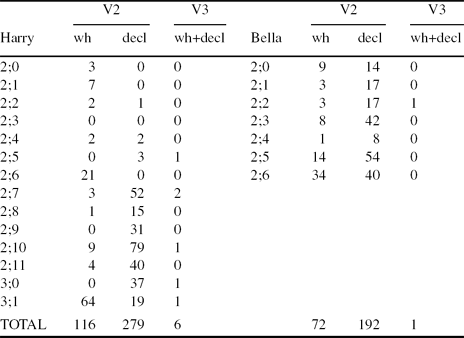
As shown in Table 1, V3 errors only account for 1% (7/666) of all non-subject-initial declaratives and wh-questions. An early and nearly flawless acquisition of V2 has been taken to support the assumption that children have access to the full syntactic structure from birth (Boser et al. Reference Boser, Lust, Marie Santelmann and Whitman1992; Poeppel & Wexler Reference Poeppel and Wexler1993; Hyams Reference Hyams, Hoekstra and Schwartz1994; Santelmann Reference Santelmann1995; Platzack Reference Platzack, Liceras, Zobl and Goodluck2008).
Albeit quite rare, finite verb placement errors appear in the speech of most children. Interestingly, the errors seem to follow the same pattern – a finite verb occurring in a position further back in the clause. The sentences in (5) provide some examples of child utterances with V3 errors, taken from Waldmann (Reference Waldmann2008:161).
(5)
A similar error pattern is found in English-speaking children's early non-subject-initial wh-questions, e.g. *what you can do? (target form: what can you do?) (Stromswold Reference Stromswold1990). Generativist approaches build their explanations of this error pattern on rule-based learning, whereas a competing constructivist approach adopts item-based learning. Both are discussed below.
Within a constructivist framework, Rowland & Pine (2000, 2003) studied subject–auxiliary inversion (errors) in wh-questions in one child (Adam), and found (i) almost no overlap between the wh+aux combinations that occurred in correctly inverted questions and those that occurred in non-inverted questions, and (ii) that wh+aux combinations that occurred in inverted questions had a significantly higher frequency in the input than the wh+aux combinations that occurred in non-inverted questions (see also Ambridge et al. Reference Ambridge, Rowland, Theakston and Tomasello2006). They argued for an item-based learning account incorporating a learning mechanism analyzing distributional patterns in the input. Thus, young children learn and reproduce wh+aux combinations which have a high frequency in the input. They do not need syntactic structure and a subject–verb inversion rule to produce inversion. Inversion errors occur when a child is attempting to produce a question without having access to the relevant wh+aux combination, due to low input frequency. The child then adds a wh-word to a subject-initial declarative (e.g. what + you can do), either one that the child has just been exposed to or one that s/he has constructed.
According to generativist approaches, on the other hand, V3 errors occur when children fail to apply the verb movement rule in a target-like way. The initial state of child grammars is characterized by the absence of verb movement (e.g. Platzack Reference Platzack1996; Chomsky Reference Chomsky2001; Pesetsky & Torrego Reference Pesetsky and Torrego2001). Whereas the movement operation itself is given by UG, children have to learn how to apply verb movement in the language they are exposed to. This learning process appears to be subject to economy principles, making children conservative learners of syntactic phenomena (Westergaard Reference Westergaard2009a, Reference Westergaardb). For example, children systematically use less verb movement and V2 than adults, but they hardly ever overuse verb movement and V2. Moreover, whereas children hardly ever overuse subject and object movement, they regularly fail to apply movement to form subject and object shift constructions (Josefsson Reference Josefsson, Johnson and Gilbert1996; Anderssen et al. Reference Anderssen, Bentzen, Rodina, Westergaard, Anderssen, Bentzen and Westergaard2010). In addition, children are sensitive to very fine distinctions in the input. For example, Westergaard (Reference Westergaard2003) found that Norwegian children correctly associate V2 in wh-questions with the copula and full DP subjects and V3 with other verbs and pronominal subjects at an early age. Together with their conservative nature, this may cause some children to make even finer distinctions than required in the adult language, e.g. associating inversion with specific wh-words (as observed in the English data in Rowland & Pine's (2000, 2003) study). Input frequency may play an important role for children to overcome verb placement errors, but, in contrast to the item-based learning account, frequency is not by itself a cause for non-adult-like production.
Summing up, previous research has shown that children acquire V2 word order early and that verb placement errors are quite rare in main clauses. However, as will be evident in this case study, this may not hold for all children; the child to be reported makes a considerable number of verb placement errors in main clauses. Previous research has also revealed a theoretical controversy between item-based and rule-based learning approaches to verb placement. This controversy forms the theoretical basis for the interpretation of my results.
4. METHODS AND MATERIAL
4.1 Material
The material is taken from the Gothenburg corpus, which was collected in the 1980s and 1990s within the project ‘Database-oriented studies of Swedish child language development’ by Sven Strömqvist and Ulla Richthoff (for details on the collection procedure, see Richthoff Reference Richthoff2000). The corpus is available on the CHILDES database (Plunkett & Strömqvist Reference Plunkett, Strömqvist and Slobin1992; Strömqvist, Richtoff & Andersson Reference Strömqvist, Richtoff and Andersson1993; MacWhinney Reference MacWhinney2000). In this study, 34 transcripts of spontaneous speech from one monolingual Swedish-speaking child named Tea, covering the age period 1;6–4;0, have been investigated. Tea grew up on the Swedish west coast in a middle-class family speaking standard Swedish with a touch of the regional dialect. Tea was recorded at least once a month, usually at home, engaged in everyday activities such as playing, reading and story-telling. The recordings include adult–child interactions, child–child interactions and child monologues. During the recording sessions, adults were advised to minimize their influence on the child and the interaction. The recordings were transcribed following the CHAT-transcription format (see MacWhinney Reference MacWhinney2000), using a modified standard Swedish orthography for spoken language (Richthoff Reference Richthoff2000:22). Thus, child utterances quoted in this article reflect the spoken language of the child and do not always correspond to the adult form.
For comparison, samples of adult speech directed to three Swedish children (Bella, Harry and Tea) have been investigated. The input samples are described when the results are presented in Section 5 below.
4.2 Is Tea typically-developing in other domains of language?
In this article, I will argue that Tea's language development is unexceptional in all language domains, the only exception being V2 word order. This means that Tea's language development is different from that of other Swedish-acquiring children described in the literature only with respect to finite verb placement. Before discussing Tea's verb placement, it is therefore crucial to determine that Tea does not differ from other children in other aspects of language development as well. Even though no formal testing of language skills has been carried out, there is evidence suggesting that several aspects of Tea's language are developing as in other Swedish-speaking children. For example, Richthoff (Reference Richthoff2000:15, 54f., 79f.) described four Swedish children and found that Tea's language development is unexceptional in pronunciation, lexicon and mean length of utterance (MLU). Moreover, Waldmann (Reference Waldmann2008) found similar developmental patterns for syntactic phenomena such as subject placement (see Section 5.1 for details), production of subordinate clauses and realization of subordinating elements in four Swedish children (Bella, Harry, Markus and Tea). Finally, in-depth reading of transcripts of Bella's, Harry's, Markus' and Tea's speech from age 1;6 to 4;0 by the author confirms that Tea's language development does not seem to differ from that of other Swedish children, V2 word order being the only exception. Thus, previous studies of Tea's language development suggest that it is typical in other domains of language.
4.3 Coding finite verbs in Swedish
The object of study is the placement of finite verbs in main clauses. In this section, I describe how finite verbs have been coded in the investigation, and in the next section, I describe how the position of finite verbs has been determined.
A verb has been categorized as finite if it is morphologically marked for present or past tense, or if its irregular form marks the verb for present or past tense (see Teleman et al. Reference Teleman, Hellberg, Andersson and Christensen1999a:543–552). In spoken Swedish, however, verbal morphology is often simplified or dropped, occasionally resulting in verb forms which could be either finite or non-finite. One way to deal with these ambiguous verb forms is to exclude them from the investigation. However, since ambiguous verb forms are a grammatical option in adult Swedish, it would be wrong to reject them in child Swedish. Besides, it is often possible to determine the finiteness of morphologically ambiguous verbs by their position in the clause. I have thus categorized a morphologically ambiguous verb as finite if it occurs in a position only acceptable for a finite verb, e.g. preceding the subject. An example uttered by Tea is given in the sentence in (6). If a morphologically ambiguous verb occurs in a position only acceptable for a non-finite verb, e.g. following negation, or if a verb occurs in an unclear position, it has been categorized as non-finite and excluded from the investigation. Examples uttered by Tea are provided in the sentences in (7).
(6)
(7)
For a finite verb to be analyzed as misplaced in this study, the following two conditions must be fulfilled: (i) the verb is morphologically finite, and (ii) the verb occurs in a position not acceptable for finite verbs. The sentences in (8) provide examples of verbs morphologically marked for present tense incorrectly placed after the subject.
(8)
4.4 Determining the position of the finite verb
Following the theoretical model sketched in Section 2, the verbal positions V, I and C are especially important in the analysis of Tea's verb placement. Recall that verb placement in V corresponds to non-V2 word order in subordinate clauses (see example (3) and structure (4b) above) and is only unambiguous when negation is present, marking the boundary between the I- and V-domain. A prerequisite for determining verb placement in V is thus that sentential negation, i.e. NegP, has been acquired. Studies of children acquiring Scandinavian languages show that sentential negation is acquired around the age of 2;0, and that the negation, from the earliest utterances, acts as a boundary between finite and non-finite verbs; finite verbs are placed before negation (Vfin–Neg) and non-finite verbs after negation (Neg–Vnon-fin) (Lange & Larsson Reference Lange and Larsson1977; Plunkett & Strömqvist Reference Plunkett, Strömqvist and Slobin1992; Santelmann Reference Santelmann1995; Waldmann Reference Waldmann2008). The same stability in the positioning of sentential negation has been found for other verb movement languages (see Section 3 above). I will thus assume that a finite verb following negation (Neg–Vfin) corresponds to finite verb placement in V. This word order pattern is attested in Tea's speech, as shown in the sentences in (9) and illustrated in the structure in (10).
(9)
(10)
Verb placement in C corresponds to V2 word order in main clauses (see example (1b) and structure (4a) above) and is only unambiguous when there is a subject in Spec-IP, marking the boundary between the C- and I-domain. A finite verb preceding a subject in Spec-IP has unambiguously moved to C. For the analysis of Tea's verb placement, it is thus crucial to determine that Tea has acquired subject movement to Spec-IP and applies this movement in an adult-like way. A detailed analysis of Tea's subject placement is given in Section 5.1 below. Being the target word order, subject–verb inversion (Vfin–Subj) is attested in Tea's speech, as shown in the sentences in (11) and illustrated in the structure in (12).
(11)
(12)
Whereas finite verb placement in V and C are used in adult Swedish, verb placement in I is assumed not to occur in Swedish. Verb placement in I is typically related to the presence of rich verbal morphology (Roberts Reference Roberts1993; Vikner Reference Vikner1995), which Swedish is lacking. However, previous research has shown that verb placement in I may in fact be attested as V3 errors in child Swedish (see example (5) above). Verb placement in I is only unambiguous when there is a negation in NegP, marking the boundary between the I- and V-domain, and a subject in Spec-IP, marking the boundary between the C- and I-domain. I will assume that a finite verb preceding a negation but following a subject in Spec-IP (XP–Subj–Vfin–Neg) corresponds to verb placement in I. This word order pattern is attested in Tea's speech, as shown in the sentences in (13) and illustrated in the structure in (14).
(13)
(14)
Finally, utterances with V3 errors often lack negation (XP–Subj–Vfin) and are, thus, characterized by an incorrect ambiguous verb placement. The position of the finite verb may be either V or I, as a negation marking the boundary between the V- and I-domain is lacking. This word order pattern is attested in Tea's speech as well, as shown in the sentences in (15) and illustrated in the structures in (16).
(15)
(16)
The analysis of Tea's verb placement in Section 5.2 is based on the four word order patterns discussed in this section: Neg–Vfin (V), Vfin–Subj (C), XP–Subj–Vfin–Neg (I) and XP–Subj–Vfin (V/I). Only utterances that require both linear V2 and verb movement to C in adult Swedish have been included in the analysis, which means that yes/no-questions, imperatives and V1-declaratives have been excluded due to the lack of linear V2. The analysis includes 584 non-subject-initial declaratives, 19 non-subject-initial wh-questions and nine subject-initial declaratives. The bulk of subject-initial declaratives and subject-initial wh-questions have been excluded, as it is impossible to determine the position of the finite verb. Including these clauses would necessitate a fifth and sixth verb placement category for the analysis (I/C and V/I/C), categories that would include all subject-initial clauses with V2 word order and, thus, would not contribute to the understanding of Tea's incorrect verb placements. Nine subject-initial declaratives have been included because they have an unambiguous verb placement (Neg–Vfin). Excluding the greater part of subject-initial clauses means that a large number of utterances produced by Tea will not be considered in this study. To be able to compare Tea with other Swedish children, the data from other children have, where needed, been re-analyzed according to the criteria outlined in this paper.
In the remainder of this article, main clause utterances belonging to the C-category are labeled V2 utterances, whereas utterances belonging to the V-, I- and V/I-categories are ungrammatical and will be labeled V3 utterances. V2 and V3 utterances in Tea's speech are discussed in the next section. However, before we examine Tea's verb placement, it is crucial to determine if Tea has acquired subject movement to Spec-IP, as subject movement to Spec-IP is a prerequisite for identifying verb placement in C.
5. RESULTS
5.1 Subject placement in Tea's speech
As subjects are merged in the V-domain, subject movement across negation indicates movement out of the V-domain. This section reports the order of the negation and the subject in Tea's speech from 1;6 to 4;0.
In Tea's speech, utterances with the subject preceding negation (Subj–Neg) are much more common than utterances with the subject following negation (Neg–Subj): 95% (264/279) vs. 5% (15/279). A clear majority of the utterances shows that Tea is moving subjects from Spec-VP to Spec-IP and Spec-CP. The sentences in (17) provide examples of subject movement across negation.
(17)
It is important to point out that the occurrence of Neg–Subj word order does not by itself mean that subject movement has not been acquired, since a subject may, under certain circumstances, follow negation in Swedish non-subject-initial clauses. In fact, only one of Tea's utterances with Neg–Subj word order is ungrammatical, see sentence (18) below. Although not marked in the transcript, this example probably consists of a false start (en lampa ‘a lamp’) followed by sentence-initial negation, subject, verb and object (inte jultomte tar d lampa ‘Santa Claus doesn't take the lamp’). Examples with sentence-initial negation have previously been analyzed as lacking subject movement out of the V-domain in Platzack (Reference Platzack1990, Reference Platzack1992), Radford (Reference Radford1990:152f.) and Clahsen, Penke & Parodi (Reference Clahsen, Penke and Parodi1993/1994:420f.).Footnote 3
(18)
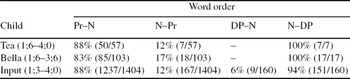
The remaining 14 utterances with Neg–Subj word order are non-subject-initial clauses where the placement of the subject is governed by a principle of information structure. According to this principle, informationally new subjects appear after negation (Neg–Subjnew) and informationally given subjects before negation (Subjgiven–Neg) (Teleman et al. Reference Teleman, Hellberg, Andersson and Christensen1999b:19, 94; Westergaard Reference Westergaard2003). As pronouns are typically used to refer to given information and DPs to introduce new information, pronominal subjects are expected to precede negation (Pr–N) and DP subjects to follow negation (N–DP). Interestingly, this is exactly what we find in Tea's speech: 88% (50/57) of the pronominal subjects precede negation (see example (17b) above), whereas 100% (7/7) of the DP subjects follow negation. Similar proportions are found in other Swedish children, as well as in child-directed Swedish. In fact, a comparison with one other Swedish child (Bella) and with a sample of child-directed speech reveals striking similarities, suggesting that Tea is target-like when it comes to subject placement.Footnote 4 This is summarized in Table 2.
The order of pronominal subjects (Pr)/DP–subjects (DP) and negation (N).

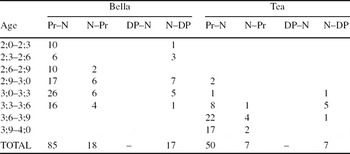
In addition, a chronological analysis shows that utterances with a pronominal subject preceding negation (Pr–N) are attested from 2;9–3;0, a couple of months earlier than utterances with a pronominal subject following negation (N–Pr). The same overall pattern is found in Bella's data, although the onset may vary across children, as shown in Table 3. These findings indicate that Tea, as well as Bella, has acquired subject movement and applies it already in the earliest utterances (see also Santelmann Reference Santelmann1995:153–157).
Chronological distribution of the order of pronominal subjects (Pr)/DP–subjects (DP) and negation (N) (raw numbers).

To sum up, subject movement across negation to Spec-IP is attested from 2;9–3;0 in Tea's speech. She has early knowledge of the principle of information structure governing subject placement in Swedish. Her overall subject placement is similar to that of other Swedish children and child-directed Swedish. Subject movement across negation and the finite verb to Spec-CP is attested already at 2;6. In total, only one utterance with non-adult-like subject placement was attested. Thus, I conclude that Tea has acquired subject movement already in her earliest utterances, and that she moves subjects at least up to Spec-IP. Consequently, I assume that Tea moves the finite verb to C when she moves it across the subject. In other words, I take utterances with subject–verb inversion (Vfin–Subj) to indicate that Tea has knowledge of verb movement to C, i.e. V2. Tea's verb placement is presented in the next section.
5.2 Verb placement in Tea's speech
In previously published studies, children rarely violate the V2 constraint (see Section 3 above). For example, Josefsson (Reference Josefsson2003a, Reference Josefssonb) and Waldmann (Reference Waldmann2008) reported 1% V3 errors in three Swedish children's non-subject-initial declaratives and wh-questions. By contrast, V3 errors are attested in 31% (185/603) of Tea's non-subject-initial declaratives and wh-questions up to 3;6. Examples illustrating V2 and V3 word orders are provided in the sentences in (19).
(19)
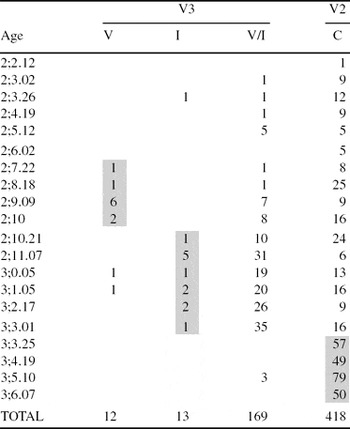
Interestingly, the four verb placement categories outlined in Section 4.4 above – V, I, V/I and C – do not appear randomly in Tea's speech. Some interesting patterns can be observed. First, verb placement in V is mainly attested from 2;7.22 (two years, seven months and 22 days) to 2;10. Second, verb placement in I is mainly attested from 2;10.21 to 3;3.01, a period following verb placement in V. Verb placement in I is not used when verb placement in V is used, and vice versa. Third, verb placement in C is attested during the whole period of investigation, but it is used quite sparsely when verb placement in V and I are attested, i.e. up until 3;3.25. Verb placement in I disappears when verb placement in C is increasing at 3;3.25. In addition, verb placement in V/I is attested from early on and starts to increase when verb placement in I appears at 2;10.21 and disappears when verb placement in I disappears. The distribution of the verb placement categories V, I, V/I and C are summarized in Table 4. The periods when the verb placement categories V, I and C are most prominent have been highlighted in gray. Besides 603 non-subject-initial declaratives and wh-questions, Table 4 includes nine subject-initial declaratives with a finite verb following negation (see the discussion of subject-initial declaratives in Section 4.4 above). Examples illustrating each verb placement category were given in the sentences in (9)–(16) above.
The development of Tea's verb placement (raw numbers).
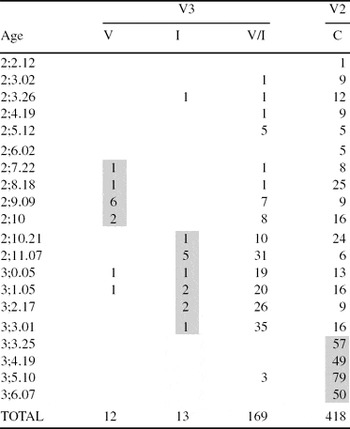
Table 4 shows that Tea is using V2 word order (C) from the age of 2;2–2;3, but that her verb placement is not fully adult-like until about a year later when V3 utterances (V, I, V/I) have disappeared. In the following three sections, I will argue that Tea is acquiring V2 word order by gradually extending the movement of the finite verb. More specifically, I propose that Tea's verb placement is developing in three phases, where phase 1 is predominantly characterized by absence of verb movement from V (up to 2;10), phase 2 by a short verb movement to I (2;10.21–3;3.01), and phase 3 by a long verb movement to C (3;3.25 and afterwards).
5.2.1 Phase 1: No verb movement
Phase 1 constitutes the age period up to 2;10 and is mainly characterized by the absence of finite verb movement from V (for examples, see the sentences in (9) above). During this phase, Tea is producing utterances without verb movement (V), as well as utterances with ambiguous verb placement (V/I). Remember that the absence of verb movement from V is determined in relation to a negation marking the boundary between the V- and the I-domain. Finite utterances with a negation appear in Tea's speech at 2;7 and are initially characterized by a finite verb following negation (Neg–Vfin). This word order is found until about 2;10 (except for two examples at 3;0–3;1). Interestingly, finite verbs do not precede negation during this period, as shown by the absence of verb placement in I (except for one example at 2;3.26). Since Tea is placing finite verbs after the negation in phase 1, it seems reasonable to assume that utterances with ambiguous verb placement, i.e. utterances belonging to the V/I-category, are in fact lacking verb movement from V during this phase as well. The 25 utterances belonging to the V/I-category during phase 1 may thus provide additional support for the absence of finite verb movement from V.
The first V2 utterances are produced at 2;2–2;3 and are largely introduced by där är ‘there is’ and här är ‘here is’. During phase 1, där är and här är account for 64% (63/99) of all V2 utterances, a substantially greater proportion than in phase 2 (24%) and phase 3 (15%). By contrast, där är and här är are exceedingly rare in V3 utterances during phase 1; only one utterance with initial där and two utterances with är. V3 utterances are constructed mainly with other initial constituents and other finite verbs. This asymmetry between V2 and V3 utterances is interesting from a theoretical perspective. If language acquisition is an item-based process, we would expect Tea to have access to a limited set of word combinations. However, if language acquisition is a rule-based process, we would expect Tea to have access to generalized rules which she can apply to many lexical items. Thus, rule-based learning should result in a higher degree of lexical variation than item-based learning. In phase 1, it seems that a substantial part of Tea's V2 utterances is in fact rote learned word combinations (där är and här är), whereas her V3 utterances are the result of productive grammatical rules. For the theoretical discussion in this paper, it is thus important to further examine the lexical variation in V2 and V3 utterances.
In order to illustrate differences in lexical variation between V2 and V3 utterances, I have calculated the ratios of different initial constituents and finite verbs per 100 initial constituents and finite verbs.Footnote 5 A higher ratio means a greater lexical variation. In V3 utterances, the ratios of different initial constituents and finite verbs are 56:100 (20/36) and 58:100 (21/36), respectively. This means that for 100 initial constituents, Tea is using 56 different initial constituents, and for 100 finite verbs, she is using 58 different finite verbs. This should be compared to the corresponding, and considerably lower, ratios in V2 utterances, 16:100 (16/99) for initial constituents and 18:100 (18/99) for finite verbs. A problem with this way of measuring lexical variation is that the ratio is expected to drop with higher raw numbers, since the probability of re-using a word is bigger if many words are used. It is thus interesting to note that even the raw numbers of different initial constituents and finite verbs are lower in V2 utterances than in V3 utterances, despite the fact that there are almost three times as many V2 utterances as V3 utterances. There thus appears to be a greater lexical variation in V3 utterances than in V2 utterances during phase 1. The sentences below provide some examples illustrating lexical differences between V2 utterances, in (20), and V3 utterances, in (21).
(20)
(21)
Despite lexical differences, there is some overlap in both initial constituents and finite verbs that are used in V2 and V3 utterances. There are 32 different initial constituents and 30 different finite verbs in V2 and V3 utterances in phase 1. Six of the 32 initial constituents (19%) and nine of the 30 finite verbs (30%) occur in both V2 and V3 utterances. However, 23 initial constituents and 14 finite verbs occur only once and, thus, could not show any overlap. Not counting these, 67% (6/9) of the initial constituents and 56% (9/16) of the finite verbs occur in both V2 and V3 utterances.
Moreover, there are 62 different XP+Vfin combinations in 135 V2 and V3 utterances. Four of the 62 XP+Vfin combinations (6%) occur in both V2 and V3 utterances. These four overlapping combinations account for 8% (11/135) of Tea's V2 and V3 utterances in phase 1. Not counting 50 XP+Vfin combinations which could not show any overlap because they occur only once, the four combinations account for 13% (11/85) of the V2 and V3 utterances. To compare, in Rowland & Pine's (2000, 2003) study of inversion in one English-acquiring child's (Adam) wh-questions, the overlapping wh+aux combinations accounted for 5.8% (6.5% if the wh+aux combinations which occur once were excluded) of the inverted and uninverted wh-questions.Footnote 6 Thus, the proportions reported for Tea in this study are somewhat larger than the proportions reported for Adam. However, due to Tea's extensive use of där är and här är in phase 1, it is difficult to interpret the data from Tea. Excluding där är and här är, the four combinations account for 15% (11/72) (50% if the 50 combinations which occur once are excluded) of Tea's V2 and V3 utterances in phase 1.
Both där/här and är are highly frequent in child-directed Swedish. Studying a sample of adult speech directed to two Swedish children during the age period 1;6–3;6, I found that där and här are the most common initial words in non-subject-initial declaratives (15%, 167/1102), and that är is the most common finite verb in non-subject-initial declaratives and wh-questions (19%, 297/1567).Footnote 7 Moreover, där är and här är are the most common initial word combinations accounting for 3% (33/1102) of the non-subject-initial declaratives.
To sum up, the prominence of där är/här är in child-directed Swedish together with an extensive use of these word combinations in phase 1 suggests that där är and här är are rote-learned forms rather than the result of a productive grammatical operation moving the finite verb to C (for similar results, see Westergaard Reference Westergaard2009a:84–85). Not counting these chunks, only 27% (36/135) of all utterances during phase 1 indicates a productive use of V2 word order. Moreover, a greater lexical variation in V3 utterances than in V2 utterances suggests that Tea has access to a productive grammatical rule leaving the finite verb in V in phase 1.
Finally, it is also important to point out that my argument is fundamentally different from that of constructivist theories arguing for item-based learning (e.g. Rowland & Pine Reference Rowland and Pine2000, Reference Rowland and Pine2003; Ambridge et al. Reference Ambridge, Rowland, Theakston and Tomasello2006). Although I acknowledge that imitated chunks constitute a substantial part of Tea's early V2 utterances (där är/här är), my principal claim – the predominant productive grammatical rule of Tea's grammar in phase 1 is the absence of verb movement from V – goes against item-based learning. Thus, my proposal is in line with generativist accounts, which assume that children have access to syntactic structure, that the initial state of child grammars is characterized by the absence of verb movement from V, and that language-specific verb movement needs to be learned (e.g. Platzack Reference Platzack1996; Westergaard Reference Westergaard2009a, Reference Westergaardb).
5.2.2 Phase 2: Short verb movement to I
Phase 2 constitutes the age period 2;10–3;3 and is primarily characterized by verb movement to I (for examples, see the sentences in (13) above). The emergence of utterances with verb movement to I co-occurs with the disappearance of utterances lacking verb movement (see category V in Table 4 above). Thus, the finite verb does not follow negation during this period, as shown by the absence of finite verbs in V (except for two examples at 3;0.05 and 3;1.05). The emergence of verb movement to I also co-occurs with an increasing use of utterances with ambiguous verb placement (category V/I). Since Tea is moving finite verbs to a position between the subject in Spec-IP and the negation (i.e. I) in this phase, it seems reasonable to assume that utterances with ambiguous verb placement, i.e. utterances belonging to the V/I-category, are characterized by verb movement to I as well. The 141 utterances belonging to the V/I-category may thus provide additional support for finite verb movement to I during phase 2.
Tea is still producing a small number of V2 utterances; the proportion of V2 utterances during phase 2 is 35% (84/239), i.e. slightly higher than in phase 1 (26%). The remaining 65% (155/239) are V3 utterances. However, there are no longer any lexical differences between V2 and V3 utterances, as in phase 1; different initial constituents and finite verbs occur in both types of utterances. For example, V2 utterances introduced by där är/här är have dropped from 64% in phase 1 to 24% (20/84) in phase 2. Moreover, där/här and är occur in V3 utterances as well; 11 utterances with initial där/här and four utterances with är have been attested.
V2 and V3 utterances are characterized by a comparable degree of lexical variation. In V2 utterances, the ratios of different initial constituents and finite verbs are 17:100 (14/84) and 36:100 (30/84), compared to 14:100 (21/155) and 31:100 (48/155) in V3 utterances.
In total, there are 26 different initial constituents and 58 different finite verbs in V2 and V3 utterances in phase 2. 35% (9/26) of the initial constituents and 34% (20/58) of the finite verbs occur in both V2 and V3 utterances. Not counting 13 initial constituents and 22 finite verbs which occur only once and, thus, could not show any overlap, 69% (9/13) of the initial constituents and 56% (20/36) of the finite verbs occur in both V2 and V3 utterances.
Moreover, there are 136 different XP+Vfin combinations in 239 V2 and V3 utterances. Fifteen of the 136 combinations (11%) occurred in both V2 and V3 utterances (6% in phase 1). These 15 overlapping combinations account for 25% (59/239) of Tea's V2 and V3 utterances in phase 2. Excluding 93 XP+Vfin combinations which occur only once, the 15 combinations account for as much as 40% (59/146) of the 146 V2 and V3 utterances. This should be compared to 5.8% (6.5% if the wh+aux combinations which occur once were excluded) in Rowland & Pine's (2000, 2003) study (see note 6). The comparatively high degree of overlap between Tea's V2 and V3 utterances goes against item-based learning. According to an item-based account, V2 and V3 utterances should involve different pairs of initial constituents and finite verbs. The following sentences provide some examples of V2, in (22), and V3 utterances, in (23), in phase 2:
(22)
(23)
To sum up, Tea is applying verb movement from V during phase 2. The decline of där är/här är suggests that Tea is not relying on rote-learned forms to produce V2 utterances. Moreover, similar degrees of lexical variation in V2 and V3 utterances and a comparatively high degree of lexical overlap between V2 and V3 utterances suggest that Tea has access to grammatical rules to generate both V2 and V3 utterances by moving finite verbs to C and I. However, the primary grammatical rule for finite verb placement involves short verb movement to I (65% V3 utterances), whereas long verb movement to C appears to play a peripheral role in Tea's grammar in this phase (35% V2 utterances). This suggests that an economy principle of verb movement is still operating in Tea's grammar, ensuring that finite verbs undergo the shortest possible movement (to I) and, ultimately, that verb movement is not overused. Remnants of this economy principle results in occasional V3 errors in other children acquiring V2 languages (see Section 3 above). The question why an economy principle of verb movement is viable and operating in Tea's grammar up to 3;3, while most children overcome it before they start producing finite utterances will be discussed in Section 6 below.
5.2.3 Phase 3: Long verb movement to C
Phase 3 constitutes the age period after 3;3 and is characterized by verb movement to C (for examples, see the sentences in (11) above). During previous phases, the use of V2 word order has increased only slightly from 27% in phase 1 to 35% in phase 2. The onset of phase 3 is marked by a substantial increase in the use of V2, an increase which co-occurs with the loss of V3 utterances. The transition from phase 2 to phase 3 happens abruptly between the ages 3;3.01 and 3;3.25, a period of only three weeks. The proportion of V2 utterances is 99% (235/238), a proportion identical to that reported for other children in previous studies (see Section 3 above). Verb placement errors are exceedingly rare; V3 utterances account for only 1% (3/238) of Tea's utterances.
The proportion of V2 utterances introduced by där är/här är has dropped from 24% in phase 2 to 15% (36/235) in phase 3. Moreover, there is a similar lexical variation in V2 utterances as in phase 2. The ratio of different initial constituents is 16:100 (37/235) (compared to 17:100 in phase 2), and the ratio of different finite verbs is 26:100 (61/235) (compared to 36:100 in phase 2). These ratios are also comparable to the corresponding ratios in V3 utterances in phase 2 (14:100 and 31:100). Thus, there are great similarities in lexical variation across V2 and V3 utterances and across phase 2 and 3, suggesting that the transition from phase 2 to 3 does not bring about any qualitative changes in the application of verb movement to C.
5.3 Verb placement in child-directed Swedish
This section investigates verb placement in Tea's input. Since the word order patterns that were taken to correspond to the verb positions V, I and C also occur in adult Swedish, it is important to examine the link between input and output in the acquisition process. The word order Vfin–Subj (C) is found in many types of main clauses and in some types of subordinate clauses,Footnote 8 whereas Neg–Vfin (V) is typically found in subordinate clauses. Examples illustrating these word order patterns in adult Swedish were given in the sentences in (1b, c) and (3) above. XP–Subj–Vfin–Neg (I) is sometimes found in some types of subordinate clauses, as illustrated in the sentence in (24). For more details on these clause types, see Teleman et al. (Reference Teleman, Hellberg, Andersson and Christensen1999b).Footnote 9
(24)
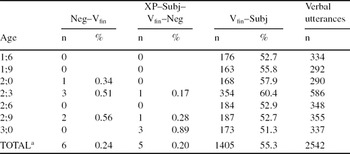
To examine Tea's exposure to the three word order patterns, seven transcripts of child-directed speech in Tea's files, covering the age period 1;6–3;0 and including 2542 verbal utterances, were investigated.Footnote 10 The results show that Tea is exposed to a very small proportion of Neg–Vfin and XP–Subj–Vfin–Neg sequences. The sequence Neg–Vfin accounts for 0.24% (6/2542) of all verbal utterances in Tea's input and XP–Subj–Vfin–Neg for 0.2% (5/2542). By contrast, Tea is exposed to a large proportion of utterances with Vfin–Subj (i.e. V2 word order), approximately 55% (1405/2542). The input for V2 is evenly distributed over the whole period of investigation. Interestingly, exactly the same patterns are found in other Swedish children's input (see Waldmann Reference Waldmann2008). The occurrence of the word order patterns in Tea's input is summarized in Table 5.
Word order patterns in Tea's input.

a The percentages do not add up to 100%, because verbal utterances with word order patterns irrelevant to this study are not reported in Table 5, e.g. clauses with Subj–Vfin order, clauses lacking a subject, and subordinate clauses lacking negation. In total, verbal utterances with word order patterns not reported in Table 5 make up about 44% (1126/2542) of all verbal utterances. For further discussion, see Waldmann (Reference Waldmann2008).
To sum up, no consistent patterns were found between Tea's input and output. The exposure to Neg–Vfin and XP–Subj–Vfin–Neg is infrequent, but Tea is frequently using these word orders in the early phases. By contrast, although the exposure to Vfin–Subj is frequent, Tea's use of this word order is infrequent during a great part of the investigated period (up to 3;3). This is interesting, considering that Tea is exposed to a similar amount of input for V2 as other Swedish children and that she develops normally in other domains of language (see Section 4.2 above). The absence of a direct link between Tea's input and output suggests that she is not merely paying attention to word order patterns in the input, but also, and more importantly, that she is guided by syntactic structure and principles of economy.
6. DISCUSSION AND CONCLUSIONS
The purpose of the present paper has been to present new data on the acquisition of V2 word order from one Swedish girl, and to discuss item-based and rule-based learning in relation to these data. The data challenge the idea that V2 is acquired early and nearly flawlessly by showing that Tea – whose language development is unexceptional in all other domains of language – often makes verb placement errors. Furthermore, it has been shown that Tea's verb placement develops systematically in three phases.
The findings pose a problem for item-based learning accounts, assuming that children learn inversion by copying highly frequent word combinations from the input. Although the majority of Tea's early V2 utterances is in fact chunks (där är and här är), her early V3 utterances and her utterances in phase 2 and 3 do not show any lexically-specific effects. According to item-based accounts, there should be no, or very little, lexical overlap between V2 and V3 utterances. In Rowland & Pine's (2000, 2003) study, around 6% overlap between the wh-words and auxiliaries present in Adam's inverted and uninverted wh-questions was taken to support item-based learning (see note 6). The overlap between the initial constituents and finite verbs present in Tea's V2 and V3 utterances is greater, 8% in phase 1 (13% not counting combinations which occur only once) and 25% in phase 2 (40% not counting combinations which occur only once). This is unexpected if children associate a specific utterance type with specific lexical items. It is, however, important to point out that it is unclear how much lexical overlap and variation is necessary in order to reject item-based learning and argue that a rule of verb movement has been acquired, and that to determine threshold levels may be difficult or even impossible. Hence, I have tried to determine a relative level of productivity in Tea's data by comparing lexical similarities, differences and overlap across utterance types, children and input/output. For example, the greater lexical overlap in Tea's utterances, in comparison with Adam's utterances, was assumed to indicate a higher level of productivity in Tea's data. Moreover, the greater lexical variation in Tea's V3 utterances in phase 1, in comparison with V2 utterances, was assumed to indicate a higher level of productivity in V3 utterances. In conclusion, it was argued that these higher relative levels of productivity suggest that Tea has category-general knowledge and access to syntactic structure and productive grammatical rules from early on.
Tea's V3 utterances pose another problem for item-based accounts. It is unclear how an item-based learning account would explain the presence of three different word order patterns in Tea's speech, as well as the systematic development in three phases and the abrupt transitions from one phase to the next. More importantly, Rowland & Pine (2000, 2003) suggest that V3 utterances arise when children add an initial constituent (wh-word, pronoun, adverbial, etc.) to an existing subject-initial declarative (e.g. då + jag ska inte gråta ‘then’ + ‘I will not cry’). While this analysis could account for V3 utterances in phase 2, V3 utterances in phase 1 are a different type, which cannot be analyzed in this way (e.g. *då jag inte ska gråta ‘then I not will cry’). Utterances like jag inte ska gråta are ungrammatical and not used in adult Swedish and, thus, cannot form a coherent unit extracted from the input, to which children can add an initial constituent. Above, it was argued that V3 utterances and the systematic development in three phases can be accounted for by assuming that Tea has access to syntactic structure and the verbal positions V, I and C, that the initial state of grammars is characterized by absence of verb movement from V, and that the process of learning the language-specific application of verb movement is subject to a principle of economy of movement.
A third problem for item-based accounts is the absence of frequency effects. Word order patterns which are highly frequent in Tea's input and, thus, are expected to be acquired early, are delayed in Tea's speech, whereas low frequency patterns are used from early on. This suggests that input frequency is not by itself the single most important factor guiding children to an adult-like grammar, nor a cause for non-target behavior. Although input frequency must surely play a role in the acquisition process, it is still largely unclear what role input frequency has for grammar acquisition. The role of frequency and how frequency interacts with the initial state of the grammar and principles of economy are important issues to address in future research.
A remarkable result of the present study is that Tea differs from other children acquiring V2 word order described in the literature only with respect to verb movement. The question is, then, why Tea is different from other children. Why is the economy principle of verb movement operative for such a long time in Tea's grammar? At present, there is no obvious answer to this question. I will, however, present some thoughts for future consideration.
In Section 4.2 above, it was argued that Tea's linguistic development in other domains of language is similar to other Swedish children. Moreover, Waldmann (Reference Waldmann2008) found that Tea's input for V2 is identical to that of other Swedish children, quantitatively as well as qualitatively (see also Section 5.3 above). More importantly, while Tea's verb placement is developing gradually in three phases, it is fully target-like at a young age (3;3–3;4). Given these facts, we cannot rule out the possibility that Tea's linguistic development is just a manifestation of normal variation, which typically appears in a large population. The variation may concern the acquisition path, which means that Tea's path towards an adult-like grammar is but one of many possible paths. Alternatively, the variation may concern the pace of acquisition, which means that Tea's language development is delayed compared to other children described in the literature. Variation in acquisition pace across children is quite common and affects many linguistic phenomena, e.g. verb inflection, clause types, subordinate word order, obligatory subjects and wh-words (see e.g. Brown Reference Brown1973; Fritzenschaft et al. Reference Fritzenschaft, Gawlitzek-Maiwald, Tracy and Winkler1990; Josefsson Reference Josefsson2002, Reference Josefsson2003a; Santelmann Reference Santelmann2003; Waldmann Reference Waldmann2008). Consequently, all children may in fact follow the same developmental path as Tea, but some children will overcome the economy principle of verb movement before they start to produce finite utterances. Other children, such as Tea (and possibly also Adam in Rowland & Pine's study), will start to produce finite utterances before they have overcome the economy principle. The idea of a developmental delay is consistent with the facts that the same types of V3 errors are occasionally also attested in the speech of other children acquiring V2 languages, and that inversion errors, which are attested in Adam's wh-questions, are also attested in other English-acquiring children (see e.g. Stromswold Reference Stromswold1990).
The difference between Tea and other children as regards the acquisition of V2 has raised important questions about variation in language acquisition and about the relation between input (frequency) and output. Currently, conclusive resolutions of these issues are lacking, and this case study is just one contribution to a better understanding of this issue. One claim made in this article is that frequency is not by itself a cause for children's ungrammatical utterances. Rather, syntactic structures and principles of economy appear to play a more crucial role. How input frequency and properties of UG interact in the acquisition process is an important area for future research.
ACKNOWLEDGEMENTS
I would like to thank the participants of the workshop 30th TABU Dag in Groningen (2009) and GALA conference in Lisbon (2009) for their comments on a previous version of this paper. My thanks are also due to the participants of CHILL at Linnaeus University and to three anonymous reviewers at the Nordic Journal of Linguistics for helpful comments.