

Introduction
In mammals the polyunsaturated fatty acid linoleic acid (LA, C18:2) is essential in the diet due to the lack of necessary endogenous synthesis in the body. LA has multiple important roles, although more work is required to fully elucidate these (Bauer, Reference Bauer2008). LA involvement in skin form and function has attracted considerable research, not least in cats and dogs (Whelan and Fritsche, Reference Whelan and Fritsche2013), with demonstrated roles in maintaining the epidermal permeability barrier, as well as being a precursor in the formation of prostaglandins and other signalling molecules.
Wertz et al. (Reference Wertz, Cho and Downing1983) showed that an inadequate dietary supply of LA damaged the functional integrity of the epidermal barrier. The epidermal barrier is formed at the outermost layer of the skin, the stratum corneum, and is composed of terminally differentiated keratinocyte cells surrounded by a highly specialised extracellular lipid. This lipid is composed of fatty acids, cholesterol and sphingolipids called ceramides. The ceramides in the skin are structurally unique to this tissue and comprise a sphingoid base linked to a medium or long chain fatty acid via an amide bond. The incorporation of linoleic acid into ceramides has a key influence on the integrity of the physical barrier provided by the skin, facilitating the characteristic lipid lamellar configuration which makes the structure relatively impermeable to both hydrophilic and hydrophobic species (Hansen and Jensen, Reference Hansen and Jensen1985). The result is an effective barrier to both the egress of water and the ingress of potentially harmful environmental agents. Insufficient LA is associated with a condition called Essential Fatty Acid Deficiency (EFAD), whereby the skin becomes dehydrated due to its increased permeability to water, and more prone to infection. As a consequence, the process of determining the dietary LA requirement of cats and dogs has used absence of any signs of EFAD as an important indicator (MacDonald, Reference MacDonald, Rogers and Morris1983). Transepidermal water loss (TEWL) is one of the main metrics for assessing skin health. It can be used to quantify skin permeability and to compare the robustness of skin structures.
The role of Zn in unsaturated fat metabolism is complex and incompletely understood. However, in the skin, Bettger et al. (Reference Bettger, Reeves, Moscatelli, Reynolds and O'Dell1979) showed that Zn deficiency can mimic or exacerbate the symptoms of essential fatty acid deficiency, suggesting a key involvement. What is more, there is evidence that activities of the desaturases which metabolise LA are influenced by Zn status (Huang et al., Reference Huang, Cunnane, Horrobin and Davignon1982), indicating an important interaction between these two essential nutrients.
In spite of the above published research, there is relatively little known regarding the effects on skin function and health of supplying LA and Zn significantly in excess of minimum requirements. As the skin is one of the largest organs in the body and has the most rapid cell turnover of all tissues, hence it is reasonable to assume that its requirement for nutritionally derived metabolites is considerable, and such requirements may vary according to environmental conditions and/or other stressors.
It is generally accepted within the veterinary community that dogs are particularly prone to dermatological pathologies. This is evidenced by the proportion of visits to the veterinarian which relate to dermatology (O'Neill et al., Reference O′Neill, Church, McGreevy, Thomson and Brodbelt2014). Many of the issues involve inflammation, and they are commonly associated a compromised skin barrier function. Given this background, the following trial was conducted to investigate the connection between LA/Zn and the canine skin barrier by feeding differential amounts of these two nutrients to healthy adult Labrador rtrievers. The Labrador is a breed generally regarded as susceptible to skin associated issues. Changes in barrier function were determined by periodic assessment of TEWL over the 12 week period that the LA and Zn enriched diet was fed.
Materials and methods
Dogs on this study were housed in purpose-built, environmentally-enriched housing. Work was approved by the WALTHAM Animal Welfare and Ethical Review Body, conducted under licenced authority according to the Animals (Scientific) Procedures Act 1986 and followed United Kingdom Home Office Code of Practice guidelines for animal welfare.
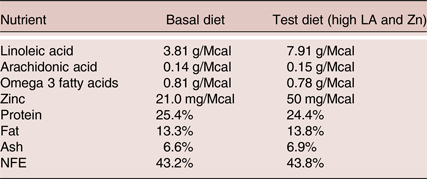
All dogs were fed nutritionally balanced and complete diets (provided by Royal Canin SAS) for the duration of the study according to individual metabolic energy requirements (bMER 95 kcal x BW0.75, NRC 2006). The LA concentration of the basal and test diets were adjusted relative to the oleic acid component via changes to the contribution of fats derived from coconut, soya or pork. Zn intake was controlled by addition of inorganic Zn sulphate to the diet. Basic compositional information for the diets is shown Table 1.
Nutrient composition of the two diets used in the feeding trial

Eight Labrador retrievers (all neutered, mean age 3.13 years, range 2–6 years; 2 males and 6 females) were fed a diet containing 3.8 g/Mcal LA, 21 mg/Mcal Zn (baseline levels) for 12 weeks to establish baseline conditions for all dogs (basal diet). After this period, all dogs were switched onto a test diet containing 7.9 g/Mcal LA and 50 mg/Mcal Zn for a further 12 weeks. The LA and Zn contents of the basal diet were tightly controlled at levels just above the adequate recommendations for dogs (NRC, 2006), whereas the levels in the ‘enriched’ test diet were set at levels approaching three times these values.
TEWL measurements, as indicators of skin integrity and control of water loss, were taken at the end of the basal period, and at six and 12 weeks of the test feeding period. Six measurements were taken at each time point for each dog. The dogs were assessed in a quiet, draught-free room with consistent environmental conditions using a Cutometer MPA580 with a Tewameter Triple TM 330 T probe. Probes were placed 1–2 inches to one side of the lumber spine, first parting the hair coat so as to ensure good contact with the skin. The first 30 seconds of recording were discarded (the stabilisation period) and the subsequent 60 seconds used for data capture. Prior to the start of the study the dogs were conditioned to remain stationary for 2 minutes at a time to improve stability of readings.
For statistical analysis, a linear mixed effects model was used where TEWL was compared against time (week) as a categorical fixed effect using the random effects structure of probe nested in repeat measure nested in time nested in each dog. Planned contrasts were applied comparing the ‘change from end of pre-feed’ and testing for differences between weeks within diet. Confidence limits were set at 95%, with P < 0.05 considered significant.
Results and discussion
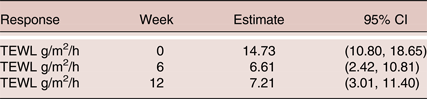
Both the basal and test diets were well tolerated by the dogs on the study, with 100% of the food offered being consumed. No health issues were observed during the period of the study. Time zero TEWL (at the end of the basal diet period) measurements showed a mean value of 14.73 g/m2/h (Table 2).
The estimated transepidermal water loss at weeks 0, 6 and 12

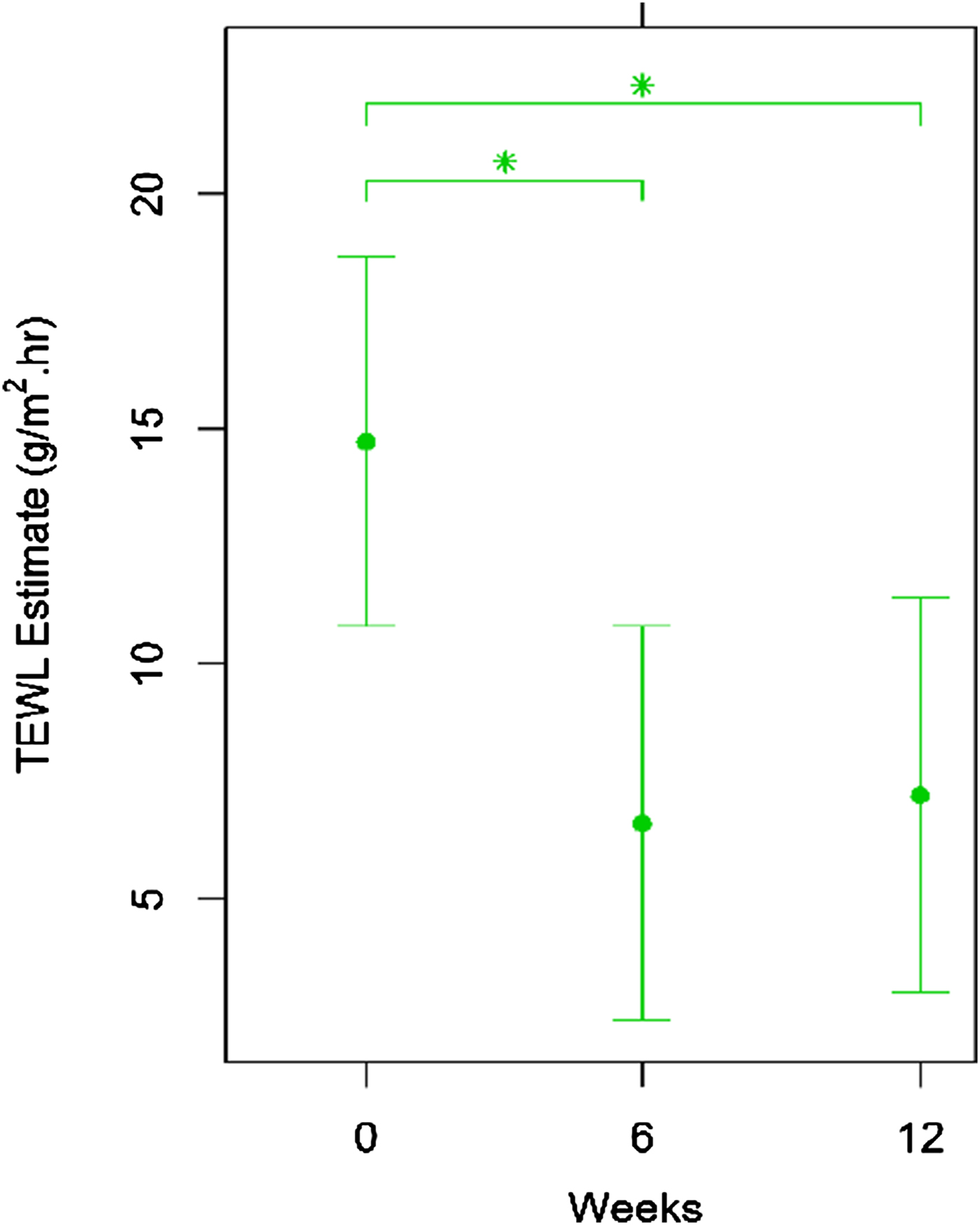
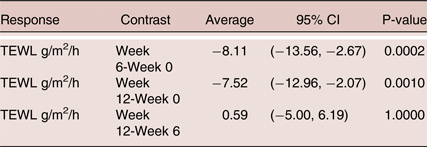
There was a significant change (reduction) in TEWL between week 0 and 6 (P < 0.001) of feeding the test diet. A comparable difference was seen between weeks 0 and 12 (P < 0.005). There were no differences detected between weeks 6 and 12, which demonstrated that TEWL stabilised over this period (Table 3; Figure 1).
Transepidermal water loss measurements over the 12 week test feeding period. Values plotted are mean estimates with 95% confidence intervals. * indicates significant difference between weeks (P < 0.005)

Transepidermal water loss during high LA and Zn feeding period changes relative to week 0 (end of basal feeding period) and between week differences.

LA plays a role in the structural and functional integrity of the epidermal barrier (Hansen and Jensen, Reference Hansen and Jensen1985; Breiden and Sandhoff, Reference Breiden and Sandhoff2014). As an essential component of the ceramides, LA is involved in the maintenance of the transepidermal water barrier. The barrier is composed of terminally differentiated corneocytes embedded in an approximately equimolar mixture of cholesterol, fatty acids and ceramides, collectively known as the lamellar lipids. Continuous environmental challenges, as well as the rapid turnover of the outer layers of the skin, leads to a substantial requirement for nutritional factors to support biosynthetic activities (Park, Reference Park2015; Boelsma et al., Reference Boelsma, Hendriks and Roza2001). LA cannot be synthesised in vertebrates and so, along with Zn, must be consumed. Minimum requirements for LA intake have been established for a number of mammals, including dogs (NRC, 2006). For skin health the minimum has been based largely on eliminating signs of overt deficiency, such as scaly, dry skin. In a deficient state, the skin barrier can be adversely affected, and increased TEWL is seen (Meguro et al., Reference Meguro, Arai, Masukawa, Uie and Tokimitsu2000). However, less is known about what happens to the barrier when animals have LA and Zn intakes greater than the minimum recommendations. The variability, and in particular intra-individual repeated measure variation, of TEWL has led to debate about the reliability of this as a metric for barrier function (Ponnagoda et al., Reference Pinnagoda, Tupker, Smit, Coenraads and Nater1989; Marsella, Reference Marsella2012). Watson et al. (Reference Watson, Fray, Clarke, Yates and Markwell2002) showed that it is necessary to control as many of the environmental factors which can impact the measurement process as possible. Guidelines have been published and subsequently updated in line with increased understanding the parameters key to successful assessment (Pinnagoda et al., Reference Pinnagoda, Tupkek, Agner and Serup1990; Du Plessis et al., Reference du Plessis, Stefaniak, Eloff, John, Agner, Chou, Nixon, Steiner, Franken, Kudla and Holness2013). In this study, all Labradors were older than 18 months (fully grown) and veterinarian verified as free of skin-associated problems. Increasing the dietary intake of LA and Zn to levels significantly in excess of minimal requirements had a significant impact on the epidermal properties in these dogs. All dogs maintained a healthy appearance to their skin and coat throughout the study in both diet groups, hence there was no visual evidence that the increased LA and Zn intake or TEWL had an impact on skin health. However, it is possible that there was an enhancement of the skin barrier, which was indicative of increased adaptability of the epidermis, ensuring it remained ceramide replete under times of increased stress or demand. It may be significant that the study described here took place over the winter months. It has previously been shown that ceramide profiles and quantities in the epidermis vary according to the seasonal temperature, and cold is associated with dry skin conditions in humans (Rogers et al., Reference Rogers, Harding, Mayo, Banks and Rawlings1996; Ishikawa et al., Reference Ishikawa, Shimotoyodome, Ito, Miyauchi, Fujimura, Kitahara and Hase2013). What is more, Conti et al. (Reference Conti, Rogers, Verdejo, Harding and Rawlings1996) found that levels of LA containing ceramide-1 have been shown to drop significantly during cold weather in human studies, a phenomenon which could be reversed by topical addition of LA rich triglycerides. In addition, Wei et al. (Reference Wei, Stella, Wehmeyer, Spruell and Wickett2017) showed that TEWL has been shown to increase during winter months. If this phenomenon were replicated in dogs, one could hypothesise that additional dietary LA may be a valuable resource to an animal.
Clearly, these findings alone do not provide definitive proof that there are benefits to feeding dogs supplementary LA and Zn. However, the observations suggest further investigation of the interaction is justified.
Acknowledgements
This work was funded by Waltham Centre for Pet Nutrition; diets were provided by Royal Canin SAS.
Declaration of interest
Adrian Watson is an employee of Royal Canin SAS, at the time of writing Gaelle Thomas, Christina Butowski and David Allaway were all employees of Mars Petcare.