Introduction
Understanding general patterns of animal communities is one of the main aims in ecological research (Morton et al., Reference Morton, Law, Pimm and Drake1996). At the parasitological level, it has been observed that the helminth community in the same host population can vary seasonally, resulting in diversity changes (Boggs et al., Reference Boggs, McMurry, Leslie, Engle and Lochmiller1990; Ibrahim & Soliman, Reference Ibrahim and Soliman2005). These seasonal changes may occur due to extrinsic factors (environmental factors) that affect the survival of free-living parasitic stages, or the density, diet or susceptibility of both intermediate and definitive hosts (Healey & Grundmann, Reference Healey and Grundmann1974; Roepstorff & Murrell, Reference Roepstorff and Murrell1997; Torres et al., Reference Torres, Miquel, Casanova, Ribas, Feliu and Morand2006; Cornell et al., Reference Cornell, Bjornstad, Cattadori, Boag and Hudson2008). Host density, in particular, should influence the transmission success of directly transmitted parasites, so that higher host densities would increase the rate of contact between the infective stage of the parasite and the new hosts (Arneberg, Reference Arneberg2002). Many studies comparing taxonomically related host species suggest that host population density is a good predictor of both parasite abundance and richness (Arneberg et al., Reference Arneberg, Skorping, Grenfell and Read1998; Arneberg, Reference Arneberg2002; Torres et al., Reference Torres, Miquel, Casanova, Ribas, Feliu and Morand2006). However, fieldwork studies evidencing that host density affects helminth infections among different populations of the same host species are scarce (Stanko et al., Reference Stanko, Miklisová, Goüy de Bellocq and Morand2002).
Although there have been several ecological studies on helminth communities of rodents in many regions of the world (Grundmann, Reference Grundmann1957; Montgomery & Montgomery, Reference Montgomery and Montgomery1988, Reference Montgomery and Montgomery1990; Goüy de Bellocq et al., Reference Goüy de Bellocq, Sarà, Casanova, Feliu and Morand2003; Behnke et al., Reference Behnke, Harris, Bajer, Barnard, Sherif, Cliffe, Hurst, Lamb, Rhodes, James, Clifford, Gilbert and Zalat2004), very few have been developed in South America (Lareschi et al., Reference Lareschi, Notarnicola, Navone and Linardi2003; Miño, Reference Miño2008; Navone et al., Reference Navone, Notarnicola, Nava, Robles, del R. Galliari and Lareschi2009). The Pampean grassland mouse Akodon azarae (Fischer, 1829) (Rodentia: Cricetidae), which inhabits South America from southern Brazil to central Argentina (Wilson & Reeder, Reference Wilson and Reeder2005), is the most abundant rodent species in the north-east of Buenos Aires Province (Argentina). It is mainly found along the fencerows of crop fields (rural environment) and poultry farms (peridomestic environment) (Miño et al., Reference Miño, Cavia, Gómez Villafañe, Bilenca, Cittadino and Busch2001). Populations of A. azarae have been widely studied in rural environments. It has been shown to have a seasonal dynamic, with more abundance in autumn–winter and a decline towards spring and summer (Zuleta et al., Reference Zuleta, Kravetz, Busch and Percich1988; Mills et al., Reference Mills, Ellis, McKee, Maiztegui and Childs1991). The breeding season lasts from September to April (Zuleta et al., Reference Zuleta, Kravetz, Busch and Percich1988; Mills et al., Reference Mills, Ellis, McKee, Maiztegui and Childs1992), though the presence of young individuals in winter on poultry farms could indicate that the breeding season is longer in populations living there (Miño, Reference Miño2003). This rodent has a highly diversified diet that varies seasonally according to the environmental availability (Bilenca & Kravetz, Reference Bilenca and Kravetz1998; Ellis et al., Reference Ellis, Mills, Glass, McKee, Enria and Childs1998). Several helminth species, with direct and indirect life cycles, from A. azarae inhabiting natural environments have been reported. Among them, nematodes (oxyurids, trichostrongylids, spirurids and trichurids) and trematodes have been mentioned (Sutton, Reference Sutton1984; Durette-Desset & Sutton, Reference Durette-Desset and Sutton1985; Robles & Navone, Reference Robles and Navone2007). On the other hand, Navone et al. (Reference Navone, Notarnicola, Nava, Robles, del R. Galliari and Lareschi2009) compared the parasite assemblage of A. azarae with that of other sympatric sigmodontines in wetlands from the north-east of Buenos Aires Province.
This paper describes the composition of the helminth community from populations of A. azarae inhabiting poultry farms in the north-east of Buenos Aires Province (Argentina). It also compares the diversity of helminths between two seasons of different rodent population abundance, expecting to find higher diversity in the season with higher host abundance.
Materials and methods
Collection and examination of rodents
Rodents were trapped on commercial poultry farms in the county of Exaltación de la Cruz (34°S, 59°W), Buenos Aires Province, Argentina. This county is located in the Pampean region, Rolling Pampa subdivision (Soriano et al., Reference Soriano, León, Sala, Lavado, Deregibus, Cauhépé, Scaglia, Velásquez, Lemcoff and Coupland1991). Specimens of A. azarae were collected in seasonal rodent samples from 14 poultry farms between the years 1998 and 2000 (for details of the sampling design see Miño et al., Reference Miño, Cavia, Gómez Villafañe, Bilenca and Busch2007). The present study includes individuals captured in winter (July–August), season of high rodent abundance (HA-season), and spring (October–November–December), season of low rodent abundance (LA-season). Rodents were sacrificed in the field and fixed in 10% formalin. They were measured (body total length and tail length) and sexed. The digestive tract (with the small intestine divided into ten equally long sections) and associated organs were examined for helminths. The collected helminths were preserved in 70% ethanol. Nematodes were cleared in Amman's lactophenol, while cestodes were stained with Langeron's carmine and mounted in Canada balsam for identification. Helminths were identified to the species level, except for trichostrongilids and adult cestodes. Most of the trichostrongilids were Stilestrongylus azarai Durette-Desset & Sutton, Reference Durette-Desset and Sutton1985 (Strongylida: Heligmonellidae). However, some of them showed a different morphology, so this parasite taxon will be treated as Stilestrongylus spp. Adult cestodes were identified to the order level. Host voucher specimens were deposited at the Mammal Collection of the Museo Argentino de Ciencias Naturales Bernardino Rivadavia, Buenos Aires, Argentina (MACN 24022–24036), while helminth voucher specimens were deposited at the Helminthological Collection of the Museo de La Plata, Buenos Aires, Argentina, with the following identification numbers: Protospirura numidica criceticola Quentin, Karimi & Rodriguez de Almeida, 1968 (Spirurida: Spiruroidea), MLP 5657–5698; Pterigodermatites (Paucipectines) azarai (Sutton, Reference Sutton1984) (Spirurida: Rictularoidea), MLP 5581–5590; Syphacia carlitosi Robles & Navone, Reference Robles and Navone2007 (Oxyurida: Oxyuridae), MLP 5825–5849; Taenia taeniaeformis (Batsch, 1786) (Cyclophyllidea: Taeniidae), MLP 6277; and Trichuris laevitestis Suriano & Navone, 1994 (Enoplida: Trichuridae), MLP 5803–5824.
Rodent populations
Mouse age was estimated by applying the following equations developed by Zuleta (Reference Zuleta1989) for A. azarae: male age = (BL – 76.916)/3.221 and female age = (BL – 70.261)/4.476, where BL (body length) = body total length – tail length. Data from mice with injuries that could affect measurement (e.g. tails cut off) were discarded. For the purpose of this work, mice were classified in three age classes: juvenile ( ≤ 1.9 months old), adult (2.0–5.9 months old) and old ( ≥ 6.0 months old). The ratio of sexes and age classes between seasons were compared using the G-test for goodness of fit (Zar, Reference Zar1996).
Helminth populations
At component population level, quantitative parameters of prevalence (Pr), intensity, mean intensity, abundance and mean abundance in each season were calculated according to Bush et al. (Reference Bush, Lafferty, Lotz and Shostak1997). The combined prevalence for both seasons was also calculated. Comparisons of prevalence for each helminth species between seasons were performed by means of the test for difference between proportions, while Mann–Whitney's U-test was used for comparisons of intensity and abundance between seasons (Zar, Reference Zar1996).
Helminth communities
Helminth richness was calculated at infracommunity level (s = number of helminth taxa present in each individual host) as well as at component community level (S = number of helminth taxa present in all the A. azarae of each season), while the diversity index of Shannon–Wienner [ , where p i is the proportion of each helminth species in the sample] and the evenness index (E = H/ln S) were estimated at component community level. We applied the Shannon–Wienner index because it allows statistical comparison between communities through Hutcheson's t-test. This test assesses significance by calculating the variances of each index [
 , where n = total number of parasites in the considered season], the t-value [
 ], and the degrees of freedom [

 ] (Magurran, Reference Magurran1988). The relationship between richness and host sex, as well as between richness and host age classes, in each season was analysed using the G-test of independence. As richness and diversity indexes depend on sample size, the minimum number of hosts required to describe the parasite community in each season was estimated by generating a plot of richness versus host number (Magurran, Reference Magurran1988). For this, hosts were randomly chosen, increasing their number gradually, and plotting the accumulated richness. The point at which the curve flattens indicates the minimum viable sample size, since it means that no more richness is expected even though the number of hosts increases (Magurran, Reference Magurran1988).
On the other hand, the dominance level of each species in the component community was estimated [D = (number of individuals of a particular parasite species in A. azarae/total number of parasites in this host species) × 100] following Morales & Pino (Reference Morales and Pino1987). In addition, a rank/abundance plot was generated for each season using the values of dominance (Magurran, Reference Magurran1988). Moreover, similarity between the communities in winter (HA-season) and spring (LA-season) was estimated by the Czekanowsky quantitative index, which was calculated as the total sum of the lower dominance value of each helminth species when comparing both seasons [ , where Di HA and Di LA are the dominance of each helminth species in the communities HA or LA, respectively] (Matteucci & Colma, Reference Matteucci and Colma1982).
Results
Rodent populations
A total of 70 specimens of A. azarae were examined: 53 captured in winter and 17 in spring. The sex ratio did not differ from 1:1 in winter (G = 3.22, P = 0.07, df = 1, N = 53) or spring (G = 0.06, P = 0.81, df = 1, N = 17). In contrast, the age distribution differed from the 1:1:1 ratio in both seasons. Mice from the three classes were present in the winter sample (G = 9.78, P = 0.007, df = 2, N = 51), with more adults and fewer young and old mice than expected, while only adults were present in the spring sample.
Helminth infection levels
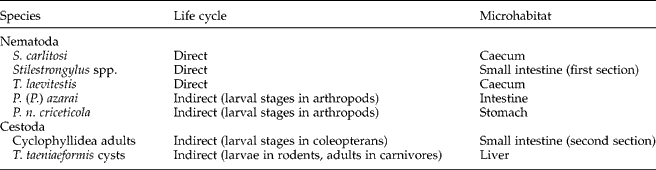
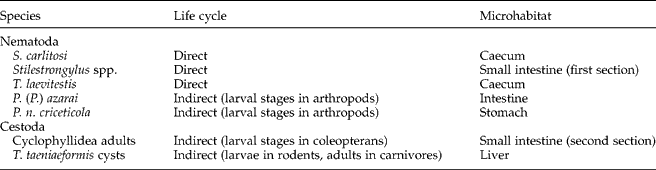
More than 3400 helminths (3412 nematodes and 33 cestodes) were recovered. The nematodes were: S. carlitosi (combined Pr = 57.1%), Stilestrongylus spp. (combined Pr = 42.9%), T. laevitestis (combined Pr = 41.4%), P. (P.) azarai (combined Pr = 27.1%) and P. n. criceticola (combined Pr = 8.5%), while the cestodes were strobilocerci of T. taeniaeformis (combined Pr = 11.4%) and adults of Cyclophyllidea (combined Pr = 8.6%). Helminths were found occupying different habitats in the digestive tract. Stilestrongylus spp. and P. (P.) azarai were mainly in the first section of the small intestine, whereas the adults of Cyclophyllidea were located along the small intestine, always after the second section. Syphacia carlitosi and T. laevitestis were located in the caecum and P. n. criceticola in the stomach, while T. taeniaeformis was encysted in the liver (table 1).
Life cycle and location within the rodent of the seven helminth taxa parasitizing Akodon azarae on poultry farms in central Argentina.
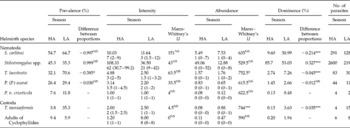
Syphacia carlitosi was the most prevalent species in the HA-season, followed by Stilestrongylus spp., T. laevitestis and P. (P.) azarai. In contrast, T. laevitestis was the most prevalent in the LA-season, followed by S. carlitosi, Stilestrongylus spp. and T. taeniaeformis (table 2). Only T. laevitestis showed a significant difference in prevalence between seasons, having more than twice the prevalence in the LA-season as the HA-season (d = − 0.385, P = 0.01, table 2). No statistical analyses were performed for P. n. criceticola nor for cestodes because of the small sample sizes.
Prevalence, intensity, abundance and dominance for the helminth taxa collected from Akodon azarae in a season of high rodent abundance (HA) and a season of low rodent abundance (LA) between 1998 and 2000 on poultry farms in central Argentina.

For intensity and abundance, the mean value (first line) and median value (second line) are informed. Values in brackets are the first and third quartiles. ***, P ≤ 0.0005; *, P ≤ 0.05; NS, P>0.05; –, the analysis was not carried out because the number of hosts or parasites was insufficient.
Stilestrongylus spp. showed the highest values of intensity and abundance in both seasons, while other species showed low values (table 2). Trichuris laevitestis and T. taeniaeformis were the only species that showed significant differences in abundance, both being more abundant in the LA-season (T. laevitestis: U = 752.5, P = 0.02; T. taeniaeformis: U = 744, P = 0.0005). In contrast, there were no significant differences in intensity between seasons in any of the seven species (Mann–Whitney U-test: P>0.05, table 2).
Helminth communities
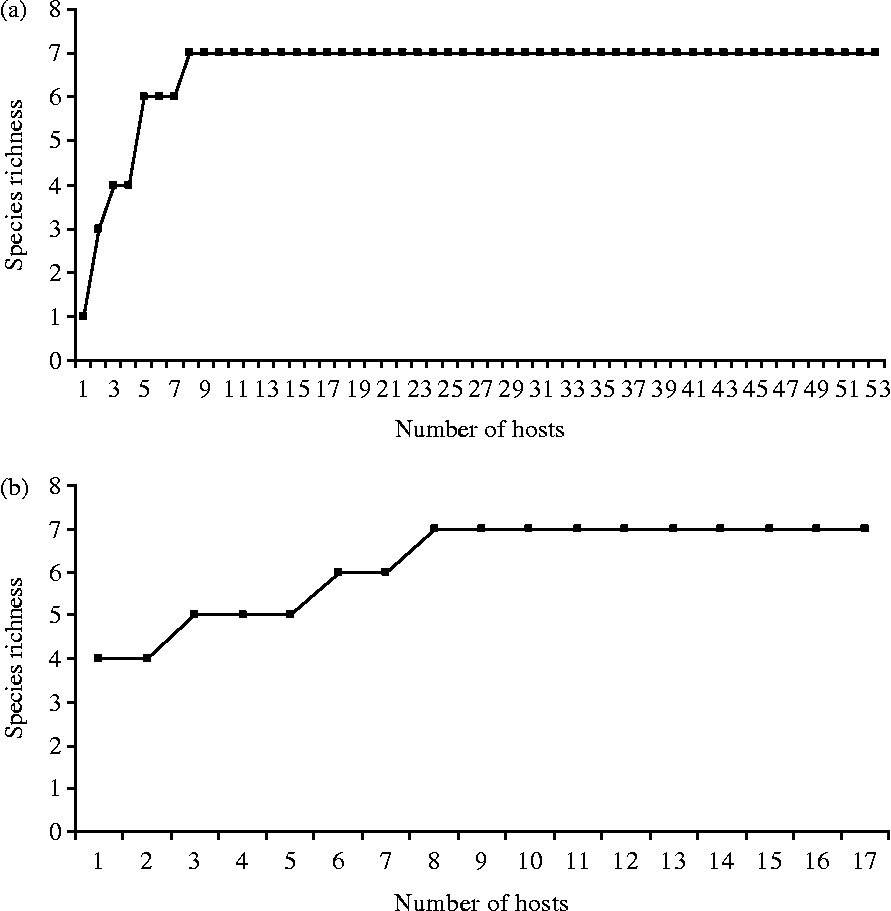
In both seasons, the minimum number of hosts required to describe the parasite community was eight (fig. 1). The highest species richness at infracommunity level was s = 5 in both seasons, while it was S = 7 in both seasons at component community level. Richness was independent of mouse sex in both seasons (winter: G = 9.08, P = 0.06, df = 4, N = 53; spring: G = 0.76, P = 0.94, df = 4, N = 17) and it was also independent of age class in winter (G = 5.23, P = 0.51, df = 6, N = 51). No statistical analysis was performed for spring because only one age class was present.
Helminth richness in an increasing number of hosts chosen randomly from a sample of Akodon azarae (Rodentia, Cricetidae) captured in (a) winter and (b) spring on poultry farms in central Argentina.

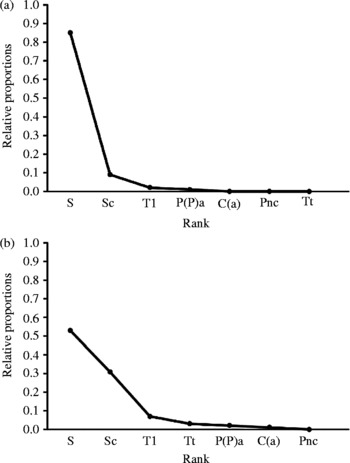
Both component communities (the community in the HA-season and that in the LA-season) showed 67% similarity (Czekanowsky quantitative index), and the diversity index was significantly higher in the LA-season (H = 0.873) than in the HA-season (H = 0.546, t = 3.40, P < 0.0005). The species composition of the helminth community was more homogeneous in the LA-season (E = 0.45) than in the HA-season (E = 0.28), with Stilestrongylus spp. dominating the component community in the latter season (D = 86%), and Stilestrongylus spp. (D = 53%) and S. carlitosi (D = 31%) co-dominating in the LA-season (fig. 2). Comparisons of dominance between seasons showed that Stilestrongylus spp. was more dominant in the HA-season than in the LA-season (d = 0.327, P = 0.0000, df = 1, N = 3445) (table 2). In contrast, S. carlitosi, T. laevitestis and T. taeniaeformis had significantly higher dominance values in the LA-season than in the HA-season (all of them P = 0.0000, df = 1, N = 3445; table 2).
Relative proportions of the helminth species found parasitizing Akodon azarae in (a) a season of high rodent abundance and (b) a season of low rodent abundance, from 1998 to 2000 on poultry farms in central Argentina. S, Stilestrongylus sp.; Sc, Syphacia carlitosi; Tl, Trichuris laevitestis; P(P)a, Pterigodermatites (Paucipectines) azarai; Pnc, Protospirura numidica criceticola; C(a), Cyclophyllidea (adults); Tt, Taenia taeniaeformis (strobilocerci).

Discussion
The helminth community of populations of A. azarae inhabiting poultry farms in Exaltación de la Cruz is characterized by seven species: five nematodes and two cestodes. This is the first report of T. taeniaeformis cysts in A. azarae and the first time that a cestode is recorded from this rodent species. In contrast, the five nematode species were already known parasitizing A. azarae in natural environments such as wetlands and grasslands (Sutton, Reference Sutton1984; Durette-Desset & Sutton, Reference Durette-Desset and Sutton1985; Sutton, Reference Sutton1989; Robles & Navone, Reference Robles and Navone2006, Reference Robles and Navone2007; Navone et al., Reference Navone, Notarnicola, Nava, Robles, del R. Galliari and Lareschi2009). Protospirura numidica criceticola was the only nematode registered on poultry farms so far (Miño, Reference Miño2008). On the other hand, no digeneans were found in A. azarae in the present study, while Navone et al. (Reference Navone, Notarnicola, Nava, Robles, del R. Galliari and Lareschi2009) mentioned two trematode species for the same host in wetlands. This difference may be due to the fact that trematodes use molluscs as intermediate hosts. The soil of poultry farms and the surroundings on which this study was carried out has good water drainage and no freshwater molluscs were observed there.
The helminth community of A. azarae on the farms showed higher diversity in the LA-season than in the HA-season. This difference is due to evenness and not to richness, since richness was equal in both seasons. Evenness was higher in the LA-season than in the HA-season mainly due to the co-dominance of two species (Stilestrongylus spp. and S. carlitosi) in the former season, in contrast to the dominance of only one species (Stilestrongylus spp.) in the HA-season. Moreover, the relative proportions of T. laevitestis and cestodes were higher in the LA-season than in the HA-season, increasing evenness even more, and therefore diversity in the LA-season.
The significantly higher dominance of Stilestrongylus spp. in the HA-season compared to the LA-season is consistent with the hypothesis that host density has a positive influence, especially on the transmission of parasites with a direct life cycle. This has been observed in several directly transmitted nematode species of mammals (Arneberg et al., Reference Arneberg, Skorping, Grenfell and Read1998). However, the other species with a direct life cycle included in this work did not have higher dominance in the HA-season. Moreover, S. carlitosi and T. laevitestis showed just the opposite behaviour, since they were significantly more dominant, and even T. laevitestis significantly more abundant, in the LA-season than in the HA-season. Extrinsic environmental factors are likely to be influencing the transmission of T. laevitestis, since this is a geohelminth for which survival and development of the eggs depend on soil conditions (Bundy & Cooper, Reference Bundy and Cooper1989; Robles, Reference Robles2008). Moreover, it has been observed that the infective stage development of trichurids is optimal at the temperature characteristic of spring–summer (LA-season) in Buenos Aires Province (25–35°C) (Bundy & Cooper, Reference Bundy and Cooper1989). However, this would not be the case for S. carlitosi, whose life cycle and development are not dependent on extrinsic factors (Robles, Reference Robles2008). On the other hand, other authors have observed higher prevalences of Syphacia when host populations are high (Montgomery & Montgomery, Reference Montgomery and Montgomery1988, Reference Montgomery and Montgomery1990). Syphacia eggs are mostly transmitted by contact during grooming of the perianal fur (Chan, Reference Chan1952). This social behaviour increases between male and female, and between female and young during the breeding season, which in A. azarae starts in spring, when population size is the lowest.
The lesser dominance in both seasons of the parasite species with an indirect life cycle (P. (P.) azarai, P. n. criceticola and Cyclophyllidea) compared with direct-cycle parasites (Stilestrongylus spp., S. carlitosi and T. laevitestis) can be attributed to the additional difficulty for heteroxenus species in finding an extra host to complete their life cycle (Bush et al., Reference Bush, Fernández, Esch and Seed2001). However, in spite of its low values, T. taeniaeformis showed more abundance and it was in a higher proportion in the LA-season than in the HA-season. Rodents would become parasitized when feeding on plants contaminated with carnivore-infected faeces. Since A. azarae has opportunistic feeding habits and the plant cover develops more in spring than in winter, then the probability of infesting with T. taeniaeformis would be higher in the LA-season than in the HA-season.
Both Stilestrongylus spp. in the small intestine and S. carlitosi in the caecum were more dominant and intense than their co-habiting species, P. (P.) azarai and T. laevitestis, respectively. This could be due to a crowding effect (density-dependence) among individuals of the larger species (P. (P.) azarai and T. laevitestis). The inverse relationship between the number of parasites and their body size has been well documented for other species (Read, Reference Read1951; Bush & Lotz, Reference Bush and Lotz2000). Here, P. (P.) azarai and T. laevitestis are large species (females about 20–30 mm long), while Stilestrongylus spp. and S. carlitosi are small (females about 2–5 mm long). In contrast, it is less probable that the difference in the values of dominance and intensity are related to interspecific competition, since in both pairs of species sharing the same habitat there is a difference in the use of microhabitat, and hence, there would also be a difference in trophic niche. According to niche theory, species that use resources differently would avoid competition (Case & Gilpin, Reference Case and Gilpin1974). In this case, S. carlitosi appears free in the caecum lumen, while T. laevitestis is fixed to the caecum wall. Similarly, Stilestrongylus spp. is attached to the intestine microvilli, ingesting blood, while P. (P.) azarai is found free in the lumen or sustained in the mucosa using its body spines. Then, they would not compete with each other, at least directly.
This study represents a new contribution to the knowledge of the parasite community from the wild rodent species A. azarae on poultry farms in central Argentina. It compares the helminth diversity in A. azarae between two seasons characterized by the difference in rodent abundance. A difference in the age structure of A. azarae was also detected. However, helminth species richness did not differ among age classes in the season when the three classes were present. Moreover, richness was equal in both seasons at infracommunity and component community level, so we assume that it is unlikely that the host age structure affects, in this case, the difference observed in diversity between seasons.
The finding of T. taeniaeformis cysts, never observed in individuals of A. azarae captured in natural environments, indicates that this rodent is susceptible to infection with this tapeworm when approaching domestic and peridomestic environments. The final hosts of this parasite are carnivores of the Felidae, Canidae and Mustelidae families, including domestic cats and dogs (Loos-Frank, Reference Loos-Frank2000), so A. azarae would help to maintain the life cycle of T. taeniaeformis among the domestic animals present on farms. Moreover, poultry farms may also have some zoonotic importance in central Argentina, since there are some sporadic cases in humans, some of them found in this country (Bowman et al., Reference Bowman, Hendrix, Lindsay and Barr2002). As for the rodent, T. taeniaeformis infection could affect the populations of A. azarae. In laboratory rodents, it has been shown that the presence of strobilocerci in the liver could contribute to the development of sarcomas and decrease fertility in males and females (Lin et al., Reference Lin, Rikihisa, Kono and Gu1990; Mahesh Kumar et al., Reference Mahesh Kumar, Reddy, Aparna, Srinivas, Nagarajan, Venkatesan, Sreekumar and Sesikaran2006). The prevalence value observed in this study (combined Pr = 11.4%) is similar to that reported for T. taeniaeformis infection in Rattus norvegicus, a recognized natural intermediate host of this parasite, on farms in the UK (Webster & Macdonald, Reference Webster and Macdonald1995). Thus, this infection may also be important in controlling A. azarae populations.
Acknowledgements
This work was supported by the Universidad de Buenos Aires (UBACyT X098) and the Agencia Nacional de Promoción Científica y Tecnológica (ANPCYT 12303), Argentina.