Introduction
The number of terrorist attacks, particularly those carried out by suicide bombers, also called modern kamikazes, is dramatically increasing worldwide. Since 1995, the year of the attack on the American Embassy in Beirut, considered by many to be the first of this type of terrorist act, more than 70,000 attacks have been completed, which have killed 170,000 and wounded 300,000. Modern suicide terrorism has some peculiarities.Reference Lankford 1 , Reference Townsend 2 First, this phenomenon is no longer confined to the countries of the Middle East, traditionally characterized by political instability, but now occur throughout the world. Second, the most recent attacks in Western countries have been perpetrated by first- or second-generation immigrants raised according to local rules and educated in local schools, who suddenly, at some point in their personal trajectory, embraced religious radicalization and repudiated the values of their societies. It is now evident that every country, every activity, and every person not sharing their beliefs and values are potential targets. Third, if previous terrorist activities were characterized and motivated by more or less declared political aims (e.g., the Red Brigades in Italy, the Rote Armee in Germany, and the IRA in Ireland),Reference Crenshaw 3 – Reference Della Porta 8 the latest suicidal attacks are driven by religion and carried out by extremists who claim to serve as God’s instruments to destroy the West, which they consider impure and corrupted.Reference Lankford 9 , Reference Gill 10 This is crucial, because it implies that these terrorists are (perhaps) not afraid to die, or at least they do not show any reluctance about abandoning their lives while at the same time killing innocent victims, without any apparent regret or overt emotionality. Instead of the joy of life or plans for a creative and better future, they harbor and fuel hatred for the members of their society, and they cultivate the concept of martyrdom and worship death, expecting to be rewarded in paradise.Reference Sela and Shackelford 11 To further complicate the situation, the attacks in Western countries over the last couple of years appear totally different from those of the past, with the apparent waning of a “central” strategy and even strict religious motivations, as they are now mainly perpetrated by isolated individuals, the so-called “lone wolves,” claiming to have acted on behalf of the so-called Islamic State (ISIL).
There are three essential questions that all professionals (including psychologists, psychiatrists, and neuroscientists) involved in understanding and possibly preventing terrorism should try to answer:
1. Who are the modern suicide terrorists?
2. What are they: psychopaths, psychiatric patients, personality-disordered subjects, or something else?
3. Why does someone become a terrorist, and what are the psychological processes that drive an individual to become a lethal weapon?
The answer to the third question is the key to disentangling a crucial quandary: how is it possible that an individual would choose to deliberately die in order to kill someone else?
In the 1970s, these questions were mainly approached using sociological and political explanations.Reference Russell and Miller 12 – Reference Atran 14 During the next two decades, much attention was paid to psychological or psychosocial factors,Reference Crenshaw 15 – Reference Post 20 with the result pointed out by VictoroffReference Victoroff 21 that “the number of suggested theories far outstrips the number of empirical studies in the literature.” These hypotheses were soon generally discredited. Instead of the previous rigid categorizations, there was a series of novel and creative suggestions that, though suicide terrorists do not suffer from any specific personality disorders, they are nevertheless “peculiar.” However, it should be underlined that the research in this area is complicated by difficulties in carrying out reliable studies with standardized instruments to “measure” and assess the suicidal terrorism phenomenon and the characteristics of terrorists. As a result, the available data appear to be not only heterogeneous and controversial, but also of limited value, since they were gathered in such small samples. According to John Horgan,Reference Horgan 22 even more dangerous is the fact that the research on recent terrorism seems to neglect previous data and the caveats they present.
Further, we cannot ignore that the research in this field may be slowed down by the reluctance that some ferocious behaviors provoke in professionals, even mental health and brain specialists or criminologists, when faced with such cold evil that has no apparent purpose other than to frighten people. In any case, if some phenomena are present, recurrent, and of great impact, if they threaten our lives, our future, our world, and our way of living, they need to be approached correctly and understood as fully as possible, though they may evoke disgust, condemnation, and disapproval.Reference Marazziti 23
The aim of our paper is to review the available literature in order to put forward some considerations and possible hypotheses on what could be the common psychological denominators or features shared by suicide terrorists and on what constitutes the “terrorist’s mind.”
Who and What Are the Terrorists?
Demographic studies from the 1960s and 1970s depicted a typical terrorist as a well-educated single male in his 20s and with a middle- or upper-class background.Reference Russell and Miller 12 Examining Federal Bureau of Investigation data on active terrorists in the United States during the 1960s and 1970s, it was found that female sex and completion of college were more common among left- than right-wing terrorists, while a blue-collar occupation was more common among right-wing terrorists.Reference Handler 13 Similar findings were obtained from investigations of Italian terrorists, where the women were reported to be predominantly in their 20s and mainly teachers or white-collar workers.Reference Weinberg and Eubank 24 No significant differences in terms of family background were detected in a controlled studyReference Ferracuti and Bruno 25 comparing Italian Red Brigade members to politically active control subjects.
A change in the terrorist’s profile was observed in the 1980s, when American and European revolutionary anarchist groups were becoming more quiescent and radical Islamic terrorism was growing worldwide. The typical Palestinian terrorists of this period were initially and uniformly described as aged 17 to 23 years, coming from large and impoverished families, and having low levels of education.Reference Strentz 26 Subsequent studies, however, yielded different data. SagemanReference Krueger and Maleckova 27 reported that more than 70% of Muslim terrorists had a college education and that more than 50% were professionals. As he wrote in 2004, “These are the best and brightest of their societies in many ways.” Krueger and MaleckovaReference Krueger and Maleckova 27 compared a group of Hezbollah fighters with members of the general Lebanese population of the same age range and showed that the poverty rate was similar but that the fighters were significantly more likely to have attended secondary school. Such reports were clearly inconsistent with the theories matching radical Islamic terrorists with poverty and a lack of education.Reference Kaplan 28 Currently, it is clear that Middle Eastern terrorists from the late 1990s came from a wider demographic range, including university students, professionals, married men in their late 40s, and even young women.Reference Ripley 29 From a recent revision of one of his previous studies,Reference Merari 4 Merari,Reference Merari 30 analyzing and comparing 15 suicide bombers and 14 recruiters with 12 non-suicide terrorists, concluded that the former had higher educational and economic levels, higher religiosity, and were suffering more frequently from avoidant and dependent personality disorders, and sometimes from depression.Reference Merari 4 , Reference Merari 30
Other personality traits commonly reported and proposed in the literature include narcissism, paranoia, victimization, and psychopathy.Reference Pearlstein 31 – Reference Silke 34 In any case, if the motivations of a typical psychopath are complex and involve personalized fantasies, both suicide bombers and psychopaths would seem to lack social and moral constraints, and they explicitly refuse the conventional moral limits that are generally accepted during times of war.Reference Blair 35 In any case, the data supporting psychopathy or sociopathy as important features of the psychology of terrorism are limited, but there is no reason that terrorist groups should be considered organizations of psychopathic individuals because of the brutality of their behavior, nor do they predominantly recruit psychopaths.Reference Post 36 On the contrary, some data indicate that terrorist leaders generally refuse to accept unstable individuals, who may become a danger to the group. Interestingly. even Hassan-i-Sabbah, the founder and grandmaster of the Hashshashin (Assassins), avoided recruiting for murderers those adepts who became agitated after smoking hashish. However, there is no doubt that suicide bombers show cold cruelty, no empathy, nor any sense of pity or guilt about their deeds, similar to sociopathic individuals. But they are not necessarily sociopaths.Reference Marazziti 23
Why Does Somebody Become a Terrorist?
If suicide terrorists do not meet the diagnostic criteria for personality disorders, major psychiatric disorders, or for psychopathy, what can explain their violent and immoral behavior? According to the so-called “rational choice theory,” terrorist actions derive from a calculated decision or strategy intended to accomplish sociopolitical goals:Reference Sandler, Tschirhart and Cauley 37 , Reference Wilson 38 to perpetrate violence and engender fear.
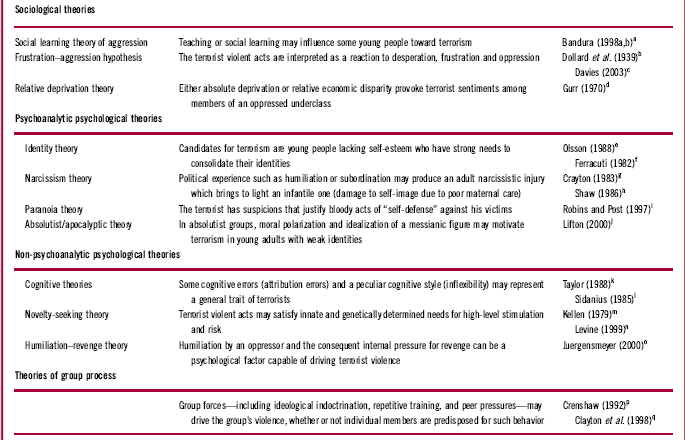
However, there is evidence which suggests that very few subjects, even those who support the goals of terrorists, ever become suicide terrorists.Reference Schbley 39 This theory thus fails to explain why only a small minority of such individuals end up as terrorists. If neither psychopathology/psychopathy nor rationality account for the genesis of terrorist behavior, what alternative explanations exist? In the past few decades, a lot of sociological and psychological theories have been proposed, but none can be considered valid and reliable. As reviewed by Victoroff,Reference Victoroff 21 these theories are categorized as sociological theories, psychoanalytic psychological theories, nonpsychoanalytic psychological theories, and group process theories (Table 1).
Sociological and psychological theories of terrorism

a Bandura A. Health promotion from the perspective of social cognitive theory. Psychol Health. 1998a; 13: 623–649. Bandura A. Mechanisms of moral disengagement. In: Reich W, ed. Origins of Terrorism: Psychologies, Ideologies, Theologies, States of Mind. Washington, DC: Woodrow Wilson Center Press; 1998b: 161–192.
b Dollard J, Doob LW, Miller NE, Mowrer OB, Sears RR. Frustration and Aggression. New Haven, CT: Yale University Press; 1939.
c Davies B. Terrorism: Inside a World Phenomenon. London: Virgin Books; 2003.
d Gurr TR. Why Men Rebel. Princeton, NJ: Princeton University Press; 1970.
e Olsson PA. The terrorist and the terrorized: some psychoanalytic consideration. J Psychohist. 1988; 16(1): 47–60.
f Ferracuti F. A sociopsychiatric interpretation of terrorism. Ann Am Acad Polit Soc Sci. 1982; 463: 129–140.
g Crayton JW. Terrorism and the psychology of the self. In: Freedman AZ, Alexander Y, eds. Perspectives on Terrorism. Wilmington, DE: Scholarly Resources; 1983: 33–41.
h Shaw ED. Political terrorists: dangers of diagnosis and an alternative to the psychopathological model. Int J Law Psychiatry. 1986: 8(3): 359–366.
i Robins RS, Post JM. Political Paranoia: The Psychopolitics of Hatred. New Haven, CT: Yale University Press; 1997.
j Lifton RJ. 2000. Destroying the World to Save It: Aum Shinrikyo and the New Global Terrorism. New York: Holt; 2000.
k Taylor M. The Terrorist. London: Brassey’s; 1988.
l Sidanius J. Cognitive functioning and sociopolitical ideology revisited. Polit Psychol. 1985; 6: 637–666.
m Kellen K. Terrorists—What Are They Like? How Some Terrorists Describe Their World and Actions. Santa Monica, CA: Rand; 1979.
n Levine S. Youths in terroristic groups, gangs and cults: the allure, the animus, and the alienation. Psychiatr Ann. 1999; 29: 342–349.
o Juergensmeyer M. Terror in the Mind of God. Berkeley: University of California Press; 2000.
p Crenshaw M. How terrorists think: what psychology can contribute to understanding terrorism. In: Howard L, ed. Terrorism: Roots, Impact, Responses. New York: Praeger; 1992: 71–80.
q Clayton SV. Preference for macrojustice vs. microjustice in environmental decisions. Environ Behav. 1998; 30: 162–183.
Some very interesting speculations may derive from a 1997 Canadian study, in which 1,482 university students (629 men and 853 women) were analyzed to deepen our understanding of the characteristics of individuals who answered “yes” to the statement “If God told me to kill, I would do it in His name”.Reference Persinger 40 The odds ratio of an affirmative response for men and women was 1.4/1. Other factors significantly associated with an affirmative response included weekly church attendance, a history of a religious experience, and elevated complex partial epileptic-like signs (limbic lability). If generalizable, these findings, as proposed by the author, would suggest that “one out of every 20 university men would be willing to kill another person” if God instructed him to do so. It is conceivable that such elements may represent risk factors for the engagement of young students with terrorist groups. It can be hypothesized that a less flexible cognitive style in men with respect to women could confer susceptibility to maintain orthodoxy and exclude (negate) some elements of reflection, such as the long-term consequences of their actions. Again, it is conceivable that extreme behaviors may be acted out within peculiar social, political, and historical contexts, as shown in a previous study in the United States,Reference Milgram 41 or in times of social uncertainty.Reference Persinger and Lafreniere 42 When paralleled and sustained by religious beliefs elicited by charismatic leaders, as in the case of modern kamikazes, this mix is deadly. The role of charismatic leaders is important in this sense, as they fuel the original sense of humiliation, typical of individuals who harbor a sense of not belonging to their society. Such leaders employ their authority to elicit homicidal impulses. Research on the personality of such leaders highlighted their extroversion, egocentrism, and lack of emotionality, but also critical refusal, suspiciousness, and aggression.Reference Taylor 43 Adherence to religious rituals and shared intents is almost always associated with social rewards from a community, and this could strengthen a sense of belonging and an individual’s identification with the aims and beliefs of a terrorist group. Some studies have focused on the power of religion as a tool to bring fulfillment to an empty life, especially when the values transmitted by an individual’s original families are lost or have been repudiated by the individual, in order to fuel acceptance by his/her compatriots. This process frequently fosters an increasing sense of isolation that can be compensated for and resolved by religion and/or belonging to a group where the individuals feel that they have become an important tile in the mosaic, that they have been appointed for a precise mission. Religious experiences are heterogeneous events in which a person feels an emotional peak, feels the presence of God, or has lucid dreams and ecstatic moments of inspiration.Reference Saver and Rabin 44 These sensations are associated with other signs of limbic lability, including subtreshold temporal epileptic phenomena, particularly of the right brain. Since the limbic system plays such a crucial role in the integration of emotions and thoughts, functional abnormalities therein may allow for a particular emotional state that interferes with higher cognitive processes. Finally, religious experiences and other events associated with limbic lability can influence an individual’s choices while introducing new priorities in their life.Reference Saver and Rabin 44 , Reference Devinsky and Lai 45 In this way, terrorism provides isolated individuals with a motivation where the related actions and their bloody consequences are the reward.
Conclusions
The impact of suicide terrorist attacks is enormous and has produced significant changes in the everyday life of Western nations. Though such acts are much less common than in such regions as the Middle East, the West has become a more common target. Unfortunately, though it may be comforting to infer that suicide bombers may suffer from personality/psychiatric disorders, or are psychopaths, the available data, including those gathered by an expert committee organized some years ago, suggest that modern kamikazes are not mentally ill.Reference Post, Ali, Henderson, Shanfield, Victoroff and Weine 19 , Reference Horgan 22 , Reference Marazziti 23 , Reference Weatherston and Moran 46 , Reference Marazziti 47 However, it is evident that their cruel behavior and the motivations behind them have nothing to do with what any individual with a conscience would consider normal. For these reasons, aside from political, sociological, and economical considerations, it is essential that some attempts should be made to bring together some of the widely recognized characteristics of suicide bombers in order to outline how it is possible that apparently normal individuals can behave in these unacceptable ways, as well as to trace possible hypotheses about which of their psychological processes would suggest a sort of particular “mind of a suicide terrorist.” Obviously, without neglecting the contributions of past studies,Reference Horgan 22 in spite of all their limitations, and while highlighting how it might be reductionist to try and put together different features of a phenomenon that is so multifaceted and increasingly heterogeneous, it could be important to study small samples of regretful, failed, or intercepted terrorists.
Let us start from what we consider the core of terrorist behavior. According to us, this is constituted by the reversal of one of the most important, if not the main, human instinct—to survive, to live. In suicide bombers, this instinct seems to be totally replaced by the death instinct, with the specific connotation that it is rewarding to die while killing many others. “To die to kill” is certainly ethically unacceptable, unintelligible if not included within a type of thinking that is “abnormal” without being pathological, as the literature suggests,Reference Post, Ali, Henderson, Shanfield, Victoroff and Weine 19 , Reference Post 20 , Reference Horgan 22 , Reference Marazziti 23 , Reference Merari 30 , Reference Weatherston and Moran 46 – Reference Salvatori 48 which perhaps should be more correctly defined as “extranormal,” or at least very far away from that domain that we consider “normality.” When there is an inversion of the common value of “life over death” in favor of “death over life,” some other psychological changes may soon occur. Life is no longer appealing, not only one’s own, but also that of thousands of innocent bystanders. Aside from that, the suicide terrorist develops (probably instigated by the group leader and by a type of negative group therapy focusing on extreme religious values and revenge for past wrongs)Reference Post 36 a sort of lust for or addiction to martyrdom and death,Reference Lankford 9 – Reference Sela and Shackelford 11 even promoted by a basic (or drug-induced in some cases) disturbance of the reward system and altered dopamine neurotransmission.Reference Adinoff 49 Who cares if one’s current life is bad? The martyr will go to paradise after death and after murdering those who do not share the same religious values.
Along these lines, it should not be too surprising that suicide terrorists seem to lack some important features of humanity and characteristics of human sociability when acting out in ferocious ways that shock us, with a feral bravery amplified by sophisticated usage of new technologies. That is why their aim is not only to kill people (even children and adolescents returning home after a concert in Manchester or traveling in a bus to attend a religious service in Egypt, just to name a few of the latest attacks), but to destroy the symbols of Western decadence (e.g., discotheques, arenas, and restaurants), and the edifices and symbols of the Christian faith. However, more importantly, they wish to elicit worldwide dread and insecurity. At the basis of this behavior, there are both an indifference for others’ suffering and a cultivated hatred for their peers and society in general.
All suicide terrorist actions, even those accomplished by lone wolves and carried out with less elaborate plans and weaponry, share the same cold rationality. This implies that terrorists are generally rational individuals able to consider the pros and cons of their behavior and its impact within a specific context. However, the considerations that lie at the basis of this behavioral rationality are clearly illogical, as they are derived via a profound alteration of cognitive processes and distortion of reality that could be considered “psychotic.”Reference Robins and Post 50 The excessive rationality coupled with extreme coldness resembles those clinical features described by Antonio DamasioReference Damasio, Tranel and Damasio 51 in several of his neurological patients who showed impairment of those parts of the brain involved in emotional processing (e.g., the limbic structures and their connections to other brain regions and the prefrontal cortex).Reference Damasio, Tranel and Damasio 51 Without emotions, “man is not reasonable.” It is only through a measured balance between emotions and reason that our humanity may spring forth.Reference Haidt 52 , Reference Moll, de Oliveira-Souza and Eslinger 53
In terms of preventing suicide terrorism, aside from political and economic changes, from the psychological point of view, strong efforts need to be devoted to promoting and nourishing correct development of emotions in children and adolescents, especially those exposed to early traumas or who live in troubling situations. It is also mandatory to act at the level of the recruiters so as to reduce the psychological power they wield on their followers, so that these disciples can be rescued and returned to a “normal” life, where they could learn to appreciate shared human values and where they could learn to respect the laws that carry no religious connotations. Put in other words, as Sophocles had Antigone declare in his eponymous tragedy, these values and laws are embedded in our nature: “For their life is not of to-day or yesterday, but for all time, and no man knows when they were first put forth.” 54
Disclosures
Donatella Marazziti, Antonello Veltri, and Armando Piccinni hereby declare that they have conflicts of interest to disclose.