Significant outcomes
Group cognitive-behavioural therapy (GCBT) plus duloxetine achieved quicker improvement for generalised anxiety disorder (GAD) treatment than duloxetine alone.
GCBT plus duloxetine may bring more comprehensive symptom improvement for GAD treatment than duloxetine alone.
GCBT was likely effective in changing the patients’ cognitive style.
Limitations
The follow-up period was relatively short.
The dropout rates were relatively high in both arms of the study.
All patients were recruited from one hospital.
Introduction
Generalised anxiety disorder (GAD) is one of the most prevalent mental disorders in the world. A recent study showed that GAD has a lifetime prevalence of 3.7%, a 12-month prevalence of 1.8%, and a 30-day prevalence of 0.8% (Ruscio et al., Reference Ruscio, Hallion, Lim, Aguilar-Gaxiola, Al-Hamzawi, Alonso, Andrade, Borges, Bromet, Bunting, Caldas, Demyttenaere, Florescu, de Girolamo, Gureje, Haro, He, Hinkov, Hu, de Jonge, Karam, Lee, Lepine, Levinson, Mneimneh, Navarro-Mateu, Posada-Villa, Slade, Stein, Torres, Uda, Wojtyniak, Kessler, Chatterji and Scott2017). GAD is associated with substantial negative economic and health impacts (Hoffman et al., Reference Hoffman, Dukes and Wittchen2008; Bereza et al., Reference Bereza, Machado and Einarson2009). Patients with GAD generally report poor perceived health, moderate to severe psychological distress, and moderate to severe disability (Pelletier et al., Reference Pelletier, O′Donnell, McRae and Grenier2017). In addition, those suffering from GAD have significantly worse health-related quality of life, and they have greater work impairment and resource use relative to the general population (Toghanian et al., Reference Toghanian, Dibonaventura, Jarbrink and Locklear2014). Furthermore, the post-treatment remission rate is relatively low, and the recurrence rate is high, making it a challenge to find effective, long-term treatment (Katzman, Reference Katzman2009).
Medications such as antidepressants for GAD treatment are effective; however, there are significant limitations, such as a lack of response in many patients, a 2- to 4-week delay before the onset of symptom relief, a general lack of full remission (30–60% of patients do not achieve remission), a high risk of relapse (relapse rates in GAD clinical trials are 10–20%), and troublesome adverse effects associated with both the selective serotonin reuptake inhibitors (SSRIs) and serotonin norepinephrine reuptake inhibitor (SNRIs) (Katzman, Reference Katzman2009; Baldwin et al., Reference Baldwin, Hou, Gordon, Huneke and Garner2017). Optimising GAD treatment beyond medications is an important challenge; psychotherapy augmentation strategies are typically considered, particularly cognitive-behavioural therapy (CBT) (Koen & Stein, Reference Koen and Stein2011; Weissman, Reference Weissman2015).
While a number of studies have examined the combined effects of CBT and medication treatment of GAD, the results regarding whether the combined treatment is superior to medication monotherapy have been inconsistent (Black, Reference Black2006; Crits-Christoph et al., Reference Crits-Christoph, Newman, Rickels, Gallop, Gibbons, Hamilton, Ring-Kurtz and Pastva2011; Wetherell et al., Reference Wetherell, Stoddard, White, Kornblith, Nguyen, Andreescu, Zisook and Lenze2011). A recent meta-analysis of randomised trials that addressed this question found that, for anxiety disorders in general, combined treatment with psychotherapy and antidepressant medication is more effective than treatment with antidepressant medication alone, and the superior effects of combined treatment remained significant at 1- to 2-year follow-up periods (Cuijpers et al., Reference Cuijpers, Sijbrandij, Koole, Andersson, Beekman and Reynolds2014). However, this meta-analysis did not specifically address GAD, where there are limited studies. Furthermore, to our knowledge, evidence of combined treatment in Chinese GAD populations is limited. Indeed, very few studies have explored the efficacy of psychotherapy at all in the Chinese context (Wong et al., Reference Wong, Mak, Cheung, Ling, Lui, Tang, Wong, Lo, Mercer and Ma2011; Hui & Zhihui, Reference Hui and Zhihui2017). In addition, there is a lack of understanding of the elements that contribute to the effectiveness of psychotherapy used in combination with medications (Roy-Byrne, Reference Roy-Byrne2015; Weissman, Reference Weissman2015).
In this paper, we report a randomised controlled study that compared the efficacy of group cognitive-behavioural therapy (GCBT) plus medication (duloxetine) versus duloxetine alone for the treatment of GAD. Duloxetine was chosen because it was one of the only two medications approved by the China Food and Drug Administration for GAD. Compared with the other approved medication (venlafaxine), duloxetine appeared to have less side effect (e.g. on blood pressure) and better tolerability (Perahia et al., Reference Perahia, Pritchett, Kajdasz, Bauer, Jain, Russell, Walker, Spencer, Froud, Raskin and Thase2008). Duloxetine as monotherapy for GAD has been demonstrated in at least three randomised, placebo-controlled studies in over 1100 patients, with pooled results showing that duloxetine significantly improved the mean Hamilton Anxiety Scale (HAMA) by more than three points (p<0.001) (Katzman, Reference Katzman2009).
We chose GCBT versus individual CBT since GCBT is as effective as individual therapy and has a more favourable cost-effectiveness profile (Dugas et al., Reference Dugas, Ladouceur, Leger, Freeston, Langlois, Provencher and Boisvert2003). GCBT as monotherapy was also superior to the comparison group by improving on the Anxiety Disorder Symptom Scale with an effect size of 1.76 (Cohen’s d) (Dugas et al., Reference Dugas, Ladouceur, Leger, Freeston, Langlois, Provencher and Boisvert2003), among others. Our primary hypothesis was that the combined treatment would take effect earlier, resulting in more improvement than medication monotherapy. We also wanted to explore – in a preliminary way – how combined therapy differs from medication alone in terms of the mechanisms of change.
Methods
Participants
From September 2015 to June 2017, participants were recruited from the general Outpatient Department at the Sixth Hospital of Peking University. Each recruited outpatient underwent initial screening to confirm their eligibility. All participants were informed of the study protocol, agreed to the randomisation process that potentially included group therapy, and signed a written informed consent. As an aspect of the study protocol, all participants agreed to take one type of medication – duloxetine. Escitalopram, paroxetine, venlafaxine, and duloxetine were the most common medications patients had taken before joining the study. If not already taking duloxetine, the participants switched their medications to duloxetine over a period of 2~4 weeks under the care of their respective primary treating psychiatrists. For those participants who did not take medications before, they were started on duloxetine. Overall, duloxetine doses ranged from 30 to 120 mg according to the severity of symptoms of the participants during the whole research period.
Inclusion criteria for the study participants were as follows: (a) aged between 18 and 65 years old; (b) diagnosed with GAD according to the Diagnostic and Statistical Manual of Mental Disorders, fourth edition (DSM-IV) (American Psychiatric Association, 1994) (The diagnostic screenings were made by two attending psychiatrists independently according to DSM-IV.); (c) scored higher than 14 on the HAMA (Hamilton, Reference Hamilton1959); (d) had the ability to understand and complete the treatment; and (e) had no language communication barrier.
The exclusion criteria were as follows: (a) any past or present history of an organic mental disorder, schizophrenia, schizoaffective disorder, major depression, bipolar disorder, or any other type of anxiety disorder based on the DSM-IV; (b) any alcohol or substance abuse disorder in the past 12 months; and (c) any serious suicidal tendencies. During the study period, participants were removed if they (a) had any suicidal behaviour or made a suicide attempt during the study period; (b) withdrew the informed consent; or (c) were absent for more than three therapy sessions.
Our sample size calculation was based on general reading of previous literature and clinical experience, with α=0.05, β=0.2, and assuming the effective rates for treatment and control groups were 60% and 40%, respectively, the sample size required was 77 cases in each group, with a total of 154 cases. With an estimated dropout rate of 10%, we aimed for a total sample size of 170 cases.
The research was approved by the Ethics Committee of the Sixth Hospital of Peking University.
Procedure
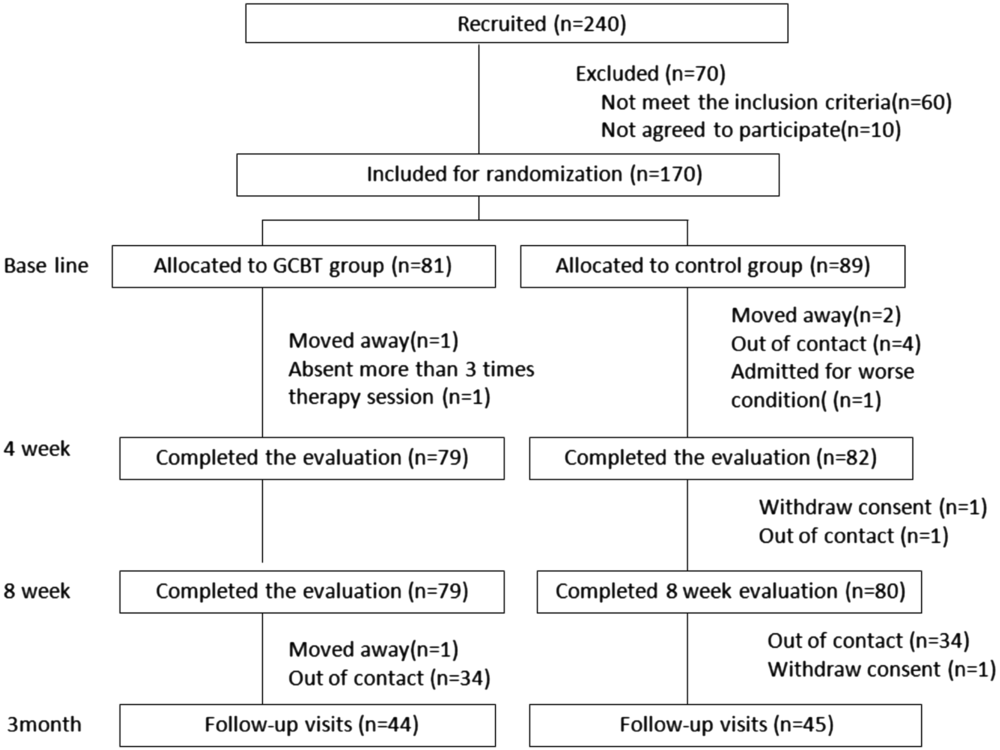
The current study was conducted as a randomised, open-label trial with masked endpoint assessment; only the outcome assessors were blinded to the treatment allocation. After screening with the inclusion and exclusion criteria, eligible patients who were interested in the study discussed the nature of the study and the randomisation process explicitly with the research coordinator who was not involved in the potential participants’ treatment. If the patient was still agreeable to participate in the study, he or she was then entered into the randomisation process. The randomisation protocol employed a SPSS-generated random number table, and group assignment based on these random numbers was prepared using sequentially numbered, opaque, sealed envelopes for concealing the randomisation sequence. Recruited participants were given the sequentially numbered envelops in order and learned of their group assignment after the written informed consent was signed. A total of 240 patients were recruited, and 180 met the inclusion criteria. A total of 170 patients were finally enrolled: 81 were randomised to the GCBT group and 89 to the control group. The study flow diagram is shown in Fig. 1.
Diagram of flow.

Treatment
We developed the process and content of the GCBT based on a literature review on GCBT for GAD (Dugas & Robichaud, Reference Dugas and Robichaud2007; Tian, Reference Tian2007; Luciani, Reference Luciani2010; Bieling et al., 2017) and informed by previous clinical experience of our research team. All of the treatment contents were reviewed by two external experts in the field to ensure that standard active components of CBT were effectively incorporated in the treatment.
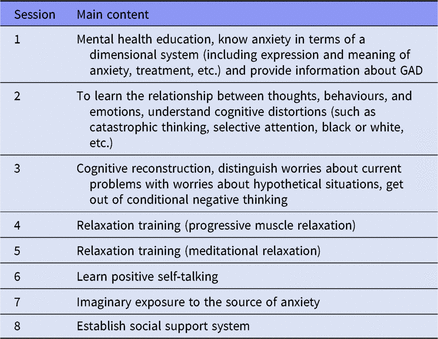
The overall treatment contents and processes were written as a study manual to standardise the implementation of the study. The theme for each session is listed in Table 1.
The theme for each GCBT session
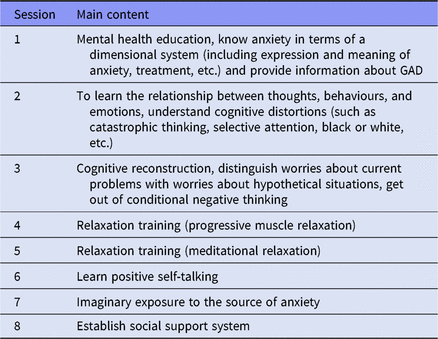
GCBT, group cognitive-behavioural therapy; GAD, generalised anxiety disorder.
Each GCBT group consisted of 6–14 participants, led by 2 therapists, who had either a psychiatry or psychotherapy background. At the end of each session, homework corresponding to the standardised content was assigned. Time to share and discuss the homework was incorporated into the following session. This technique was designed to help the participants to practice, reflect, and master the associated techniques. There was a total of 8 weekly, 90-min sessions. All participants continued their regular outpatient psychiatrist visits for medication management and general support throughout the research period.
Like the treatment group, all control group participants continued their outpatient psychiatrist visits. While the control group did not meet in person as a group, they received general health and GAD psycho-education materials weekly in the form of a leaflet for the 8 weeks that the treatment group received GCBT. The educational leaflet materials were not a reproduction of the GCBT content, but general advices on how to understand and cope with anxiety, with self-help tips, in essay forms developed by the team. All control group participants actively signed up to a dedicated group account and received the leaflet using an internet-based social media application (WeChat).
CBT therapist and quality control
Five psychiatrists and three psychotherapists formed the pool of therapists who provided the standardised GCBT therapy. All therapists had specialised training in CBT and at least 3 years of practice experience. All were trained using the session-by-session GCBT treatment manual.
To control treatment integrity, in addition to the two therapists in each group, there was an independent observer who observed and recorded the treatment process for all sessions. The observer also gave feedback and had discussions with the therapists and the supervisor after each treatment session to ensure competence and quality of the treatment and to ensure fidelity to the treatment protocol across the sessions.
All the GCBT therapists had received additional weekly supervision during the study with a senior supervisor, who is a registered supervisor of the Chinese Psychological Society.
Assessments
Assessments were done by two trained research assistants blind to the treatment condition.
Participant characteristics. Demographic information, including age, sex, marital status, and level of education, was collected using a questionnaire.
Primary outcome measures. Response and remission rates, as measured by the HAMA (Hamilton, Reference Hamilton1959), were chosen as the primary outcome. Response and remission rates were assessed at the 4-week, 8-week, and 3-month follow-up. For this study, HAMA scores less than 7 were regarded as clinical remission, and a ≥50% decrease in HAMA total score relative to the baseline score was regarded as effective treatment (response).
Secondary outcome measures. To further explore the results, we included some key secondary measures. The main ones are score reductions of the HAMA total score, and the psychic and somatic anxiety subscale scores. The HAMA is divided into two subscales: the psychic anxiety subscale (item 1, anxious mood; item 2, tension; item 3, fears; item 4, insomnia; item 5, intellectual; item 6, depressed mood; and item 14, behaviour at the interview) and the somatic anxiety subscale [item 7, somatic (muscular); item 8, somatic (sensory); item 9, cardiovascular symptoms; item 10, respiratory symptoms; item 11, gastrointestinal symptoms; item 12, genitourinary symptoms; and item 13, autonomic symptoms]. Score reductions were defined as the score at baseline minus the score at the evaluation time point (4-week, 8-week, and 3-month follow-up).
Additional secondary outcomes included the following: (a) level of depression (measured by the 17-item version of Hamilton Depression Scale (HAMD) (Hamilton, Reference Hamilton1960); (b) overall illness severity [measured by the Severity Subscale of the Clinical Global Impression Scale (CGI-S)] (Guy, Reference Guy1976); (c) level of disability and level of general function [measured by the Global Assessment of Functioning (GAF)] (American Psychiatric Association, 1987) with scores that could range between 1 and 90 points, divided into nine grades); and (d) quality of life [measured by the 12-item Short-Form Health Survey (SF-12)] (Ware et al., Reference Ware, Kosinski and Keller1996).
Statistical analysis
Chi-square tests were used to analyse categorical data, and t-tests were used for continuous data (all continuous data were confirmed for normal distribution using the Kolmogorov–Smirnov test). All data were analysed based on an intention-to-treat approach. In addition, logistic regression was used to compute the odds ratio (OR) of response rates and remission rates between the two groups. The statistical significance threshold was set at p<0.05. The data were analysed using SPSS for Windows statistical software 20.0 (SPSS Inc., Chicago, IL, USA).
Results
Baseline characteristics of study participants and dropout rates
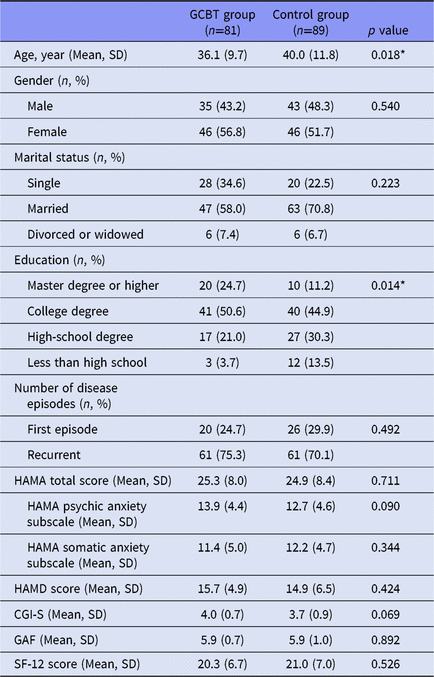
A total of 170 patients were finally included in this study, including 78 males and 92 females, with a mean age of 38.2 (SD=11.0) years. Demographic and baseline characteristics of the two groups are listed in Table 2. Despite randomisation, there were differences in age [the GCBT group was younger: 36.1 (SD=9.7) vs. 40.0 (SD=11.8); p=0.018] and education levels (the GCBT group had higher education; p=0.014). All other demographic and baseline characteristics of the two groups were otherwise well balanced.
Baseline characteristics of study participants

GCBT, group cognitive-behavioural therapy; HAMA, Hamilton Rating Scale for Anxiety; HAMD, Hamilton Rating Scale for Depression; CGI-S, Clinical Global Impression-Severity of Illness; GAF, Global Assessment of Functioning; SF-12, 12-item Short-Form Health Survey.
* p<0.05.
The study dropout rates were somewhat higher in the control group, but the differences were not statistically significant. The dropout rate at 8 weeks was GCBT (2.5%) versus control (10.1%), p=0.060; at 3-month follow-up, the rate was GCBT (44.4%) versus control (48.3%), p=0.646.
Post hoc analyses show that there were no differences between those who remained in the study and those who were lost to follow-up in terms of their socio-demographic characteristics, baseline HAMA total score, CGI-S, GAF, and SF-12 scores. There were, however, differences in their baseline HAMD total score (16.3±5.3 and 14.2±6.1, respectively, p=0.015), suggesting those who experienced a lower depression level were more likely to be lost to follow-up as a whole. Further analyses on differences in baseline HAMD between participants from the GCBT and the control groups found no significant differences among those who were lost to follow-up (14.2±4.9, 14.2±7.0, p=0.998) and among those who stayed (16.9±4.6,15.7±5.9, p=0.287).
Primary outcome
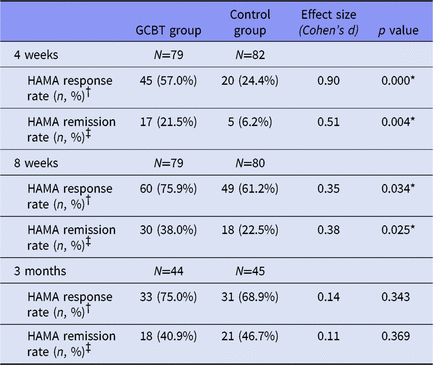
At 4 weeks, the two groups showed significant differences in HAMA response rate (57.0% in GCBT group vs. 24.4% in control group, p=0.000, Cohen’s d=0.90) and remission rate (21.5% in GCBT group vs. 6.2% in control group, p=0.004; Cohen’s d=0.51). At 8 weeks, the significant differences in HAMA response rate (75.9% in GCBT group vs. 61.2% in control group, p=0.034, Cohen’s d=0.35) and remission rate (38.0% in GCBT group vs. 22.5% in control group, p=0.025, Cohen’s d=0.38) were maintained. The effect sizes were more robust at 4 weeks (Cohen’s d=0.90 and 0.51) than those at 8 weeks (Cohen’s d=0.35 and 0.38), suggesting a trend towards less differences as time went on, particularly given that these differences were no longer significant at 3-month follow-up (p>0.05) (Table 3).
Primary outcome

GCBT, group cognitive-behavioural therapy; HAMA, Hamilton Rating Scale for Anxiety.
* p<0.05.
† ≥50% reduction in HAMA total score from baseline.
‡ HAMA total score <7.
To compare the overall group results further, we performed logistical regression. To filter the independent variables to avoid dilution effect, bivariate testing was done for all the baseline factors (gender, age, marital status, education, first vs. repeat episode, baseline HAMA total score, baseline HAMD score, baseline CGI-S score, baseline GAF score, and baseline SF-12 score) to select factors most related to the treatment outcome (response or remission). Age and education level (the two demographic and baseline characteristics that were not well balanced between the two groups despite randomisation) were automatically included as independent variables. Based on this bivariate analysis, the final logistic regression model included age, education, baseline HAMA, and baseline HAMD. The results show superiority of the treatment group (combined therapy) over medication (duloxetine) alone for both the primary outcomes: HAMA response rates [OR=2.12, 95% confidence interval (CI) 1.02−4.42, p=0.04] and remission rates (OR=2.80, 95% CI 1.27−6.16, p=0.01). The effect sizes of these outcomes are inferred from the OR themselves.
We performed a power analysis of one of the primary outcomes: HAMA response rates (at 4 weeks) for the GCBT and control groups were 57.0% and 24.7%, respectively; at sample sizes of 79 and 82, respectively, the power to detect such group difference was 0.990, using two-sided Chi-square test with normal approximation, and a significance level of 0.05.
Secondary outcomes
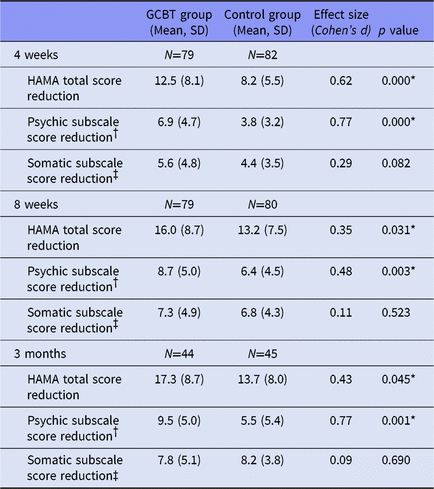
Acknowledging potential risk of multiple testing, we made explorative analyses on the following secondary outcomes. Most notably, at 4-week, 8-week, and 3-month follow-up, the two groups showed consistently significant differences in reductions of the HAMA total score and the psychic anxiety subscale score, with strong and sustained significance levels and effect sizes (Table 4).
Secondary outcome of HAMA

HAMA, Hamilton Rating Scale for Anxiety; GCBT, group cognitive-behavioural therapy.
* p<0.05.
† Consisting of the following items: anxious mood, tension, fears, insomnia, intellectual changes, depressed mood, and behaviour symptoms.
‡ Consisting of the following items: muscular, sensory and cardiovascular, respiratory, gastrointestinal, genitourinary, and autonomic system disturbances.
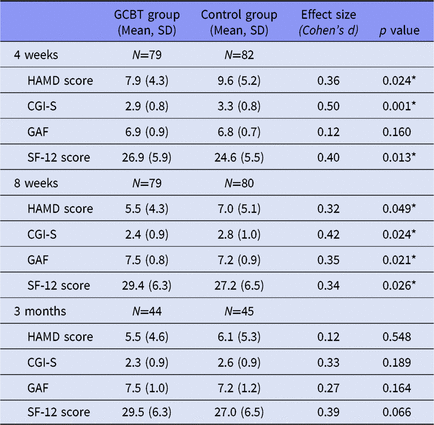
For the other secondary outcomes explored, at 4 weeks, the comparisons showed that the GCBT group had significantly lower depressive symptoms and their severity as assessed by HAMD, lower severity of illness as measured by CGI-S scores, and a higher level of health as indicated by the higher SF-12 scores. At 8 weeks, all the differences found at 4 weeks remained significant, and with largely similar effect sizes. Also notable is that the GCBT group now showed significantly better global functioning as measured by GAF scores as well (p<0.05, d=0.35). However, at 3-month follow-up, there was no longer any significant difference in any of these above secondary measures (Table 5).
Other secondary outcomes

GCBT, group cognitive-behavioural therapy; HAMD, Hamilton Rating Scale for Depression; CGI-S, Clinical Global Impression-Severity of Illness; GAF, Global Assessment of Functioning; SF-12, 12-item Short-Form Health Survey.
* p<0.05.
Discussion
Findings from this study suggest that GCBT offered in combination with duloxetine is superior to duloxetine alone in terms of achieving treatment response in the relief of GAD symptoms in a shorter period of time. In addition, our explorative analyses show the combined therapy likely also offered additional benefits in preventing coexisting depressive symptoms, as well as improving both health status and quality of life. Furthermore, the improvements were sustained over the study course for the core GAD symptoms, particularly the psychic anxiety symptoms. The results offer good support for the efficacy of GCBT in the treatment of GAD and may provide some insights into GAD treatment courses in general.
As early as the first evaluation point at 4 weeks, the GCBT plus duloxetine group showed significant therapeutic benefits over the duloxetine only control group in primary outcomes of reducing the core GAD symptoms, as indicated by the HAMA response and remission rate, and explorative secondary outcomes in HAMA total score and psychic anxiety subscale score reduction from baseline. Correspondingly, the clinical improvements in other explorative secondary outcomes for the GCBT treatment group over those for the control group, in terms of depressive symptoms, illness severity, and quality of life, were also significant by the 4-week follow-up. All of these improvements were all maintained throughout the 8 weeks after baseline, with the addition of significant improvement at a general functioning level as well. For GAD treatment, medication alone does not work quickly (Starcevic, Reference Starcevic2015). It is often associated with a delay of approximately 2–8 weeks in the onset of symptom relief, with a full response taking up to 12 weeks or more (Katzman et al., Reference Katzman, Bleau, Blier, Chokka, Kjernisted, Van Ameringen, Antony, Bouchard, Brunet, Flament, Grigoriadis, Mendlowitz, O′Connor, Rabheru, Richter, Robichaud and Walker2014). As found in the current study, GCBT may play an important and unique role in the early phase of GAD treatment, to account for the slow onset of effect for the medications, helping to alleviate the patient’s suffering much quicker. To be thorough, however, one should still bear in mind that it was possible that the 4- and 8-week positive treatment outcome could be simply due to the supportive effect of having regular group meetings, rather than the GCBT content itself.
At the 3-month follow-up visit, only a few differences between the GCBT group and control group remained statistically significant. A likely explanation for this was the onset of the medication (duloxetine) effect in the control group. As time went on, the medication (duloxetine) alone treatment was able to provide therapeutic effects, therefore, narrowing the gap in the differences between the two groups to the point of non-significance. On the other hand, other factors may have influenced long-term efficacy; in particular, participants need to constantly practice the techniques they learned in the GCBT sessions, even after they have stopped. This would argue that ongoing or booster GCBT may be as important as ongoing pharmacotherapy. Another possibility is related to the participants who dropped out between 8 week and 3-month follow-up, particularly if responders from the GCBT group and non-responders from the control group have disproportionally dropped out.
At a detailed level, the current study also explored and found likely differences between the GCBT and control groups in their specific psychic and somatic anxiety symptoms. Significant differences between groups were found in HAMA psychic anxiety subscale at all time points (4 weeks, 8 weeks, and 3-month follow-up), but not for HAMA somatic anxiety subscale. These findings suggest that GCBT could be effective in changing the patients’ cognitive style, which may have more specifically helped to ameliorate the psychic symptoms such as fear, tension, intellectual problems, and anxious, depressed moods, among others. These improvements were quickly achieved by the first assessment time (i.e. 4 weeks) and were sustained over the follow-up periods. This is consistent with earlier studies in this field: cognitive, higher brain centre-based changes are the targeted goals for CBT, and their positive changes are long-lasting (Hofmann et al., Reference Hofmann, Sawyer, Korte and Smits2009).
As we mentioned above, research on whether combined treatment is superior to medication monotherapy has been inconsistent. For example, one study found that adding CBT to escitalopram can significantly reduce anxiety symptoms and pathological worry (Wetherell et al., Reference Wetherell, Stoddard, White, Kornblith, Nguyen, Andreescu, Zisook and Lenze2011), while another study found no additional benefit for combined CBT and venlafaxine extended release version (XR) compared to venlafaxine XR alone (Crits-Christoph et al., Reference Crits-Christoph, Newman, Rickels, Gallop, Gibbons, Hamilton, Ring-Kurtz and Pastva2011). There were some limitations in these studies, however, such as that the CBT plus venlafaxine study had only 33% of participants accepting and attending at least one CBT treatment session, likely underestimating the results. In theory, psychotherapy and pharmacotherapy may have additive and synergistic effects in treating GAD. CBT is an exposure-based approach aimed at helping patients to reacquire a sense of safety around cues associated with anxiety disorders through cognitive and behavioural changes, involving higher level neuro-cognitive centres in the brain. A recent functional magnetic resonance imaging (fMRI) study found that short-term group CBT could down-regulate the abnormal higher connectivity of a prefrontal–amygdala network that is associated with anxiety disorders, along with producing clinical improvements (Yuan et al., Reference Yuan, Zhu, Qiu, Meng, Zhang, Shang, Nie, Ren, Gong, Zhang and Lui2016). In contrast, pharmacological interventions directly target biochemical pathways at the level of lower brain centres, which underlie the anxiety elicited by disorder-specific cues (Hofmann et al., Reference Hofmann, Sawyer, Korte and Smits2009). In addition, some theoretical conceptualisations of GAD identify specific thoughts/patterns of cognition as the primary pathogenic mechanism of GAD (Behar et al., Reference Behar, DiMarco, Hekler, Mohlman and Staples2009). Thus, psychotherapy and pharmacotherapy would likely complement each other in producing the overall therapeutic effects (Hofmann et al., Reference Hofmann, Sawyer, Korte and Smits2009; Schneier et al., Reference Schneier, Belzer, Kishon, Amsel and Simpson2010). Different symptoms may respond to different therapeutic modalities; changes in somatic anxiety symptoms may be more sensitive to pharmacotherapy, whereas pathological worry may respond better to CBT (Wetherell et al., Reference Wetherell, Petkus, White, Nguyen, Kornblith, Andreescu, Zisook and Lenze2013). Along these lines, the combination therapy would be expected to have a beneficial impact on both of these therapeutic outcomes.
In terms of therapeutic content, overall, the study ensured that all the standard active components of CBT were present in the treatment protocol (Ladouceur et al., Reference Ladouceur, Dugas, Freeston, Leger, Gagnon and Thibodeau2000; Olatunji et al., Reference Olatunji, Cisler and Deacon2010). Behar et al. (2009) reviewed five contemporary models of CBT interventions for GAD: the Avoidance Model, the Intolerance of Uncertainty Model, the Meta-Cognitive Model, the Emotion Dysregulation Model, and the Acceptance-Based Model. They also pointed out that there were several common key treatment components shared across these models, including psycho-education about GAD, self-monitoring, and an emphasis on training clients to cope with internal experiences. The content of the GCBT mainly focused on cognitive models and the understanding and evaluating core cognition (i.e. beliefs and thoughts) about internal experiences. This approach aims to help participants understand the key clinical characteristics of GAD, which involve subjective and excessive worries that are beyond a person’s control, accompanied by hyperactivity of the nervous system and motor restlessness (Katzman et al., Reference Katzman, Bleau, Blier, Chokka, Kjernisted, Van Ameringen, Antony, Bouchard, Brunet, Flament, Grigoriadis, Mendlowitz, O′Connor, Rabheru, Richter, Robichaud and Walker2014; American Psychiatric Association, 1994). The GCBT also helped the participants to appreciate the relationship between their thinking, emotions, and behaviour, to recognise somatic anxiety symptoms, to avoid automatic negative thinking, and to learn to use relaxation techniques. Moreover, from a cross-cultural perspective, a Delphi study by Chinese experts to explore the essential CBT components for GAD showed that the top 10 ranked components were as follows: establish treatment relationships, psychological education, data collection and evaluation, relaxation training, development of treatment plans, normalisation, behavioural experiments, homework, checking evidence, and identifying automatic thinking (Han et al., Reference Han, Yao, Zhan-Jiang, Guo, Zhao-Yan, Zi-Yan, Guo, Luo, Liu and Hospital2013). The current study’s GCBT protocol has incorporated all of the above components, except for the behaviour experiment.
In this study, the dropout rate from the eight sessions of GCBT was relatively low (2.5%), in contrast to a recent systematic review that showed the weighted mean dropout rates in individual psychotherapy for GAD were higher than 16% (Gersh et al., Reference Gersh, Hallford, Rice, Kazantzis, Gersh, Gersh and McCarty2017). Low dropout rates may be related to the patients’ preference. A growing body of evidence suggests that providing patients with their preferred treatment is associated with better treatment retention and clinical outcomes (McHugh et al., Reference McHugh, Whitton, Peckham, Welge and Otto2013). Combined treatments can ensure that patients get their preferred treatment format, no matter what form they had in mind (psychotherapy or pharmacotherapy, or both), as the combination contains all the options. Second, the group therapy format may have some advantages over individual therapy, including provision of a natural support group (not to mention greater cost efficiency) (Dugas et al., Reference Dugas, Ladouceur, Leger, Freeston, Langlois, Provencher and Boisvert2003; Beck & Coffey, Reference Beck and Coffey2005). The group format also allows interactions between group members to solve common psychological problems, with other known group therapy benefits such as universality, behaviour modelling, group cohesion, and normalisation (Yalom, Reference Yalom1995). This combination of CBT with group therapy format may have unique advantages in clinical application for the treatment of GAD.
Furthermore, the positive results of this current study should also be interpreted in the context that the control group was not inert, such as that recruited from a waiting list where no support or psycho-education was provided. In contrast, the control group in this study received general outpatient psychiatric care (like the treatment group) and weekly leaflet psycho-education materials on general health and GAD. As a result, the psychotherapeutic effect of GCBT was less likely to be overestimated (Cuijpers et al., Reference Cuijpers, Cristea, Karyotaki, Reijnders and Huibers2016).
There are also a number of limitations in the current study. One was the relatively short follow-up period, which limited our ability to draw conclusions about the durability and long-term effects of both treatments. Another limitation was the relatively high dropout rate at the 3-month follow-up visit in both treatment arms of the study. However, this dropout rate was balanced by the very high completion rate in both arms, making the high dropout rates at follow-up likely to have a somewhat limited impact on the main findings of the study – which was that the GCBT had rapid onset and robust positive effects. Another limitation is related to the demographic differences between the participants in the GCBT and control groups – the GCBT patients were better educated and may be, therefore, more likely to benefit from GCBT, and this could have contributed to an overestimation of the effect of GCBT in the current study. We conducted statistical tests to check and found no significant impact from these two factors. Also, there were some differences between those who remained in the study and those who were lost to follow-up in terms of their baseline HAMD total scores – those who were less depressed were more likely to leave the study. However, further analyses on those who were lost to follow-up showed no differences between the participants from the GCBT group and the control group, and any potential bias may be in the direction of underestimating the effects of the interventions. In addition, the positive outcome of the GCBT treatment group may be conflated by the benefits of having regular meeting as a supportive group in the GCBT arm that was absent in the control arm. We do note that having a supportive group setting is a built-in unique advantage of group therapy. Also, due to the design of the study that mirrored the naturalistic practice of dosage adjustment decided between the participants and their psychiatrist, we did not have the data on the exact dosing of duloxetine to deduce the dosage effect on outcome. One additional limitation was that all patients were recruited from one hospital; further investigation will be required to improve the generalisability of the findings to a broader GAD population. This study points to the need for more basic research to better understand which therapeutic factors contribute to treatment results, and how.
Conclusions
In sum, the current study found that compared with duloxetine alone, GCBT combined with duloxetine can have significant treatment response for GAD over a shorter period of time; however, the advantage may somewhat diminish over time. The response may also be more specific for psychic anxiety symptoms, and comprehensive in improving depressive symptoms, overall function, and higher quality of life. Improvement of psychic anxiety symptoms may suggest that GCBT was effective in changing cognitive style. Our findings lend support for clinicians to consider a combined strategy of GCBT plus medications (e.g. duloxetine) in the treatment of GAD.
Acknowledgements
We are indebted to all participants in this study for their support and help. We acknowledge the language editorial assistance of Professor Kelly Gallagher-Mackay.
Authors Contributions
Z-JX did data analysis and wrote the draft. SL helped revising the paper. Z-WL gave support on the data analysis and interpretation. NH, S-YC, J-PX, YZ, B-LG, S-SJ, and H-MG were GBCT therapists. X-BH designed the whole study and did the GCBT supervision and paper revision.
Financial support
This research was supported by Beijing Municipal Science and Technology Commission Capital Citizen Health Training Project (Z151100003915104).
Conflict of Interest
Nothing to declare
Ethical standards
The authors assert that all procedures contributing to this work comply with the ethical standards of the relevant national and institutional committees on human experimentation and with the Helsinki Declaration of 1975, as revised in 2008.