“I can't pass laws that say I'm just helping black folks. I'm the president of the United States. What I can do is make sure that I am passing laws that help all people, particularly those who are most vulnerable and most in need. That in turn is going to help lift up the African-American community.”—President Barack Obama
In July 2011, members of the Congressional Black Caucus (CBC) publicly denounced President Obama's approach to dealing with issues of economic inequality among African Americans, claiming that the President's actions had been inadequate in addressing high levels of unemployment among blacks, especially in urban areas, where over 30% of African-American men were unemployed.Footnote 1 CBC Chair Emanuel Cleaver (a Democratic representative from Missouri) put the matter in starkly racial terms, alleging that the Obama administration would have given much more attention to the issue of unemployment if job losses had been concentrated among whites (Ross Reference Ross2011).
The Obama administration is only the latest to be criticized for failing to address interests important to black voters. According to the conventional wisdom, presidents have often shied away from engaging in discussions of issues of paramount concern to African Americans, whether on the campaign trail or in the White House. As O'Reilly (Reference O'Reilly1995, 12) argues, “An urge to confront problems of race and racism head on has appeared in the Oval Office about as often as a famous named comet cuts the earth's heavens”. This reluctance has often been explained as a way of maintaining good relations with white constituents who would likely be alienated by explicit appeals to African-American interests (Frymer Reference Frymer1999; Glazer, Grofman, and Owens Reference Glazer, Grofman and Owens1998; Harris Reference Harris2012; Mendelberg Reference Mendelberg2001; Nteta and Schaffner Reference Nteta and Schaffner2013; Walton Reference Walton1975).
While these analyses have advanced our understanding, considerable uncertainty remains about the nature of presidential representation of black interests. To date, research on presidential representation of black interests has been largely qualitative in nature, constraining researchers' ability to rigorously assess either the degree of representation within presidential administrations or variation in the scope of representation over time (but see Newman and Griffin Reference Newman and Griffin2011). Perhaps more important, existing studies define the interests of African Americans almost exclusively in terms of economic redistribution and civil rights—policy areas in which African-American preferences are very different from those of whites (Frymer Reference Frymer1999; Kinder and Sanders Reference Kinder and Sanders1996; Valentino and Sears Reference Valentino and Sears2005). Because presidents have few incentives to side with African Americans when opposed by a large majority of whites, studies that define black interests in these terms may be biased in favor of finding that these interests are unrepresented at the presidential level.
We take a broader approach to conceptualizing black interests and develop a more nuanced theory of presidential representation of those interests. Rather than defining black interests narrowly in terms of economic redistribution and civil rights, we define them as whatever issues African Americans indicate are important to them. In doing so, we first conduct an original analysis of the Gallup Poll's measure of the “most important problem facing the nation” from 1969 to 2012 among both African Americans and whites. Using this data, we find that the issues deemed most important by African Americans cover the full range of foreign and domestic policy issues and exhibit considerable variation over time. We also find substantial overlap between the issues viewed as “most important” by African Americans and those perceived as most important by whites.
Based on these observations, we develop a conditional theory of presidential representation of black interests. We agree with the prevailing wisdom that, as a general matter, political and electoral incentives encourage presidents to prioritize the interests of whites over those of African Americans (Frymer Reference Frymer1999; Gillion Reference Gillion2016; Glazer, Grofman, and Owens Reference Glazer, Grofman and Owens1998; Harris Reference Harris2012; Mendelberg Reference Mendelberg2001; Nteta and Schaffner Reference Nteta and Schaffner2013; Walton Reference Walton1975). However, we theorize that when: (1) African Americans give precedence to concerns other than economic redistribution and civil rights and (2) these priorities overlap with those of whites, presidents will provide considerable representation of black interests. We test this theory using a quantitative content analysis of more than 200 major presidential addresses from 1969 to 2012.
In line with the existing scholarship, our results indicate that presidents do, in fact, provide greater attention to the issues prioritized by whites, and that when African American and white interests diverge, presidents are more likely to represent the issues of greater concern to the white community. Consistent with our theory, however, we find that because African American and white perceptions of the “most important problems” overlap to a considerable degree, presidents provide notable representation to black interests. Indeed, a substantial proportion of the issues of greatest concern to African Americans are routinely represented in the president's agenda. Equally notable, the issues prioritized by presidents are often wholly independent of those viewed as most important by whites as well as blacks.
Our findings have important implications, both for theories of presidential representation and for the politics of race in the United States. Our results suggest that the ways in which the interests of groups are defined and operationalized have critical consequences for our assessment of how well these interests are represented. Scholars must think carefully about how their preferred definition of black interests—or interests in general—are likely to influence their assessment of whether or not these interests are represented in the public arena. Our research also has practical implications for racial politics in the United States. On one hand, it confirms the conventional wisdom that black interests that are divergent from those of whites are likely to receive minimal representation in American politics. On the other hand, it suggests that African Americans can enhance their representation in the political arena by identifying and emphasizing the many important areas of interest that overlap with those of whites.
The Limited Representation of Black Interests
The discussion of black political representation necessarily engages current debates on the representation of poor and minority groups in society. While this literature is largely dominated by studies of congressional and state legislative representation—which is easier to assess quantitatively—research on inequalities in presidential representation is also present. In examining the relationship between economic inequality and political representation, some scholars have argued that working- and lower-class Americans receive limited political representation because elected officials cater primarily to wealthy constituents, who contribute to campaigns and participate extensively in elections (Bartels Reference Bartels2009; Ellis Reference Ellis2013; Gilens Reference Gilens2005; Gilens and Page Reference Gilens and Page2014). But others have questioned the severity of unequal representation: noting that poor, middle-class, and wealthy Americans hold similar views on a wide range of political issues, they argue that representation of the wealthy necessarily entails considerable representation of the preferences of the less fortunate (Soroka and Wlezien Reference Soroka and Wlezien2008; Ura and Ellis Reference Ura and Ellis2008; Wlezien and Soroka Reference Wlezien, Soroka, Enns and Wlezien2011).
In contrast, the debate over racial inequality in representation appears virtually united in the view that African Americans receive limited representation, compared with white constituents, from white elected officials.Footnote 2 At a fundamental level, African Americans are consistently more likely than other groups to vote for the losers of political campaigns (Hajnal Reference Hajnal2009). Moreover, white representatives at all levels often appear indifferent to black concerns. Surveys of urban residents indicate that African Americans, relative to whites, are more likely to express dissatisfaction with government responsiveness (Hajnal and Trounstine Reference Hajnal, Trounstine, Nagel and Smith2013). In a similar vein, field-experimental studies indicate that white state legislators are less intrinsically motivated to advance black interests and may racially discriminate against black constituents (Broockman Reference Broockman2013; Butler and Broockman Reference Butler and Broockman2011). And work on congressional representation suggests that representatives are more responsive to the policy demands of white constituents, due to whites' greater emphasis on policy representation, more frequent participation in elections, and greater tendency to operate as swing voters (Griffin and Flavin Reference Griffin and Flavin2007, Reference Griffin and Flavin2011; Griffin and Newman Reference Griffin and Newman2008, Reference Griffin and Newman2013).
Research on presidential representation of black interests, though less extensive, arrives at a broadly similar conclusion. Using qualitative methods, both Frymer (Reference Frymer1999, 104–19) and O'Reilly (Reference O'Reilly1995) concluded that presidents accord little attention to black interests because they must, in Frymer's (Reference Frymer1999, 41) words, “continually focus on primarily white swing voters who party leaders believe are hostile to black interests.”Footnote 3 Indeed, O'Reilly (Reference O'Reilly1995, 11) argues, “Republicans seeking election or reelection to the land's highest office are expected to solidify their hold on the angry white male vote while Democratic presidential candidates are expected to win that vote back.” More recent qualitative research focusing on the presidency of Barack Obama makes essentially the same point (Harlow Reference Harlow2009; Harris Reference Harris2012; Metzler Reference Metzler2010; Smith, King, and Klinkner Reference Smith, King and Klinkner2011). Although quantitative research on presidential representation of black interests is rare, a recent study (Griffin and Newman Reference Griffin and Newman2013) finds that presidential budget requests are generally less responsive to black spending preferences relative to those of whites, though this difference disappears when Democrats are in the White House.
The Limitations of Existing Research: Measurement and Theory
Assessment of the representation of racial group interests necessarily entails conceptualizing racial groups as relatively unified blocs with coherent interests. Although it is difficult to characterize almost any demographic group in America as having a unified and defined set of interests, many scholars have argued that African Americans are among the most cohesive minority groups in American politics (Dawson Reference Dawson1994; Haynie Reference Haynie2001; Tate Reference Tate1994). Dawson's (Reference Dawson1994) “black utility heuristic” identifies the mechanisms behind this relatively unified set of political preferences: even as more African Americans move into the middle class, the unifying experience of being black in a race-conscious (and racially stratified) society encourages feelings of “linked fate” among members of the black community.
Given the perceived cohesiveness of the African-American community, empirical scholarship has tended to define black interests primarily as “support for legislation and policies favoring social welfare, economic redistribution, and civil rights issues” (Haynie Reference Haynie2001, 24; see also Whitby Reference Whitby2000, 2–3; Platt Reference Platt2008).Footnote 4 In research that employs “objective” measures of black interests—such as employment status, educational attainment, or income (e.g. Canon Reference Canon1999; Swain Reference Swain2006; Tate Reference Tate2003)—the underlying assumption is that because African Americans usually score lower on these measures they will be more supportive of redistributive and civil rights policies that help level the economic playing field. Likewise, a major rationale for employing the “support scores” of predominantly minority organizations such as the Leadership Conference on Civil Rights or the NAACP as a measure of black interests is that they capture African Americans' shared interests in civil rights and economic redistribution (Baker and Cook Reference Baker and Cook2005; Cameron, Epstein, and O'Halloran Reference Cameron, Epstein and O'Halloran1996; Hutchings, McClerking, and Charles Reference Hutchings, McClerking and Charles2004). Finally, studies that use survey data to compare the policy attitudes of African Americans and whites, respectively (e.g. Canon Reference Canon1999; Griffin and Newman Reference Griffin and Newman2008; Kinder and Sanders Reference Kinder and Sanders1996; Kinder and Winter Reference Kinder and Winter2001; Lublin Reference Lublin1997) tend to find notable differences on issues such as affirmative action, job discrimination, civil rights, and welfare, smaller differences on social policy issues such as education and health care, and minimal differences on issues relating to foreign affairs, immigration, or abortion, lending credence to the notion that distinctive African-American interests revolve around redistributive and civil rights concerns.
Defining black interests in this fashion is not unreasonable, but it does have limitations. Put simply, this definition erodes African-American agency in defining black interests, in two related ways. First of all, in defining black interests in this way, analysts are effectively substituting external criteria—objective economic circumstances, interest group judgments, researchers' beliefs about what black interests should be—for African Americans' own subjective understanding of what their interests are. This observation holds even in the case of survey-based measures of spending preferences. While there is little doubt that when queried by an interviewer, African Americans will often express more liberal attitudes than whites on most spending issues, it does not logically follow that the issues on which African Americans report distinct preferences, best represent “black interests”. Rather, it is the researcher's subjective view that black interests should be defined by what differentiates black concerns from those of whites that transforms evidence of racial gaps in spending preferences into the unique interests of African Americans.
Second, by defining black interests in terms of civil rights and economic redistribution, researchers have created a static definition of black interests that may not reflect the subjective dynamism of black interests. If, as is likely, the relative salience of different issues among African Americans varies over time, black interests (at least as identified by African Americans themselves) may also be subject to change. The prevailing way of thinking about the interests of African Americans does not make this possibility central to the definition of black interests (but see Newman and Griffin Reference Newman and Griffin2011).
We point out these considerations because we believe that defining black interests as static and focused on economic redistribution and civil rights has pivotal consequences for our theories and interpretations of (the lack of) presidential representation of issues of paramount importance to African Americans. If: (1) African Americans are consistently focused on redistributive and civil rights issues and (2) African-American preferences on these matters are always sharply distinct from those of whites, presidents will have extremely limited incentives to represent black interests, because doing so would put them at severe risk of alienating many if not most whites. We would expect, therefore, that presidents would provide very limited representation of black interests as defined in this way. As noted above, this is, in fact, the logic animating arguments by numerous scholars of racial politics in presidential campaigns and governance, including recent critiques of Obama's presidency (Frymer Reference Frymer1999; Harlow Reference Harlow2009; Harris Reference Harris2012; King and Smith Reference King and Smith2005; Lieberman Reference Lieberman2002; Metzler Reference Metzler2010; O'Reilly Reference O'Reilly1995).
However, as our discussion suggests, the conclusion that presidents provide minimal representation of black interests could—at least in part—be an artifact of the narrow, top-down manner, in which black interests are defined. What might happen if we broadened the definition of black interests, allowing it to derive from the bottom-up, according to African Americans' subjective understanding of their own interests (Lee Reference Lee2002)? We believe that such a re-conceptualization of black interests will uncover a greater level of representation of African Americans by presidents, particularly when black interests dovetail with those of whites. We now turn to a discussion of our redefinition of black interests and exploration of black and white opinion on the nation's most important problems. This sets the stage for our more nuanced theory of presidential representation.
Re-Defining Black Interests and Re-Theorizing Presidential Representation
Our assessment of prevailing methods of defining and measuring black interests led us on a quest to identify an alternative measure that avoids some of the pitfalls of previous approaches and, hopefully, helps advance the study of presidential representation of African Americans. After a long search, we converged on the well-known “most important problem” survey question as the best option currently available. We explain the strengths—and limitations—of this measure here, explore the validity of this measure as proxy for black interests, and show how utilizing this measure alters our understanding of black interests and suggests new directions for theorizing about presidential representation of the priorities of African Americans.
Since 1935, the Gallup poll has periodically asked a representative sample of Americans to identify “the most important problem facing this country today,” (Smith Reference Smith1985). We are not the first to use this item to measure the political interests of subsets of Americans (Baumgartner and Jones Reference Baumgartner and Jones2010; Dunaway, Branton, and Abrajano Reference Dunaway, Branton and Abranjano2010; Feeley, Jones, and Larsen Reference Feeley, Jones and Larsen2001; Baumgartner and Jones Reference Baumgartner and Jones2005; MacKuen and Coombs Reference MacKuen and Coombs1981). In fact, in speaking of the validity of this item as a measure of Americans' central policy interests, Baumgartner and Jones (Reference Baumgartner and Jones2005) have said, “the Gallup MIP (most important problem) data are the most important long-running time series indicating the salience of issues to the American public” (253). Given the long history of scholarship employing this item, we have confidence in the reliability and validity of this item in measuring the content of African Americans' and whites' most salient political interests.Footnote 5
From the perspective of defining and measuring black interests in a study of presidential representation of African Americans, the “most important problem” question has important virtues relative to alternative measures employed in previous research. First of all, because the “most important problem” question is an open-ended question, the measure allows individual survey respondents (both black and white) to construct their own understandings of what is important (and hence, what is in their interest), rather than imposing a definition upon them (Lee Reference Lee2002). Second, the open-ended nature of the question allows understandings of self-interest to vary, both between individuals and over time. As we will explain shortly, this reconceptualization of black interests has pivotal consequences for theories of presidential representation of black interests.
Admittedly, the “most important problem” question is not a perfect measure of black interests. Obviously, the question only measures the salience of issues among respondents, and not their positions on these issues. However, in cases when African Americans and whites agree that an issue is important, we can use existing knowledge to determine whether they are likely to have similar or different positions on how to resolve it. There are other reasons to believe that this measure has considerable utility as an indicator of black (and white) interests for the purposes of evaluating presidential representation of these interests. From a normative perspective, we would prefer if elected officials paid most attention to the issues deemed most important by their constituents (Pitkin Reference Pitkin1967). Moreover, attention is a necessary precursor of substantive representation: in order to represent the position of constituents on a given issue, representatives must first allocate attention to that issue. For these reasons, the “most important problem” measure provides a good—if imperfect—measure of the interests of blacks (and whites) against which to gauge presidential representation.
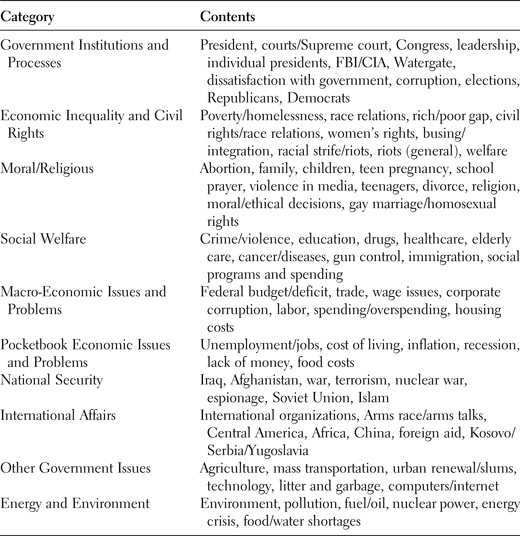
To construct the “most important problem” measures used in our research, we first obtained MIP Gallup survey data from the online polling site, iPoll, which provides a comprehensive, online, and up to date catalog of U.S. public opinion poll data from 1935 to 2012. In order to capture the annual distribution of African American and white respondents' perceptions of the MIP (first mention only), we analyzed data from the Gallup survey closest to the end of the year when available.Footnote 6 Once we compiled this data, we recoded each unique response to the question under 10 broad categories that included: economic inequality and civil rights, governing institutions and processes, moral/religious issues, social welfare issues, macro-economic issues and problems, pocketbook economic issues and problems, national security, international affairs, energy and environment, and other government policies.Footnote 7 The types of responses that comprised each of the 10 categories are presented in Table 1. For each year, we identified the three categories that received the most support among self-identified African Americans and whites, respectively.
Categories of public opinion and speech data

Given that the “most important problem” question prompts respondents to focus their attention on issues of national concern it is an open question whether this item captures African Americans' perceptions of “black interests”, or their views of the problems facing the national community more broadly. In order to address questions regarding the validity of the “most important problem” question as a measure of “black interests”, we sought to compare the findings derived from our analysis of Gallup's MIP data with existing items asking African Americans to identify the MIP facing the African-American community. Unfortunately, open-ended items that specifically query African-American opinion regarding problems facing their community are relatively rare. For instance, while the 1984, 1988, and 1996 National Black Election Studies include items that tap black opinion on the MIP facing African Americans, the question is not open-ended. Instead, the question asks respondents to select whether unemployment, discrimination, or crime is the MIP in the black community, with the consequences of both priming these considerations and foreclosing alternative responses.Footnote 8
Given the problems with closed ended measures of black interests, we instead test the construct validity of our measure of black interests with an open-ended item found in 1994, 2001, 2006, and 2009 Pew Center opinion surveys. The relevant item asks respondents “What do you think is the most important problem facing your local community today?” Admittedly, this measure does not directly ask respondents to think about problems facing their racial group. However, due to the extremely high level of residential segregation experienced by African Americans, it is very likely that prompting black respondents to think about their local community will lead them to think about problems facing African Americans (Iceland and Weinberg Reference Iceland and Weinberg2002; Massey and Denton Reference Massey and Denton1993; Oliver and Shapiro Reference Oliver and Shapiro2006).
Do blacks identify a similar set of issues as the “most important problem” when asked about their local community relative to when asked about the “most important problem” facing the nation? As detailed in Table 2, we find high levels of convergence between the Gallup measure of black interests and the Pew Center items. In 1994 and 2006, African Americans in both the Gallup and Pew surveys identified social welfare issues as the MIP, and in 1994 and 2009 African Americans in both surveys held the exact same top three issues priorities. Finally, in 2001 and 2006 African Americans in both surveys identified the same two out of three issue priorities as the most important facing the nation and their local communities. We believe the convergence in responses across the two surveys furthers our contention that Gallup's MIP item captures black opinion concerning the community's most pressing issues.Footnote 9
Black assessment of most important problem: Gallup vs. Pew

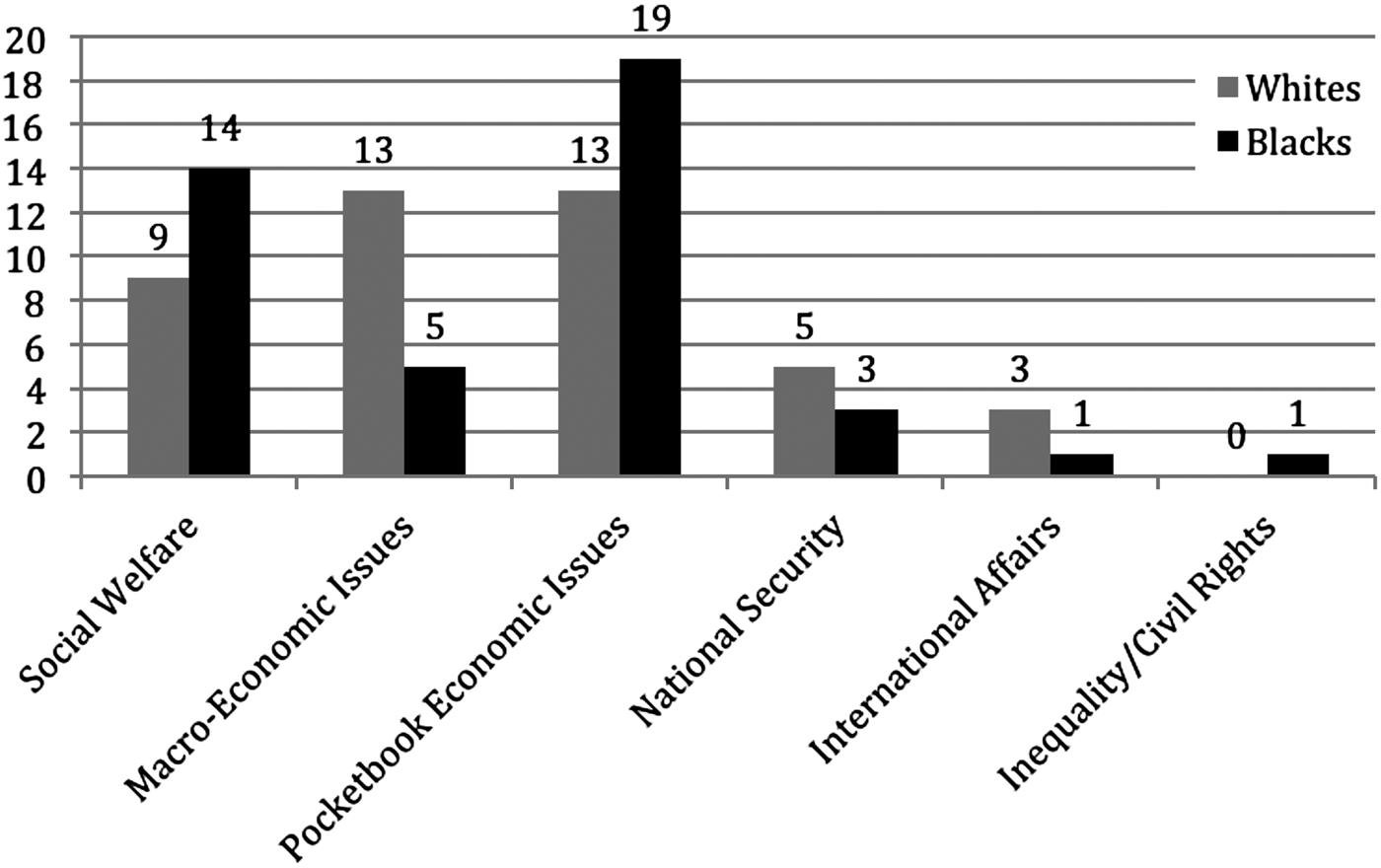
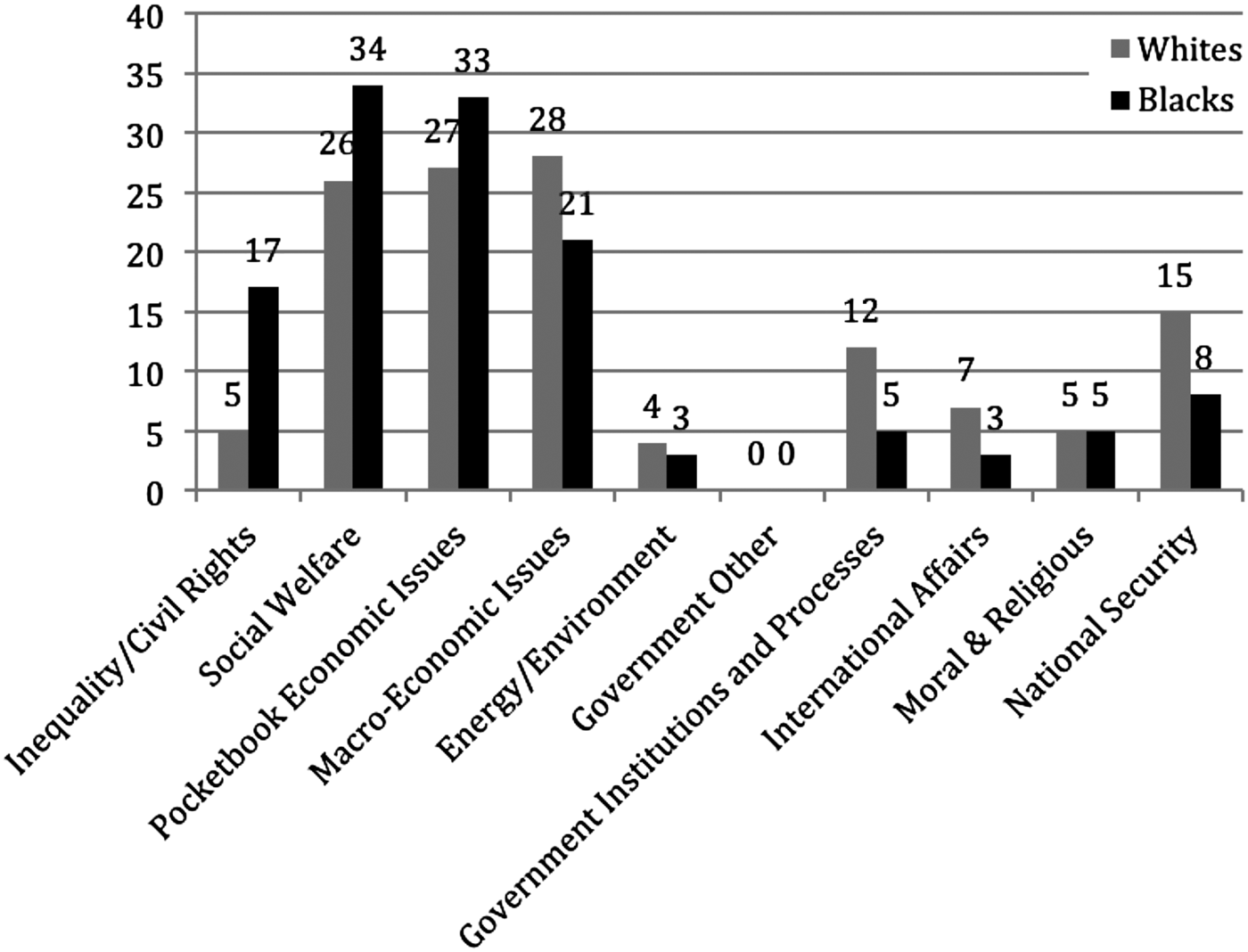
Using the “most important problem” data as a measure of black (and white) interests has important implications for our understanding of what African Americans care about and how much these priorities overlap with those of whites. First of all, as Figure 1 shows, African Americans only occasionally rank economic inequality and civil rights as the most important issue facing the nation. Indeed, in only one of the 43 years in our dataset did African Americans rank civil rights and redistributive issues as the single MIP. Instead, African Americans tend to prioritize other concerns, especially pocketbook economic issues and problems (19 years), social welfare issues (13 years), and macro-economic issues and problems (5 years). Even when we take into consideration the top three issues prioritized by African Americans each year in Figure 2, we find that matters related to economic inequality and civil rights (mentioned in the top three in 17 years) are dominated by social welfare (mentioned in the top three in 34 years), pocketbook economic issues and problems (mentioned in the top three in 33 years), and macro-economic issues and problems (mentioned in the top three in 21 years).
Number of years when Issue was chosen as Single Most Important Issue by Race, 1969–2012 Gallup

Number of years Issue was mentioned as one of the top three Most Important Issues by Race, 1968–2012 Gallup

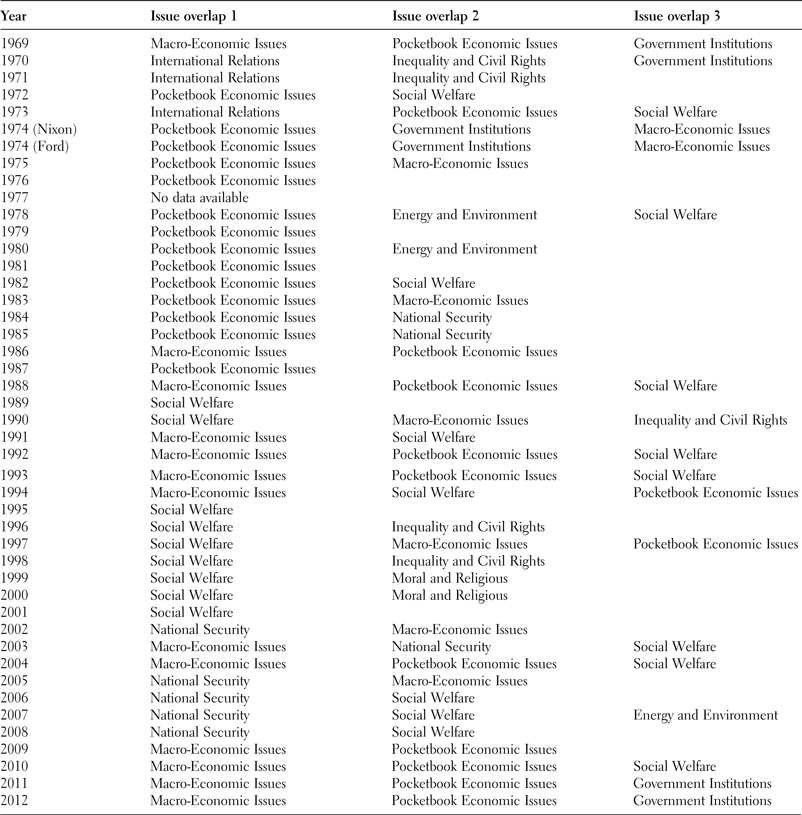
Second, our data show that the issues viewed as most important by African Americans are also frequently among the top priorities of whites. African Americans and whites agreed on the single most important issue in 30 of the 43 years in our dataset. Taking a different cut at the phenomenon of racial congruence in priorities, we find that African Americans and whites held the exact same top three priorities in 17 out of 43 years, shared two out of three top priorities in an additional 20 years, and overlapped on one of three issues in the remaining 6 years.Footnote 10 Far from sharply disagreeing about the most pressing issues facing the nation, African Americans and whites have frequently agreed to a large extent about what is most important.Footnote 11
Of course, it is hypothetically possible that blacks and whites agree that the same issues are important, but hold very different views about how to address these concerns. This would occur if the types of issues that African Americans and whites agreed were most important also tended to be those, on which they had the most divergent opinions. Crucially, however, Table 3 shows that the types of issues that blacks and whites have converged on as most important tend to be those which existing research on policy attitudes suggests are not those that are most racially divisive (Canon Reference Canon1999; Griffin and Newman Reference Griffin and Newman2008; Kinder and Sanders Reference Kinder and Sanders1996; Kinder and Winter Reference Kinder and Winter2001; Lublin Reference Lublin1997). Rather than converging on racially divisive priorities such as economic redistribution and civil rights, African Americans and whites have tended to agree on prioritizing issues, over which there is likely to be greater racial overlap in preferences.
Black/White overlap in issue priorities, 1969–2012

Note: Table only identifies instances of overlap among top three issues of blacks and whites, respectively; not whether same priority was accorded by each group.
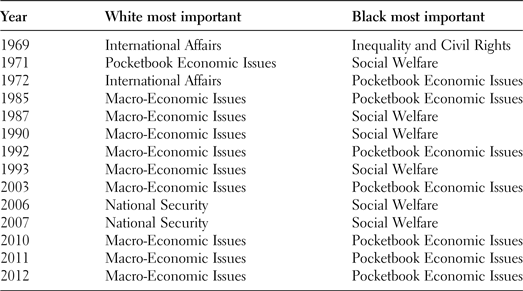
While our results point to high levels of convergence between African American and white issue priorities, we do recognize that there are instances in which the two groups diverge in their assessments of the nation's MIP. In exploring these periods of divergence, we first examine the 14 years in which African Americans and whites express distinct opinions on the nation's most pressing problem. As seen in Table 4, there are 9 years in which whites identified macro-economic issues as the nation's most important issue, while during these same years African Americans pointed to pocketbook economic and social welfare issues as the nation's central problems. Indeed in 13 of the 14 years when white and African American opinion diverged, African Americans either pointed to pocketbook economic or social welfare issues as the nation's primary problem with whites pointing to international affairs, national security, or macro-economic problems as their top issue priority in these years. These differences likely reflect African Americans' greater exposure to economic risks such as unemployment and underemployment, as well as to their lesser tendency to enjoy work-based health and retirement benefits (Oliver and Shapiro Reference Oliver and Shapiro2006).
Divergence in black and white assessments of most important problem incongruent by year, 1969–2012

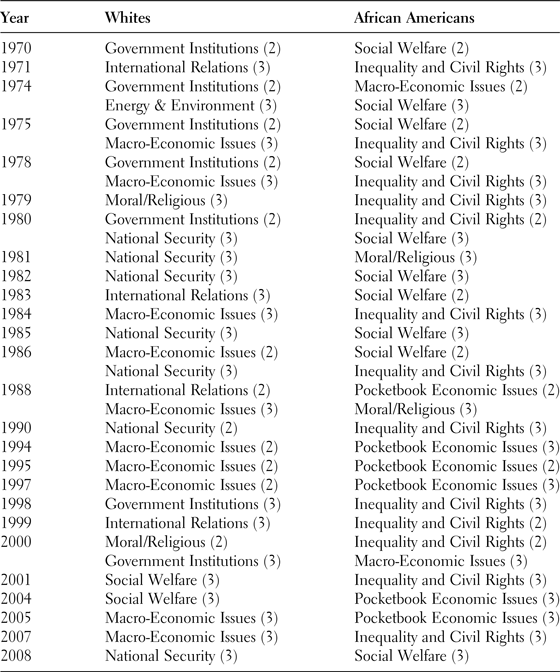
In further examining the ways in which African Americans and whites differ in their views of the nation's MIP, in Table 5 we detail the number of years, in which an issue appears in the top three for one racial group (e.g. whites), but did not appear in the top three for the opposing racial group (e.g. blacks). As seen in Table 5, there are 12 years in which issues of economic inequality and civil rights were in the top three for African Americans, 10 years in which social welfare issues were among the top three issue priorities for African Americans, and 6 years when pocketbook economic issues were in the top three among African Americans, but in each of these years these issues did not place in the top three among whites. Correspondingly, among whites there are 9 years in which macro-economic issues were among the top three, 7 years when national security appeared in whites' top three, and 6 years when government institutional issues were in whites' top three, but in each of these years these issues did not appear in the top three issue concerns among African Americans. Again, African Americans' disproportionate tendency to focus on bedrock economic and civil rights issues (and whites' greater proclivity to emphasize broader economic and national security concerns) almost certainly reflects the groups' different respective positions in the United States' economic and social order.
Divergence in black and white top three most important issues, 1969–2012

Theory of Conditional Representation of Black Interests
These findings have profound implications for theorizing about presidential representation of black interests. Our expanded definition of black interests—grounded in individual African Americans' (and whites') self-reported subjective priorities—suggests a very broad range of African-American interests and a considerable (though by no means perfect) correspondence between the priorities of blacks and those of whites. This, in turn, suggests that the logic governing presidential representation of black interests may not be quite as dire as suggested by the extant literature. We suggest that presidential representation of African Americans is likely to be conditional, depending both on the types of issues emphasized by African Americans and on the extent to which these issues overlap with the priorities of whites.
Hypothesis 1: As a general matter, presidents should provide more representation to whites than to African Americans; but they will not ignore the interests of African Americans.
Presidents have stronger incentives to represent the interests of whites than they do for African Americans. Whites represent a much larger proportion of the population; they are more likely to participate in and contribute to campaigns; they are more likely to be swing voters; and they are usually more likely to vote (Verba, Schlozman, and Brady Reference Verba, Schlozman and Brady1995).Footnote 12 As a general matter, therefore, presidents should be expected to provide more representation to whites than to African Americans. However, presidents should not completely ignore African-American interests. Indeed, because the interests of African Americans often overlap with those of whites, presidents should provide considerable (though almost certainly unequal) representation of these interests.
Hypothesis 2: When (1) African Americans prioritize issues that are not related to economic redistribution and civil rights and (2) when these priorities converge with those of whites, presidents will represent black interests
Under these conditions presidents can provide representation to African Americans without fear of antagonizing racially-resentful whites (Frymer Reference Frymer1999; Harris Reference Harris2012; Nteta and Schaffner Reference Nteta and Schaffner2013). Moreover, under conditions of converging racial priorities presidents can provide representation to African Americans without intending to do so, simply by representing the priorities of whites. Indeed, this scenario is parallel to the situation posited by critics of “unequal democracy”, who note that broad agreement between the rich and the poor on many issues ensures considerable representation of the less economically fortunate (Soroka and Wlezien Reference Soroka and Wlezien2008; Ura and Ellis Reference Ura and Ellis2008; Wlezien and Soroka Reference Wlezien, Soroka, Enns and Wlezien2011). When these conditions are met, therefore, we expect presidents to provide considerable representation of black interests.Footnote 13
Hypothesis 3: When either (1) African Americans prioritize redistributive and civil rights issues or (2) their priorities do not overlap with those of whites, presidents should provide minimal representation of black interests.
Under these conditions, presidents' strategic imperatives are similar to those posited in standard theories. Presidents have few incentives to represent black interests because doing so risks antagonizing whites. Consequently, we expect presidents to provide very limited representation of African Americans under these specific conditions.
Hypothesis 4: Presidential priorities will be partially independent from the interests of either whites or blacks.
For various reasons, presidents may have incentives to adopt priorities that are unrelated to the aggregated opinions of either group. For example, presidents may cater primarily to their own partisans, in order to rally support for shared ideological objectives (Wood Reference Wood2009). Or presidents may be most responsive to wealthy constituents, who provide campaign contributions, engage in lobbying, and often participate in presidential administrations (Bartels Reference Bartels2009; Druckman and Jacobs Reference Druckman, Jacobs, Enns and Wlezien2011; Jacobs and Page Reference Jacobs and Page2005). Other factors can encourage presidents to adopt priorities that are independent of the opinions of either whites or blacks. In the realms of national security and international relations, presidential priorities may be heavily influenced by crises and other unexpected events (Andrade and Young Reference Andrade and Young1996; Edwards and Wood Reference Edwards and Wood1999; Wood and Peake Reference Wood and Peake1998). With regard to economic issues, presidents must be highly sensitive to the fact that their words and actions can influence macro-economic performance (Wood, Owens, and Durham Reference Wood, Owens and Durham2005), and thus may feel compelled to behave in ways that depart from the priorities of either whites or blacks. In sum, we expect some slippage between the priorities of both blacks and whites and what presidents emphasize and act upon.
Measuring Presidential Representation of Black (and White) Interests
We employ presidents' attention to the issues prioritized by African Americans and whites––as evident in their nationally televised addresses—as our measure of their representation of black and white interests, respectively.Footnote 14 For the purposes of our project, there are several reasons that presidents' issue attention as evident in their public rhetoric is a good indicator of representativeness. First of all, presidential rhetoric provides a direct measure of presidential issue attention (Wood Reference Wood2009), which in turn provides a good measure of the president's priorities. Second, previous research shows that issue attention as evident in presidential rhetoric is representative in the sense that it is responsive to public opinion (at least at a high level of aggregation, without regard to race) (Cohen Reference Cohen1997; Lenz Reference Lenz2013; Rottinghaus Reference Rottinghaus2006). Finally, issue attention as evident in presidential rhetoric is substantively important. By using rhetoric to focus attention on certain issues, especially issues that are already popular with the public, presidents can influence the agenda of policymakers in Congress (Barrett Reference Barrett2004; Canes-Wrone Reference Canes-Wrone2001) and the priorities of federal bureaucrats (Whitford and Yates Reference Whitford and Yates2003).
To measure presidential attention to African-American and white issues, respectively, we performed a dictionary-based quantitative content analysis of “major” (nationally televised) presidential speeches over the period 1969–2012, and then examined the extent to which the issues viewed as most important by blacks and whites enjoyed the greatest prominence in presidential rhetoric.
Dictionary-based quantitative content analysis entails the application of various dictionaries of keywords, each representing a concept of interest, to a text or texts. In this method, the frequency of use of keywords related to a given concept's dictionary within a text provides an indication of the prevalence of that concept in the text. If multiple concepts and dictionaries are employed, the relative rate of use of keywords contained in each dictionary conveys information about the relative attention in the text to each of the various concepts (Hart Reference Hart2000; Stone et al. Reference Stone, Dunphy, Smith and Ogilvie1966). Dictionary-based quantitative content analysis has important advantages: once dictionaries are constructed (an important challenge, to be sure, described in more detail below), this method is easy to implement, extremely efficient, and perfectly reliable (Young and Soroka Reference Young and Soroka2012). Moreover, computer coding of textual data using dictionary-based methods is “unbiased” insofar as the computer (unlike human coders) brings no preconceived notions to analysis of texts (Laver and Garry Reference Laver and Garry2000). While dictionary-based methods cannot interpret semantic meaning or provide granular details about texts in the same way that manual content analysis by human coders can, they can provide a “bird's eye view” of overall patterns evident in texts (Hart Reference Hart and West2001), while sidestepping the high cost and challenges to inter-coder reliability characteristic to manual methods (Burden and Sanberg Reference Burden and Sanberg2003; Kellstedt Reference Kellstedt2000; Laver and Garry Reference Laver and Garry2000; Young and Soroka Reference Young and Soroka2012).
The first step in our analysis of presidential representation was acquiring texts of major presidential addresses. We defined “major” presidential speeches as televised addresses delivered by the president to a national audience. This includes inaugural addresses and annual state of the union messages, as well as other scheduled major speeches. We focused on major speeches, as opposed to all addresses, because these speeches are broadcast to large audiences and thus provide the best indication of what presidents perceive as most important.Footnote 15
Second, we examine presidential rhetoric from 1969 to 2012, which covers the presidencies of Richard Nixon (R), Gerald Ford (R), Jimmy Carter (D), Ronald Reagan (R), George H.W. Bush (R), Bill Clinton (D), George W. Bush (R), and Barack Obama (D) (first term only). We selected this period because it is the era in which racial issues became both highly salient and extremely divisive, thus making this period a “least likely” case for presidential representation of black interests (Carmines and Stimson Reference Carmines and Stimson1989; Kinder and Sanders Reference Kinder and Sanders1996; Layman and Carsey Reference Layman and Carsey2002).
Next, we developed dictionaries of keywords representing each of the 10 thematic categories used to organize the public opinion data described above.Footnote 16 We created our own dictionaries, rather than relying on “off-the-shelf” dictionaries, in order to ensure that the keywords in each dictionary were closely aligned with how the words were actually used in the context of major presidential addresses (Grimmer and Stewart Reference Grimmer and Stewart2013).
To build our dictionaries, we began by creating a new file that comprised all the major presidential addresses between 1969 and 2012. Next, using the Concordance program (http://www.concordancesoftware.co.uk/), we generated a list of every unique word uttered in any of the major presidential addresses in the combined file (N = ~16,000). We then allocated words from this list to one (and only one) of 10 dictionaries, each related to one of the thematic categories. To construct the dictionaries, each of the authors read through the list of keywords and assigned words from the list to one of the 10 categories. Every unique word was considered for inclusion in a dictionary, though many words were ultimately excluded because they were not relevant to any of the themes. Following this initial effort, each of the dictionaries was subsequently refined on the basis of extensive discussion and consensus agreement among the authors.Footnote 17 The finalized dictionaries were quite extensive: each comprised more than 100 keywords and some contained several hundred keywords.Footnote 18
Once the dictionaries were established, we applied them to each of the files containing major presidential addresses. We used YoshiKoder (http://www.yoshikoder.org/), an open-source dictionary-based quantitative content analysis program developed by the Identity Project at Harvard University's Weatherhead Center on International Affairs. We assessed presidents' attention to each of the 10 thematic categories by evaluating the proportion of total words in a given year's worth of major addresses contained in the dictionary related to each category. For each year, we identified the three categories receiving the most presidential attention, defined as the categories with the largest proportions of keywords.
Finally, we examined whether and to what extent the issues deemed most important by black and white Americans also received the most attention in the presidential addresses. To do this, we employed three basic measures and a more involved additional test. First, for each year of the data, we identified the top three issues for blacks, whites, and presidents, respectively. We assessed the degree of “overlap” between black interests and presidents' priorities, and between white interests and presidents' priorities, with the presidential measure for each year being matched with the previous year's public opinion data to ensure that “overlap” measured presidential responsiveness to public priorities rather than presidential agenda-setting. Overlap is defined as the presence of shared issues (we do not require African Americans, whites, and presidents to rank these priorities in the same order), and ranges from 0 to 3. We then assessed the “overlap advantage” enjoyed by whites by subtracting black-president overlap from white-president overlap.
The overlap measure provides a good sense of whether presidents are addressing any of blacks' or whites' top three issues among their top three issues, but it does a poor job accounting for the weight assigned by blacks (or whites) to a particular issue.Footnote 19 Thus, we devised a second dichotomous measure, which flags whether the president's top three priorities in a given year include the single issue deemed most important by African Americans and whites in the previous year (again, we lag the public opinion data so that we are certain that congruence is evidence of presidential responsiveness).
Third, we assess whether the president's number one priority in a given year is identical to the single most important issue identified by African Americans and whites, respectively, in the previous year. This test provides the most stringent measure of presidential representation of black and white interests, respectively.
Lastly, to provide a clear test of our theory of conditional representation, we investigate the extent to which presidents represent issues that African Americans and whites both agree are the most important facing the country and ignore those issues that only African Americans (and not whites) deem are important. To do this, we first identify the number of issues on which there is bi-racial convergence for each year (excluding issues related to economic inequality and civil rights, which we anticipate will be most racially divisive) and calculate the number and proportion of these bi-racial convergence issues appearing among the president's top priorities in the subsequent year. We also identify the number and proportion of issues emphasized by blacks that did not overlap with the priorities of whites, and investigate the number and proportion of these issues appearing among the president's top priorities. Finally, we make comparisons across these quantities to determine whether the presence of issue convergence between African Americans and whites leads to greater presidential representation of black interests, as our theory of conditional representation predicts.
Results
We begin our assessment of presidential representation of black interests by asking whether whites enjoy an advantage in overlapping priorities with the president and, if so, whether this advantage is large or small (Hypothesis 1). Figure 3 shows the number of the top three priorities of blacks and whites in the previous year, respectively, appearing among the president's top three priorities, for every year between 1969 and 2012 (min = 0, max = 3). Our analysis indicates that whites do, in fact, enjoy an overlap advantage: over the 44 year-observations in our analysis, whites enjoy an overlap advantage in 17 years (blacks only enjoy an advantage in 1 year), as well as an average overlap advantage of .36 issues per year (SD = .53).Footnote 20 However, it would be misleading to conclude from this that African Americans receive minimal presidential representation. The magnitude of whites' overlap advantage varies considerably over time (as indicated by the large standard deviation of the mean overlap advantage). More importantly, in 27 of the 44 years whites' overlap advantage is 0, indicating that (by this measure at least) in the majority of years in our analysis presidents are providing equal representation to the priorities of African Americans and whites, respectively. Consistent with Hypothesis 1, this analysis suggests that presidents provide more representation to whites; but they do not by any means ignore the interests of African Americans.
Number of top three Black/White Issues appearing among top three Presidential Issues, 1969–2012

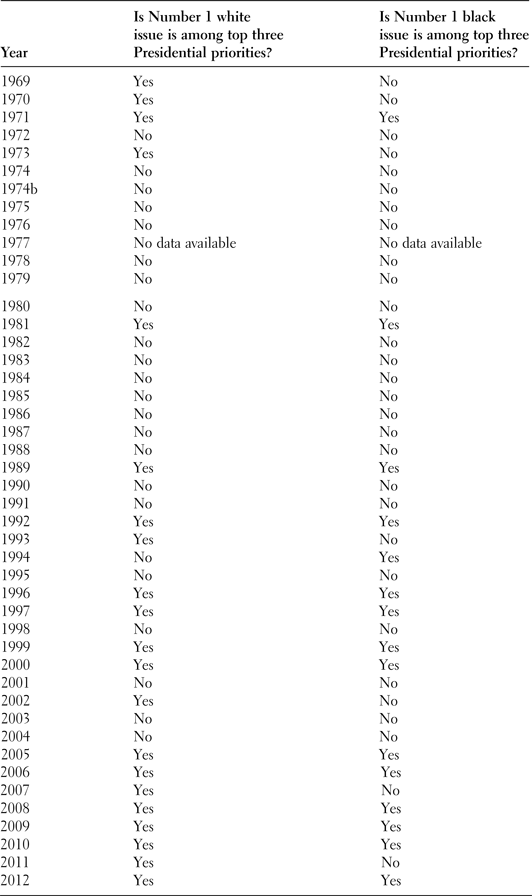
As noted above, however, this measure does not take into consideration the weight accorded by African Americans and whites, respectively, to each of the top three issues. Perhaps presidents tend to represent the number one priority of whites, while only the second- or third- most-important priorities of African Americans. If presidents do not represent the single most important priority of African Americans among their top issues, we could say that they largely fail to represent black interests. To investigate this possibility, we assessed whether the single most important issue identified by African Americans and whites, respectively, in the previous year appeared among the top three priorities of presidents for each year between 1969 and 2012 in Table 6. We find that the number one African-American priority is represented among the president's top three issues in 16 years, while the number one priority of whites is represented among the president's top three issues in 21 years. Clearly, the number one priority of whites is more likely to appear among presidents' top three issues. However, and consistent with Hypothesis 1, the issues of import to the black community do receive notable presidential attention: the number one priority of African Americans also receives representation among the president's top priorities in more than one-third of the 44 years in our analysis. Notably, and consistent with Hypothesis 4, in many years neither the top priority of African Americans nor the single most important issue identified by whites appears among the president's top three issues.
Number 1 white/black issue among top three presidential priorities, 1969–2012

Perhaps presidents fail to provide representation to black interests by declining to align their single most important priority with the number one priority of African Americans. It may also be that presidents tend to align their attention with the single most important issue identified by whites. Our analysis indicates that, in fact, the single most important priority of African Americans is also the number one priority of the president in only 4 of the 44 years in our analysis. Perfect alignment of African-American and presidential priorities is, indeed, quite rare. However, the single most important priority of whites is the top priority of presidents in only 9 out of 44 years. On the whole, this is consistent with Hypothesis 1: by this measure, whites receive more representation than African Americans, but African-American interests also receive some representation. However, the advantage enjoyed by whites is overshadowed by the fact that in most of the years in our analysis neither the top priority of African Americans nor the number one issue cited by whites is also the top concern of the president. This is most consistent with our Hypothesis 4, which predicts substantial independence of the presidential agenda from that of either African Americans or whites.
Using a variety of measures, our analysis has established that (1) whites do appear to enjoy a modest advantage in presidential representation, and (2) African Americans also enjoy notable representation of their priorities by presidents (Hypothesis 1). We have also found that presidential priorities are not infrequently independent of the priorities of both African Americans and whites (Hypothesis 4). However, our theory of conditional presidential representation of black interests requires that African-American priorities should receive notable representation from presidents when (1) African Americans emphasize issues other than economic redistribution and civil rights and (2) these non-racial priorities often overlap with those of whites (Hypothesis 2). It also asserts that when either (1) African Americans emphasize redistributive or civil rights issues or (2) their priorities do not overlap with those of whites, presidents should provide minimal representation of black interests (Hypothesis 3). Is this, in fact, the case?
As noted above, between 1969 and 2012, African Americans and whites tend to identify the same three issues as the most important facing the nation, though they often differ in their ordering of these issues. The number of non-racial issues, which both African Americans and whites perceive among the top three most important in a given year averages about 2.14 (SD = .73). The frequency of racial overlap in perceptions of the most important issues facing the country creates considerable opportunities for presidential representation of black interests, even if this representation is incidental to presidential representation of whites. In fact, in the average year presidents have placed .77 (SD = .74) of the issues prioritized by both African Americans and whites among their top three priorities. These findings provide evidence for Hypothesis 2 of our theory of conditional presidential representation of black interests, suggesting that when African Americans and whites view the same issues as important, presidents provide notable, though not reflexive, attention to these issues.
Given the high level of correspondence between black and white perceptions of the most important issues, the average number of issues per year viewed as important by African Americans but not by whites is comparatively small (.73, SD = .69). Indeed, in 17 years, the top three issues identified as most important by African Americans and whites, respectively, overlap completely (though the ordering of these issues may vary across groups). However, when the issues deemed most important by African Americans are not also viewed as most important by whites, presidents provide virtually no attention to them. Indeed, the average number of issues identified as most important by African Americans but not by whites in a given year appearing among the president's top priorities is close to zero (.06, SD = .22).
Additionally, we find that when issues of economic redistribution and civil rights are prioritized by African Americans, presidents fail to provide any representation of these issues in their rhetoric. In fact, in the 17 years, in which economic redistribution and civil rights were among blacks' top three issue concerns these problems did not rise to the top of the president's priorities. Furthermore, in line with the existing scholarship on the representation of “black interests”, we find that in the 44 years under analysis that issues of economic redistribution and civil rights have never appeared among the president's top three issue areas as measured by average mentions in his major speeches. These findings provide further evidence for our theory of conditional presidential representation of black interests, by showing (consistent with Hypothesis 3) that (1) when African American prioritize issues of economic redistribution or civil rights or (2) when black priorities do not overlap with those of whites, the issues which blacks deem the most important do not receive any substantive attention from presidents. These findings provide further evidence for our theory of conditional presidential representation of black interests, by showing (consistent with Hypothesis 3) that (1) when African American prioritize issues of economic redistribution or civil rights or (2) when black priorities do not overlap with those of whites, the issues which blacks deem the most important do not receive any substantive attention from presidents.
Conclusion
Do presidents represent the interests of African Americans? Answering this question has important implications for our understanding of how well American democracy works. One of the greatest tests of democratic government is whether it can serve minorities, especially those with distinct—or unpopular—preferences. Because African Americans have often suffered at the hands of federal elected officials—either due to direct government action or to federal acquiescence to violence and discrimination on the part of state and local governments or private actors—determining whether presidents represent the interests of African Americans is of special importance.
To date, most scholars have concluded that presidents provide minimal representation of black interests. They reason that African Americans' distinct preferences in the politically charged areas of economic redistribution and civil rights discourages presidents from representing black interests, because doing so would likely alienate white voters. As we have suggested, this conclusion proceeds almost inevitably from a narrow definition of black interests, in which the core interests of African Americans are defined by what differentiates them from those of whites. In this paper, we have suggested that defining black interests more broadly—as whatever African Americans subjectively perceive as most important to them—have important implications, both for our understanding of black interests and for our theories of presidential representation of African Americans. Using this broader definition, and measuring black interests based on subjective responses to the Gallup “most important issue” question in public opinion polls from 1969 to 2012, we find that African Americans prioritize a broad range of political issues (not just economic redistribution and civil rights) and that their priorities often overlap with those of whites. These findings have profound implications for theorizing about presidential representation of black interests, because they suggest greater opportunities for presidential responsiveness to the concerns of greatest interest to African Americans. We argue that presidential representation of black interests is likely to be conditional: when (1) African Americans prioritize issues other than economic redistribution and civil rights and (2) these priorities overlap with those of whites, presidents should provide notable representation of black interests.
We test this argument by investigating whether and to what extent the priorities of African Americans and whites (as identified in the Gallup “most important problem” data) appear as top priorities in major presidential addresses, and assessing whether African American priorities that overlap with those of whites are especially likely to be represented in presidential rhetoric. We conduct a quantitative content analysis of major presidential speeches to track presidential priorities over time. Our results indicate that while the priorities of whites do receive more attention in major presidential addresses, the priorities of African Americans are also reasonably well-represented. Additionally, and consistent with our theory of conditional presidential representation of black interests, we find that priorities of African Americans that overlap with those of whites are much more likely to receive representation in presidential addresses than are priorities that are emphasized by African Americans but not whites. Only when African-American priorities do not overlap at all with those of whites—a phenomenon, which fortunately does not occur with great regularity—are these concerns largely ignored.
Our findings suggest new insights about presidential representation and about racial politics in the United States. A major implication of our work is the manner, in which the interests of groups are conceptualized and measured, has large implications for the evaluation of how well these interests are represented. In defining African-American interests narrowly, previous scholarship led almost inevitably to the conclusion that these interests would not be represented; contrariwise, by defining these interests more broadly, we found greater (though still unequal) presidential representation of black interests. Our research also has interesting implications for racial politics today. By emphasizing black priorities that overlap with those of whites in the political arena, it suggests, African Americans may be able to secure considerable (though likely still unequal) representation of these concerns from American presidents.
Acknowledgments
We thank Joseph Delfino and Laurie Roberts for outstanding research assistance. We also would like to thank Elizabeth Sharrow, Ray La Raja, Brian Schaffner, Seth Goldman, Bruce Desmarais, George Serra, Mark Kemper, Brian Frederick, the participants of the “Political Rhetoric Surrounding Racial/Ethnic Issues” panel at the Midwest Political Science Association's 2013 conference, and the anonymous reviewers and editor of the Journal of Race, Ethnicity, and Politics for their invaluable advice, helpful comments, and constructive feedback on the paper. We thank the Department of Political Science at the University of Massachusetts, Amherst, College of Behavioral and Social Sciences at the University of Massachusetts, Amherst, and Center for Democratic Governance and Leadership at Bridgewater State University for providing valuable financial support for the project.