Introduction
In plants, several hypotheses explain the allocation of resources for defence against herbivores. For instance, the growth-differentiation balance hypothesis states that investments in defence can occur to the detriment of other functions such as growth (Herms & Mattson Reference Herms and Mattson1992). Also, as the resource availability hypothesis poses, antiherbivore defence can be studied as an optimality problem under different selective pressures: plants will use different defence strategies depending on the benefit of the investment (Coley et al. Reference Coley, Bryant and Chapin1985). For instance, fast-growing species should invest less in defences than a slow-growing species, as the reallocation of resources from photosynthesis and growth to defence would have a smaller pay-off.
Plants also balance their investment in different types of defences. Direct defences refer to chemical (secondary compounds) and mechanical (e.g. trichomes, spines, leaf toughness) defences, while indirect defences refer to the investment in ant rewards that attract herbivore enemies (e.g. plant volatiles or extrafloral nectaries [Aljbory & Chen Reference Aljbory and Chen2018]). Tradeoffs among direct and indirect defences have been studied in myrmecophytes (plants associated with ants), and the evidence shows mixed results. There is reduction of some secondary compounds but not of others and not in all myrmecophytes, compared to closely related species (Heil et al. Reference Heil, Staehelin and McKey2000, Reference Heil, Delsinne, Hilpert, Schürkens, Andary, Linsenmair, Sousa and McKey2002; Koricheva & Romero Reference Koricheva and Romero2012; Val & Dirzo Reference Val and Dirzo2003; Webber & McKey Reference Webber and McKey2009). Moreover, the allocation of resources to different antiherbivore defences may change during ontogeny. In myrmecophytes, the rewards for ants increase with plant age or size (reviewed in (Quintero et al. Reference Quintero, Barton and Boege2013); the cost to produce ant rewards can also change throughout ontogeny (Blatrix et al. Reference Blatrix, Renard, Djieto-Lordon and McKey2012). Besides, some myrmecophytic species are expected to shift investments from direct to indirect defences, although they can also show redundancy of defences (e.g. Val & Dirzo Reference Val and Dirzo2003). The investment in ant rewards may change depending on the time that the ant colony settles on the tree, which in turn can be determined by environmental factors, such as light availability. For instance, growing in the shade may delay the production of domatia in swollen-thorn acacias (Leichty & Poethig Reference Leichty and Poethig2019).
Myrmecophytes are also well suited to study yet another tradeoff that has received little attention: tradeoffs in the production of structures for defending ants (hereafter, ‘ant rewards’). These plants house an ant colony inside hollow structures called domatia, feed workers with nectar secreted by extrafloral nectaries, and some species also produce protein or lipid-rich food bodies used by the ants to feed the brood (Rico-Gray & Oliveira Reference Rico-Gray and Oliveira2007). In exchange for these rewards, the ant colony patrols the plant’s tissue, attacking potential herbivores and in some cases removing encroaching or nearby vegetation (Amador-Vargas Reference Amador-Vargas2019; Frederickson et al. Reference Frederickson, Greene and Gordon2005). Several myrmecophytes are pioneer fast-growing species (e.g. Cecropia, Vachellia), for which investments in defence usually do not outweigh investments in growth (Coley et al. Reference Coley, Bryant and Chapin1985). Hence, it is possible that myrmecophytes producing constitutive ant rewards must balance their investment in structures that house or feed their ant colony. Also, these tradeoffs should be aggravated when trees are inhabited by non-defending ants (also known as parasites of the mutualism), which may push the balance for investing either in direct defences or in a different function. Moreover, herbivore selective pressure and the effectiveness of the defence influence the extent to which a plant invests in ant rewards (González-Teuber & Heil Reference González-Teuber and Heil2015; Young & Okello Reference Young and Okello1998).
Few myrmecophytes are adequate to quantify tradeoffs in the production of ant rewards, either because they only produce one type of reward (food or housing) or because the different rewards are not simultaneously produced. Central American swollen-thorn acacias present an excellent opportunity to test this idea, because they produce the domatia (as swollen and hollow spines) and two types of feeding structures at each new node: extrafloral nectaries and food bodies, called Beltian bodies (Janzen Reference Janzen1966). Moreover, the ant rewards are constitutive (i.e. produced regardless of ant presence) but plastic and variable (Amador-Vargas et al. Reference Amador-Vargas, Dyer, Arnold, Cavanaugh and Sánchez-Brenes2020). Hence, the production of nesting space and food for the colony are linked and develop under the same environmental circumstances (e.g. light, rain, herbivory pressure). Besides, sympatric swollen-thorn acacias can be inhabited by aggressive mutualistic ant colonies (several species in the genus Pseudomyrmex) or by non-defending ants (e.g. Crematogaster crinosa; Amador-Vargas et al. Reference Amador-Vargas, Orribarra, Portugal-Loayza and Fernández-Marín2021; Amador-Vargas et al. Reference Amador-Vargas, Dyer, Arnold, Cavanaugh and Sánchez-Brenes2020), which allows for the comparison of investment in ant rewards under different defence conditions.
Here, we tested whether Central American swollen-thorn acacias (Vachellia collinsii) show evidence of resource allocation tradeoffs that are dependent on defence context (i.e. ant occupancy and level of defence). In the study sites, the mutualistic ants are Pseudomyrmex spinicola, which obligatorily nest on swollen-thorn acacias and exclusively feed on the plant rewards, and the non-mutualistic ants are Crematogaster crinosa, which facultatively nest on swollen-thorn acacias, do not defend against herbivores, and can use other sources of nectar and protein besides the plant. Specifically, we investigated: (1) how the investment in ant rewards changes during ontogeny for ant-defended and ant-undefended trees; and (2) whether the investment in one type of ant reward comes at a cost to another reward (e.g. spines vs. nectaries). Because larger trees can afford a greater investment in the production of ant rewards and host larger colonies, we predicted a positive relation between plant diameter and investment in ant rewards (size, number), with a steeper slope when trees are inhabited by mutualistic rather than parasitic ants - that is, a greater investment in ant rewards per unit increase in plant diameter when having mutualistic ants. We also expected that any tradeoff between ant rewards (e.g. food vs. housing) would be observed as a negative allometry or a negative association between ant rewards, with a steeper slope when trees are inhabited by parasitic ants compared to mutualistic ants, given their lack of defence against herbivores.
Materials and methods
Study sites
We sampled swollen-thorn acacia trees (Vachellia collinsii, Fabaceae, formerly Acacia collinsii) in Panama and Costa Rica: Bosque Seco de Coronado, Reserva Eugene Eisenmann (hereafter, ‘Coronado’; Panama West Province, 8° 31ʼ 56" N, 79° 53ʼ 59" W) and Palo Verde National Park (Guanacaste, Costa Rica, 10° 20′ 42″ N, 85° 20′ 20″ W). Samples from Panama were measured during the wet season (October to November 2019), while samples from Palo Verde were measured at the end of the wet season (December 2018 and 2021). Coronado has a mean annual rainfall of 1592 mm (Wolfe & Kursar Reference Wolfe and Kursar2015), and it is a young forest of about 45 hectares with a strong marine influence, with trees typically not taller than 10 m. Common trees include Luehea speciosa, Cecropia peltata, Bursera simaruba, Cochlospermum vitifolium, and Coccoloba lasseri. Palo Verde National Park protects a seasonal dry forest (1500 mm mean annual precipitation), with a mixture of young and old secondary forest. Guazuma ulmifolia, Enterolobium cyclocarpum, Albizia nipoides, Bursera simaruba, and Cochlospermum vitifolium trees are common in the site. Swollen-thorn acacias (V. collinsii) are very common at both sites.
Study species
Swollen-thorn acacias are obligate mutualists of Pseudomyrmex ants, and their survival largely relies on ant-mediated defence against herbivores. These plants provide nesting sites to the ants as swollen and hollow stipular spines (Figure 1). The spines develop from the stipules that protect the developing leaf, which fuse and swell, growing in length and diameter and leaving a hollow space for the ants. The spine length serves to mechanically deter large herbivores, and the spine diameter sets the available space for the ants. In concert with the development of the stipules as spines in the new nodes, an unfolding leaf produces protein-rich Beltian bodies at the tip of pinnules (Figure 2a), and one to five nectaries develop at the base of the leaf rachis (Figure 2b). Once a leaf has unfolded, the ants patrol the Beltian bodies and harvest them to feed the larvae (Janzen Reference Janzen1974). Hence, Beltian bodies are produced only once in a leaf’s lifetime.
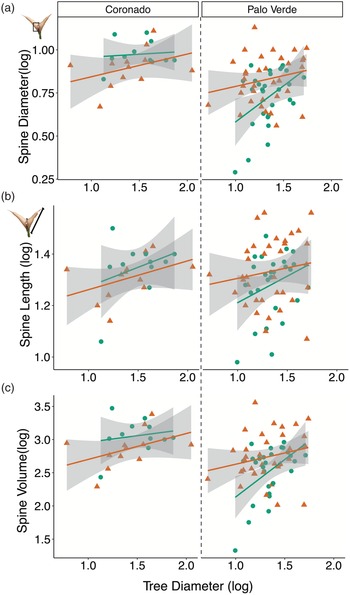
Association of tree diameter in swollen-thorn acacias (V. collinsii) with: (a) spine diameter, (b) spine length, and (c) spine volume, for trees inhabited by the defending Pseudomyrmex spinicola ants (orange triangles) or the non-defending ants Crematogaster crinosa (green circles), at two study sites. The lines show a linear fit and the shaded area represents the 95% CI.

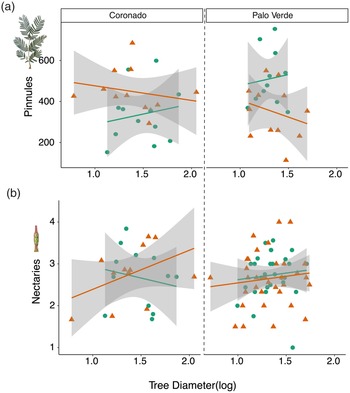
Tree diameter is correlated with (a) the mean number of pinnules, but not with (b) the mean number of nectaries on a leaf. Both relations were not affected by ant species (Pseudomyrmex spinicola in orange triangles; Crematogaster crinosa in green circles) while controlling for location (Palo Verde and Bosque Seco Coronado). The lines show a linear fit, and the shaded area represents the 95% CI.

At both study sites, swollen-thorn acacias can be inhabited by mutualistic and parasitic (non-defending) ant species. The mutualistic ant species is Pseudomyrmex spinicola, and the non-defending species is Crematogaster crinosa. C. crinosa is an arboreal ant species that facultatively nest on V. collinsii. They keep the queen and larvae inside the spines, adults feed on nectar (Janzen Reference Janzen1966; Longino Reference Longino2003), but brood is fed on other protein sources (mainly insects). Because C. crinosa can also nest in other plant species, their survival does not depend on the survival of the host plant. Also, they typically displace P. spinicola (and other mutualistic species) from swollen-thorn acacias. Therefore, the queens of Pseudomyrmex look for unoccupied saplings to start a colony, whereas the queens of Crematogaster inhabit unoccupied swollen-thorn acacias or nest on other tree species, but can move to inhabit Pseudomyrmex-protected swollen-thorn acacias once they have a large number of workers. Trees occupied by different ant species share similar microhabitats and are sometimes found right next to each other.
Measured ant rewards
Part of the dataset was collected simultaneously for this and another project, so detailed explanations on our measurements on ant rewards are found in Gijsman et al. (Reference Gijsman, Guevara, González and Amador-Vargas2021). Briefly, on each tree, we quantified ant rewards of leaves on recently developed branches (where the stem was still green). We counted the number of extrafloral nectaries and took photographs of the leaves to accurately count the number of leaflets and pinnules (as a proxy for the number of Beltian bodies produced by that leaf). Because the number of pinnules is strongly correlated with the number of leaflets (Figure S1; R2 = 0.70, F1,365 = 855, P < 0.0001), we only present the analyses for the number of pinnules. We also measured trunk diameter at the base of the tree (i.e. at 5 cm above ground), and two dimensions of swollen spines: the diameter at the point of fusing (Figure 1a) and length of the two spine sides (Figure 1b), using a caliper (±0.1mm). We then estimated the volume of the spines as two times the volume of a cone (following Amador-Vargas et al. Reference Amador-Vargas, Dyer, Arnold, Cavanaugh and Sánchez-Brenes2020). At Coronado, we sampled 24 trees in total, and measured up to two nodes on three branches per tree (12 trees and 320 nodes for P. spinicola; 12 trees and 212 nodes for C. crinosa). At Palo Verde, we sampled 63 trees in total, measuring up to six nodes on each tree (35 trees and 166 nodes for P. spinicola; 28 trees and 149 nodes for C. crinosa).
Statistical analyses
To test for a relationship between tree size, ant occupancy, and investment in ant rewards, we compared the relationship of number or size of ant rewards (spine dimensions, number of nectaries and pinnules) with the interaction of tree diameter and ant species. We added site (location) as another factor to the models. Our sampling unit for these comparisons was the tree; therefore, we tested for an association between tree diameter and the mean size or mean number of ant structures using ordinary least square estimations, looking for an interaction between tree diameter and ant species, controlling for the effect of location. More specifically, we ran linear models for log-transformed continuous variables (spine length, spine diameter, spine volume, tree diameter) and generalised linear models (“glm”) with Poisson distribution for counts of pinnules and nectaries.
Second, to test whether there is a tradeoff between ant rewards, we used the Standardized Major Axis approach (‘sma’ function from SMATR package for R; Warton et al. Reference Warton, Duursma, Falster and Taskinen2012) for spine length vs. spine diameter (log transformed), using nodes as the sampling unit. As SMA estimations do not allow for the inclusion of a second categorical factor, we ran separate analyses per site. We tested whether the slope of each resident ant species was different from one, that is, whether the relation between variables was isometric. For discrete variables (number of nectaries vs. number of pinnules), we square-root transformed the counts to run a random effects model (‘lmer’ function of lme4 R package Bates et al. Reference Bates, Mächler, Bolker and Walker2015), adding the individual tree ID as a random factor. We also used random effects models (‘lmer’) to test whether the log-transformed continuous variables (spine length, spine diameter, and spine volume) were predicted by the number of pinnules or the number of nectaries (square-root transformed), once again including individual tree IDs as a random factor.
Results
Tree diameter and ant rewards
Spine dimensions
Spine diameter, length, and volume correlated with tree diameter, but the association was not affected by the ant species (Figure 1). In other words, controlling by site, the regression slope was similar between trees with C. crinosa and P. spinicola for all three spine dimensions (i.e. interaction term not significant; Tables S1, S2, S3).
Food rewards and tree diameter
Overall, the mean number of pinnules per leaf slightly decreased with tree diameter controlling by study site (Figure 2a; estimate: −0.18, z = −3.32, P = 0.0009). The relation between tree diameter and number of pinnules was not affected by ant species (estimate: −0.006, z = −0.09, P = 0.93). Similarly, the mean number of nectaries per leaf was not correlated with tree diameter, and therefore the interaction was also not significant (Figure 2b; Table S4).
Tradeoffs between ant structures
Spine length and spine diameter
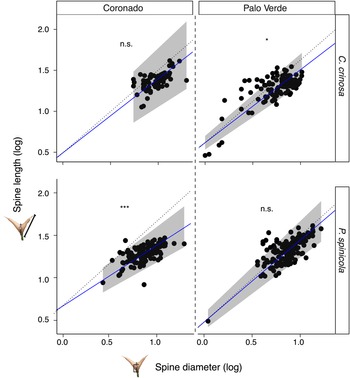
Spine length increased with spine diameter, but slopes varied depending on the resident ant species and site (Figure 3). In Coronado, the relation between spine length and diameter was isometric (slope of one) for trees inhabited by C. crinosa but it showed negative allometry (slope smaller than one) for P. spinicola (Table 1). In Palo Verde, we found the opposite: P. spinicola-inhabited trees had an isometric relation, but negative allometry if inhabited by C. crinosa; however, the confidence interval is very close to 1 (Table 1). In other words, trees inhabited by P. spinicola in Coronado showed the smallest increase in spine length for a unit increase in spine diameter, whereas P. spinicola from Palo Verde showed the largest slope (Table 1; Figure 3). Accordingly, it was unlikely that there was a common slope (likelihood ratio: 8.36, d.f. = 3, P = 0.039). Specifically, the slope of P. spinicola in Coronado differed from the slope of both P. spinicola (P = 0.004) and C. crinosa (P = 0.04) from Palo Verde (Table S5). The slopes of P. spinicola and C. crinosa from Coronado marginally differed (P = 0.087), while the other comparisons did not show significant differences in the slopes (all P > 0.05; Table S5).
Spine length (log) increased with spine diameter (log), and the allometry varied between sites and depending on the resident ant species. The blue line represents the best fit by the Standardized Major Axis approach, and the dotted line represents a theoretical isometric slope (slope = 1). Vertical panels show the two study sites and horizontal panels show the study species. Asterisks denote significant differences between the estimated slope and an isometric slope (* P < 0.05, *** P < 0.0001). Pairwise comparisons between slopes of the ant species at different sites are shown in Table S5.

Estimated slopes and upper and lower 95% CI between spine length and spine diameter using a Standardized Major Axis approach. The r statistic, degrees of freedom (D.f.), and P-value correspond to the test of whether the slope is isometric (equal to one).

P < 0.05 are bolded.
Number of pinnules and number of nectaries
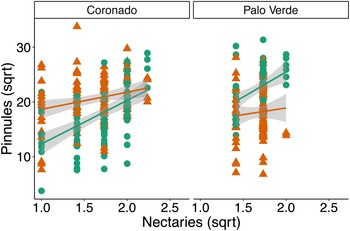
Across all sites and ant occupancy conditions, the number of pinnules on a leaf was positively correlated with the number of nectaries (Figure 4; Table S6). The association between nectaries and pinnules was not affected by the resident ants (interaction term Table S6).
The number of nectaries per leaf in V. collinsii positively correlates with the number of pinnules on a leaf (square-root transformed). The slope of the association was independent of resident ants: Pseudomyrmex spinicola (orange triangles) or Crematogaster crinosa ants (green circles). Panels show the two study sites. The line shows a linear fit and the shaded area represents the 95% CI.

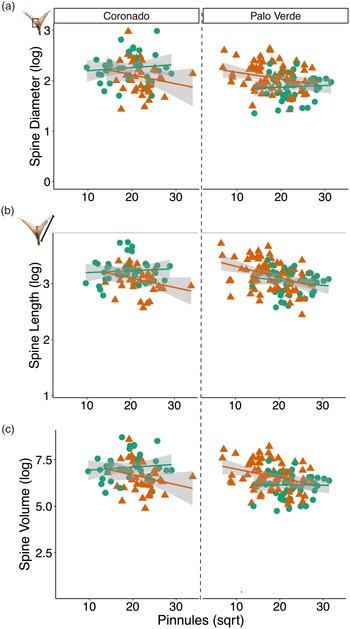
Relation between the number of pinnules on a leaf and (a) spine diameter, (b) length of the spine, or (c) spine volume. Crematogaster crinosa (green circles) or Pseudomyrmex spinicola (orange triangles). The line shows a linear fit and the shaded area represents the 95% CI.

Number of nectaries and spine dimensions
The number of nectaries on a leaf was not associated with spine diameter (Figure S2a), spine length (Figure S2b), or spine volume (Figure S2c). Therefore, there was no interaction between the number of nectaries and the resident ant species for any of the spine dimensions (Tables S7, S8, S9).
Number of pinnules and spine dimensions
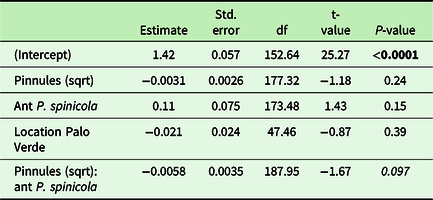
The spine dimensions did not correlate with the number of pinnules on a leaf: diameter (Figure 5a; Table S10), length (Figure 5b; Table 2), or volume (Figure 5c; Table S11). However, there was a marginal interaction (P = 0.097) between spine length and spine volume (P = 0.08) with number of pinnules (Tables 2, S10): when the tree has a P. spinicola colony, the negative slope of the association of pinnules with spine length or spine volume is steeper compared to trees with C. crinosa. In other words, an increase in the number of pinnules corresponded to a decrease in the length (and volume) of the spine, only when inhabited by P. spinicola ants, but not when occupied by C. crinosa.
Random effects model to test whether the spine length was associated with the number of pinnules. Crematogaster crinosa (ant) and Coronado (location) were the reference groups.

P values < 0.05 are bolded, 0.01 > P > 0.05 are in italics.
Although it was not a goal of our study, our concern for the potential effect of location on the ant rewards proved to be important. Out of five variables, three showed an effect of location: in Palo Verde the spine diameter and volume were smaller than in Coronado (regardless of ant; Tables S1, S3, S7, S9, S10, S11). Plants in Palo Verde also showed a greater number of pinnules per leaf (estimate: 0.065, z = 4.27, P < 0.0001).
Discussion
In Central American swollen-thorn acacias, plant size (tree diameter) was positively associated with spine dimensions, negatively correlated with the number of pinnules (a proxy for the number of Beltian bodies) and it was independent of the number of nectaries. Contrary to our prediction, the associations between tree diameter and rewards for the ants were not affected by the defence provided by the ants. Regarding tradeoffs between ant rewards, we detected the possibility of a weak tradeoff only between number of pinnules per leaf and spine length (and therefore volume), but contrary to our prediction there was a steeper negative slope in ant-defended trees. We also detected negative allometry between spine length and spine diameter, but only for particular combinations of ant species and site. Hence, our evidence shows that the scaling of structures with plant size is independent of the resident ants, and that increasing food rewards (and photosynthetic area) may come at a cost to nesting space.
Although it seems as if the tree is investing less in food bodies for the ants as it grows larger, we also have evidence from another study which shows that production rate of new leaves can be faster in some trees (Gijsman et al. Reference Gijsman, Guevara, González and Amador-Vargas2021). Hence, if trees are producing leaves at a faster rate, it may compensate for the smaller leaf size. Also, pinnule number is correlated with leaf length, which is in part determined by light exposure, which is congruent to findings in another plant where shaded plants usually produce longer leaves than plants under direct sunlight (Markesteijn et al. Reference Markesteijn, Poorter and Bongers2007). The decrease in the number of pinnules per leaf with increasing tree diameter, therefore, could be the result of larger trees growing in sunnier environments. Light limitation has been demonstrated to delay the onset of ant-reward production in saplings of swollen-thorn acacia trees (Leichty & Poethig Reference Leichty and Poethig2019); as the species is shade intolerant, light could still be key for the development of structures later in life. Alternatively, it is possible that despite the lack of direct anti-herbivore defence, Crematogaster-inhabited trees still get a benefit from the ants. For instance, plants can obtain additional nitrogen (Chanam et al. Reference Chanam, Sheshshayee, Kasinathan, Jagdeesh, Joshi and Borges2014), or because the presence of the ant presence is enough to deter visits by potential herbivores (Rudgers Reference Rudgers2004).
While myrmecophytes are known to adjust or vary their investment in ant rewards depending on the resident ant colony (e.g. Heil et al. Reference Heil, Fiala, Linsenmair, Zotz and Menke1997, Reference Heil, Hilpert, Fiala and Linsenmair2001), we could not detect that the level of defences (mutualistic or parasitic partners) influenced the relationship between tree size and nectaries. These results suggest that the number of nectaries per leaf is independent of tree size, and that variation in this ant reward is subject to factors other than plant size. The lack of association between the number of nectaries and tree size can be attributed to two reasons. First, it is possible that other variables related to nectar are associated with tree size, such as production rate of nectar or sugar concentration (Fagundes et al. Reference Fagundes, DÁttilo, Ribeiro, Rico-Gray, Jordano and Del-Claro2017; González-Teuber et al. Reference González-Teuber, Silva Bueno, Heil and Boland2012; Heil et al. Reference Heil, González-Teuber, Clement, Kautz, Verhaagh and Bueno2009). Second, because the number of nectaries per leaf varies only between one and five it may be hard to find a linear association with tree diameter. The result is consistent with another study on the same species in Nicaragua, where the number of nectaries on a branch was not correlated with tree size. On the other comparison, we did find a positive relation between the number of nectaries and the number of pinnules. This positive correlation is logical considering that more nectaries may ensure a higher number of ant visits to patrol a larger leaf (Ness Reference Ness2006; Sobrinho et al. Reference Sobrinho, Schoereder, Rodrigues and Collevatti2002).
We only found a potential weak tradeoff between ant rewards in ant-defended trees: pinnule number and spine length (and volume). This result is contrary to our expectation that tradeoffs should be more intense when inhabited by non-defending ants. However, the result does not necessarily indicate that the tree is offering more food (as food bodies) at the cost of reduced nesting space. Swollen-thorn acacias have two types of spines: A and B (Janzen Reference Janzen1974). Type B spines are larger, shaped differently than the V-shaped A spines, and are produced only after the tree reaches a certain size. Therefore, it is possible that a reduction in length and volume in A spines, as pinnule number increases, may be compensated by an earlier onset of B spines (i.e. at a smaller tree diameter) when occupied by mutualists than by parasites. It would be worth assessing whether mutualistic-inhabited trees start the production of B spines at smaller tree diameters than parasitic ant-inhabited trees. However, this comparison has the difficulty that parasitic ant species usually take over a tree previously occupied by mutualistic ants. Hence, it is difficult to know whether the production of B spines started before or after the shift in colonies.
We also detected a negative allometric relation between spine length and spine diameter, that is, for any unit increase in spine diameter there is a proportionally smaller increase in spine length, which was not consistent between study sites or species. In Coronado, the trees with negative allometry (slope < 1) were occupied by Pseudomyrmex spinicola, whereas in Palo Verde a weak negative allometry was observed in trees with Crematogaster crinosa. An important difference between our sites is that in Palo Verde (but not in Coronado) most stipules develop as swollen spines when housing defending ants, whereas in trees with parasitic species the stipule often does not develop as a spine (Amador-Vargas et al. Reference Amador-Vargas, Dyer, Arnold, Cavanaugh and Sánchez-Brenes2020; Gijsman et al. Reference Gijsman, Guevara, González and Amador-Vargas2021). Other myrmecophytes are known to adjust ant rewards production according to the defence they get from the ant partner (e.g. Heil et al. Reference Heil, Fiala, Linsenmair, Zotz and Menke1997). However, fewer studies document whether this investment is at the expense of another ant reward. For instance, Brouat and McKey (Reference Brouat and McKey2001) report negative allometry between leaf size and domatia size, but for plants where domatia are hollow stems. In that case, a larger domatia may compromise the plant physical stability and would explain the reduction in leaf size. The domatia of swollen-thorn acacias is made of lignified tissue, and hence, plants could be investing that energy in producing other relevant structures. Spine volume determines the available space for storing brood and food. Hence, spine diameter is the most relevant dimension for the ants, as a unit increase in spine diameter has a greater effect on spine volume than a unit increase in spine length. Spine length is of course important for the final volume of the domatia, but it also serves as a mechanical defence. However, with the available evidence, it is hard to understand the biological implications of having relatively shorter spines for a given spine diameter. Specifically, we still do not know whether a negative allometry has implications for the mechanical defence against herbivores or for the available nesting space for the ants. Reductions in spine length have been demonstrated in African acacias excluded from herbivores (Young et al. Reference Young, Stanton and Christian2003), although the effect on the available nesting space for the ants was not tested. In our study, the allometry of spine length and spine diameter changes depending on the ant species occupying a tree, but it was not consistent between sites (isometric in P. spinicola – Palo Verde and C. crinosa – Coronado; negative allometry in P. spinicola – Coronado and C. crinosa – Palo Verde). This inconsistency indicates that microenvironmental or intrinsic factors may be more important in determining the relationship between spine dimensions in swollen-thorn acacias.
Myrmecophytes are a useful system to study plant investment in different types of defences. Traditionally, the emphasis has been on the tradeoff between direct and indirect defences or on how the indirect defences change through plant ontogeny. Our research revealed intriguing allometric patterns depending on ant partner and study site, and a general lack of tradeoffs between ant structures. Our evidence shows that the interacting ants exert weaker pressures on the scaling of defence structures in myrmecophytes than expected, but the habitat (location) had an unexpected role in the size of ant rewards.
Supplementary material
To view supplementary material for this article, please visit https://doi.org/10.1017/S0266467422000293
Data availability statement
Dataset available at Figshare 10.25573/data.20235462.
Acknowledgements
We are thankful to the staff at Parque Nacional Palo Verde and at Bosque Seco de Coronado Reserva Eugene Eisenmann. Dumas Gálvez, Katherine Porras, Rosannette Quesada, and two anonymous reviewers provided helpful comments to earlier versions of the manuscript. Research was conducted under permits 001-2020 ACAT & 044-2021-ACAT. This work was funded by the Smithsonian Tropical Research Institute.
Authors’ contributions
SAV: Conceptualisation, data curation, formal analysis, visualisation, writing – original draft, writing – review and editing. YG: Data curation, formal analysis, visualisation, writing – original draft, review and editing. MG: Data curation. FG: Data curation, writing – review and editing.
Competing interests
The author(s) declare none.