Introduction
The concept of ageing in place is promoted by the Organization for Economic Co-operation and Development (OECD) and applied by most European countries. The aim is to enable the elderly people to live at home as long as possible. Thus, long-term care at home is much more common than institutional care (Damiani et al., Reference Damiani2011). With regard to the present financial situation in Europe, the balance of social and individual responsibilities is being redefined and will most likely lead to more responsibilities for families, including financial responsibilities (Swartz, Reference Swartz2013); however, under certain circumstances, nursing home placement might be necessary (e.g. at an advanced stage of dementia). In Germany, approximately 2.34 million people are in need of nursing care; 80% are aged 65 years or older. Approximately 70% of all care-dependent persons are cared for at home (Pfaff, Reference Pfaff2013). Approximately half of community-dwelling care recipients suffer from dementia (Engels et al., Reference Engels2005). The functioning and well-being of informal caregivers are therefore integral to maintaining care at home. Two-thirds of informal caregivers in Germany do not receive any type of professional service or support. Hence, they work entirely alone (Pfaff, Reference Pfaff2013). Their willingness to provide care at home might increase because German long-term care insurance pays an expense allowance for informal care, supplementing household income.
Much research has been performed regarding the impact of caregiving, and it is well known that informal caregivers, especially those of persons with dementia, are under considerable strain. Caregiving is often associated with negative effects on caregivers’ health (Etters et al., Reference Etters, Goodall and Harrison2008; Brodaty and Donkin, Reference Brodaty and Donkin2009). Caregiving usually does not end even after admission to nursing home. Informal caregivers visit their relatives and are still involved in caring, so the burden may persist after nursing home admission (Gaugler et al., Reference Gaugler, Mittelman, Hepburn and Newcomer2010).
A recent systematic review suggests that caregiver characteristics have a greater impact on perceived burden, stress, and depression than the intensiveness of the care needed (Schoenmakers et al., Reference Schoenmakers, Buntinx and Delepeleire2010). The relevance of positive aspects of caregiving has been underestimated in the past: positive emotions may have a significant effect on how caregivers perceive their situation (Zarit, Reference Zarit2012). Appropriate assessment tools are required to initiate supportive interventions for informal caregivers, considering both caregivers’ subjective experiences and positive aspects of caregiving. Few instruments measuring caregiver burdens or reactions are available in German. These instruments are either insufficiently validated (Gräßel and Leutbecher, Reference Gräßel and Leutbecher1993), too comprehensive for clinical use (Zank et al., Reference Zank, Schacke and Leipold2006), neglectful of positive aspects of caregiving (e.g. the Zarit Burden Interview (ZBI); Braun et al., Reference Braun, Scholz, Hornung and Martin2010), or focused exclusively on caregiving at home.
The Caregiver Reaction Assessment (CRA) scale is a generic instrument that was developed by Given et al. (Reference Given, Given, Stommel, Collins, King and Franklin1992) 20 years ago. It is a multidimensional concept of caregiver reactions that encompasses positive aspects of caring. The CRA scale is suitable for measuring changes over time. Compared with other tools, the scale was well developed, was tested across different target groups, caregiving situations, and settings (Deeken et al., Reference Deeken, Taylor, Mangan, Yabroff and Ingham2003), and demonstrated sufficient psychometric properties in different languages and countries (Nijboer et al., Reference Nijboer, Triemstra, Tempelaar, Sanderman and van den Bos1999; van Exel et al., Reference van Exel, Brouwer, van den Berg, Koopmanschap and van den Bos2004a; Grov et al., Reference Grov, Fosså, Tønnessen and Dahl2006; Bachner et al., Reference Bachner, O’Rourke and Carmel2007; Persson et al., Reference Persson, Wennman-Larsen, Sundin and Gustavsson2008; Misawa et al., Reference Misawa2009; Ge et al., Reference Ge2011). Therefore, the consortium of the 7th Framework Program of European Union project RightTimePlaceCare (RTPC) chose the CRA scale for collection of data on informal caregivers of persons with dementia at home and in institutional long-term care (iLTC). First, a professional translator translated the instrument into German (G-CRA). Forward/backward translation was employed to ensure that the original meaning remained unchanged. Testing of psychometric properties of the G-CRA scale was embedded in the German part of the RTPC project.
Methods
Context and data collection
The RTPC project aims at developing best-practice strategies for persons with dementia and their informal caregivers, focusing on the transition from home care (HC) to iLTC. Eight countries are involved in the project: Estonia, Finland, France, Germany, the Netherlands, Sweden, Spain, and the United Kingdom. The core of RTPC is a prospective cohort study of persons with dementia on the border between care at home and iLTC and their informal caregivers. In each country, data collection took place between November 2011 and May 2012 and consisted of baseline interviews and follow-up three months later. Two sets of dyads were enrolled. The first group consisted of persons with dementia and informal caregivers receiving professional home care and judged to be at risk for admission to iLTC within the next six months. The second group consisted of persons with dementia recently admitted to iLTC (at least four but not longer than 12 weeks before) and their informal caregivers. Inclusion criteria were age of the person with dementia being ≥65 years, dementia formally diagnosed by a physician (and Mini-Mental State Examination (MMSE) ≤ 24), and no recent psychiatric illness. Inclusion criteria for informal caregivers were being the person most involved in caregiving and visiting the person with dementia at least twice per month. No restriction was made regarding the relationship to the person with dementia, i.e. spouses, children, friends, and others were included.
Nominated staff (e.g. nurses) in the long-term care facilities or home care organizations acted as gatekeepers for consecutive enrollment of participants. Trained interviewers performed personal face-to-face interviews covering quality of care, quality of life and health, and the social and economic situation of persons with dementia and their informal caregivers (Verbeek et al., Reference Verbeek2012). The CRA scale was part of the interview and was administered to informal caregivers in both settings. For the validation study, the baseline data of 234 informal caregivers in Germany (North Rhine-Westphalia and Hamburg) were included. These subjects included 116 informal caregivers for persons with dementia living at home and 118 informal caregivers for persons living in iLTC.
Ethical considerations
The study protocol was approved by the ethical committee of the German Society for Nursing Science (7 October 2010). All informal caregivers gave their written informed consent.
The caregiver reaction assessment (CRA) scale
The original CRA scale consists of 24 items and five subscales representing five different dimensions (Given et al., Reference Given, Given, Stommel, Collins, King and Franklin1992). Agreement is assessed on a 5-point ordinal Likert scale (strongly disagree = 1 point, disagree = 2, neither agree nor disagree = 3, agree = 4, strongly agree = 5 points). A higher score on a subscale indicates stronger impact. The scale includes five reversely scored items: four positive questions in three subscales with negative polarity, and one negative question in a subscale with positive polarity.
According to Given et al. (Reference Given, Given, Stommel, Collins, King and Franklin1992), sum-scores of subscales rather than overall score are calculated. The subscale caregivers’ self-esteem (seven items, one reversed) describes how caring is related positively to the sense of self-worth. The subscale lack of family support (five items, one reversed) assesses the degree to which the family supports informal caregivers. The subscales impact on finances (three items, one reversed), impact on daily schedule (five items), and impact on health (four items, two reversed) describe how caring negatively influences a caregiver's life.
Statistical analysis
Construct validity measures the extent to which an instrument measures the intended theoretical construct or dimension. Therefore, exploratory factor analysis (EFA) was performed to derive independent subscales from the 24 items without assumptions. Beforehand, the Kaiser–Meyer–Olkin (KMO) and Bartlett tests were performed as measures of sampling adequacy. Criteria used to determine the subscales (factors) were minimum eigenvalues >1.00 (Kaiser criterion). As the Kaiser criterion tends to retain too many factors, the scree plot test was added (Costello and Osborne, Reference Costello and Osborne2005). Criterion validity was assessed by correlational analysis using Spearman's rank correlation (Kraemer, Reference Kraemer2006). First, derived subscales were correlated with each other. Assuming that different dimensions are captured, correlation was expected to be moderate or lower (r < 0.5; Given et al., Reference Given, Given, Stommel, Collins, King and Franklin1992). Criterion validity was further explored by correlating subscales with appropriate external variables (DeVon et al., Reference DeVon2007). Developers of the CRA scale state that subscales measure psychological states that are connected with caregivers’ depression as a result of persisting burdens (Given et al., Reference Given, Given, Stommel, Collins, King and Franklin1992). Following this assumption, the widely used ZBI (assessing caregiver's burden; Zarit et al., Reference Zarit, Reever and Bach-Peterson1980) and the General Health Questionnaire (GHQ-12; assessing overall psychological well-being; Goldberg et al., Reference Goldberg1997) were used as reference values. Both instruments are frequently used in clinical practice and research. Beyond that, impact on health was correlated with the five-dimensional version of the EuroQuol questionnaire (EQ-5D), which captures health-related quality of life (Brazier et al., Reference Brazier, Jones and Kind1993). Based on the results of a similar validation study, we expected to find correlation coefficients that were not excessively high (r < 0.7), as the concepts are similar to but distinct from the concepts of the CRA scale (Nijboer et al., Reference Nijboer, Triemstra, Tempelaar, Sanderman and van den Bos1999).
The reliability of the subscales was assessed through internal consistency in terms of Cronbach's α coefficient, which is based on a mean inter-correlation of all possible pairs of items (Peterson and Kim, Reference Peterson and Kim2013). Reliability was considered good if Cronbach's α ranged between 0.7 and 0.9 (Nijboer et al., Reference Nijboer, Triemstra, Tempelaar, Sanderman and van den Bos1999). A two-tailed test of statistical significance was performed. For significance testing of differences between the samples at home and in iLTC, the Mann–Whitney U and χ 2 tests were used.
Missing values of the G-CRA scale were not replaced to avoid biasing the results. As the number of items per subscale is quite low, no sum-scores were calculated in cases of missing values. Less than 5% of the subscales’ sum-scores were missing, varying from 11 values missing from caregivers’ self-esteem to three from impact on daily schedule. For EFA, list-wise deletion of missing values was chosen, resulting in 9% (21/234) missing values. Statistical analyses were performed using Statistical Package for the Social Sciences (SPSS version 20.0).
Testing of feasibility
The research assistants and researchers (n = 9) who conducted the interviews were asked to judge the feasibility of the G-CRA scale. The time required to administer the scale was assessed in a convenient subsample of 20 interviews. The frequencies of missing values regarding particular items and the shift to the neutral middle (“neither agree nor disagree”) were investigated. Interviewers held at least a Bachelor's degree in health, social care, or other related disciplines. They were intensively trained and supervised by the investigators in charge of the RTPC project (Astrid Stephan, Anna Renom Guiteras, Anja Gerlach, and Gabriele Meyer).
Results
Participant characteristics
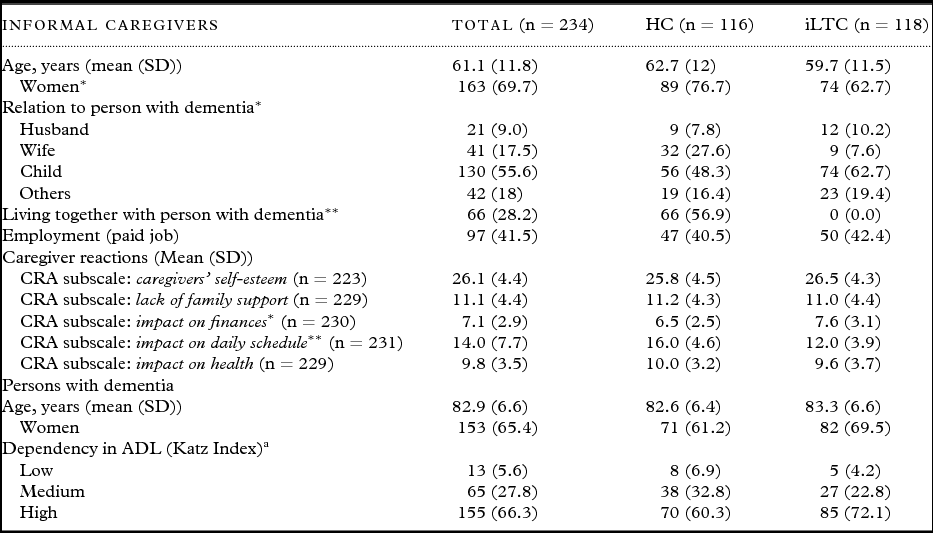
Table 1 displays the characteristics of the dyads of informal caregivers and persons with dementia at home and in iLTC. The main informal caregivers were predominantly females. In the home care setting, wives were the predominant caregivers for their husbands, whereas in iLTC, children were the most frequent informal caregivers for their parents.
Characteristics of caregivers and persons with dementia; values are numbers (percentages) unless stated otherwise. Significant differences between home care (HC) and institutional long-term care (iLTC) are marked

Notes: aKatz Index: low = 6 points, medium = 3–5 points, high = 0–2 points.
*p < 0.05; **p < 0.01.
Construct validity
Data collected from 213 participants were available for factor analysis due to list-wise deletion of missing values. The Bartlett test generated a statistically significant result (p < 0.001). The KMO measure of sampling adequacy (KMO = 0.798) indicated sufficient sample size for factor analysis. A varimax rotation revealed six factors with eigenvalues >1; however, scree plot analysis supported the original five subscales of the original CRA scale, which explain 56.2% of the total variance (see Figure 1). The five dimensions of the original version of the instrument were thus confirmed. The sixth dimension (eigenvalue = 1.002) was considered coincidental and was therefore disregarded. When retaining the five dimensions of the original CRA scale, only one item (“tired all the time”) of 24 deviated with regard to the original version of the CRA scale. The item originally belonged to the subscale impact on health but revealed slightly higher loadings in the subscale impact on daily schedule (0.59 vs. 0.44).
Scree plot displaying eigenvalues and factors.
Criterion validity
Inter-correlation between subscales was very weak to moderate (r = –0.1 to 0.50), indicating that the measured concepts are distinct (see Table 2). The subscales impact on daily schedule and impact on health showed the strongest inter-correlation (r = 0.50), suggesting that these concepts might not be sufficiently distinguished from each other.
Inter-correlation of subscales using Spearman's rank correlation (r)

Note: *p < 0.05, **p < 0.01.
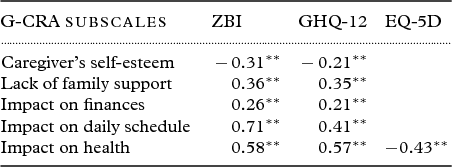
Table 3 shows the correlations of the subscales and external variables ZBI, GHQ-12, and EQ5-D. Moderate-to-weak negative inter-correlation between caregivers’ self-esteem and the overall burden (ZBI) and psychological well-being (GHQ-12) was found, indicating that the captured concepts are opposed (r = −0.31/–0.21). The respective correlations between impact on daily schedule and impact on health and overall burden and psychological well-being were moderate to strong (r = 0.41 to 0.71), suggesting that the concepts are connected but not exactly the same. The correlation between impact on health and EQ-5D was negative and moderate (r = −0.43), indicating that a higher impact on health is correlated with lower health-related quality of life. Lack of family support and impact on finances showed only weak-to-moderate correlations with the reference variables, suggesting that the concepts are distinct.
Correlations of G-CRA subscales with reference values
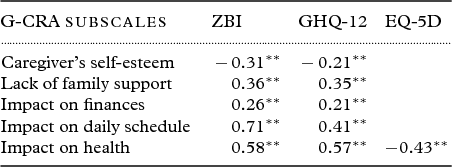
Note: **p < 0.01.
Reliability
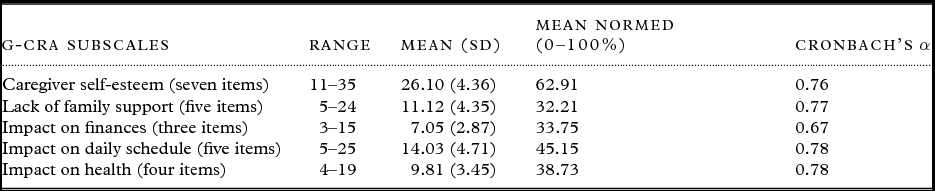
Table 4 displays the Cronbach's α values of the subscales that are sufficiently high and vary between 0.67 and 0.78, indicating sufficient reliability.
Reliability of G-CRA subscales in terms of Cronbach's α
Feasibility
The number of interviews per interviewer varied between 15 and 100. In general, interviewers considered G-CRA adequate. Three of the nine interviewers judged the scale to be even more appropriate than the ZBI, especially in iLTC. The G-CRA took 2.35 to 10.20 min in a face-to-face interview (median value 6.50 min).
The neutral middle (“neither agree nor disagree”) was most often chosen within the subscale caregivers’ self-esteem. Item 12 (“never do enough to repay”) was answered with “neither agree nor disagree” by 28% respondents, item 23 (“enjoy caring”) by 27%, and item 1 (“privileged to care”) by 22% respondents. The few missing values were equally distributed throughout all items.
Discussion
Our study results suggest that the G-CRA scale is a sufficiently valid and internally reliable instrument for measuring the experiences of informal caregivers caring for people with dementia at home and in iLTC. The five subscales of the original CRA scale were confirmed by EFA and supported by scree plot analysis. The finding is further supported by weak-to-moderate inter-correlation of subscales. The results are comparable with those of the validation of the original instrument (Given et al., Reference Given, Given, Stommel, Collins, King and Franklin1992). Only subscales impact on health and impact on daily schedule had a higher inter-correlation, indicating that these dimensions might be insufficiently distinguished. EFA supports a possible overlap between both scales, as the item “tired all the time” from the subscale impact on health revealed higher factor loading within the subscale impact on daily schedule. Within the validation of the original CRA scale, this item also revealed only moderate factor loading within the subscale impact on health and considerable loading within the subscale impact on daily schedule (Given et al., Reference Given, Given, Stommel, Collins, King and Franklin1992). We therefore decided not to modify the G-CRA scale based on the findings of the recent validation study.
Validity is further indicated by the correlations of CRA subscales and external reference values. The subscales impact on health and impact on daily schedule were strongly correlated with overall burden and psychological well-being, supporting the findings of other studies using comparable reference values (Given et al., Reference Given, Given, Stommel, Collins, King and Franklin1992; Nijboer et al., Reference Nijboer, Triemstra, Tempelaar, Sanderman and van den Bos1999; Misawa et al., Reference Misawa2009). As expected, caregivers’ self-esteem is negatively correlated with the reference values “overall burden” and “psychological well-being.” Subscale impact on health is significantly negatively correlated with “health-related quality of life.” Van Exel et al. (Reference van Exel, Brouwer, van den Berg, Koopmanschap and van den Bos2004b) suggest that the five domains of the CRA scale do not contribute equally to the overall perceived burden and that lack of family support does not influence the burden at all. Our findings support the suggestion that not all domains contribute equally to the overall burden; however, we found at least moderate correlations between lack of family support and impact on finances and the “overall burden,” as measured with the ZBI.
The internal consistency was sufficient, although Cronbach's α was low compared with the values reported in other studies (Bachner et al., Reference Bachner, O’Rourke and Carmel2007; Persson et al., Reference Persson, Wennman-Larsen, Sundin and Gustavsson2008; Misawa et al., Reference Misawa2009). The lowest Cronbach's α was found for impact on finances (0.67), and the highest Cronbach's α was found for impact on health (0.78). The results support the feasibility of using the G-CRA scale for clinical purposes. It takes less than ten minutes to apply the instrument in a face-to-face interview. Similar results are reported in other feasibility tests (Nijboer et al., Reference Nijboer, Triemstra, Tempelaar, Sanderman and van den Bos1999; Persson et al., Reference Persson, Wennman-Larsen, Sundin and Gustavsson2008). Our interviewers judged the G-CRA scale to be appropriate and even more suitable than the ZBI, especially in iLTC. Study participants most often chose the neutral middle within the subscale caregivers’ self-esteem. Questions in this subscale might be difficult to answer and perceived as too intimate in a face-to-face interview. Self-administration of the G-CRA might yield different results.
Limitations and strengths
Our study has some limitations. We did not investigate the stability of the G-CRA scale. The participants were informal caregivers for people with dementia on the border between home care and iLTC, and often faced severe burdens. Hence, meaningful changes regarding caregiver reactions were strongly expected.
A recent review suggests that the relationship between informal caregivers and care recipients influences the perceived impact of caring (Schoenmakers et al., Reference Schoenmakers, Buntinx and Delepeleire2010). In the RTPC project, the somewhat unspecific definition of informal caregivers might have influenced the clinical results. Other validation studies included a more specific sample, e.g. family members or partners (Given et al., Reference Given, Given, Stommel, Collins, King and Franklin1992; Nijboer et al., Reference Nijboer, Triemstra, Tempelaar, Sanderman and van den Bos1999; Misawa et al., Reference Misawa2009; Ge et al., Reference Ge2011); however, it is unlikely that the psychometric properties of the CRA scale are affected by the relationship of the study participants (Given et al., Reference Given, Given, Stommel, Collins, King and Franklin1992).
We did not separately investigate the subsamples of caregiver–patient dyads at home and in iLTC because the CRA scale is a generic tool that is supposed to measure caregiver reactions in different settings and caregiving situations and given different diseases. Although most validation studies have investigated caregivers of community-dwelling patients, the CRA scale also demonstrated sufficient psychometric properties in studies including stroke patients in rehabilitation wards (van Exel et al., Reference van Exel, Brouwer, van den Berg, Koopmanschap and van den Bos2004a). The CRA scale was further successfully used to measure post-caregiving reactions in bereaved caregivers of cancer patients (Bachner et al., Reference Bachner, O’Rourke and Carmel2007).
Our study also has strengths. The sample size was adequate (as indicated by the Bartlett and KMO tests) and comparable to other validation studies (Nijboer et al., Reference Nijboer, Triemstra, Tempelaar, Sanderman and van den Bos1999; Bachner et al., Reference Bachner, O’Rourke and Carmel2007; Persson et al., Reference Persson, Wennman-Larsen, Sundin and Gustavsson2008). Our sample presents a realistic and unbiased mix of informal caregivers of persons with dementia in Germany.
As the number of persons with dementia will continue to increase, measurement tools that are applicable and useful throughout the course of the disease are needed. The transition from home care to iLTC has rarely been investigated (Verbeek et al., Reference Verbeek2012). The G-CRA scale constitutes a valuable contribution to the body of existing instruments on caregiver impact and is suitable for measurement of the informal caregivers’ reactions in the transitional phase.
Conclusions
Our study suggests that the G-CRA scale is a sufficiently valid and internally reliable instrument for measuring the reactions of informal caregivers for persons with dementia in different settings. Based on our findings, no modifications of the five dimensions or items appear to be necessary. We consider the G-CRA scale appropriate for use in clinical practice and research. The scale appears to be applicable in home care and iLTC as well as in the transition between settings. The subscales can be used as separate measures, and different domains enable practitioners to easily identify specific problems to initiate tailored counseling and interventions. Nevertheless, our results await confirmation by future studies with larger sample sizes and caregivers of different groups in different settings. In further studies, the possible overlap between the subscales impact on health and impact on daily schedule should be carefully considered. The stability of the G-CRA scale should also be assessed.
Conflicts of interest
None.
Description of authors’ roles
Astrid Stephan (AS) and Gabriele Meyer (GM) developed the research question and conceived the study design. Herbert Mayer (HM) contributed to the planning. AS and Anna Renom Guiteras (ARG) collected and managed the data. AS performed data analysis, supported by HM. AS drafted the manuscript, supported by GM, HM, and ARG. All authors critically read and approved the final manuscript.
Acknowledgments
We thank Gabriele Krause, MSc Nursing, Witten/Herdecke University, for contributing to the analysis of psychometric properties through a pilot study and conducting the feasibility study. We thank Anja Gerlach, MSc Nursing, University of Hamburg, for collecting data in Hamburg. We further thank our research assistants who supported data collection and data management. We are grateful to the collaborating institutions and the study participants for their valuable contribution.
The RightTimePlaceCare study was supported by a grant from the European Commission within the 7th Framework Program (project 242153).