In the focal article, Mitchell and colleagues (Reference Mitchell, Haslam, Burke and Steffens2026) examine how human resource (HR) practices can either stimulate or suppress leader narcissism by shaping how leaders define themselves in terms of personal or group identity. However, I argue that these same HR practices may have broader implications for teams, through collective narcissism, such that, like leaders, teams may develop an inflated but shared belief of superiority over other groups (de Zavala et al., Reference de Zavala, Cichocka, Eidelson and Jayawickreme2009; de Zavala & Lantos, Reference de Zavala and Lantos2020). This form of narcissism in teams is troublesome because, unlike productive intrateam aspects of healthy team identification (e.g., cohesion, efficacy, pride), collective narcissism reflects a distinct feeling of ingroup identification characterized by a more insecure form of pride coupled with a strong need for recognition and heightened sensitivity to intergroup threat (Eker et al., Reference Eker, Cichocka and Sibley2023). Additionally, because collective narcissism is more predictive of negative intergroup behavior (e.g., hostility) than individual measures of narcissism (de Zavala & Lantos, Reference de Zavala and Lantos2020), and a predominant focus on one’s team can be detrimental for interteam cooperation and collaboration (Marinthe et al., Reference Marinthe, Cislak, Stronge, Biddlestone, Azevedo, Kasper, Sibley and Cichocka2025; Mell et al., Reference Mell, DeChurch, Leenders and Contractor2020; Richter et al., Reference Richter, Scully and West2005), it is essential to understand how an organization’s HR practices can drive interteam processes (e.g., conflict), which can have consequences across levels.
As such, the following commentary extends the focal article by the shifting analysis beyond leader narcissism at the individual level to highlight the often-overlooked factor of collective narcissism in teams. Specifically, I address how HR practices that shape leader identity may inadvertently stimulate or suppress collective narcissism in teams as they make the group identity most salient. I present collective narcissism as an additional factor that should be considered in tandem with HR practices, such that practices can be effective or ineffective at stimulating or suppressing one or both.
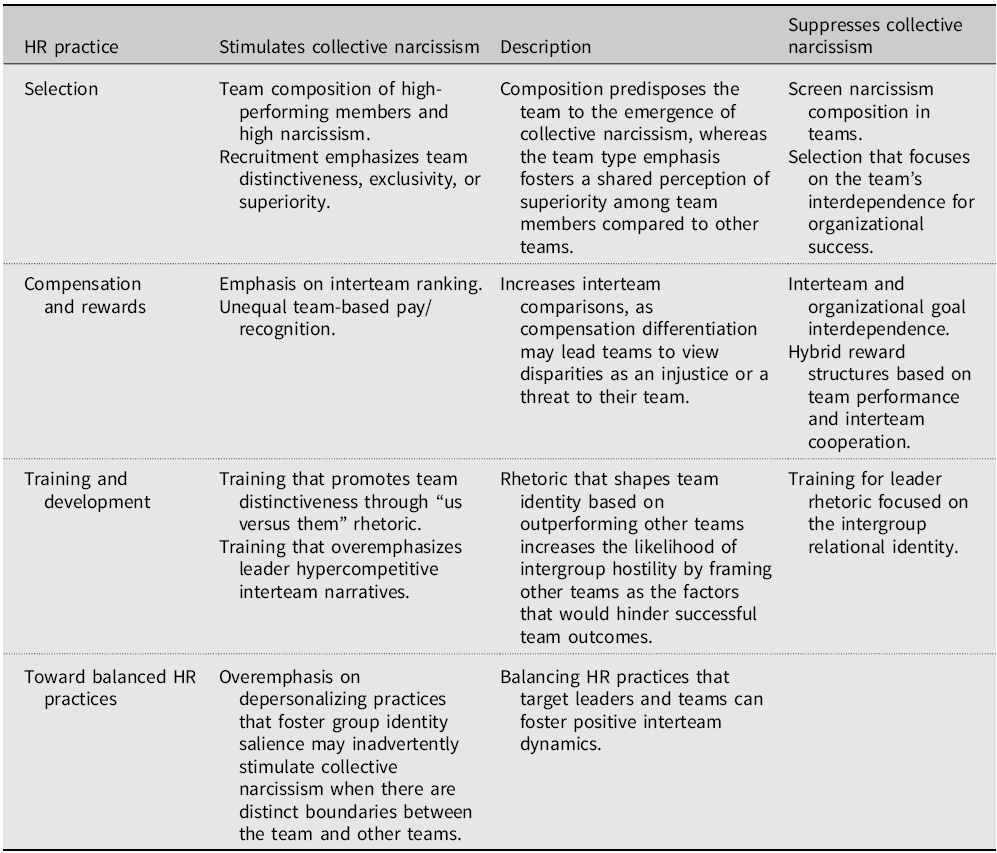
In what follows, I will outline how the three core HR practices (e.g., selection, compensation and rewards, leader training and development) noted in the focal article may stimulate or suppress collective narcissism (see Table 1). For each, I identify mechanisms through which HR practice can fuel suboptimal interteam dynamics or shape more optimal interdependent team identities. Through this, I also provide guidance for assessing how HR practices can fuel the dark side of team identification, which can impact team interactions within the organization.
Human resource practices and collective narcissism
Human Resource (HR) Practices and Collective Narcissism in Teams Summary Table

Recruitment and selection practices
Stimulate
Recruitment and selection practices can influence teams’ perceptions of boundaries, distinctiveness, and superiority over other teams. From a team composition perspective, selection practices (e.g., personality composition) are critical antecedents for team processes, emergent states, and outcomes (Baer et al., Reference Baer, Vadera, Leenders and Oldham2014; Bell et al., Reference Bell, Brown, Colaneri and Outland2018). So although the depersonalizing HR selection practices noted by Mitchell and colleagues may suppress leader narcissism through team identification, if not balanced at the group level, these HR practices may fail to account for individual narcissism composition as an antecedent for the emergence of collective narcissism in teams (de Zavala et al., Reference de Zavala, Cichocka, Eidelson and Jayawickreme2009; de Zavala & Lantos, Reference de Zavala and Lantos2020; Lynch et al., Reference Lynch, McGregor and Benson2022).
Stated differently, even though HR selection may involve random selection from a group of highly qualified candidates, the formulation of that pool of candidates may narrowly focus on composing teams with highly competent members high in specialized knowledge, skills, and abilities (KSAs) necessary for the teams function rather than levels of individual narcissism resulting in higher team narcissism composition (Grijalva et al., Reference Grijalva, Maynes, Badura and Whiting2020; Lynch et al., Reference Lynch, McGregor and Benson2022). Additionally, as members are recruited and selected, framing team types as high-performing, elite, or “star” teams signals the team’s distinctiveness and hierarchy of status within an organization, which may inflate their perceptions of group superiority. Although team type framing can be a catalyst during recruitment, feelings of superiority may be heightened if the team perceives itself as undervalued by the organization. In such cases, HR practices may inadvertently fuel collective narcissism despite intentions to suppress leader narcissism.
Additionally, signaling during recruitment not only signals superiority and status to external hires but to those within the organization. As such, although depersonalizing HR practices may shift from leader status, recruiting to a special team may cause other teams to make distinctions that result in feelings of devaluation by the organization and subsequently heightened feelings of threat toward those with more specialized teams.
Suppress
Selection practices can also be structured in a way that hinders collective narcissism rather than amplifying it. At the same time, the challenge is particularly pronounced in domains where high levels of expertise are scarce but highly valued. For example, surgical teams or elite military units may comprise skilled physicians and combat experts with higher levels of narcissism. Although such individuals bring critical knowledge skills and abilities, their narcissism may manifest in hostility toward other teams perceived as inferior, especially when compared to them. In hospital settings, this can undermine collaboration between specialties and jeopardize patient outcomes. Although in a military setting where teams may be working as a part of a multiteam system, viewing their elite team as special over other teams may lead to collective narcissism, which impacts how they team may engage with other teams especially in a multiteam context where rather than having a systems focus the team may focus on the component team, which can lead to less information sharing (Mell et al., Reference Mell, DeChurch, Leenders and Contractor2020; Wijnmaalen et al., Reference Wijnmaalen, Voordijk, Rietjens and Dewulf2019). Thus, although HR practitioners cannot always avoid selecting individuals high in narcissism when expertise is paramount, failure to consider narcissism composition at the risk of personalizing one team over others and seeding collective narcissism across organizational boundaries (Eker et al., Reference Eker, Cichocka and Sibley2023).
Suggestions for suppressing collective narcissism include screening out for individual narcissism when composing teams by utilizing a comprehensive approach to measure personality and setting specific guidelines for how personality may be distributed in teams. This does not mean screen out anyone with high narcissism, but be complementary when composing teams, such that there is the least likelihood of collective narcissism manifesting in teams. Additionally, cross-departmental selection panels allow recruits to see the interdependence of the team throughout the organization. Prioritizing the visibility of teams interdependent during the recruitment process may detract from the incoming employee’s hyperfocus on the “special team” and highlight the team within the organization. Additionally, recruitment and organizational communication that move away from framing the team as special or higher status may limit the hyperfocus on special team status, superiority, and intergroup comparison
Compensation and rewards practices
Stimulate
When team-based rewards are applied without careful consideration, they may carry unintended consequences at the interteam level. Specifically, rewards structures that disproportionately emphasize one team over another can lead to a sense of competitive comparison, superiority, or underappreciation (Baer et al., Reference Baer, Leenders, Oldham and Vadera2010; DeShon et al., Reference DeShon, Kozlowski, Schmidt, Milner and Wiechmann2004; Rico et al., Reference Rico, Hinsz, Burke and Salas2017; Sapegina & Weibel, Reference Sapegina and Weibel2017) that can foster collective narcissism. For instance, overcompensated teams may internalize feelings of superiority, whereas undercompensated teams may perceive themselves as undervalued in comparison to other teams (Yang et al., 2025). In both situations, the HR practice reinforces the salience of team identity as individuals transition from receiving sole rewards contingent on their solo performance to rewards aimed at group competition, which intensifies intergroup comparisons and increases the risk of hostility between teams.
Additionally, as teams make comparisons, their perceptions of a fair distribution of rewards heighten their identification (Yang et al., 2025). Conversely, an unfair distribution compared to effort can lead teams to feel that the organization undervalues their contributions (Olkkonen & Lipponen, Reference Olkkonen and Lipponen2006; Yang et al., 2025). So, it is plausible that the same HR practices (e.g., collective rewards) that are intended to attenuate leader narcissism can also influence the emergence of collective narcissism. In this way, HR practices that seek to suppress leader narcissism through collective-oriented rewards may inadvertently fuel rivalry and defensiveness at the interteam level.
Suppress
To mitigate against these risks, HR practices should extend beyond team incentives to emphasize interteam and organizational goal interdependence (Rico et al., Reference Rico, Hinsz, Burke and Salas2017). In congruence with Mitchell et al. (Reference Mitchell, Haslam, Burke and Steffens2026), rewards may be most effective in suppressing collective narcissism when they are tied to shared performance across teams either directly through joint performance goals or indirectly through HR recognition for collaborative outcomes. As such, when teams view their success as intertwined with the contributions of other teams and their rewards depend on achieving organizational objectives, team identity becomes decentered as the primary basis for categorization, as teams are encouraged to acknowledge the contributions of others.
Thus, whereas the focal article emphasizes the importance of linking rewards to team and organizational performance to mitigate leader narcissism, I extend this argument to the interteam context to address collective narcissism at the team level. If organizations stop utilizing HR compensation and reward practices reinforcing “us versus them” comparisons perpetuated by collective narcissism, they can instead emphasize interdependence across organizational teams. This approach may be more effective in reducing intergroup threats that perpetuate collective narcissism.
Leader training and development practices
Stimulate
Leader training and development can be the foundation that shapes the content of leader rhetoric in teams, stimulating collective narcissism by emphasizing a team’s social identity and mobilizing collective action. For instance, a large body of research has demonstrated that through their rhetoric, leaders can act as entrepreneurs of identity, enabling them to craft a sense of “us” within their teams (Haslam et al., Reference Haslam, Reicher and Platow2020; Reicher et al., Reference Richter, Scully and West2005). However, their rhetoric can go beyond just the team, as it may be used to help the team identify what makes “us” different from “them.” Such content can frame the team in ways that foster the aforementioned problematic intergroup comparisons and threats that stimulate collective narcissism (Eker et al., Reference Eker, Cichocka and Sibley2023).
For instance, leader rhetoric that clearly defines other teams as threats through “us versus them” language or outlines the ingroup’s superiority through language that emphasizes “us over them” can lead to collective narcissism, as teams come to define themselves not only by their prototype but by their perceived dominance over, or hostility toward, other teams (de Zavala, & Lantos, Reference de Zavala and Lantos2020); Hogg & Rast, Reference Hogg and Rast2022). As such, if HR practices for leadership training and development are not centered on content that emphasizes the secure position of one’s team within the broader organizational goals, it risks amplifying interteam rivalry.
Suppress
One solution could be HR practices that align leader rhetoric with a superordinate identity (Hogg et al., Reference Hogg, Van Knippenberg and Rast2012), whereby the leader uses “we” language to frame identity by emphasizing similarity among groups within the organization. Although optimal in some contexts, this approach can be less effective when teams have distinct identities that may not align as closely with those of other groups (Hogg & Rast, Reference Hogg and Rast2022). In such cases, efforts to limit a team identity to a superordinate category may feel like miscategorization, leaving teams to believe their unique contributions are being devalued (Guerra et al., Reference Guerra, de Zavala, Bierwiaczonek, Ciesielski, Abakoumkin, Wildschut and Sedikides2025).
A more promising approach to leadership training and development practices involves structured content for leader rhetoric that acknowledges and affirms team identities, whereas simultaneously focusing on the relationships between teams within a more interdependent organizational context (Hogg & Rast, Reference Hogg and Rast2022). Rather than decentering team identity, leaders can frame it as a relational identity (i.e., one that views team success as meaningful precisely because it contributes to and depends on the success of other teams) (Wombacher & Felfe, Reference Wombacher and Felfe2017). Extant literature suggests that this kind of leader rhetoric can be effective in healthcare settings when leaders frame physician groups as interdependent with nurses and allied professionals, leading to improved communication and reduced intergroup conflict (Hogg et al., Reference Hogg, Van Knippenberg and Rast2012).
Moreover, this relationship emphasis aligns with the social identity approach to leadership, as identity leadership rhetoric can foster healthy forms of ingroup identification that support cooperation and engagement, rather than the destructive aspects of collective narcissism (Haslam et al., Reference Haslam, Reicher and Platow2020). As such, HR practices that guide and shape leader rhetoric content while also developing strong “teamful” leaders (e.g., 5-R Framework; Haslam et al., Reference Haslam, Steffens, Peters, Boyce, Mallett and Fransen2017 Reference Haslam, Reicher and Platow) are critical to supporting effective intrateam and interteam processes and outcomes, as noted by Mitchell and colleagues (Reference Mitchell, Haslam, Burke and Steffens2026). Therefore, training and development practices focused on developing identity leadership and leader rhetoric that frame team identity through relational rather than competitive intergroup narratives may reduce a sense of intergroup threat and thus suppress the emergence of collective narcissism while still leveraging the benefits of strong team identification.
Conclusion
In conclusion, recognizing both the implications of collective narcissism in teams and the role of HR practices can be essential for maintaining healthy forms of team identification, limiting negative intrateam and interteam processes, and thus attaining optimal organizational outcomes. So, although my extension bridges HR practice implications from the impact on leader narcissism to collective narcissism, I also note the paradox that comes with some HR practices, whereby suppressing one (e.g., leader narcissism) may stimulate another (e.g., collective narcissism). Thus, it is essential to consider the two in tandem when developing and evaluating organizational HR practices.