1. Introduction
Even though Sue and Karen forms a plural NP that triggers plural subject–verb agreement in (1), this subject phrase does not seem to be interpreted as a plurality by the verbs in (1). For example, in (1a) Karen is not an agent of jog and Sue is not an agent of drive. It is clear, however, that such coordinate subject NPs do form a syntactic and semantic subject because of data like (2). Thus, respectively readings seem to create a fundamental disconnect between subcategorization and predication.
- (1)
(a) Sue and Karen jog and drive respectively.
(=‘Sue jogs and Karen drives.’)
(b) Sue and Karen hired Bob and Tim respectively.
(=‘Sue hired Bob and Karen hired Tim.’)
- (2)
(a) Sue and Karen, who love each other very much, sing and dance respectively.
(b) The boy and the girl (who are) in the same picture are Dutch and Italian respectively.
Postal (Reference Postal1998: 136, 160), Kehler (Reference Kehler2002: 125), and Gawron & Kehler (2003, 2004) point out that the problem is more severe in cases of ‘long-distance’ respectively readings, such as (3). Although both predicates share the same phrase extracted across-the-board (ATB), they predicate a different subset of its denotation. Postal (Reference Postal1998: 163) argues that the problem is as severe for transformational approaches as it is for non-transformational approaches, and like Gawron & Kehler (Reference Gawron and Kehler2004: 193) concludes that the identity condition imposed by coordination must be weakened somehow. This paper will attempt to solve this problem.
- (3)
(a) [What book and what magazine] did John buy and Bill read respectively?
(b) [Where] did Mary vacation and Bill decide to live respectively?
a. I finally met Susan, Lynn, and Mary yesterday. They are the [three sisters] that Bob hired, John promoted, and Bill fired respectively.
Note that the presence of the adverb is not necessary for respectively readings to arise. In fact, if the adverb is not present then other readings are available as well (collective, distributive, etc.). For example, Sue and Karen hired Bob and Tim can mean that Sue hired Bob and Karen hired Tim, or that Sue and Karen collectively hired Bob and Tim, etc. In all the accounts that I am familiar with, the optionality of the adverb is left without an explanation and assumed to be the result of a respectively operator (Resp f) which can be phonetically null. I regard this stipulation as suspect, and will provide an account that explains the optionality of the adverb.
Kay (Reference Kay, Hall, Meacham and Shapiro1989) argues that respectively readings require a one-to-one mapping. Thus, in (1a) Sue is paired with jog and Karen with drive. Similarly in (1b), Sue is in some sense paired with Bob, and Karen is paired with Tim. When such a bijective mapping is not possible, as in (4), both the respectively reading and the adverb are disallowed.
- (4)
(a) Sue and Karen jog (*respectively).
(b) Sue jogs and sings (*respectively).
Moreover, McCawley (Reference McCawley1998) noted that these bijections can target any number of NPs in the sentence. Take for example (5a) below, which is many-ways ambiguous. In the extreme, every NP is pair-wise mapped (i.e. Sue sent a book to Bob and Karen sent a magazine to Tim), but it could also be the case that only two NPs are pair-wise mapped (e.g. Sue sent a book to Bob and Tim, and Kare sent a magazine to Bob and Tim, among others). Similarly, (5b) illustrates a case where only the complement NPs are involved in the bijection, not the subject. The point is that respectively readings can target any number of co-arguments.
- (5)
(a) Sue and Karen sent a book and a magazine to Bob and Tim respectively.
(b) I gave Tom and Mary a book and a magazine respectively.
A major tenet of most theories of grammar is that the process of semantic composition should be as simple as possible. In some theories, semantic composition is viewed as ideally being monotonic.Footnote 2Shieber (Reference Shieber1988) states that a grammar is semantically monotonic if, for every phrase admitted by the grammar, the semantic structure of each immediate subphrase subsumes some portion of the semantic structure of the entire phrase. In other words, for semantic composition to operate monotonically it must not allow representations previously built to be subsequently changed or deleted. A monotonic semantic theory is maximally parsimonious because it simply joins meanings without resorting to non-trivial computations that lead to loss of information about previously assembled representations. Whether or not all of natural language semantics can be handled by monotonic composition is debatable, but one of the phenomena that has traditionally been evoked to necessitate non-monotonic operations is precisely respectively readings.Footnote 3 Take for example Sue and Karen jog and drive. All existing accounts of ‘respectively’ are based on the assumption that Sue and Karen yields a plurality – e.g. an i-sum like s⊕k, or some equivalent plural meaning – but that at a subsequent stage of semantic composition, s⊕k is destroyed in order to produce jog(s)∧drive(k). The plurality that was assembled by parsing the subject NP Sue and Karen is not present in the final semantic representation. In this paper I show that respectively readings can be modeled monotonically, maintaining a tight correspondence between syntax and semantics. In particular, the syntactic and semantic representation of sentences like Sue and Karen hired Bob and Tim will be the same irrespective of a respectively interpretation. The same applies to Sue and Karen sing and dance. In my account these sentences allow a reading which is compatible with the semantics of the adverb respectively.
The paper is structured as follows. Section 2 reviews previous accounts of respectively phenomena and discusses their shortcomings. New data is provided to suggest that respectively readings are of a different nature than usually assumed. In Section 3 it is argued that the sentence meanings which are compatible with the presence of the adverb respectively are special cases of two independent phenomena. As a result of this reconceptualization, sentences with respectively readings do not have special syntactic or semantic representations and do not resort to non-monotonic and optionally covert operators. My proposal can in principle be adopted by any theory of grammar, and in Section 4 I show, by formalizing my account in Head-driven Phrase Structure Grammar (Pollard & Sag Reference Pollard and Sag1994), that Postal (Reference Postal1998: 160–163) and Gawron & Kehler (Reference Gawron and Kehler2004: 194) are incorrect in claiming that unification-based frameworks are particularly ill-suited to handle respectively readings.
2. Previous accounts
2.1 Syntactic accounts
Goodall (Reference Goodall1987), Moltmann (Reference Moltmann1992) and others propose that ‘respectively’ triggers a syntactic operation in the presence of coordination that transforms a sentence with phrasal conjunctions into clausal conjunctions. However, McCawley (Reference McCawley, Bach and Harms1968: 297), Chomsky (Reference Chomsky and Peters1972: 123, note 26), Stockwell, Schachter & Partee (Reference Stockwell, Schachter and Partee1973), Pullum & Gazdar (Reference Pullum and Gazdar1982), Kay (Reference Kay, Hall, Meacham and Shapiro1989), Dalrymple & Kehler (Reference Dalrymple and Kehler1995), and McCawley (Reference McCawley1998) noted data like (6), which refute this assumption.
- (6)
(a) Those five men are Polish, Irish, Armenian, Italian, and Chinese (respectively).
(b) They live in Chicago and New York (respectively).
(c) The successive descendants of my fruit fly will be heavier, respectively, than the successive descendants of yours.
Kay (Reference Kay, Hall, Meacham and Shapiro1989: 182) shows that ‘respectively’ can only establish a one-to-one mapping between denotata if there is an independent ranking. Thus, the sentence in (7a) is acceptable but the one in (7b) is not.Footnote 4
- (7)
(a) The three best students received the three best scores respectively.
(b) #The students were pleased by their scores, respectively.
In (8) I provide more examples lacking conjunction altogether. As Kay (Reference Kay, Hall, Meacham and Shapiro1989, Reference Kay, Horn and Ward2004) observes, the correct generalization is that a one-to-one mapping between pluralities is established via some pragmatic ranking due to context, surface order, or world knowledge.
- (8)
(a) The following two sections will deal with these two issues respectively.
(b) Two different formulas were tested, respectively, by two groups of patients with various periodontal disorders.
(c) This controversy revolved around the place where a new meeting house should be set, and as the parties could not agree, they built two in places they respectively chose.
In sum, the data indicate that the so-called ‘respectively construction’ cannot be seen as a syntactic operation on coordinate structures. In these data, a bijection is established between plural-denoting nominal phrases, which strongly suggests that the correct account is semantic in nature.
2.2 Semantic accounts
Link (Reference Link1998) proposes a special conjunction meaning that forms ordered tuples using higher-dimensional λ-abstractions like λxy and allows predicates to distribute over them. For example, the conjunction George and Nick yields a tuple (g, n) which is then used to produce a propositional conjunction as shown in (9). Such an account is not monotonic because the i-sums corresponding to the NPs George and Nick and Martha and Honey are destroyed when combined with the verbal semantics.Footnote 5
- (9)
(a) George and Nick hate Martha and Honey, respectively.
λx 1x 2.[λy 1y 2[hate(x 1, y 1)∧hate(x 2, y 2)](m, h)](g, n)
 hate(g, m)∧hate(n, h)
(b) George and Martha are drinking and dancing, respectively.
λxy[drink(x)∧dance(y)](g, m)
drink(g)∧dance(m)
 hate(g, m)∧hate(n, h)
Gawron & Kehler (Reference Gawron and Kehler2004) propose a more comprehensive account, which scales up to non-coordinate cases. Conjunction is systematically viewed as sum formation: nominal conjunction yields individual sums while verbal conjunction yields property sums. A pragmatically established sequencing function f can access the surface of conjuncts and a Resp f operator produces the respectively readings. The Resp f operator is similar to a distribution operator Distr in the sense that it attaches to a pluralic entity and operates over its members. As (10) illustrates, Resp f takes two arguments: a verbal representation and a nominal representation.
(10) Sue and Karen jog and drive.
Resp f(jog⊔drive)(s∨k)=jog(s)⊔drive(k)
The analysis of Sue and Karen love Bob and Tim proceeds as follows. The subject and object NPs correspond to the joins s∨k and b∨k. The distribution Distr copies the verb meaning over each conjunct Distr(love(b⊔t))=love(b)⊔love(t), and then the operator Resp f combines this VP with the subject: Resp f(loves(b)⊔loves(t))(s∨k)=loves(b)(s)⊔loves(t)(k). Basically the same applies to respectively readings without NP conjunction.
Like Link's, this account is non-monotonic. At some point in the process of semantic composition we have an i-sum for the representation of a conjoined NP, but later that representation disappears. There is no representation for the NP plurality in the final semantics of the sentence. This point is important because it reverberates in the syntax–semantics interface. If Gawron & Kehler (Reference Gawron and Kehler2004: 193) are right, no theory of grammar may assume that verbs directly predicate the NP valents that they subcategorize. There is aways the potential for a respectively reading, in which case Resp f intervenes and causes a verb to predicate only a strict subset of its argument's denotation. My main goal is to show that there is an alternative analysis of respectively readings which does not create such a divide between syntax and semantics. Semantic composition can remain simple and monotonic, and subcategorization can operate in tandem with predication, as assumed by contemporary syntactic theories.
There seem to be three empirical problems with the account in Gawron & Kehler (Reference Gawron and Kehler2004) . First, although every occurrence of the adverb respectively is assumed to trigger the insertion of a Resp f operator, it is possible for a Resp f operator to be inserted without the overt presence of the adverb. The problem is that nothing but a stipulation captures the fact that the adverb can be optional in respectively interpretations. Ideally, the optionality of the adverb should follow from independently motivated factors.
A second problem is that the f mechanism that captures the contextually-determined orderings is claimed to only apply to non-atomic referents. According to Gawron & Kehler (Reference Gawron and Kehler2004: 174), this correctly captures the oddness of cases like #A/The/Every man smiled respectively, where at least one of the NPs is singular and therefore has no proper subparts in which to map anything. However, this stance may be excessive. The native speakers of English that I have consulted accept the example in (11) below, found in the Web 1T 5-gram Version 1 of Google's N-Gram Corpus (which is also the source of the other attested examples included in this paper, referenced by their URLs). In this data point the presence of ‘respectively’ is allowed because a ranking of parties and their costs is easy to conceptualize, even though each party is a singular NP. The adverb respectively is felicitous because the universally quantified subject can outscope the verb and obtain an interpretation where there is a different ‘bearing’ event for each party/cost.
(11) While the relationship of the parties remains amicable, it is essential that an agreement be reached as to the costs [that] each party will respectively bear.
The third problem is that Gawron & Kehler (Reference Gawron and Kehler2004) predict that there should be no difference between respectively readings with or without the adverb, because in both cases the relevant interpretations are produced by Resp f. Below I provide empirical evidence against this prediction. Consider the sentence in (12). There is a pragmatically odd first interpretation where the same twenty executives were promoted and demoted on the same day. This is the ‘strict identity’ reading, where each conjunct predicates exactly the same dependent. However, there is also a ‘weak identity’ reading, where out of twenty executives some were promoted and others were demoted. The latter seems to be what is usually called a respectively reading, but in fact this is not true. The example in (12) actually worsens with the overt presence of the adverb respectively.
(12) Today, twenty executives were promoted and demoted (#respectively).
This suggests that the reading in (12) is related to – but not the same as – a respectively reading. In this case the adverb respectively is not felicitous because there is no independent ranking of executives. Such data are unexpected in Gawron & Kehler (Reference Gawron and Kehler2004) . In (13) I provide more examples of sentences with interpretations that appear to be respectively readings but which cannot co–occur felicitously with the adverb.
- (13)
(a) The front and the back of the ship are called the bow and the stern, but which is which?
(b) We know houses four and five are the Swede and the German, but which is which?
(c) Goodman and I are like Drysdale and Koufax. Yeah, but which one is which?
(sfgate.com/cgi-bin/blogs/mlasalle/detail?blogid=38&entry_id=10946)
(d) Caesar and I are as fire and water, but as to which is which you must judge for yourself.
(Talbot Mundy, in Tros of Samothrace, Appleton-Century, 1934, Chapter XXXI, p. 168)
The data in (13) also indicate that the surface pairing between nominal conjuncts is not a grammatical constraint, since it can be canceled by certain continuations. In other words, respectively readings without an overt adverb are biased towards presentation order, whereas respectively readings with an overt adverb are restricted to it.Footnote 6
A third empirical argument against the notion that respectively readings with or without adverbs arise from the same Resp f operator is based on the contrast in (14). Since both sentences are only felicitous if interpreted with a respectively reading, both should require the presence of a covert operator Resp f. But whereas example (14a) tolerates the overt realization of the adverb, (14b) becomes less acceptable with the overt realization of the adverb. The function of the adverb respectively is to single out a certain kind of interpretation in a larger set of possible interpretations. In cases like (14b) – where no ambiguity is usually perceived because husband and wife is such a strong binomial expression – the presence of the adverb is unwarranted. For Gawron & Kehler (Reference Gawron and Kehler2004) it should not matter if Resp f is overt or covert, and yet the data indicate that it does.
- (14)
(a) Tom and Mary are tall and short.
(Tom and Mary are tall and short respectively.)
(b) Tom and Mary are husband and wife.
(?#Tom and Mary are husband and wife respectively.)
The fact that the adverb respectively can access surface order is not remarkable. Many other expressions like the former, the latter, in that order, conversely, contrariwise, and vice versa, seem to access surface order metalinguistically, even in the absence of conjunction, as the data in (15) illustrate. I conclude that such expressions are contextual in the sense of Kay (Reference Kay, Hall, Meacham and Shapiro1989), and have the means to access surface order. I do not discuss how such access works as this is an independent question beyond ‘respectively’.
- (15)
(a) [Craig Jones]i is a different kind of film-maker from [Stuart Lee]j.
While [the former]i is more comfortable with abstract concepts, [the latter]j likes to convey his thoughts as directly as possible.
(b) About 20% of [men]'s underwear is bought by [women], and vice versa.
(=‘About 20% of women's underwear is bought by men.’)
(c) [Worms] may have evolved from [arthropods] rather than the other way around.
(d) [The Hobbit] was written before [The Lord of the Rings], but I didn't read them in that order.
I have tried to argue that so-called respectively readings are nothing but a subset of a more general kind of reading. The latter are often not compatible with the presence of the adverb, as shown in (12) and (13). This means that Resp f is missing important generalizations: on the one hand, it is too restrictive to model the ‘respectively readings’ that arise without ‘respectively’ like in (12), while on the other, it does not correspond to the actual semantic contribution made by the adverb. I thus reject the existence of an optionally covert operator like Resp f, and seek an alternative analysis.
3. An alternative account of ‘respectively’ readings
In this section I explore the possibility of respectively readings being epiphenomenal. The claim is that two different kinds of phenomena yield interpretations that – in certain conditions – happen to be compatible with the semantics of the respectively adverb. To give a rough analogy, consider plural subject–verb agreement. There are three completely different phenomena in English that can trigger it. One is noun pluralization (the morphological process by which a singular noun can be used to obtain a plural noun), the second is non-Boolean conjunction (which yields a plurality when conjoining singular nominal expressions), and the third is collective noun coercion (e.g. The faculty are voting themselves a raise). Although pluralization, conjunction, and collective-to-plural coercion are clearly not the same phenomenon, they can all yield nominal expressions that can occur as subjects and trigger plural subject–verb agreement. My hypothesis is that two unrelated and independent phenomena can yield interpretations which include what are usually viewed as respectively readings (i.e. cases in which there are bijections between denotata). In certain circumstances, the adverb respectively can be added for disambiguation purposes. This predicts the optionality of the adverb and the subtle differences between respectively readings with or without the adverb.
Section 3.1 focuses on cases that do not involve verbal conjunction and argues that these are a kind of cumulative reading in the sense of Scha (Reference Scha, Groenendijk, Janssen and Stokhof1981) . Section 3.2 deals with cases that involve verbal conjunction, and argues that these follow from how the syntax–semantics interface of conjunction integrates shared dependents. In Section 3.3 the role of the adverb is discussed.
3.1 Cumulative quantification readings
The sentences in (16) have an interpretation known as cumulative quantification, in the sense of Scha (Reference Scha, Groenendijk, Janssen and Stokhof1981: 497).Footnote 7 For instance, in a cumulative reading of (16a) there are many possible mappings between the soldiers and the targets they hit. As Beck & Sauerland (Reference Beck and Sauerland2000) and others note, data like (16) indicate that such readings also occur with conjunction.
- (16)
(a) Two soldiers hit two targets.
(b) Several critics praised some movies.
(c) 700 Dutch companies used 10 000 American computers.
(d) These dots correspond to those cities.
(e) Jim and Frank want to marry two dentists.
Various accounts have been proposed for such readings.Footnote 8 For example, Kroch (Reference Kroch1974: 205) and Scha (Reference Scha, Groenendijk, Janssen and Stokhof1981: 497) use meaning postulates like (17).
(17) P(α, β)=(∀α′∊α→∃β′∊β∧P(α′, β′))
∧
(∀β′∊β→∃α′∊α∧P(α′, β′))
Krifka (1989), Sternefeld (Reference Sternefeld1998) and many others make use of a **-operator to a similar effect. For my purposes, it is not important which analysis is adopted, and I remain agnostic with respect to this choice.
Figure 1 shows the readings that (17) allows for a cumulative interpretation of (16a). Crucially, two of these are bijections. In fact, when discussing a sentence like (16a), Link (Reference Link1998: 56) writes that ‘the situation described (…) is a special cumulative reading where, in addition, the relation is a bijective function’.
I therefore propose that some respectively readings are simply a bijective cumulative interpretation. The functions of the adverb respectively is to single out one of the bijective relations in the set of possible independently obtained cumulative interpretations. This explains why the presence of the adverb is optional, and why respectively readings do not arise when the NPs are disjoined rather than conjoined.Footnote 9 To be clear, in this view respectively interpretations are a consequence of cumulative readings, and the function of the adverb is to pick a cumulative reading that is bijective and satisfies a pragmatic- or linearization-based ranking.
Respectively readings as an instance onf cumulative readings.

This approach makes several predictions. Cumulative quantification can apply to predicates with more than two arguments, and when it does, it does not force all arguments to be cumulatively interpreted. For example, any two NPs in (18) can be interpreted cumulatively (or all three).
(18) Two students sent four letters to three congressmen.
One student may have mailed two letters to the three congressmen, while the other student mailed the two other letters; or the two students collectively sent one letter to one congressman and another letter to the remaining congressmen. The total of combinations is 24 (=2×4×3), minus other readings due to scope ambiguity (e.g. Link Reference Link1998: 54).
This has consequences for the current account of respectively readings. It entails that sentences with three plural NPs are ambiguous in essentially the same way. This prediction is borne out in data like (19), from McCawley (Reference McCawley1998) and Gawron & Kehler (Reference Gawron and Kehler2004), where ‘respectively’ allows all or any two NPs to be mapped bijectively. This follows without stipulation if such readings are just special cases of cumulative readings, as proposed above.
(19) George and Martha sent a bomb and a nasty letter to the president and the governor respectively.
Cumulativity can also target NPs that are not co-arguments of the same verb, as shown by examples involving adjuncts like (20). In these cases the cumulation process seems to target the predicates in and causing, which can be argued to take as arguments an eventuality and a nominal. It is therefore tempting to assume that events are structured mereologically as in Bach (1986), and that in(e,x) and cause(e,y) can be interpreted cumulatively. For more discussion see for example Schein (Reference Schein1993: Chapter 9).
(20) Five alarms malfunctioned in two locations, causing four accidents.
Whatever the proper account of cumulative readings is, my claim is that it will predict the bijective mappings that ‘respectively’ requires, among many other readings. I use the admittedly oversimplified account in (17) for exposition purposes only, but more sophisticated approaches can be adopted, like the generalized PPart operator of Schwarzschild (Reference Schwarzschild, Stokhof and Torenvliet1990, Reference Schwarzschild1996).
Crucially, however, none of the above accounts can deal with respectively readings that involve predicate conjunction, like that in (21a).
- (21)
(a) For their talent exposition, the top three pageant winners sang, breathed fire, and played the kazoo (respectively).
(b) For their talent exposition, [the top three pageant winners]i sang, theyi breathed fire, and theyi played the kazoo (#respectively).
As Gawron & Kehler (Reference Gawron and Kehler2004: 200) show, even the PPart operator account in Schwarzschild (Reference Schwarzschild1996: 88) cannot explain why (21a) has a respectively reading but (21b) does not. Gawron & Kehler (Reference Gawron and Kehler2004: 199) also observe that the PPart operator is limited to relations among individual-level groups, and does not extend to cases that involve relations that include property-level groups. Gawron & Kehler take such data to show that predicates cannot directly predicate their dependents, but I argue otherwise below.
3.2 Dependent sharing in conjunction
As already discussed in Section 2.2, sentences like (12) above, repeated here in (22), can be said to have two kinds of readings.
(22) Today, twenty executives were promoted and demoted.
In the ‘strict identity’ reading, twenty executives were both promoted and demoted (perhaps because of a computer glitch). This reading is somewhat implausible because of world knowledge, but would otherwise be the preferred interpretation (compare with Twenty executives were interviewed and surveyed). The reading is one where the executives that were promoted are different from the executives who got demoted (a ‘weak identity’ reading). The latter interpretation is similar – but not identical to – a respectively reading: the presence of the adverb is not allowed because the denotata of the subject lack an independent ranking.
Arguably, the sentence in (23) also has strict/weak identity readings. The weak reading is what is usually called a respectively reading, since it can be forced by adding the adverb respectively. In the absence of the adverb, the strict reading is the preferred one.
(23) Tom and Fred sang and danced.
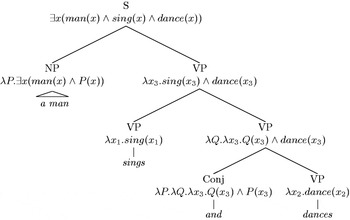
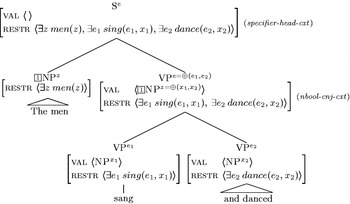
Technical differences aside, most accounts of VP coordination assume that conjuncts must necessarily share the subject (i.e. must have a ‘strict identity’ reading), as shown in Figure 2. This explains the observed subject–verb agreement and semantic interpretation.
Shared dependent identity.

However, in light of ambiguous examples like (22) above, I will revise the analysis of conjunction so that any dependents that are shared by conjuncts are either equated (‘strict identity’) or cumulated (‘weak identity’). The former yields the same result as in Figure 2 and the latter yields a kind of interpretation of which respectively readings are a subset. Fortunately, there is a simple operation that can succinctly capture all the relevant patterns: Link's ‘⊕’ sum operator. In order to model non-Boolean nominal conjunction, Link (Reference Link, Bauerle, Schwarze and Stechow1983) resorts to a sum relation ‘⊕’ interpreted as a join operator in a mereological domain:  x⊕y
 =x ⊔y . This definition does not rule out the possibility that x=y, in which case the sum does not yield a plurality. This follows from the fact that the join ‘⊔’ is idempotent (i.e. ∀x[x⊔x=x]).Footnote 10 Formally, Link's sum encapsulates exactly what is necessary to deal with the two readings of (22a), and consequently, the respectively readings in (22b). The proposed generalization is stated in (24) as a condition on the syntax–semantics interface of conjunction. In Section 3.5 I argue that (24) should be generalized to other kinds of dependencies.
(24) Shared Dependent Condition for Conjunction (informal)
Predication dependencies shared by conjuncts are combined via ‘⊕’.
I will formalize (24) by augmenting the semantic content of the conjunction and. For simplification, I assume that the semantics of conjunction only takes two conjuncts Q and P.Footnote 11 I thus propose the lexical entry in (25). Here, P[x 0, …, x n] and Q[y 0, …, y n] are two conjuncts with exactly n (n⩾0) free variables, each corresponding to a shared dependent. The variables corresponding to the shared dependents are combined via ‘⊕’.
(25) Conjunction (preliminary)
and : λP.λQ.λz 0…λz n. Q[x 0…x n]∧P[y 0…y n] ∧
z 0=(x 0⊕y 0) ∧…∧ z n=(x n⊕y n)
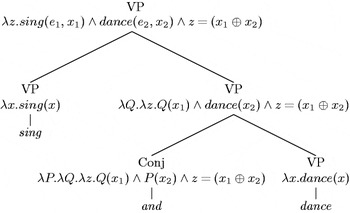
In VP coordination there is exactly one shared dependent: the subject. This means that the variables of the subjects selected by each of the VP conjuncts are combined via ‘⊕’. As a consequence, these variables are either equated or cumulated. If equated, both VPs predicate the same entity (‘strict identity’). If cumulated, each VP predicates a different part of the plurality (‘weak identity’). This is shown in Figure 3.
Non-deterministic dependent sharing.

If the obtained coordinate VP combines with a subject like Tom and Sue, we obtain the representation in (26). The arrow ‘↦β’ indicates beta-reduction.
(26) Tom and Sue sing and dance.
(λz.sing(x 1)∧dance(x 2)∧z=(x 1⊕x 2)) (t⊕s) ↦β
sing(x 1)∧dance(x 2)∧(t⊕s)=(x 1⊕x 2)
if x 1=x 2 then ‘⊕’ does not form a plurality and we obtain a reading where Tom and Sue are both agents of singing and dancing (i.e. z=x 1=x 2). Conversely, if x 1≠x 2 then ‘⊕’ is interpreted as a plurality-forming cumulation and we obtain a reading where t⊔s=x 1⊔x 2. Because ‘⊕’ is a symmetric relation, in the latter case it is not known whether t=x 1 and s=x 2 or if t=x 2 and s=x 1. This indeterminacy can be resolved by adding the adverb respectively. That is the adverb's function.
The account scales to other kinds of plural NP subjects, like (27). As before, if ‘⊕’ is interpreted as equality then all students sang and danced, and if ‘⊕’ is interpreted as a plurality-forming cumulation then some students sang while other students danced.
(27) Several students sing and dance.
(λP.∃x(student*(x)∧P(x)))
(λz.dance(x 1)∧sing(x 2)∧z=(x 1⊕x 2))↦β
∃x(student*(x)∧sing(x 1)∧dance(x 2)∧x=(x 1⊕x 2))
As discussed in Section 2.2, this falls short of being a true respectively reading because (27) does not allow the presence of the adverb respectively. There must be an independent ranking between denotata in order to obtain a true respectively reading. Out of the blue, (27) exhibits no such ranking, and therefore respectively is not allowed. Conversely, in cases like Robin and Kim are cousins. They live in Chicago and New York (respectively), an independent ranking is provided, and therefore the adverb can be used.
The bijection forced by the presence of the adverb respectively in sentences like Tom and Fred sang and danced holds between the atoms in the denotation of the plural NP and the eventualities denoted by the conjoined VP. I thus assume that verbs come with Neo-Davidsonian eventuality arguments, as argued by Kamp (Reference Kamp, Bäuerle, Egli and von Stechow1979), Partee (Reference Partee1984), Higginbotham (Reference Higginbotham1985), Bach (Reference Bach1986), Carlson (Reference Carlson1987), Krifka (1989b), Parsons (Reference Parsons1990), and Pustejovsky (Reference Pustejovsky1991), inter alia. Support for this comes from well-known evidence that events can be bound anaphorically, modified by a non-restrictive relative clause, distributed, compared, and intensified:
- (28)
(a) Fred stabbed Jones. It happened at midnight.
(b) Kim evaded the police, which is not an easy thing to do.
(c) John called every Monday.
(=‘For all past Mondays John called.’)
(d) I love you more than you love me.
(e) Fred is so going to jail.
If such eventualities exist, then their conjunction should also form a plural eventuality. This is empirically supported by the adverbials in (29), which predicate the conjoined plural eventuality. I thus follow Carlson (Reference Carlson1987: 540–542), Lasersohn (Reference Lasersohn1995: Chapter 14), Gawron & Kehler (Reference Gawron and Kehler2004) and many others in assuming that plurality-forming conjunction can operate cross-categorially: nominal conjunction yields a nominal plurality and predicate conjunction yields a plural eventuality.
- (29)
(a)
(b)
(c)
(d)




Accordingly, the conjunction in (25) above must be revised so that it forms a plurality with the denotata of the conjuncts. Drawing from Link (Reference Link, Bauerle, Schwarze and Stechow1983) and Krifka (Reference Krifka, Kálman and Pols1990), I adopt the conjunction in (30), where the α1 and α2 variables correspond to individuals or eventualities denoted by the conjuncts. If the conjuncts are verbal, so is the plurality, and if the conjuncts are nominal, so is the plurality. Nothing hinges on this particular formalization, however, as other approaches to conjunction like Lasersohn (Reference Lasersohn1995), Schwarzschild (Reference Schwarzschild1996), and Landman (Reference Landman2000) can be adopted instead.
(30) Conjunction (revised)
and : λP.λQ.λz 0 … λz n.∃α(α=(α1⊕α2)∧
Q(α1)[x 0 … x n]∧P(α2)[y 0, … y n]∧
z 0=(x 0⊕y 0)∧…∧z n=(x n⊕y n))
The revised conjunction in (30) allows VP conjunction to be modeled as shown in (31). The α variables are renamed as e for perspicuity. In (31a) we combine and with danced. In (31b) we combine sang with and danced. Note that a sum is formed with the denotation of the conjuncts, and the shared subject dependent is combined via ‘⊕’. Finally, in (31c) we combine Tom and Fred with sang and danced.
(31) [[Tom and Fred]NP [sang and danced]VP]S.
(a) (λP.λQ.λz.∃e(e=(e 1⊕e 2)∧Q(x 1)(e 1)∧P(x 2)(e 2)∧z=(x 1⊕x 2)))
λx.λe.dance(e, x))
↦βλQ.λz.(e 3=(e 1⊕e 2)∧Q(x 1)(e 1)∧dance(e 2, x 2)∧z=(x 1⊕x 2)
(b) (λQ.λz.∃e(e=(e 1⊕e 2)∧Q(x 1)(e 1)∧dance(e 2, x 2)∧∃z(z=(x 1⊕x 2)))
λx.λe.sing(e, x))
↦βλz.(e=(e 1⊕e 2)∧sing(e 1, x 1)∧dance(e 2, x 2)∧z=(x 1⊕x 2))
(c) (λz.∃e(e=(e 1⊕e 2)∧sing(e 1, x 1)∧dance(e 2, x 2)∧z=(x 1⊕x 2))) (t⊕f)
↦β∃e(e=(e 1⊕e 2)∧sing(e 1, x 1)∧dance(e 2, x 2)∧(t⊕f)=(x 1⊕x 2))
Exactly as before, the semantic representation obtained in (31) allows two distinct interpretations. If ‘⊕’ is interpreted as equality then we have the reading where each conjunct predicates the same plurality (i.e. (t⊕s)=(x 1=x 2)), and if ‘⊕’ is interpreted as a plurality-forming cumulation then we have a reading where each verb predicates a different individual (i.e. (t=x 1 & f=x 2) or (t=x 2 & f=x 1)). The same account deals with sentences like (32). Although the preferential interpretation conveys that both men sing and dance, there is also an interpretation where different men do different things.Footnote 12
(32) Two men sing and dance.
∃z(men(z)∧|z|⩾2 ∧
∃e(e=(e 1⊕e 2)∧sing(e 1, x 1)∧dance(e 2, x 2)∧z=(x 1⊕x 2)))
3.3 On the role of the adverb respectively
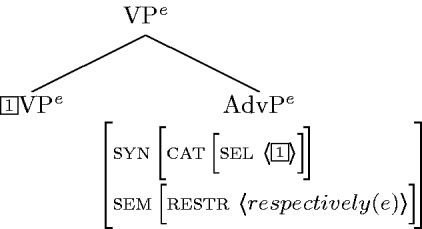
In this account, respectively is similar to other adverbs in that it simply adds restrictions to the semantics of the verbal structure that it adjoins to. It does not alter it in any way. Let us tentatively assume that this adverb is represented as in (33). The sentence in (34) can thus obtain the intended representation.
(33) respectively: λP.λx.λe.(P(x)(e)∧respectively(e)) (preliminary)
(34) Tom and Fred sang and danced respectively.
∃e(e=e 1⊕e 2∧sing(e 1, x 1)∧dance(e 2, x 2) ∧
(t⊕f)=(x 1⊕x 2))∧respectively(e))
The respectively reading only arises if ‘x 1⊕x 2’ is interpreted as a plurality-forming cumulation. In that case, each verb predicates a different referent. As before, this is the weak identity reading of the shared subjects. Let us assume that this sentence is true because e =e′1⊔e′2, where 〈e′1, t〉∊I(sing) and 〈e′2, f〉∊I(dance). Since the adverb respectively can access surface order, it can readily identify the rankings t≺f and e′1≺e′2. I use the relation ‘≺’ to mean ‘outranks’, in Kay's sense. The adverb can then detect the bijection {(e′1, t), (e′2, f)} by inspecting the tuples above (i.e. denoted by the verbs described by the plural eventuality e).
The adverb operates in basically the same way in sentences like (35). As discussed in Section 3.1, an independently motivated cumulative interpretation allows a reading where Tom loves Sue and Fred loves Mia.
(35) Tom and Fred love Sue and Mia respectively.
∃e (sing(e, t⊕f, s⊕m)∧respectively(e))
For example, assuming that e =e′1⊔e′2, where 〈e′1, t, s〉∊I(love) and 〈e′2, f, m〉∊I(love), then the rankings t≺f and s≺m allow the bijection {(t, s),(f, m)} to be evoked. The ‘love’ events denoted by e lack an independently established ranking, and therefore cannot enter any bijection. One can assume that existential closure applies to e in (35).
Now let us consider some negative examples. The sentence #A man smiled respectively is not felicitous because there is only one event and one individual participant. This follows from the fact that ‘≺’ is a relation (i.e. requires at least two entities). In (36), however, the oddness is caused by the absence of an independent ranking for the entities denoted by the subject and the predicate.
- (36)
(a) #The women smiled respectively.
(b) #Every man smiled respectively.
(c) ?#Each woman read a book respectively.
As discussed in Section 2.2, the same is true for #The students smiled respectively and #The students were pleased by their scores respectively. As Kay (Reference Kay, Hall, Meacham and Shapiro1989) correctly notes, The three best students received the three best scores respectively more readily elicits a contextually determined ranking and therefore can be felicitous.
I now turn to the adverb. This word combines with verbal expressions and predicates their eventuality variable, just like many other adverbials. The difference lies in the satisfaction conditions introduced by ‘respectively’. Put informally, (37a) states that ‘respectively’ construes two sets, X and Y. Set X contains all tuples describing an event e′, where e′⩽e. Here, e is the eventuality that the adverb predicates and ‘⩽’ is the event-mereological ‘part-of’ relation. Set Y is composed of all the pairs of entities occupying two fixed positions n and m in the tuples of X. Finally, Y must be a bijection according to a contextual ranking r, as defined in (37b). A ranking r is simply a set of contextually determined relations like ‘a 1≺a 2’. Although I omit rankings from (37b), I assume that they are established along the lines of Kay (Reference Kay, Hall, Meacham and Shapiro1989, Reference Kay, Horn and Ward2004) and Section 2.2.
- (37)
(a)
respectively(e)=1 iffX={τ: ∃P∃e′(τ∊I(P) & τ=〈e′ ,… 〉 & e′⩽
e )} &∃n∃m(Y={(p n, q m): =〈…, p n, …, q m, …〉∊X} &
Bij r(Y))(b)
Bij r (Y)=1 iff¬∃a∃b∃c(a≠b≠c & ({(a, b), (a, c)}⊆Y ∀ {(a, b), (c, b)}⊆Y))
For illustration, let us suppose that the sentence in (38) is true because 〈e 1, t〉∊I(sing) and 〈e 2, f 〉∊I(dance), for e =e′1⊔e′2. From the truth conditions in (37) it follows that X={〈e 1, t〉, 〈e 2, f)}, and from the surface order we extract the ranking t≺f and e 1≺e 2. This yields the bijection Y={(e 1, t),(e 2, f)}. The same analysis applies to These two men sing and dance, with the difference that the ranking is not due to surface order.
(38) Tom and Fred sang and danced respectively.
∃e(e=e 1⊕e 2∧sing(e 1, x 1)∧dance(e 2, x 2) ∧
(t⊕f)=(x 1⊕x 2)∧respectively(e))
Now let us consider cases without verbal conjunction. As described in Section 3.1, a cumulative quantification reading of These two boys love these two girls can be interpreted so that 〈e′1, b 1, g 2〉∊I(love) and 〈e′2, b 2, g 1〉∊I(love). By adding the respectively adverb we can felicitously obtain Y={(b 1, g 1), (b 2, g 2)} if there is a metalinguistically determined ranking b 1≺b 2 and g 1≺g 2. As discussed above, e′1 and e′2 are not sufficiently distinct and salient in order to establish an independent ranking. In multiple ‘respectively’ sentences like (39) (McCawley Reference McCawley1998: 294), there is a cumulative quantification reading of the verb which yields X={〈e 1, t, b, p〉, (e 2, m, l, g〉}. This allows one adverb to evoke Y={(t, b), (m, l)} and the other to evoke Y′={(b, p), (l, g)}.
- (39)
(a) Tom and Martha respectively sent a bomb and a nasty letter to the president and the governor respectively.
(b) Tom and Martha sent a bomb and a nasty letter respectively to the president and the governor respectively.
This analysis is also compatible with (11), repeated here as (40).
(40) While the relationship of the parties remains amicable, it is essential that an agreement be reached as to the costs that each party will respectively bear.
First, note that my account of raising will ensure that the verb bear predicates the subject referent each party and the object referent the costs.Footnote 13 Second, in order for the respectively reading to be felicitous, there must be a different event and a different cost for each party, and comprehenders must be able to conceptualize the respective rankings. This is possible because the eventuality e has narrow scope under the each party NP. Thus, for each party there will be a different ‘bear’ situation with a certain cost. One way to model the respectively reading of (40) is to assume that the adverb respectively has access to all assignments made to the eventuality variable e that it predicates. In this approach, the set X will contain the tuples formed by the various values for the e variable and for x and y that are relevant for the interpretation of the verb bear in the sentence. Consequently, set Y will contain pairs of costs and parties, which must form a bijection for the sentence to be felicitous, as usual, according to a pragmatically determined ranking.
There may be an alternative analysis, however. Schein (Reference Schein1993) and Kratzer (Reference Kratzer2003) note that quantifiers like every allow cumulative readings (e.g. Three copy-editors caught every mistake in the manuscript can have an interpretation where different editors caught different mistakes). A respectively reading like (40) would become unremarkable if each can have this kind of cumulative reading as well.
3.4 Other kinds of dependent cumulation with respectively readings
3.4.1 Inter-clausal dependencies
In (41) we have a respectively reading entangled with raising and control structures. The logical subject of help is the matrix subject, a fact which is independent from the respectively reading.
(41) Fred and Sue seem to want to help Kim and Mia (respectively).
Any account of raising and control should predict that the logical form of the lower verb is help(f⊕s, k⊕m), regardless of the existence of a respectively reading. Nothing more needs to be said because a cumulative quantification interpretation of help(f⊕s, k⊕m) as discussed in Section 3.1 suffices to obtain the respectively reading. I discuss an explicit account of raising and control in Section 4.2 in more detail, but it should be clear that any suitable theory of raising and control would obtain the intended representation.
A more serious challenge is posed by cases like (42), noted by an anonymous reviewer.
(42) Different newspapers are running conflicting reports. The Guardian and the Telegraph reported that Michael Phelps won the silver medal and the gold medal respectively.
The clause-embedded VP conjunction and the matrix subject somehow license a respectively reading, even though these two conjunctions are in different clauses and do not involve raising or control. It is not obvious how the Guardian and the Telegraph and the silver medal and the gold medal allow a respectively reading since there is no syntactic or semantic relationship between the former and the latter.
I suspect that an independent phenomenon is at work here, which creates the illusion that the respectively reading occurs across the clause barrier. It has long been argued that a ‘left-periphery ellipsis’ phenomenon (Ross Reference Ross1967, Sag Reference Sag1976, Neijt Reference Neijt1979, Hudson Reference Hudson1984, van Oirsouw 1987, Wilder Reference Wilder and Zwart1994) can partially omit conjuncts as illustrated in (43).Footnote 14
- (43)
(a) [Did Tom call Mary and did Mia call Sue]?
(b) The doctor [examined Mia on Tuesday and examined Tom on Friday].
(c) He [drinks coffee with milk at breakfast and drinks coffee with cream in the evening].
(d) Mary [talked about Monet on Wednesday and talked about Renoir on Thursday].
(e) Margaret [spoke to Mr. Wimble on Friday, and spoke to the Dean on Saturday].
(f) I [gave your brother a coloring book and gave a brand new bike to your sister].
In particular, Sag (Reference Sag1976: 357) and Beavers & Sag (Reference Beavers, Sag and Müller2004) assume that this ellipsis process can target clausal conjuncts if smaller ellipsis domains are not available for independent reasons. For example, world knowledge causes the parse in (44a) to be more likely than the one in (44b). The latter yields a strange reading where the same men die twice.
- (44)
(a) Two men died in Baghdad on Tuesday, and two men died in Tikrit on Friday night.
(b) Two men died in Baghdad on Tuesday, and died in Tikrit on Friday night.
Similarly, (45a) is preferentially interpreted to mean that there is a total of two trees because cut down is a ‘one time’ predicate. This effect vanishes in (45b) because photograph is not a one-time predicate.
- (45)
(a) Two oak trees were cut down by me in 1986, and by my wife in 1999.
(b) Two oak trees were photographed by me in 1986, and by my wife in 1999.
The latter sentence is compatible with both an elliptical S coordination reading where there is a total of four trees (like (44a)) and an elliptical VP coordination reading where there is a total of two trees (like (44b)). Crucially, ellipsis sometimes yields what looks like constituent coordination:
(46) Two men died in Baghdad on Tuesday, and two men died on Friday night.
For these reasons, it is at least plausible that the same phenomenon occurs in (42) above, and creates the illusion of ‘respectively’ spanning two different clauses. If so, then (42) becomes unremarkable, as illustrated in (47). This parse yields all that is needed for a respectively reading, via a cumulative quantification interpretation of believe (j⊕b, e 1⊕e 2).
(47) The Guardian and the Telegraph reported [[that Michael Phelps won the silver medal] and [that Michael Phelps won the gold medal]] respectively.
Let us consider some evidence in support of an elliptical analysis of (42). If ellipsis is at work then it should be able to license non-constituent remnants, as in (44a) and (45). This is consistent with (48).
(48) John and Bill believe that Tom gave a book to Sue and a magazine to Mia, respectively.
Second, if (42) is elliptical then it follows without further stipulation that the adverb can appear to be realized in a higher clausal position, to the left of the conjunction that it is semantically linked to. This is shown in (49), where the object coordinate phrase that ‘respectively’ must interact with is embedded in the clause.
(49) John and Bill [respectively [believed that Sue wanted to jog and walk]].
Note that this also dispenses any additional assumptions about the adverb being allowed to float to the left while combining semantically with the lower conjunction. Examples like (50) cast serious doubt on the adverb's ability to float out of its embedded clause.
(50) *I respectively believe that Tim and Sue love Fred and Mia.
Finally, if ellipsis is at work in (42) then it is possible to manipulate the sentence so that world knowledge can force an elliptical S interpretation, as in (44a) and (45a) above. Although such a sentence is necessarily complex and therefore difficult to process, this prediction seems to be borne out in (51), which can refer to two different coins being found, as opposed to the same coin being found twice (a less plausible interpretation).
(51) John and Fred claim that a coin was found in the kitchen on Monday and in the yard on Tuesday respectively.
I conclude that there is independent evidence supporting the hypothesis that (41) follows as a direct prediction of raising/control, and that (42) follows as a direct prediction of left-periphery ellipsis. Thus, these respectively reading data points are not different from the cases discussed so far. I direct the reader to the references given above for accounts of left-periphery ellipsis phenomena. In Section 4.2 I illustrate how an independent analysis of raising/control can interface with these respectively readings without further stipulation.
3.4.2 Across-the-board unbounded dependencies
It is generally assumed since the seminal work of Ross (Reference Ross1967) that an identity condition must hold between elements extracted across-the-board. For example, in It was Robin who Fred hugged and Mia kissed, it must be the case that the patient of hug and kiss is the same person, Robin. However, Postal (Reference Postal1998: 136, 160), Kehler (Reference Kehler2002: 125), and Gawron & Kehler (Reference Gawron, Kehler, Young and Zhou2003, Reference Gawron and Kehler2004) note that there are certain filler–gap constructions which show that this is not always the case. Consider the conjunction in (52), from Gawron & Kehler (Reference Gawron and Kehler2004: 193).
(52) I finally met Susan, Lyn, and Mary yesterday. They are the three sistersx⊕y⊕w that Bob hired_x, John promoted_y, and Bill fired_w.
There is an interpretation – possibly the most prominent one – where the patients of ‘hire’, ‘promote’, and ‘fire’ are the same (strict identity), and one interpretation where they are not (weak identity). The latter reading can be made more prominent by adding respectively. As before, I represent both readings of (52) via ‘⊕’, to mean that x and y are either identical or cumulate into a plurality.
In (53) I offer more examples of filler–gap constructions with comparable interpretations.Footnote 15 Some of these sentences, such as (53b, c, d), allow the presence of respectively and therefore correspond to what has been called a respectively reading.
- (53)
(a) Whatx⊕y did [Kim [eat_x and drink_y]]?
(b) Setting aside illegal poaching for a moment, how many sharksx⊕y do you estimate [[_x died naturally] and [_y were killed recreationally]]?
(c) The [shipsx⊕y that [[a U-boat destroyed_x] and [a Kamikaze plane blew up_y]]]] were the Laconia and the Callaghan.
(d) The housesx⊕y that [[the fire reduced to ash _x] and [the flood leveled down _y]] were near each other.
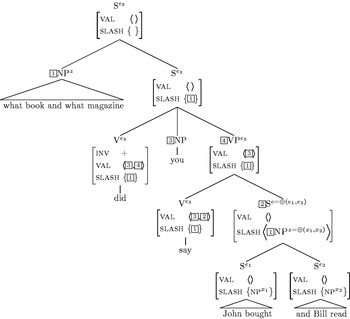
Postal (Reference Postal1998: 136) and Kehler (Reference Kehler2002: 125) also note data like (54), which Postal classifies as an interwoven dependency. I view these cases as falling in the same category as (53). All of these cases follow from the Shared Dependent Condition for Conjunction proposed in (24). Basically, any shared dependent is combined by ‘⊕’, even if extracted.
- (54)
(a) [[Which pilot]x and [which sailor]y]x⊕y will Joan invite_x and Greta entertain _y respectively?
(b) [[What book]x and [what magazine]y]x⊕y did John buy _x and Bill read _y respectively?
(c) [[How many frogs]x and [how many toads]y]x⊕y did Greg capture _x and Lucille train _y respectively?
The same applies to shared dependents that are realized to the right of their canonical positions, as in certain Right-Node Raising (RNR) constructions. Vergnaud (Reference Vergnaud1974), Abbott (Reference Abbott1976), Jackendoff (Reference Jackendoff1977), Gazdar (Reference Gazdar1981: 180), Postal (Reference Postal1998: 136, 178) and others noted cases of additive RNR like (55).
- (55)
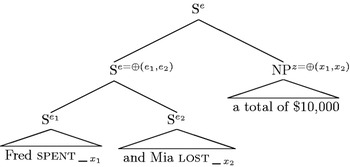
(a) Fred spent and Mia lost [a total of $10,000].
(b) John defeated and Mary lost to [very different opponents].
(c) Greg captured and Lucille trained [312 frogs between them].
(d) John hummed and Mary sang [the same tune].
(e) I know a man who lost and you know a woman who spent [a total of $10,000 between them].
Sentences like (55a) have at least two kinds of reading: one in which Fred spent and Mia lost the same amount of money (a total of $10,000), or one where the sum of the amounts lost and spent is $10,000. This may be modeled by ‘⊕’, as before. Since very different opponents in (55b) denotes a plurality, it forces the summation interpretation. Conversely, the same tune in (55d) forces the strict identity reading. The adverb respectively is not felicitous in these cases because the Right-Node-Raised constituent does not provide an explicit ranking. Compare with (58) below.
The semantics of additive RNR is similar to the cumulative readings in filler–gap dependencies in (52)–(54). In both cases the shared dependents are combined into a unique and semantically richer dependent. Carlson (Reference Carlson1987) and Sabbagh (Reference Sabbagh2007) assume that such readings only arise with relational/symmetric predicates, but examples like (55a) suggest that this is not always the case. Note that the additive reading in (55a) is still available even if a total of is omitted, although it is not the preferential interpretation. Other cases such as (56) provide further evidence that additive RNR does not require relational/symmetric predicates, and can in principle arise with any plural NP in a suitable context.
(56) Tom relocated to London, and Sue spent her summer in Paris. I can't imagine why Tom would move to and Sue would vacation in [two of the most expensive cities in Europe].
There are two kinds of evidence suggesting that additive RNR is due to the Shared-dependent condition for Conjunction. Like respectively readings, additive RNR readings only occur in plurality-forming conjunction structures. Hence, the disjunction in (57), based on Beavers & Sag (Reference Beavers, Sag and Müller2004, 66), only has a non-additive reading. The additive reading re-appears with and instead of either … or.
(57) Either Fred spent or Mia lost [$10,000].
(=‘Either Fred spent $10,000 or Mia lost $10,000.’)
Second, like the leftward extraction cases in (54), additive RNR allows respectively readings. This is shown by (58), from Postal (Reference Postal1998: 136, 178), Gawron & Kehler (2003) and Abels (Reference Abels, Moulton and Wolf2004), respectively. These readings should follow naturally if RNRaised dependents are allowed to be cumulated by ‘⊕’ just like any other dependent.
- (58)
(a) Ernest sold cocaine and George sold heroin [to the first nurse and to the second dental assistant] respectively.
(b) I bought travel guides for Paris and London yesterday. Mary vacationed and Bill decided to live [in these two cities] respectively.
(c) Mary vacationed and Bill decided to live [in the two most expensive cities in Europe] respectively.
3.4.3 Adnominal dependencies
Another construction which arguably also exhibits cumulation of shared dependent phrases is illustrated in (59). Such data were first noted by Ross & Perlmutter (Reference Ross and Perlmutter1970), Hintikka (Reference Hintikka1974), and McCawley (Reference McCawley1998: 771).
- (59)
(a) A manx entered the room and a womany went out [who were quite similar]x⊕y
(b) A manx entered and a womany left [who had met in Vienna]x⊕y
(c) *A man entered or a woman left who were quite similar.
Here, a relative clause is simultaneously linked to the subjects of the preceding conjoined clauses. Like all the other cases discussed so far, such readings are not possible with logical disjunction and involve a shared dependent that is interpreted cumulatively.
If shared dependent cumulation is responsible for both split–antecedent relative clause readings and respectively readings then one would expect them to be able to co-occur in the same structure, all things being equal. This prediction is borne out in (60).
(60) A man entered the room and a woman left who were Dutch and Greek, respectively.
Something similar happens when adnominal adjectival phrases conjoin, and share the nominal head that they select. The conjunction of singular adjectives can yield an adjectival phrase capable of modifying a plural nominal. This was already seen in the attested data point in (13b) above, which I repeat here as (61).
(61) We know houses four and five are the Swede and the German, but which is which?
This phenomenon is not obvious in English because of the lack of number agreement, but it can be more readily observed in languages which require adjectives and nouns to agree in number overtly. Consider for example (62) and (63), from European Portuguese, where the conjunction of two singular adjectives yields a phrase that can adjoin to a plural nominal. In general, it is not possible for a singular adjective to combine with a nominal without number agreement (e.g. *os chás preto).
(62) Os chás preto e verde são obtidos da mesma planta.the.pl teas.pl black.sg and green.sg are.pl obtained.pl from same plant‘The black and green teas are obtained from the same plant.’
(63) O Carlos e o Manuel foram respectivamente os segundo e quarto classificados.the Carlos and the Manuel were respectively the.pl second.sg and fourth.sg ranked-participants.pl‘Carlos and Manuel came in second and third place respectively.’
These data are consistent with the Shared Dependent Condition for Conjunction. Since the two conjoined adjectivals select a nominal dependent, the latter should be shared via ‘⊕’. The plural eventuality formed by the conjunction of adjectival predicates is a plurality that respectively can exploit in the usual way.Footnote 16 Further examples of this pattern are in (64).
- (64)
(a) The average lifespan was between [[zero and one] [years old]].
(b) Kowal discovered the [[13th and 14th] [moons of Jupiter]].
(c) I read the [[second and third] [chapters of your book]].
(d) The production of carbon and nitrogen will peak on [days [six and seven]].
(e) Bart and Lisa are [players [three and four]].
Sentence (64a), for example, shows that by conjoining one with zero one obtains a phrase that can now combine with a plural noun. This contrasts with *one years old, which is ungrammatical because one must combine with singular nouns. Each conjunct is predicating a different day, and hence seems to involve shared dependent cumulation. As is expected, the adverb respectively can be felicitously added, e.g.:
(65) The production of carbon and nitrogen will peak on days six and seven, respectively.
In conclusion, a wide range of phenomena suggests that shared dependents can be semantically combined via summation, and that this mechanism can yield so-called respectively interpretations as a special case, which can be forced by the overt realization of the respectively adverb, in case there is a pragmatically available ranking.
4. A Head-driven Phrase Structure Grammar account
Postal (Reference Postal1998: 160–163) and Gawron & Kehler (Reference Gawron and Kehler2004: 194, 195) argue that respectively phenomena pose foundational problems for current theories of grammar, especially for unification-based theories like Head-driven Phrase Structure Grammar (HPSG; Pollard & Sag Reference Pollard and Sag1994). However, the account proposed above suggests that these foundational problems have been overstated. In what follows I show that HPSG can model the relevant phenomena without any major changes to how subcategorization and predication are usually lexically coupled. I will, however, revise how subject–verb agreement is enforced. All else will follow from the grammar of coordination. In Section 4.1 I present the basic foundations of HPSG as outlined in the construction-based approach in Sag (Reference Sag2010a, Reference Sag, Boas and Sagb), and in Section 4.2 I show how the grammar fragment scales up to respectively phenomena. The cumulative quantification phenomena discussed in Section 3.1 are dealt with at the level of semantic interpretation and therefore will not be discussed here.
4.1 Basics
Head-driven Phrase Structure Grammar is a theory of grammar where phonology, syntax, semantics, and pragmatics co-exist locally in the same kind of linguistic structure, called a sign. Central to this non-derivational theory is the notion of constraint satisfaction (Carpenter Reference Carpenter1992). The grammar rules (which I interchangeably refer to as constructions) are nothing more than declarative statements that impose constraints about linguistic structure, rather than operations that alter, compare, or displace previously assembled representations. The information conveyed by a sign is encoded as sets of features. The feature phon encodes phonology, syn encodes various kinds of syntactic information (including part-of-speech, agreement, case, and subcategorization constraints), and sem contains semantic representations. Signs can be of type word or phrase. The sign for the proper name Tim is given in (66).
(66)

Valency is recorded in a list-valued feature val, which in this case is empty (i.e. 〈 〉). The empty set value for slash means that there are no extracted dependents. Semantics is represented as a list of restrictions restr containing predications. For exposition purposes I adopt the ‘flat’ semantic formalism of Copestake et al. (Reference Copestake, Flickinger, Sag and Pollard2005) and ignore the treatment of quantifier scope, but nothing hinges on this.Footnote 17 From now on I use the symbol ‘NP’ as a shorthand for a feature structure description of a nominal sign with an empty valence list, as in (67). Hence, NPx is nothing but a nominal sign that has empty valence and a referential index x.
(67)
Lexical entries and grammar rules are partial descriptions of linguistic structure. For example, the verbs in (68) require a valent with nominal part-of-speech, empty valence, and a referential index, but say nothing about the phonology or semantic representation of that valent.
(68)
Any sign that satisfies the stated constraints will do. Drawing some inspiration from Kathol (Reference Kathol, Levine and Green1999), I assume that verbal morpho-syntactic agreement information is appropriate for the type verb. Hence, the verb form in (68a) is underspecified and can combine with any kind of subject (e.g. I/You/He/They left), whereas (68b) can only combine with third person singular subjects. The two occurrences of x indicate that the two indices must be unified. In other words, the variable contributed by the subject NP is exactly the same as the variable predicated by the verb; the two are inextricably identified in the lexical entry in (68). In general, variable binding is ensured lexically in HPSG: predicates directly link their logical arguments to the variables of their valents. This is one of the aspects of unification-based grammar that Gawron & Kehler (Reference Gawron and Kehler2004) identify as problematic for respectively readings.
Everything in the grammar is uniformly represented with features, and syntactic trees are no exception. This is shown in Figure 4. The feature mtr encodes information about the mother node and the list-valued feature dtrs encodes information about the daughters of the construction. I use the tree notation when talking about structures licensed by the grammar, and reserve the feature matrix notation when talking about the grammar.
A feature structure representation of a tree.

As (69) shows, VP is shorthand for a verbal sign that seeks an NP, and an S is shorthand for a verbal sign with empty valence.
(69)
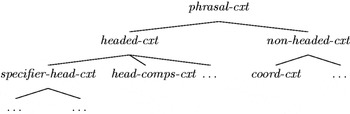
All grammar rules are of the form τ⇒φ, where τ is a type and φ is a set of features that any entity of the type τ must satisfy. These rules can capture varying degrees of generalization because they are hierarchically organized. Any piece of linguistic information of a given type τ must not only satisfy any rule of the form τ⇒φ, but also every rule τ′⇒φ′, where τ′ is a (direct or indirect) supertype of τ. For example, consider the type hierarchy of phrasal rules in Figure 5. The constructions (cxt) in this fragment are phrasal, and can be either headed or non-headed. I view coordinate structures (and perhaps certain comparatives) as a non-headed constructions, but nothing hinges on this as far as this work is concerned.
Top nodes of the hierarchy of phrasal constructions.

For now, let us focus on the rules governing headed constructions, i.e. the types subsumed by headed-cxt in Figure 5. The head-comps-cxt type in Figure 5 models phrases formed by a lexical head and its complements, and the specifier-head-cxt models structures formed by a specifier and a head. Other rules will model adjunction constructions, and so on. The feature hd-dtr, which is only appropriate for headed constructions, is used to identify which of the daughters is the head. Throughout, I use X, Y, Z as variables over feature structures and L as a variable over lists of feature structures. The specifier-head-cxt construction allows a head phrase to combine with a specifier, as seen in (70).
(70) Specifier–Head Construction
The notation X:φ means that the variable X describes a feature structure with at least as much information as the feature structure description φ. Note that (70) is silent about semantics, part-of-speech, or phonology. This rule simply imposes (partial) syntactic constraints on a local tree, by stating that a construction of the type specifier-head-cxt can be formed by a sign X and a head that selects X as a valent. The resulting mother node has empty valence (i.e. [val 〈〉]), like the one shown above in Figure 4.
Following Malouf (Reference Malouf2000) and Sag (Reference Sag2010a), I assume that the type specifier-head-cxt has various subtypes, each capturing specific grammatical patterns for different specifier–head constructions. For example, Malouf (Reference Malouf2000: 15) models different case assignment patterns for gerund clauses with three different subtypes of specifier-head-cxt: an accusative subject rule deals with clauses like (71), a possessive subject rule deals with (72), and a nominative subject rule deals with cases like (73).
(71)
(a) Pat disapproved of [[me] [quietly leaving before anyone noticed]].
(b) Everyone was impressed by [[Pat] [artfully folding the napkins]].
(72)
(a) Pat disapproved of [[my] [quietly leaving before anyone noticed]].
(b) Everyone was impressed by [[Pat's] [artfully folding the napkins]].
(73)
(a) [[He] [wears a tuxedo]].
(b) I insist that [[Sandy] [leave me alone]].
(c) [[Pat] [artfully folded the napkins]].
There are at least four other kinds of specifier–head construction that have their peculiar syntactic, semantic, pragmatic, and prosodic conditions. First, we have ‘Mad magazine’ sentences (Akmajian 1984), such as (74), which have a number of idiosyncratic properties that can be naturally captured constructionally (e.g. they cannot be embedded, their subject must be accusative, and the they never include tense, modals, and sentential adverbials).
(74)
(a) [[Him] [wear a tuxedo]?! (Sure.)
(b) [[My boss] [give me a raise]]?! (Ha.)
(c) What! [[Larry] [be a doctor]]?
Second, consider absolute constructions like (75), which also differ from (71) in several ways: the preposition with is required, does not have an NP distribution, adjoins to a clause, and has variable semantic connectivity with the matrix (Stump Reference Stump1985, Culicover & Jackendoff Reference Culicover and Jackendoff2005).
(75) With [[him] [organizing things]], we'll never get anything done.
Third, structures like (76) appear to be a kind of specifier–head fragment construction with an accusative subject.
(76) Tom: I'd like to see that movie.
Kim: [[Me] [too]].
Finally, directive and imperative sentences like (77) allow optional non-first person subjects (but are only compatible with second person reflexive objects), and come with special pragmatics and intonation.
(77)
(a) [[You] [leave me alone]]!
(b) [[Everyone] [seat yourselves/*themselves]]!
The above subtypes of specifier-head-cxt can be modeled by the hierarchy in Figure 6. Each type can introduce particular syntactic, semantic, pragmatic and prosodic constraints. For example, nom-subject-pred-cxt corresponds to the rule in (78) below, which licenses structures formed with a nominative subject phrase and an agreeing finite verbal head phrase. Since nom-subject-pred-cx is a subtype of specifier-head-cxt, it inherits all its constraints: the specifier sign is required to be the only member of the head's val, and the mother's val list is empty.
Hierarchy of specifier–head constructions (extending hierarchy in Figure 5).

Departing from Pollard & Sag (Reference Pollard and Sag1994) I propose that subject–verb agreement is computed at the phrasal level rather than lexically, as shown in (78), similarly to Sag, Wasow & Bender (Reference Sag, Wasow and Bender2003: 102).
(78) Nominative Subject–Predicate Construction
Basically, this rule ensures that whatever is the agreement information X in the VP daughter, it must unify with the information in the nominative subject daughter. The Headed Construction discussed below will ensure that the agreement specifications the verb's cat are percolated to its phrasal projections. Finally, the Coordination Construction in Section 4.2 will require that the conjuncts and the mother have the same cat value, and therefore, verbal conjuncts shall impose the same agreement specifications on their shared dependents.
Although the headed constructions in Figure 5 are different, they also have similarities which can be captured by the head-cxt supertype. For example, the Headed Construction in (79) ensures that for any headed construction the syn information of the head daughter and of the mother are the same, by default (see Ginzburg & Sag Reference Ginzburg and Sag2000: 33). The default constraint ‘/’ ensures that the features X of the head daughter and of its mother are identical, except if explicitly contradicted by the application of other rules. Thus, (70) does not allow the head daughter and the mother to have the same val information in specifier–head constructions, but does allow them to have the same part-of-speech. Thus, a VP projects an S, an N′ projects an NP, and so on.Footnote 18
(79) Headed Construction
Some rules are even more general and apply to all phrasal types in Figure 5, not just to headed constructions. One example is the semantic composition rule in (80), which states that the semantic content of the mother of any phrasal structure is the concatenation of the semantic contents of the n daughters. The ‘o’ symbol denotes list concatenation.Footnote 19
(80) Principle of Compositionality
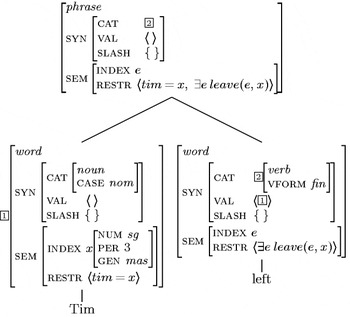
The cumulative effect of all of these constraints is shown in Figure 7. As mentioned above, whenever the grammar requires two features to have the same value, the result is unification (or more accurately, structure-sharing, since in model-theoretical grammar there are no procedural operations). In the linguistic structures licensed by the grammar constraints, unification is represented via multiple occurrences of a boxed tag, such as the 1 in Figure 7. This states that the specifier-head-cxt has identified the valent subcategorized by the head with the non-head daughter.
Representation of the sentence [[Tim]NP [left ]VP]S.

Consider now how complementation constructions are modeled. A head–complement rule allows any lexical head to combine with its lexically subcategorized complements (i.e. the more oblique valents X 2, …, X n) as determined by (81).
(81) Predicational Head–Complement Construction
Note that nothing is said about the semantics or part-of-speech of the daughters or of the mother node. Any word with a non-empty valence can instantiate the head Y and impose the relevant lexically specified constraints on the X valents. The Headed Construction in (79) interacts with this rule and makes sure that the mother and the head daughter Y have the same cat information.
Following Pollard & Sag (Reference Pollard and Sag1994), a subject raising verb like continue lexically selects an infinitival VP complement and shares with its subject valent X. The infinitival auxiliary verb to is also a raising verb and therefore also shares the subject valent with its (base form) VP complement. The analysis of subject control verbs like want is similar in that the verb lexically selects a base form VP and shares with it the same subject index. The lexical entires for these verbs are shown in (82).
(82)
Semantically, want embeds the meaning of the complement VP phrase, labeled by l 1. The two verbs differ in that continue does not assign any semantic role to its subject. Thus, the subject variable of help in (83) is bound to the subject variable of every dominating verb up to the matrix verb continue, and cumulative quantification can then apply to help(e, x, y) as discussed in Section 3.1 above, and yield the intended respectively interpretation.
(83) Fred and Sue continue to want to help Kim and Mia (respectively).
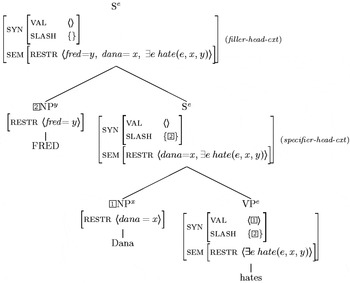
Let us now turn to how unbounded filler–gap dependencies are modeled in HPSG.Footnote 20 Basically, certain lexical constraints allow valents to be located in slash rather than in val. The values of slash are percolated to the mother node by the Headed Construction in (79), since slash is a syn feature. This is why the dependency is unbounded, and can be iterated indefinitely. The percolation of gaps can be interrupted only by certain constructions, namely those that impose constraints on the value of slash. One such construction is the topicalization construction, shown in (84), in which some sign X is realized as a sister of the head clause that contains the corresponding gap.
(84) Filler–Head Construction
Other gaps (if any) are percolated to the mother, via the remainder set Y. The effect of this headed construction is illustrated in the topicalization sentence in Figure 8. For exposition purposes I abbreviate cat information.
A topicalization construction.

4.2 Conjunction and respectively
For the analysis of verbal coordination I assume a familiar binary branching rule like X→XX, which I formalize in HPSG terms as (85), drawing from Beavers & Sag (Reference Beavers, Sag and Müller2004). I leave open the possibility of revising this rule as proposed in Sag (Reference Sag, Kim and Wechsler2002) in order to generalize to other categories, and to deal with coordination of ‘unlike categories’ phenomena.Footnote 21
(85) Verbal Coordination Construction
This construction allows two verbal constituents to be coordinated as long as they have compatible cat values and first daughter is not marked with a coordinator (i.e. bears the specification [crd–]), and the second daughter is marked with a coordinator (i.e. bears [crdcrd-marked]). I assume that the crd-marked type has several subtypes, one for each kind of coordination marker. Thus, the lexical entry for and is lexically specified as [crdconj], the entry for disjunction or is lexically specified as [crddisj], and so on. Since the mother node in (85) is underspecified for the value of crd, this rule can apply recursively as intended.
There are various types of coordination, often with special syntactic, prosodic, semantic and pragmatic characteristics. To give some well-known examples, consider packaging conjunction (e.g. Eggs, cheese and bacon was all I needed), numeral conjunction (e.g. I counted five hundred and twenty-two cats), arithmetical conjunction (e.g. Two and two is four), conditional conjunction (e.g. Take one more step and I'll shoot you where you stand), and intensification conjunction (e.g. The sound became louder and louder), among others like Boolean conjunction, and plurality-forming non-Boolean conjunction (Tom and Mary agreed, You can't simultaneously drink and drive, Kim rarely sings and dances, or Robin read the newspaper and dried her hair in exactly twenty seconds). These and other coordination patterns can be modeled with a type hierarchy of constructions in which each type introduces the specific constraints associated with that kind of coordination.
In this work I focus on non-Boolean conjunction, and on the formalization of the Shared Dependent Condition for Conjunction. In order to describe sum indices in HPSG, I view ‘⊕’ as the function defined in (86).
(86) ⊕(x, y)=z iff
z =(x ⊔y )
Plurality-forming conjunction must create a plurality from the denotation of the conjuncts. This is done by taking the indices α1 and α2 of the conjuncts and combining them via ‘⊕’. Similarly, the referents of every sign selected by the conjuncts must be combined via ‘⊕’. This is formalized in (87), which generalizes to any number m of shared dependents.Footnote 22
(87) Non-Boolean Conjunction (m⩾0)
In this work I focus on the instances of v-coord-cxt which are also subtypes of nbool-cnj-cxt. Obviously, other kinds of verbal coordination do not form a plurality (e.g. Boolean coordinations like It is not raining and it is not snowing or disjunctions like I can sing or dance).
The current grammar thus licenses structures like the one in Figure 9, with the semantics ∃z(men(z)∧z=(x 1⊕x 2)∧sing(e 1, x 1)∧dance(e 2, x 2)). If x 1⊕x 2 is interpreted as equality then x 1=x 2 and therefore the men are both singing and dancing. However, if x 1⊕x 2 is interpreted as a sum then x 1≠x 2 and we obtain a reading where the men singing and dancing are different. This interpretation is consistent with the adverb respectively. Whereas Gawron & Kehler's (Reference Gawron and Kehler2004) account obtains these readings from different syntactic trees and different semantic representations, the present account does not. In fact, both strict and weak identity readings are the result of a single tree structure and a single semantic representation.
Valent sharing in conjunction: The men sang and danced.

A sentence like (88) is modeled in the same way, the only difference being that the subject is an i-sum rather than a plural.
(88) Sue and Karen sing and dance.
z=(y 1⊕y 2)∧sue=y 1∧karen=y 2∧z=(x 1⊕x 2)∧ sing(e 1, x 1)∧dance(e 2, x 2)
This can be interpreted with or without a respectively reading because of ‘⊕’. Moreover, if z is a plurality then by the symmetry of ‘⊕’ it follows that either y 1=x 1 and y 2=x 2, or that y 1=x 2 and y 2=x 1.
Instances of respectively readings involving filler–gap dependencies like Which book and what magazine did you say that John bought and Bill read? and others discussed in Section 3.4.2 are captured in a very similar way, as shown in Figure 10. The only difference is that the dependents that are shared and summed are extracted signs rather than signs in situ. For simplicity, I omit the semantic representation but it should be clear that the verbs bought and read predicate x 1 and x 2 respectively, and that the two variables are combined via ‘⊕’ at the conjunction node. The signs in slash percolate in the tree as a consequence of the Headed Construction. Exactly as before, if ‘⊕’ is interpreted as equality then z=(x 1=x 2), but if it is interpreted as plurality-forming cumulation then z is a plurality formed with x 1 and x 2. For an account of interrogative and subject–auxiliary inversion constructions see Ginzburg & Sag (Reference Ginzburg and Sag2000) and Sag (Reference Sag, Boas and Sag2010b).
Gap sharing in an across-the-board extraction construction.

The adverb respectively operates essentially like any other verbal modifier, syntactically and semantically. The feature sel(ect) allows modifiers, determiners and markers to lexically impose constraints on the heads that they combine with. Such structures are modeled via the head-functor-cxt provided in (89).Footnote 23 Since this rule does not impose any constraints on the mother node, the Headed Construction will force all the syntactic features of the head and the mother to be identical.
(89) Head–Functor Construction
The lexical entry for respectively is provided in (90), and consists of an adverb that selects a verbal head via sel and predicates the verb event.
(90)
Note that since no constraints are imposed on val, the verbal head can be a verb phrase or a sentence, coordinate or not. Figure 11 illustrates how (90) and (89) interact. I omit some features for exposition purposes. The adverb is interpreted as in Section 3.3.
Generic example of adverbial adjunction.
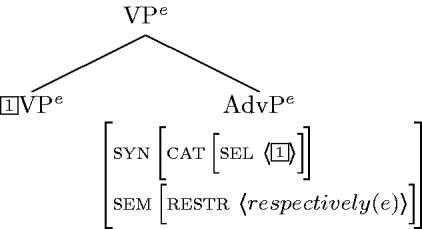
If we revise the conjunction rule in (4.2) so that the sign in sel that conjuncts share is combined via ‘⊕’ then we obtain an N′ like the one in (91) and the respective semantic representation. The analysis is shown in Figure 12, and is parallel to what happens to shared dependents recorded in val and slash as discussed above.
(91) The event will take place between [days six and seven]N′
days(z)∧∃s 1order(s 1, x 1)=6∧∃s 2order(s 2, x 2)=7∧
s=s 1⊕s 2∧z=x 1⊕x 2
Conjunction of adnominal expressions.

Basically, when adjuncts are conjoined any sign selected via sel is combined via the ‘⊕’ relation. It is trivial to revise the conjunction rule in (87) to achieve this effect on sel values.
A similar approach can be adopted for shared dependent cumulation in RNR and in split–antecedent relative clause extraposition, as discussed in Section 3.4.2. There are several alternative analyses of RNR and Extraposition, which I cannot discuss because of space limitations (but see Chaves Reference Chaves2012a). My goal here is to suggest that Right-Node-Raised shared dependents are also subject to the shared dependent cumulation phenomenon: any signs selected as dependents by each of the conjuncts are combined via ‘⊕’, as shown, for the example in (55a) above, in Figure 13.
If ‘⊕’ is interpreted as equality then we obtain standard non-additive RNR (the strict identity reading, where the total of money under discussion is $20,000). If ‘⊕’ is interpreted as plurality-forming cumulation then we obtain the additive RNR cases (the weak identity reading, where the total of money is $10,000). I suspect that there are various kinds of RNR construction, and that the kind illustrated below is essentially across-the-board rightward extraction, along the lines of Gazdar (Reference Gazdar1981); see also Chaves (Reference Chaves2011). The adverb respectively can adjoin to the coordinate Se and evoke a bijection as usual, provided that there is a ranking established by surface order. In the case of Figure 13 no such ranking is possible and therefore the presence of ‘respectively’ is not felicitous. If a ranking can be established, however, we obtain cases like (58) above.
Right-Node Raising.

5. Conclusion
This paper has argued that respectively readings are the consequence of two independently motivated phenomena and that the role of the adverb respectively is not to alter previously assembled semantic structures, but rather, to add constraints on the semantics of the adjoined phrase. The adverb is best viewed as a contextual operator in the sense of Kay (Reference Kay, Hall, Meacham and Shapiro1989), whose function is to single out one-to-one mappings according to an independently established contextual ranking. Access to such rankings is also available to other expressions like the former, the latter and in that order. I have proposed that two completely distinct and independently motivated phenomena can yield certain interpretations which are compatible with the presence of the adverb respectively. Some respectively readings follow from a phenomenon usually called cumulative quantification (Scha Reference Scha, Groenendijk, Janssen and Stokhof1981), and others arise from conjuncts cumulating their shared dependents. The generalization underling the latter cases is encapsulated by the Subject Dependent Condition for Conjunction, which states that the i-sum operation independently proposed by Link (Reference Link, Bauerle, Schwarze and Stechow1983) to model non-Boolean conjunction is also relevant for modeling how dependents shared by conjuncts are semantically integrated. In this view, respectively readings are but special cases of a wider range of independently motivated interpretations. As far as I am aware, this is the only analysis in the literature which explains why respectively readings can arise without the overt realization of the adverb.
The proposed analysis is more parsimonious than its predecessors in two crucial ways. First, sentences have the same syntactic and semantic structure regardless of the respectively reading. Second, there is no need for a radical decoupling between subcategorization and predication. Predicates can directly predicate the referents of the dependents that they select. This is achieved without resorting to non-monotonic operations that disrupt the tight connection between syntax and semantics, and extends to complex cases that involve filler–gap dependencies, extraposition, adjunction, and Right-Node Raising. As a consequence, respectively readings can be straightforwardly modeled by unification-based grammar without the foundational problems raised by Postal (Reference Postal1998) and Gawron & Kehler (2004). Finally, this account can model certain respectively readings involving singular NPs, which previous accounts predict to be ungrammatical.
 -syntax: A study of phrase structure.