

Long-term post-excavation preservation of artifacts is often one of the greatest challenges in archaeological projects, especially those with limited funding. Insufficient resources are common, and projects often do not initially budget for adequate long-term curation facilities. Instead, many resort to existing infrastructure that either is poorly constructed or lacks local stewards trained in ethical and scientific curation standards. Furthermore,the concept of curation standards can vary in meaning and importance depending on region or collection. Small Caribbean or Central American countries such as Belize often do not provide the adequate financing required for research and antiquity preservation. Solutions are tenuous when it comes to the recurring issue of foreign researchers short on funds for proper continued curation. Local financial realities are another issue because they often do not even come close to covering the funding necessary to conduct the work. Such issues are a reality throughout the wold, and here we offer solutions and stress the importance of budgeting for and ensuring the safe conservation of materials excavated from archaeological sites.
There are many examples of once-forgotten private collections or collections in disrepair (MacFarland and Vokes Reference MacFarland and Vokes2017; Voss Reference Voss2012). It is important that we, as historians, archaeologists, and anthropologists, bring our expertise to these collections and salvage what we can from those lost rooms and boxes, whether they contain artifacts, documents, or even human remains. In the example of human remains, the need for ethical treatment and curation is imperative : these were once living human beings whose remains deserve far better than to be lost to time in a box in a closet (Cassman et al. Reference Cassman, Odegaard and Powell2008).
A private collection revisited in the summer of 2016 at St. John's College in Belize City, Belize, is a textbook example of the challenges faced when provenience is lost,. The assemblage is an extensive combination of biological specimens, objects of material culture from the ancient Maya, and human remains with unknown provenience. The authors discuss their process to reconstruct the broken history of the collection, and while care and indexing of the collection as a whole is underway, the curation of the human remains are the primary focus of this article.
The St. John's College (SJC) collection proves difficult for a number of reasons: First, over the course of three decades of abandonment, the collection has fallen into substantial disarray. Second, the collection represents nearly 2,000 years of prehistory and history, from ancient Maya through the Colonial periods, and much of it lacks records and discernable provenience information. Third, it remains unclear which artifacts were actually excavated by archaeologists, which might have been looted, and the extent of a collection assembled by a seemingly enthusiastic private collector. These issues make this case study particularly pertinent within a larger discussion of ethics in collection management.
FR. LEONARD DIECKMAN AND THE ST. JOHN'S COLLECTION
Founded in 1887, St. John's College is one of the oldest educational institutions in Belize. It was founded in the region known as British Honduras (named Belize in 1973) by the Society of Jesus in England; its province in St. Louis, Missouri, is a substantial donor to this day. As part of their involvement in Belizean education, the Jesuits have made substantial contributions to the fields of anthropology and history. During the late 1970s, Fr. Richard Buhler helped to establish the widely circulated and recognized academic journal Belizean Studies. Though now out of print, the journal highlighted all things Belizean: culture, history, society, economy, and politics. Belizean Studies asserted its legacy in the country's history and has featured articles on artifacts stored in the collection discussed here (Boxt Reference Boxt1984; Healy and McKillop Reference Healy and McKillop1980; McKillop Reference McKillop1985). This collection is referred to as the SJC collection, and Fr. Leonard E. Dieckman is identified as the primary person responsible for storing, cataloging, and curating it from the 1980s to the early 2000s.
Fr. Dieckman came to Belize as a young Jesuit in 1964 to teach at St. John's College. An enthusiast of anthropology, archaeology, and biology, he was arguably the only individual in the country to have held such a large private collection of biological specimens and artifacts at that time. The collection is classified as private because there seems to be little evidence that Dieckman received any significant institutional support except for the space to house it on the SJC Landivar campus.
Fr. Dieckman was a science teacher for 36 years (1964–2000) at the high school and junior college at St. John's College. He taught chemistry at the high school and ecology at the college. He was also a founding member of the Belize Audubon Society. In May 2000, he and longtime friend and fellow enthusiast Alice M. Craig created an exhibit at the Image Factory Art Foundation in Belize City. Eclectic featured an array of items: human remains, ancient and historic archaeological material culture, and coral collections (Yasser Musa, personal communication 2016).
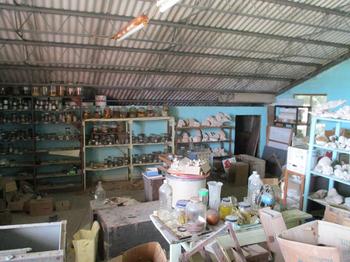
Before and after his retirement, Dieckman used the SJC collection as teaching material. In and out of professional circles, Dieckman and his collection were well-known. However, after Dieckman's death in 2003, no effort was made to provide stewardship for the collection, and it quickly deteriorated in the tropical environment, forgotten and falling into disrepair. The disordered nature of the collection as it exists today (Figure 1) is evident in its storage room: the wooden shelves are rotting; the cupboard storage boxes are torn, and their contents have fallen; and the room is severely infested with rodents, bats, lizards, nesting birds, and other small animals.
East-facing view of the Dieckman collection at St. John's College. The human remains were stored near the window. Photo by Quiroz, July 2016.

The complete inventory of this collection is yet unknown because a review of Dieckman's notes has so far been inconclusive, and restabilizing the collection by the authors and the faculty at SJC has only just begun. A brief survey of the room indicated a wide variety of artifacts, from precontact Maya objects to Belize's early European settlement and occupation of the seventeenth century and through the eighteenth, nineteenth, and twentieth centuries. Examples of Maya artifacts we observed include ground stones, stone tools of various styles and utility, boxes of ceramic sherds and reconstructed ceramic vessels spanning Maya civilization, obsidian, ceramic figurines, lithic eccentrics, and modified faunal remains. Boxt (Reference Boxt1984) acknowledged St. John's College for assisting him with the safe storage of materials from his excavations on that site, but he did not elaborate on what types of artifacts were stored at SJC or the long-term conservation plan for the excavated materials. Some of the colonial material observed in this collection include a wide range of glass bottles, what appear to be burial headstones and other architectural pieces, and various miscellaneous artifacts.
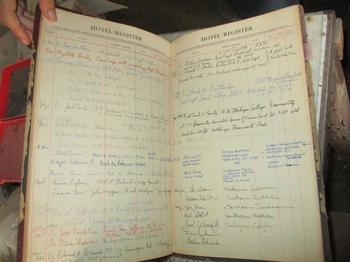
There are many biological specimens in Dieckman's collection. Shelves hold faunal bone, fleshed faunal specimens (reptiles and amphibians) preserved in formaldehyde, and an array of marine specimens, such as shells and marine faunal remains. Campus lore at St. John's College names Dieckman as having one of the most extensive and inclusive biological collections in Belize (Musa, personal communication 2016). Regardless of whether this was the case, researchers from outside of Belize, including from the Smithsonian Institution, have visited the collection, but it is not always clear what they were studying or if any reports were made to Dieckman or the authorities in Belize. One logbook we discovered in this room records the names of people who visited the collection from around the globe and their respective institutions (Figure 2). One thank-you note referred to Dieckman as the collector, but notes on what or how he collected, the treatments applied to those materials, and other such information has not been found in any of the logbooks in the room.
A logbook, from the room at St. John's College, thought to reference Dieckman's collection. Photo by Miller Wolf, July 2016.

Quiroz and Musa added bioarchaeologists Plumer-Moodie and Miller Wolf to the project in the summer of 2016 even though full efforts to salvage the artifacts are still in the planning and early implementation processes. Further collaboration has been established between SJC and the Maya Research Program (directed by T. Guderjan) to store the human remains in an appropriate curation facility. Guderjan is attempting to support the archaeological materials from the room while the authors address the ethically urgent issue of proper housing for the human remains discovered in cardboard boxes.
THE HUMAN REMAINS OF THE SJC COLLECTION
Initially salvaged in the summer of 2016 from poor storage conditions (see Figure 1) by Quiroz and Musa, 12 partial human crania were transported to the Maya Research Program (MRP) facilities in Blue Creek, Orange Walk District, Belize. Musa (personal communication 2016) remembers that these crania were part of the exhibit Dieckman curated at the Image Factory in 2000. Quiroz requested that Plumer-Moodie and Miller Wolf conduct analyses on the 12 crania, which included only the calvarium, and provide a preliminary report to the St. John's College president, Alicia Peralta, to negotiate access to what was assumed to be the postcranial remains associated with those crania. Plumer-Moodie, Miller Wolf, and Quiroz successfully reviewed the isolated associated remains and encountered the remains of at least 75 additional individuals that included isolated partial crania, broken mandibles, long bones, loose and isolated teeth, and bone fragments. The remains—many more than previously thought and housed in much worse condition than expected—were removed with permission of SJC and transported to the MRP facilities, where they are currently curated and are undergoing osteological analysis. The 12 crania were carefully studied while the remains of the other individuals were only documented and cataloged in the summer of 2016. Plumer-Moodie and Quiroz then conducted additional analysis in March and July of 2017. Currently, while the administration at St. John's College can choose to have remains returned to their campus, it has been jointly agreed between President Peralta (Musa, personal communication 2016) and the authors that the remains stay at the MRP facilities indefinitely, as the facilities in Blue Creek are more appropriate for housing human remains. In addition, bioarchaeological studies including DNA, 87Sr/86Sr, and biodistance analyses are underway.
The analysis of the SJC human remains was conducted according to the bioarchaeological standards set by Buikstra and Ubelaker (Reference Buikstra and Ubelaker1994). Ancestry assessments were based in forensic anthropological methodology using anthroposcopic traits of the vault, nasal bridge, and superior eye orbits (Brues Reference Brues1977; Byers Reference Byers2011; Krogman Reference Krogman and Thomas1986; Rhine Reference Rhine, Gill and Rhine1990; Sauer Reference Sauer1992). These methods are the basis for most osteological analyses in the Americas.
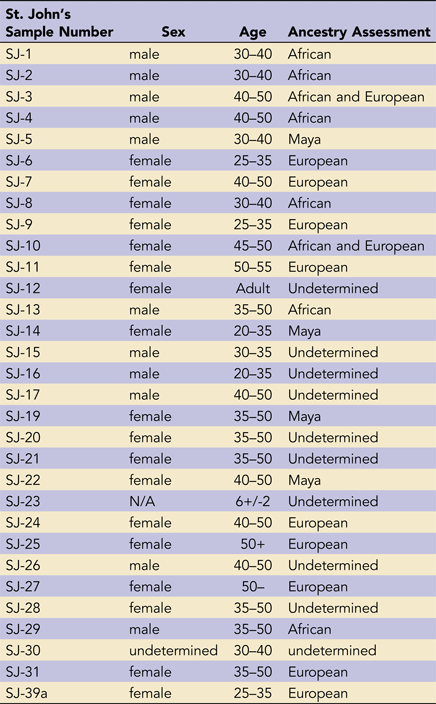
Each individual skeletal element has been photographed and assigned a skeletal inventory number. Analysis indicates that the human remains of the SJC collection are of African, European, and Maya descent (see Table 1), and there is marked evidence of physical trauma, intense physical labor, and poor health. The ages at death are wide ranging: while many adults are represented, only two children are present, the youngest being six years old at death. The ancestry of the individuals within the collection is equally varied; however, it is noteworthy that no males of European descent seem to be represented in the collection. The taphonomy of the bones—staining patterns, erosion, and the presence of mollusks—suggests long periods in seawater or in an island environment.
Skulls in the SJC Collection According to Sex, Age, and Ancestry.

MOHO CAYE
The best provenience for the human remains of the SJC collection is from the recollections of people who personally knew Dieckman. In an interview granted with Chanel 5 News Belize from the opening of the exhibit at the Image Factory, Dieckman mentions briefly Moho Caye in connection with the skulls from his collection. Additionally, though tenuous at best, one degraded cardboard box contained a note on one side that reads “Moho Caye.”
I would collect various things and I would come across these skulls. I really did not know what to do with them, I didn't want to throw them back in and so I just kept them and Yasser Musa thought it would be a great idea to let the people see them. I can't really tell you who they were. I am not sure if they were Maya, but Moho Caye was occupied for many years and there was an entry port at the end of the Belize River for the Mayas and others and at one time people lived there and I think it was a prison one time. I think maybe a Yellow Fever place, so there were burials there in any case (Leonard E. Dieckman, interview by Jacquiline Wood, News 5 Belize, 7 May 2000, http://edition.channel5belize.com/archives/21005).
Moho Caye is a small island just off the coast of Belize City, about 1.26 km from the St. John's College Landivar campus. The occupation of Moho Caye spans from the ancient Maya period (McKillop Reference McKillop1985) through the British colonial period and into the present. Its location is just 4 km southwest (105.29 degrees [GoogleMapsPro 2017]) of the mouth of the Belize River, which made it an integral part of a major trade route during the precolumbian period, as well as within a highly trafficked area at the height of the British logwood and mahogany logging industry during the nineteenth and twentieth centuries (Bulmer-Thomas and Bulmer-Thomas Reference Bulmer-Thomas and Bulmer-Thomas2012).
McKillop undertook archaeological excavations on Moho Caye in 1979 (Healy et al. Reference Healy, McKillop and Walsh1984; McKillop Reference McKillop1984; Reference McKillop1985; Reference McKillop and Garber2004), recovering lithic, ceramic, and other material artifacts as well as human skeletal material from burials, which she studied in the old science lab at SJC during the excavations and in the following months, after which she moved the excavated material to the Mountain Pine Ridge Forest Reserve. The excavated material was exported in 1980 under permit to her advisor, Paul Healy, at Trent University (McKillop, personal communication 2018).
McKillop also reported that Diekman brought about 60 boxes of artifacts and skeletal remains without proveniences to the science lab as she was completing analyses. Diekman told her he had collected them from Moho Caye. The SJC collection from Moho Caye was registered with the Belize government's department of archaeology. McKillop briefly surveyed the box contents and put notes in them (McKillop, personal communication 2018).
Unfortunately, the archaeological site on Moho Caye was leased to a developer in June 1980 and dredged to create a tourist destination on the island, destroying the site. The human remains from Diekman's collection from the cay remained at SJC. The skeletons described here were removed from Moho Caye by Diekmanbefore McKillop's 1979 excavations.
The narrative the authors have been able to ascertain thus far is that most of the skeletal remains in the SJC collection are from the period when the island was used to house a quarantine facility, which is supported in the historical record. The Annual Report of the Surgeon-General of the Public Health and Marine Hospital Service of the United Sates for the Fiscal Year 1909 describes “the suspicious case or cases [tropical illness like yellow fever and malaria] being removed to the isolation hospital at Moho Caye, about three miles from town” (US Treasury Department Reference Department1910:136). Additionally, in a description of the geography of Belize at the time, author A. Barrow Dillon (Reference Dillon1923) cites Moho Caye as a quarantine station. Finally, it was known that several epidemics of yellow fever, typhoid, and influenza from 1700 to 1918 struck the vulnerable populations hardest. In the 1918 to 1919 influenza epidemic, nearly 100,000 people died in the Caribbean, with the greatest mortality among laborers and slaves, especially males from 15 to 40 years old and low-status European single or widowed women working as servants (Killingray Reference Killingray1994). The apparent demographic profile seems to support the hypothesis that the skeletal remains of the SJC collection were indeed from the quarantine period of Moho Caye, as males of European descent do not appear to be represented.
The absence of a specific provenience for each individual in the SJC collection remains a challenge even if the Moho Caye theory holds. If all individuals are in fact from Moho Caye, the question remains of what historical period most are from. The particulars of the estimated demographic profile (African and Maya males and females and European females with signs of physiological stress) can place these individuals as early as the second half of the 1600s with the first Spanish and British pirate activities along the isthmus of the Central American coast (Shoman Reference Shoman2004; Bulmer-Thomas and Bulmer-Thomas Reference Bulmer-Thomas and Bulmer-Thomas2012). The earliest historical record of a settlement established at Moho Caye dates to 1807, when a Rev. W. Standford was granted official title to take up residence on the island (Burdon Reference Burdon1934). Eighteen years after the first known document of occupation on Moho Caye, the settlement of British Honduras became one of the busiest entrepôts in Central America (Bulmer-Thomas and Bulmer-Thomas Reference Bulmer-Thomas and Bulmer-Thomas2012). Researchers estimate that from 1825 to 1845, “Belize controlled between 90 [and] 100% of the value of Central American imports from the UK” (Bulmer-Thomas and Bulmer-Thomas Reference Bulmer-Thomas and Bulmer-Thomas2012). This would also coincide with the peak of the mahogany exports from Belize, with the majority of those exports coming from the Belize River (Bulmer-Thomas and Bulmer-Thomas Reference Bulmer-Thomas and Bulmer-Thomas2012). African and Indigenous indentured servants and slaves provided the labor. With the removal of the Spanish empire from the isthmus of Central American and the Yucatán, the migration of people once restricted under Spanish colonial law became fluid, and Belize City became the busiest port along the coast en route from Yucatán to Honduras, with Moho Caye at its nucleus. The consistent flow of travel and goods along the coast creates further challenges in chronicling the history of the individuals believed to have been recovered from Moho Caye and stored in Dieckman's collection.
FURTHER ANALYSIS OF THE ST. JOHN'S COLLEGE SKELETAL COLLECTION
Through a grant to Miller Wolf, laboratory analyses are currently underway to more accurately estimate ancestry, migration, and dates. These analyses form the basis from which we can begin to reconstruct the life history of those in the SJC collection, given that we lack virtually all other contextual information. Samples were taken from the dental apatite of 20 individuals (SJ-10, SJ-11, SJ-14, SJ-16, SJ-23, and SJ-26 [see Table 1] and 14 other individuals) to acquire radiogenic strontium isotope values (86Sr/87Sr) to identify any potential first-generation paleomobility. Two additional dental samples were collected for radiocarbon dating (SJ-10 and SJ-14), and three for DNA analysis (SJ-14 and two others). Results of the radiocarbon dates were inconclusive given the contextual information from the collection. The dental collagen samples dated much earlier than we expected (1960 +/- cal BP and 2140 +/- 30 cal BP), as a gross examination of the skeletal material suggested a more recent history. A potential though unlikely possibility is that the remains, having been submerged in the ocean turf, underwent reservoir effect (Druffel Reference Druffel1980; Ulm Reference Ulm2006), in which remains take on the radiocarbon dates of coral or sea life if the remains are submerged or the individual had an extremely high seafood diet. The latter would only be possible if the individuals had a nearly 100% seafood diet, and even that would not suffice in skewing the data so dramatically (Darden Hood, personal communication 2018). Instead, the resulting discrepancy could be attributed to the remains being treated at some point (perhaps by Dieckman or perhaps by others) with a yet-undetermined or macroscopically undetected varnish or glue (Darden Hood, personal communication 2018).
The discrepancy in the radiocarbon dates, whatever the cause, shows that further analysis is required to conclusively ascertain the origins of the individuals represented, perhaps including additional samples for carbon dating. The forthcoming results of the 87Sr/86Sr and biodistance analyses will provide more insight into the origins and history of these individuals.
CONCLUSIONS
We hope restoring the room that once housed Dieckman's curated collection will elucidate the key contextual information needed to determine some provenience information for the remains, artifacts, and objects he once studied. The initial review of the notebooks found in that room and piecemeal historical data indicated that Dieckman was primarily concerned with the biological specimens (excluding the human remains) within his collection. Because Moho Caye is the most likely provenience for the human remains, we are using this as the foundation for future investigation in reconstructing the history of these individuals in a collaborative effort between bioarchaeologists (Plumer-Moodie and Miller Wolf) and historians concerned with their own cultural patrimony (Quiroz and Musa). The skeletal remains are presently stored at the MRP, where the authors continue their gross analysis of the remains. The material artifacts and biological samples remain at the SJC.
In the wider chronology of Belizean history, not much emphasis has been placed on the role of Moho Caye in the nucleus of early British settlement in this area. Regarding Moho Caye as a footnote in the wider narrative creates an additional challenge for researchers. However, it is anticipated that more archival investigations into the occupation of the island since European contact will correlate with the bioanalysis of the individual remains. The authors are currently undertaking full-scale biodistance and osteological analyses of the skeletal remains. Ideally, we would return to Moho Caye for further archaeological investigation, but it is highly unlikely that this will occur because of major development on the island. There has been extensive dredging in the cay's northern portion for the construction of a harbor to serve its repeated use as a destination for tourists who may be unaware of the cay's unfortunate history. This inability to collect data is just another example as to why care in the maintenance of collections curation is important. If we let collections continue to erode, we will lose vital information on culture history. In the case of human remains, it is our ethical duty to properly care for, curate, or repatriate those remains.
Acknowledgments
The authors would like to give their heartfelt thanks to Dr. Heather McKillop. Her help and her valuable insight into the background of the SJC collection cannot be overstated. Funding for the laboratory analysis (87Sr/86Sr, aDNA, and C14 dates) provided to Miller Wolf from Women's Philanthropic Leadership Council at Indiana University East. The authors also wish to thank Dr. Tom Guderjan and the Maya Research Program for their support in the storage of the St. John's College remains and for providing the vehicles and boxes that were used to recover the remains from the site. Thank you to Mrs. Peralta, the president of St. John's College, for her permission and support to conduct this research. No permits were required in the collection of data for this research.
Data Availability Statement
Skeletal data used in this article is housed at the Maya Research Program in Blue Creek, Orange Walk District, Belize. Saint John's College houses the material artifacts. The authors can be contacted for additional information.