The period of Austro-Hungarian dualism is, beyond doubt, one of the best-researched epochs of the Habsburg monarchy. In the last twenty years in particular, research activities into various aspects of that era have intensified and differentiated considerably. Through the works of Pieter Judson, Tara Zahra, Gerald Stourzh, and Börries KuzmanyFootnote 1—to name just a few of many possible scholars—research into the so-called “nationality struggles” has led us from simplistic readings to a more complex and dynamic interpretation of the increasing salience of the national principle in society. Éva Somogyi, Karin Olechowski-Hrdlička, Tamara Scheer, John Deak,Footnote 2 and many others have analyzed institutions of dualism, and Jana Osterkamp has drawn our attention to the dynamics of cross-level cooperation with her concept of the “cooperative empire.”Footnote 3 Moritz Csáky has changed our understanding of the intersection of cultural codes and post-colonial readings of Habsburg history,Footnote 4 just as Lawrence Cole and Daniel Unowski have investigated the functions and limits of imperial loyaltiesFootnote 5—and we could go on with this list for quite some time. Given this diversity of literature, one might be tempted to ask: what sense does it make to choose the concept of conflict communities as an anchor point of our considerations?
The concept of the community of conflictFootnote 6 was introduced by the Czech historian Jan Křen in his classic study from 1986 on German-Czech relations in the nineteenth and twentieth centuries.Footnote 7 Křen conceives of the “konfliktní společenství” or “Konfliktgemeinschaft” as the entanglement of two national movements that oppose each other as competitors and, at the same time, are intensively and constantly intertwined in the most important political, socioeconomic, and cultural spheres. The idea addresses a clear paradox: Czechs and Germans are rivals in terms of their programs and political, economic, and cultural aspirations, but they are also closely entangled through a fundamental reference to their opponents and their actions. This fixation increasingly shaped political and socioeconomic agendas and attitudes toward local and crownland institutions, the Austrian state, and the Habsburg Empire as a whole. By constantly assessing concrete leaps and general strategies of their counterparts, national activists on both sides were confronted with dynamically changing demands on their core policies. The national counterpart became a moving target, in part because it copied concepts and activities that had proven successful in one’s own national mobilization. The ability of an opponent to learn and adapt was increasingly being factored into one’s own political calculations, and not only in the Czech-German case.
At this point, it is important to include two further approaches in our considerations: consensual conflicts and compromises. At first glance, conflicts are negative phenomena. Being disruptive and dysfunctional, they are commonly associated with struggles over and resistance to power structures. At the same time, they can be understood as a form of social integration: Thorsten Bonacker and Peter Imbusch have pointed out that the long-held definition of conflict—as a confrontational or escalating scenario—represents just one of many conflict types. They also force conflicting parties to interact with one another and thus contribute to strengthening integration in the camps of all groups involved. As a matter of fact, many conflicts can be defined as consensual conflicts: common legal frameworks and interests permit power-sharing scenarios and make agreements on sensitive issues possible.Footnote 8 This point brings us to the question of how we may understand the nature of compromises. Ute Schneider and Ulrich Willems define compromises as “a technique for settling conflicts in which conflicting parties give up part of their claims, that is, make concessions, without giving up their claims.”Footnote 9 While a consensus resolves a conflict because the parties agree on a position that both sides consider to be true or correct, in the case of a compromise, the conflict is defused but not resolved, and continues to exist.
With all these concepts in mind, we now turn to the Austro-Hungarian Compromise itself. It is commonly accepted among historians that the Austro-Hungarian Compromise of 1867 was a turning point in the history of the late Habsburg monarchy. Academic literature on the Habsburg monarchy is full of descriptions of the complicated legal regulations and procedures on which the Austro-Hungarian compromise rested. Although we cannot go into detail,Footnote 10 it should be highlighted that it contained two new elements. First, the compromise placed Habsburg rule in both states of the monarchy on a solid constitutional basis. Second, and more importantly for our argument, it established for the first time the principle of parity of the lands of the Hungarian crown in relation to the rest of the monarchy.
At the same time, however, Austro-Hungarian dualism was far from being a clearly defined legal architecture. Instead, it should be interpreted as a legally framed, multilayered power structure. In 1917, Fritz von Keller summarized his impressions that from the standpoint of constitutional law, dualism clearly eluded classification: “A sharp conceptual delimitation of the essence of the Austro-Hungarian monarchy is impossible; it is to be regarded as an entity of its own within the community of nations, in the forms of which at different times not always the same features emerge, but rather those elements which are the predominant ones according to the tasks at hand and the political balance of power.”Footnote 11 What is more, the confusion surrounding the definition of dualism was not only a concern for constitutional lawyers and legal experts. As Novi Pravnik, a newspaper published in the town of Sisak, Dalmatia, commented: “The Habsburg monarchy, by its present organization, is neither a unitary nor a federal state, nor an alliance of ‘states,’ nor is it constituted on the basis of the principle of nationality, nor is it strictly constitutional or absolutist.”Footnote 12
It is therefore important to keep in mind that the Austro-Hungarian compromise was never interpreted identically, nor reciprocally recognized in terms of its long-term status. As László Péter noted, it remained unclear whether the laws that outlined the dualist system should be regarded as a bilateral internal state contract, a set of independent statutory laws, an international treaty enacted by two sovereign legislatures, or some mixture of all these elements. The regulations also lacked a provision about whether the compromise constituted a permanently binding treaty or was based on a parallel set of laws that could be changed even unilaterally.Footnote 13 In his seminal work on Hungarian constitutional history, Sámuel Radó-Rothfeld (1857–1919) placed dualism in the realm of historical compensation, making its binding effect dependent on the future development of relations with the rest of the Habsburg Empire: “The constitution of Hungary is the outcome of great struggles, it has been defended in hundreds of battles. … Therefore, dualism is rather to be seen as the consequence of a historic necessity than as the solution to a constitutional problem.”Footnote 14 That this kind of consideration was far from theoretical is shown by the statement of Albert Apponyi (1846–1933), leader of the Hungarian parliamentary opposition in 1904–5 and minister for culture and education in the coalition government of 1906–10. For him, the compromise was ordinary Hungarian law that could be repealed or changed at any time, so that “the Hungarian legislature would be capable of blowing up the whole with a single article of law.”Footnote 15
Friedrich Tezner, one of the most prominent constitutional lawyers of Austria, spoke of the intent “to achieve the highest possible degree of obscurity and vagueness, so that each of the political powers struggling for recognition of its principles can read from the constitutional formula what it wants.”Footnote 16 Due to this strategic ambiguity, as we would call it, only very few institutions represented the monarchy as a whole. The competencies of these common institutions were mostly defined negatively and imprecisely. No common system of jurisdiction or a court of appeal existed to decide in disputed cases.Footnote 17 This left as the final arbiter the emperor-king, who united two separate constitutional personalities in one person.
Éva Somogyi has referred to the so-called delegations as “a strange structure” and “a contestable stopgap solution for the handling of common affairs, arising for lack of anything better.”Footnote 18 The peculiar and somewhat artificial distance between them and the three common ministers on the one hand and the governments of the two states on the other reflected the official Hungarian attitude that they were merely administrative bodies and by no means a joint parliament and government. To meet Hungarian expectations and anxieties, the institutional design of dualism avoided anything that gave the impression that a third state entity stood above the two sovereign states. Not surprisingly, however, many German-Austrian politicians and state officials treated the delegations precisely as an imperial decision-making body. It is one of the many paradoxes of the compromise that, despite the extensive consideration of Hungarian interests and sensitivities in the design of the dualistic construct, the political landscape in Hungary developed along the line of pro- and anti-compromise parties in which the so-called “constitutional question” became almost an obsession in public life, leading to a “politics of creeping constitutional radicalism.”Footnote 19
The reason was that Franz Joseph, as joint ruler, was prepared to subordinate everything else to two political goals: the preservation of the common army to ensure the monarchy’s position as a great power and the conclusion of the economic settlement that was renegotiated every ten years. Although Hungarian governments were able to pursue largely independent policies in most policy areas, these conditions had significant consequences for the shape of the political landscape in Hungary. As András Gerő so aptly put it, the elements of absolutism built into the Hungarian constitutional state effectively served to block attempts to bring about a transformation of the political regime by constitutional and parliamentary means. Any opposition supporter who aspired to power first had to abandon their political program, as happened with Kálmán Tisza (1830–1902) and Ferenc Kossuth (1841–1914).Footnote 20 Under these circumstances, demagogy proved to be the most effective way of improving one’s political standing: according to András Cieger, the Hungarian opposition, being unable to carry out its political program, clutched at and clung on to so-called “national demands” to maintain its popularity and further its position.Footnote 21
Although the intentional neglect of some issues in 1867 and the changed economic situation following the stock market crash of 1873 led to constant problems, the dualist system stabilized during the 1870s. Despite all odds, the handling of common matters became more of a routine task. Open conflicts about the fair distribution of financial costs or the best trade and customs policies arose repeatedly and complicated the search for agreements. Economist Joseph Grunzel aptly summed this up, saying that during the negotiations, “interesting veil dances were performed with statistical materials, witty speeches, and endless nuncios.”Footnote 22 Nevertheless, a procedure now existed that enabled both Hungary and the Austrian state to pursue economic interests at different speeds and with different approaches. By its institutional frame, the compromise helped create closely intertwined economic spheres, a condition that in the end proved to be advantageous for both states. Not only the unifying elements—the regent, the council of ministers, foreign and defense policies, and regulations of important economic-financial aspects—made it clear that Austria-Hungary remained much more interconnected than a mere confederation would be.Footnote 23
Contemporaries, however, were only too aware of the economic vulnerability of the dualistic structure. For example, the Viennese Neue Freie Presse, one of the leading daily newspapers of the monarchy, complained about the consequences of the lack of constitutional clarity for economic development: in other federal states of the world, such as Switzerland, Germany, or the United States, “such a monstrosity as the connection of the pragmatic community with a terminable customs agreement and a quota floating in the air every ten years” is not to be discovered. “Only here a lovely law exists that forces government and parliaments to tear at the seams of the monarchy every decade, to make the conflict of interests as obvious as possible and to accumulate a resentment that will not disappear until the next due date.”Footnote 24 The worst case, the implementation of customs barriers between Austria and Hungary, would have “such far-reaching consequences that not only the economic but also the political unity of the monarchy would be endangered … so that the common affairs would remain just an empty letter. …Just think of the possibility that Hungary would be cut off from the western countries and Austria from the Orient! This is not an adventurous idea, for the separation would provoke such hatred that any extreme would be more likely than a calm confrontation.”Footnote 25
According to Kristina Fink, Austria-Hungary represented the rather unique phenomenon of incomplete integration as an intermediate stage of a dissolving rather than a forming economic union.Footnote 26 Foreign trade interests were difficult to harmonize during commercial negotiations with foreign countries, and in the actual practice of the economic community, there were numerous other problems and internal difficulties. Hungarian Ministers of Agriculture repeatedly, but largely unsuccessfully, called for unhindered access for Hungarian livestock and grain to Austrian markets; they protested on several occasions against restrictions in Tyrol and Vorarlberg, as well as in Dalmatia and the Quarnero Islands, suggesting that veterinary police regulations should also be codified within the framework of the customs and trade alliance.Footnote 27
In return, constant complaints about the economic policies of Hungary were voiced by numerous Chambers of Commerce and Industry in the Austrian state. Accusations of social dumping against Hungary—mainly because Hungarian social legislation lagged far behind Austria’s—also resulted in demands that binding minimum guidelines on worker protection, health and accident insurance, as well as regulations on Sunday and public holiday rest, should be included in the provisions of the customs and trade alliance. Due to the common border, smaller producers, businesses, and traders in crownlands like Lower Austria, Styria, or Galicia, were directly exposed to Hungarian competition, and bitter accusations against Hungarian economic policy accumulated. In a petition to the Galician diet, the Cracow Agricultural Society complained that “the decline of the mills in the main strips of Galicia bordering on Hungary is alarming,” with numerous unemployed millers’ assistants being left with no prospect of employment. Hungary had already overtaken the Galician economy in this field, “thanks to its independence, which allows it to act quickly and decisively.”Footnote 28
A memorandum of the Graz Chamber of Commerce and Industry expressed the widespread displeasure in the chamber’s district that Hungary was systematically violating the provisions concerning the unity of the economic area and the movement of people and goods. That Hungary’s extraordinary economic upswing could be achieved within such a short period of time was mainly due to “a tariff policy of the state railways that was as clever as it was ruthless” due to the concessions granted to the Hungarian companies and the “complete exclusion of Austrian industry from all deliveries for the Hungarian state.” Long-established Styrian craftsmen felt that their livelihoods were threatened by the increasing Hungarian competition and the resulting price war with Hungarian market traders, “who have virtually become a plague for Styria.”Footnote 29
We have gone into these memoranda and petitions in some detail because economic relations were the area of politics in which conflicts could be traced down to the level of associations and municipalities, particularly in Austria. While the discussions on constitutional and state law remained abstract to most segments of society, the motive of unfair treatment or even economic exploitation seems to have had a much greater political impact. As of October 1897, the Budapester Tagblatt wrote: “No one should be deceived any longer about the anti-Hungarian mood in Austria; hatred against Hungary has taken on dimensions in recent years that are downright disturbing, and every serious politician in Hungary must take account of that mood in Austria.”Footnote 30
To its own public, the Hungarian political establishment presented Hungary as a stable, solidly structured national state with unprecedented confessional tolerance and an administration acting according to liberal principles, managed in a uniform state language, Hungarian. It did so in deliberate contrast to an allegedly internally torn Austria. Once we assess the statements of the political elite in Hungary at the turn of the century, we can still recognize a basic understanding of Hungary’s geopolitical situation and its security and foreign policy necessities. In his analysis of dualism, Gyula Andrássy—the son of the former Austro-Hungarian Foreign Minister of the same name (1860–1929)—was convinced that in that part of Europe, Hungary could not rely on herself. “We have exercised the influence granted to us in the spirit of the compromise to the proper extent.Footnote 31 Indeed, as a result of our more developed political life, as a result of the unity of our public opinion, our value has so far weighed more heavily in the scales of unity than the value of the politically less unified Austria.” For Andrássy, Austria was still a natural partner: while Austria consisted of loosely connected parts and needed Hungary to survive, Hungary was in a much better position due to its compact territory and the central location. From the turn of the century, however, uncritically self-confident, even arrogant tones increased, as in the following statement of Prime Minister Kálmán Széll (1843–1915): “We have only one single categorical imperative, the Hungarian state-idea, and we must demand that every citizen should acknowledge it and subject himself unconditionally to it. … The Hungarians [Magyars] have conquered this country for the Hungarians and not for others. The supremacy and hegemony of the Hungarian is fully justified.”Footnote 32 In their works, authors such as Gustáv Beksics (1847–1906) combined pressure on the nationalities within Hungary with an outward-looking claim to shape the future of the region, increasingly focusing on Bosnia-Herzegovina.
In view of the transformation from the suppressor of the Hungarian Revolution of 1848/1849 to a ruler who strictly adhered to his separate roles as Emperor of Austria and King of Hungary, Georg Kastner coined the phrase “Franz Joseph as the incarnation of compromise.”Footnote 33 Given the history of conflict between the Habsburgs and the Hungarian estates since 1526, especially against the backdrop of the revolution of 1848/1849 and the absolutist rule of the 1850s, it is astonishing how forgiving the Hungarian public was toward the king. On the occasion of Franz Joseph’s coronation anniversary on 8 June 1896, the Neue Freie Presse mocked: “Without objection, even with enthusiasm, the most stubborn kuruc agreed that the highlight of the millennium would be a grandiose homage to the king, his family and the crown, and one reads and hears expressions of loyalty from the most diverse political camps that can hardly be surpassed in devotion.”Footnote 34 This devotion to Franz Joseph can be observed in numerous letters and addresses from counties and towns. They suggest a certain amount of strategically calculated amnesia—for example, in the case of the county assembly of Háromszék saying that “Your Majesty pressed the loyal Hungarian nation to his fatherly heart with love in its cheerful and cloudy days,”Footnote 35 or the municipal assembly of Kassa (Košice, Kaschau) describing how “Your Majesty’s glorious ancestors, each one our national hero, made our history dazzling with their glorious deeds.”Footnote 36
In March 1895, the Hungarian Minister of Culture, Gyula Wlassics (1852–1937), approached Franz Joseph to acquire a collection of relics from the years 1848–49 for the National Museum—not least because this collection, if it remained in private hands, would be a constant object of publicity for the revolution and agitation against the army.Footnote 37 As this anecdote shows, the issue that caused the most controversy in Austro-Hungarian relations was the armed forces. In Hungary, the army was still regarded as a product of the old absolutism, and its often-provocative appearance was a constant source of irritation; the strictly dynastic common army was a living symbol of the historical conflicts of the past. The annual approval of the budget and the recruitment of new recruits repeatedly provided the two parliaments in Vienna and Budapest with opportunities to exert influence over the military. On the Hungarian side, questions of constitutional law and the language of command overshadowed these debates, so that symbolic quid pro quos were expected in return for approval of the budget and recruits. The Hungarian opposition repeatedly demanded parity with regard to the organization of the common army.
Another source of uncertainty about the very nature of Austro-Hungarian dualism became evident in official terminology. The term empire ( Reich in German or birodalom in Hungarian) became controversial since the Hungarian opposition polemicized against all terms derived from it. Gerald Stourzh has pointed out that this loss of significance of the term “empire” for the entire monarchy was accompanied by its “shrinking” to the Austrian state. The impression prevailed after 1900 that the old concept of Austria no longer referred to Hungary, which, according to popular belief, benefited disproportionately from the dualist system at the expense of the greater Habsburg monarchy’s political power status in Europe.Footnote 38 Even if the emperor tried to create a link between “Austrian state consciousness” and “dynastic and patriotic feelings,” emotional mobilization in Austria was, according to Peter Becker, not for the state, which, as an abstract concept and “colorless being,” was seen as unsuitable for creating widespread and sustainable loyalties by contemporary commentators.Footnote 39 This gap was increasingly filled by the quest for national affiliation, and the gradual introduction of ethnolinguistic difference as a guiding principle for the reorganization and conflict prevention in regional or local constituencies (as in the series of “small compromises” in the crownlands Moravia and Bukowina or the city of České Budějovice/Budweis).
One fact is, however, even more important for assessing the Austro-Hungarian relationship as a community of conflict: in Austria-Hungary, we have a nationalizing state within a composite monarchy that presented itself as a counter-model to nation-state building. In other words, the two-state concepts and a diametrically different approach to multilingualism were incompatible with each other, but they nonetheless had to coexist side by side. This resulted in scenarios that repeatedly exposed the systemic differences between the two states of the monarchy and caused spillover effects that were undesirable for the emperor-king and both governments. On the one hand, the legal construct of dualism remained a point of reference for the implementation of other historical legal claims: in this case, primarily Czech nationalists’ claims for the implementation of Bohemian constitutional law. And we see expressions of solidarity with groups on the other side of the internal border, such as the Slovak national movement. Serbian and Romanian minority activists in particular took the principle of equality in the Austrian state as a model and advocated for the reorganization of Hungary as a multinational state. This led to new coalitions of interest across internal borders and corresponding potential for conflict.
One example of this is the memorandum movement of the Romanian National Party of Transylvania and the subsequent criminal trial. In 1892, a memorandum criticizing the Hungarian government’s policy toward the Romanians of Transylvania was drawn up by the leaders of the Romanian National Party, who demanded political rights for Romanians in the Kingdom of Hungary. A delegation of 237 members took the memorandum to Vienna to the “wrong regent,” namely the Austrian emperor, instead of the Hungarian king. Franz Joseph forwarded it unopened to the Budapest Parliament, from where it was returned to the head of the delegation, also unread. As the document was printed and began to be distributed, its authors were prosecuted in Kolozsvár (Cluj, Klausenburg) in May 1894 on charges of incitement through the press. The majority of the defendants were convicted (from two months to five years in prison), even if they were all freed with a royal amnesty in 1895 (Figure 1). Among the convicted was also Aurel Popovici (1863–1917), who later lived in exile in Romania and finally in Switzerland, and who became a member of the Belvedere Circle. In 1906, he published a reorganization plan for the Habsburg Empire as The United States of Greater Austria. This federalization plan can be understood as a program loyal to the Habsburg dynasty but primarily directed against the ruling political system in Hungary and aimed at abolishing the dualistic order completely.Footnote 40 The heir to the throne, Franz Ferdinand, was known for his aversion to Hungary and his sympathies for the nationalities there. Spillover effects, like in this case, added to the anxiety of the Hungarian political elite.
“Educational institution”: a satirical depiction in the Hungarian press of the imprisonment and release of Romanian national activists. “Nevelő-intézet,” Borsszem Jankó, 25 September 1895, 3.

Figure 1. Long description
The cartoon is split vertically by a central building labeled with Hungarian words including ‘Szegedi Államfogház’ (Szeged state prison) and ‘Büntetés” (punishment) over the left door and ‘Kegyelem.’ (pardon) over the right. On the left, prime minister Sándor Wekerle dressed as prison guard pushes a bearded man with wild hair into a door marked by a keyhole, his expression aggressive. On the right, the same man, now neat and subdued, is escorted out by prime minister Dezső Bánffy in the uniform of prison guard. The left panel is captioned ‘Vadul megy be,’ (He goes in as a wild man) and the right ‘Megszelídülve jön ki’ (He comes out tamed). The building’s perspective and text emphasize the transformation from unruly to tamed.
One of the few politicians who had met with the Romanian delegation in Vienna was Karl Lueger (1844–1910), Christian Social politician and mayor of Vienna from 1897. Lueger was infamous and popular at the same time, not only for his antisemitism but also for his anti-Hungarian attitudes. His political aversion to the liberals and his deeply rooted personal loyalty to the Catholic Church and the Habsburg dynasty found an ideal target in the ruling political system in Hungary. As a politician, Lueger never accepted dualism as a form of government. From his perspective, the ordinary Hungarians were just as oppressed as the nationalities due to Hungarian chauvinism, state terrorism, violence, and brutality. One of the most remarkable propagandistic creations of Lueger in this respect was the slogan of the “Judaeomagyar” and the conspiracy theories in which Lueger placed “Judapest,” as he often called the Hungarian capital.Footnote 41 What is more, Lueger saw only disadvantages in the economic agreements with Hungary, which, as he saw it, drastically curtailed Austria’s sovereignty: “we pay 70 percent, the Magyars 30 percent, and we have zero or actually negative rights, because we have to do what the current Hungarian government wants. … Austria has always given in; Austria was always the dupe, the cheated. Things must change. Austria must be free in order to be able to assert its position in the chorus of states with honor.”Footnote 42
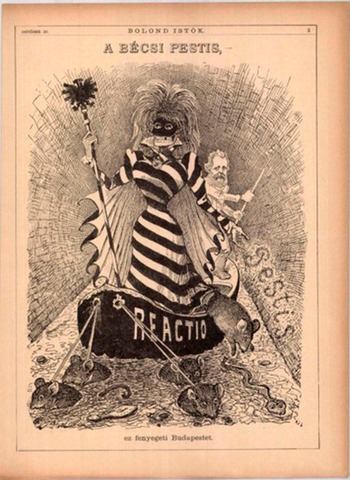
The Hungarian government avoided any official reaction to statements like these, considering them to be something happening in a foreign country. If we look at Hungarian cartoons of that time, however, we can see a great deal of anxiety and a clear visual response. Lueger was one of the few Austrian individual politicians, except for prime ministers, who became a target of Hungarian cartoons aimed at discrediting his attitudes (Figure 2). In the cartoon, which shows the Viennese mayor’s visit to the Kingdom of Romania, Lueger is shown wearing Romanian peasant clothes and in a homoerotic setting with Gheorghe Grigore Cantacuzino (1832–1913), Prime Minister of Romania. The three dishes served are “Ung. Gollasch,” a stew of cooked Hungarians (with boots, hat, and hand axe still visible), which is being eaten by a greedy Romanian peasant on the left; a cake with Hebrew inscriptions and the star of David; and Transylvanian beef. In another cartoon, you can see the “Viennese plague that threatens Budapest” (Figure 3). With a feminine body in a black and yellow striped dress, crowned by a skull, Vienna, as a deadly sickness, is traveling through a sewer system. The ship is drawn by rats, accompanied by snakes, and operated by Lueger. What we see here is the representation of everything that the two satirical journals consider to be the threatening Other for Hungary, in the form of a cross-fade of enemy images.
“Lueger Banquet in Bucharest”: another satirical depiction in the Hungarian press, mocking the Viennese mayor. “Lueger-bankett Bukarestben,” Borsszem Jankó, 24 June 1906, 4.

Figure 2. Long description
At the center, a large ornate dish with a star-shaped garnish is presented on a platter, surrounded by five caricatured men in exaggerated traditional hats and attire, engaged in eating and conversation. The man at the left bites into a piece of meat, while the man at the right holds a fork and knife, both wearing hats with visible insignia. The central pair embrace, with one figure (Karl Lueger) in a traditional Romanian fur hat and the other (Gheorghe Grigore Cantacuzino) in a tall hat. The table is laden with food, including sausages and bread, with a plate labeled ‘Ung[arisches] Gollasch.’ (Hungarian Goulash). In the background, the wall is divided into two panels: the left panel shows a stylized animal labeled ‘AUSZTRIA,’ (the double eagle) and the right panel features the Aurochs, the heraldic animal of the Principality of Moldavia, labelled as ‘ROMANIA’, above a steaming dish labeled ‘ERDÉLYI TOKANY’ (Transylvanian stew). The lower border includes a Hungarian caption ‘Ez volt az igazi judeo-magyar falás’ ( That was the real Judeo-Hungarian feast). The overall composition uses exaggerated features and symbolic food to satirize political and ethnic relations.
“The Viennese Plague,” with Lueger at the rudder. “A bécsi pestis,” Bolond Istók , 30 October 1906, 3.

Figure 3. Long description
At the center, a masked figure with wild hair and striped dress stands on a boat labeled REACTIÓ. The figure holds a scepter with a spiked orb in the left hand and a flag in the right. At the stern, a smaller figure, identified as Lueger, stands holding the rudder. The boat floats on water filled with rats, snakes, and debris. The word PESTIS is inscribed in the water to the right. The title and the text at the bottom state that ‘A BÉCSI PESTIS’ (the Viennese plague) ‘ez fenyegeti Budapestet’ (this is threatening Budapest). The background is densely hatched, emphasizing darkness and chaos.
At this point, I would like to come back to the beginning of the presentation: how do we relate all this to what we already know about Austria-Hungary? How do institutions interfere in what they interpret as national conflicts? How does the state manage rivalries and competition that emerge from the handling of cultural differences? Pieter Judson’s work is crucial for our understanding that conflicts between linguistic or national collectives in our sources are not what they seem to be. Nationalistic rhetoric is salient in some contexts, in others not. What Judson addresses in the following quote is highly relevant for our understanding of communities of conflict: “What made Austria-Hungary, and especially the Austrian half of the dual monarchy, unique was not so much its ethnic makeup but rather the legal and administrative structures it developed to manage questions of linguistic and religious difference. … we also need to take the role of empire seriously in the construction of ideas of nationhood. Imperial institutions, laws, and administrative practices played crucial roles in giving shape to the more successful forms of nationalism. … If we examine how existing laws, imperial structures, and political institutions shaped beliefs about nations or cultures, we may gain a clearer understanding of the dynamics that repeatedly reproduced nationalist conflict.”Footnote 43
Let us, at this point, come to some concluding remarks. Was Austria-Hungary the perfect example of a community of conflict, as suggested in the title of this presentation? I hope the point has been made that this question can be answered with a general “yes,” followed, however, by some important qualifications. First, the strategic ambivalence of Austro-Hungarian dualism led to the implementation of a constitutional setting in which conflict lines were too often blurred, and the activities of various communities of conflict intensified across the Austro-Hungarian divide. More routines needed to be developed for the negotiation process between national activists, government agencies, and the population to contain the consequences of the conflict and enable political decision-making to continue.
In future research, we need to know more about the effects that communities of conflict had on the multi-tiered or even multipolar state structures of Austria-Hungary. This is especially true with the concept of a community of conflict, or the respective codes of practice traveled between different layers and spheres of statehood. What we can see already is that communities of conflict increasingly shaped central policy areas at all levels and determined the political disputes over those bodies, institutions, and networks that symbolized the sovereignty as well as the interdependence of the two states of the dual monarchy. As a result, this was one factor that increasingly impaired the functioning of the Austrian state and stimulated discussions about the nature of statehood and possible alternatives to the existing constitutional setting.
In short, Austria-Hungary was not a simple community of conflict that consisted of two rival or competing states. It rather resembled a kaleidoscope of nested communities of conflict, with planned as well as unintended consequences and numerous spillover effects. Both states of the monarchy remained entangled through the institutions and administrative practices of dualism. Although legal systems, regulations, and reasons of state grew ever more distant from one another, the Austro-Hungarian relationship as a community of conflict adapted to this dynamic so that political spaces and processes in both states remained closely yet negatively entangled with one another.
Vienna, 17 July 2025
Acknowledgments
First of all, the author would like to thank the organizers for giving the opportunity to open the convention with this keynote, and by also honoring the author’s colleague and friend, Pieter Judson. The author is also very grateful to the Austrian History Yearbook for publishing the text.