Introduction
Centella asiatica (L.) is a medicinally important plant of Apiaceae family and is commonly known as ‘Indian Pennywort’ or Gotu Kola. C. asiatica has a number of medicinal properties including nerve function improvement, inflammatory reduction, wound healing and memory enhancement (Arora et al., Reference Arora, Kumar and Dubey2002). The plant is also used in cosmetic masks and creams to increase the synthesis of collagen and the firming-up of the skin (Sikareepaisan et al., Reference Sikareepaisan, Ruktanonchai and Supaphol2011). Furthermore, C. asiatica is considered an effective anti-diabetic, anti-microbial and anti-proliferative herb (Roy et al., Reference Roy, Barman and Shaik2013).
C. asiatica has been reported to exhibit considerable variability in phytomolecules belonging to the triterpenoid class. Triterpenoids are biosynthesized via the mevalonate–1-deoxy-D-xylulose 5-phosphate (DOXP) pathway of isoprenogenesis (Chaurasiya et al., Reference Chaurasiya, Sangwan, Misra, Tuli and Sangwan2009). Plant phytochemicals/ bioactive molecules can be characterized and profiled by using efficient and sensitive techniques such as high-performance liquid chromatography (HPLC) to provide quality-related information for the identification of superior and elite chemotypes. Owing to the diverse medicinal uses of C. asiatica, qualitative as well as quantitative studies are conducted to evaluate phytochemical content of the plant. To assess natural and genetic variability, a comparative quantitative analysis of phytochemicals in the selected accessions of C. asiatica collected from different locations is reported (Thomas et al., Reference Thomas, Kurup, Johnson, Chandrika, Mathew, Dan and Baby2010; Zhang et al., Reference Zhang, Han, Zhang, Zhang, Huang, Xu and Qin2009; Joshi et al., Reference Joshi, Savai, Varghese and Pandita2012). Studies have also assessed the levels of asiaticoside and madecassoside in various parts of the plant with different phenotypes being observed in vitro and in vivo (Aziz et al., Reference Aziz, Davey, Power, Anthony, Smith and Lowe2007; Singh et al., Reference Singh, Sabir, Sangwan, Narnoliya, Saxena and Sangwan2014). In an earlier report, all major phytochemicals in different phenotype-derived calli and cell suspension cultures have been analysed (James et al., Reference James, Meyer and Dubery2008). The results of such analysis have provided valuable qualitative and quantitative information on the improvement and establishment of superior chemotypes for commercial and medicinal purposes. In the present study, selected accessions of C. asiatica were analysed to detect the variation in major individual phytochemicals as well as their total content. This study would help in the characterization and utilization of elite accessions and chemotypes that are rich in specific pentacyclic triterpenoid phytomolecule(s), leading to their utilization in plant improvement programmes.
Experimental
A total of 14 phenotypically distinct accessions of C. asiatica were sampled and used in the present study (coded as CA1–CA14). Fresh leaves (1 g) of all the chemotypes were chopped into pieces, finely ground and soaked in methanol for 24 h. The extract was collected by centrifugation and dried. The dried methanolic extract was dissolved in HPLC-grade methanol for HPLC analysis as reported earlier (Singh et al., Reference Singh, Sabir, Sangwan, Narnoliya, Saxena and Sangwan2014). The HPLC analysis system consisted of a high-pressure constant flow pump (600E), an autosampler injector and the Waters 2996 Photodiode Array Detector, Waters Corporation, Milford Massachusetts, USA. Chromatographic separation was performed using a Waters C18 column, Waters Corporation, Milford Massachusetts, USA with a pore size of 4 μm. The chromatograms were developed at 216 nm. The HPLC analysis was performed in triplicate, and values were derived from the peak areas obtained from linear concentrations of authentic markers. The experiments were carried out in at least three replicates, and data were subjected to a one-way analysis of variance to assess the significant difference using Duncan's multiple range test (P< 0.05).
Discussion
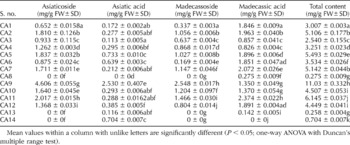
Secondary metabolites of medicinal plants are of primary importance in their chemical profiling because these compounds are considered to be characteristic at the genus, species and individual levels (Sangwan et al., Reference Sangwan, Yadav and Sangwan2003). In this study, HPLC analysis of these compounds was performed in order to characterize them as chemotypes (Table 1). Our results revealed that the highest content of asiaticoside, asiatic acid and madecassoside was found in accession no. CA-9, and the highest content of madecassic acid was found in accession no. CA-11 (Table 1). There have been several reports on the profiling of secondary metabolites from the samples of C. asiatica collected from different locations, which involved phytochemical analysis of all four major triterpenoids (Randriamampionona et al., Reference Randriamampionona, Diallo, Rakotoniriana, Rabemanantsoa, Cheuk, Corbisier, Mahillon, Ratsimamanga and Jaziri2007), minor triterpenoids (Zhang et al., Reference Zhang, Han, Zhang, Zhang, Huang, Xu and Qin2009), glycosides (Thomas et al., Reference Thomas, Kurup, Johnson, Chandrika, Mathew, Dan and Baby2010), aglycones (Joshi et al., Reference Joshi, Savai, Varghese and Pandita2012) or selected glycoside and its corresponding aglycones (Devkota et al., Reference Devkota, Acqua, Comai, Innocenti and Jha2010). An extensive report on 60 different accessions of C. asiatica has been based on HPTLC analysis, wherein only triterpenoid glycosides have been profiled (Thomas et al., Reference Thomas, Kurup, Johnson, Chandrika, Mathew, Dan and Baby2010). There have also been reports on the quantitative estimations of the phytochemicals of C. asiatica using the HPLC method; however, a more efficient method with better resolution of chromatographically generated peaks belonging to triterpenoids is desirable (Rafamantanana et al., 2009). The accessions used in the present study were grown under identical glass house conditions to minimize/avoid the effect of environmental conditions on the phenotype and chemo-composition(s). The reason for selection of these accessions was their distinct morphology with respect to leaf shape and size (Fig. S1, available online). The sensitive and high-resolution HPLC procedure afforded improved separation and thereby better quantification of all major triterpenoids (Fig. S2, available online). The sharp and well-resolved peaks for each of the triterpenoids of C. asiatica could be resolved in chromatographic profiles.
Quantitative estimation of major triterpenoids in 14 different accessions of C. asiatica a

FW, fresh weight.
Mean values within a column with unlike letters are significantly different (P< 0.05; one-way ANOVA with Duncan's multiple range test).
a Data represent the values of three replicates of independent experiments.
HPLC analysis of triterpenoid content in the cell and callus suspension of two morphologically different chemotypes of C. asiatica collected from South Africa has been reported to reveal the presence of varied accumulation of four major bioactive compounds (James et al., Reference James, Meyer and Dubery2008). The variation in the content of secondary metabolites might be attributed to their different geographical distribution as reported in the chemotypes of C. asiatica collected from different locations of Nepal (Devkota et al., Reference Devkota, Acqua, Comai, Innocenti and Jha2010). The variation in the concentrations of quercetin and kaempferol of two different chemotypes of C. asiatica collected from the regions of Maharastra and Gujrat also supported this hypothesis (Joshi et al., Reference Joshi, Savai, Varghese and Pandita2012). On the contrary, asiaticoside content in C. asiatica obtained from three plantation areas in Indonesia did not vary substantially (Sondari et al., Reference Sondari, Harmami, Ghozali, Randy, Amanda and Irawan2011). C. asiatica grown at different locations also differed based on their essential oil content (Devkota et al., Reference Devkota, Acqua, Comai, Innocenti and Jha2013). Chemotypic variation is directly related to the environment or genetic variability of species (Sangwan et al., Reference Sangwan, Tripathi, Singh, Narnoliya and Sangwan2013; Yadav et al., Reference Yadav, Sangwan, Sabir, Srivastava and Sangwan2014; Zhang et al., Reference Zhang, Han, He, Zhang, Zhang, Rahman and Qin2012). This variation has revealed that not only growing conditions but also the genetic make-up of the plant is the contributing factor in relation to the biosynthesis of medicinally important triterpenoids. Thus, in the present study, we report a HPLC-based quantification of major triterpenoids that reveals chemotypic variability under identical environmental conditions, implying their genetic origin. This study provides useful information on the selection of C. asiatica chemotypes for the development of high-yielding plants.
Supplementary material
To view supplementary material for this article, please visit http://dx.doi.org/10.1017/S1479262114000860
Acknowledgements
The authors gratefully acknowledge the financial grant from DBT, New Delhi and NWP09. J. S. thanks CSIR, New Delhi for fellowship. The authors thank Ritesh K. Yadav for performing the statistical analysis. The authors sincerely thank the director, CSIR–CIMAP, for constant encouragement.