


Introduction
Dysfunctional cognition is important in the etiology and treatment of emotional disorders in youth (e.g. Curry et al., Reference Curry, Rohde, Simons, Silva, Vitiello and Kratochvil2006; Stallard, Reference Stallard2005). Studies have found that distorted cognitive processing predicts or correlates with youth anxiety (e.g. Epkins, Reference Epkins1996; Weems, Berman, Silverman and Saavedra, Reference Weems, Berman, Silverman and Saavedra2001) and depression (e.g. Kingery et al., Reference Kingery, Kepley, Ginsburg, Walkup, Silva and Hoyle2009; Leitenberg, Yost and Carroll-Wilson, Reference Leitenberg, Yost and Carroll-Wilson1986), and that it influences treatment outcomes (e.g. Silverman et al., Reference Silverman, Kurtines, Ginsburg, Weems, Rabian and Serafini1999). The content of dysfunctional cognition is theorized to vary with each disorder: anxiety is thought to be characterized by cognitions related to threat and danger, and depression by cognitions related to failure and loss (Beck, Reference Beck1976; Beck, Emery and Greenberg, Reference Beck, Emery and Greenberg1985). One type of cognition considered to be particularly influential in the development and maintenance of anxious and depressive symptoms in adults as well as youth is negative cognitive error (Yurica and DiTomasso, Reference Yurica, DiTomasso, Freeman, Felgoise, Nezu, Nezu and Reinecke2005). Negative cognitive errors are also major targets in cognitive therapy for youth with internalizing disorders (Curry et al., Reference Curry, Rohde, Simons, Silva, Vitiello and Kratochvil2006; Silverman et al., Reference Silverman, Kurtines, Ginsburg, Weems, Rabian and Serafini1999; Stallard, Reference Stallard2005). Unfortunately, cognitive errors have not received much research attention, so that little is known about them or their influence on psychological well-being. Moreover, studies into the relationship between distinct error categories and anxious versus depressive symptoms and disorders in youth often yielded mixed results, probably due to the quality of measurement. Yet both researchers and clinicians would benefit from knowing more about the role of cognition in youth psychopathology in general, and specifically whether certain errors are more detrimental than others and whether some errors are particularly related to specific symptoms and disorders (e.g. Epkins, Reference Epkins1996; Kingery et al., Reference Kingery, Kepley, Ginsburg, Walkup, Silva and Hoyle2009; Leitenberg et al., Reference Leitenberg, Yost and Carroll-Wilson1986; Maric, Heyne, Van Widenfelt and Westenberg, Reference Maric, Heyne, Van Widenfelt and Westenberg2011). Such information will contribute to our understanding of causal and maintaining factors of youth psychopathology and will help us to tailor therapy to the needs of individual children.
Most research into negative cognitive errors in youth has used Children's Negative Cognitive Error Questionnaire (CNCEQ; Leitenberg et al., Reference Leitenberg, Yost and Carroll-Wilson1986) to assess four errors: catastrophizing (assuming the worst will happen or has happened); overgeneralizing (formulating general rules on the basis of limited experience and applying them too broadly); personalizing (taking responsibility for events without evidence of personal causality); and selective abstraction (allowing one negative aspect of a situation to colour the whole) (Yurica and DiTomasso, Reference Yurica, DiTomasso, Freeman, Felgoise, Nezu, Nezu and Reinecke2005). The CNCEQ has been shown to have good clinical utility, especially when the total score is used (Curry et al., Reference Curry, Rohde, Simons, Silva, Vitiello and Kratochvil2006; Silverman et al., Reference Silverman, Kurtines, Ginsburg, Weems, Rabian and Serafini1999). In studies on the etiology of youth internalizing problems, total CNCEQ scores have been found to correlate with symptoms of depression as well as anxiety (Epkins, Reference Epkins1996; Kingery et al., Reference Kingery, Kepley, Ginsburg, Walkup, Silva and Hoyle2009; Leitenberg et al., Reference Leitenberg, Yost and Carroll-Wilson1986; Ostrander, Nay, Anderson and Jensen Reference Ostrander, Nay, Anderson and Jensen1995) and with comorbid depression and anxiety (Epkins, Reference Epkins1996). In contrast, mixed results were found in studies investigating the role of specific cognitive errors in either depression or anxiety. “Selective abstraction” seemed to be more commonly associated with depression than with anxiety (e.g. Leitenberg et al., Reference Leitenberg, Yost and Carroll-Wilson1986; Weems et al., Reference Weems, Berman, Silverman and Saavedra2001), and “personalizing” tended to be predictive of anxiety but not depression (Epkins, Reference Epkins1996; Weems et al., Reference Weems, Berman, Silverman and Saavedra2001). In most other studies, however, all errors predicted both anxiety and depression (for an overview, see Maric et al., Reference Maric, Heyne, Van Widenfelt and Westenberg2011).
There are several possible reasons why no clear, consistent relationship has been found between error types and either depression or anxiety. One is that depression and anxiety frequently co-occur in clinical practice, which makes it difficult to differentiate disorder-specific cognitions (e.g. Garber and Weersing, Reference Garber and Weersing2010). Further, it is possible that cognitions are not as specific to disorders as Beck and colleagues assume (Beck, Reference Beck1976; Beck et al., Reference Beck, Emery and Greenberg1985) but are characterized by a general underlying negative affectivity/cognitivity dimension, as found in youth with internalizing problems (e.g. Clark and Watson, Reference Clark and Watson1991; Marien and Bell, Reference Marien and Bell2004). Also, a limitation associated with the CNCEQ is that it was modelled after the Cognitive Error Questionnaire (CEQ; Lefebvre, Reference Lefebvre1981), a measure for cognitive errors in adult depression, and may therefore be insufficiently developmentally sensitive to capture cognitive errors in youth, both in terms of the wording of items as well as the types of errors included. However, the lack of consistent knowledge about the role of negative cognitive errors in youth has recently been attributed mostly to methodological issues (Maric et al., Reference Maric, Heyne, Van Widenfelt and Westenberg2011). It has been suggested that the CNCEQ-items designed to measure specific cognitive errors lack specificity, possibly because items have not been formulated specifically enough or because of overlap in the content of the scales (Maric et al., Reference Maric, Heyne, Van Widenfelt and Westenberg2011). This problem may stem in part from the overlap that is already present in Beck and colleagues’ descriptions of the types of cognitions (Leitenberg et al., Reference Leitenberg, Yost and Carroll-Wilson1986), illustrated by the initial failure to achieve interrater consensus on error categories in the development of the CEQ (Lefebvre, Reference Lefebvre1981). Results of several factor analytic studies seem to confirm that CNCEQ-items lack specificity in as much as all the studies find evidence for one general factor (Cole and Turner, Reference Cole and Turner1993; Kingery et al., Reference Kingery, Kepley, Ginsburg, Walkup, Silva and Hoyle2009; Messer, Kempton, Van Hasselt, Null and Bukstein, Reference Messer, Kempton, Van Hasselt, Null and Bukstein1994; Stewart et al., Reference Stewart, Kennard, Lee, Hughes, Mayes and Emslie2004).
In an attempt to enhance its capacity to measure separate error categories, Maric et al. (Reference Maric, Heyne, Van Widenfelt and Westenberg2011) developed a refined and expanded version of the CNCEQ, the CNCEQ-Revised (CNCEQ-R). In addition, they aimed to make the CNCEQ-R more suitable for measuring cognitive errors associated with anxiety, because even though the CNCEQ had originally been designed to measure cognitive errors in youth depression, it was also frequently used to measure cognition in youth anxiety (Silverman et al., Reference Silverman, Kurtines, Ginsburg, Weems, Rabian and Serafini1999; Weems et al., Reference Weems, Berman, Silverman and Saavedra2001). To this end, items related to two cognitive errors often associated with anxiety, “threat conclusion” and “underestimation of the ability to cope,” were added (Maric et al., Reference Maric, Heyne, Van Widenfelt and Westenberg2011), resulting in a scale with five theoretical error categories. The initial study, held among a community sample of youth, was promising in that both exploratory and confirmatory factor analyses yielded greater support for a five-factor solution than for a one-factor solution. The “mind reading” subscale (containing “threat conclusion” items), along with the subscale “underestimation of the ability to cope” were stronger predictors for anxiety than the other subscales (Maric et al., Reference Maric, Heyne, Van Widenfelt and Westenberg2011). Regarding the other error types and anxiety, “overgeneralizing” was also found to predict anxiety. In contrast, “selective abstraction” was inversely and nonsignificantly related with anxiety and “personalizing without mind reading” did not predict anxiety. The researchers hypothesized that the latter subscale measured internal attributions to negative events, a construct more closely linked with depression. However, in this initial study, no relations between cognitive errors and depressive symptoms were investigated.
Another aspect of cognitive errors in youth that was not addressed in the initial study by Maric et al. (Reference Maric, Heyne, Van Widenfelt and Westenberg2011) is the influence of age. Negative cognitions are thought to be reported more by adolescents and to be more strongly related to internalizing disorders in adolescents than in children (e.g. Alfano, Beidel and Turner, Reference Alfano, Beidel and Turner2002). Additionally, younger children may be unable to differentiate between cognition types, and instead experience thoughts as more globally negative (e.g. Marien and Bell, Reference Marien and Bell2004). Therefore, differentiation of cognitions (specifically related to anxiety and depression) may emerge with advancing age. Studies have yielded mixed results: while some found higher reports of errors in children (e.g. Leitenberg, et al., Reference Leitenberg, Yost and Carroll-Wilson1986), others found higher reports of errors in adolescents (e.g. Weems, et al., Reference Weems, Berman, Silverman and Saavedra2001).
The major aim of this study is to investigate whether distinct negative cognitive error categories as measured by the CNCEQ-R are associated with anxious and depressive symptoms in a community sample of youth. Based on the results of Maric et al.'s study (Reference Maric, Heyne, Van Widenfelt and Westenberg2011), it is expected that the errors “mind reading” and “underestimation of the ability to cope” will be the strongest predictors for anxiety. Based on theory (e.g. Beck, Reference Beck1976) and previous research (Epkins, Reference Epkins1996; Maric et al., Reference Maric, Heyne, Van Widenfelt and Westenberg2011; Weems et al., Reference Weems, Berman, Silverman and Saavedra2001) we expect that the cognitive errors of “selective abstraction” and “personalizing without mind reading” will predict depression, but not anxiety. No hypotheses are formulated about the relation of “overgeneralizing” to depression or anxiety because of mixed results in previous studies (Epkins, Reference Epkins1996; Leitenberg et al., Reference Leitenberg, Yost and Carroll-Wilson1986; Weems et al, Reference Weems, Berman, Silverman and Saavedra2001). Additionally, we will examine whether children and adolescents report differently on negative cognitive error categories.
Method
Participants and procedure
The sample consisted of 281 students from two primary (n = 78) and four secondary schools (vocational schools: n = 96; pre-university schools, n = 106) in the west of the Netherlands. Ages ranged from 9 through 17 (M = 12.46; SD = 0.41). Fifty-three percent were girls; gender information was missing from one participant. Most participants had been born in the Netherlands (269; 95.7%); the remaining 4.3% had been born in other countries in Europe, Asia and America.
Participants were administered a booklet of measures in a classroom setting under supervision of the researcher during a free period in school. Measures of anxiety and depression were administered either before or after the CNCEQ-R, in equal proportions. The study was carried out according to the regulations and with the approval of the Psychology Ethics Committee of the University. Participation was voluntary and anonymous. Parental consent as well as children's assent were obtained.
Measures
Children's Negative Cognitive Error Questionnaire-Revised (CNCEQ-R). This questionnaire, developed by Maric et al. (Reference Maric, Heyne, Van Widenfelt and Westenberg2011), assesses cognitive errors in 9–17 year-olds. It contains five subscales and 16 items in total. The scales measure the errors “underestimation of the ability to cope” (three items); “personalizing without mind reading” (three items); “mind reading” (four items); “selective abstraction” (three items); and “overgeneralizing” (three items). Each item consists of a description of a situation and of the thought someone might have in this situation. The rater indicates on a 5-point scale how similarly he/she would think in this situation, ranging from “almost exactly like I would think” (5 points) to “not at all like I would think” (1 point). An example of a “personalizing without mind reading” item is: “Your team loses a trivia quiz. The other team won with ease. You think: “If I was smarter, we wouldn't have lost.” Total scores range from 16–80.
The CNCEQ-R was evaluated in a previous study (Maric et al., Reference Maric, Heyne, Van Widenfelt and Westenberg2011) for readability and imaginability of the scenarios among different age groups. Furthermore, construct validity was tested; principal and confirmatory factor analyses supported the 5-factor solution. In that same study, good test-retest reliability of the total questionnaire (r = .90) was found. The test-retest reliabilities for the subscales were moderately stable (range .71–.85). The internal reliability of the total test was good (α = .80). The alphas for the five subscales ranged between .58–.62. In the present study, principal component analyses on the 16 CNCEQ-R items yielded five components with eigenvalues > 1 (i.e., 3.28, 1.54, 1.3, 1.06, 1.01). These five components accounted for 51.16% of the total variance. Eleven of the items intended to measure the five errors loaded on the five distinct components (in line with the components found in Maric et al.'s Reference Maric, Heyne, Van Widenfelt and Westenberg2011 study). Five items loaded on factors with items intended to be unrelated: item 9 (“selective abstraction”) loaded on a factor with two “overgeneralizing” items, item 7 (“underestimation of the ability to cope”) loaded with two “selective abstraction” items, item 12 (“mind reading”) loaded with the three “personalizing without mind reading” items, item 15 (“mind reading”) loaded on two components; with the three “personalizing without mind reading” items, and with two “selective abstraction” items and item 4 (“overgeneralizing”) loaded with two “underestimation of the ability to cope” items. All factor loadings were > .40 except for item 15 (factor loadings > .30). In the current study, the overall internal reliability is acceptable at α = .74. For the five subscales, alphas are low at .45 (“underestimation of the ability to cope”), .53 (“personalizing without mind reading”), .40 (selective abstraction), .43 (overgeneralizing) and .56 (mind reading).
Multidimensional Anxiety Scale for Children (MASC)
The MASC contains 39 items on anxiety symptoms in youth aged 8–18 (March, Parker, Sullivan, Stallings and Conners, Reference March, Parker, Sullivan, Stallings and Conners1997). Each item consists of a statement (e.g. “I stay away from things that upset me”), are scored on a 4-point Likert scale ranging from 0 = never true about me to 3 = often true about me). Scores range from 0–117. The Dutch version has good internal reliability (Muris, Merckelbach, Ollendick, King and Bogie, Reference Muris, Merckelbach, Ollendick, King and Bogie2002).
Children's Depression Inventory (CDI)
The CDI measures the severity of cognitive, affective and behavioural symptoms of depression in youth aged 7–18 (Kovacs, Reference Kovacs1992). It contains 27 items. For ethical reasons, an item on suicide is not used with a normal population and was therefore removed in this study, leaving 26 items. Each item consists of three statements on the same topic, ranging from “not severe” (0 points) to “severe” (2 points) (e.g. “I’m sad once in a while / I’m sad many times / I am sad all the time”). Scores range from 0–52. The Dutch-language version of the CDI has good reliability and validity (Braet and Timbremont, Reference Braet and Timbremont2002).
Results
One participant with missing birth data was excluded from the analysis of the effect of age on CNCEQ-R scores. One participant had missed one question on the CDI, in place of which a conservative score of 0 was inserted. The scores of three participants with extreme scores (z > 4 on the CDI) were removed from all analyses, leaving a total of 278 participants. CDI and CNCEQ-R scores were slightly skewed (but MASC scores were not); however, given the disadvantages of data transformation (Field, Reference Field2009), no corrections were performed. The correlation between anxiety and depression scores was low (r = .19, p < .01); separate analyses were used to analyse the prediction of anxiety and depression by distinct cognitive errors.
For the analyses on age effects, the group was divided into children aged 9–12 (n = 115; M = 11.37, SD = 0.78) and adolescents aged 13–17 (n = 162; M = 13.88, SD = 1.15). Twelve was chosen as the cut-off age, as it represents the moment of transition in the Netherlands from elementary to secondary schooling, and is in line with the cut-off age used in previous studies (e.g. Karakaya et al., Reference Karakaya, Coskun, Agaoglu, Oc, Cakin Memik and Sismanlar2007).
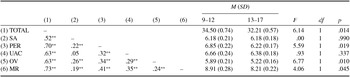
Means and standard deviations for the five subscales and the total score are presented in Table 1, together with the correlations between the five subscales and the total score.
Descriptives, Pearson correlations and F-test comparing CNCEQ-R total and subscale scores per age group

Notes: SA = selective abstraction, PER = personalizing without mind reading, UAC = underestimation of the ability to cope, OV = overgeneralizing, MR = mind reading.
**p < .001
Which cognitive errors predict anxiety?
A multiple regression was conducted to determine which cognitive errors were predictive of anxiety (Table 2). Using participants’ total scores on the cognitive error subscales, all CNCEQ-R subscales were entered simultaneously as predictors, with the total anxiety scores (MASC) as the dependent variable. The correlation coefficient of the model was significantly different from zero, F(5, 272) = 22.82, p < .001, with an adjusted R 2 of .28. The R 2 of .30 indicated that cognitive errors explained 30% of the variance in anxiety. The errors “underestimation of the ability to cope” and “mind reading” were the only significant predictors of anxiety. “Selective abstraction” showed an inverse, and nonsignificant, semipartial correlation with anxiety.
Multiple regression analyses predicting anxiety (MASC) and depression (CDI) (N = 278)

Notes: UAC = underestimation of the ability to cope; OV = overgeneralizing; PER = personalizing without mind reading; SA = selective abstraction; MR = mind reading.
* p < .01. ** p < .001.
Which cognitive errors predict depression?
To examine which cognitive errors predict depression, a second linear regression analysis was conducted (Table 2). Again, all subscales were entered simultaneously as predictors, with the total depression scores (CDI) as the dependent variable. The model differed significantly from zero, F(5, 272) = 10.02, p < .001. An R 2 of .16 showed that 16% of the variance in depression scores was explained by cognitive errors. The adjusted R 2 was .14. The errors “selective abstraction” and “overgeneralizing” were the only significant predictors for depression, with “selective abstraction” explaining most variance.
Does age influence the occurrence of cognitive errors?
A chi-square test revealed no gender differences between the group of children and adolescents (χ2(1) = 0.842, p > .05). Group cognitive error scores were compared using a MANOVA-test, with “age group” entered as an independent variable and “cognitive error subscales and total score” as dependent variables. Levene's test showed that group variances were equal, indirectly assuring that slightly different group sizes did not affect the results. Using Pillai's trace, there were significant differences between the groups on their scores on cognitive errors, V = 0.41, F(5, 271) = 2.29, p = 0.46. Separate univariate ANOVAs revealed significant differences per age group on four occasions. On the total scale, the 9–12-year-olds reported a higher score than the 13–17-year-olds. On the “overgeneralizing” subscale the 9–12-year-olds also scored higher than the 13–17-year-olds, as well as on the “personalizing without mind reading” and “mind reading” subscales (Table 1).
Discussion
The present study investigated associations between specific negative cognitive errors and anxiety and depression in children and adolescents. Results showed that the only predictors of anxiety symptoms were the negative cognitive errors of “underestimation of the ability to cope” and “mind reading.” These results are in line with those of Maric et al. (Reference Maric, Heyne, Van Widenfelt and Westenberg2011), who added these scales to the CNCEQ-R questionnaire with the intent to measure cognitive errors theorized to relate to anxiety. Symptoms of depression were predicted by the errors of “selective abstraction” and “overgeneralizing,” with “selective abstraction” being the strongest predictor. In comparison to adolescents, children reported higher scores on the total CNCEQ-R score, and on the errors “overgeneralizing”, “personalizing”, and “mind reading”.
“Selective abstraction” in Maric et al. (Reference Maric, Heyne, Van Widenfelt and Westenberg2011) showed a negative relation to anxiety symptoms. This was also the case in the current study in which, moreover, “selective abstraction” was positively related to depressive symptoms. Similarly, Weems et al. (Reference Weems, Berman, Silverman and Saavedra2001) had found “selective abstraction” to be a stronger predictor of depression than of anxiety. The error “selective abstraction”, together with the errors “underestimation of the ability to cope” and “mind reading” may therefore have the potential to discriminate between anxious and depressive symptomatology.
The error of “overgeneralizing” also predicted depressive symptoms, but its unique relation to depression was modest. Further, in Maric et al. (Reference Maric, Heyne, Van Widenfelt and Westenberg2011), who included a measure of anxiety but not of depression, “overgeneralizing” predicted anxiety symptoms in a normal population. In studies among clinically depressed or anxious children, where measures of both anxiety and depression were used, “overgeneralizing” predicted both (Epkins, Reference Epkins1996; Weems et al., Reference Weems, Berman, Silverman and Saavedra2001). Therefore its ability to distinguish between anxiety and depression thus far seems limited.
Contrary to expectation, the error “personalizing without mind reading” did not predict depression (nor did it predict anxiety). It did not correlate with depression when controlling for the other errors. Maric et al. (Reference Maric, Heyne, Van Widenfelt and Westenberg2011) found similar results in the case of its relation to anxiety; they theorized that after the changes the scale had undergone, “personalizing without mind reading” had become a purer measure for internal attributions for negative events, and thereby a measure for depression. This supposition, however, was not supported by the current study. Although therefore the scale may be useful as an indication of the extent a child makes the error of “personalizing”, it does not appear to discriminate between depressive versus anxious symptoms.
Notably, no cognitive error predicted both anxiety and depression. This is perhaps a surprising contrast to the general, undifferentiated negative cognition assumed in models of anxiety and depression (the tripartite model; Clark and Watson, Reference Clark and Watson1991). In contrast to previous reports (e.g. Marien and Bell, Reference Marien and Bell2004), our results seem to suggest that different types of negative cognitions are uniquely related to anxiety or depression in children and adolescents. Potentially, this may be related to the low correlation between anxiety and depression measures used in our study. This hypothesis needs to be tested in larger and clinical samples, taking into account that the nature of comorbidity between anxiety and depression can differ across development. At the same time, it is possible that there are specific errors that are related to both anxiety and depression, such as the error of “overgeneralizing”.
Additionally, our study showed that children exhibited significantly more negative cognitive errors than adolescents on the total scale and on the errors “overgeneralizing”, “personalizing without mind reading” and “mind reading”. These results follow those of Karakaya et al. (Reference Karakaya, Coskun, Agaoglu, Oc, Cakin Memik and Sismanlar2007) and Leitenberg et al. (Reference Leitenberg, Yost and Carroll-Wilson1986), who found that 9–10-year-olds reported more cognitive errors than 13–14-year-olds on the CNCEQ total scale, and on the “personalizing” and “catastrophizing” subscales. In a group of 11–15-year-olds, Flouri and Panourgia (Reference Flouri and Panourgia2011) found that the younger the child, the higher the score on the CNCEQ total scale, as well as on all subscales. Leitenberg et al. (Reference Leitenberg, Yost and Carroll-Wilson1986) assumed that younger children scored higher on “personalizing” because their thinking is more egocentric and they therefore tend to blame themselves for negative events. Findings on age differences are inconsistent, however; Cole and Turner (Reference Cole and Turner1993), for example, found that 13–15 year olds reported higher total scores on the CNCEQ than 9–10 year olds, and Weems et al. (Reference Weems, Berman, Silverman and Saavedra2001) found no effect of age on subscale scores, while they did find that the relationship between anxiety scores and the errors of “catastrophizing” and “personalizing” was stronger for adolescents than it was for children. So although our findings are consistent with several previous studies, a few other studies found contradictory results. For a clearer understanding of an effect of age on cognitive errors, studies among much larger groups of children and adolescents than in the studies mentioned are recommended, as well as, ideally, longitudinal studies on the development of cognitive errors over time. As age is not a perfect indicator of developmental level, such studies should preferably control for developmental level (e.g. logical reasoning) that could potentially influence children's reports of cognitive errors. For the same reason, language comprehension levels prior to the administration of the CNCEQ-R may be assessed.
Some issues concerning the study merit consideration. First, although factor analysis of the CNCEQ-R resulted in the expected 5-factor solution, the analyses also showed that five items did not load on the expected error categories (Maric et al., Reference Maric, Heyne, Van Widenfelt and Westenberg2011). The 5-factor solution (also found by Maric et al., Reference Maric, Heyne, Van Widenfelt and Westenberg2011), however, is an improvement over the one-factor solution (Cole and Turner, Reference Cole and Turner1993; Kingery et al., Reference Kingery, Kepley, Ginsburg, Walkup, Silva and Hoyle2009; Messer et al., Reference Messer, Kempton, Van Hasselt, Null and Bukstein1994; Stewart et al., Reference Stewart, Kennard, Lee, Hughes, Mayes and Emslie2004) and the three-factor solution (Karakaya et al., Reference Karakaya, Coskun, Agaoglu, Oc, Cakin Memik and Sismanlar2007) found for the original CNCEQ, and suggests that, in contrast with the CNCEQ, the CNCEQ-R measures more clearly distinct error categories. At the same time, although five items did not load on the expected error categories, we also found the same results as Maric et al. (Reference Maric, Heyne, Van Widenfelt and Westenberg2011) with regard to associations between anxiety and specific cognitive errors (i.e. “underestimation of the ability to cope” and “mind reading”). However, the quality of the factor solution would likely improve if items were further refined to better illustrate the different error categories. Second, the reliability of the subscales was low; this may be a result of the small number of items in each subscale and may be improved through the addition of extra items to each subscale. Third, this study, as well as the initial study using the CNCEQ-R (Maric et al., Reference Maric, Heyne, Van Widenfelt and Westenberg2011), was held among a community sample of children and adolescents. To learn about the relationship between specific cognitive error categories and clinical depression and anxiety, the CNCEQ-R should be tested among clinically depressed, anxious and depressed-anxious youth.
Conclusions
To conclude, our study showed distinct cognitive errors to be uniquely related to symptoms of either anxiety or depression. In addition, younger children were found to make specific cognitive errors more frequently than older children. The results of this study lend support to the theory that anxiety and depression in youth are characterized by distinct cognitive processes, as well as to the practice of adapting the focus of the treatment and the type of intervention techniques in accordance with cognitive differences between children. In terms of future research, our results also seem to justify the investigation of anxiety-specific and depression-specific cognitive errors as mediators of CBT outcome for youth with either an anxiety or a depressive disorder. The results of our study also indicate that the CNCEQ-R is an improvement over the CNCEQ in terms of measuring errors specifically related to anxiety versus depression, and as such can be a valuable instrument for assessment and treatment purposes. Although its specific psychometric properties in a clinical population are yet to be fully tested, these initial results on the CNCEQ-R show that this questionnaire can be a useful aid in diagnosis and the measurement of the progress and effect of therapy in anxious and depressive youth.




Comments
No Comments have been published for this article.