Introduction
Very little information exists on the relationships between flowering insects and many plant species in Cameroon. Nevertheless, it is known that generally anthophilous insects, and bees in particular, usually increase the fruit and seed yields of many plant species through pollination provision (Keller and Waller, Reference Keller and Waller2002; Fluri and Frick, Reference Fluri and Frick2005; Sabbahi et al., Reference Sabbahi, De Oliveira and Marceau2005; Klein et al., Reference Klein, Vaissière, Cane, Steffan-Dewenter, Cunnigham, Kremen and Tscharntke2007; Tchuenguem Fohouo et al., Reference Tchuenguem Fohouo, Djonwangwe, Messi and Brückner2009a). The genus Callistemon is an annual plant that originated from Australia. It is now established in many regions of the world. It is an evergreen tree, and its inflorescences have 8–68 flowers. The flowers are red, hermaphroditic and produce nectar and pollen that attract insects (Tchuenguem Fohouo, Reference Tchuenguem Fohouo2005). Each flower opens in the morning and remains open until it fades 3–7 days later (Tchuenguem Fohouo et al., Reference Tchuenguem Fohouo, Messi, Brückner, Bouba, Mbofung and Hentchoya Hemo2004). In Cameroon, Callistemon rigidus R. Br. 1819 (Myrtaceae) is planted for ornamental purposes. In this country, the demand for C. rigidus plants is high and their seed yields are low. It is therefore important to investigate how to improve the yield of this ornamental Myrtaceae in Cameroon. The relationships between C. rigidus and anthophilous insects such as honeybees have not been well studied in Cameroon. Preliminary studies by Tchuenguem Fohouo (Reference Tchuenguem Fohouo2005) have shown that at Ngaoundéré, Apis mellifera adansonii Latreille (Hymenoptera: Apidae) visits C. rigidus flowers to harvest both nectar and pollen and increases its pollination possibilities. There has been no previous research reported on the pollination efficiency of A. m. adansonii on C. rigidus flowers. This study was carried out to assess the foraging activity of A. m. adansonii workers on C. rigidus flowers during the rainy season and the effects of pollination efficiency of A. m. adansonii on yields of the Myrtaceae.
Materials and methods
Study site and biological material
The experiment was carried out twice, first from June to August 2009 and then from July to September 2010 at Dang, a village of Ngoundéré in the Adamaoua Region of Cameroon, within the University campus. This region belongs to the high-altitude Guinea Savanna agro-ecological zone. The climate is characterized by two seasons: a rainy season (April–October) and a dry season (November–March). The annual rainfall is about 1500 mm. The mean annual temperature is 22 °C, while the mean annual relative humidity is 70%. At the study site, there were 246 C. rigidus trees in bloom in 2009 and 2010. Plants chosen for observations were located in an area 3 km in diameter, centred on a Kenyan top-bar hive inhabited by an A. m. adansonii colony. The hive is located at a latitude of 7°24.949′N and a longitude of 13°32.870′E (altitude, 1093 m above sea level). The number of honeybee colonies located in this area varied from 31 in June 2009 to 51 in October 2010. The vegetation represented included crops, ornamental, hedge and native plants of the savanna, and gallery forests.
Estimation of the frequency of A. m. adansonii in the flowers of C. rigidus
On 29 June 2009, 40 C. rigidus plants that had started to bloom were labelled at the University campus. On these plants, 240 inflorescences with flowers at the bud stage were labelled; of these, 120 were left unattended (treatment 1) and 120 were bagged (treatment 2) to prevent visitors (Roubik, Reference Roubik1995). There were three unattended inflorescences and three bagged inflorescences per tree. On 20 July 2010, 240 inflorescences of C. rigidus with flowers at the bud stage were labelled; of these, 120 were left for unlimited visits (treatment 3) and 120 were bagged (treatment 4). The frequency of A. m. adansonii in the flowers of C. rigidus was determined based on observations on inflorescences of treatments 1 and 3, every day, from 3 to 13 August 2009 and from 24 July to 12 August 2010, at 06.00–07.00, 08.00–09.00, 10.00–11.00, 12.00–13.00, 14.00–15.00 and 16.00–17.00 h. In a slow walk along all labelled inflorescences of treatments 1 and 3, the identity of all insects that visited C. rigidus flowers was recorded. Specimens of all insect taxa were caught with an insect net on unlabelled flowers, and conserved in 70% ethanol for subsequent taxonomy determination. All insects encountered on flowers were registered and the cumulated results expressed as the number of visits to determine the relative frequency of A. m. adansonii in the anthophilous entomofauna of C. rigidus (Tchuenguem Fohouo, Reference Tchuenguem Fohouo2005).
In addition to the determination of the floral insect frequency, direct observation of foraging activity on flowers was made on insect pollinator fauna in the experimental field. The floral products (nectar or pollen) harvested by A. m. adansonii during each floral visit were registered based on its foraging behaviour. Nectar foragers were seen extending their proboscis to the base of the corolla and the stigma, while pollen gatherers scratched the anthers with the mandibles or the legs. In the morning of each sampling day, the number of opened flowers carried by each labelled inflorescence was counted.
On the same days as for the frequency of visits, the duration of individual flower visit was recorded (using a stopwatch) at least three times during each of the following daily time frames: 07.00–08.00, 09.00–10.00, 11.00–12.00, 13.00–14.00, 15.00–16.00 and 17.00–18.00 h. Moreover, the number of pollinating visits (the bee came into contact with the stigma: Jacob-Remacle, Reference Jacob-Remacle1989; Freitas, Reference Freitas1997; Tchuenguem Fohouo, Reference Tchuenguem Fohouo2005), the abundance of foragers (highest number of individuals foraging simultaneously on a flower or on 1000 flowers: Tchuenguem Fohouo et al., Reference Tchuenguem Fohouo, Messi, Brückner, Bouba, Mbofung and Hentchoya Hemo2004) and the foraging speed (number of flowers visited by a bee per minute: Jacob-Remacle, Reference Jacob-Remacle1989) were measured. Abundance per flower was recorded following the direct counting, on the same dates and daily periods as for the registration of the duration of visits. For the abundance per 1000 flowers (A 1000), some foragers were counted on a known number of flowers. A 1000 was then calculated by the formula:

where F x and A x are the number of opened flowers and the number of foragers effectively counted on these flowers at time x (Tchuenguem Fohouo et al., Reference Tchuenguem Fohouo, Messi, Brückner, Bouba, Mbofung and Hentchoya Hemo2004). The disruption of the activity of foragers by competitors or predators and the attractiveness exerted by other plant species on A. m. adansonii were assessed.
During each daily period of investigations, a mobile thermo-hygrometer was used to register the temperature and the relative humidity at the station.
Evaluation of the effect of A. m. adansonii and other insects on C. rigidus yields
This evaluation was based on the impact of flower-visiting insect on pollination, the impact of pollination on fruiting of C. rigidus, and the comparison of yields (fruiting rate, mean number of seeds per fruit and percentage of normal seeds) of treatment X (unlimited inflorescences) and treatment Y (bagged inflorescences) (Roubik, Reference Roubik1995). The fruiting rate due to the influence of foraging insects (Fri) was calculated by the formula:

where FrX and FrY are the fruiting rate in treatment X and treatment Y. The fruiting rate (Fr) is:

where F2 is the number of fruits formed and F1 the number of viable flowers initially set (Tchuenguem Fohouo et al., Reference Tchuenguem Fohouo, Messi and Pauly2001). At maturity, fruits were harvested from each treatment and the number of seeds per fruit counted. The mean number of seeds per fruit and the percentage of normal seeds were then calculated for each treatment. The impact of flower-visiting insects on seed yields was evaluated using the same method as mentioned above for fruiting rate.
Assessment of the pollination efficiency of A. m. adansonii on C. rigidus
Parallel to the formation of treatments 1 and 2, 100 inflorescences were isolated (treatment 5) as those of treatment 2 (Roubik, Reference Roubik1995). Parallel to the formation of treatments 3 and 4, 100 inflorescences were isolated (treatment 6) as those of treatment 4. Between 10.00 and 12.00 h of each observation date, the gauze bag was delicately removed from each inflorescence carrying new opened flowers, and this inflorescence was observed for up to 20 min. The inflorescence was protected once more.
The contribution (Frx) of A. m. adansonii in the fruiting was calculated by the formula:

where FrZ and FrY are the fruiting rate in treatment Z (bagged inflorescences and flowers visited exclusively by A. m. adansonii) and treatment Y (bagged inflorescences). At maturity, fruits were harvested from treatments 5 and 6 and the number of seeds per fruit counted. The mean number of seeds per fruit and the percentage of normal seeds were then calculated for each treatment. The impact of A. m. adansonii on seed yields was evaluated using the same method as described above for fruiting rate.
Data analysis
Data were analysed using descriptive statistics, Student's t-test for the comparison of means of the two samples, correlation coefficient (r) for the study of the association between two variables and χ2 for the comparison of percentages using Microsoft Excel software.
Results
Frequency of floral entomofauna of C. rigidus
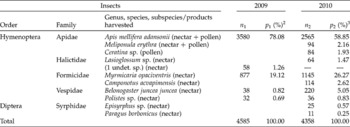
Among the 4585 and 4358 visits of five and ten insect species recorded on C. rigidus flowers in 2009 and 2010, respectively, A. m. adansonii was the most represented insect with 3580 visits (78.08%) and 2565 visits (58.85%), in 2009 and 2010, respectively (Table 1). The difference between these two percentages is highly significant (χ2 = 384.06; P < 0.001).
Diversity of floral insects on Callistemon rigidus inflorescences in 2009 and 2010, and number and percentage of visits of different insects1

n 1, number of visits on 120 inflorescences in 11 days; n 2, number of visits on 120 inflorescences in 17 days; p 1 and p 2, percentages of visits; undet. sp., undetermined species.
1 Comparison of percentages of A. m. adansonii visits for 2 years: χ2 = 384.06; P < 10− 9.
2 p 1 = (n 1/4585) × 100.
3 p 2 = (n 2/4358) × 100.
In 2009, the highest mean number of A. m. adansonii simultaneous in activity was one per flower (n = 400; s = 0) and 488 per 1000 flowers (n = 30; s = 1.60; maximum = 566). In 2010, the corresponding numbers were also one (n = 400; s = 0) and 462 (n = 100; s = 2.40; maximum = 575). The difference between the mean number of foragers per 1000 flowers in 2009 and 2010 is highly significant (t = 68.77; P < 0.001).
Flowers of C. rigidus were visited by Apidae (A. m. adansonii and Meliponula erythra) to collect nectar and pollen. Apidae (Ceratina sp.), Halictidae (Lasioglossum sp.), Formicidae (Myrmicaria opaciventris and Camponotus acvapimensis), Vespidae (Belonogaster juncea juncea and Polistes sp.) and Syrphidae (Episyrphus sp. and Paragus borbonicus) collected nectar.
Activity of A. m. adansonii on C. rigidus flowers
Floral products harvested
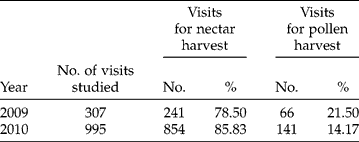
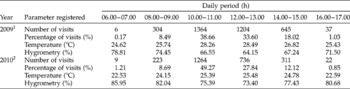
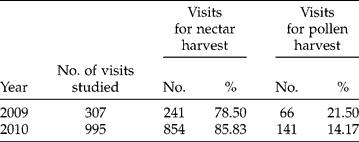
From our field observations, nectar collection by A. m. adansonii workers in C. rigidus flowers was found to be regular and intensive, whereas pollen collection was low. In 307 and 995 visits counted on flowers, 241 (78.50%) and 854 (85.83%) were for nectar collection, and 66 (21.50%) and 141 (14.17%) for pollen collection, respectively, in 2009 and 2010. Nectar collection occurred all day long, whereas pollen collection occurred only in the mornings (Table 2). Some individuals collected both nectar and pollen during the same floral visit.
Products harvested by Apis mellifera adansonii on flowers of Callistemon rigidus in 2009 and 2010
Rhythm of visits according to the flowering stages
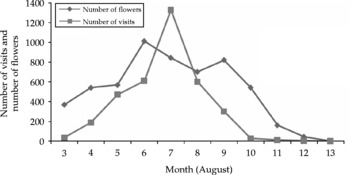
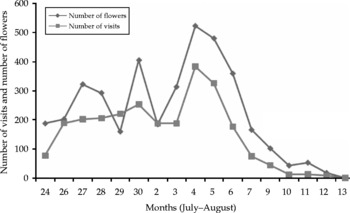
Visits were most numerous when the number of open flowers was highest (Figs 1 and 2): a positive and significant correlation was found between the number of C. rigidus opened flowers and the number of A. m. adansonii visits in 2009 (r = +0.71; df = 9; P < 0.05) as well as in 2010 (r = +92; df = 15; P < 0.001).
Seasonal distribution of the number of Callistemon rigidus opened flowers and the number of Apis mellifera adansonii visits in 2009

Seasonal distribution of the number of Callistemon rigidus opened flowers and the number of Apis mellifera adansonii visits in 2010

Daily rhythm of visits
Apis mellifera adansonii foraged on C. rigidus flowers throughout the blooming period, with a peak of activity between 10.00 and 11.00 h daily (Table 3). Climate influenced the activity of A. m. adansonii. In 2009 and 2010, the correlation was positive and significant (r = +0.98; df = 4; P < 0.05; r = +0.83; df = 4; P < 0.05) between the number of A. m. adansonii visits on C. rigidus flowers and the temperature, while it was negative and significant (r = − 0.84; df = 4; P < 0.05; r = − 0.78; df = 4; P < 0.05) between the number of visits and relative humidity.
Daily distribution of Apis mellifera adansonii visits on 120 Callistemon rigidus inflorescences over 10 days in 2009 and 16 days in 2010, and mean temperature and humidity of the study site

1 For temperature and hygrometry, each figure represents the means of 60 observations.
2 For temperature and hygrometry, each figure represents the means of 96 observations.
Duration of visits per flower
The mean duration of A. m. adansonii visits per C. rigidus flower varied significantly according to the type of food harvested. In 2009, the mean duration of a visit was 4.62 s (n = 241; s = 5.27), with a maximum of 45 s for nectar harvest, against 1.84 s (n = 66; s = 3.14), with a maximum of 17 s for pollen collection. In 2010, the corresponding figures were 3.50 s (n = 854; s = 1.60), with a maximum of 8 s for nectar, against 1.65 s (n = 141; s = 2.34), with a maximum of 4 s for pollen harvest. The difference between the duration of the visit to harvest nectar and pollen is highly significant (t 2009 = 5.40; P < 0.001 and t 2010 = 9.05; P < 10− 9). Furthermore, the difference between the duration of the visit to harvest nectar in 2009 and 2010 is highly significant (t = 3.26; P < 0.001), whereas the difference between the duration of visit for pollen in 2009 and 2010 is not significant (t = 0.44; P>0.05).
Foraging speed of A. m. adansonii on C. rigidus flowers
On C. rigidus plants, A. m. adansonii visited between 3 and 45 flowers/min in 2009 and between 3 and 25 flowers/min in 2010. The mean foraging speed was 17.88 flowers/min (n = 238; s = 5.27) in 2009 and 16.08 flowers/min (n = 515; s = 6.80) in 2010. These means are significantly different (t = 3.96; P < 0.001).
Influence of neighbouring flora
During the observation period, A. m. adansonii workers visited flowers of many other plant species growing in the study area for nectar (n) and/or pollen (p). Among these plants were Tithonia diversifolia (Asteraceae; n and p); Mimosa invisa (Mimosaceae; p), Bidens pilosa (Asteraceae; p), Waltheria indica (Sterculiaceae; n and p), Arachis hypogaea (Fabaceae; p), Phaseolus vulgaris (Fabaceae; n), Senna mimosoides (Mimosaceae; p); Brachiaria brizantha (Fabaceae; p) and Gossypium hirsutum (Malvaceae; n and p). While honeybees were seen visiting these other species, on any one foraging trip, they were more likely to specialize in a particular focal plant species. During one foraging trip, an individual bee foraging on C. rigidus scarcely visited another plant species (for each plant species studied, not more than three observations of such behaviour, for the study period).
Impact of anthophilous insects on pollination and on the fruit and seed yields of C. rigidus
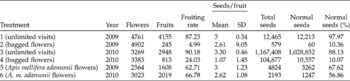
During nectar and/or pollen harvest on C. rigidus, foraging insects always shook flowers and regularly contacted anthers and stigma, increasing the cross-pollination possibility of C. rigidus. The comparison of the fruiting rate (Table 4) shows that differences observed are highly significant between treatments 1 and 2 (χ2 = 6592.02; df = 1; P < 0.001), and treatments 3 and 4. Consequently, in 2009 and 2010, the fruiting rate of unprotected flowers (treatments 1 and 3, respectively) was higher than that of protected inflorescences (treatments 2 and 4, respectively).
Callistemon rigidus yields under pollination treatments

SD, standard deviation.
The comparison of the mean number of seeds per fruit (Table 4) shows that the differences observed are highly significant between treatments 1 and 2 (t = 848; P < 0.001), and treatments 3 and 4 (t = 43.26; P < 0.001). Consequently, in 2009 and 2010, the number of seeds per fruit of exposed flowers (treatments 1 and 3, respectively) was higher than that of protected inflorescences (treatments 2 and 4, respectively).
The comparison of the percentages of normal seeds (well developed) (Table 4) shows that the observed differences were highly significant between treatments 1 and 2 (χ2 = 7637.30; df = 1; P < 0.001), and treatments 3 and 4 (χ2 = 392,185.45; df = 1; P < 0.001). Consequently, in 2009 and 2010, the percentage of normal seeds of exposed flowers (treatments 1 and 3, respectively) was higher than that of protected inflorescences (treatments 2 and 4, respectively).
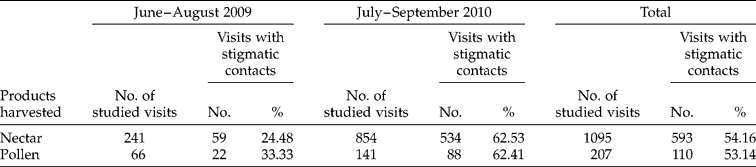
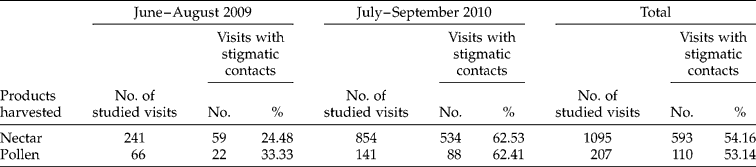
The percentages of the fruiting rate due to the action of flower-visiting insects were 24.48% in 2009 and 62.53% in 2010 (Table 5). For the 2 years of study, the percentage of the fruiting rate attributed to the influence of insects was 83.82%.
Number and frequency of contacts between Apis mellifera adansonii and the stigma during floral visits to Callistemon rigidus
The percentage of the number of seeds per fruit due to A. m. adansonii was 33.33% in 2009 and 62.41% in 2010 (Table 5). For the 2 years of study, the percentage of the number of seeds per fruit attributable to the influence of A. m. adansonii was 83.82%.
The percentages of the normal seeds due to the action of insects were 89.43% in 2009 and 88.55% in 2010. For the 2 years of study, the percentage of the normal seeds due to flower-visiting insects was 88.99%.
Pollination efficiency of A. m. adansonii on C. rigidus
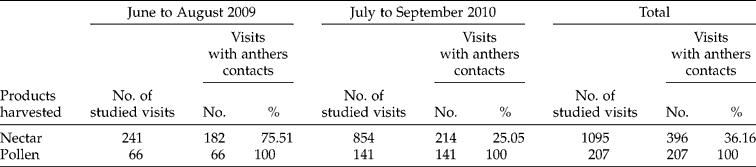
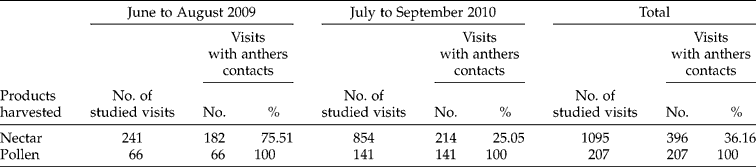
During the collection of pollen or nectar on flowers, foragers regularly contacted anthers and carried pollen. With this pollen, they flew frequently from flower to flower. The percentage of the number of visits for nectar harvest during which worker bees came into contact with the stigma of the visited flower was 24.48% in 2009 and 62.53% in 2010. The percentage of the number of visits for pollen harvest during which worker bees came into contact with the stigma of the visited flower was 33.33% in 2009 and 62.41% in 2010. The percentage of the total number of visits during which worker bees came into contact with the stigma of the visited flower was 53.14% for pollen harvest and 54.16% for nectar harvest (Table 5). The percentage of the total number of visits during which worker bees came into contact with anthers was 100% for pollen harvest and 36.16% for nectar harvest (Table 6). Thus A. m. adansonii greatly increased the pollination possibilities of C. rigidus flowers.
Number and frequency of contacts between Apis mellifera adansonii and anthers during floral visits to Callistemon rigidus
The comparison of the fruiting rate (Table 4) showed that the differences observed were highly significant between treatments 2 and 5 (χ2 = 3005.45; df = 1; P < 0.001), treatments 4 and 6 (χ2 = 1183.24; df = 1; P < 0.001) and treatments 5 and 6 (χ2 = 10.11; df = 1; P < 0.001). Consequently, in 2009 and 2010, the fruiting rate of flowers bagged and visited exclusively by A. m. adansonii (treatments 5 and 6, respectively) was higher than that of flowers bagged during their flowering period (treatments 2 and 4, respectively).
The comparison of the mean number of seeds per fruit (Table 4) shows that the differences observed are highly significant between treatments 2 and 5 (t = 8.28; P < 0.001), and treatments 4 and 6 (t = 27.56; P < 0.001). Consequently, in 2009 and 2010, the number of seed yields per fruit of flowers bagged and visited exclusively by A. m. adansonii (treatments 5 and 6, respectively) was higher than that of flowers bagged during their flowering period (treatments 2 and 4, respectively).
The comparison of the percentages of normal seeds (Table 4) shows that the differences are highly significant between treatments 2 and 5 (χ2 = 715.67; df = 1; P < 0.001), and treatments 4 and 6 (χ2 = 4795.67; df = 1; P < 0.001). Consequently, in 2009 and 2010, the percentage of normal seeds of flowers bagged and visited exclusively by A. m. adansonii (treatments 5 and 6, respectively) was higher than that of flowers bagged during their opening period (treatments 2 and 4, respectively).
The percentage of the fructification rate due to A. m. adansonii activity was 92.04% in 2009 and 64% in 2010. For the 2 years of study, the percentage of fructification rate attributed to the influence of A. m. adansonii was 78.92%.
The percentage of the number of seeds per fruit due to A. m. adansonii was 38.67% in 2009 and 59.16% in 2010. For the 2 years of study, the percentage of the number of seeds per fruit attributable to the influence of A. m. adansonii was 48.92%.
The percentage of the normal seeds due to A. m. adansonii was 84.67% in 2009 and 82.30% in 2010. For the 2 years of study, the percentage of the number of seeds per fruit attributable to the influence of A. m. adansonii was 83.48%.
In short, the influence of A. m. adansonii on fruit and seed yields was positive and significant. A positive and highly significant correlation was found between the number of fruits and the number of A. m. adansonii visits on C. rigidus inflorescences in 2009 (r = 0.49; df = 30; P < 0.001) as well as in 2010 (r = 0.73; df = 58; P < 0.001).
Discussion
Our study indicates that A. m. adansonii was the main floral visitor of C. rigidus followed by M. opaciventris during the observation periods. In a related study conducted in the same site, A. m. adansonii was ranked second in terms of flowering insects of the Myrtaceae, after this ant (Tchuenguem Fohouo, Reference Tchuenguem Fohouo2005). The significant difference between the visit frequencies of A. m. adansonii and those of other insects can be explained by the strategies adopted by this bee that consist of the recruiting of a great number of workers for the exploitation of an interesting nutritional source (von Frisch, Reference von Frisch and Michel1969; Louveaux, Reference Louveaux, Pesson and Louveaux1984; Schneider and Hall, Reference Schneider and Hall1997; Goodman, Reference Goodman2003; Kajobe, Reference Kajobe2006). Consequently, there may be a limitation of the number of visits of other insect species due to the occupation of the majority of open flowers by A. m. adansonii workers.
In Dang, Tchuenguem Fohouo (Reference Tchuenguem Fohouo2005) also registered a high nectar harvest and a low pollen collection on C. rigidus flowers by A. m. adansonii. This author found that 99.7, 92.8 and 92.8% of A. m. adansonii visits were devoted to nectar collection in the years 1996, 2000 and 2001, respectively, whereas for the corresponding years, 0.3, 7.2 and 7.2 of A. m. adansonii visits were devoted to pollen collection. The fact that pollen collection occurred during the morning only whereas nectar collection occurred throughout the day is in agreement with the observations of Tchuenguem Fohouo et al. (Reference Tchuenguem Fohouo, Nyomo, Hentchoya Hemo and Messi1997, Reference Tchuenguem Fohouo, Messi, Brückner, Bouba, Mbofung and Hentchoya Hemo2004).
According to Philippe (Reference Philippe1991), honeybees generally forage only when the temperature is between 12 and 38 °C. Our study shows that at Dang, ambient temperature was low, with a mean of 24.62 °C (n = 42; SD = 1.72) in 2009 and 22.53 °C (n = 32; SD = 1.02) in 2010 and the humidity was high, with a mean of 78.81% (n = 42; SD = 6.43) in 2009 and 85.95% (n = 32; SD = 4.57) in 2010 (Table 3). These conditions probably affected the activity of workers negatively. This could explain the lowest number of bee visits on C. rigidus flowers between 06.00 and 07.00 h (Table 3). Around 10.00 and 11.00 h, temperature and humidity were probably more favourable for bee activity. In 2009 and 2010, we found a positive and significant correlation between the number of visits and the temperature (r = +0.98; df = 4; P < 0.05; r = +0.83; df = 4; P < 0.05), but a negative and significant correlation between the number of visits and the humidity (r = − 0.84; df = 4; P < 0.05; r = − 0.78; df = 4; P < 0.05), respectively (Table 3).
The high abundance of workers per 1000 flowers, and the positive and significant correlation between the number of C. rigidus flowers and the number of honeybee visits, underscore the attractiveness of C. rigidus nectar for A. m. adansonii. The attractiveness for C. rigidus nectar could be partially explained by its concentration in total sugars (mean 46.19%: Tchuenguem Fohouo, Reference Tchuenguem Fohouo2005), at the relatively higher end of the range of 15–75% sugar concentration in which most of the plant species fall (Proctor et al., Reference Proctor, Yeo, Lack, Corbet, Walters, Richard, Streeter and Ratcliffe1996).
Significant differences observed between the duration of nectar harvest visit and that of pollen harvest could be explained by the accessibility of each of these floral products. Pollen is produced by the anthers, which are on the top of the stamens and are thus easily accessible to A. m. adansonii, whereas nectar is between the base of the style and stamens and is thus less accessible (Tchuenguem Fohouo et al., Reference Tchuenguem Fohouo, Messi, Brückner, Bouba, Mbofung and Hentchoya Hemo2004). Under these conditions, an individual bee must spend much more time on flowers to obtain its nectar load, compared with the time needed for the collection of pollen.
The disruption of visits by other insects reduced the duration of certain A. m. adansonii visits. This obliged some workers to visit more flowers during a foraging trip to maximize their pollen or nectar loads. Similar observations have been made in A. m. adansonii workers foraging on the flowers of: Entada africana (Fabaceae) and Psidium guajava (Myrtaceae) (Tchuenguem Fohouo et al., Reference Tchuenguem Fohouo, Djonwangwe, Messi and Brückner2007); Croton macrostachyus (Euphorbiaceae) and Syzygium guineense var. guineense (Myrtaceae) (Tchuenguem Fohouo et al., Reference Tchuenguem Fohouo, Djonwangwe, Messi and Brückner2008a); Persea americana (Lauraceae) and Vitellaria paradoxa (Sapotaceae) (Tchuenguem Fohouo et al., Reference Tchuenguem Fohouo, Djonwangwe and Brückner2008b); Vigna unguiculata (Fabaceae) (Tchuenguem Fohouo et al., Reference Tchuenguem Fohouo, Ngakou and Kengni2009b); and Meliponula erythra (Hymenoptera: Apidae) foraging on the flowers of Dacryodes edulis (Burseraceae) (Kengue et al., Reference Kengue, Tchuenguem Fohouo and Adewusi2002).
The bee foragers had a high affinity with respect to C. rigidus compared with the neighbouring plant species, indicating their faithfulness to this Myrtaceae, a phenomenon known as ‘floral constancy’ (Louveaux, Reference Louveaux, Pesson and Louveaux1984; Backhaus, Reference Backhaus1993; Basualdo et al., Reference Basualdo, Bedascarrasbure and De Jong2000). This flower constancy could be partially due to the high sugar content of the nectar. Indeed, it is known that the workers of A. m. adansonii are generally constant on a plant species when the concentration in sugars of its nectar is more than 15% (Philippe, Reference Philippe1991). The fidelity of A. mellifera has been demonstrated on flowers of several other plant species among which are Persea americana (Valdeyron, Reference Valdeyron, Pesson and Louveaux1984), Helianthus annuus (Basualdo et al., Reference Basualdo, Bedascarrasbure and De Jong2000; Tchuenguem Fohouo et al., Reference Tchuenguem Fohouo, Djonwangwe, Messi and Brückner2009a), Vigna unguiculata (Tchuenguem Fohouo et al., Reference Tchuenguem Fohouo, Ngakou and Kengni2009b), Combretum nigricans, Erythrina sigmoidea, Lannea kerstingii and Vernonia amygdalina (Tchuenguem Fohouo et al., Reference Tchuenguem Fohouo, Fameni Tope, Mbianda Pharaon, Messi and Brückner2010), Ximenia americana (Djonwangwe et al., Reference Djonwangwe, Tchuenguem Fohouo and Messi2011a) and Syzygium guineense var. guineense (Myrtaceae) (Tchuenguem Fohouo et al., Reference Tchuenguem Fohouo, Djonwangwe, Messi and Brückner2008a; Djonwangwe et al., Reference Djonwangwe, Tchuenguem Fohouo, Messi and Brückner2011b).
As a highly nectariferous and slightly polliniferous bee plant, C. rigidus can be planted and protected to increase honey production and to strengthen honeybee colonies, as earlier studies in Dang have suggested (Tchuenguem Fohouo, Reference Tchuenguem Fohouo2005).
During the collection of nectar and pollen on each flower, A. m. adansonii workers regularly come into contact with the stigma and anthers. They could thus enhance auto-pollination, which has been demonstrated in the past (Tchuenguem Fohouo, Reference Tchuenguem Fohouo2005). Apis mellifera adansonii could provide allogamous pollination through carrying of pollen on their fur, legs and mouth accessories, which is consequently deposited on another flower belonging to a different plant of the same species (geitogamy) or to a different plant of a different species (xenogamy). The intervention of A. m. adansonii foragers on the pollination of C. rigidus is especially probable since their density per 1000 flowers and their foraging speed are high. In addition, their daily period of intense activity on C. rigidus flowers, which was in the morning, coincided with the period of optimal receptivity of the stigma of this plant species (Tchuenguem Fohouo, Reference Tchuenguem Fohouo2005). The positive and significant contribution of A. m. adansonii in the fruiting of C. rigidus is justified by the action of this forager bee on self-pollination and cross-pollination. Nevertheless, the morphology of C. rigidus flowers seems to avoid auto-pollination and seems to favour cross-pollination (pollen is sticky; the style is longer than the stamens) (Tchuenguem Fohouo et al., Reference Tchuenguem Fohouo, Messi, Brückner, Bouba, Mbofung and Hentchoya Hemo2004). The latter mode of pollination could mainly explain the contribution of A. m. adansonii to fruit and seed yields. Higher productivity of flowers exposed to visits by A. m. adansonii only compared with that of flowers under unlimited visits by all kinds of visitors shows that this bee is a main pollinator of C. rigidus and thus can be targeted for managed pollination of this plant species. In flowers that rely on insects for cross-pollination, the pollen is difficult to carry by the wind, and anthers and stigma are usually separated by at least a small gap (Faegri and Pijl, Reference Faegri and Pijl1979; Proctor et al., Reference Proctor, Yeo, Lack, Corbet, Walters, Richard, Streeter and Ratcliffe1996). Thus C. rigidus appears to be a typical insect-cross-pollinated plant on which honeybees play the major pollinator role in Dang.
Conclusion
Callistemon rigidus is a highly nectariferous and slightly polliniferous bee plant that highly benefits from pollination by insects, among which A. m. adansonii is one of the most important. The comparison of fruit and seed set of unprotected inflorescences, with that of inflorescences visited exclusively by A. m. adansonii, underscores the value of this bee in increasing fruit and seed yields as well as seed quality. Based on our results, we recommend: (i) the installation of a A. m. adansonii colony in environments where C. rigidus occurs abundantly and (ii) the cultivation and/or protection of C. rigidus in the surroundings of A. m. adansonii apiaries.
Acknowledgements
We thank A. Pauly for his contribution to the identification of flowering insects and P. M. Mapongmetsem for the identification of plant species. The financial support from the International Foundation for Sciences (Stockholm, Sweden) and the United Nations University (Tokyo, Japan) (research grant to F.-N.T.F.; 3181-1) provided some equipment and contributed to the installation of honeybee colonies within the University campus.