Introduction
Sexuality issues are often considered ‘private affairs’. However, reproductive health, early pregnancy, HIV and other sexually transmitted infections, and other gender-based issues (e.g. decision-making and violence) have received considerable attention because they impact the developmental agenda of developing societies (Carmargo, 2006; Corrêa & Jolly, Reference Corrêa, Jolly and Cornwall2008; Evans, Reference Evans2020; Fiaveh, Reference Fiaveh2011). One clarion call towards the developmental narratives is the protection of the girl child from harmful socio-cultural practices such as female genital mutilation (FGM), also known as female genital cutting (Evans, Reference Evans2020).
According to the World Health Organization (WHO), FGM involves procedures leading to the partial or total removal of the external parts of the female genitalia and/or injury to the female genital organs for non-medical reasons (WHO, 2013). The term ‘female genital mutilation’ emerged from the terms ‘female circumcision’ and ‘female genital cutting’, with the word ‘mutilation’ differentiating the practice from male circumcision and emphasizing its rigorousness (Groeneveld, Reference Groeneveld2013). Within practising countries, FGM is considered as an important initiation rite or marker for girls going into their next stage of life through the transition from childhood to adulthood, and is often connected with cultural and habitual rites purported to enhance girls’ marriage prospects (Almroth et al., Reference Almroth, Almroth-Berggren, Hassanein, El Hadi, AlSaid and Hasan2001; Hernlund & Shell-Duncan, Reference Hernlund and Shell-Duncan2007; Mulongo et al., Reference Mulongo, McAndrew and Hollins Martin2014). Several socio-cultural reasons that have strongly accounted for the practice of FGM include special religious/ethnic beliefs, social norms, customs, rituals and social hierarchies, as well as political and socio-economic systems (Mulongo et al., Reference Mulongo, McAndrew and Hollins Martin2014; Ahinkorah et al., Reference Ahinkorah, Hagan, Ameyaw, Seidu, Budu, Sambah and Schack2020a).
Female genital mutilation is very pervasive in Africa, with significant regional variations in the prevalence of this traditional practice. Approximately 101 million girls over the age of 10 years have undergone FGM in Africa alone, with a further 3 million being at risk of undergoing FGM annually (WHO, 2013, 2020; Njue et al., Reference Njue, Karumbi, Esho, Varol and Dawson2019). According to UNICEF (2018), FGM is practised in over 28 African countries located around the Atlantic coast of the continent. In Africa, Mali and Sierra Leone are among the countries with an FGM prevalence of over 80% – specifically, 89% and 88%, respectively (UNICEF, 2013, 2016, 2018; WHO, 2020). What makes the practice of FGM in Mali and Sierra Leone more serious is that, in both countries, there is no legal ban on FGM and no explicit laws against the practice (Cetorelli et al., Reference Cetorelli, Wilson, Batyra and Coast2020; Ameyaw et al., Reference Ameyaw, Tetteh and Armah-Ansah2020).
Despite global efforts to eliminate FGM over the past decades by governments, non-governmental organizations, reputable institutions (e.g. UNICEF, WHO), and civil society groups, reports and research evidence indicate that this traditional procedure is still practiced in many societies, including Mali and Sierra Leone (Makhlouf Obermeyer, Reference Makhlouf Obermeyer2005; Van Rossem & Gage, Reference Van Rossem and Gage2009; WHO, 2013; Njue et al., Reference Njue, Karumbi, Esho, Varol and Dawson2019; WHO, 2020). The continuous practice of FGM is primarily driven by some socio-cultural narratives such as dignity and honour, control over sexuality, purity, rites of passage, tradition, and aesthetics (Yoder et al., Reference Yoder, Camara and Soumaoro1999; Jones et al., Reference Jones, Ehiri and Anyanwu2004; Rajadurai & Igras, Reference Rajadurai and Igras2005; Shaaban & Harbison, Reference Shaaban and Harbison2005). For example, maintaining honour and dignity is considered vital for preserving a family’s good name, with ‘despicable’ behaviour (e.g. inappropriate sexual behaviour) negatively affecting the family’s image. Therefore, girls and women are required to maintain their virginity before marriage (Hicks, Reference Hicks1993; Gruenbaum, Reference Gruenbaum2001).
What is unclear from these socio-cultural norms is whether FGM, rather than protecting women from sexual risk, instead exposes them to early sexual encounters with one or multiple partners to test their sexual readiness (i.e., sexual skills) for later adult life. Van Rossem and Gage (Reference Van Rossem and Gage2009) contended that there should be a strong link between FGM and woman’s sexual history, including her age at first sex, the possibility of premarital sex and/or multiple sexual partnership (MSP). Hence, FGM might trigger a sense of security and encourage ‘deviant’ sexual behaviour (Hicks, Reference Hicks1993; Gruenbaum, Reference Gruenbaum2001).
Most research on FGM has been dedicated to its health implications, criticizing the procedure, policies, personal experiences of women, and interventions (Makhlouf Obermeyer, Reference Makhlouf Obermeyer2005). There seems to have been little attention made to how FGM practice might relate to the sexual behaviour of girls and women (Mpofu et al., Reference Mpofu, Odimegwu, De Wet, Adedini and Akinyemi2017). To help attain the goal of averting the continuance of FGM, it is essential to better understand the socio-cultural factors that reinforce the procedure and facilitate appropriate interventions. These interventions could help change the socio-cultural practices that facilitate FGM and hinder the continuation of the practice. The current study was grounded on the premise that FGM, which is highly prevalent in Mali and Sierra Leone, might lead to MSP. Therefore, the central aim of this study was to ascertain whether undergoing FGM could be associated with MSP in these countries. Based on previous evidence, it is hypothesized that girls and women who have undergone FGM are more likely to have multiple sexual partners than their counterparts who have not undergone FGM.
Methods
Study design
The study used data from the women’s file of the 2018 Mali and 2013 Sierra Leone Demographic and Health Surveys (DHS). The DHS is a nationally representative survey that is conducted in over 85 low-and middle-income countries globally. The survey focuses on essential maternal and child health markers, including FGM and MSP (Corsi et al., Reference Corsi, Neuman, Finlay and Subramanian2012). It employs a two-stage stratified sampling technique, which makes the data nationally representative (see Aliaga & Ruilin, Reference Aliaga and Ruilin2006, for details of the sampling process). A total of 4750 women in Mali and 16,614 women in Sierra Leone who had complete information on all the variables of interest were included in the present study.
Definition of variables
Outcome variable
The outcome variable was ‘multiple sexual partnership’. This was derived from the question, ‘Apart from your spouse, have you had any other sexual partners in the last 12 months?’ Those who indicated that they had had at least one other sexual partner apart from their spouse were considered to practice MSP (yes=1), with those indicating otherwise considered not to practise MSP (no=0).
Independent variable
The study considered FGM to be the independent variable. To derive this variable, respondents were asked if their genital area ‘was nicked with nothing removed’, ‘[had] something removed’ or ‘[was] sewn shut’, with the responses ‘yes’ and ‘no’.
Control variables
Nine control variables were considered, grouped broadly into individual-, household- and community-level categories. Individual and household variables included age, educational level, employment status, wealth, exposure to mass media and sex of household head. The original DHS coding of age, wealth quintile and sex of household head was maintained, and the rest of the individual- and household-level variables were re-coded to make them suitable for the analyses. In the DHS, age was coded as 15–19, 20–24, 25–29, 30–34, 35–39, 40–44 and 45–49. Wealth quintile was coded as poorest, poorer, middle, richer and richest. Sex of household head was coded as male and female. Educational level was re-coded as no education, primary and secondary/higher, and employment status as not working and working. Exposure to media was coded as ‘yes’ for women who either read newspapers/magazines, listened to the radio, or watched television at least once a week and ‘no’ for those who did not read newspapers/magazines, listen to the radio or watch television at all.
The community-level factors included place of residence, community literacy level, and community socioeconomic status. Place of residence was coded as rural and urban. Community literacy level was defined as the proportion of women in the community who could read and write. This variable was not directly available in the datasets but generated from the variable that measured literacy through a method of aggregation at the cluster level and coded as low, middle, and high (Solanke & Rahman, Reference Solanke and Rahman2018). Community socioeconomic status was defined as the proportion of women in the community in the richest wealth quintile. This variable was also not directly available in the datasets but generated from household wealth quintile through a method of aggregation at the cluster level and coded as low, middle, and high. These variables were not determined a priori, but were based on parsimony, theoretical relevance, and practical significance with multiple sexual partnership among women (e.g. Exavery et al., Reference Exavery, Kanté, Tani, Hingora and Phillips2015; Gaffoor et al., Reference Gaffoor, Wand, Street, Abbai and Ramjee2016; Mlambo et al., Reference Mlambo, Peltzer and Chirinda2016; Ahinkorah et al., Reference Ahinkorah, Hagan, Seidu, Torgbenu, Budu and Schack2020b).
Statistical analysis
The data were analysed with Stata version 14.0. Analyses were done in four steps. The first step was a graphical representation of the proportion of MSP and FGM in each country. The second step was a univariate analysis to calculate the proportion of sampled women with their percentages across the independent variables. The third step was a bivariate analysis that calculated the proportions of MSP among women across the independent variables with their significance levels (see Table 1). Statistical significance was considered at p<0.05. Variables that showed statistical significance in the bivariate analysis were further analysed using multilevel logistic regression in the final step. Before conducting the multilevel logistic regression analysis, a multi-collinearity test was carried out among all the statistically significant variables to determine if there was evidence of multicollinearity between them. Using the variance inflation factor (VIF), the multicollinearity test showed that there was no evidence of collinearity among the explanatory variables: mean VIF = 1.94, maximum VIF = 4.43, minimum VIF = 1.03 for Mali; and mean VIF = 2.20, maximum VIF = 5.31, minimum VIF = 1.06 for Sierra Leone.
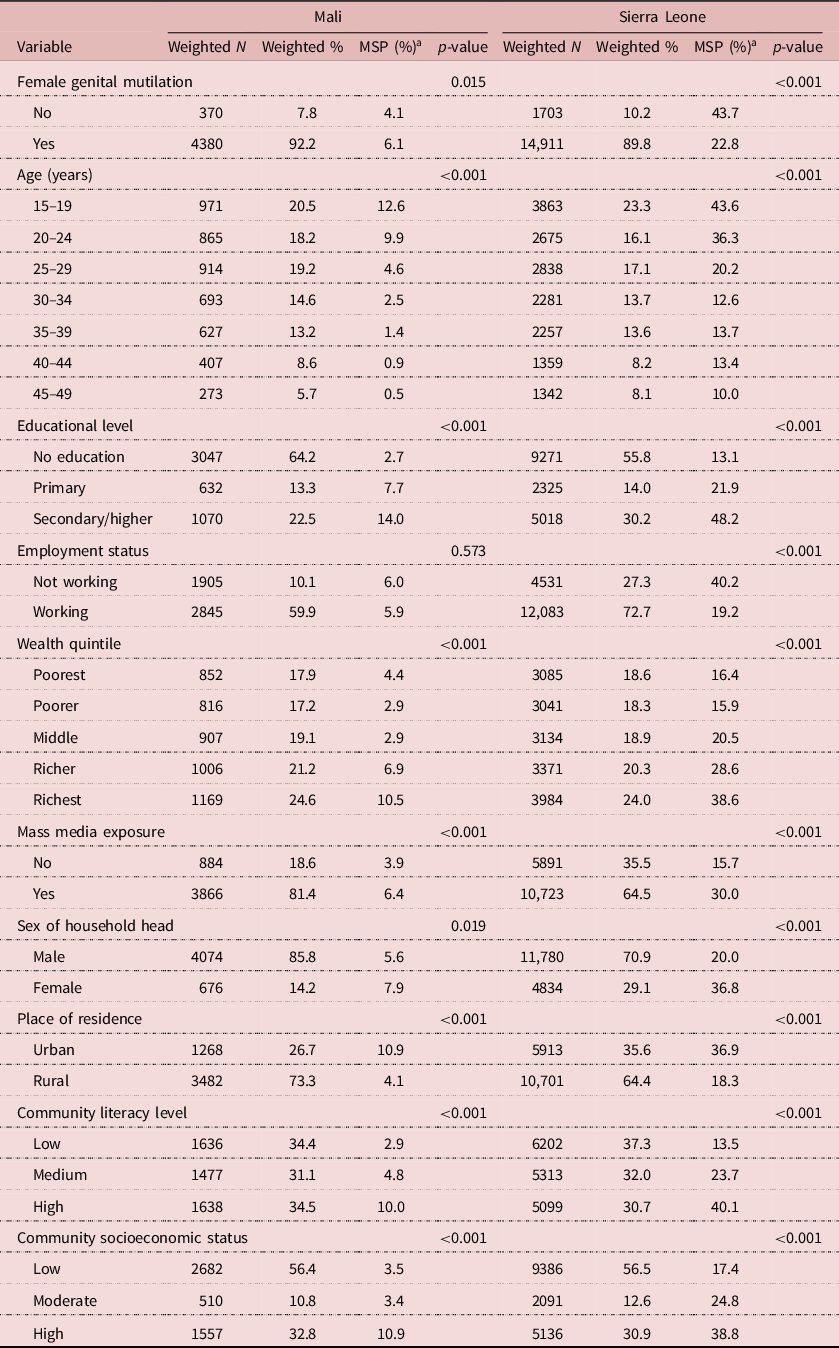
Distribution of sample women by prevalence of multiple sexual partnership (MSP) and female genital mutilation (FGM) and socio-demographic characteristics, Mali and Sierra Leone

a MSP (%): proportion of women who engaged in multiple sexual partnership.
For the multilevel logistic regression, a two-stage approach was employed. The two-level modelling indicated that women were nested within clusters while clusters were considered as random effects to cater for the unexplained variability at the contextual level (Solanke et al., Reference Solanke, Oyinlola, Oyeleye and Ilesanmi2019). Four models were generated from the multilevel modelling, consisting of the null model (Model 0), Model I, Model II and Model III. The multilevel logistic regression models consisted of both fixed and random effects and models fitted were specified as:
 $${\rm{logit}}\,{\rm{(Pr(}}{Y_{ij}} = {\rm{1}})) = {\alpha _0} + {\alpha _{oj}} + {\alpha _{\rm{1}}}{x_{{\rm{1}}ij}} + \ldots + {\alpha _k}{x_{kij}} + {\beta _{\rm{1}}}{z_{{\rm{1}}j}} + \ldots + {\beta _m}{z_{mj}},$$
where α oj ∼N (0, τ 2); Y ij = binary response for whether a woman i in community j has a multiple sexual partner; α 0 = fixed intercept; α 0j = cluster specific random effects; τ 2 = denotes a variance parameter; x ij –x kij = individual- and household-level characteristics; z 1j –z mj = community-level characteristics.
The main independent variable (FGM) was taken care of as one of the x variables in the equation. This was not included in the present article.
Intra-community correlation
The intra-community correlation (ICC) was calculated as:
 $${{\sigma _{uj}^2} \over {_{\oacute\ uj}^2 + [{{{\pi ^2}} \over 3}]}},$$
where
 $\sigma _{uj}^2$
shows the variation in multiple sexual partnership due to community-level factors. The ICC values range from 0 to 1 and measure the importance of the community-level factors in explaining the outcome. Model 0 showed the variance in MSP attributed to the distribution of the primary sampling units (PSUs) in the absence of the explanatory variables. In Model I, FGM, together with the individual-level variables that showed statistical significance with MSP among women at the bivariate analysis, were entered to assess their association with MSP among women. The community-level variables that showed statistical significance with MSP among women at the bivariate analysis were also entered in the second model to assess their association with MSP among women (see Model II). In the final model, FGM and all the independent variables (individual and household variables as well as community-level variables) were entered. An applied sample weight (v005/1,000,000) to correct for over- and under-sampling, as well as the svy command to account for the complex survey design and generalizability of the findings, were employed.
Results
Prevalence of FGM and MSP in Mali and Sierra Leone
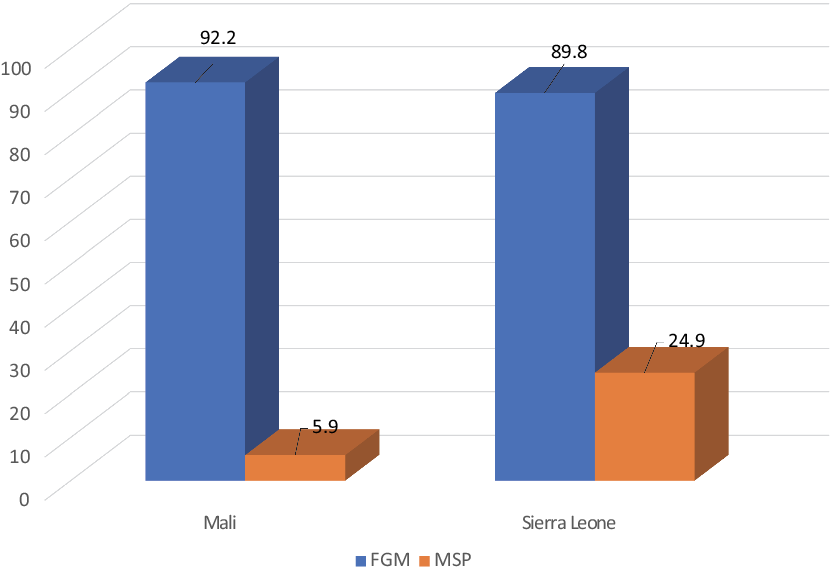
Figure 1 shows the prevalence of FGM and MSP among women in Mali and Sierra Leone. In Mali, 92.2% of women had undergone FGM and 5.9% had engaged in MSP. In Sierra Leone, 89.8% had undergone FGM and 24.9% had engaged in MSP.
Prevalence of female genital mutilation and multiple sexual partnership in Mali and Sierra Leone. Sources: 2018 Mali DHS and 2013 Sierra Leone DHS.

Distribution of MSP by FGM and socio-demographic characteristics
Table 1 presents the distribution of MSP by FGM and the socio-demographic characteristics among women in Mali and Sierra Leone. In Mali, 20.5% of the respondents were aged 15–19, 64.2% had no education, 59.9% were working and 24.6% were in the richest wealth quintile. Furthermore, 81.4% were exposed to mass media, 85.8% had male household heads, 73.3% lived in rural areas, 34.5% were in communities with a high literacy level and 56.4% were in low socioeconomic status communities. In Sierra Leone, 23.3% were aged 15–19, 55.8% had no education, 72.2% were working and 24.0% were in the richest wealth quintile. Furthermore, 64.5% were exposed to mass media, 70.9% had male household heads, 64% resided in rural areas, and 37.3% and 56.5% were in low literacy level and socioeconomic status communities, respectively.
Association between FGM and MSP
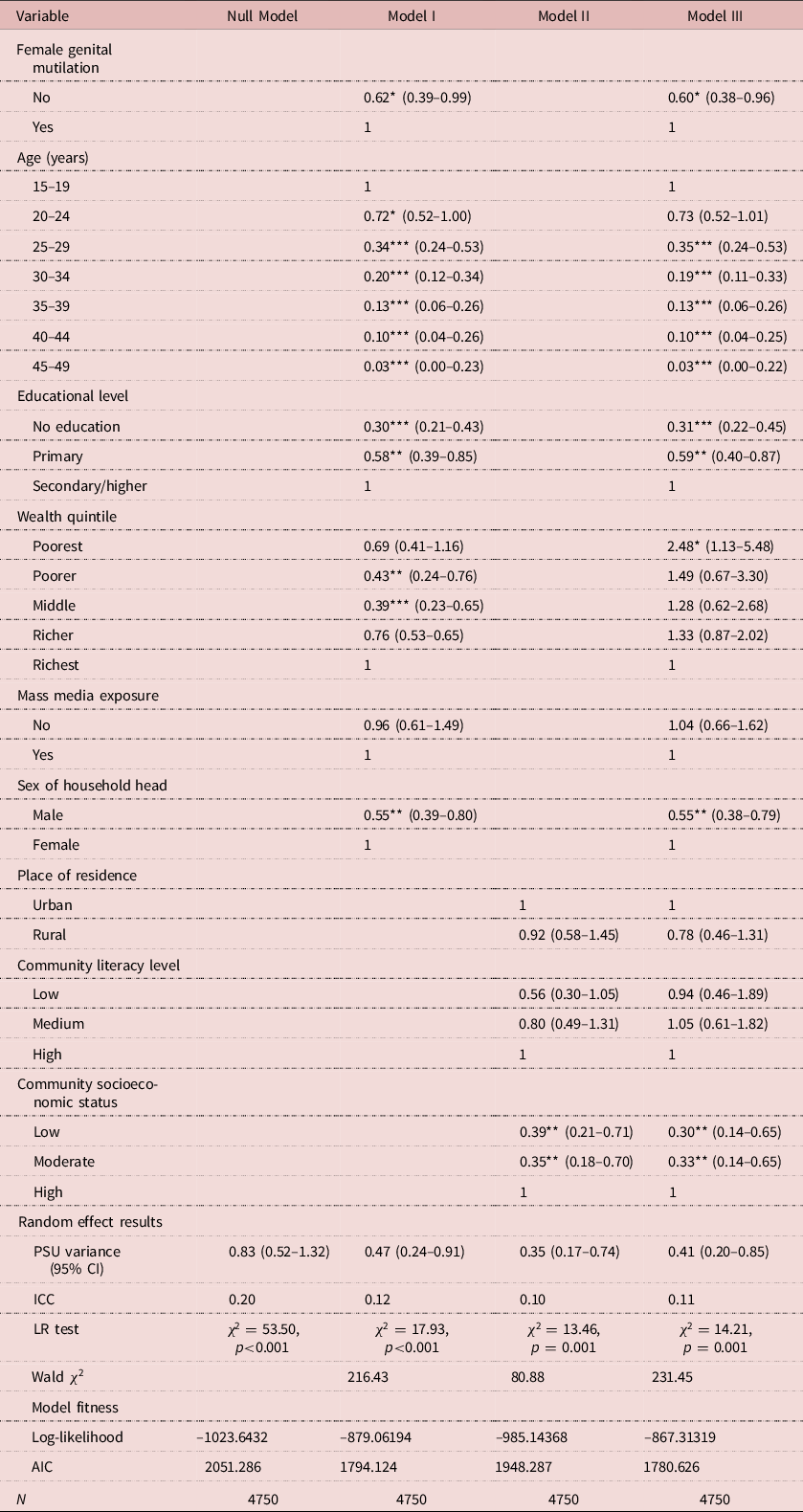
Tables 2 and 3 show the fixed and random effects results of the association between FGM and MSP among women in Mali and Sierra Leone, respectively. In Mali (Table 2), those who had not undergone FGM were less likely to have MSP (aOR=0.60, CI=0.38–0.96) compared with those who had undergone FGM. The odds of MSP decreased with age, with women aged 45–49 (aOR=0.03, CI=0.00-0.22) having lower odds of MSP compared with those aged 15–19. Women with no education (aOR=0.31, CI=0.22–0.45) had lower odds of having MSP, compared with those having higher education. However, women in the poorest wealth quintile (aOR=2.48, CI=1.13–5.48) had higher odds of having MSP, compared with those in the richest wealth quintile. Women in households with male heads had lower odds of having MSP compared with those living in households with female heads (aOR=0.55, CI=0.38–0.79). For the community-level factors, women living in low socioeconomic status communities (aOR=0.30, CI=0.14-0.65) were less likely to have MSP than those in high socioeconomic status communities.
Fixed and random effects results on the association between female genital mutilation and multiple sexual partnership among women in Mali

Exponentiated coefficients; 95% confidence intervals (CIs) in brackets; AOR=adjusted Odds Ratios; N=sample size; PSU=Primary Sampling Unit; ICC=Intra-Class Correlation; LR test=Likelihood ratio test; AIC=Akaike’s Information Criterion.
The Null model is a baseline model without any explanatory variables; Model I is adjusted for individual/household-level variables; Model II is adjusted for the community-level variables; Model III is the final model adjusted for individual/household- and community-level variables.
*p<0.05; **p<0.01; ***p<0.001.
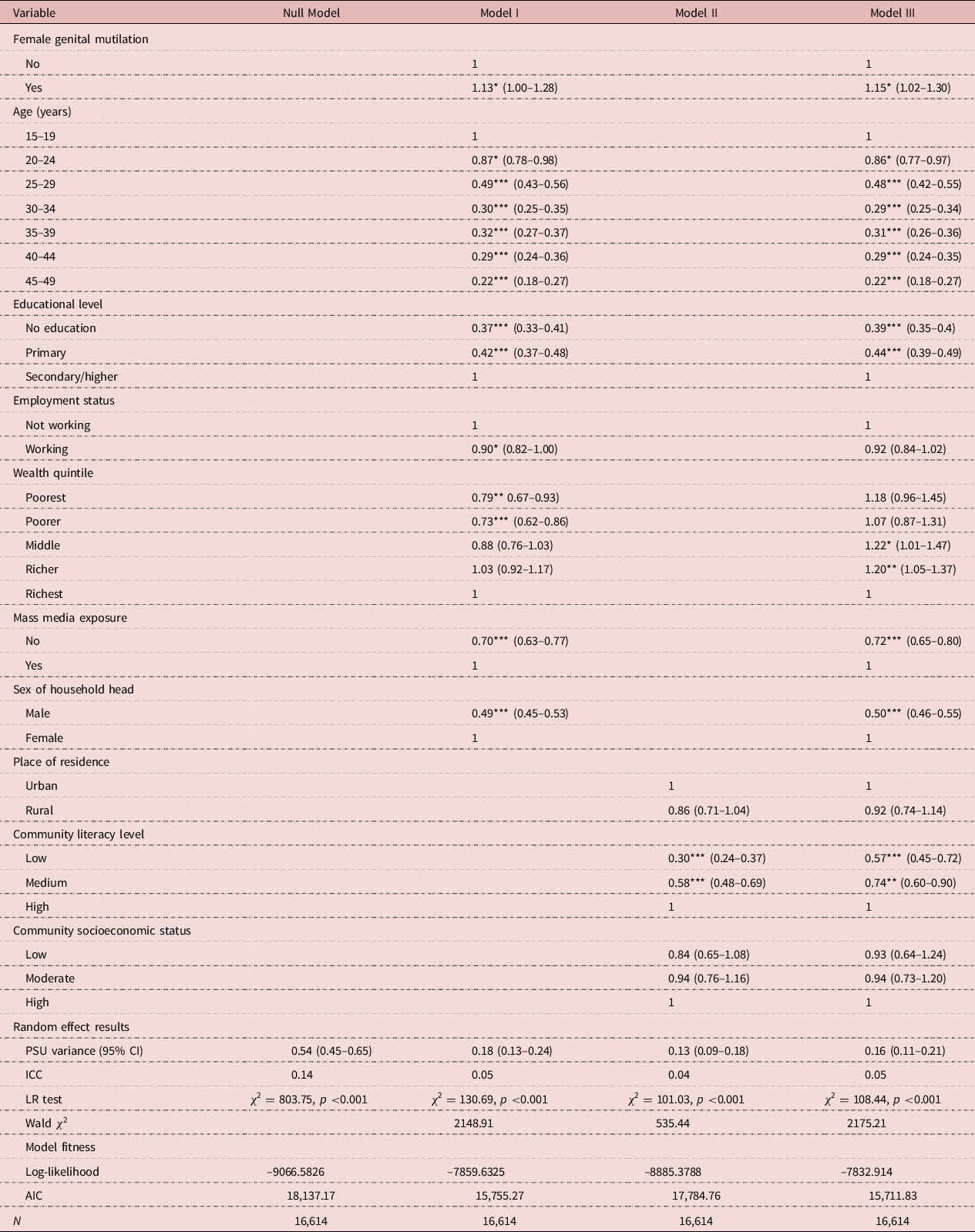
Fixed and random effects results on the association between female genital mutilation and multiple sexual partnership among women in Sierra Leone

Exponentiated coefficients; 95% confidence intervals (CIs) in brackets; AOR=Adjusted Odds Ratios; N=sample size; PSU=Primary Sampling Unit; ICC=Intra-Class Correlation; LR test=Likelihood ratio test; AIC=Akaike’s Information Criterion.
The Null model is a baseline model without any explanatory variables; Model I is adjusted for individual/household-level variables; Model II is adjusted for the community-level variables; Model III is the final model adjusted for individual/household- and community-level variables.
*p<0.05; **p<0.01; ***p<0.001.
In the Null model, there were substantial but insignificant variations in the likelihood of MSP across the clustering of the PSUs (σ 2=0.83, CI=0.52–1.32) (see Table 2). Model 0 shows that 20% of the total variance in MSP was attributed to between-cluster variation of the characteristics (ICC=0.20). The between-cluster variations decreased by 8% in Model 1 – from 20% in the empty model to 12% in Model I. From Model I, the ICC declined to 10% (ICC=0.10) in Model II but increased to 11% in the complete model (Model III), which had both the individual/household- and community-level factors. With the lowest AIC (1780.626) and highest log-likelihood (–867.31319), Model III was chosen as the best-fit model for predicting MSP among women in Mali.
In Sierra Leone (Table 3), those who had undergone FGM (aOR=1.15, CI=1.02–1.30) were more likely to have MSP, compared with those who had not undergone FGM. The odds of MSP reduced with age, with women aged 45–49 (aOR=O.22, CI=0.18–0.27) being less likely to engage in MSP compared with those aged 15–19. Women with no education (aOR=0.39, CI=0.35–0.4) were less likely to have MSP compared with those with secondary/higher education. Similarly, women in the middle wealth quintile (aOR=1.22, CI=1.01–1.47) were more likely to have MSP, compared with women those in the richest wealth quintile. Furthermore, women who were not exposed to mass media (aOR=0.72, CI=0.65–0.80), those in households with male heads (aOR=0.50, CI=0.46–0.55) and those in low literacy level communities (aOR=0.57, CI=0.45–0.72) had lower odds of MSP.
In the Null model, there were substantial and significant variations in the likelihood of MSP across the clustering of the PSUs (σ 2=0.54, 95% CI=0.45–0.65) (see Table 3). Model 0 shows that 14% of the total variance in MSP was attributed to between-cluster variation of the characteristics (ICC=0.14). The between-cluster variations decreased from 14% to 5% in Model 1. From Model I, the ICC declined further to 4% (ICC=0.04) in Model II but increased to 5% in Model III, which had both the individual/household- and community-level factors. With the lowest AIC (15711.83) and highest log-likelihood (–7832.914), Model III was chosen as the best-fit model for predicting MSP among women in Sierra Leone.
Discussion
Female genital mutilation remains an unending cultural practice that is not only a public health problem but discriminatory against females in many societies globally (WHO, 2008; Wadesango, et al., Reference Wadesango, Rembe and Chabaya2011; Ibekwe, et al., Reference Ibekwe Perpetus, Onoh Robinson, Onyebuchi Azubike, Ezeonu Paul and Ibekwe Rosemary2012; Pashael, et al., Reference Pashael, Rahimi, Ardaian, Felah and Majiessi2012). This study sought to estimate the linkages between FGM and MSP in Mali and Sierra Leone. Preliminary assessment revealed that the prevalence of FGM in Mali (92.2%) and Sierra Leone (89.9%) remain high, with Mali having a higher prevalence than Sierra Leone. This finding is similar to many previous studies in sub-Saharan Africa, which have found that FGM prevalences are high and remain a big problem (Mitike & Deressa, Reference Mitike and Deressa2009; Guttmacher Institute, 2012; Sipsma et al., Reference Sipsma, Chen, Ofori-Atta, Ilozumba, Karfo and Bradley2012; Yirga, et al., Reference Yirga, Kassa, Gebremichael and Aro2012; Bjälkander et al., Reference Bjälkander, Grant, Berggren, Bathija and Almroth2013; Abeya, et al., Reference Abeya, Chuluko and Gemeda2017). Socio-cultural beliefs attached to FGM in these countries (e.g. women’s social status and the maintenance of family honour, chastity and marriageability) might account for the consistently high figures. The prevalence of MSP among women who have undergone FGM in Mali is low (nearly 6%) compared with that of Sierra Leone (approximately 25%), and similar to that of a recent survey in South Africa, which found the rate of concurrent relationships in the last 12 months to be 5% (Steffenson, Reference Steffenson, Pettifor, Seage, Rees and Cleary2011). Doyle et al. (Reference Doyle, Mavedzenge, Plummer and Ross2012) found the prevalence of MSP to range from 0.4% in Ethiopia and Niger to 12% in Liberia, showing more similarity with the MSP prevalence in Mali than that of Sierra Leone.
The study found that women who had undergone FGM were more likely to engage in MSP. This finding confirms the contention by Van Rossem and Gage (Reference Van Rossem and Gage2009) of a strong link between FGM and woman’s sexual history, including her age at first sex, the possibility of premarital sex and/or MSP. Other scholars have explained that FGM might trigger a sense of security and encourage ‘deviant’ sexual behaviour (Hicks, Reference Hicks1993; Gruenbaum, Reference Gruenbaum2001). Apart from these reasons, economics could, in part, explain the variation in the linkages between FGM and MSP in these countries. It is possible that buoyant economic developmental interventions might be more dominant in Mali than in Sierra Leone – a country still recovering from the ravages of civil war (Jang, Reference Jang2015). Limited economic opportunities might seriously restrict women’s autonomy and financial independence, increasing their vulnerability to having the multiple sexual partners who often provide them with financial and personal support.
The study found that women’s age was a strong determinant of MSP, with those aged 15–19 being more likely to have multiple partners than their older counterparts. Given that FGM is commonly believed to boost sexual morality (by promoting premarital chastity, protecting virginity, encouraging marital fidelity and controlling girls’/women’s sexuality, as well as being a prerequisite for marriage) and is seen as the cornerstone of moral virtue (Williams-Breault, Reference Williams-Breault2018), there should be a strong relationship between FGM and a girl’s/woman’s sexual history, including her age at first sex, age at first marriage and likelihood of having premarital sex (Van Rossem & Gage, Reference Van Rossem and Gage2009). According Van Rossem and Gage (Reference Van Rossem and Gage2009), a counter-argument to the FGM morality perspective is that FGM does not necessarily provide moral security, but instead gives girls and women a false sense of security and encourages ‘deviant’, often concealed, sexual behaviour (Hicks, Reference Hicks1993; Gruenbaum, Reference Gruenbaum2001). Therefore, the youthful exuberance and experimentation often seen in adolescent girls and young women might increase their likelihood of early sexual initiation and having multiple sexual partners. This is supported by the anomie theory, which asserts that when people are denied the things that they think are their legitimate rights, they are more likely to indulge in those things by resorting to different mechanisms, some of which are illegitimate (Marks, Reference Marks1974). From this perspective, when girls are subjected to FGM with the expectation of preventing them from indulging in illicit sexual behaviour (e.g. having multiple sexual partners), they instead feel that society is infringing their rights. Hence, they might initiate sex early and experiment with multiple partners as a way of regaining their rights (Oyefara, Reference Oyefara2014). Nnebue et al. (Reference Nnebue, Chimah, Duru, Ilika and Lawoyin2016) reiterated that, as adolescent girls are maturing, they think that they have adequate knowledge and the skills to navigate sexual relationships successfully, and hence might be tempted to explore with multiple partners. However, their rate of sexual experimentation deceases with age.
Women with no education were found to be less likely to have multiple sexual partners compared with their counterparts with secondary or higher education. Women with no formal education tend to live in rural settings and hold on to a self-reinforcing socio-cultural belief in the conventional norm of chastity being associated with marriageability, as part of family honour, dignity and self-respect. These norms might deter them from engaging in negative sexual behaviours, such as having multiple sexual partners. In most indigenous societies in sub-Saharan Africa, uneducated young girls tend to be entrenched in traditional practices that typify group identity and culture, and hence may strongly uphold the traditions of marriage, family and other gender roles (Freymeyer & Johnson, Reference Freymeyer and Johnson2007). These women are strongly influenced by living with their elderly relatives and grandparents while learning about issues related to their culture and the need to uphold them through vicarious experiences over time. Therefore, sexual morals (e.g. premarital chastity and marital fidelity) are seen as proof of morality, granting young girls/woman social respect or recognition (Berg & Denison, Reference Berg and Denison2013; Williams-Breault, Reference Williams-Breault2018).
Women in the richest wealth quintile were less likely to have multiple sexual partners compared with those in the poorest–middle wealth quintiles. This finding implies that women’s risk of having multiple sexual partners is higher in low–middle wealth households than in rich households, and that better socioeconomic status (wealth) is inversely associated with FGM practice and risky sexual behaviours. While wealth is usually connected with other social parameters (e.g. place of residence and/or household level of education), it undoubtedly remains associated with a decreased risk of FGM and risky sexual behaviour in some countries (Andro et al., Reference Andro, Lesclingand, Grieve and Reeve2016). Strong economic and/or working opportunities increase women’s autonomy and financial independence, thus reducing their vulnerability to having multiple sexual partners as a source of livelihood. Mmbaga et al. (Reference Mmbaga, Leonard and Leyna2012) found that adolescents whose parents were wealthier postponed their sexual debut to much later than did those whose parents had a low income. Greater wealth has been found to delay sexual initiation among women (Amo-Adjei & Touyire, Reference Amo-Adjei and Tuoyire2018). Similarly, women who attend schools of high socioeconomic status tend to delay their sexual initiation (Kim, Reference Kim2015). Well-off women have been shown to have strong decision-making power on negative practices such as FGM and number of sexual partners (Setegn et al., Reference Setegn, Lakew and Deribe2016).
Respondents in this study who were exposed to mass media were more likely to have multiple sexual partners. Previous studies in Ethiopia have indicated that young respondents’ primary source of information is mass media (Hussein, Reference Hussein, Abdi and Mohammed2013; Bogale, Reference Bogale, Markos and Kaso2014; Abeya et al., Reference Abeya, Chuluko and Gemeda2017). Mass media exposure promotes the dissemination of health information and other educational campaigns on the harmful effects of the FGM and its associated risky sexual behaviours, including multiple sexual partnership. However, in the present study women from Sierra Leone who were not exposed to the media had lower odds of having multiple sexual partners. It is speculated that media outlets in Sierra Leone might be inadvertently promoting negative behaviours such as the use of aphrodisiacs and alcohol through advertisements, which might encourage negative sexual behaviours. Well-groomed women may stay away from such negative media publicity.
Most of the study respondents reported males as the household head in both study sites. Men, due to the patriarchal norms in sub-Sahara Africa, usually make household decisions and enforce a strict disciplinary code, prohibiting women from engaging in negative sexual practices. Such women are less likely to have multiple partners, especially where FGM might serve as a proxy for family identity, societal respect and honour.
The study had its limitations and strengths. The strengths are that it used nationally representative data to study an important public health issue of global interest and had a large sample size obtained using a multi-stage sampling approach allowing generalization of the findings to the whole population. However, the study’s use of cross-sectional survey data made it difficult to establish causality rather associations. In addition, since data on the main independent and dependent variables were taken retrospectively, there is the possibility of recall bias. Also, the data may have been subject to social desirability bias, resulting in the under- or over-reporting of FGM and multiple sexual partnerships by respondents.
The national FGM and MSP prevalences reported in this study could mask significant within- and/or between-country, as well as sub-regional, variations. Understanding these would help refine policies and programmes, and provide useful insights into interventions are working to promote change or help identify specific areas that require modification or adjustment. The marked variance in the prevalence of FGM and MSP across age cohorts will inform policymakers about efforts that need to be put in place to alleviate FGM and MSP. Using this approach might boost the progressive, long-term decline in these practices, especially among the younger generation. More research is required to investigate the possible influences of social changes as a result of increased girls’ education, economic development and women’s empowerment (Shell-Duncan et al., Reference Shell-Duncan, Naik and Feldman-Jacobs2016). Female genital mutilation and sexual behaviours are deeply rooted in complex socio-cultural systems, with diverse common rationales ranging from assurance of girls’/women’s social status, marriageability, traditional initiation into womanhood, religious identity in the maintenance of family dignity and respect across many societies (Gruenbaum, Reference Gruenbaum2001; Shell-Duncan et al., Reference Shell-Duncan, Wander, Hernlund and Moreau2011). How FGM directly or indirectly influences sexual behaviour within a broader societal social context requires investigation, as does the investigation of the determinants of FGM, and how, for example, social change such as improvement in socioeconomic status education and decision-making might lead to the abandonment of FGM and promote healthy sexual behaviours, among girls/women. Furthermore, qualitative exploration of the unique socio-cultural beliefs and deeper meanings ascribed to FGM within diverse societies, and their patterns of influence on sexual behaviours over time, could provide useful insights about which community-based social reform strategies would be most effective. More research is required in different countries to provide a more reliable and accurate picture of the current situation in sub-Saharan Africa.
In conclusion, this study of the linkages between FGM and multiple sexual partnership among women in Mali and Sierra Leone found that, in both countries, women who had undergone FGM were more likely to have multiple sexual partners, after controlling for potential confounding variables. Other socio-demographic factors, including age, level of education, wealth index, sex of household head, community socioeconomic status, mass media exposure and community literacy level, were also found to be associated with the likelihood of having multiple sexual partners among these women. Circumcised girls/women in Mali and Sierra Leone continue to be vulnerable to risky sexual behaviours. Based on the current findings, age-group-based comprehensive risk reduction strategies such as abstinence education and help with decision-making skills (assertiveness training) are needed in these settings to reduce multiple sexual partnership among girls and young women. Anti-FGM legislation and other interventions such as the ‘Schooling for the Female Child’ initiative, aimed at reducing social inequality among girls/women, particularly economic dependency and educational disadvantage, and the provision of more employment opportunities, might help reduce FGM and health-compromising behaviours such as multiple sexual partnership. These interventions should take into consideration the significant socio-demographic characteristics of girls/women identified in this study.
Funding
This research received no specific grant from any funding agency, commercial entity or not-for-profit organization.
Conflicts of Interest
The authors have no conflicts of interest to declare.
Ethical Approval
Ethical clearance was obtained from the Ethics Committee of ORC Macro Inc., as well as the ethics boards of the partner organizations of the two study countries. The DHS follows the standards for ensuring the protection of respondents’ privacy. Inner City Fund (ICF) International ensured that the survey complied with the US Department of Health and Human Services regulations for the respect of human subjects. The study employed a secondary analysis of DHS data available in the public domain (www.DHSprogram.com), so no further approval was required. Further information about DHS data usage and ethical standards are available at http://goo.gl/ny8T6X.