

This paper provides an overview of the cost-of-living adjustment (COLA) changes made to date in state and local pensions, discusses the impact of eliminating COLAs on benefits, explores the extent to which the courts view COLAs differently from ‘core’ benefits, and assesses the factors related to enacting COLA cuts.
The discussion is organized as follows. The first section describes the prevalence and characteristics of COLAs in effect in 2009, the worst of the financial crisis. The second section covers the proposed changes to COLAs between 2010 and 2014. The third section discusses the magnitude of the COLA cuts. The fourth section explains how the courts reacted to proposed changes to the COLAs, in most – but not all – cases upholding the cuts. The fifth section uses regression analysis to summarize the factors associated with enacting a cut to COLAs – being a state-administered plan, offering a fixed-rate COLA (not linked to the consumer price index (CPI)), residing in a state with weaker legal protections, having a large unfunded liability relative to payroll, and having a sponsor with a high ratio of debt to revenues.
The conclusion is that defined benefit promises in the public sector are not as secure as one would have thought. Moreover, while the pace of COLA cuts has slowed, they are likely to reappear if plans come under renewed financial pressures.
1 The prevalence of COLAs in state and local plans, 2009
Defined benefit plans in the state/local sector generally calculate the initial benefit as a product of three elements: the plan's benefit factor, the number of years of employee service, and the employee's average earnings. To mitigate the effect of inflation on retirement income, most public plans provide retirees with a post-retirement COLA.
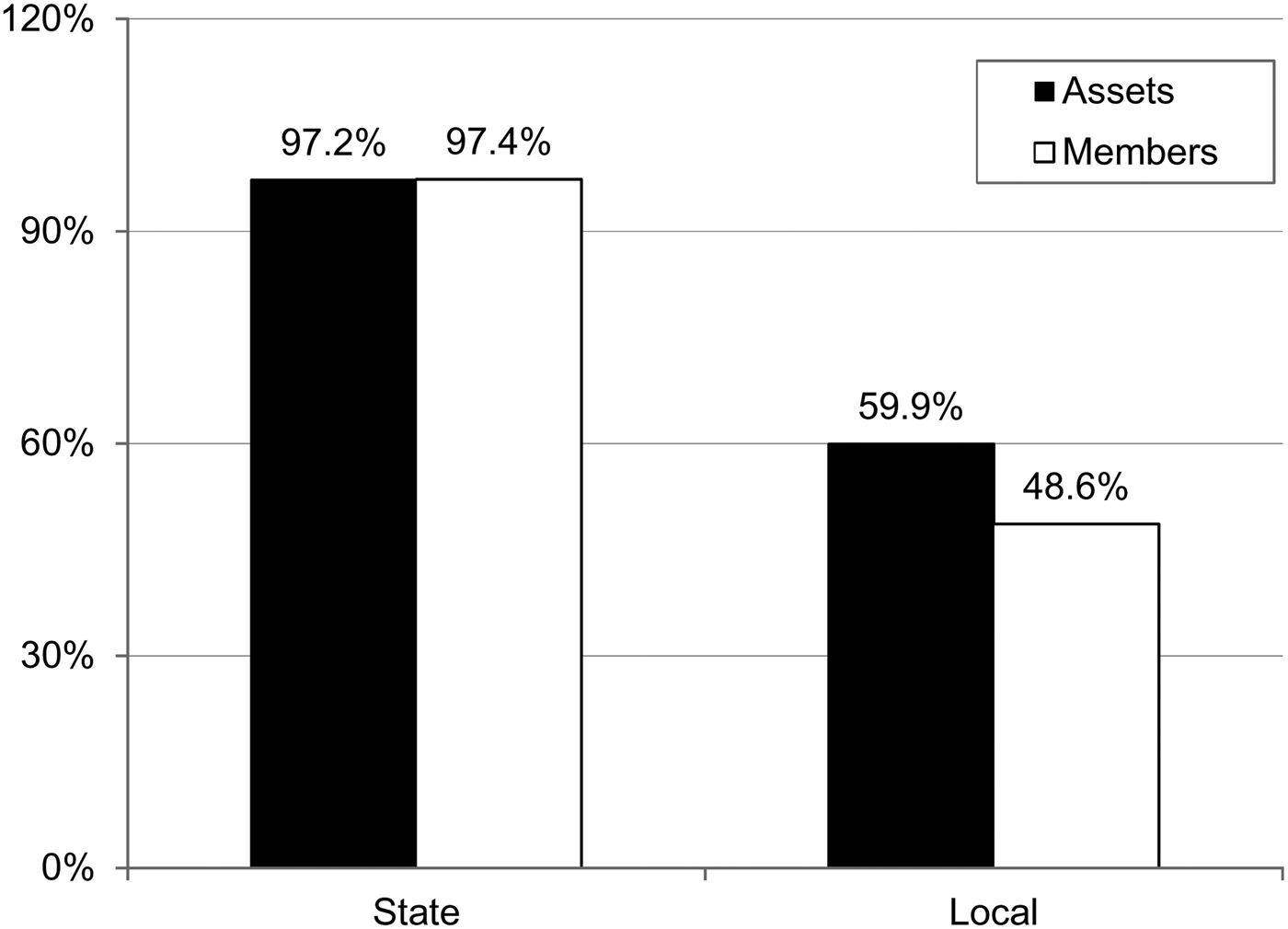
The data for COLAs come from the public plans database (PPD), which contains extensive information for 150 plans – 114 state and 36 local. Overall, the sample accounts for 91% of public pension assets and workers relative to the totals reported by the United States Census Bureau. Coverage, however, varies by level of government (see Figure 1). The PPD at the state level covers about 97% of state plan assets and members, while at the local level the PPD (which includes some major cities such as New York, Los Angeles, and Chicago) represents only about 60% of local plan assets and 49% of local plan members. This outcome is to be expected given that state-administered plans are few and large, while locally administered plans are many and often small.Footnote 1

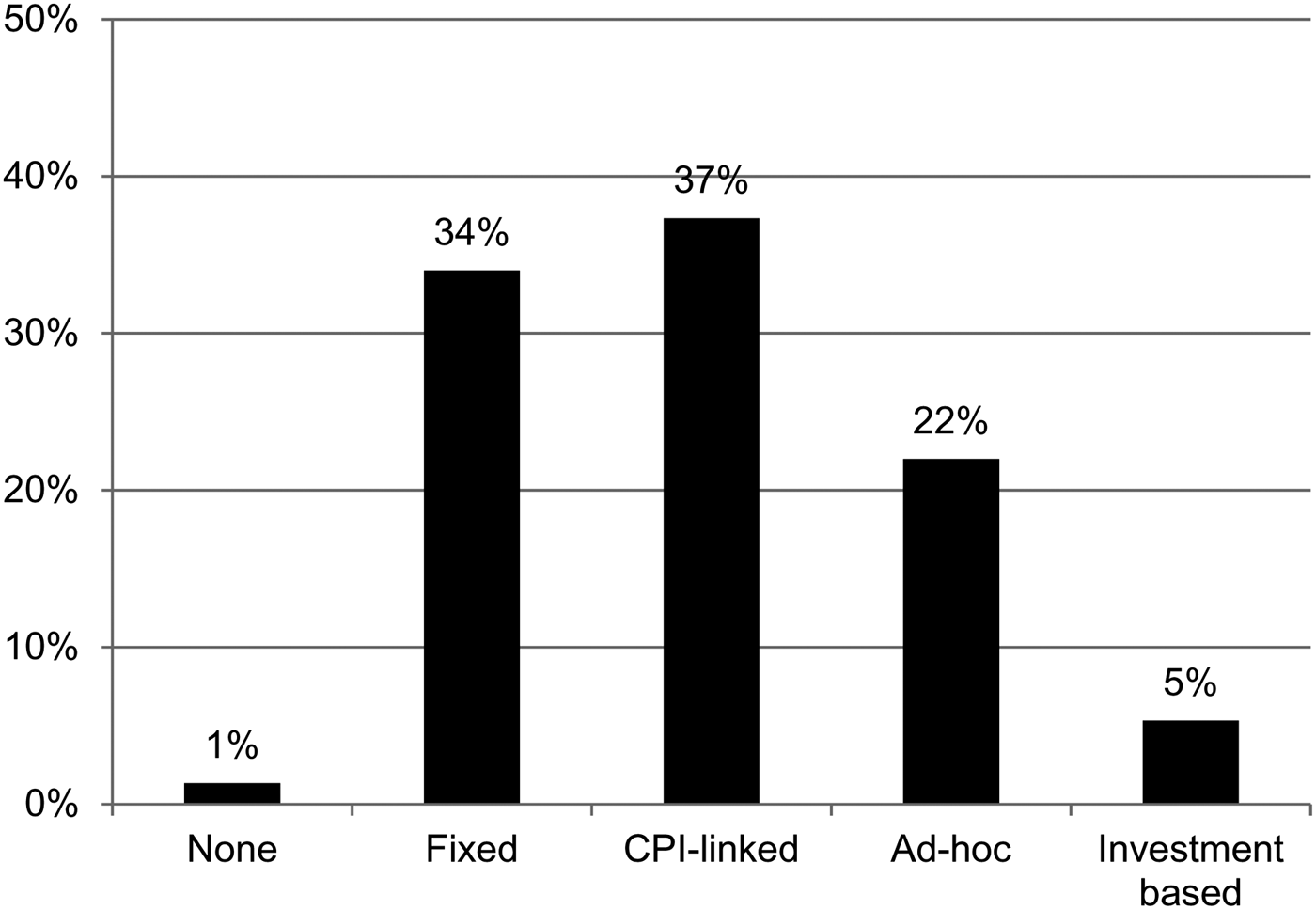
The PPD data show that COLAs come in four main forms: (1) fixed rate – the increase is a constant percentage or dollar amount that is not tied to the CPI; (2) CPI-linked – the increase is tied to the CPI; (3) ad-hoc – the increase is set by the legislature and revised on an ad-hoc basis; and (4) investment-based – the increase is tied to some financial metric, generally the plan's overall funded level, recent investment returns, or the level of assets in a special COLA fund. As of 2009, about 70% of sample plans provided automatic increases either in a fixed-rate or CPI-linked COLA (see Figure 2). Roughly half of these were linked to the CPI, with increases generally capped at 3%; the other half applied automatic adjustments at a fixed rate specified by the plan. The remaining plans provided increases either on an ad hoc basis or linked to plan finances.
Distribution of State and local plans in PPD, by COLA type, 2009. Source: Public Plans Database (2012–2015).

These COLAs warrant some comment. First, trying to maintain the real purchasing power of benefits in retirement is a laudable goal.Footnote 2 It makes little sense to leave the well-being of retirees to the vagaries of the economy. Second, inflation protection is particularly important to the 25–30% of state and local workers who are not covered by Social Security, which provides full inflation protection. Third, providing full inflation protection is a risky undertaking for state and local governments, because few states have economies that can ensure the revenues to cover this type of commitment. Thus, it is not surprising that many CPI-linked COLAs are capped. Finally and importantly when thinking about the legal ramifications of cutting or eliminating COLAs, these arrangements generally do not exist in private sector defined benefit plans.Footnote 3
2 Changes to COLAs 2010–2014
Between 2010 and 2014, 17 states (with a total of 32 plans) and three localities (Chicago, Denver, and Duluth) in the PPD enacted legislation that reduced, suspended, or eliminated COLAs for current workers and often for current retirees (see Figure 3).Footnote 4
State and local plans eliminating, suspending, or reducing COLAs for current workers and/or retirees, 2010–14. Sources: National Association of State Retirement Administrators (2014); and National Conference of State Legislatures (1999–2015). Note: Washington State closed its plan. Local plans include: Denver Public Schools Retirement System, Duluth Teachers’ Retirement Fund, and Chicago Municipal Employees Annuity Benefit Fund.

Cutting COLAs is an extremely attractive option to plan sponsors, because it is virtually the only way to make large reductions in a plan's unfunded liability. Reducing benefits for new hires or even future benefits for current employees – if legally possible – lowers future pension costs but has no effect on the existing liability. The existing liability represents benefits already earned, including promised COLAs. To the extent that the cost of future COLA payments is embedded in the liability estimate, cutting COLAs reduces the unfunded liability.
All the COLA changes represent a cut in benefits, but the magnitude of the cuts varies. They essentially fall into three groups: (1) virtually eliminating the COLA for the foreseeable future; (2) reducing guaranteed fixed amounts; and (3) reducing caps for CPI-linked COLAs.
2.1 Eliminated COLAs for foreseeable future
Three states with seriously underfunded plans – New Jersey, Rhode Island, and Oklahoma – essentially eliminated their COLAs for the foreseeable future. Under legislation enacted in 2011, New Jersey terminated all post-retirement COLAs for current and future retirees, until the plans are 80% funded – an unlikely event given the plans’ current funded ratios of about 60% and the state's unwillingness to fund – at which point a committee will be formed to determine whether COLAs will be reactivated. (As will be discussed later, the Appellate Division of the New Jersey Superior Court ultimately reversed the cuts, although they remain in place.) In 2011, Rhode Island also suspended its COLA until the plan is 80% funded and tied the COLA to the investment performance of the fund thereafter.Footnote 5 Under a mediation agreement reached in February 2014, the COLA would have been linked to the CPI as well as investment performance. However, in April 2014, some police union members rejected the mediation agreement.Footnote 6 Negotiations then continued, a new mediation agreement was reached, and this agreement – which includes the COLA cut – received both judicial and legislative approval in June 2015, with the terms of the settlement taking effect on July 1, 2015.Footnote 7 Oklahoma required that any COLA must be prefunded at the time of enactment, making future COLAs very unlikely.
2.2 Reduced guarantees
Interestingly, the vast majority of states that changed their COLAs had fixed guarantees of 2.5%–3.5%, compounded annually regardless of what was happening to inflation. These states include Colorado, Florida, Illinois, Minnesota, Montana, New Mexico, Ohio, and South Dakota.Footnote 8 In the current low-inflation environment, such guaranteed adjustments more than compensate for increasing prices and produce increasing real benefits after retirement. Three states – Colorado, Ohio, and South Dakota – abandoned their guarantees and linked future COLAs to changes in the CPI, with both Colorado and South Dakota including provisions that also link the COLA to funded status. Two states – Minnesota, and Montana – reduced their guarantees and linked future increases to the funded status of the plans. Illinois and New Mexico simply reduced the amount of their guarantees. (As will be discussed later, a State Circuit Court in Illinois rejected the cuts.) Florida suspended the COLA for several years but plans to reinstate a 3% guaranteed increase in 2016.
2.3 Lowered caps on CPI-linked COLAs
Six states with CPI-linked adjustments cut their COLAs. Maine and Maryland reduced the cap on the CPI adjustment, with Maryland linking the cap to investment returns. Oregon moved away from CPI-linking entirely, providing instead fixed COLA guarantees that vary inversely with participants’ benefit levels.Footnote 9 Washington suspended the COLA indefinitely for tier 1 of its Public Employees Retirement System (PERS) (a closed tier), and Wyoming suspended the COLA until the plan is 100% funded. Since the Wyoming plan is currently 84.5% funded, 100% is a feasible target. Connecticut lowered its minimum COLA from 2.5% to 2%.
3 Impact of the COLA cuts
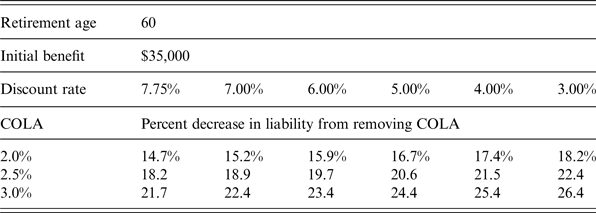
A simple model suggests that eliminating a 2% compounded COLA reduces benefits by 15%–18% (see Table 1). Eliminating a 3% COLA on the same initial benefit reduces lifetime benefits by 22%–26%. These ranges reflect the impact of the assumed discount rate on the magnitude of the cut. With high discount rates, COLAs scheduled in later years are not very valuable when discounted to the present; with low interest rates, they are more valuable and the loss greater. Reductions in guarantees or lowered caps on CPI-linked COLAs have a lesser impact.
COLAs as a percent of total benefits by discount rate assumption

Source: Authors’ calculations.
The seriousness of the effect of these changes on retirees depends critically on whether state and local workers are covered by Social Security. Social Security benefits are fully adjusted for price increases, so those public employees also covered by the program are assured that at least their basic retirement income is inflation protected.
Four states that cut their COLA – Colorado, Illinois, Maine, and Ohio – have plans in which workers are not covered by Social Security. It is worth taking a closer look at the cuts in these states.
-
• Colorado lowered the COLA from 3.5% to a modified 2% for those hired prior to 2007, and shifted to a CPI-linked COLA with a 2% cap for those hired during or after 2007.Footnote 10
-
• Illinois, where participants in the State Universities Retirement System and the Teachers’ Retirement System (STRS) are not covered by Social Security, reduced the COLA for those hired before 2010 from a guaranteed 3% to 3% of the lesser of: (1) their current benefit; or (2) $1,000 multiplied by their years of service. Those who retire on or after July 2014 will receive COLAs only every other year for the next 10 years. (The Illinois cuts were deemed unconstitutional by the Illinois Supreme Court.)
-
• Maine froze its CPI-linked COLA for 3 years (2011, 2012, and 2013) and reduced the cap from 4% to 3% of the first $20,000 thereafter.
-
• Ohio changed its three major plans, all of which rely on a simple – rather than a compounded – COLA. Ohio PERS and Ohio Police and Fire moved from a 3% guarantee to a CPI-linked COLA, with a 3% cap. Ohio STRS simply reduced the guarantee from 3% to 2%, but also suspended COLAs for existing retirees from July 1, 2013 to June 30, 2014.
If inflation remains low (less than 2%) most public employees in plans without Social Security will not be seriously hurt by the changes in the COLA. Even at low inflation rates, however, those with higher benefits in Maine will be affected, as these states have targeted their COLAs to retirees with benefits below $30,000 and $20,000, respectively. If inflation rises to 3% or 4%, participants in all four states at all benefit levels will see the real value of their entire retirement income erode.
From the employer's perspective, the COLA cuts reduce employer costs. On average, the annual required contribution (ARC) – the cost of benefits accrued in that year and payment towards eliminating the unfunded liability – amounts to about 6% of state and local budgets. Cutting a 3% COLA in half reduces benefits and, consequently, the ARC by roughly 10%, which translates to a 0.6% reduction in budgets. While these benefit cuts might save employers money, it may cost them in terms of the quality of their workforce. COLA cuts reduce the deferred component of public employee compensation that helps ensure the comparability of total compensation between the private and public sectors.Footnote 11 Research by our center suggests that reductions in total compensation through benefit cuts results in lower-quality workers.Footnote 12
4 How did the courts react?
Before looking at how the courts reacted to lawsuits seeking to prevent the COLA cuts, it is useful to have a little background on the legal protections afforded benefits provided by state and local pension plans. Generally public pensions appear to be better protected than pensions provided in the private sector. In the private sector, Employees Retirement Income Security Act of 1974 (ERISA) protects benefits earned to date but permits plan sponsors to adjust future benefits. In contrast, many states face legal constraints on their ability to change future benefits for current employees.
Most states protect pensions under a contracts-based approach. The United States Constitution's Contract Clause and similar provisions in state constitutions prohibit states from passing any laws that impair existing public or private contracts.Footnote 13 A handful of states that protect pensions under the contract theory have state constitutional provisions that expressly prevent the state from amending the plan in any way that would produce benefits lower than participants expected at the time of employment. Illinois and New York have such a provision. Alaska has language that specifically applies only to accrued benefits, but the courts have interpreted the provision to protect all benefits from the date that participants enroll.Footnote 14
Six states have adopted a property-based approach for protecting pensions. To the extent that pension benefits are considered property, they cannot be taken away without due process according to the Fifth and 14th Amendments to the United States Constitution. Due process has both a procedural and a substantive component. Most of the challenges to state actions are made on substantive due process and have not been successful. Courts have generally found amendments to public pension plans to be ‘an adjustment to the benefits and burdens of economic life’ rather than the taking of private property without just compensation.Footnote 15 Thus, state officials have much more freedom to adjust pensions in states that have taken the property-based approach to pension rights.
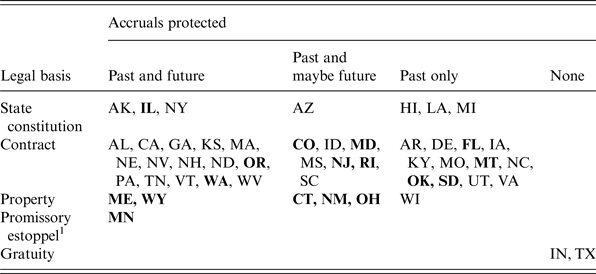
Table 2, which is based on an earlier study of legal protections, categorizes the states as of 2012 by the extent to which benefit accruals are protected and the legal basis for the protections.Footnote 16 States that appear in bold have cut their COLAs. The pattern looks like what one would have expected. Those states where benefits are not well protected or protected only under a property-based approach have seen a large number of COLA cuts. Those where past and future accruals are protected either under the constitution or under the contract clause have seen far fewer COLA cuts.
Legal basis for protection of public pension rights under state laws

Source: Munnell and Quinby (Reference Munnell and Quinby2012).
1 Promissory estoppel is the protection of a promise even where no contract has been explicitly stated.
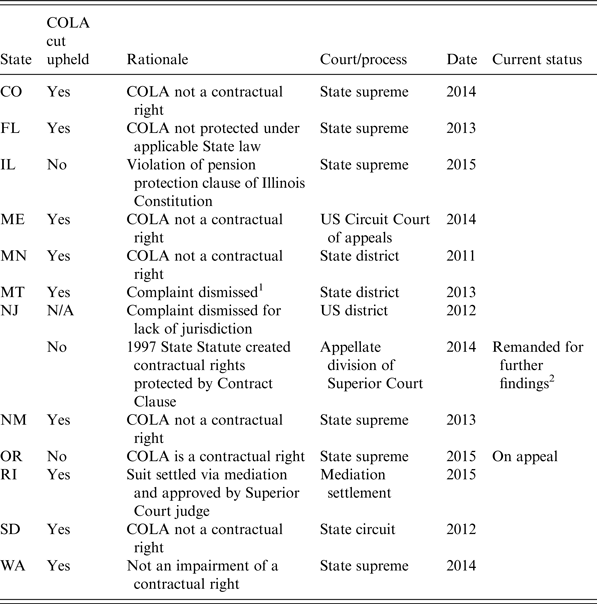
Of the 17 states that changed their COLA, 12 have been challenged in court. The courts have ruled in ten states and have upheld the cuts in all but three states – New Jersey, Illinois, and Oregon. In New Jersey, the Appellate Division of the Superior Court has ruled that workers have a contractual right to their COLAs but has sent the case back to a lower court to ultimately determine whether the impairment of the contractual right is responsible and necessary. The Illinois Circuit Court ruled in 2014 that COLA cuts (and other changes) were unconstitutional. The state appealed to the Illinois Supreme Court; in May 2015, the Supreme Court upheld the Circuit Court ruling that the COLA cuts were unconstitutional, stating that the cuts violated the pension protection clause of the state's constitution.Footnote 17 In April 2015, the Oregon Supreme Court ruled against the COLA cuts, stating that a COLA is a contractual right. This decision is currently on appeal. Table 3 summarizes the status of these suits.
Responses to COLA Cuts, 2010–15

Sources: National Association of State Retirement Administrators (2014); National Conference of State Legislatures (1999–2014); Buck (Reference Buck2011 and Reference Buck2013); and various court cases.
1 The court refused to issue a preliminary injunction, finding that it was not clear that plaintiffs would be successful in proving that the COLA was protected as a contractual right.
2 Remanded back to the lower court to determine whether the impairment of rights is reasonable and necessary to serve an important public purpose.
The main rationale for allowing COLA cuts is a judicial determination that COLAs are not considered a contractual right. For example, a lower court judge in Colorado found that the plaintiffs had no vested contract right to a specific COLA amount for life without change and also that the plaintiffs could have no reasonable expectation of a specific COLA amount for life given that the General Assembly has changed the COLA formula numerous times over the past 40 years. This decision was upheld on appeal. In Minnesota, the judge ruled both that the COLA was not a protected core benefit and that the COLA modification was necessary to prevent the long-term fiscal deterioration of the pension plan.Footnote 18 The courts clearly view COLAs very differently than core benefits. At this point, the legal hurdles to cutting COLAs appear to be quite low.
5 Who cut and why: regression analysis
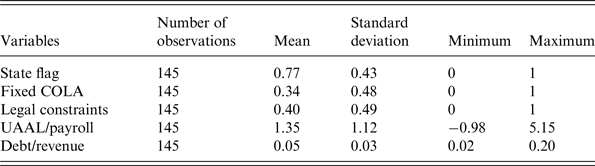
The final section attempts to bring together the story that emerged above and estimates a probit regression to see if a systematic relationship exists between the probability of enacting COLA legislation and factors identified in the narrative. The dependent variable is equal to 1 if the pension plan cut its COLA between 2009 and 2014, for either current retirees or current employees of the plan. The explanatory variables are as follows:
-
• State flag: COLA cutting appears to be a state-level phenomenon: 34 of 114 state-administered plans in the PPD had COLA cuts, compared with three of the 36 locally administered plans. This dummy variable is equal to 1 if the plan is administered by a state.
-
• Fixed COLA: a much higher share of plans with a fixed COLA, which provides an automatic increase unlinked to annual changes in inflation, appears to have had COLA cuts than plans with a CPI-linked COLA, an ad hoc COLA, or an investment-based COLA. This dummy variable is equal to 1 if the plan has a fixed COLA.
-
• Legal constraints: as discussed, states provide varying levels of legal protections for the benefits of public sector employees and retirees. The assumption is that plans in states where past and future accruals are protected under the state's constitution or contract laws would have a tougher time cutting their COLAs. In this case, the relationship between cutting COLAs and legal constraints is expected to be negative.
-
• Unfunded Actuarial Accrued Liability (UAAL)/payroll ratio: not discussed so far are the financial pressures to cut. The assumption regarding the plan finances is that a higher UAAL relative to payroll would be positively related to COLA cuts, since cutting retiree COLAs is one of the few ways plans can lower their existing unfunded liability.
-
• Debt/revenue ratio: also relevant is the financial pressures on plan sponsors. The assumption is that the larger the sponsor's debt relative to its own-source revenue, the more likely the sponsor is to cut the COLA in an effort to decrease its liabilities. This variable is the ratio of the state's or locality's annual debt service to its annual own-source revenue.
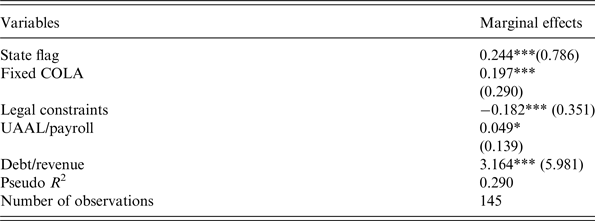
The results of the regression are shown in Tables 4 and 5. Four of the five variables are statistically significant at the 99% level, and the unfunded liability measure at the 90% level.

Regression results for introducing a COLA cut for retirees/employees

Source: Authors’ calculations from United States Census Bureau (2012a); United States Census Bureau (2012b); United States Census Bureau (2011); and Public Plans Database (2012–2015)
Note: Robust standard errors are in parentheses. The coefficients report marginal effects from a probit estimation and are significant at the 90% (*) level or 99% (***) level. The dependent variable is 1 for pension plans that cut their COLAs for current retirees or current employees, and 0 otherwise. Five defined benefit plans that are closed to new members were dropped from the regression: Alaska Public Employees Retirement System, Alaska Teachers’ Retirement System, Michigan State Employees Retirement System, Minneapolis Employees Retirement Fund, and West Virginia Teachers’ Retirement System.
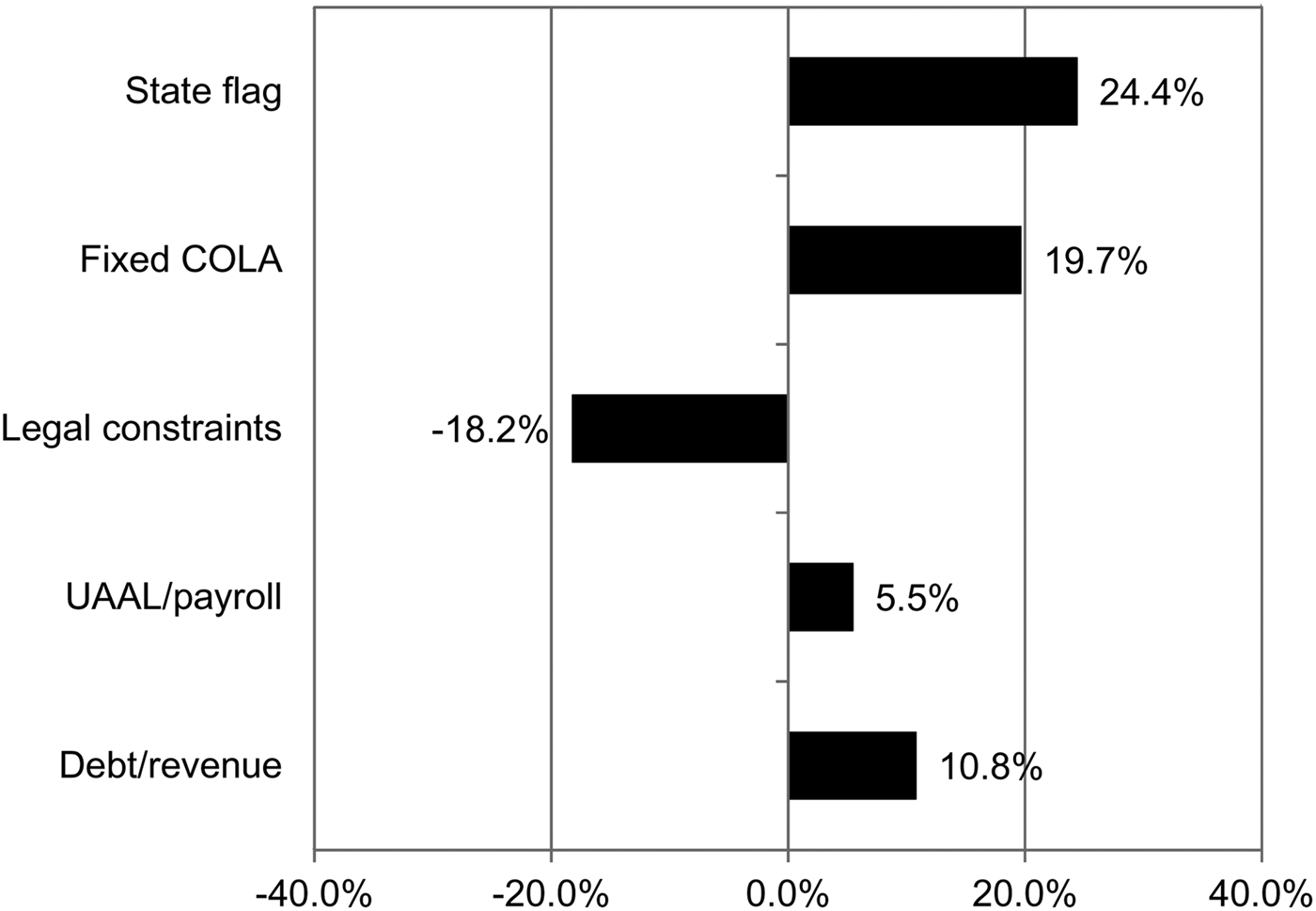
The three factors that emerged from the discussion – state-administered plans, fixed COLAs, and legal constraints – all affect the probability of a COLA cut by about 20%, with state-administered and fixed COLA associated with a 20% increase and legal constraints with a 20% decrease. The marginal effects of the financial pressure variables are measured in terms of a one-standard-deviation change. A one-standard-deviation higher ratio of unfunded liability to payroll is associated with a 10% increase in the probability of a COLA cut and a one-standard-deviation higher ratio of debt-to-revenue is associated with a 5% increase in the probability. Together all the variables explain about 30% of the variance (see Figure 4).
Impact on the probability of introducing a COLA cut for retirees/employees, 2009–2013. Source: Authors’ calculations from United States Census Bureau (2012a); United States Census Bureau (2012b); United States Census Bureau (2011s); and Public Plans Database (2015). Note: Changes are one-standard deviation for continuous variables and 0/1 for dichotomous variables. All results are statistically significant at least at the 90% level.

6 Conclusion
How state and local defined benefit promises have actually played out in the wake of the financial crisis is an interesting story. Public plan participants were thought to have a higher degree of protection than their private sector counterparts. While ERISA protects benefits earned to date in private plans, participants may end up with less than expected if their employer closes down the plan for reasons of economy or bankruptcy so that the benefit formula applies to today's earnings rather than to the higher earnings at retirement. In contrast, constitutions in many states prescribe, or the courts have ruled, that the public employer is prohibited from modifying the plan. This prohibition means that employees hired under a public retirement plan have the right to earn benefits as long as their employment continues. Thus if the employer wants to reduce the future accruals of benefits, such a change usually applies only to new hires.
On the other hand, in the wake of the financial crisis, in many instances the pension wealth of both current employees and retirees has been reduced through COLA cuts. Many courts apparently do not view COLAs as a core benefit protected under the laws of the state. One wonders how COLAs would be treated under ERISA in the private sector. Of course, almost no private sector defined benefit plans have COLAs, so a direct comparison is not possible.
COLA cut initiatives nationwide seem to have played themselves out for this round. However, if the stock market plummets again and plans and their sponsors feel under substantial pressure, we may see a new round of COLA cuts.
Appendix: States and Localities Enacting COLA Legislation
(* Denotes plan not included in Public Plans Database)
*Cincinnati, OH (Employees Retirement System (ERS) of the City of Cincinnati)
On December 31, 2014, Cincinnati and city workers reached a deal to stabilize the city's pension plan after 10 months of negotiations. The city will contribute $38 million to the pension system next year by borrowing against future revenue and will contribute $200 million in 2016 from the financially stable retiree healthcare trust fund to the pension system. It will also make larger contributions to the pension (16.25% of the annual operating budget contribution, vs. 14% in recent years) and these higher contributions will continue for 30 years. Employees and retirees have agreed to forgo their COLA adjustments for 3 years and, after that, the COLA will be based on 3% simple interest (current COLA for retirees is 3% compounded).Footnote 19 There are no known lawsuits challenging this COLA cut at this time.
Chicago, IL (Municipal Employees Annuity Benefit Fund, *Chicago Laborer's Retirement Board)
In 2014, Illinois lawmakers passed SB1922, which cut COLAs for current retirees, current employees, and new hires for Chicago's Municipal Employees Annuity Benefit Fund and Chicago's Laborer's Retirement Board. Previously, the COLA was 3.0% compounded annually. The new legislation cut the COLA to the lesser of 3% or half of the inflation rate (not compounded) and suspended all COLAs for certain years (2017, 2019, and 2025). A lawsuit was filed (Mary J. Jones, et al. vs. Municipal Employees’ Annuity and Benefit Fund of Chicago) in 2014 in the Illinois Circuit Court. The plaintiffs argue that SB1922, which cuts retiree benefits as well as COLAs, violates the Pension Protection Clause of the Illinois Constitution. No decision has been made as of this report.
Colorado (Public Employees Retirement Association: Municipal Employees Retirement System (MERS), School Employees Retirement System, State Employees Retirement System (SERS))
On February 23, 2010, Colorado legislators passed SB 10–001, which changed its COLA structure for current retirees, current employees, and new hires who participate in Colorado PERA. Previously, all three state pension plans (MERS, School Employees, and SERS) provided an automatic 3.5% COLA. After the law was signed, COLAs for each of the state plans became tied to the funded ratio of the plan. The law established an automatic 2.0% COLA baseline with a 0.25% increase if the plan is more than 103% funded, and a 0.25% decrease if the plan is less than 99% funded.
This COLA cut was challenged in court (Justus vs. Colorado) in 2011. The plaintiffs’ principal argument was that both the base pension and a specific COLA are constitutionally protected by the Contract Clauses of the Colorado and United States Constitutions. The court found that the Colorado legislation never included language making any particular COLA adjustment a contractual commitment for life without change. It noted that many legislative changes have been made in Colorado COLA provisions over the years and found that the plaintiffs could have no reasonable expectation that the COLA formula that happened to be in place at the date of their retirement would be unchangeable for the rest of their lives. This decision was appealed to the State Supreme Court in 2012, which ruled in 2014 that the cuts were constitutional. In addition to the COLA cut, Colorado made additional changes to benefits for non-vested workers and new hires. It raised the full retirement age to the ‘Rule of 88’ (age plus service years must equal 88 prior to retirement) and increased employer and employee contributions by 4.5% and 5.5% of salary, respectively.Footnote 20
Connecticut (SERS)
In 2011, Connecticut changed its COLA formula for current state employees and new hires retiring after October 2, 2011. The new COLA formula is a CPI-linked COLA with a minimum guarantee of 2.0%. Before the law took effect, those retiring after October 2, 2011 would have received 60% of the CPI, up to 6% and 75% of the CPI over 6%, with a minimum COLA of 2.5% and a maximum of 6.0%. There are no known lawsuits challenging this COLA change.
*Detroit, MI (ERS, Police and Fire Retirement System (PFRS))
In 2013, Detroit filed for the largest municipal bankruptcy in US history. After a 9-day trial on eligibility, the US Bankruptcy Court ruled that Detroit was eligible for Chapter 9 bankruptcy protection due to its $18.5 billion debt, and in 2014 the Michigan Legislature passed a package of bills (the city's legislative Plan of Adjustment) to help Detroit avoid further bankruptcy proceedings. Retirees of the Detroit ERS will have a 4.5% cut to their core pension benefit and lose their COLAs indefinitely.Footnote 21 Retirees of the Detroit PFRS will retain 100% of their core pension benefit, but will receive only 45% of their COLAs.Footnote 22 These cuts were approved overwhelmingly by retirees who feared far greater cuts if these measures did not pass.Footnote 23 Prior to the bankruptcy proceedings, retirees of both ERS and PFRS were given an automatic 2.25% COLA.
Denver, CO (Denver Public Schools Retirement System)
On February 23, 2010, Colorado lawmakers passed SB 10–001, which changed its COLA structure for current retirees, current employees, and new hires in the Denver schools.Footnote 24 Previously, the Denver Public Schools Retirement System provided an automatic 3.25% compounded COLA, and, for those hired after July 1, 2005, the lesser of 3% per year or the increase in the CPI. After the law was signed, however, the COLAs were fully suspended in 2010 with an automatic 2.0% COLA issued thereafter. This COLA cut was challenged in court (Justus vs. Colorado) in 2011. The state's Supreme Court ruled in 2014 that the cuts were constitutional.Footnote 25
Duluth, MN (Teachers’ Retirement Fund Association) Footnote 26
Minnesota lawmakers passed an Omnibus Pension Bill in 2010 that directly impacted COLAs for members of Duluth Teachers’ Retirement Fund Association (as well as members of Minnesota's three state-sponsored pension plans). Previously, an automatic 2.0% COLA was awarded. The new law provides for COLA payments if the funded ratio of the plan exceeds either an actuarial funded ratio of 90% or a market value funded ratio of 80%.Footnote 27 Since neither of these thresholds was met in 2010, 2011, or 2012, COLAs were effectively suspended for those years.
These cuts were challenged in court (Swanson et al. vs. State of Minnesota et al.) in 2011 in the District Court of Minnesota. The plaintiffs claimed that the legislation in the Omnibus Bill constituted a violation of the contract and takings clauses of the United States and Minnesota Constitutions. The court ruled that the relevant statutory language did not constitute a contract to provide COLAs, thereby allowing the COLA cuts to remain in effect. No known appeals have been filed at this time.
Florida (Retirement System)
In 2011, Florida legislators passed SB 2100, which suspended the automatic 3.0% COLA for current employees and new hires until June 2016, after which it will be reinstated. The COLA suspension was ultimately challenged in the Florida courts (Scott et al. vs. Williams et al.) in 2013. Initially, the Circuit Court found that the suspension violated the Contract Clause of the Florida Constitution and ruled the legislation invalid on this and other grounds. On appeal, the Florida Supreme Court reversed the judgment of the Circuit Court and ruled that the legislation did not violate the Florida Constitution, concluding that, while retirement benefits that have already been earned are protected as vested contract rights, future benefits for future service are not contractual rights protected against changes. There is no known further appeal at this time. In addition to its COLA cut, Florida also introduced a mandatory employee contribution for all employees and increased the final average salary period, the vesting period, and the age/service requirements used to determine the full retirement age for new hires.Footnote 28
Illinois (SERS, State Universities Retirement System, Teachers’ Retirement System)
In 2013, Illinois lawmakers passed Public Act 98–599, which cut COLAs for current retirees and current employees for three of its state plans. Previously the COLA award was 3.0% compounded for each of these plans. Public Act 98–599 cut this COLA by introducing a new formula to determine the COLA, which will be the minimum of: 3% of the current benefit payment or 3% multiplied by the number of years of service multiplied by $1,000.Footnote 29 This law also imposed a pensionable earnings limit, introduced an optional DC plan, reduced employee contributions, and delayed retirement for current workers and new hires.Footnote 30
A lawsuit challenged the legality of this bill (‘We Are One Illinois Coalition’ vs. Patrick Quinn in capacity as Governor of Illinois) in 2014 in the Illinois Circuit Court. The court ruled in 2014 that because Public Act 98–599 diminishes and impairs pension benefits, the Act violates the Pension Protection Clause of the Illinois Constitution.Footnote 31 Thus, the COLA cuts were deemed to be unconstitutional. The state of Illinois appealed this ruling to the state's Supreme Court. In May of 2015, the Supreme Court ruled that these cuts violated the pension protection clause of the Illinois Constitution.Footnote 32
Maine (PERS consolidated plan for participating local districts, State Employee and Teacher Retirement System)
In 2011, legislators in Maine passed L.D. 1043 (their biennial budget for 2012 and 2013). This budget eliminated COLAs for retirees and current employees from September 2011 to September 2013, after which COLAs will be CPI-linked up to 3.0% (previously, the CPI-linked COLA maximum was 4.0%). This new law also increased the full retirement age from 62 to 65 for non-vested workers and new hires.Footnote 33
The COLA cut was challenged in the United States District Court of Maine (Maine Association of Retirees et al. vs. Board of Trustees of the Maine Public Employees Retirement System) in June of 2013. The plaintiffs claimed that the legislation violated the Contract Clause of the United States Constitution. The court concluded that COLAs are not a contractual obligation. The plaintiffs appealed, but in 2014 the United States Circuit Court of Appeals upheld the COLA cuts, stating the COLAs in question are not a contractual right.
Maryland (State Retirement and Pension System)
In 2011, Maryland legislators passed HB72, which decreased COLAs for current state employees and new hires. Previously, the COLA was CPI-linked, with a 3.0% cap. HB72 lowered the cap to 2.5% if the investment performance exceeded expectations or up to a 1.0% cap if the investment performance was worse than expectations. There are no known lawsuits challenging this law at this time. In addition to this COLA cut, the law also increased employee contributions, and lowered the benefit formula for new hires.Footnote 34
Minnesota (General Employees Retirement Fund, State Employees Retirement Fund, Teachers’ Retirement Fund)
In 2010, Minnesota lawmakers passed the Omnibus Pension Bill, which increased the employer contribution for all of its plans, increased the vesting period for new hires, and cut COLAs uniquely for each state retirement plan.Footnote 35 Previously, the state provided an automatic 2.5% COLA for members of its General Employees, State Employees and Teachers’ state retirement plans. Under the new bill, COLAs for current retirees, current employees, and new hires were tied to the funded ratio of each individual plan.Footnote 36 These cuts were challenged in District Court of Minnesota (Swanson et al. vs. State of Minnesota et al.) in 2011. The Plaintiffs claimed that the legislation in the Omnibus Bill constituted a violation of the contract and takings clauses of the United States and Minnesota Constitutions. The court ruled that the relevant statutory language did not constitute a contract to provide COLAs, thereby allowing the COLA cuts to remain in effect. No known appeals have been filed at this time.
Montana (Public Employees Retirement Administration, Teachers’ Retirement System)
In 2013, Montana lawmakers passed HB 377, which increased contributions for current workers and new hires, increased the full retirement provisions for new hires, and cut COLAs for current retirees, current employees, and new hires.Footnote 37 Previously, an automatic 1.5% COLA was awarded. Under the new law, the COLA became tied to the funded ratio of each plan.Footnote 38 These COLA cuts were challenged in 2013 in the First Judicial District Court of Montana (Association of Retired Montana Public Employees et al. vs. State of Montana et al.). The court refused to issue a preliminary injunction, finding that it was not clear that the plaintiffs would be successful in proving that the COLA was protected as a contractual right. Consequently, the COLA cut was upheld. No known appeals have been filed at this time.
New Jersey (PERS, PFRS, Teachers’ Pensions and Annuity Fund)
In 2011, New Jersey Senate Bill 2937 (Chapter 78, 2011) terminated all post-retirement COLAs for current and future retirees until the plans are 80% funded, at which point a committee will be formed to determine whether COLAs will be reactivated. This new law also increased employee contributions for all members of all of New Jersey's state plans and established a new tier of benefits for workers hired after June 28, 2011.Footnote 39
As a result of the bill, various unions and union members sued in United States District Court (New Jersey Education Association vs. State of New Jersey), claiming that the COLA suspension was unconstitutional. The court did not reach a decision on the merits of the case but dismissed the complaint on the basis that the District Court lacked jurisdiction over the claim. The plaintiffs subsequently brought the same claims in a New Jersey State court, where they were dismissed via an oral opinion, thereby allowing the cuts to stand. The plaintiffs filed an appeal, and in 2014 the Appellate Division of the New Jersey Superior Court (an intermediate appellate court) ruled that retired public workers have a contractual right to yearly increases in their pension benefits and that right cannot be impaired unless the legislation is reasonable and necessary to serve an important public purpose. The cuts, however, remain in effect while the case is being sent back to a lower court to determine if the decision to suspend the COLAs was reasonable and necessary to serve an important public purpose.
New Mexico (Public Employees Retirement Association, Educational Retirement Board)
In 2013, New Mexico lawmakers passed SB 115, which impacted COLAs for current retirees, current employees, and new hires. For the New Mexico Public Employees Retirement Association, the COLA was reduced from a 3% to a 2% automatic COLA for existing retirees and was suspended indefinitely for future retirees.Footnote 40 For the New Mexico Educational Retirement Board, the COLA awarded previously was 50% of the CPI, with a minimum of 2% and a maximum of 4%. After the law was passed, COLAs were immediately reduced and linked to the benefit level and the funded level (until the plan reaches a 100% funded level).Footnote 41 The law also increased employer and employee contributions as well as the vesting period for new hires.Footnote 42
The law was challenged in the New Mexico courts (Bartlett et al. vs. Board of Trustees of the New Mexico Education Retirement Board et al.) in 2013. The plaintiffs claimed the COLA cuts for existing employees and retirees were unconstitutional. The New Mexico Supreme Court rejected the plaintiffs’ claims, ruling that the COLA was not part of the contractually protected retirement benefit provided by public employee retirement legislation. There are no known appeals at this time.
Ohio (PERS, STRS, Police and Fire Pension Fund (OP&F))
In 2012, Ohio legislators passed SBs 343, 342, and 340 covering the Ohio PERS, STRS, and OP&F, respectively; each law covered both current employees and new hires. Before the new laws, all of these plans issued an automatic 3.0% COLA. However, each plan introduced a unique COLA cut. PERS introduced a CPI-linked COLA with a 3.0% cap (in effect 5 years from the bill's passage). STRS suspended COLAs in 2012 and 2013, after which it provides an automatic 2.0% COLA. OP&F introduced a CPI-linked COLA with a 3.0% cap. In addition to the COLA cuts, Ohio also increased employee contributions, reduced benefits, and increased the age and tenure requirements for retirement for current and future plan members.Footnote 43 There are no known lawsuits at this time.
Oklahoma (PERS, Teachers’ Retirement System)
In 2011, lawmakers in Oklahoma passed HB 2132, which increased the full retirement age from 62 to 65 for new hires only but decreased COLAs for retirees, current employees, and new hires.Footnote 44 Previously a 2.0% COLA was awarded on an ad-hoc basis. The new law requires that any COLA must be prefunded at the time of enactment, making future COLAs very unlikely. There are no known lawsuits at this time.
Oregon (PERS)
In 2013, Oregon legislators passed SB 822, which cut COLAs for the state's current retirees, current employees, and new hires. Previously, COLAs were CPI-linked, with a 2% cap. Under the new law, a 1.5% COLA was awarded in 2013, with all post-2013 COLAs being linked to the level of the core pension benefit. A lawsuit was filed in the state Supreme Court challenging the legality of these cuts (Moro vs. State of Oregon) in 2014. In April of 2015, the Oregon Supreme Court ruled against the COLA cuts, stating that a COLA is a contractual right. This decision is currently on appeal as of this writing.Footnote 45
Rhode Island (ERS, Municipal Employees Retirement System)
In 2011, Rhode Island passed the Rhode Island Retirement Security Act (RIRSA), which, in addition to increasing the full retirement age for new hires, established a mandatory hybrid plan for new hires and current employees with less than 20 years of tenure, and suspended the COLA for retirees, current employees, and new hires until the state retirement plans are 80% funded. This Act, specifically its impact to the benefits of current employees and retirees, was challenged in court, but ended up in a mediation process. Under a mediation agreement reached in February 2014, the COLA would have been linked to the CPI and to the investment performance of the fund. However, in April 2014, some police union members rejected the mediation agreement.Footnote 46 Negotiations then continued, a new mediation agreement was reached, and this agreement – which includes the COLA cut – received both judicial and legislative approval in June 2015, with the terms of the settlement taking effect on July 1, 2015.Footnote 47
South Dakota (Retirement System)
In 2010, South Dakota lawmakers passed SB 20, which changed the COLA formula for current retirees, current employees, and new hires in the state retirement plan. Previously, the COLA awarded was an automatic 3.1%. SB 20 immediately lowered the COLA to 2.1% in 2010 and then tied all future COLAs to the funded ratio.Footnote 48 COLAs were also eliminated for first-year retirees. These COLA cuts were challenged in the Circuit Court of South Dakota (Tice vs. State of South Dakota et al.) in 2012. The plaintiffs claimed that the legislation was unconstitutional and violated the Contract Clauses of the United States and South Dakota Constitutions. The court rejected plaintiffs’ claims, stating that the COLA was not a contractual right. No appeal has been filed at this time.
Washington (Department Retirement System-PERS Plan I)
In 2011, legislators in Washington passed HB2021, which suspended all COLAs indefinitely for current retirees and current employees of its PERS Plan I (this plan is currently closed to new employees). The COLA previously awarded to retirees was CPI-linked, with a 2.0% cap. This COLA suspension was challenged in the Washington courts (RPEC vs. The State of Washington) in 2011. The lawsuit contends that the new law violates the state constitution and due process rights and is a breach of contractual pension obligations. The judge agreed with the union that the legislature's repeal of the COLA amounted to an illegal impairment of contract. The State of Washington appealed the court's decision. In 2014, the Supreme Court of Washington ruled that the COLA cuts were permissible, effectively reversing the lower court's decision. No further appeal has been filed at this time.
Wyoming (Retirement System)
In 2012, Wyoming lawmakers passed SB 59, which suspended all COLAs for current retirees, current workers, and new hires until the state retirement plan is 100% funded. Previous COLAs were CPI-linked up to 3.0%. The new law also increased the final average salary period, increased the normal retirement age, and decreased the benefit multiplier for new hires.Footnote 49
There are no known lawsuits at this time.