Introduction
Knowledge of adjectives is a central component in understanding and producing language. Adjectives are a critically important grammatical class for expanding children's repertoire beyond naming to describing, modifying, and discriminating entities. They can help children predict upcoming nouns in the speech stream (Tribushinina & Mak, Reference Tribushinina and Mak2016) and extend vocabulary. However, they have a protracted developmental course in both comprehension and production (Berman, Reference Berman1988; Ninio, Reference Ninio, Levy, Schlesinger and Braine1988; Ramscar, Thorpe, & Denny, Reference Ramscar, Thorpe and Denny2007; Waxman & Booth, Reference Waxman and Booth2001). Although 30-month-olds typically have around 50 adjectives in their repertoire (Dale & Fenson, Reference Dale and Fenson1996), children are unable to use adjectives flexibly until around four years of age, e.g., by being unable to extend novel adjectives (e.g., blickish) to the properties of a new object (Klibanoff & Waxman, Reference Klibanoff and Waxman2000), a late stage compared to the acquisition of other open word classes (Caselli et al., Reference Caselli, Bates, Casadio, Fenson, Fenson, Sanderl and Weir1995; Gentner & Boroditsky, Reference Gentner, Boroditsky, Bowerman and Levinson2001; Ninio, Reference Ninio, Levy, Schlesinger and Braine1988; Salerni, Assanelli, D'Odorico, & Rossi, Reference Salerni, Assanelli, D'Odorico and Rossi2007; see Gasser & Smith, Reference Gasser and Smith1998, for a review). Several explanations for this late emergence have been proposed. These relate to the relatively low frequency of adjectives in the input – estimated at around 10% of tokens by English-speaking caregivers (Sandhofer, Smith, & Luo, Reference Sandhofer, Smith and Luo2000; see also Behrens, Reference Behrens2006; Salerni et al., Reference Salerni, Assanelli, D'Odorico and Rossi2007; Tribushinina & Gillis, Reference Tribushinina and Gillis2012; Tribushinina et al., Reference Tribushinina, van den Bergh, Ravid, Aksu-Koç, Kilani-Schoch, Korecky-Kröll, Leibovitch-Cohen, Laaha, Nir, Dressler and Gillis2014) – as well as to challenging features of the adjectives themselves; specifically, their semantic, syntactic, and pragmatic variability (Fernald, Thorpe, & Marchman, Reference Fernald, Thorpe and Marchman2010; Ricks & Alt, Reference Ricks and Alt2016; Thorpe & Fernald, Reference Thorpe and Fernald2006; Tribushinina et al., Reference Tribushinina, van den Bergh, Ravid, Aksu-Koç, Kilani-Schoch, Korecky-Kröll, Leibovitch-Cohen, Laaha, Nir, Dressler and Gillis2014).
To develop models of adjective acquisition, we need a comprehensive survey of the quantity and quality of adjectives that children experience in the input. Here we measure three- and four-year-olds’ quantitative and qualitative exposure to adjectives across a range of interactive and socioeconomic contexts. We analyse patterns of adjective use in three sources of child-directed speech (CDS) in order to: (i) measure the variability in adjective use across interactive and socioeconomic contexts; and (ii) reflect on how features of the input might help (or hinder) adjective acquisition. Despite the clear importance and relatively late mastery of adjectives in children's repertoires, adjectives have traditionally received little explicit attention in the acquisition literature. Historically, researchers have primarily focused on the development of other open word classes such as nouns and verbs (see He & Arunachalam, Reference He and Arunachalam2017, for a review). Although more attention has been devoted to adjective processing and development in recent years (e.g., Arunachalam, Reference Arunachalam2016; Blackwell, Reference Blackwell2005; Fernald et al., Reference Fernald, Thorpe and Marchman2010; Huang & Snedeker, Reference Huang and Snedeker2013; Klibanoff & Waxman; Reference Klibanoff and Waxman2000; Murphy & Jones, Reference Murphy and Jones2008; Ninio, Reference Ninio2004; Ramscar Yarlett, Dye, Denny, & Thorpe, Reference Ramscar, Yarlett, Dye, Denny and Thorpe2010; Ricks & Alt, Reference Ricks and Alt2016; Sandhofer & Smith, Reference Sandhofer and Smith2007; Sekerina & Trueswell, Reference Sekerina and Trueswell2012; Syrett, Kennedy, & Lidz, Reference Syrett, Kennedy and Lidz2010; Thorpe & Fernald, Reference Thorpe and Fernald2006; Tribushinina, Reference Tribushinina2009, Reference Tribushinina, Handl and Schmid2011a, Reference Tribushinina2011b, Reference Tribushinina2012, Reference Tribushinina2013a; Tribushinina et al., Reference Tribushinina, van den Bergh, Kilani-Schoch, Aksu-Koç, Dabašinskienė, Hrzica, Korecky-Kröll, Noccetti and Dressler2013, Reference Tribushinina, van den Bergh, Ravid, Aksu-Koç, Kilani-Schoch, Korecky-Kröll, Leibovitch-Cohen, Laaha, Nir, Dressler and Gillis2014; Tribushinina & Mak, Reference Tribushinina and Mak2016; Tribushinina, Mak, Dubinkina, & Mak, Reference Tribushinina, Mak, Dubinkina and Mak2018), more research is needed to further the understanding of how adjectives occur in the input and how their various forms are processed. This is vital for fully understanding the challenges they bring. Here we survey CDS in a diverse sample since these challenges may be disproportionate for children from low socioeconomic backgrounds, whose CDS may be more restricted, e.g., by featuring less diverse vocabulary (Rowe, Reference Rowe2008), and whose language skills may be limited relative to their peers (Locke, Ginsborg, & Peers, Reference Locke, Ginsborg and Peers2002).
This comprehensive analysis of the real-world use of adjectives in the language directed at three- and four-year-olds highlights a mismatch between features of adjective use that should make these words easier to learn and the way in which those words are actually heard in the child's environment. It goes beyond prior work that has depended on small-scale enquiries into adjectives in CDS, and instead surveys a larger number of uses of adjectives in three different contexts (including one with a socioeconomically diverse sample) to capture a broader array of CDS than has been examined previously for this purpose. Our study is also comprehensive in terms of how these adjectives are categorised and counted – looking not just at their syntactic position (e.g., Thorpe & Fernald, Reference Thorpe and Fernald2006) or just at their pragmatic function (Blackwell, Reference Blackwell2005; Murphy & Jones, Reference Murphy and Jones2008; Tribushinina et al., Reference Tribushinina, van den Bergh, Kilani-Schoch, Aksu-Koç, Dabašinskienė, Hrzica, Korecky-Kröll, Noccetti and Dressler2013), but taking a multidimensional approach. This analysis is intended to serve as a basis for anyone thinking about the relationship in language learning between the ideal for learnability vs. the reality of language use with children in general, and for understanding this particularly challenging word class in particular.
Adjectives are a relatively difficult word class in language comprehension for a number of reasons. For example, the meaning of an adjective depends on the noun that it modifies. This relational relativity (Gentner, Reference Gentner and Kuczaj1982) emerges when we consider the different scales involved in interpreting subsective adjectives in, e.g., “a small car” and “a small elephant”, and the range of meanings between “nice day”, “nice meal”, and “nice work”. So, the task of linking a semantic concept to a lexical label is not at all straightforward in adjective acquisition, and is likely to depend more heavily on linguistic knowledge of other grammatical categories than the acquisition of nouns or verbs. Also, a child has to learn that adjectives refer to only a single characteristic, e.g., an object's surface or temperature, which violates the whole-object assumption (Markman, Reference Markman1990; Sandhofer & Smith, Reference Sandhofer and Smith2007). At the interface of syntax and semantics, in languages such as English that frequently place the adjective before the noun, the property of an adjective has to be processed and retained before the noun has been heard. Given that children learn object names before many types of adjectives, e.g., colours (Clark, Reference Clark2009), placing adjectives instead in a postnominal frame, e.g., “the boy is little” would first narrow the child's focus from the holistic environment to the specific referent in readiness for processing the following adjective. Indeed, Yoshida and Hanania (Reference Yoshida and Hanania2013) showed that English-speaking two-year-olds are more successful in mapping novel adjectives to their properties when they followed the (known) noun, e.g., “elephant vap” than when they preceded it. Further, two-year-olds’ adjective understanding significantly improved after training on postnominal, predicative frames such as “This crayon is red”, while they showed no improvement after training on prenominal, attributive utterances, e.g., “This is a red crayon” (Ramscar et al., Reference Ramscar, Yarlett, Dye, Denny and Thorpe2010). However, the postnominal ordering is rare in English for colour adjectives (Thorpe & Fernald, Reference Thorpe and Fernald2006), presenting a tension between input frequency and ease of acquisition.
Pragmatically, adjectives are multifunctional. When pragmatically enriched, they trigger powerful inferences such as contrastive inference (Huang & Snedeker, Reference Huang and Snedeker2013; Kronmüller, Morisseau, & Noveck, Reference Kronmüller, Morisseau and Noveck2014; Sedivy, Tanenhaus, Chambers, & Carlson, Reference Sedivy, Tanenhaus, Chambers and Carlson1999) and relevance inference (Schulze, Grassmann, & Tomasello, Reference Schulze, Grassmann. and Tomasello2013; Tribushinina, Reference Tribushinina2012). Here we focus on their contrastive and descriptive power (cf. Karmiloff-Smith's Reference Karmiloff-Smith1979determinor and descriptor functions). On the one hand, adjectives can be used contrastively, as when “the chatty sister” implies the existence of a quieter sibling. On the other hand, they can be used descriptively, where “the devious husband” does not necessarily point to the existence of a more trustworthy counterpart. Although this multifunctionalism makes adjectives a flexible word class, identifying the intended function increases processing complexity for the child. Knowing the difference between descriptive and contrastive functions is crucial for comprehenders’ online sentence processing, particularly when drawing contrastive inferences. To contrastively infer, comprehenders must know that a premodifying adjective is likely to refer to a member of a set rather than to a singleton referent – a key process in deriving implicit meaning of utterances (Arunachalam, Reference Arunachalam2016; Huang & Snedeker, Reference Huang and Snedeker2013; Sedivy et al., Reference Sedivy, Tanenhaus, Chambers and Carlson1999; Sekerina & Trueswell, Reference Sekerina and Trueswell2012; Thorpe & Fernald, Reference Thorpe and Fernald2006).
Using explicitly contrastive contexts is an effective strategy for scaffolding children's understanding of relational terms, including adjectives. Contrasting multiple referents of the same nominal class using adjectives, e.g., “That bag is heavy and this bag is light” focuses the child's attention on only the dimensions where the two objects differ, and helps the child to map the adjective's meaning onto the focused dimension. Several experimental studies have shown that comparison in CDS helps toddlers to learn the meanings of novel adjectives (Au & Laframboise, Reference Au and Laframboise1990; Au & Markman, Reference Au and Markman1987; Carey & Bartlett, Reference Carey and Bartlett1978; Klibanoff & Waxman, Reference Klibanoff and Waxman2000). Children assigned a roughly appropriate meaning to a novel adjective when they heard frames such as “Give me the chromium tray, not the red one” (Carey & Bartlett, Reference Carey and Bartlett1978), and children are more successful in mapping novel adjectives to properties when those adjectives are applied to at least two contrasting objects from the same category than when applied only to objects that shared the target property (Waxman & Klibanoff, Reference Waxman and Klibanoff2000). In the wild, parents exploit contrastive frames when teaching their children adjectives by presenting them in antonymous pairs or contrast sets to bootstrap their acquisition (Tare, Shatz, & Gilbertson, Reference Tare, Shatz and Gilbertson2008; Voeikova, Reference Voeikova, Bondarko and Shubik2003). Murphy and Jones (Reference Murphy and Jones2008) found that caregivers of children who have a firmer grasp of adjectives tend to use them (in this case antonyms) in clearly contrastive ways, e.g., “I have a little spoon and you have a bigger one”. In a larger corpus of parent–child interactions across eight different languages, Tribushinina et al. (Reference Tribushinina, van den Bergh, Kilani-Schoch, Aksu-Koç, Dabašinskienė, Hrzica, Korecky-Kröll, Noccetti and Dressler2013) showed that, where parents frequently used contrastive adjectives, their children were also likely to do so. This had a desirable knock-on effect on children's wider adjective development; children who frequently used contrastive contexts demonstrated a faster growth and earlier plateau in their adjective use. Despite the evidence that contrastive adjectives in the input are helpful, this type of construction seems rare in the input. In Blackwell's (Reference Blackwell2005) preliminary analysis, less than 3% of maternal adjectives in her data were contrastive. This pattern is in line with the primacy of the descriptor function in CDS, attributed by Karmiloff-Smith (Reference Karmiloff-Smith1979) to adults’ tendency to talk about objects that are already uniquely identifiable.
Empirical evidence suggests that some kinds of input are more likely to support adjective acquisition than others. Specifically, the greater an adjective's input frequency and the greater the diversity of syntactic frames that it appears in, the earlier children produce that adjective in novel sentence frames (Blackwell, Reference Blackwell2005); this finding replicates those for nouns and verbs (e.g., Brown, Reference Brown1958; Naigles & Hoff-Ginsberg, Reference Naigles and Hoff-Ginsburg1998; Tardif, Shatz & Naigles, Reference Tardif, Shatz and Naigles1997). Multiple exposures to an adjective should enable a child to better disambiguate which property the adjective refers to, and a wider range of syntactic environments should provide more information about its grammatical category (Blackwell, Reference Blackwell2005). Tribushinina et al. (Reference Tribushinina, van den Bergh, Kilani-Schoch, Aksu-Koç, Dabašinskienė, Hrzica, Korecky-Kröll, Noccetti and Dressler2013) found a strong positive correlation between the semantic classes of adjectives (e.g., colour or physical state) in CDS and those same semantic classes in children's speech, and attribute this to parents’ awareness of their children's growing conceptual understanding. Further, Tribushinina et al. (Reference Tribushinina, van den Bergh, Ravid, Aksu-Koç, Kilani-Schoch, Korecky-Kröll, Leibovitch-Cohen, Laaha, Nir, Dressler and Gillis2014) found that adjective use by children matches that of parental speech for the adjective category as a whole, as well as for prominent semantic classes, i.e., colour terms, and spatial and evaluative adjectives, especially earlier in acquisition. Thus, the nature of adjectives in CDS is closely linked to those produced by the child (though since Tribushinina et al.’s findings are correlational, further longitudinal evidence is required for investigating any causal link between input and acquisition).
It is important to examine different interactive contexts because the properties of CDS vary depending on the activities engaged in (e.g., Hoff-Ginsberg, Reference Hoff-Ginsberg1991; Soderstrom & Wittebole, Reference Soderstrom and Wittebolle2013). Free play and shared book reading are known to elicit different kinds of CDS with respect to measures of language complexity (e.g., Crain-Thoreson, Dahlin, & Powell, Reference Crain-Thoreson, Dahlin, Powell, Britto and Brooks-Gunn2001; Hoff-Ginsberg, Reference Hoff-Ginsberg1991; Noble, Cameron-Faulkner, & Lieven, Reference Noble, Cameron-Faulkner and Lieven2017), and children's book text itself has also been shown to contain more unique word types and greater syntactic complexity than spontaneous CDS (e.g., Cameron-Faulkner & Noble, Reference Cameron-Faulkner and Noble2013; Montag, Jones, & Smith, Reference Montag, Jones and Smith2015). Thus, although there is tentative evidence that parental adjective use influences children's adjective production (Murphy & Jones, Reference Murphy and Jones2008), what is sorely needed is a comprehensive understanding of what adjective input looks like across interactive and socioeconomic contexts.
The current study
Given the link between adjective input and adjective development, coupled with the complex nature of adjective processing, shaping the input in certain ways might support adjective development. On the pragmatic measure of descriptive vs. contrastive use, there seems to be a paradox: a mismatch between the form of the adjective that should best scaffold acquisition (i.e., contrastive) and – at least from one preliminary analysis (Blackwell, Reference Blackwell2005) – the incidence of this form in CDS. Likewise for syntactic distribution; although colour adjectives occurring postnominally have been shown to boost comprehension (Ramscar et al., Reference Ramscar, Thorpe and Denny2007), they instead appear prenominally in roughly 70% of spoken adjective uses in English (Thorpe & Fernald, Reference Thorpe and Fernald2006). How does this relationship play out across more diverse datasets with a greater range of adjectives? The primary aim of this study is to measure children's naturalistic experience of adjectival CDS in multiple contexts in order to reflect on how features of the input might help (or hinder) adjective acquisition. To capture the loci of adjective variability, we monitor four key features of adjectives: syntactic frames, semantic categories, pragmatic functions, and contrast sources. On the basis of the literature reviewed above, we predict that CDS adjectives will be found more commonly in prenominal frames and with a descriptive function.
Analysing data from three sources of CDS provides a comprehensive investigation of the forms and functions of adjectives that children encounter (i) during free play, (ii) from the text provided in children's books, and (iii) from the spontaneous CDS produced during shared book-reading. We selected this range of CDS sources to capture some of the heterogeneity of interactive adult input heard by children, from lexically and syntactically rich prewritten texts, through CDS constrained by a story, to fully spontaneous CDS during free play. The book texts were also included to provide a form of CDS that was more likely to contain adjectives across a range of syntactic frames and pragmatic functions, and those of high and low frequencies.
Our corpora of CDS needed to represent the kinds of talk-based activities that three- and four-year old children commonly spend their time doing. Using two large surveys of time use by this age group in Australia and the US, we found that, of those activities involving talk with adults, play accounted for the largest proportion of time at 64% (Baxter & Hayes, Reference Baxter and Hayes2007) and 29% (Hofferth & Sandberg, Reference Hofferth and Sandberg2001), followed by personal care and mealtimes at 35% (Baxter & Hayes, Reference Baxter and Hayes2007) and 11% (Hofferth & Sandberg, Reference Hofferth and Sandberg2001), and social and organised activities at 23% (Baxter & Hayes, Reference Baxter and Hayes2007) and 24% (Hofferth & Sandberg, Reference Hofferth and Sandberg2001), though note that the activities occurring within these social visits are not specified. Within the play category, Baxter and Hayes (Reference Baxter and Hayes2007) found that 10% of young children's time was spent reading, while Hofferth and Sandberg (Reference Hofferth and Sandberg2001) measured reading as a separate activity to play, taking up 1% of children's time.Footnote 1 Thus it was important that we analysed a sample of free play to reflect the large proportion of young children's time spent playing. The shared book-reading data was important due to the reasonably large proportion of time spent on this activity (at least in Baxter and Hayes’ survey), as well as the range of adjectival constructions it was likely to yield.
For the shared book-reading analysis, data produced by families from a socioeconomically diverse sample allows us to investigate the relationship between family background and language input. Our corpus analysis addresses the following research questions:
RQ1: Which syntactic frames (prenominal, postnominal), semantic categories (absolute, relative, non-gradable), and pragmatic functions (descriptive, contrastive) do three- and four-year-olds experience from CDS during free play, from book texts, and during shared book reading?
RQ2: Do the forms of adjectives that occur in real-world CDS coincide with the forms that should be most developmentally useful?
Since the adjectives in our corpus formed a range from the very familiar (e.g., “big”; “blue” that children aged three to four years would be expected to know), to adjectives that were less familiar to children in the sample (e.g., “frazzled”, “lethargic”), we investigated whether word familiarity affects their pattern of usage. Using age-of-acquisition (AoA) as a measure of familiarity, where earlier AoAs suggest greater familiarity to the children in our sample, RQ2 was refined into two subsidiary research questions to determine how word familiarity interacts with the syntactic frames and pragmatic functions of adjectives in CDS:
RQ2b: Are late-acquired adjectives more likely than early-acquired ones to occur in postnominal position?
RQ2c: Are late-acquired adjectives more likely than early-acquired ones to occur with a contrastive function?
We hypothesised that later-acquired (less familiar) adjectives would be used in forms that are more developmentally helpful for three- to four-year-olds, i.e., postnominally and contrastively (Carey & Bartlett, Reference Carey and Bartlett1978; Ramscar et al., Reference Ramscar, Yarlett, Dye, Denny and Thorpe2010; Tribushinina et al., Reference Tribushinina, van den Bergh, Kilani-Schoch, Aksu-Koç, Dabašinskienė, Hrzica, Korecky-Kröll, Noccetti and Dressler2013; Waxman & Klibanoff, Reference Waxman and Klibanoff2000).
Method
Materials: selection of data sources
1. Free play CDS
As a measure of spontaneous spoken adjective exposure, 16 interactions between three-year-old children (M = 36.7 months, SD = 4.2 months, range = 30–45 months) and their mothers were selected from the Child Language Data Exchange System (CHILDES; MacWhinney, Reference MacWhinney2000). The Tommerdahl corpus (Tommerdahl & Kilpatrick, Reference Tommerdahl and Kilpatrick2013) contains transcripts of spontaneous interactions between typically developing British English-speaking two- to three-year-old children and their caregivers from a range of socioeconomic backgrounds during free play with toys in a developmental research lab. These toys included vehicles, animals, a tea set, and building blocks, such that contrastive adjective use would be pragmatically appropriate (e.g., multiple colours of dishes in the tea set). Of the 23 first-visit transcripts available, we selected those from the oldest 17 children to obtain a sample of three-year-old children (in line with the age of the children in our other two data sources). Of these transcripts, one was excluded because it had previously been incorrectly transcribed and did not have a corresponding video file. The remaining 16 went forward for analysis.
2. Popular children's books
As a measure of written adjective exposure, text from 16 popular children's books was analysed. Following Cameron-Faulkner and Noble's (Reference Cameron-Faulkner and Noble2013) selection criteria, the books were selected from a list of UK bestsellers aimed at three-year-olds on 3 October 2016, taken from the website of a well-known online retailer. Of the top bestsellers, books were excluded if: (a) they were preschool workbooks intended for children to learn how to count, read, write, etc., or were “I Spy” books that required children to play a finding game in certain locations; (b) they were written by an author who had written another book in the corpus, or came from the same series as another book in the corpus (e.g., “Ten Little Xs”); (c) the book was inappropriate for the target age group. Customer reviews were considered if the book appeared inappropriate. If the intended age was not clear from the reviews, we examined the book ourselves in order to ascertain its suitability for the target age group; and (d) they were only available in a Kindle edition. This exclusion process resulted in 16 books going forward for analysis. These are listed in the ‘Appendix’.
3. Shared book reading videos
As a second measure of spoken adjective exposure, a series of videos of shared book-reading interactions were analysed. These were originally recorded as part of the separate project Promoting language development via shared reading (ES/M003752/1). Video data consisted of a parent reading One Snowy Night (Butterworth, Reference Butterworth2011) at home to their four-year-old child. The book consisted of a 24-page story with an optional treasure hunt activity at the end, in which dyads had to find a series of different objects (e.g., a thimble, a sweet, a dice). Consent forms were received from 62 participants for a re-analysis of their video recordings for the current study. Of these, nine dyads were excluded due to siblings being actively involved in the story-telling session. Three further dyads were later excluded from the analysis because their shared reading transcripts did not contain any adjectives. This resulted in a final sample of 50 dyads (child age M = 50 months, SD = 1.1, range 48–53 months), of which 47 included a mother, and three a father. The mean length of the video recordings was 10 minutes and 16 seconds (SD = 12 seconds) including the book text, although only the spontaneous CDS around the written texts was analysed. Thirty-seven of the 50 dyads completed the optional treasure hunt at the end of the book, and these interactions were transcribed, coded, and analysed as part of the shared book-reading session. As a measure of socioeconomic status (SES), we used National Deprivation Index (IMD) scores based on the postcode of the family home. An IMD score of 1 indicates an area that is amongst the most deprived 10% in England (Department for Communities and Local Government, 2015). The shared book-reading videos were transcribed into the Child Language Analysis (CLAN) program using the Code for the Human Analysis of Transcripts (CHAT) transcription format.
Extraction, exclusion, and coding procedures
CDS utterances containing at least one adjective were extracted from the transcriptions. This resulted in subcorpora of 25,175 word tokens in the free-play data, 9,997 word tokens in the book texts, and 24,354 tokens in the shared book-reading data. Within these subcorpora, there were 100 adjective types and 371 adjective tokens in the free-play data, 228 adjective types and 597 adjective tokens in the book text data, and 102 adjective types and 404 adjective tokens in the shared book-reading data. This resulted in 430 adjective types and 1,372 adjective tokens in the entire corpus. Adjectives in CDS from the free play and the shared reading subcorpora were automatically extracted from CLAN using the CHILDES MOR software tool. Sentences containing adjectives from the children's books were extracted manually.
Any adjectives which had been incorrectly extracted (i.e., words which belonged to other word classes) from CLAN (including compound nouns such as ninja turtle; creepy-crawly) were not analysed. A number of exclusions were then made. Adjectives functioning as discourse or speech markers (e.g., okay; sorry; I'm not sure; that's right; cool; ready?) and formulaic expressions (e.g., happy birthday; goodnight; a little bit; you're welcome) were excluded. Adjectives that could only appear in a prenominal or a postnominal position (e.g., main; own; asleep; awake) were also excluded to ensure that we only analysed the distribution of adjectives that can appear in both positions. These excluded adjectives made up 21% of the total adjectives in the free-play CDS, 5% of the adjectives in the book text data, and 7% in the shared reading CDS. We also excluded adjectives with weaker meanings (e.g., nice; lovely; good) relative to adjectives with richer semantics (e.g., big; bumpy; thirsty) on the assumption that these often functioned as discourse markers. These weak adjectives comprised 14% of all adjectives in the free-play CDS, 7% of all adjectives in the book texts, and 23% of all adjectives in the shared reading CDS. In total, we excluded 35% of all adjectives in free-play CDS, 12% of all adjectives in the book texts, and 30% of all adjectives in the shared reading CDS. Rare incidences of reduplicated adjectives (e.g., big big tongue) were coded as one instance.
The syntactic frame of CDS adjectives was coded as prenominal (adjective precedes a noun attributively, e.g., little door; special helicopter), postnominal (adjective follows a verb predicatively, e.g., the thimble is difficult; my bed is too small), postpositive (adjective follows a noun, e.g., a bed full of snow), isolated (adjective appears as a one-word utterance or without a head noun, e.g., purple), or a relative clause (e.g., a book that's heavy).
The semantic category of CDS adjectives was determined by their context dependence (Tribushinina, Reference Tribushinina2011b). Coding the semantic category of adjectives aligns with the dominant semantic categorisation of adjectives in the literature (e.g., Kennedy & McNally, Reference Kennedy and McNally2005; Syrett et al., Reference Syrett, Kennedy and Lidz2010; Tribushinina, Reference Tribushinina2011b). Adjectives were categorised as absolute if they were semantically consistent across nouns (e.g., a pan and a glass are similarly empty; other examples include closed and nervous), relative if they were semantically variant according to the noun being modified (e.g., what's big for a glass is not necessarily big for a pan; other examples include tall and cheap), or non-gradable if they could not vary in intensity or grade (e.g., *very boiling; *extremely plastic). All colour terms were coded as absolute due to the relatively simple conceptual link they held with their referent, e.g., “two brown horses”; “show me the red car” (though cf. debates about the gradability of colour terms; Kennedy & McNally, Reference Kennedy and McNally2010).
The pragmatic function of CDS adjectives was determined by the contextual presence or absence of multiple potential referents. Adjectives were coded as descriptive if there was only one potential referent in the context, and where they denote a finer-graded meaning of the noun under discussion without contrasting the referent to a competitor (e.g., “a bumpy road”; “the bouncy slide”). Alternatively, they were coded as contrastive if there were multiple potential referents in the normative, perceptual, or discourse context, with the adjective serving to disambiguate between candidate referents (e.g., “the green ones”; “Mummy is bigger”). Coding the pragmatic function monitors whether an adjective disambiguates within the communicative context, and in so doing will indicate the cognitive skills used by children when processing an adjective's pragmatic function.
A secondary stage of pragmatic coding was used to categorise all contrastive adjectives by contrast source (Ebeling & Gelman, Reference Ebeling and Gelman1994). We coded whether the source of contrast was normative (described a referent relative to its comparison class or prototypical example, e.g., big for a hat), perceptual (describes a referent relative to another object of the same class in the perceptual context, e.g., “there's a bigger plate”) or discourse (describes a referent relative to another object of the same class in the discourse context, e.g., “There were three little pigs. The oldest pig …”). The contrast source measure was used in a post-hoc analysis of the contrastive category. Assessing the source of contrast for all contrastive adjectives in this way enables us to measure the nature of the comparison that children need to make when processing contrastive adjectives.
Reliabilities and planned analyses
A second research assistant coded 12% of the first coder's data (randomly selected) from each CDS source, i.e., free play (n = 2/16); book texts (n = 2/16); shared book-reading (n = 6/52). Correlations between scorers indicated a good level of agreement between coders for each CDS source (r = .94). All discrepancies were resolved through discussion between coders.
To address the first research question, we ran three mixed analysis of variance tests (ANOVAs) with CDS source (free-play CDS, book texts, shared book-reading CDS) as the independent variable and proportions of syntactic frame (prenominal, postnominal); semantic category (absolute, postnominal, non-gradable); and pragmatic function (descriptive, contrastive) as the dependent variables. We followed this up with a post-hoc analysis to explore which contrast sources (normative, perceptual, discourse) the contrastive adjectives drew from, across different CDS sources. The ‘Discussion’ section addresses the second research question by assessing the degree of overlap between the findings of this analysis and those from existing theoretical and empirical research into the forms of adjectives that should be more developmentally helpful.
We ran a further analysis focusing on the relationship between (i) age of acquisition (AoA) and syntactic frame, and (ii) AoA and pragmatic function to determine how word familiarity interacts with the frames and functions of adjectives in CDS. AoA norms were taken from a large database of test-based AoA norms (Brysbaert & Biemiller, Reference Brysbaert and Biemiller2017), derived from directly testing children's knowledge of word meanings at various ages (n = 43,992), coded by US school grade, i.e., grades 2 (age 7–8), 4, 6, 8, 10, 12, and 14 (college sophomore year, age 19–20). No norms were collected lower than grade 2, so all words known to children in grade 2 are coded as 2, even though the words may have been acquired much earlier (Brysbaert, p.c.). In a categorical analysis, adjectives known at grade 2 or below were coded as early-acquired, and the remainder as late-acquired. We used chi-square tests of independence to analyse the association between AoA and the dichotomous outcomes of syntactic frame and pragmatic function (prenominal vs. postnominal; descriptive vs. contrastive). We extracted from the database all of the adjectives with their intended senses in each case, e.g., “hard” (difficult) as distinct from “hard” (not soft) appearing in our CDS data.
To capitalise on the SES measures available from the shared book-reading sample, we also report a follow-up analysis to explore the role of SES on the types of adjectives that four-year-olds experience in spontaneous CDS during shared book-reading. To do this, we ran multivariate regressions to test whether IMD decile (as a proxy for SES) predicted the use of different syntactic frames, semantic categories, and pragmatic functions in shared book-reading CDS. We also ran a linear regression to test whether IMD decile predicted the number of CDS word tokens in shared book-reading CDS. All analyses were conducted using RStudio version 3.4.4 (2018).
Results
Overall descriptives
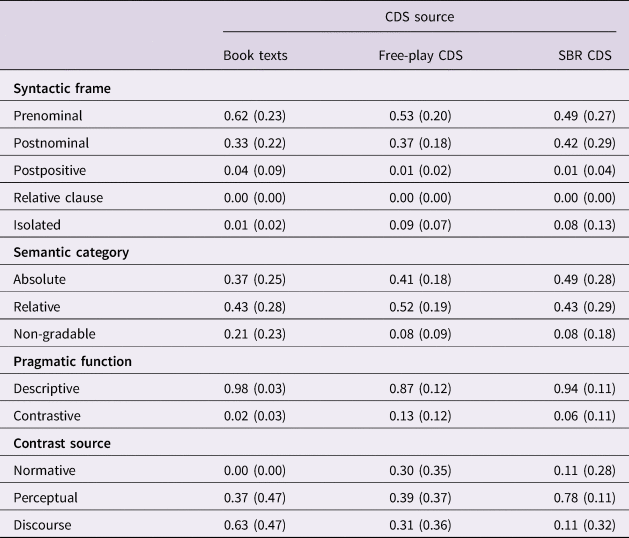
Proportions of different syntactic frames, semantic categories, and pragmatic functions across CDS sources are shown in Table 1. Proportions did not include any adjectives which had been excluded (as described above) and therefore we report only adjectives which were included in the core coding scheme. Proportions were calculated by totalling the number of adjectives within a subcategory (e.g., prenominal adjectives) and dividing it by the total number of adjectives in the whole category (e.g., prenominal, postnominal, postpositive, relative clause, and isolated adjectives). For example, if there were a total of 30 prenominal, 40 postnominal, 10 postpositive, 10 isolated, and 0 relative clause adjectives in free-play CDS, the proportion of prenominal adjectives would be 30/90 = 0.33.
Mean proportions of syntactic frames, semantic categories, pragmatic functions, and contrast sources in book texts, free-play CDS, and shared book-reading CDS. SDs are in parentheses.

Syntactic frame
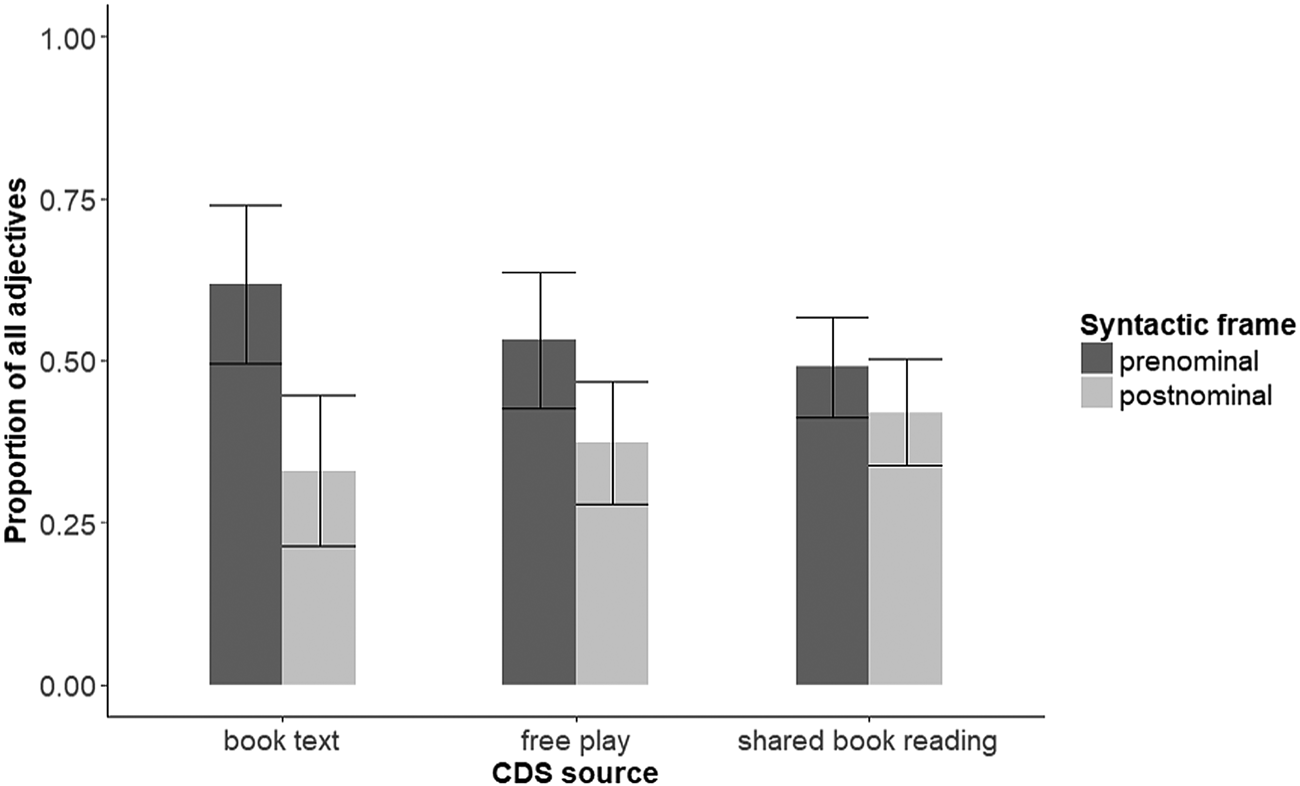
A two-way mixed ANOVA was conducted to investigate the effect of CDS source (free-play CDS, book texts, shared book-reading CDS) on the two main categories of syntactic frame (prenominal and postnominal). There was a main effect of syntactic frame (F(1,80) = 5.57, p < .05, n p2 = 0.07), showing that adjectives were more frequent in prenominal positions (M = 0.52, SD = 0.25) than postnominal positions (M = 0.39, SD = 0.26). However, there was no main effect of CDS source (F(1,80) = 0.02, p = .88) and no interaction between syntactic frame and CDS source (F(1,80) = 0.90, p = .34), as shown in Figure 1.
Proportion of major syntactic frames across CDS sources. Error bars represent standard error of the mean.

Semantic category
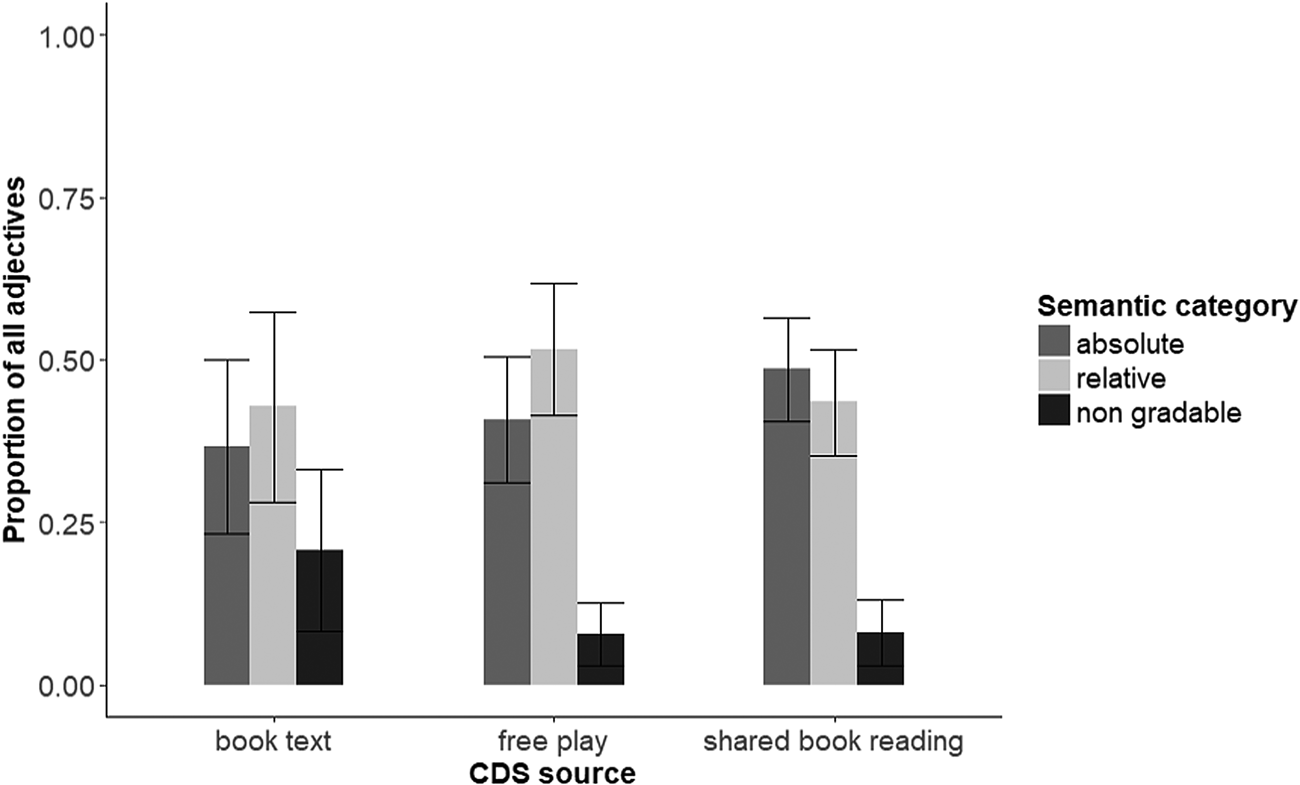
A two-way mixed ANOVA was conducted to investigate the effect of CDS source on semantic category. There was a main effect of semantic category (F(2,160) = 37.20, p < .001, n p2 = 0.32), with both absolute adjectives (M = 0.45, SD = 0.26) and relative adjectives (M = 0.45, SD = 0.27) appearing more frequently than non-gradable adjectives (M = 0.10, SD = 0.18; both ps < .001). Absolute adjectives (M = 0.45, SD = 0.26) and relative adjectives (M = 0.45, SD = 0.27) occurred similarly frequently (p = .97). There was no main effect of CDS source (F(1,80) = 2.04, p = .16) on semantic category, nor was there any interaction between semantic category and CDS source (F(2,160) = 1.17, p = .31), as shown in Figure 2.
Proportion of semantic categories across CDS sources.

Pragmatic function
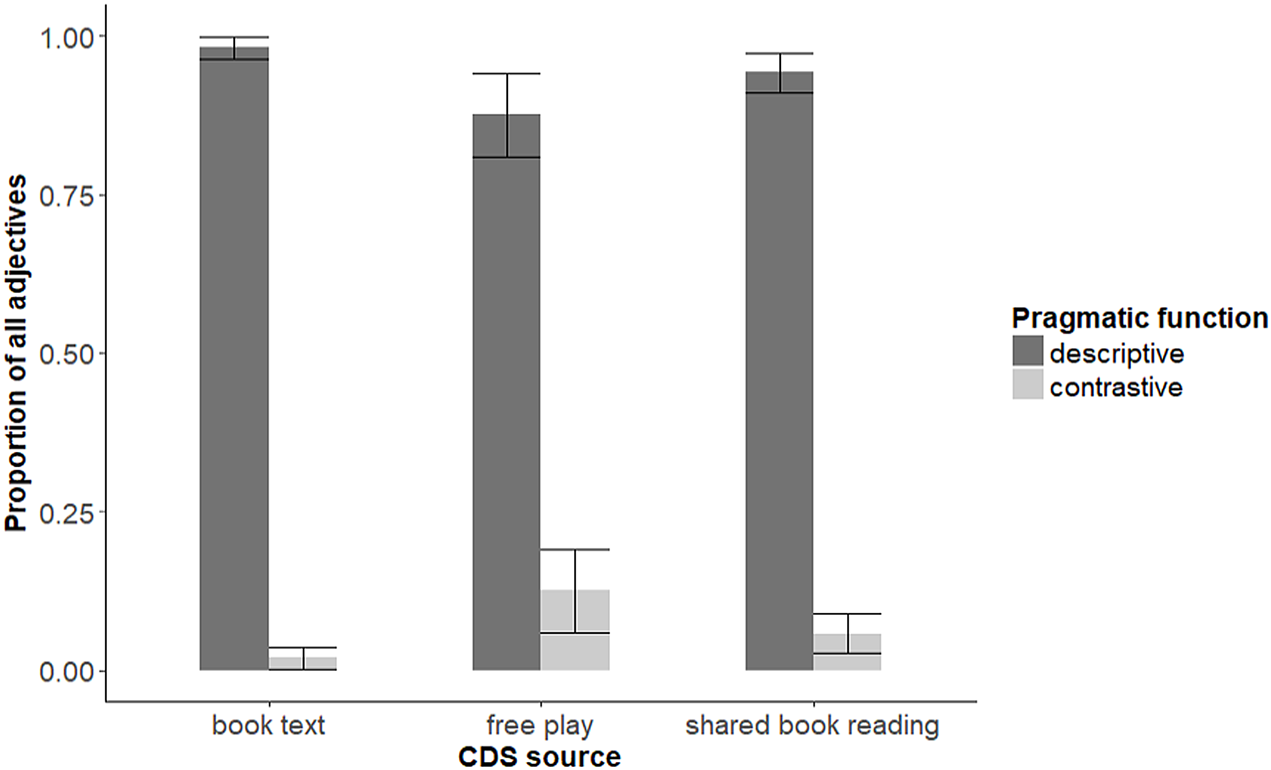
A two-way mixed ANOVA was conducted to investigate the effect of CDS source on pragmatic function. There was a main effect of pragmatic function (F(1,80) = 1364.81, p < .001, n p2 = 0.91) with descriptive adjectives (M = 0.94, SD = 0.11) appearing more frequently than contrastive adjectives (M = 0.06, SD = 0.11). There was no main effect of CDS source (F(1,80) = 0.75, p = .39), nor was there any significant interaction between pragmatic function and CDS source (F(1,80) = 2.70, p = .10), as shown in Figure 3.
Proportion of pragmatic functions across CDS sources.

As a post-hoc analysis, we explored which contrast sources (normative, perceptual, discourse) the contrastive adjectives drew from, across different CDS sources. Proportions of contrast sources were calculated by totalling the number of adjectives within each subcategory (e.g., normative sources) and dividing that sum by the total number of contrastive adjectives. For example, if there was a total of two normative, one perceptual, and one discourse adjectives in free-play CDS, the proportion of normative adjectives would be 2/4 = 0.5.
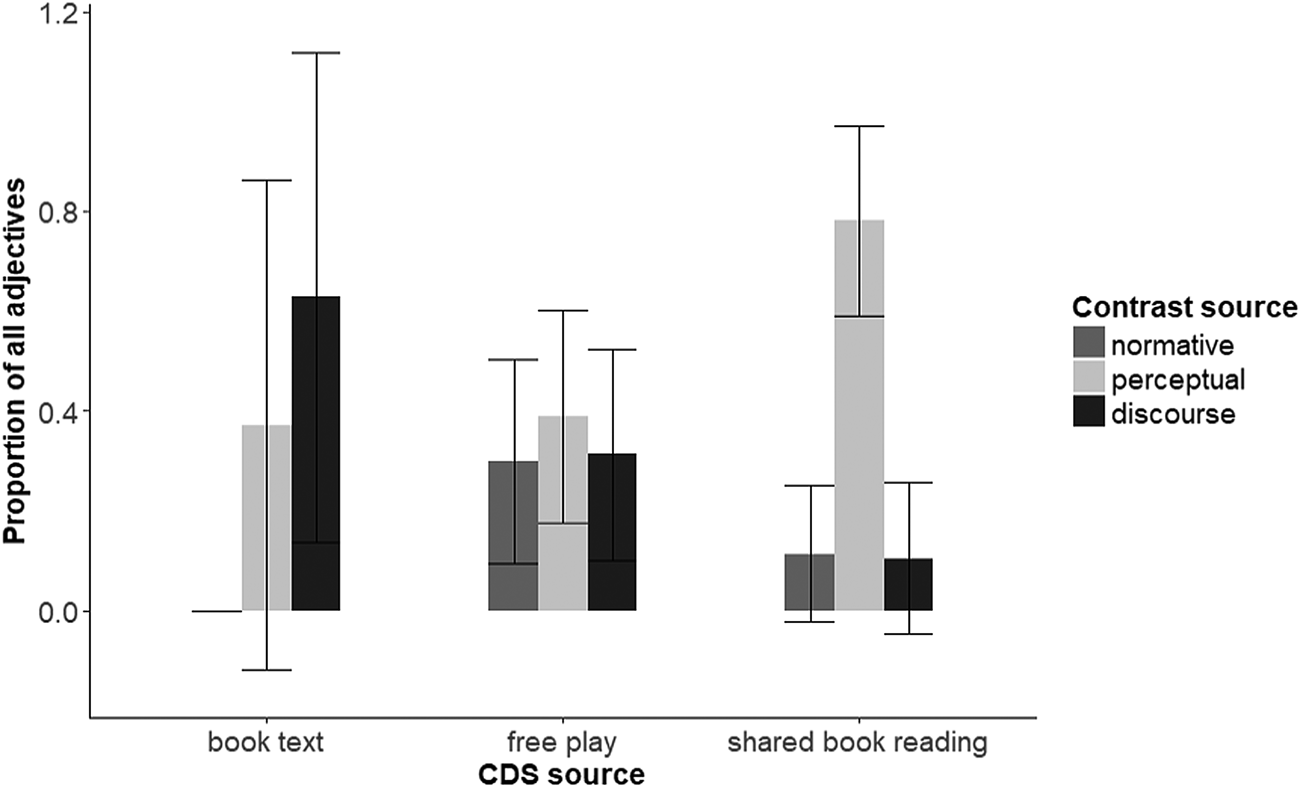
A two-way mixed ANOVA was conducted to investigate the effect of CDS source on contrast source. There was a main effect of contrast source (F(2,74) = 9.28, p < .001, n p2 = 0.20), with perceptual sources (M = 0.58, SD = 0.43) occurring more frequently than both normative sources (M = 0.16, SD = 0.30; p < .001) and discourse sources (M = 0.26, SD = 0.39; p < .05). There was no significant difference between normative sources (M = 0.16, SD = 0.30) and discourse sources (M = 0.26, SD = 0.39; p = .28). The main effect of CDS source was not significant (F(1,37) = 0.28, p = .60). The interaction between contrast source and CDS source was significant (F(2,74) = 4.99, p < .01, n p2 = 0.12). Discourse sources were more frequent in book texts, whereas perceptual sources were more frequent in shared book-reading, as shown in Figure 4.
Proportion of contrast sources across CDS sources.

Although the three main forms and functions of adjectives did not vary by CDS, note that adjective diversity (measured using a simple adjective type–token ratio (TTR) where the higher the TTR, the greater the adjective diversity) was greater in the book text subcorpus (228 types/597 tokens = 0.38) than in the free-play (100/371 = 0.27) and shared book-reading (102 /404 = 0.25) subcorpora. This accords with the richer vocabulary diversity found in written vs. spoken language for children (Montag et al., Reference Montag, Jones and Smith2015), and highlights the importance of reading for learning a wide range of adjectives. All three CDS sources shared the same most frequent adjectives, i.e., “big” and “little”, which together formed 27%, 22%, and 15% of all adjective usages in the book texts, shared book-reading, and the free-play subcorpora, respectively. Other size expressions occurred in the top 10 most frequent adjectives across sources, e.g., “small”, “huge”, “tiny”, “high”, and “long”.
Word familiarity
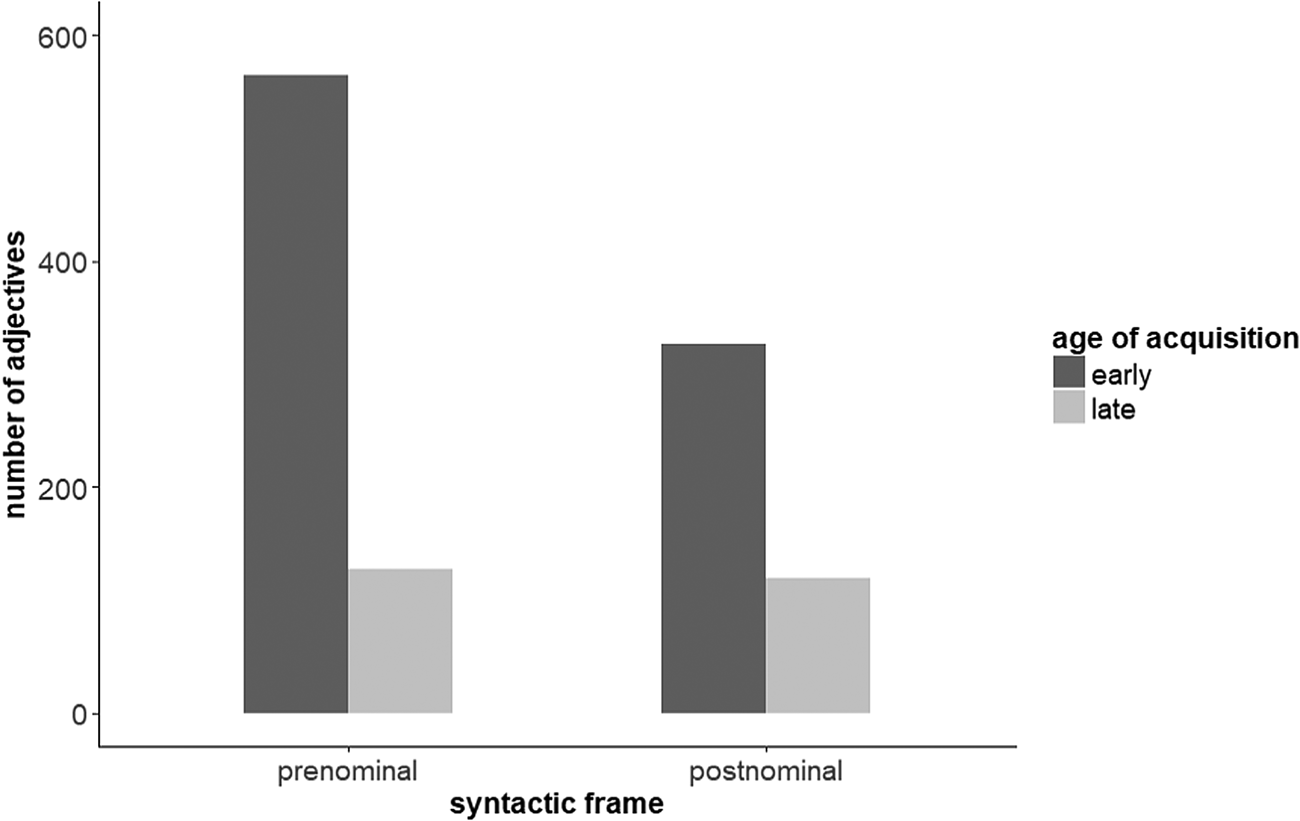
Figure 5 shows the proportions of early- (familiar) and late-acquired (less familiar) adjectives occurring in prenominal and postnominal frames. Of the early-acquired adjectives (i.e., learned before the age of 8 years), 564 appeared prenominally and 326 postnominally. The late-acquired adjectives (i.e., learned at or after the age of 8 years) appeared more equivocally between prenominal (127) and postnominal frames (119).
Proportion of early- and late-acquired adjectives occurring in prenominal and postnominal frames.

A chi-square test of independence was run to examine the relation between AoA and syntactic frame. The relation between these variables was significant (X 2 (1, N = 1136) = 11.16, p < .001). Although the stated hypothesis that later-acquired adjectives would be used postnominally is not borne out in the data, the corollary of this is true, i.e., earlier-acquired (more familiar) adjectives were more likely to occur in prenominal frames, i.e., in the more challenging position.
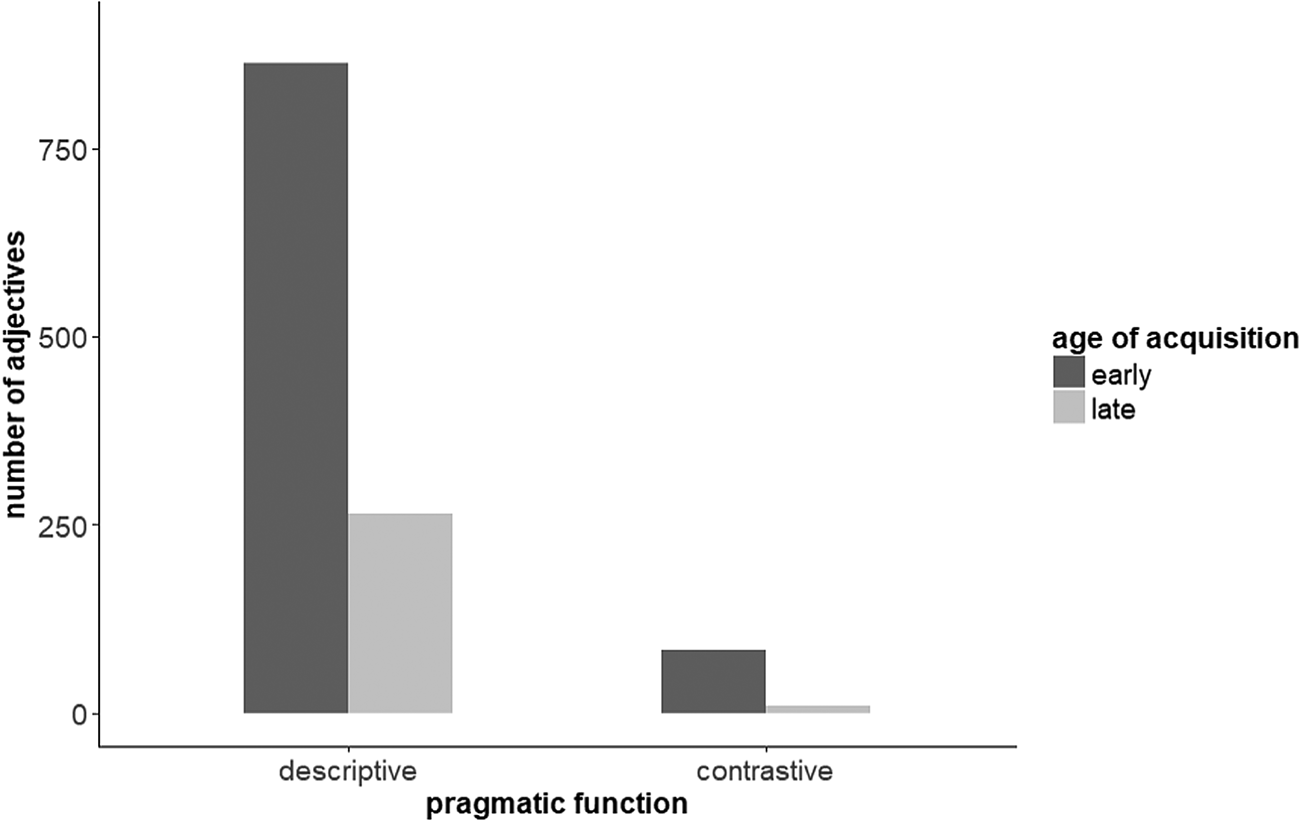
Figure 6 shows the proportions of early- (familiar) and late-acquired (less familiar) adjectives occurring with descriptive and contrastive functions. Of the early-acquired adjectives (i.e., learned before the age of 8 years), 863 occurred descriptively and 83 contrastively. The late-acquired adjectives (i.e., learned at or after the age of 8 years) showed a similar distribution, with 264 occurring descriptively and just 9 contrastively.
Number of early- and late-acquired adjectives occurring with descriptive and contrastive functions.

A chi-square test of independence was run to examine the relation between AoA and pragmatic function. The relation between these variables was significant (X 2 (1, N = 1219) = 9.11, p < .01). Against our hypothesis, later-acquired (less familiar) adjectives were more likely to be found with a descriptive function (the less developmentally helpful function) than with a contrastive one.
Effect of socioeconomic status and adjective use in CDS
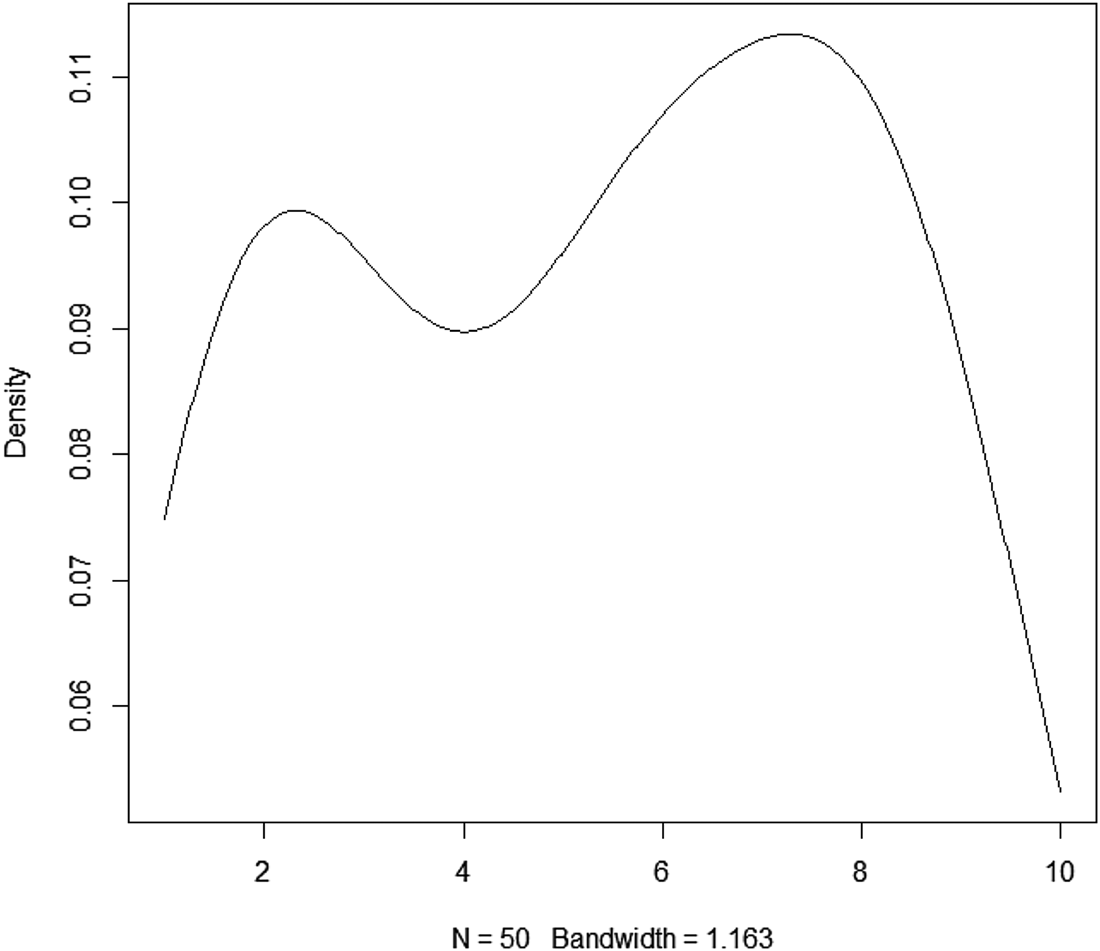
As a follow-up analysis, we used multivariate regression models to determine whether there was an effect of SES on use of syntactic frames, semantic categories, and pragmatic functions during shared book-reading CDS. IMD decile was used as a proxy measure of SES. Deciles are calculated by ranking areas in England from most deprived to least deprived and dividing them into 10 equal groups, from 1 (most deprived) to 10 (least deprived). In the current study, the mean IMD decile score was 5.34, SD = 2.83, range 1–10. Figure 7 shows the IMD decile distribution in our sample, which was bimodal due to small peaks at deciles 2 and 8.
Density plot showing distribution of IMD decile scores in the shared book-reading corpus.

The first model analysed the effect of SES on prenominal and postnominal syntactic frames (n = 50). For prenominal syntactic frames, the model predicted only 1% of variance in prenominal syntactic frames and was not significant (R 2 = 0.01, F(1,48) = 0.01, p = .95) and for postnominal syntactic frames, the model predicted only 1% of variance and was not significant (R 2 = 0.01, F(1,48) = 0.12, p = .74). A second model analysed the effect of SES on absolute, relative, and non-gradable syntactic frames (n = 50). For absolute semantic categories, the model predicted only 1% of variance and was not significant (R 2 = 0.01, F(1,48) = 0.53, p = .47). For relative semantic categories, the model predicted only 1% of variance and was not significant (R 2 = 0.01, F(1,48) = 0.01, p = .93). For non-gradable semantic categories, the model predicted only 2% of variance and was not significant (R2 = 0.02, F(1,48) = 1.02, p = .32). A final model analysed the effect of SES on descriptive and contrastive pragmatic functions (n = 50). For descriptive pragmatic functions, the model predicted only 3% of variance and was not significant (R 2 = 0.03, F(1,48) = 1.59, p = .21). For contrastive pragmatic functions, the model predicted only 3% of variance and was not significant (R 2 = 0.03, F(1,48) = 1.59, p = .21).
We then ran a linear regression model to determine whether there was an effect of SES on number of word tokens in CDS. Number of word tokens was calculated using the ‘frequency’ function in CLAN and included any shared book-reading CDS which was not book text. CDS word tokens ranged from 62 to 1257 (M = 495, SD = 289). The model predicted only 3% of variance in number of word tokens and was not significant (R 2 = 0.01, F(1,48) = 1.30, p = .26). All regression models were repeated with IMD rank as the predictor variable. A similar pattern of results was found.
As a final exploratory analysis to check for the effect of child age on the variables of interest, multivariate regressions were conducted with age (in months) as a predictor variable, and syntactic frame (prenominal, postnominal), semantic category (absolute, relative, non-gradable), and pragmatic function (descriptive, contrastive) as dependent variables for both the free-play and the shared book-reading subcorpora. Age was not a significant predictor in either corpus, for any dependent variable (all p-values > .30).
Discussion
This corpus analysis measured three- and four-year-olds’ exposure to adjectives across a range of interactive and socioeconomic contexts. It provides a systematic and comprehensive analysis of adjective use in CDS by measuring the frequency of adjectives presented in various syntactic frames, semantic categories, and pragmatic functions. The analysis is used to investigate how the forms of adjectives in CDS might affect their acquisition. The patterns of adjective use found in the analysis also have implications for the psycholinguistic demands involved in children's processing of adjectives across a range of syntactic, pragmatic, and interactive contexts.
With respect to the first research question, the children in our sample heard adjectives more frequently in prenominal than in postnominal syntactic frames, in line with the existing literature. Semantically, they heard more absolute and relative adjectives than non-gradable ones. Pragmatically, they heard many more descriptive adjectives than contrastive ones, as predicted. On all three measures, these patterns were the same regardless of whether the adjectives were presented as part of free play, as part of book texts, or through the spontaneous speech that occurred during shared book-reading. A post-hoc analysis of contrast source revealed that contrastive adjectives drew most frequently from perceptual sources (e.g., contrasting the target referent with another referent of the same nominal class in the visual context) than normative or discourse sources. Book texts contained more discourse sources than the other two forms of CDS, and shared book-reading CDS contained more perceptual sources than the other two forms.
A subsequent finer-grained analysis of the link between adjectives’ AoA and their syntactic frame suggests that the overall bias towards prenominal frames is driven by those adjectives that are more familiar to three- to four-year-olds, e.g., “a little sweet” than those that are learned in later childhood, e.g., “the baby was divine”. Although our analysis can not reveal whether this syntactic planning is strategic on the part of the caregiver, our data does support previous experimental work that shows that postnominal adjective use can help learning. The second finer-grained analysis of the link between AoA and pragmatic function shows that the abundance of adjectives used with a descriptive function is more marked for less familiar adjectives, e.g., “terrestrial planets”.
To address the second research question, we compare our quantitative findings with those of existing research that highlights adjective forms that are most likely to help their development and processing. The prevalence of prenominal frames (52%) relative to postnominal ones (39%) accords with a small-scale survey finding that colour terms occur before the noun in around 70% of spoken adjective usage in English (Thorpe & Fernald, Reference Thorpe and Fernald2006). At first blush, this pattern would seem counter to Ramscar et al.’s (Reference Ramscar, Yarlett, Dye, Denny and Thorpe2010) experimental finding that postnominal frames improve young children's understanding of adjectives. However, the finer-grained analysis of familiarity suggests that, when adjectives are less familiar, the more helpful postnominal syntactic frame is sometimes deployed. This sensitivity to children's limited processing capacities in specific situations has also been demonstrated in a referential communication task; caregivers were more likely to use adjectives postnominally when the comprehension task was hard than when it was easy (Arunachalam, Reference Arunachalam2016). In this way, adjective position is in line with other ways that caregivers tailor their language to support language development (e.g., Bornstein, Hendricks, Haynes, & Painter, Reference Bornstein, Hendricks, Haynes and Painter2007; Hoff-Ginsberg, Reference Hoff-Ginsberg1994; Huttenlocher, Vasilyeva, Waterfall, Vevea, & Hedges, Reference Huttenlocher, Vasilyeva, Waterfall, Vevea and Hedges2007; Newport, Gleitman, & Gleitman, Reference Newport, Gleitman, Gleitman, Snow and Ferguson1977; Pan, Rowe, Singer, & Snow, Reference Pan, Rowe, Singer and Snow2005; Snow, Reference Snow1972).
Intuitively, first narrowing a child's focus to a referent using the head noun, and then providing the adjective should facilitate identification of the referent as well as acquisition of the adjective's meaning (in line with Ninio's Reference Ninio2004 two-step model of adjective processing). Adults with memory deficits, too, have more difficulty with adjectives in prenominal position than postnominal position (Martin & Freedman, Reference Martin and Freedman2001) For (healthy) adults, who are faster at using prenominal adjectival information incrementally to identify a referent (e.g., Huang & Snedeker, Reference Huang and Snedeker2013), it is more efficient to place the adjective in prenominal position in simple contrastive contexts where the adjective alone, e.g., “the blue (X)”, is sufficient to distinguish the target. Even in more complex arrays, a prenominal adjective denoting a visually salient property may rule out several non-referents via the pop-out effect (Gatt, Krahmer, Deemter, & van Gompel, Reference Gatt, Krahmer, Deemter and van Gompel2017; Wolfe, Vo, Evans, & Greene, Reference Wolfe, Vo, Evans and Greene2011). In such cases, the post-adjectival noun can be disregarded by the addressee. Children, however, who are both less efficient language processors and may have less robust adjective knowledge, are hindered by this ordering.
The preponderance of descriptive usage frames (94%) relative to contrastive ones (6%) is in line with Blackwell's (Reference Blackwell2005) preliminary analysis of a corpus which found less than 3% of adjectives used contrastively, and Karmiloff-Smith's (Reference Karmiloff-Smith1979) observation of a bias towards given rather than new referents in CDS. The paucity of contrastive adjectives cutting across levels of adjective familiarity is at odds with what has been shown to be a more helpful form of input for children acquiring adjectives (Carey & Bartlett, Reference Carey and Bartlett1978; Murphy & Jones, Reference Murphy and Jones2008; Tribushinina et al., Reference Tribushinina, van den Bergh, Kilani-Schoch, Aksu-Koç, Dabašinskienė, Hrzica, Korecky-Kröll, Noccetti and Dressler2013; Waxman & Klibanoff, Reference Waxman and Klibanoff2000). We suggest that descriptive usages outnumber contrastive ones (in our data at a rate of around 15 to one) for several reasons. First, contrastive contexts are more specific. To contrast an object with another requires a competitor to be present, whereas referents can be described on their own merits in much less constrained circumstances, which might also explain why descriptive functions become more common for adjectives acquired later, for example those conveying abstract properties. In regard to descriptive usage in CDS, it may be the case that adults choose to modify their referring expressions in order to help the child to (a) find the referent more easily and (b) extend vocabulary. The first point is supported by accessibility accounts of discourse reference (Ariel, Reference Ariel1990; Chafe, Reference Chafe and Li1976, Reference Chafe1994; Gundel, Hedberg, & Zacharski, Reference Gundel, Hedberg and Zacharski1993), which predict that modified noun phrases signal least accessible information while pronouns signal highly accessible information. Assuming that adults seek to maximise accessibility for the child addressee, they may strategically use over-specified referring expressions. These manifest as an increased number of descriptive adjectives in CDS. On the second point, it has been suggested that children are more likely than adults to hear redundant descriptions of objects as their caregivers attempt to teach them new words (Deutsch & Pechmann, Reference Deutsch and Pechmann1982; Pechmann, Reference Pechmann, Bouma and Bouwhuis1984; Snow, Reference Snow1972). Regarding adjective use specifically, this hypothesis remains untested; we welcome future work that compares adjective use in child- versus adult-directed speech.
Since descriptive forms do not point to the existence of a contrast object, their frequency is likely to have implications for children's processing. First, the relative lack of contrastive adjectives reduces the opportunity for children to map meaning and form via focusing their attention on only the distinctive features between multiple referents. Second, hearing relatively few contrastive adjectives may delay the development of contrastive inference. Contrastive inference occurs when listeners use modified nouns to pragmatically infer the existence of other entities of the same noun class, (e.g., “the small rabbit” generating the inference that a larger rabbit also exists in the discourse context), or when they use the presence of a contrast set to infer that a prenominal adjective relates to a member of that contrast set rather than a singleton object (e.g., the smaller of the two rabbits rather than a lone small fox). This type of inference is not fully established even by ten years of age (Kronmüller, Morisseau, & Noveck, Reference Kronmüller, Morisseau and Noveck2014), and leaves children slower to process modified noun phrases since they are less likely than adults to engage in early reference resolution, i.e., during the adjective (Fernald et al., Reference Fernald, Thorpe and Marchman2010; Huang & Snedeker, Reference Huang and Snedeker2013, though cf. Tribushinina & Mak, Reference Tribushinina and Mak2016, for counter-evidence, and critique by Arunachalam, Reference Arunachalam2016, p. 106). The lack of contrastive usage may also limit the extent to which children scan the visual environment, again because the CDS they hear does not cue comparison. Indirectly, this may account for young children's habitual use of under-informative referring expressions in production (Davies & Katsos, Reference Davies and Katsos2010; Davies & Kreysa, Reference Davies and Kreysa2018; Matthews, Butcher, Lieven, & Tomasello, Reference Matthews, Butcher, Lieven and Tomasello2012; Matthews, Lieven, & Tomasello, Reference Matthews, Lieven and Tomasello2007).
It is important to remember that our results are limited to a sample of English data. This prevalence of descriptive adjectives may not be universal in CDS, leading to interesting cross-linguistic differences between cultures that expose children to descriptive adjectives to a greater or lesser extent. Klinger, Mayor, and Bannard (Reference Klinger, Mayor and Bannard2016) found that, in cultures where descriptive usage is rarer and thus adjective function is less nuanced, e.g., to Chatino-speaking indigenous children from Santa Lucia Teotepec in Oaxaca, Mexico, children copy redundant adjectives (an example of over-imitation), whereas children accustomed to redundant descriptive usage, e.g., speakers of German, Swiss French, and American English over-imitate less often. In turn, this may lead children in the latter group to ‘listen through’ adjectives (Thorpe & Fernald, Reference Thorpe and Fernald2006) because this can safely be done in descriptive contexts.
While we did not have a specific prediction regarding the difference in the number of absolute and relative adjectives in our CDS sample, we might have expected adults to use more absolutes on the grounds that these have more consistent and therefore simpler semantics. We attribute the lack of difference between the two categories to the relative importance of the adjective's meaning (e.g., ‘red’, ‘small’, etc.), rather than their degree semantics, which may simply be less important in communication.
When adjectives were contrastive, they tended to draw a contrast between referents in the perceptual (largely visual) environment rather than in the discourse or normative context. This is unsurprising, since all of the interactive contexts were visually stimulating, and most referring expressions pointed to co-present objects in the here-and-now. This was particularly the case during shared book-reading, where most of the CDS focused on the book's illustrations. The bias towards discourse contrasts in book texts is also unsurprising, since contrast contexts are set up via the written discourse. We also saw a small numerical increase in normative contrasts during free play relative to the other two CDS sources, which we attribute to a very specific aspect of the task. The toy set used in the free-play corpus included a magnifying glass so there was frequent mention of size in relation to the normal appearance of objects.
We selected three forms of CDS to investigate context-variability in adjective use. None of our measures of interest varied by CDS source, despite differences in interactive context and related levels of spontaneity. Our data suggests that adults are largely consistent in the forms and functions of adjectives they use with children, and even in the specific adjectives used: recall that “big” and “little” were the most common adjectives found across all three CDS sources (in line with a large literature on adjective development proposing that adjectives with more general application are acquired prior to those with greater restrictions, e.g., wide/narrow; e.g., Bartlett, Reference Bartlett1976; Clark, Reference Clark1972; Tribushinina, Reference Tribushinina, Paradis, Hudson and Magnusson2013b). This is all the more striking when we consider that free play and book reading vary not just in CDS form but also the content of what is being spoken or written about. Although our range of CDS sources was selected for its breadth, in another sense the three forms had similar discourse goals. Whether engaged in free play or book-reading, caregivers were spending time talking with their children, with no separate external goal. Moreover, these activities may facilitate discussion of known objects (hence the frequency of descriptive cf. contrastive adjectives). Other discourse contexts such as collaborative tasks or instructions may yield different patterns of adjective use. If this turns out to be the case in future studies, we must acknowledge a possible bias in our data relating to the CDS we sampled vs. the type of sampling required to obtain a more comprehensive and accurate picture of adjective use in CDS (Tomasello & Stahl, Reference Tomasello and Stahl2004). However, although our corpora form a relatively sparse dataset (in that they capture only a small fraction of the CDS that children encounter every day), our free-play and shared book-reading subcorpora are representative of common talk-based activities that three- to four-year-old children devote their time to. Moreover, we increased the density of our sample by analysing only those utterances that contained adjectives. Future work in this area would benefit from analysing an even wider sample of CDS, e.g., during personal care or mealtimes, to further increase the representativeness of the CDS sample (Baxter & Hayes, Reference Baxter and Hayes2007; Hofferth & Sandberg, Reference Hofferth and Sandberg2001), and reporting any similarities or differences in patterns of adjective use.
While analysing the shared book-reading CDS, we noticed that the proportion of adjectives increased as dyads began the treasure hunt activity at the end of the story. This is unsurprising as the activity encouraged description of the hidden objects (and also involved lots of comments about how hard/difficult/tricky it was!). The generation of adjective-rich language during this activity suggests that shared book-reading is not the only way – indeed may not even be the best way – of increasing adjective frequency and context-variability (especially contrastive uses) in the language that children hear. Games such as Where's Wally-style treasure hunts or spot-the-difference are excellent opportunities for rich linguistic input and interaction.
As explained in the ‘Method’ section and listed in the ‘Appendix’, we took online sales information as a proxy for books that three-year-olds typically share, following Cameron-Faulkner and Noble (Reference Cameron-Faulkner and Noble2013). Although it is feasible that books aimed at three-year-olds are those that are actually read to them, we do not have direct evidence for this. Indeed, a recent paper reporting a survey which asked caregivers of children aged 0–36 months about the books they commonly read to their children revealed relatively little overlap between bestseller lists and those that the 1,107 respondents reported reading to their children (Hudson Kam & Matthewson, Reference Hudson-Kam and Matthewson2017). Since only four of the respondents in that survey were comparable to the market that our bestseller list was aimed at (caregivers of 25- to 36-month-old children, responding from the UK), it is not possible to use that source to verify the reliability of our book list. However, looking more generally at the books listed in Hudson Kam and Matthewson's survey, the items on our list are likely to present children with comparable input in terms of syntactic forms and lexical diversity (our overarching variables of interest), since the genres of books are largely the same across sources, i.e., story-books (only two of the sixteen on our list were non-fiction).
Our shared book-reading data came from a socioeconomically diverse sample. Our analysis showed that parental SES (measured using IMD decile and IMD rank) did not predict the use of different patterns of syntactic frames, semantic categories, or pragmatic functions in shared book-reading CDS. Likewise, SES did not predict quantity of CDS in this subcorpus. In general, families from lower SES backgrounds have been found to offer a less rich language environment than their more privileged counterparts. CDS has been shown to be quantitatively and qualitatively different in low-SES families, e.g., featuring smaller quantities of speech with less varied vocabulary (Hart & Risley, Reference Hart and Risley1995; Hoff, Reference Hoff2003; Hoff-Ginsberg, Reference Hoff-Ginsberg1991; Lawrence & Shipley, Reference Lawrence and Shipley1996). Based on this, we might have expected the amount of CDS in our sample to vary by SES. This was not the case in our data, nor were adjective forms and functions influenced by SES. Where adjectives are included, they tend to be used similarly in CDS by caregivers from a range of backgrounds. However, there is an alternative methodological explanation to the lack of socioeconomic effect in our data. SES is a challenging concept to measure, with a range of metrics available (Coleman, Reference Coleman1988; Conger & Donnellan, Reference Conger and Donnellan2007; Ensminger & Fothergill, Reference Ensminger, Fothergill, Bornstein and Bradley2003). Although a wide range of SES is represented in our sample (IMD deciles 1 to 10), the families who chose to participate in the study may have had a richer home literacy environment than might be typical of the population. The original study that provided the data for our secondary analysis was advertised as investigating the factors affecting children's school readiness, and included details of the book-sharing that would be involved. This may have particularly encouraged families for whom reading is a frequent activity to volunteer, thus weakening the distinguishing effect of IMD decile. As part of that study, participants completed a Home Life questionnaire which collected information about family routines and activities. Responses revealed that, for the vast majority of our sample, reading was a frequent and enjoyable activity: 96% of the 49 returned questionnaires stated that someone reads or looks at books with their child daily (90%) or more than three times per week (6%), and 92% of caregivers who returned questionnaires agreed (78%) or strongly agreed (14%) that they found reading on their own enjoyable. To more effectively measure variability in CDS, future studies might consider analysing their data by variation in home literacy environment, e.g., degree of early print exposure, number of hours caregivers spend reading with their children, and number of books in the home (Raz & Bryant, Reference Raz and Bryant1990; Whitehurst, Reference Whitehurst, Adamson and Romski1997). We would also welcome studies of adjective exposure across the SES when families are engaged in a wider range of interactive contexts, e.g., mealtime talk. Likewise, studies on adjective use in languages other than English would form a valuable comparison to the current study, by revealing the influence of parental input across languages with more vs. less rich and specialised adjectival morphology, and in languages which allow pre- vs. postnominal adjectives.
Regarding the second research question, our findings show that syntactic frame may help the acquisition of more challenging adjectives. At the same time, they show a mismatch between a developmentally useful form (i.e., contrastive function) and the forms found in the real-world CDS. Although this discrepancy may contribute to the protracted developmental trajectory of adjective acquisition, we do not wish to prescribe that caregivers consciously adjust their adjectival forms to accelerate their children's language development, beyond encouraging talk-based activities that promote explicit comparison between referents. However, our findings have useful implications for clinical practice. There are several cohorts of children whose language and conceptual development lags behind their peers. For example, children with Developmental Language Disorder (DLD) with delays in receptive and/or expressive language, children with learning difficulties whose understanding of contrastive elements might take longer to be established than typically developing children and who may struggle to generalise to novel contexts, and children with autism spectrum conditions – especially those with higher-level language – who can find the abstract and variable nature of both contrastive and descriptive adjectives challenging. Designing therapeutic materials for these children to include more explicitly contrastive uses would provide useful scaffolding by encouraging visual comparison and highlighting distinctive features (and thereby the meaning of the adjective) between competitor referents. Indeed, this approach is well established in therapeutic processes, with speech and language therapists first establishing noun (and verb) vocabulary with the child, then teaching the concrete adjectival concept with the non-referent visually present, e.g., by sorting different objects by colour, teaching the linguistic label “red / not red”, then teaching the contrast “red/blue”. Caregivers are then encouraged to provide referential models to extend a child's expressive language from single words to two-word phrases by using an adjective–noun order, e.g., “car – blue car – big car – mummy's car”. Note that this approach favours prenominal frames. One of the key pieces of advice for caregivers and professionals working with children struggling with early language development is to restrict the complexity of language to the key content words that children need to process and respond to instructions (e.g., the Hanen Program; Earle & Lowry, Reference Earle and Lowry2011; Girolametto, Weitzman, Wiigs, & Pearce, Reference Girolametto, Weitzman, Wiigs and Pearce1999, and the Derbyshire Language Scheme; Knowles & Masidlover, Reference Knowles and Masidlover1982). Hence, predicative constructions are not generally used in therapy for preschoolers. Since this contradicts Ramscar et al.'s (Reference Ramscar, Yarlett, Dye, Denny and Thorpe2010) finding that postnominal frames are most helpful for learning, future research should investigate whether prenominal or postnominal frames are more effective for supporting adjective learning in children with delayed language.
In summary, our study used complementary sources of UK English CDS to provide a comprehensive survey of adjective use by caregivers to reveal relatively stable forms and functions of CDS across interactive and socioeconomic contexts. It revealed a mismatch between the forms of adjectives that are theoretically useful for language acquisition (contrastive; postnominal) and those that children more regularly experience (descriptive; prenominal). We attribute this to several factors, including the ubiquity of opportunities in discourse for describing (cf. contrasting) objects, and adults’ drive to use more specific descriptions to help children resolve reference and to extend their vocabulary. Although these are potentially helpful strategies within their respective domains, the relative lack of contrastive adjectives in the input is likely to reduce opportunities for developing contrastive inference and limit the extent to which children notice differences among referents and among linguistic forms. Considering the conceptual and linguistic difficulties that adjectives present, increasing the opportunities for practice would help children overcome these challenges.
The adjective forms found in our corpus analysis converge syntactically with, but diverge pragmatically from, what previous longitudinal, correlational, and offline behavioural studies have concluded to be useful for learning. This has important implications for processing, development, and intervention, particularly for researchers investigating the ideal structures for ‘learnability’ vs. the reality of language use. Future studies should use online processing methods to investigate whether our predictions about the utility of postnominal modification and of contrastive function are borne out. For example, the specific adjectives in their attested frames and functions from our novel CDS corpus would make useful naturalistic stimuli in rigorous online investigations of children's incremental processing. Language interventions might benefit from our documentation of the real input that children hear by using our adjective corpus to investigate whether exposure to specific forms of adjectives can boost children's use of descriptive language. Finally, while we have proposed arguments concerning adjectives in CDS, a comparable survey of adjective usage patterns in adult-directed speech would be very useful.
Author ORCIDs
Catherine DAVIES, 0000-0001-9347-7905
Acknowledgments
This research was supported by an ESRC New Investigator Grant awarded to the first author (ES/P010296/1). The authors thank Ellinor Hull, Charissa Lim, Catherine Porter, Anna Richardson, and Emilia Troup for assistance with transcription and coding, Chris Norton for preparing the age-of-acquisition data, and Jo Sandiford for helpful guidance regarding clinical interventions.
Appendix
Children's books used in the book text subcorpus
Antony, S. (2015). The Queen's hat. London: Scholastic Press.
Astley, N. (2013). Peppa Pig: George catches a cold. London: Ladybird.
Beaty, A. (2016). Ada Twist, scientist! New York: Abrahams.
Bright, R. (2016). The lion inside. London: Hachette Children's Group.
Brownlow, M. (2015). Ten little dinosaurs. London: Hachette Children's Group.
Dickman, N. (2011). Harvest festival. London: Heinemann Library.
Donaldson, J. (2016). The detective dog. London: Pan Macmillan.
Fox, M. (2008). Ten little fingers and ten little toes. London: Walker Books.
Gray, C., & Gray, K. (2016). Oi dog! London: Hachette Children's Group.
Hughes, C. (2012). National geographic little kids first book of space. London: National Geographic Kids.
Ironside, V. (2012). The huge bag of worries. London: Hachette Children's Group.
McBratney, S. (2015). Guess how much I love you. London: Walker Books.
Monks, L. (2007). Aaaarrgghh, spider! London: Egmont.
Potter, B. (2002). The tale of Peter Rabbit. London: Warne.
Rosen, M. (2011). Sad book. London: Walker Books.
Sharratt, N. (2007). The shark in the park. London: Picture Corgi.