Introduction
Ever since Trump's victory in the 2016 election, scholars and commentators alike note his robust and unwavering levels of support among white evangelicals. Eighty-one percent of white evangelicals reported voting for Trump in 2016 (Martinez and Smith Reference Martinez and Smith2016), a number that had declined by just 3 points in the 2020 election (Smith Reference Smith2020).Footnote 1 These trends are noteworthy considering that a group which was so mobilized in opposition to Bill Clinton by the Lewinsky scandal (Green et al. Reference Green, Rozell and Wilcox2000) would exhibit such high levels of support for a presidential candidate who had an alleged extramarital affair with an adult film actress (Feuer Reference Feuer2018), and was also unable to name a single bible passage when asked which was his favorite (Merritt 2016). These developments have spurned debate over why so many white evangelicals are willing to support Trump given this apparent irreligiosity and well-publicized moral transgressions (Whitehead et al. Reference Whitehead, Perry and Baker2018; Wehner Reference Wehner2019; Ayris Reference Ayris2020; Margolis Reference Margolis2020; Whitehead and Perry Reference Whitehead and Perry2020).
This contradiction raises a number of interesting questions. For instance, does Trump represent something of a unique case when it comes to white evangelical evaluations of elite religiosity? Or is his support among the group indicative of a new era of evangelical support for candidates that do not assess religiosity as it used to? In considering these questions, it is useful to consider patterns of white evangelical voter behavior in recent presidential election cycles. The 2012 election provided an initial indication that white evangelicals were willing to support non-traditional Republican candidates. Indeed, while there was a great deal of speculation as to whether white evangelicals would support Mitt Romney on account of his Mormon faith, the group voted as heavily for Romney as they had done for McCain in 2008 and Bush in 2004 (Pew Research Center 2012). When faced with another non-traditional candidate in the 2016 election, white evangelical voters backed Trump at remarkably similar levels they had Romney in 2012. Taken together, the results of the 2012 and 2016 elections indicate that white evangelicals are likely to support the Republican nominee for president, perhaps somewhat irrespective of candidate religiosity.Footnote 2
If white evangelicals no longer view religiosity as a particularly important heuristic when deciding whether to support Republican candidates, what then might explain their support for Trump? Contemporary work at the intersection of religion and political science proposes that negative partisanship—or the tendency of voters to form their political opinions in opposition to parties they dislike—helps to explain white evangelical support for Trump (Margolis Reference Margolis2020). However, such studies underplay the role that perceived threats to religious identities play in shaping candidate support. Past scholarship highlights how perceived threats to religious identity mobilize support for Republican candidates (e.g., Campbell and Monson Reference Campbell and Monson2008). 2016Scholars have expanded on the threat literature by demonstrating how perceived threats to Christian identity not only shape support for Trump but, crucially, also operate independent of the effects of religiosity (Whitehead et al. Reference Whitehead, Perry and Baker2018).
In this paper, I build on these works by exploring why so many Evangelicals are willing to support Trump despite his apparent irreligiosity and well-documented personal transgressions. To do this, I begin by reviewing academic debates about religion as a social identity. I then provide an overview of the scholarship on the impact of religious identity on evaluations of the religiosity of elites, focusing on the effects of evangelical identity on support for Republican candidates who use religious cues to mobilize support. With these streams of literature in mind, I draw attention to how Trump's apparent irreligiosity and moral transgressions give us reason to doubt whether or not Trump's religiosity matters at all to white evangelicals.
Next, I build a theoretical framework for thinking about why so many white evangelicals not only support Trump, but, interestingly, think that God played a role in his election—an interesting and seemingly contradictory finding given his aforenoted irreligiosity and well-documented personal behavior that has yet to be fully explored within the extant scholarship. Drawing on contemporary debates in the Christian nationalism and religious psychology scholarship, I posit that white evangelicals who perceive threats to their religious identity are likely to believe that God played some role in Trump's election in order to arrest the specific decline of Christian America. I hypothesize that it is these religious identity threats that condition white evangelicals' beliefs in whether Trump's election was a divine outcome. If white evangelicals do believe that God played some role in Trump's election to address the perceived marginalization of their beliefs, then this finding may go some way in explaining why some 81% of them support Trump despite his seeming irreligiosity.
Overall, I find that white evangelicals have a high likelihood of considering themselves minorities as a result of their religious beliefs. Moreover, these beliefs condition white evangelicals' views about whether Trump's election was a divine outcome. Specifically, I find that increases in the salience of perceived identity threat led to an increase in the likelihood of white evangelical respondents believing that Trump's election was a part of God's plan. Notably, these increases coincide with a decrease in the likelihood of white evangelical respondents believing that God does not get involved in elections. The findings contribute to the scholarship in two important ways. First, they add to the extant scholarship on the role that perceived threats to religious identity play shaping attitudes toward Republican candidates (Campbell and Monson Reference Campbell and Monson2008). Second, they provide evidence of how threats to religious identity operate independently of the effects of religiosity on white evangelicals' views toward Trump. These findings lend weight to the argument that assessments of candidate religiosity increasingly matter less when it comes to understanding why religious voters are willing to support non-traditional candidates such as Trump (Margolis Reference Margolis2020).
White evangelicals and social identity theory
Scholarship within the field of social psychology outlines how the groups to which people belong provide individuals with a social identity (Tajfel and Turner Reference Tajfel, Turner, Austin and Worchel1979). Individuals who identify strongly with their religious group not only share a set of common beliefs, but also perceive their group memberships as central to their idea of self, thereby gaining a sense of self-esteem from group membership and a robust link to fellow group members (Ysseldyk et al. Reference Ysseldyk, Matheson and Anisman2010). The unique characteristics of religion include compelling affective experiences and a sense of moral authority, which imbue religious social identities with significant meaning for many individuals (Wellman and Tokuno Reference Wellman and Tokuno2004). Another important component to identity development concerns the ingroup–outgroup distinction (Tajfel Reference Tajfel1978; Tajfel and Turner Reference Tajfel, Turner, Austin and Worchel1979). In the particular case of white evangelicals, much of the outgroup hostility expressed by the group is driven toward racial and religious minorities (Hetherington et al. Reference Hetherington, Weiler and Weiler2009).
Religious identities have a long history of being important explanatory measures in the political science scholarship (Layman Reference Layman1997; Smith Reference Smith2000; Wald and Calhoun-Brown Reference Wald and Calhoun-Brown2014), and their application to the study of political attitudes and behaviors has been no less pervasive in recent years (Williams Reference Williams2012; Margolis Reference Margolis2018). Many of these recent analyses have come in the wake of the 2016 election, which revealed an electorate highly polarized along the lines of religion (Martí Reference Martí2019; Margolis Reference Margolis2020). Consequently, it is unsurprising to find an emergent scholarship pointing to the importance of religious group identities conditioning political behavior in the Trump era.Footnote 3 In addition to these works, scholars play close attention to how religion affects the political behavior of white Americans in particular, finding a consistentFootnote 4 link to white evangelicalism and support for Trump (Martí Reference Martí2019; Margolis Reference Margolis2020).
While religious affiliation can be a social identity, it is important to qualify that I do not provide a direct test of the impact of white evangelical identity on my outcome measures. An objective basis for group membership—that is, coding ATP respondents who reported being “white,” “Protestant,” and “evangelical” as white evangelical as I do here—does not provide a sufficient basis for justifying a social identity, per se, since individuals experience attachment to their social group to varying degrees. Given my inability to account for white evangelicals' varying levels of attachment to their social identities, my argument is that social identity theory simply offers a useful frame for understanding how white evangelicals may be conceptualized as a group with a set of common beliefs about God's role in Trump's election.
Elite religiosity and the impact of religious identity
While many have questioned Trump's relative popularity among white evangelicals given his seeming religiously and well-documented personal transgressions (Whitehead et al. Reference Whitehead, Perry and Baker2018; Wehner Reference Wehner2019; Ayris Reference Ayris2020; Whitehead and Perry Reference Whitehead and Perry2020), we have not yet seen an analysis that directly addresses the question of Trump's religiosity with empirical data. The closest that an empirical analysis that has come to addressing this question is Margolis (Reference Margolis2020). Margolis (Reference Margolis2020) uses support for Trump among highly devout evangelicals as a proximate measure of elite religious evaluations, finding that those with higher levels of religiosity were more reticent to support Trump in the initial stages of the 2016 Republican Presidential primaries. While these findings provide evidence that non-traditional candidates such as Trump were less likely to enjoy the support of devout evangelicals in 2016, they do not offer direct evidence of their specific evaluations of Trump's religiosity.
Trump's apparent irreligiosity and personal transgressions bring into question the relative impact of elite religiosity on elite evaluations and voter behavior. Elite religiosity is defined as an emphasis on the importance of religious descriptive representation among individuals who are highly religious themselves (e.g., Castle et al. Reference Castle, Layman, Campbell and Green2017; Smidt and Miles Reference Smidt and Miles2017). While the descriptive representation scholarship has focused on the impact readily-visible identities such as race (Schildkraut Reference Schildkraut2017), it is likely that identities such as religion, which can easily be hidden from public view, function in a similar manner to those which cannot be easily hidden (Haider-Markel Reference Haider-Markel2007). Consistent with this observation, studies find religious identity to have a substantive impact on evaluations of elites (Castle et al. Reference Castle, Layman, Campbell and Green2017; Smidt and Miles Reference Smidt and Miles2017).
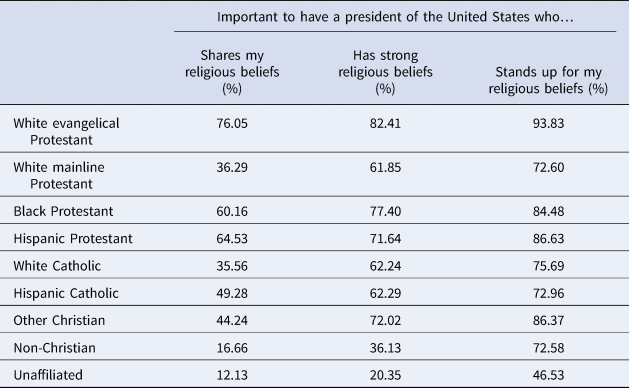
To illustrate the impact of white evangelical identity on preferences for elite religiosity, I draw on data from Wave 61 of the American Trends Panel (ATP). Wave 61 of the ATP contains a number of items asking respondents whether it is important to have a president who exhibits a number of qualities. Table 1 displays the percentage of ATP respondents who thought it was important to have a president who (i) shares their religious beliefs, (ii) has strong religious beliefs themselves, and (iii) stands up for their religious beliefs. As evidenced by Table 1, a strong majority of white evangelical respondents report that it is important to have a president who exhibits all three qualities. Further, these figures are consistently higher than respondents with other religious identities, lending weight to the argument that white evangelicals exhibit strong preferences for elite religiosity.
Preferences for elite religiosity, by religious identity

Notes: Table entries represent the percentage of respondents who thought that it was either “somewhat” or “very” important to have a president who exhibited each quality.
Source: American Trends Panel (Wave 61).
The American public know notoriously little about elite policy positions or voting records, and instead rely on “informational shortcuts” when making evaluations about elites (Popkin Reference Popkin2020). In this way, elite identity cues help the public evaluate their ideological orientations, likely positions, and personality traits. Identity markers such as religious affiliation and religiosity therefore function as heuristics that allow the public to make evaluations about which elites will best represent them (McDermott Reference McDermott2009). Consistent with this theorizing, scholars find religious cues to have a substantive effect on elite approval, elite evaluations, and voter behavior (Olson and Warber Reference Olson and Warber2008; Calfano and Djupe Reference Calfano and Djupe2009; Weber and Thornton Reference Weber and Thornton2012; Campbell et al. Reference Campbell, Layman, Green and Sumaktoyo2018).
Elites who frame themselves as being religious are more likely to attract support from highly religious voters whilst repelling less-devout individuals (McLaughlin and Wise Reference McLaughlin and Wise2014). Republican elites often deploy covert cues to mobilize religious support (Albertson Reference Albertson2015). Covert cues do not directly reference God or their Christian faith (Calfano and Djupe Reference Calfano and Djupe2009), instead relying on specific references to biblical passages that are detected by religious groups such as evangelical Protestants who are typically loyal to the Republican Party (Schwadel Reference Schwadel2017).Footnote 5 A salient and practical example of covert cues includes Ted Cruz directly quoting scripture after victory in the 2016 Iowa Caucuses (Blair Reference Blair2016).
This observation is interesting considering the specific case of Trump. Trump's attempt to use covert cues to mobilize evangelical support is noteworthy because of his apparent lack of awareness of specific bible passages (Merritt 2016). If the attempted use of covert cues by Trump has not proved effective in convincing white evangelicals of his religiosity, then we have reason to suspect that they will not perceive him as being particularly religious.Footnote 6 Another reason to doubt whether white evangelicals perceive Trump as being religious are his well-publicized personal transgressions, including his alleged extramarital affair with the adult-film actress Stormy Daniels. Given the Christian Right's reaction to the Lewinsky Scandal (Green et al. Reference Green, Rozell and Wilcox2000), it is not out of the realm of possibility that some reacted the same way to Trump.Footnote 7
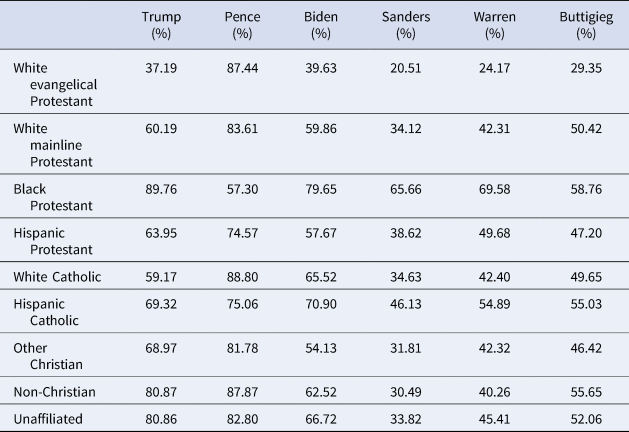
To illustrate that white evangelicals do not evaluate Trump as being particularly religious, I once again draw on Wave 61 of the ATP. Wave 61 of the ATP contains several items that ask respondents how religious they perceive a number of candidates in the 2020 election to be. Table 2 displays the percentage of respondents who thought that each candidate was either “somewhat” or “very” religious. As evidenced by the first column in Table 2, just 37.19% of white evangelicals perceive Trump as being “somewhat” or “very” religious. The remaining columns in Table 2 indicate that white evangelicals also perceive a slew of Republican/Democratic candidates as being either religious or irreligious. For instance, 87.44% of white evangelicals think that Mike Pence is either “somewhat” or “very” religious, while none of the Democratic candidates are perceived as being particularly religious white evangelicals. In sum, the data illustrate that Trump is something of a unique case when it comes to white Evangelicals' evaluations of elite religiosity; they perceive a slew of Democratic elites as irreligious,Footnote 8 whilst concurrently demonstrating that they are able to evaluate non-Trump Republicans (Pence) as being highly religious.
Perceptions of elite religiosity, by religious identity

Notes: Table entries represent the percentage of respondents who thought that each presidential candidate was either “somewhat” or “very” religious.
Source: American Trends Panel (Wave 61).
Declining influence, marginalized beliefs, and elections as divine outcomes
While religious cleavages were once shaped by religious tradition, social changes beginning in the 50s led to “religious restructuring” whereby religious commitment played an increasingly vital role in structuring individual differences (Wuthnow Reference Wuthnow1988). Resultingly, the religiously committed had a greater propensity to incorporate religion into their social identifies, were exposed to culturally traditional religious doctrine, and became more embedded in social networks that communicated distinctive political values (Castle Reference Castle2019). The sum of these changes was an emergent “culture war” (Hunter Reference Hunter1992) over issues including public education (Zimmerman Reference Zimmerman2009), abortion (Mouw and Sobel Reference Mouw and Sobel2001), and later same sex marriage and transgender rights (Castle Reference Castle2019).
Because culture politics usually involves disagreement about what society should or should not prescribe as the appropriate way of life, any political controversies on conflicts over cultural norms qualify as cultural politics. Since cultural politics are perceived as intrinsically good or evil, issues over culture are often framed as “explosive” or “nonbargainable” (Leege et al. Reference Leege, Wald, Krueger and Mueller2009). In this way, cultural politics deals with what certain subcultural groups (for instance, the religiously affiliated) perceive as being right or wrong for society. Subcultural groups argue it is crucially important that they are able to practice and propound their own values within a pluralist society (Leege et al. Reference Leege, Wald, Krueger and Mueller2009). However, if certain cultural subgroups come to feel that they are not able to do either of these things, individuals with a salient attachment to their group membership may come to feel threatened. The perceived implications of an identity threat may elicit varying degrees of distress depending on the group membership that is targeted (Branscombe et al. Reference Branscombe, Ellemers, Spears, Doosje, N, R and B1999). Threats to some identities, such as religious identities, may be perceived as having greater implications than threats to identities associated with other groups. For instance, a threat to religious identity could be perceived as being paramount because of the “eternal” significance of religious group membership and the highly revered belief system to which it is attached (Kinnvall Reference Kinnvall2004).
It is common for elites to organize voters around cultural issues in U.S. elections (Leege et al. Reference Leege, Wald, Krueger and Mueller2009). Elites present themselves as defending cultural norms, thereby separating themselves from their opponents, who are usually defined as being against such values. Multiple studies indicate that this strategy is likely to prove effective in politically mobilizing culturally aggrieved religious identifiers. Perceptions of threat can motivate white evangelicals to support Republican candidates at higher rates in national elections. Likewise, Campbell and Monson (Reference Campbell and Monson2008) demonstrate how threat perceptions can motivate other theologically conservative religious groups such as Latter Day Saint (LDS) members to become politically active.
As the percentage of Americans who do not identify with an organized religion has increased (Putnam et al. Reference Putnam, Campbell and Garrett2012), White Christians are now a minority in American politics, a trend which has fed into perceptions of declining influence among many white evangelicals (Jones Reference Jones2016). As America becomes an increasingly plural nation along religious lines, elites such as Trump have come to view these changes as an opportunity to activate cultural threat and mobilize support among those who feel as though their beliefs are becoming increasingly marginalized as a result of consequence of these changes. It is with these developments in mind that lead me to state my first hypothesis:
H1: White evangelicals will have a high probability of considering themselves minorities because of their beliefs.
Still, Trump's ability to mobilize white evangelical support seems puzzling when we consider the fact that he appears to know very little about the bible (Merritt 2016) or that some see his personal behavior as unbecoming of a devout Christian. Does Trump's behavior, as well as an apparent lack of religiosity, not matter at all to white evangelicals? This question beget a point made by numerous scholars regarding Trump's relationship with white evangelicals; Trump may not share their religion and lifestyle, but does share—and, more importantly, articulates on their behalf—many of the same grievances (Whitehead et al. Reference Whitehead, Perry and Baker2018; Posner Reference Posner2020). Indeed, and perhaps the most crucial grievance articulated by Trump, is the idea that the aforenoted changes that have occurred since the 50s robbed white evangelicals of the Christian America that many believed was God's intention for America's founding (Gorski Reference Gorski, JL and JC2019; Whitehead and Perry Reference Whitehead and Perry2020).
Even if white evangelicals think that Trump is not particularly religious, there is reason to suspect that they support him on a political level because of the many policies championed by Trump that have sought to further white Christian interests. Crucially, these policy “wins” may overpower concerns related to his lack of religiosity or personal behavior, since they seek to arrest the apparent decline in Christian influence that has led many white evangelicals to feel as though they are now, themselves, minorities. While public beliefs do not crystalize into well-formed policy preferences (Achen and Bartels Reference Achen and Bartels2017) or are simply not attuned to which elites favor which policy, evidence suggests that policy does matter to white evangelicals (Keenan and Pereira Reference Keenan and Pereira2020). This observation is important because Trump has largely delivered in policy areas such as court appointments, which public opinion data indicate matters highly to evangelical voters (Renard Reference Renard2017).Footnote 9
Given Trump's articulation of the Christian nation myth and his relative success in enacting policies to arrest the apparent decline in white Christian influence, it is perhaps not surprising to find that some 73% of white evangelicals believe that God played some role in his election in 2016.Footnote 10 The idea that God played some role in Trump's election has been especially prevalent among evangelical leaders including Ralph Reed (Reference Reed2020) and Robert Jeffress (Mooney Reference Mooney2019). White evangelicals' specific rationale for divine influence varies. Some common rationales include the idea that Trump is fulfilling America's destiny or restoring America as a Christian nation (Posner Reference Posner2020), which fits directly with the Christian nationalism thesis (Whitehead and Perry Reference Whitehead and Perry2020). An addendum to this rationale is the idea that God chooses unlikely leaders to represent his followers (Posner Reference Posner2020). The allegory here being that, though Trump does not exude religiosity despite self-identifying as a Christian, his followers nonetheless see him as restoring a version of a Christian America just as biblical characters such as King Cyrus, the Persian King, restored Jerusalem.
This rationale is important to consider because it may explain why so many white evangelicals think that God played some role in Trump election even if he is not an overtly devout follower of the Christian faith. Religious psychology scholars posit that threats to religious identity are especially salient because they may lead to individuals adopting “coping mechanisms,” including passive resignation to the threat itself, as well as wishful thinking (Ysseldyk et al. Reference Ysseldyk, Matheson and Anisman2011). The belief that God played some role in Trump's election could be an example of wishful thinking on the part of white evangelicals especially concerned about the decline of a white Christian America.
In this model, white evangelicals perceive that Christian America is declining, making them feel as though they are a religious minority. Political elites then frame issues such as the decline of Christian America in a way that appeals to these threat perceptions. In the specific case of Trump, this includes harks to the restoration of a “Christian America” (Whitehead et al. Reference Whitehead, Perry and Baker2018). In this way, identity threat perceptions are activated by the specific frame regarding the “restoration” of Christian America as promoted by Trump, with the activation of these frames depending on the degree of resonance between the threat perceptions themselves and white evangelicals' belief in Trump's message. Given that religious identity threats explain support for Trump (Whitehead et al. Reference Whitehead, Perry and Baker2018), we therefore have reason to expect that they will also condition their beliefs about God's role in Trump's election.Footnote 11 These developments lead me to state my second hypothesis as:
H2: Perceptions of minority status will condition white evangelical beliefs about God's role in Trump's election.
Definitions, data, and measures
A definitional issue must first be addressed before proceeding to outline my data and measures. Despite being a pervasive group of scholarly interest since Trump's election in 2016, Evangelicals are defined in a number of different ways. How evangelicals are defined is important because different coding schema may elicit diverging inferences about the group in question (Hackett and Lindsay Reference Hackett and Lindsay2008; Ayris Reference Ayris2020). Burge and Lewis (Reference Burge and Lewis2018) posit that a question about broad religious affiliation followed by a question about a respondents' status as a “born again” or evangelical Christian is sufficient. However, this approach may lead to a sample that is smaller and slightly more Republican leaning than other definitions (Burge and Lewis Reference Burge and Lewis2018).Footnote 12 This approach, also used in contemporary studies (Margolis Reference Margolis2020), defines evangelicals by their theological beliefs, and locates Evangelism within Protestantism and views religion as an individual identity.
A separate approach defines evangelicals by the religious tradition that individuals belong to (Steensland et al. Reference Steensland, Robinson, Wilcox, Park, Regnerus and Woodberry2000; Smidt Reference Smidt2019). The RELTRAD method similarly focuses on intra-Protestant variations. However, perhaps the most glaring limitation especially relevant in the context of the current study is that, in the RELTRAD method, a respondents' race is not factored into these categorizations (Steensland et al. Reference Steensland, Robinson, Wilcox, Park, Regnerus and Woodberry2000; Smidt Reference Smidt2019). The RELTRAD method may therefore not be the most appropriate definition to take in studies such as this one, where the aim is to understand white evangelical beliefs and behaviors. Because of my theoretical interest in understanding white evangelical beliefs about God's role in Trump's election, I therefore opt for the former method. Crucially, this method allows for the inclusion of race into my religious classification scheme, and as noted in the previous paragraph, has also been used to study white evangelicals in a number of contemporary studies. Nonetheless, it is important to be aware of the limitations of my chosen definition for the purposes of conducting a transparent investigation.
To test my two hypotheses, data are taken from Wave 61 of Pew's ATP. The ATP is a nationally representative, probability-based online panel of noninstitutionalized persons aged 18 or over living in any of the 48 contiguous U.S. states, as well as AK or HI. Wave 61 of the ATP was conducted on behalf of Pew by the polling company Ipsos from February 4 to 20, 2020. Altogether, N = 6395 ATP panelists completed Wave 61. Survey weights were constructed by Pew for the online sample, which are used here so that results are generalizable to the U.S. adult population.
Dependent variables
To test H1, I use a dichotomous item that asks respondents whether they consider themselves to be a minority because of their religious beliefs. Respondents who consider themselves to be a minority because of their religious beliefs are coded as 1, and those who do not as 0.
The dependent measure to test H2 is a four-point categorical item that asks which statement comes closest to a respondent's view about god's role in the 2016 election, even if none are exactly right. The four statements are: (i) God chose Trump to be President because God approves of Trump's policies, (ii) Trump's election must be part of God's plan but doesn't necessarily mean that God approves of Trump's policies, (iii) God does not get involved in elections, and (iv) I do not believe in God.Footnote 13
Independent variables
Religion measures
Denomination and religiosity are both used to measure religion. Religious denominations are coded using a classification scheme outlined by the Public Religion Research Institute (PRRI) using eight categories: white evangelical Protestant, Black Protestant, Hispanic Protestant, white Catholic, Hispanic Catholic, other Christian, non-Christian, and the religiously unaffiliated, with white mainline Protestants serving as the reference category.Footnote 14
Religiosity is measured with three items
The first is a four-point ordinal item that asks how important religion is to a respondent, with possible responses ranging between 1 = “not at all important,” and 4 = “very important.” The second is a six-point ordinal item that asks how often a respondent attends religious service, with possible responses ranging between 1 = “never,” and 6 = “more than once a week.” The third item is a seven-point ordinal item that asks how often a respondent prays, with possible responses ranging between 1 = “never,” and 7 = “several times a day.” The three items are summed to create a single measure of religiosity (Cronbach's α = 0.87).
Controls
In addition to the measures outlined above, models are also estimated with a number of socio-political, demographic, and structural covariates. Respondents with a partisan or leaned partisan affiliation with the Republican Party are coded 1, and those with a partisan or leaned partisan affiliation with the Democratic Party as 0.Footnote 15 Ideology is a five-point ordinal item ranging between 1 = “very liberal,” and 5 = “very conservative.” Age is a four-point ordinal item ranging between 1 = “18–29,” and 4 = “65 + .”Footnote 16 Male are coded as 1 and females as 0. Education is a six-point ordinal item ranging between 1 = “less than high school,” and 6 = “postgraduate.” Lastly, respondents who reside in the South are coded 1, and those who reside elsewhere as 0. Unless noted, all variables are z-transformed to obtain standardized coefficient estimates.
Results
White evangelicals as religious minorities
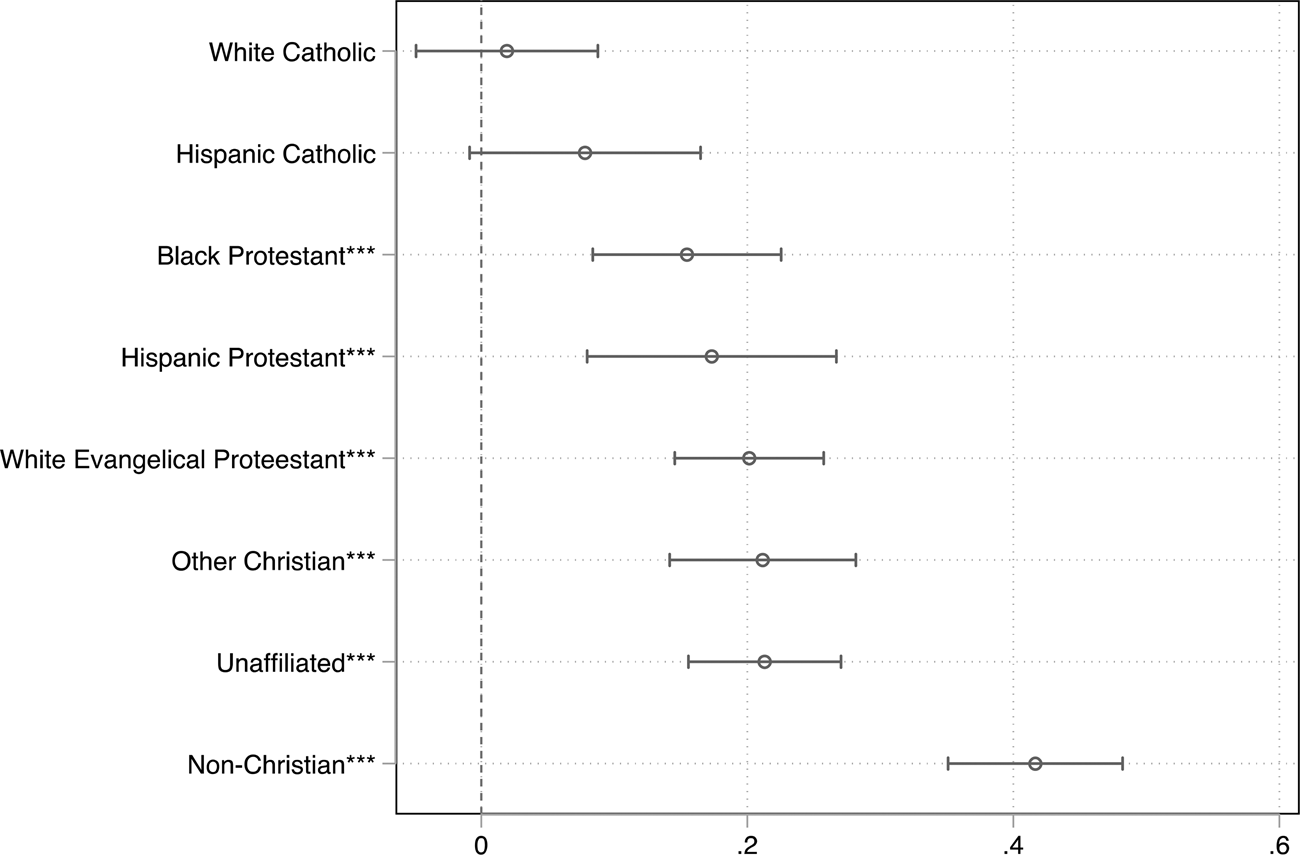
I first turn to examine the extent to which minority status perceptions shape evaluations of Trump. In order to understand whether minority status perceptions condition evaluations of Trump, it is first necessary to quantify the extent to which white evangelicals consider themselves to be minorities as a consequence of their religious beliefs (H1). To test this possibility, the dichotomous item for perceptions of minority belief status was regressed against the religion and religiosity measures, as well as the set of covariates. Given that my outcome of interest is dichotomous, I use a binary logit estimator. For brevity, Figure 1 depicts the average marginal effect (AME) of religious identity for the eight respective PRRI classifications. Points to the right of the x axis in Figure 1 indicate a positive marginal effect, or an increase in the probability of a respondent considering themselves to be a minority because of their religious beliefs. Conversely, points to the left of the x axis indicate a negative marginal effect, or a decrease in the probably of a respondent considering themselves to be a minority because of their religious beliefs.
Logit estimates for minority status perceptions, by religious identity.
Notes: Points represent the marginal effect of various religious identities (sorted by size). The capped lines are 95% confidence intervals. Data are weighted. Asterisks indicate a statistically significant marginal effect (*p < 0.05, **p < 0.01, ***p < 0.001). Full estimates presented in section A3 of the SI file.
Source: American Trends Panel (Wave 61).

As evidenced by Figure 1, being a white evangelical is associated with a 20-point increase in the probability of a respondent considering themselves a minority because of their religious beliefs (AME = 0.201, p ≤ 0.001).Footnote 17 Notably, the size of the AME through white evangelical identity is larger than that for a number of other racial-religious groups including Black Protestants (p ≤ 0.001) and Hispanic Protestants (p ≤ 0.001). Elsewhere, being a non-Christian (p ≤ 0.001), religiously unaffiliated (p ≤ 0.001), and an “other Christian” increase the probability of considering oneself a minority. However, being a white Catholic or a Hispanic Catholic does not substantively affect the probability of considering oneself a minority. In sum, the results from Figure 1 therefore provide robust evidence in favor of the hypothesis that white evangelicals consider themselves to be a marginalized group as a result of their religious beliefs (H1).
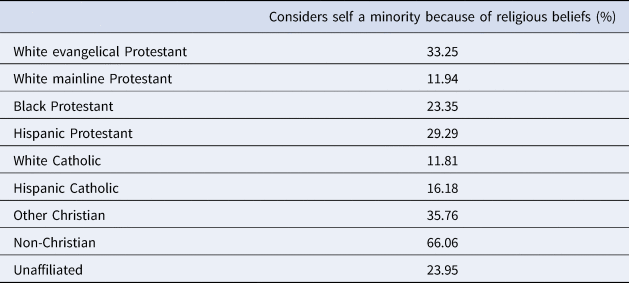
Minority status perceptions, by religious identity

Notes: Table entries represent the percentage of respondents who consider themselves to be minorities because of their religious beliefs.
Source: American Trends Panel (Wave 61).
Elections as divine outcomes
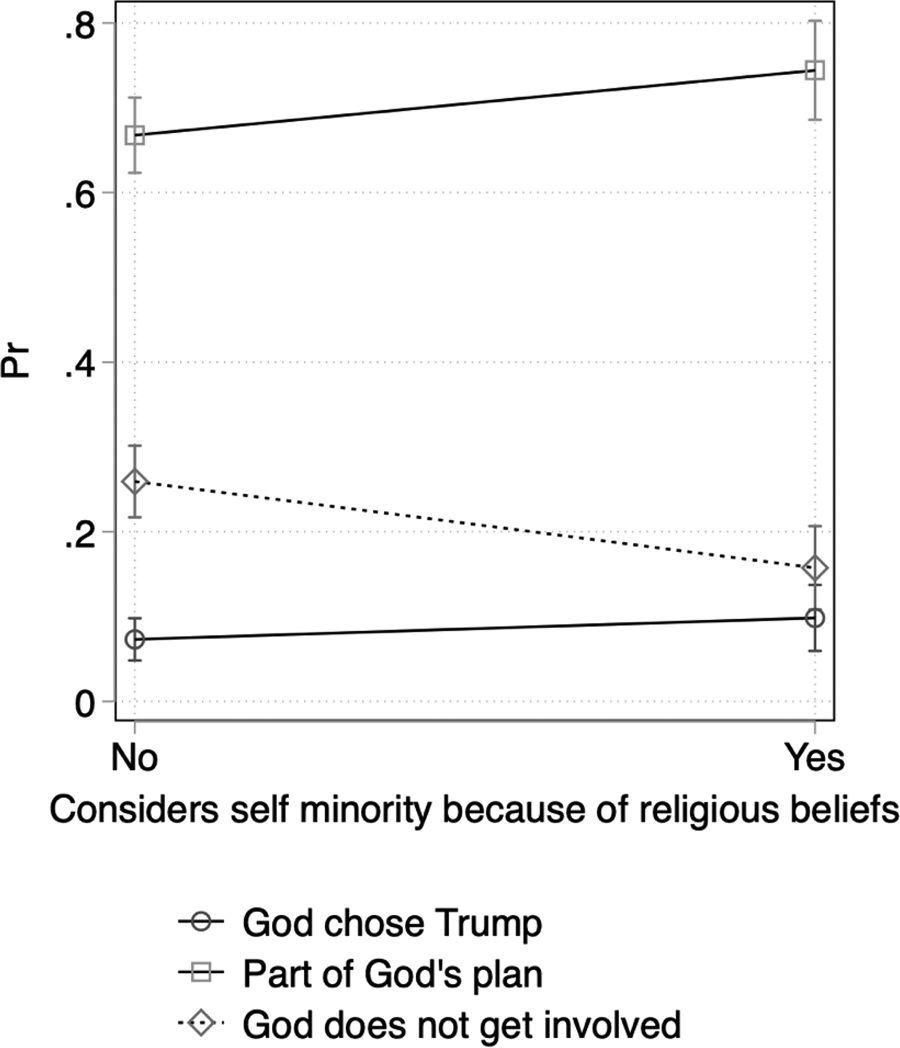
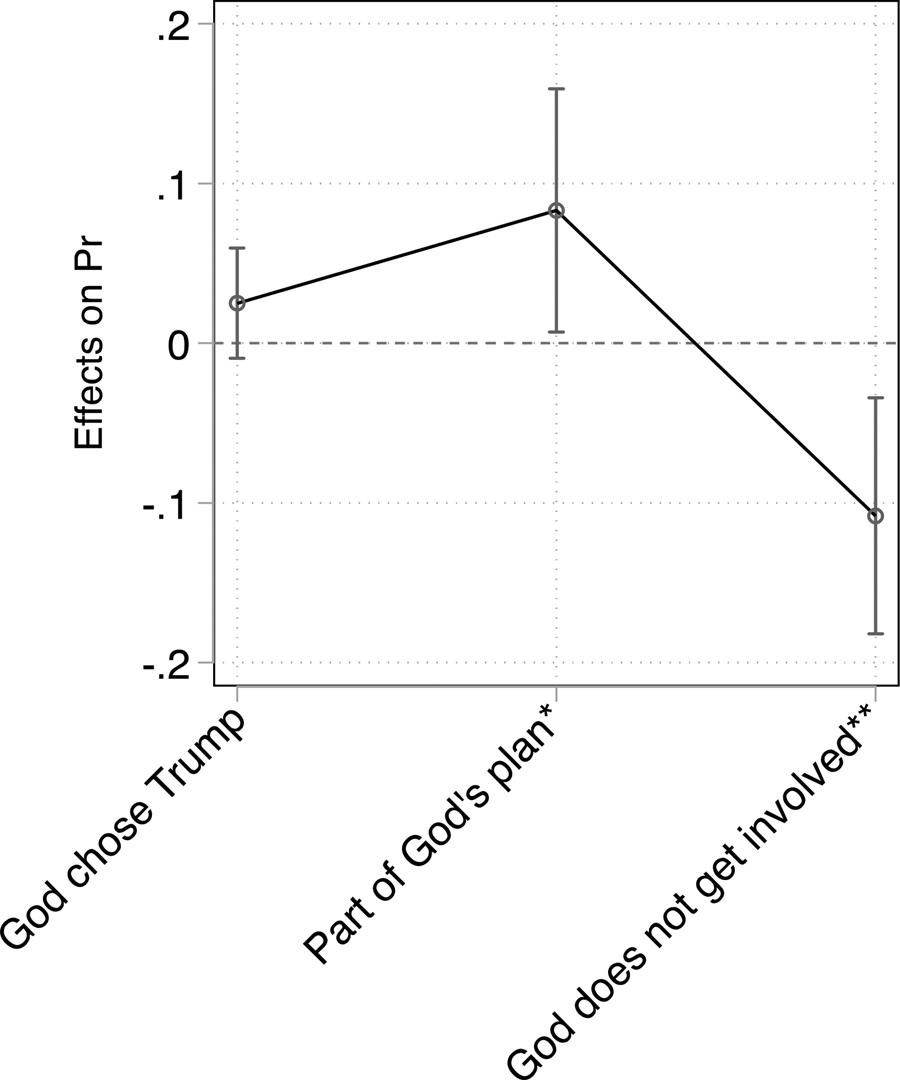
Having established that white evangelicals consider themselves minorities because of their religious beliefs, I now turn to examine whether these beliefs shape perceptions of whether Trump's 2016 election was a divine outcome (H2). To test this possibility, I limit my analytical sample to white evangelicals only, and regress the categorical dependent variable against the dichotomous variable indicating whether respondents consider themselves minorities because of their religious beliefs. Given that my dependent variable of interest is categorical I use a multinomial logit estimator. After estimating the multinomial logit model, I then use postestimation to graph two sets of results. The estimates of the postestimations are presented below in Figures 2 and 3.
White evangelical beliefs on god's role in Trump's election, by minority status perceptions.
Notes: Points represent the predicted probability of a white evangelical respondent response to each category of the multinomial-dependent measure at each level of the minority status perception item. Estimates based on a multinomial probit. All other variables in model hold constant or at their respective mean values. Full model estimates presented in section A5 of the SI file.
Source: American Trends Panel (Wave 61).

Marginal effect of minority status perceptions on white evangelical beliefs in god's role in Trump's election.
Notes: Points represent the marginal effect of a white evangelical respondent perceiving that they are a religious minority on each outcome. Estimates based on a multinomial logit model. All other variables in model hold constant or at their respective mean values. Asterisks indicate a statistically significant marginal effect (*p < 0.05, **p < 0.01, ***p < 0.001). Full model estimates presented in section A5 of the SI file.
Source: American Trends Panel (Wave 61).

Figure 2 depicts white evangelical responses to each category of the dependent variable across levels of the minority status perceptions variable. I begin first with those who believe that “God chose Trump to be president.” A white evangelical who does not consider themselves to be a minority as a result of their religious beliefs has just a 0.07 predicted probability of believing that God chose Trump to be President. By contrast, a white evangelical who does consider themselves to be a minority as a result of their religious beliefs has a 0.09 predicted probability of believing that God chose Trump to be President. Therefore, increases in the salience of minority status perceptions are associated with a two-point increase in the predicted probability of a white evangelical believing that God chose Trump to be president.
Turning next to the second response category, a white evangelical who does not consider themselves to be a religious minority has a 0.66 predicted probability of believing that “Trump's election is part of God's plan.” Conversely, a white evangelical who does consider themselves to be a religious minority have a 0.74 predicted probability of believing that Trump's election is part of God's plan. As such, increases in the salience of minority status perceptions are associated with an eight-point increase in the predicted probability of a white evangelical respondent believing that Trump's election is part of God's plan.
Turning finally to the third response category, a white evangelical who considers themselves a minority as a consequence of their religious beliefs has a 0.26 predicted probability of believing that “God does not get involved in elections.” Contrastingly, a white evangelical who considers themselves to be a religious minority has just a 0.16 predicted probability of believing that God does not get involved in elections. Therefore, increases in the salience of minority status perceptions are associated with a 10-point decrease in the predicted probability of a white evangelical respondent believing that God does not get involved in elections.
To aid in substantive interpretation of these effects, Figure 3 graphs the marginal effect of a white evangelical respondent perceiving that they are a religious minority on each response category of the dependent variable. Asterisks indicate whether the changes in the predicted probabilities observed in Figure 2 are statistically distinguishable from zero. When it comes to the belief that God chose Trump to be president, we see that increases in the salience of minority status perceptions do not condition white evangelical respondents' beliefs about elections as divine outcomes; while we observe a two-point increase in the predicted probability, the 95% confidence intervals overlap with the reference line along the y-axis, indicating that changes in the predicted probability are not distinguishable from zero.
By contrast, the most substantive changes in the predicted probability of each response to the dependent variable come from those who are more ambivalent in their views on God's role in Trump's election.Footnote 18 For instance, the eight-point increase in the predicted probability of a white evangelical believing that Trump's election is part of God's plan as minority status perceptions become more salient is statistically significant at the p < 0.05 level, indicating a substantive degree of change. Likewise, the 10-point decrease in the belief that God does not get involved in elections as minority status perceptions become more salient is significant at the p < 0.01 level.
What then, might explain the pattern of results seen in Figures 2–3? Firstly, it is useful to consider why there is (essentially) no change in the probability of a white evangelical believing that God chose Trump to become president as minority status perceptions become more salient. One possibility relates to the fact that, among white evangelicals who believe that God chose Trump to be president, 44.03% of respondents already see themselves minorities as a result of their religious beliefs. Crucially, this figure is higher than overall percentage of white evangelicals (33.25%) who consider themselves minorities as a result of their religious beliefs (see Table 2), suggesting that such views are overrepresented within the first response category. The overrepresentation of white evangelicals who consider themselves religious minorities within the first response category brings to mind scholarship on public opinion which speaks to how ceiling effects often lead to limited changes in mass attitudes (Page and Shapiro Reference Page and Shapiro1983). In other words, minority status perceptions do little to change the belief that God chose Trump to be president because the number of white evangelicals who are already of the belief that they are religious minorities leaves little room for opinions to change.
Discussion
This paper explores why so many white evangelicals support Trump despite his well-publicized personal transgressions and seemingly irreligiosity. As noted in the introduction, this contradiction raises an interesting consideration—namely, whether Trump represents something of a unique case when it comes to white evangelical evaluations of elite religiosity, or whether his support among white evangelicals is indicative of a new era of evangelical support for candidates that do not assess religiosity as it used to.
Overall, the results presented here go some way to addressing this contradiction. First, it was necessary to understand whether white evangelicals exhibited particularly strong preferences for elite religiosity. Despite the burgeoning number of studies highlighting the contradiction between Trump's irreligiosity and distinctly “un-Christian” behavior and his strong support among white evangelicals (Whitehead et al. Reference Whitehead, Perry and Baker2018; Wehner Reference Wehner2019; Ayris Reference Ayris2020; Whitehead and Perry Reference Whitehead and Perry2020), the extent to which they had strong preferences for having a President who was religious was somewhat unclear. However, given the scholarship on the effects of religious identification on evaluations of elites (Castle et al. Reference Castle, Layman, Campbell and Green2017; Smidt and Miles Reference Smidt and Miles2017), we had reason to suspect that religious adherents (including white evangelicals) would exhibit strong, generalized preferences for elite religiosity. The bivariate data from Table 1 thus go some way to answering this question by demonstrating that white evangelicals do exhibit relatively strong, generalized preferences for having a President who exudes religiosity and is willing to stand up for their religious group interests.
Next, the finding regarding white evangelical evaluations of Trump's religiosity (see Table 2) underscores an important point. White evangelicals appear to know and acknowledge that Trump isn't particularly religious. However, they are able to evaluate the perceived religiosity or irreligiosity of a slate of Democratic and Republican elites beyond Trump. This finding suggests that Trump is a unique case when it comes to white evangelical evaluations of the religiosity of elites: instead of projecting their beliefs onto Trump, and thereby supporting him because of his perceived religiosity, white evangelicals support him despite his lack of religiosity.Footnote 19 This finding is noteworthy because it goes some way to answering the contradiction that has piqued the interests of contemporary scholarship at the intersection of politics and religion—the answer is that white evangelicals exhibit strong, generalized preferences for elite religiosity. However, in the specific case of Trump's religiosity, they are notably ambivalent.Footnote 20
While the findings within the bivariate data provide an answer to the first part of the puzzle, they do not tell us what factors might explain white evangelicals' robust levels of support for Trump if his perceived religiosity does not matter to the group. This consideration is further compounded by another interesting finding within the public opinion data—namely, the belief among many white evangelicals that God played some role in Trump's election. Indeed, if white evangelicals do not evaluate Trump as being particularly religious, then why would 73% of them believe that God played some role in his election? Consistent with extant theorizing in the religious psychology scholarship (Ysseldyk et al. Reference Ysseldyk, Matheson and Anisman2011), as well as work attesting to how perceived threats to religious identity may become politically relevant attitudes (Campbell and Monson Reference Campbell and Monson2008), I hypothesized that religious identity threats would condition white evangelicals' beliefs about God's role in Trump's election. Drawing on contemporary debates in the Christian nationalism scholarship (Whitehead et al. Reference Whitehead, Perry and Baker2018), I argued that white evangelicals believed that God played some role in Trump's election to arrest the decline of Christian America. These beliefs are important because they are examples of coping appraisal mechanisms that individuals might adopt when encountering threats to their religious identities (Ysseldyk et al. Reference Ysseldyk, Matheson and Anisman2011).
Largely in line with my expectations, I found that perceptions of minority status do condition white evangelical beliefs regarding God's role in Trump's election. While these perceptions did little to condition to those whose views were the most extreme (i.e., white evangelicals who thought that Trump was directly chosen by God), much greater movement was observed when it came to those whose beliefs were ambivalent about Trump's election as a divine outcome. Here, I found that perceptions of minority status increased the probability of a white evangelical believing that Trump's election was part of God's plan. Crucially, these increases coincided with declines in the probability of white evangelical respondents thinking that God does not get involved in elections.
This finding is important because it offers a rationale for why white evangelicals not only support Trump electorally (Margolis Reference Margolis2020), but also think that God played some role in Trump's election. The findings concerning the salience of identity threats on conditioning white evangelical beliefs also provide an additional explanation for why evaluations on Trump's religiosity might not have mattered when it came to their vote choice in 2016. Namely, because Trump's invocation of the decline of white Christian America proved effective in activating religious identity threat in a way that led to white evangelicals to coalesce around his candidacy. In this way, Trump's ability to articulate white evangelicals' fears about the declining influence of Christianity likely overrode any lingering concerns about his religiosity.
Limitations and future directions
It is also important to point out the limitations of the current study, as well as potential avenues for future research. One limitation of the current study is that I am not able to account for the potential effects of elite religious cues in shaping white evangelical responses to the ATP measures. Elite cues are a powerful heuristic that shape individual beliefs and behaviors. Therefore, the manner in which elites such as Trump use and deploy elite religious cues ought to have noteworthy effects on white evangelical evaluations of his religiosity. As noted in the literature review, Trump's failure to name a single bible passage gives us reason to doubt whether his efforts proved effective in convincing white evangelicals about his religiosity. In this way, ineffective deployment of covert religious cues may explain why white evangelicals do not evaluate Trump as being particularly religious. Future research should look into the effects of similar cues in shaping evaluations of elite religiosity. Experimental research designs would allow for the investigation of the impact of these cues across a variety of similar measures to those used in this paper.
Supplementary material
The supplementary material for this article can be found at https://doi.org/10.1017/S1755048322000219.
Data
Data are publicly available at: https://www.pewforum.org/dataset/american-trends-panel-wave-61/
Jack Thompson is a Postdoctoral Research Associate in the Department of Politics at the University of Exeter. His research interests include misinformation attitudes, LGBTQ+ politics, and political geography.