Congenital heart disease is the most prevalent birth defect affecting nine in every 1000 live births, with 1.35 million newborns diagnosed annually worldwide.Reference van der Linde, Konings, Slager, Witsenburg, Helbing, Takkenberg and Roos-Hesselink1 Today more than 90% of infants with various forms of congenital heart disease will survive to adulthood, although mortality remains greatest in the first year of life. In order to improve the morbidity and mortality associated with congenital heart disease, we need to identify and stratify those at highest risk. In recent studies, low birth weight (weight <2500 g) has been identified as a significant pre-operative risk factor for mortality in infants with congenital heart disease undergoing cardiothoracic surgery.Reference Curzon, Milford-Beland and Li2, Reference Ades, Dominguez, Nicolson, Gaynor, Spray, Wernovsky and Tabbutt3 An infant's growth can be stratified and followed up longitudinally throughout the pregnancy by estimating the foetal weight by ultrasound or postnatally measuring the birth weight and then classifying an infant as: small for gestational age (weight <10th percentile for gestational age), appropriate for gestational age (weight >10th and <90th percentile for gestational age), or large for gestational age (weight >90th percentile for gestational age). Infants who are small for gestational age may have a constitutional reduction in their growth or may have intrauterine growth restriction due to a pathological process – environmental, maternal heath, placental abnormality, or a primary aetiology with the foetus. Limitation of foetal growth may affect developmental pathways within the cardiovascular system or other organs, which can have life-long effects on an individual. The heart usually completes its development by the 7th week of gestation and all forms of congenital heart disease have their origins within this time frame. As the pregnancy progresses, the heart and vascular system continue to grow along with the foetus. An abnormal foetal environment may cause alterations to the foetal DNA – post-processing modifications of histone proteins or methylation patterns – that may lead to changes in all foetal organs. End-organ modification within the systemic vasculature, kidney, pancreas, and endocrine system may predispose small for gestation infants to many chronic diseases such as: systemic hypertension, type 2 diabetes (insulin resistance), obesity, and endothelial dysfunction. Infants with congenital heart disease are 1.8–3.6 times more likely to experience foetal growth restriction and be small for gestational age.Reference Ades, Dominguez, Nicolson, Gaynor, Spray, Wernovsky and Tabbutt3 We performed a retrospective study to evaluate the mortality and morbidity associated with small for gestational age infants with critical congenital heart disease who required cardiothoracic surgery.
Methods
After institutional review board approval, a single-institution retrospective review was performed of all patients under 2 months of age who underwent surgical repair or palliation of their congenital heart disease at All Children's Hospital from January of 2007 to December of 2011. Data were collected from the CardioAccess Database and the electronic medical record. Patients excluded from the study included infants born large for gestational age and infants undergoing patent ductus arteriosus ligation as their primary cardiothoracic procedure. Large for gestational age infants were excluded to avoid any confounding bias from gestational diabetes. Size for gestational age was determined using anthropometric data obtained at birth and weight for gestational age growth curves.Reference Fenton4
Pre-operative data were composed of patient demographics, anthropometric measurements, cardiac anatomy, documentation of genetic disorders and/or metabolic abnormalities from chromosomal analysis or infant metabolic screens, pre-operative cranial ultrasounds, and pre-operative renal ultrasounds. All patients undergoing cardiothoracic surgery at All Children's Hospital received pre-operative screening including: echocardiography, genetic screening, and renal/cranial ultrasonography.
Peri-operative data included day of life at time of surgery, corrected gestational age at time of surgery, weight at time of surgery, use of cardiopulmonary bypass, primary and secondary procedures performed, perfusion time, cross-clamp time, need for delayed sternal closure, need for dialysis, need for extracorporeal membrane oxygenation, cardiac arrhythmias, seizures, and vocal cord injury. Post-operative data appraised were the duration of hospitalisation, duration of ventilatory support, abnormal hearing screening, abnormal vision screening, and need for gastrostomy tube placement. Abnormal renal ultrasound or cranial imaging were considered positive if there were post-operative changes from pre-operative baseline that required additional follow-up imaging or subspeciality supervision/care. Ventilatory support was distinguished by total number of days on mechanical ventilation. In-hospital mortality was recorded at two intervals: 30 days post-operatively and at the time of discharge home or death.
Surgical procedures were further stratified based on their relative risk of in-hospital mortality using the Society for Thoracic Surgeons and European Association for Cardiothoracic Surgery congenital heart surgery categories.Reference O'Brien, Clarke and Jacobs5 Procedures were partitioned into categories labelled 1–5, with higher numbered categories implying greater in-hospital mortality risk. If multiple procedures were performed, the surgery bearing the highest associated risk score and category was chosen for stratification.
Descriptive statistics are reported as counts (percentages) for categorical variables and mean (with standard deviation) or median (range). Comparison between groups was performed using χ2 test or Fisher's exact test for categorical variables and Student's t-tests or Wilcoxon–Mann–Whitney test for continuous variables. We estimated unadjusted and adjusted (for gender) odds ratios and 95% confidence intervals for outcomes in the small for gestational age and appropriate for gestational age groups. Receiver operating curve analyses, computing the area under the curve and corresponding 95% confidence intervals, were performed to compare the performance of small for gestational age to low birth weight in predicting post-operative mortality. Statistical analyses were performed using SAS 9.3 and all statistical tests were two-sided with the threshold for significance set at p < 0.05.
Results
Demographics/anthropometrics
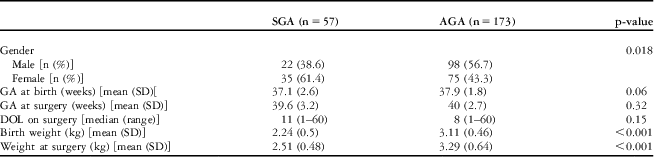
A total of 245 patients had critical congenital heart disease and underwent a cardiothoracic surgical procedure within the timeframe of the study. Of those, 15 were identified as large for gestational age and subsequently excluded from weight for gestational age analysis. Table 1 shows the demographic and anthropometric characteristics of the infants included in the study. Of the 230 patients included, 57 (23.3%) were small for gestational age and 173 (70.6%) were appropriate for gestational age. The mean gestational age at birth and at the time of surgery were similar in both groups: 37.1 ± 2.6 weeks and 39.6 ± 3.2 weeks for the small for gestational age; 37.9 weeks ±1.8 weeks and 40 weeks ±2.7 weeks for the appropriate for gestational age group (p = 0.06 and 0.32). The median day of life at time of surgery was also similar – 11 days for small for gestational age and 8 days for appropriate for gestational age infants (p = 0.15). The mean birth weight for small for gestational age infants was 2.24 ± 0.5 kg and was significantly less than that for appropriate for gestational age infants 3.11 ± 0.46 kg (p < 0.001). The mean weight at time of surgery was also significantly different – 2.509 ± 0.48 kg for small for gestational age and 3.291 ± 0.64 kg for appropriate for gestational age infants (p < 0.001).
Pre-operative demographics and anthropometric measurements for a cohort of 230 patients undergoing cardiothoracic surgery for congenital heart disease <60 days of age.
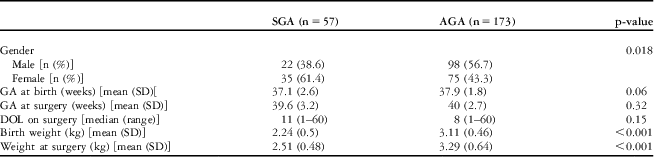
AGA = appropriate for gestational age; DOL = day of life; GA = gestational age; SD = standard deviation; SGA = small for gestational age
Society for Thoracic Surgeons and European Association for Cardiothoracic Surgery in-hospital mortality classification
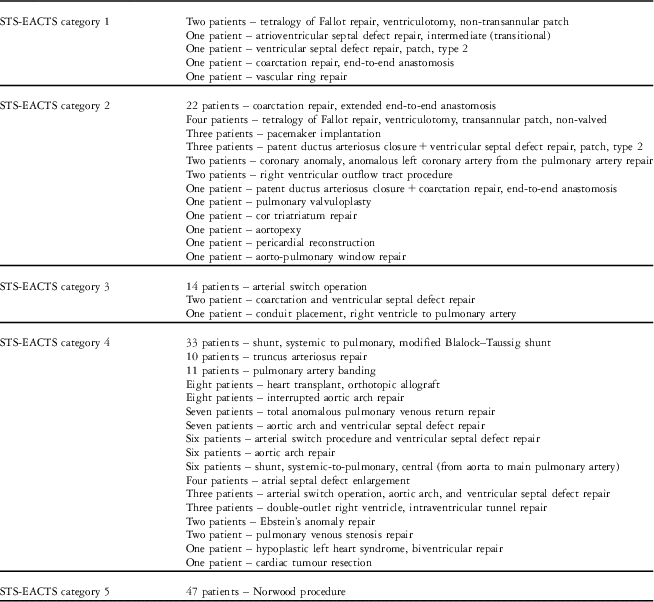
Primary procedures were organised by Society for Thoracic Surgeons and European Association for Cardiothoracic Surgery mortality categories and are shown in detail in Table 2. The mean Society for Thoracic Surgeons and European Association for Cardiothoracic Surgery mortality category was 3.65. The majority of the primary procedures, 71.7%, were classified as either category 4 or 5 (see Fig 1). The small for gestational age and appropriate for gestational age infants had similar complexity and risk in their scheduled cardiac procedures with the mean Society for Thoracic Surgeons and European Association for Cardiothoracic Surgery mortality category for the small for gestational age group at 3.51 and 3.75 for the appropriate for gestational age group (p = 0.21). Equivalent distributions of small for gestational age and appropriate for gestational age infants were organised into the Society for Thoracic Surgeons and European Association for Cardiothoracic Surgery mortality categories (see Fig 2a and b).
Procedures stratified by the STS-EACTS mortality category.

STS-EACTS=Society of Thoracic Surgeons – European Association for Cardiothoracic Surgeons
Society of Thoracic Surgeons – European Association for Cardiothoracic Surgeons (STS-EACTS) mortality category classification for cohort of 230 infants, 173 appropriate for age (AGA) and 57 small for gestational age (SGA), with congenital heart disease who underwent cardiothoracic surgery under 60 days of life.
(a) STS-EACTS mortality categories for small for gestational age infants. (b) STS-EACTS mortality categories for appropriate for gestational age infants. STS-EACTS=Society of Thoracic Surgeons – European Association for Cardiothoracic Surgeons.
Size for gestational age mortality analysis
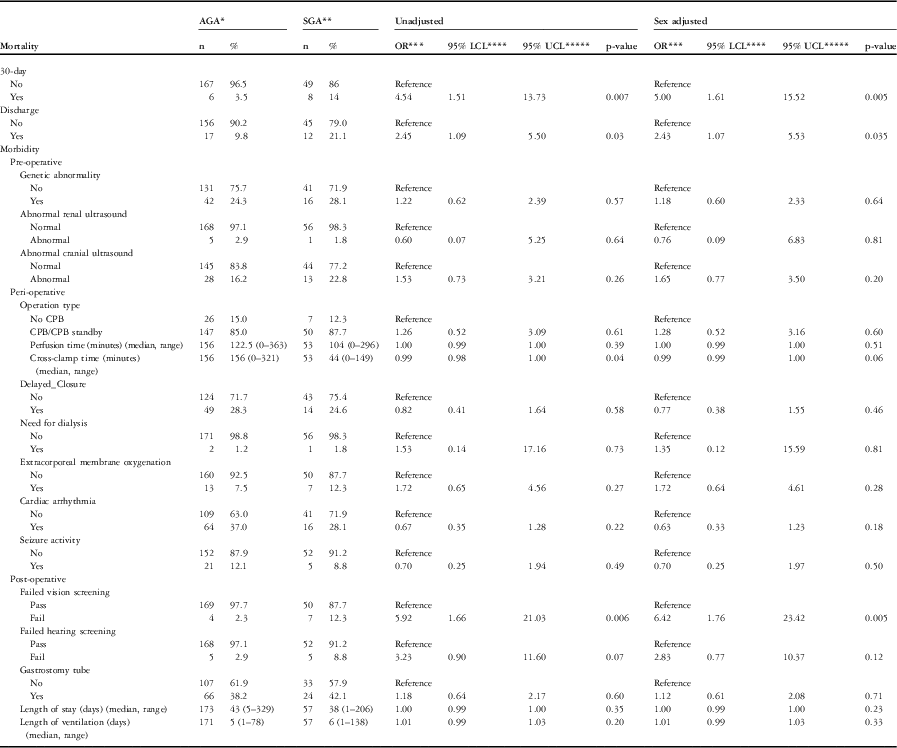
Compared with appropriate for gestational age, the small for gestational age cohort had a statistically significant higher 30-day mortality (14% versus 3.5%, p = 0.005) and discharge mortality (21.1% versus 9.8%, p = 0.035); see Table 3. This analysis was adjusted for gender and also revealed that small for gestational age infants had a statistically significant increased risk of 30-day (odds ratio = 5.00, 95% confidence interval = 1.61–15.52, p = 0.005) and discharge (odds ratio = 2.43, 95% confidence interval = 1.07–5.53, p = 0.035) mortality; see Table 5. We also assessed the cumulative mortality in the most complex surgical procedures (categories 4 and 5) and compared small for gestational age to appropriate for gestational age infants. The small for gestational age cohort had a significantly higher 30-day and discharge mortality than the appropriate for gestational age group for these complex procedures (21.1% versus 3.9% at 30 days, p = 0.0006 and 29% versus 12.6% at discharge, p = 0.017). These findings are represented in Figure 3.
Mortality data at 30 days and discharge for infants undergoing cardiothoracic surgery under 60 days of life by size for gestational age and birth weight.

AGA = appropriate for gestational age; AGA-NBW = appropriate for gestational age and normal birth weight; LBW = low birth weight; NBW = normal birth weight; SGA = small for gestational age; SGA-NBW = small for gestational age and normal birth weight
Thirty-day and discharge (DC) mortality for combined Society of Thoracic Surgeons – European Association for Cardiothoracic Surgeons (STS-EACTS) mortality categories 4 and 5 in small for gestational age (SGA) and appropriate for gestational age (AGA) infants.
Low birth weight
Of the 230 patients originally identified for investigation, 49 were identified as low birth weight and 181 were normal birth weight (>2500 g). Infants born with a low birth weight had a 30-day post-operative mortality of 12.2% and discharge mortality of 22.5%. Alternatively, the 181 infants with a normal birth weight had a 30-day post-operative mortality of 4.4% and discharge mortality of 9.9%. These data were statistically significant at both time intervals, with p-values of 0.04 and 0.026, respectively (see Table 3).
Small for gestational age with normal birth weight
We also analysed small for gestational age infants who had a birth weight >2500 g compared with appropriate for gestational age with a birth weight >2500 g. There were 20 small for gestational age normal birth weight infants with a 30-day mortality of 15.0% and discharge mortality of 20.0% compared with 161 appropriate for gestational age normal weight infants with a 30-day mortality of 3.1% and discharge mortality of 8.7% (p = 0.045 at 30 days and p = 0.12 at discharge). Statistical significance was not achieved for discharge mortality, but the small sample size may have limited the analysis (see Table 3).
Pre-, peri-, and post-operative comorbidities
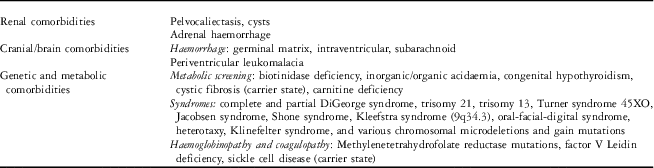
At our institution, all pre-operative patients receive a screening chromosomal analysis, renal ultrasound, and cranial ultrasound. We compared these parameters between small for gestational age and appropriate gestational age infants and did not observe any statistical difference (genetic abnormality p = 0.64, abnormal renal ultrasound p = 0.81, and abnormal cranial ultrasound). Table 4 summarises the abnormal pre-operative screening findings from these three modalities. In addition, peri-operative morbidities between the two cohorts did not show any statistical difference for the following categories: need for cardiopulmonary bypass (p = 0.60), perfusion time (p = 0.51), cross-clamp time (p = 0.06), need for delayed sternal closure (p = 0.46), need for dialysis (p = 0.81), need for extracorpeal membrane oxygenation (p = 0.28), cardiac arrhythmia (p = 0.18), seizure activity (p = 0.50), and vocal cord injury (p = 0.87). Post-operative morbidities were also assessed and small for gestational age infants were more likely to have failed vision screens as compared with appropriate for gestational age infants (p = 0.005). No differences were seen for length of stay (p = 0.23), length of ventilation (p = 0.33), need for a gastrostomy tube (p = 0.71), and failed hearing screen (p = 0.12). Please see Table 5 for a summary of the morbidity data.
Pre-operative findings from screening renal ultrasound, cranial ultrasound, and chromosomal analysis in a cohort of 230 infants with critical congenital heart disease who underwent surgical repair or palliation.
Post-operative comorbidities in 230 patients with critical congenital heart disease who underwent cardiothoracic surgery before 60 days of life.
*Appropriate for gestational age
**Small for gestational age
***Odds ratio
****Lower confidence limit
*****Upper confidence limit
Utility of small for gestational age versus low birth weight in predicting mortality
Receiver operating curve analysis revealed that both the identification of infants who were small for gestational age and who were low birth weight predicted mortality at 30 days and mortality at discharge fairly well (all area under the curve ≥0.6). In comparing small for gestational age with low birth weight as a better predictor of mortality, we did not observe a statistically significant difference in the predictive value of these two measures for all participants (all p ≥ 0.42) or when limited to combined Society for Thoracic Surgeons and European Association for Cardiothoracic Surgery mortality categories 4 and 5 (p ≥ 0.44).
Discussion
Small for gestational age and low birth weight are important predictors of mortality in infants with congenital heart disease undergoing cardiothoracic surgery under 60 days of age. Our data demonstrated a statistically significant difference in mortality at 30 days in all small for gestational age infants versus appropriate for gestational age (p = 0.005), low birth weight infants versus normal birth weight (p = 0.04) and small for gestational age infants with normal birth weights >2500 g (p = 0.045), as well as increased mortality at discharge in small for gestational age infants (p =0.0345) and low birth weight infants (p = 0.026). Infants who are born small for gestational age may be smaller because of constitutional issues or may have foetal growth restriction because of a pathological process in the environment, mother, placenta, or foetus. Our small for gestational age population had a mean gestational age of 37.1 weeks, which limited prematurity as a confounding variable. In addition, the surgical procedures performed when stratified by the Society for Thoracic Surgeons and European Association for Cardiothoracic Surgery Congenital Heart Surgery mortality categories were comparable (mean score of 3.51 for small for gestational age and 3.75 for appropriate for gestational age). Our surgical outcomes were comparable to nationally reported averages (see Table 6). Mortality categories 4 and 5 compromised a majority of infants studied, 71.7%. The bulk of these category 4 and 5 procedures, 61.2%, were palliative including pulmonary artery banding, modified Blalock–Taussig shunts, and Stage 1 Norwood procedures (Table 2).
STS-EACTS mortality category classification for a cohort of 230 infants at a single institution compared with nationally reported outcomes.Reference O'Brien, Clarke and Jacobs5

STS-EACTS=Society of Thoracic Surgeons – European Association for Cardiothoracic Surgeons
The hypothesis that factors affecting foetal development subsequently result in paediatric and adult disease has been well described and is known as the Barker hypothesis.Reference Boo and Harding6 Since Barker's initial publications presenting the association between infant mortality and early ischaemic coronary heart disease, foetal growth restriction has been linked with developing early systemic hypertension, type 2 diabetes mellitus, insulin resistance, hyperlipidaemia, chronic lung disease, reduced renal function, poor academic performance, low social competence, and behavioural/affective disorders.Reference Boo and Harding6–Reference Berle, Mykletun, Daltveit, Rasmussen and Dahl13 Low birth weight has been shown in various studies to be a risk factor for mortality and morbidity in infants undergoing cardiothoracic surgery for congenital heart disease.Reference Curzon, Milford-Beland and Li2, Reference Ades, Dominguez, Nicolson, Gaynor, Spray, Wernovsky and Tabbutt3, Reference Reddy, McElhinney, Sagrado, Parry, Teitel and Hanley14, Reference Ades, Johnson and Berger15 Pre-operative screening programmes to assess for secondary comorbidities vary by surgical centre and usually do not include assessment of foetal growth restriction. Our study demonstrated that having an assessment of foetal growth – the determination of small for gestational age – may be helpful in predicting the overall outcome of infants undergoing cardiothoracic surgery. We also demonstrated that small for gestational infants with a normal weight >2500 g are also at risk of increased mortality and should not be overlooked by practitioners. The calculation of small for gestational age can be easily done upon admission to the hospital and may be a useful adjunct to the pre-operative screening protocol and risk stratification of patients with critical congenital heart disease.
Small for gestational age and low birth weight infants were both interestingly not associated with additional pre-operative comorbidities – genetic anomalies, renal anomalies, or central nervous system anomalies – and peri-/post-operative end-organ morbidities, such as need for dialysis, need for extracorpeal membrane oxygenation, seizures, need for gastrostomy tube, hearing abnormality, length of ventilation, or length of stay. Small for gestational age has been associated with a variety of chronic adult end-organ disease as listed above. We therefore acknowledge that small for gestational age infants with critical congenital heart disease may have the potential to develop end-organ dysfunction in later life, but our data infer they appear to have adequate end-organ reserve to successfully overcome the stress of cardiopulmonary bypass and a cardiothoracic surgical procedure without significant acute end-organ failure. The exception to this was vision exams, which were abnormal in the small for gestational age infants compared with the appropriate for gestational age infants. This is consistent with a recent report that demonstrated that small for gestational infants were prone to develop low visual acuity.Reference Pinello, Manea, Visonà Dalla Pozza, Mazzarolo and Facchin16
Limitations of this study include its inherent retrospective design and limited sample size. Further studies should be prospective or focused on larger, multi-centre databases. Special interest could be placed on infants who are born small for gestational age with and without normal birth weight to delineate further differences in this patient population.
Conclusion
Pre-operative assessment for foetal growth restriction in infants with critical congenital heart disease identifies a subgroup of patients at increased risk of surgical mortality. Infants born small for gestational age who are also normal birth weight may have increased mortality. Assessment of foetal growth restriction may be useful in a pre-operative screening protocol. Pre-operative family counselling and education should be given to the families of small for gestational age infants with critical congenital heart disease, which includes the increased risk of mortality during surgical procedures and potential life-time risk of end-organ dysfunction including visual dysfunction.