With the spread of angiosperms some lineages of ants, originally ground-dwellers and predators, adapted to arboreal life. Ground-nesting worker ants probably constituted the first case of biotic plant protection through their predatory activity while foraging on plant foliage. Then, ants developed tight evolutionary bonds with plants varying from facultative diffuse relationships to obligatory specific associations, necessary to the survival of both partners. In diffuse relationships plants induce different ant species to patrol their foliage by producing energy-rich food rewards such as extra-floral nectar (EFN) and/or food bodies (FBs) (Dejean et al. Reference DEJEAN, CORBARA, ORIVEL and LEPONCE2007, Heil Reference HEIL2008, Heil & McKey Reference HEIL and MCKEY2003). First described by Janzen (Reference JANZEN1966), myrmecophytes, or plants that provide specialized plant-ants a nesting place in hollow structures called domatia, represent a good example of a strict association as, in return, they are protected from several kinds of enemies, particularly defoliating insects (Heil & McKey Reference HEIL and MCKEY2003, Hölldobler & Wilson Reference HÖLLDOBLER and Wilson1990).
The Araceae, a monocotyledon family of 3000 mainly tropical species, has only a few known cases of associations with ants. In a few genera (i.e. Alocasia, Culcasia, Philodendron), ants can exploit nectar produced by young leaves and sometimes tend Aleyrodidae (Bastien & Belin-Depoux Reference BASTIEN, BELIN-DEPOUX and Bournoville1998, Blüthgen et al. Reference BLÜTHGEN, VERHAAGH, GOITÍA, JAFFÉ, MORAWETZ and BARTHLOTT2000). Philodendron insigne, a trash-basket epiphyte with suspended soil, is inhabited by a variety of ant species and particularly the Ponerinae Odontomachus hastatus (Gibernau et al. Reference GIBERNAU, ORIVEL, DELABIE, BARABÉ and DEJEAN2007); while Philodendron megalophyllum (= P. myrmecophyllum) and Anthurium gracile develop in ant-gardens (Orivel & Dejean Reference ORIVEL and DEJEAN1998). Hence, excluding these few examples, no aroid is known to have strict relationships with ants or to be a myrmecophyte.
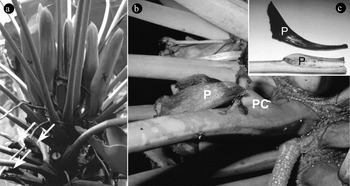
Philodendron solimoesense A. C. Smith is a hemi-epiphytic aroid species found in upland or riverine forests where it develops on sandy and flooded soils, as was the case in our study site. Like other species of the genus, P. solimoesense produces EFN on bud bracts, the petiole, the base of the leaf lamina and the spathe of the inflorescence, suggesting a diffuse relationship with ants (Bastien & Belin-Depoux Reference BASTIEN, BELIN-DEPOUX and Bournoville1998). Solitary inflorescences, arising vertically from the petiolar sheath at the base of the leaves (Figure 1a), are thermogenic and pollinated by dynastine beetles (Gibernau et al. Reference GIBERNAU, BARABÉ, CERDAN and DEJEAN1999). At maturity the closed spathe abscises from the base, exposing ripe fruits to frugivorous animals. After fruit dispersal, the spadix falls, breaking above the peduncle, which is hollow and remains inserted in the petiolar sheath (Figures 1b-c).
Flowering in Philodendron solimoesense. At the top of the stem, several inflorescences developing at the base of the leaves coming out of their petiolar sheath (a). Note below dry peduncles of fallen inflorescences from previous flowering events (white arrows). Detail of a dry peduncle (P) inserted within the petiolar sheath forming a petiolar cavity (PC) after the inflorescence fell off (b). Dry peduncle (P) removed from the petiolar cavity (PC) (c).

In this study we hypothesized that the P. solimoesense petiolar sheaths can serve as durable shelters for ant colonies, making this plant species a possible myrmecophyte.
During July 1998 and 1999 we monitored 326 P. solimoesense growing at 12 sites in French Guiana; each individual was marked, and its developmental stage noted. Seven sites were situated along Route N°1 (RN1) between kilometric points 87 and 97 (219 plant individuals) and the five others were located along the road leading to the Petit Saut dam (107 plant individuals). The sites along RN1 were situated at the limit between the secondary forest and the savanna, while those along the dam road were at the edge of the rain forest. All of these populations were established from hemi-epiphytic plants growing on trees cut down during the construction of the road in 1989. Due to long-lived leaves (at least 3 y; M. Gibernau, pers. obs.) the presence of the hollow, dry peduncles (Figure 1b) indicates that the plant has already flowered.
Each individual plant, as well as every petiolar sheath, was screened 2–6 times at different hours of the day, and ants were collected from the leaves. Voucher specimens were deposited in the CPDC collection (Laboratório de Mirmecologia, Cocoa Research Center, Itabuna, Bahia, Brazil) after identification. We distinguished three groups of ant species. (1) Visitors (i.e. non-resident) only represented by workers patrolling on the plant in order to gather EFN; (2) inhabitants with colonies located in carton pavilions built on the trunk, under dead leaves fallen from large trees, or in dry bracts trapped by lower petioles; and (3) colonies nesting in the petiole and/or peduncle cavities with queen(s), workers and brood.
Using an analysis of variance and a binomial error (GLIM 3.77 software, 1986; Royal Statistical Society, London), we analysed the frequency at which P. solimoesense was inhabited by ants according to the habitat, the plant's developmental stage, or both factors combined. The number of inhabiting and visiting ant species (count data) per plant was analysed in the same way using a Poisson error (GLIM 3.77 software). The covariate for the number of inhabiting ant species was the logarithm(number of petiole cavity + 1) on each plant individual, since when the number of cavities increases, the number of potential nesting sites for ant species also increases. The covariate for the number of visiting ant species was the logarithm(number of inhabiting species +1), as inhabiting ants may become locally dominant and partly exclude visitor ants.
Two developmental stages were distinguished: immature individuals had not yet flowered and did not yet have cavities, and their petiolar sheaths are closed; whereas mature individuals bore several cavities from previous flowerings (Figure 1b).
The proportion of mature individuals was similar in the two habitats: 58% of all Philodendron, but the proportion of flowering individuals differed greatly between habitats (Table 1). On average, a plant had 5 ± 3.4 (mean ± SD) petiolar sheaths (e.g. cavities available for ants). More than 48 ant species were found on the 326 studied P. solimoesense, with 27 species nesting on the plants, and more than 40 diurnal ant species were visitors (Appendix 1).
Total number of studied Philodendron solimoesense, number of individuals inhabited by ants and number of P. solimoesense belonging to each developmental stage: immature and mature individuals in the two studied habitats (along the Route N°1 and the road leading to the Petit Saut dam). The last column indicates the number of mature individuals which were flowering during the study.

The frequency of ant-visited plants was not affected by the combination of habitat and developmental stage (χ21 = 1.3; P = 0.25), but this frequency varied significantly according to the developmental stage alone (χ21 = 5.4; P = 0.02) and between the two habitats (χ21 = 16.2; P < 0.001; Table 2).
Frequencies (± SD) of Philodendron solimoesense visited by ants according to its habitat (along the Route N°1 or the road leading to the Petit Saut dam) and its developmental stage (immature or mature individuals).

The number of ant species visiting a plant was not affected by the combination of habitat and developmental stage (χ21 = 0.02; P = 0.88), nor the developmental stage alone (χ21 = 0.35; P = 0.55) and was negatively correlated with the number of inhabiting ant species (slope = −0.21, χ21 = 4.5, P = 0.034). On the other hand, Philodendron plants along RN1 were visited by twice as many ant species as those growing along the dam road (2.3 ± 1.4 versus 1.2 ± 1; χ21 = 46.4; P < 0.001).
The frequency of plant inhabited by ants was not affected by the combination of habitat and development stage (χ21 = 1.7; P = 0.19), nor the habitat alone (χ21 = 1.2; P = 0.27). Yet the frequency of plants inhabited by ants differed significantly according to the developmental stage alone (χ21 = 118; P < 0.001). Immature individuals of P. solimoesense were less frequently inhabited than mature individuals (ratios: 0.20 ± 0.40 vs. 0.80 ± 0.41). In fact, ant colonies were rarely present on immature individuals. When present, they nested only in pavilions, under dead leaves or in dry bracts since the cavities formed by petiolar sheaths were not yet available. In contrast, mature individuals of P. solimoesense were inhabited by ant colonies nesting in their dry hollow peduncles and in their petiolar sheaths.
The number of ant species inhabiting a plant was not affected by the combination of habitat and developmental stage (χ21 = 1.9; P = 0.17), nor of the habitat alone (χ21 = 0.02, P = 0.88). Yet, the number of ant species inhabiting a plant varied significantly according to the developmental stage alone (χ21 = 16.2, P < 0.001; 0.23 ± 0.49 for immature versus 1.44 ± 0.64 for mature individuals) and increased with the number of petiolar cavities present on the plant (slope = 0.10; χ21 = 4.41; P = 0.036). Interestingly the ant species found in pavilions, under dead leaves or in dry bracts on immature plants were also able to colonize the petiolar sheaths of mature individuals.
Finally, the P. solimoesense–ant interaction appeared to be non-specific and to be mainly established with ant species present in the forest edge. However, there were few species (1–2) nesting on each plant (Appendix 1).
One important factor in the ant–plant interaction is the habitat or the ecological zone (King et al. Reference KING, ANDERSEN and CUTTER1998, Majer et al. Reference MAJER, DELABIE and MCKENZIE1997, Vasconcelos Reference VASCONCELOS1999). In fact, a greater diversity in ant species was found along RN1 than along the dam road. Firstly, the P. solimoesense located along RN1 grew in more open habitats than those growing in the shade of pioneer trees in the forest edges along the dam road. Consequently, P. solimoesense individuals along RN1 were exposed to a greater light intensity than the other populations. This light exposure favours flowering in P. solimoesense (unpubl. data). Hence, there was a greater number of flowering specimens growing along RN1 (40%) than in populations growing along the road leading to the dam (13%), while the same proportion (58%) of individuals were mature at both sites. A population of P. solimoesense with a greater number of flowering individuals may attract a greater number of ant species (RN1 vs. dam road) due to the EFN produced on the spathes.
Immature and first-flowering individuals of Philodendron solimoesense are visited by workers from various opportunistic ant species looking for EFN or searching for prey (Appendix 1). This is considered to be a diffuse relationship. On the contrary, ant colonies generally occupied several petiolar cavities on most mature individuals, which can be considered to be a stable association as they provide ants with a permanent residence (see also Way & Bolton Reference WAY and BOLTON1997 for coconut palms). Moreover, their presence was associated with fewer visitor ants, probably because their territoriality leads to the exclusion of the foraging workers of other species.
Such colonies can remain on a plant for a long time due to long-lived leaves and because new cavities appear at each flowering. Flowering thus appears to be an important factor in the relationships between P. solimoesense and ants. Consequently, P. solimoesense falls somewhere between plants attracting ants with EFN and/or FBs (Dejean et al. Reference DEJEAN, CORBARA, ORIVEL and LEPONCE2007, Heil Reference HEIL2008, Heil & McKey Reference HEIL and MCKEY2003) and true myrmecophytes (Hölldobler & Wilson Reference HÖLLDOBLER and Wilson1990, Janzen Reference JANZEN1966). Hence P. solimoesense is not a myrmecophyte as its petiolar sheaths, non-specialized structures linked with flowering, are not real domatia. Ant-domatia have been defined by Beattie & Hughes (Reference BEATTIE, HUGHES, Herrera and Pellmyr2002) as ‘plant structures that appear to be specific adaptations for ant occupation, often formed by the hypertrophy of internal tissue at particular locations in the plant, creating internal cavities attractive to ants’. Thus, the interaction between P. solimoesense and ants is in between a non-specific diffuse relationship and a specific obligatory interaction, and still needs to be properly defined.
Further studies are needed to prove the positive impact ant presence has on this plant to determine if the relationship is a true mutualism. The presence of petiolar cavities resulting from flowering is a general characteristic in the genus Philodendron. This suggests that there are numerous possibilities for this genus and ants to interact. Moreover the cavity present within the petiole is also a common trait in Araceae, but varies in size and degree of inclination based on the genus and, thus, can result in the selection of different kinds of inhabiting ant species. It would be interesting to determine if these cavities promote ant–plant interactions in this plant family, as well as in other monocotyledon families.
ACKNOWLEDGEMENTS
We are grateful to Andrea Dejean for proofreading the manuscript and the staff of the Laboratoire Environment for technical support. This research was supported by the Natural Sciences and Engineering Research Council of Canada, the Programme Amazonie II (project 2ID) of the French Centre National de la Recherche Scientifique and the Programme Convergence 2007–2013 Région Guyane (project DEGA) from the European Community. JHCD acknowledges his research grant from CNPQ (Brazil).
APPENDICES
Appendices are available as supplementary material on-line at http://journals.cambridge.org/tro