Implications
In this paper, the cytochrome c oxidase subunit I (COI) gene sequences of 119 individuals of Canis, including the Tibetan Mastiff, were determined. The intra- and interspecies phylogenetic relationships and sequence differences between Canis members were analyzed using COI and COI barcoding. The results will play an important role in the protection of the Tibetan Mastiff, will be useful for studying the worldwide speciation of large dogs and the origin of the domestic dog, and will help to identify Canis species.
Introduction
The use of short DNA sequences for the standardized identification and phylogenetic analysis of organisms has recently gained attention under the term DNA barcoding. Owing to its quick identification and handy operation, DNA barcoding has been widely used in the fields of ecology, systems biology and conservation biology (Kress and Erickson, Reference Kress and Erickson2008; Derycke et al., Reference Derycke, Vanaverbeke, Rigaux, Backeljau and Moens2010). In 2003, Hebert et al. (Reference Hebert, Cywinska, Ball and de Waard2003) found that the 5′-end of the 648 bp DNA sequence of the cytochrome c oxidase subunit I (COI) gene could distinguish different species at a molecular level, and considered that the COI gene was the suitable DNA barcode for Animalia, being the first to apply this DNA barcoding to research. Subsequent to this, scientists widely used the COI gene and found that COI barcoding can identify species exactly and effectively (Hebert et al., Reference Hebert, Stoeckle, Zemlak and Francis2004), distinguish amphibolous species in traditional taxonomy (Janzen et al., Reference Janzen, Hajibabaei, Burns, Hallwachs, Remigio and Hebert2005) and recognize species variation of different geographies (Yassin et al., Reference Yassin, Markow, Narechania, O'Grady and DeSalle2010).
The Tibetan Mastiff is a special domestic dog breed that mainly inhabits high and cold zones with 3000 to 5000-m altitudes, belongs to the second-protection group of animals in China and is the only canine ‘living fossil’ of the snowfield, unchanged by time and environment (Ren et al., Reference Ren, Yang, Ye, Xu, Zhao and Wu2009; Li et al., Reference Li, Li, Zhao, Xie and Xu2011). However, large profits can be made from the sale of Tibetan Mastiffs, and the outflow of Tibetan Mastiffs has become a serious problem since the 1980s. Therefore, the purebred Tibetan Mastiff is at the edge of extinction (Li et al., Reference Li, Liu, Li, Zhao, Dong, Pan, Sun, Li, Xu and Xie2008). Being the only large breed dog in China and one of the most idioplasmatic resources worldwide, the Tibetan Mastiff must be protected and rapidly researched.
No studies of the origin of domestic dogs and species identification of Canis according to the COI gene and COI barcoding have been found. In this study, we analyzed the phylogenetic relationships among Canis members, including the Tibetan Mastiff, using COI sequences and COI barcoding (nt 58 to 705 in COI, 648 bp) in order to offer a reference for protecting the idioplasmatic resource of the Tibetan Mastiff and further studying the origin and domestication of domestic dogs. For research animals, we chose Canis lupus as the domestic dog most closely related to human beings, and Canis latrans as the closest genetic relative to C. lupus. The grey wolf and sheepdog of C. lupus are closer to C. latrans in appearance and body form. We analyzed the intra- and interspecies sequence differences between members of Canis and discussed the feasibility of using DNA barcoding to identify Canis species.
Material and methods
Samples and DNA extraction
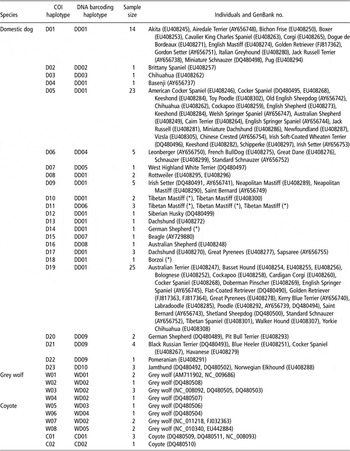
The samples included 119 individuals of Canis, including 102 domestic dogs (77 breeds), 13 grey wolves (C. l. lupus) and four coyotes (C. l. latrans; Table 1). Blood samples (5 mL) were obtained from the ear arteries of four Tibetan Mastiffs (two females and two males), one German shepherd (male) and one Borzoi (male) from the Police Dog Base of Xigang, Nanjing. Genomic DNA was extracted by the standard phenol–chloroform method. The rest of the individual resources were searched for in the database and tracked literature.
Experimental samples used in this study

COI = cytochrome c oxidase subunit I.
*Sequences produced during this work. There is GenBank no. in the parenthesis.
PCR amplification and sequencing
Primers were designed by Primer Premier 5.0 software (Premier Biosoft International, Palo Alto, CA, USA) using the mitochondrial genome sequence of the domestic dog (Accession no. U96639). Primer sequences were UCOI: 5′-CAC TGC CTT GAG CCT CCT CAT C-3′ and DCOI: 5′-GGG GAG GTT GCG TCC TGT AAT C-3′. Amplification conditions consisted of initial denaturalization at 94°C for 5 min, 35 cycles of denaturalization at 94°C for 30 s, annealing at 60°C for 45 s, extension at 72°C for 1 min and a final extension at 72°C for 10 min. The purified PCR products were obtained using a V-gene Kit (Tiangen, Beijing, China) and sequenced by Shanghai Invitrogen Co. (Shanghai, China).
Data analysis
The analyses of the sequence alignment and sequence divergence were carried out by DNAStar 5.02 software (DNAStar Inc., Madison, WI, USA). The base transition, transversion, proportion of distance (p-distance) and genetic distance among the different sequences were calculated by MEGA4.1 software (Kumar et al., Reference Kumar, Dudley, Nei and Tamura2008). The haplotype was determined by DNASP 5.0 software (Librado and Rozas, Reference Librado and Rozas2009). Phylogenetic trees were constructed by Neighbor-Joining (NJ) methods of the MEGA4.1 software. The minimum-spanning network was received by Network4.5 software (Polzin and Daneschmand, Reference Polzin and Daneschmand2003).
Results and discussion
Mitochondrial COI gene and COI barcoding in Canis
We obtained the complete COI gene sequence of the Tibetan Mastiff, German Shepherd and Borzoi by PCR amplification and sequencing, and the sequence length was 1545 bp. The length, base composition and codon distribution of the COI gene in the Tibetan Mastiff, German Shepherd and Borzoi were consistent with those in other Canidae species (Björnerfeldt et al., Reference Björnerfeldt, Webster and Vilà2006).
There were 119 variable sites in the Tibetan Mastiff and 76 domestic dogs, and the percentage of variable sites was 7.70%. A total of 23 haplotypes were defined in the COI gene sequence of the Tibetan Mastiff and 76 domestic dog breeds (Table 1), and the haplotype percentage was 21.50%. The polymorphism was lower than that based on the mitochondrial displacement loop (D-loop; especially hypervariable region 1; Vilà et al., Reference Vilà, Savolainen, Maldonado, Amorim, Rice, Honeycutt, Crandall, Lundeberg and Wayne1997; Savolainen et al., Reference Savolainen, Zhang, Luo, Lundeberg and Leitner2002; Luo, Reference Luo2003), but higher than that based on the mitochondrial Cytb gene (Li et al., Reference Li, Liu, Li, Zhao, Dong, Pan, Sun, Li, Xu and Xie2008). Vilà et al. (Reference Vilà, Savolainen, Maldonado, Amorim, Rice, Honeycutt, Crandall, Lundeberg and Wayne1997) found 27 variable sites and identified 26 haplotypes in the 261-bp D-loop region with a 10.34% polymorphism loci percentage and an 18.57% haplotype percentage. Savolainen et al. (Reference Savolainen, Zhang, Luo, Lundeberg and Leitner2002) found 128 variable loci and identified 109 haplotypes in the 582-bp D-loop region with a 21.84% polymorphism loci percentage and a 16.67% haplotype percentage. Luo (Reference Luo2003) found 113 variable loci and identified 184 haplotypes in the 597-bp D-loop with an 18.93% polymorphism loci percentage and a 15.11% haplotype percentage. Li et al. (Reference Li, Liu, Li, Zhao, Dong, Pan, Sun, Li, Xu and Xie2008) found 88 variable loci in a 2525 bp mitochondrial sequence, with a 3.39% polymorphism loci percentage. Therefore, the COI gene, as the moderate variant mitochondrial DNA sequence, applied to the phylogenetic analysis among domestic dogs. There exist 636 conserved sites and 12 variable sites in the COI barcoding (nt 58 to 705, 648 bp) of the Tibetan Mastiff and 76 domestic dogs, and the percentage of variable sites was 1.85%. On the basis of the 12 variable sites, 10 haplotypes were defined in the COI barcoding sequence of the Tibetan Mastiff and 76 domestic dog breeds, with a 9.85% haplotype percentage. Thus, compared with the COI gene, COI barcoding of domestic dogs, which offers limited polymorphism, could not be applied to the analysis of the phylogenesis among domestic dog breeds.
Two criteria are available to test the validity of DNA barcoding. One is whether two species possess the same sequences, and the other is whether the interspecific difference is markedly larger than the intraspecific difference (Hebert et al., Reference Hebert, Stoeckle, Zemlak and Francis2004; Yoo et al., Reference Yoo, Eah, Kim, Kim, Min, Paek, Lee and Kim2006). On the basis on the complete sequence of the COI gene, we found a shared sequence in domestic dogs and grey wolves, but this instance did not exist between domestic dogs/grey wolves and coyotes. The mean genetic distance was 0.58% in domestic dogs/grey wolves, 0.26% in coyotes and 4.45% between domestic dogs and grey wolves. The interspecific difference was 8 to 17 times the intraspecific difference. In the 648 bp COI barcoding, we found that shared sequences existed in domestic dogs/grey wolves and coyotes, but not between domestic dogs/grey wolves and coyotes. The mean genetic distance was 0.40% in domestic dogs/grey wolves, but was 0.31% in coyotes; the mean genetic distance was 4.73% between domestic dogs/grey wolves and coyotes. The interspecific difference was larger than the intraspecific difference by 12 to 15 times. Thus, COI barcodes, compared with the complete sequence of the COI gene, are easier to amplify and more suitable for Canis species identification.
The origin of domestic dogs and the Tibetan Mastiff
Domestic dogs originate from the grey wolf, a finding that is well established and recognized by both biologists and sociologists. However, disputes remain regarding the exact domestication and origination processes. According to the complete mitochondrial sequence and part control region (hypervariable region), domestication of domestic breed dogs was not an isolated event. All sequences of domestic dogs are primarily clustered in four clades, considering that the domestic breed dogs had four maternal origins. Vilà et al. (Reference Vilà, Savolainen, Maldonado, Amorim, Rice, Honeycutt, Crandall, Lundeberg and Wayne1997) found that Clades A, B, C and D contained 19, 1, 3 and 3 haplotypes, respectively, among 26 haplotypes. The earliest domestication is estimated at about 100 000 years before the present (YBP) and originated in Europe, Southwest Asia and East Asia, considering its multiregion and asynchronous domestic events. Savolainen et al. (Reference Savolainen, Zhang, Luo, Lundeberg and Leitner2002) found that Clades A, B and C included 71.3%, 13.7% and 7.2% domestic dogs, respectively. The haplotype distributions of various geographic areas showed that Clade A originated from East Asia and that haplotypes of Europe and Southwest Asia were formed by a subset of East Asian types. In the same way, Clade B originated from East Asia. For Clade C, the pattern is less clear, but an East Asian origin for this clade is also possible. The estimated origins of Clades A, B and C were 40 000, 13 000 and 17 000 YBP, respectively. If Clades A, B and C are simultaneously considered, the origin of domestic breed dogs was approximately 15 000 YBP.
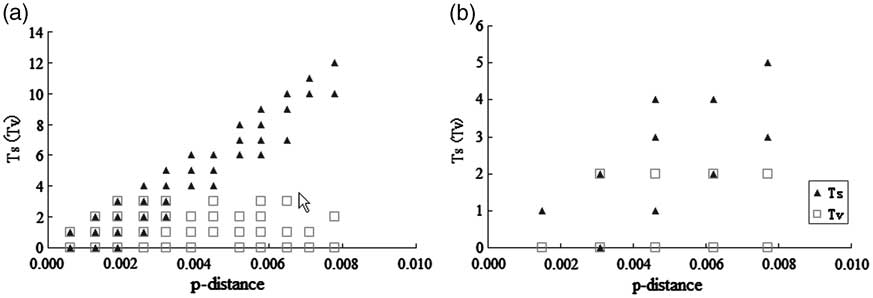
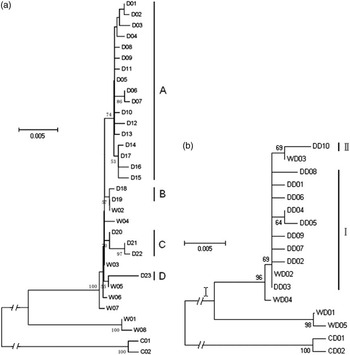
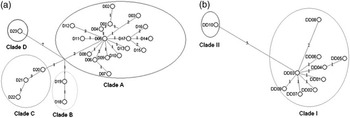
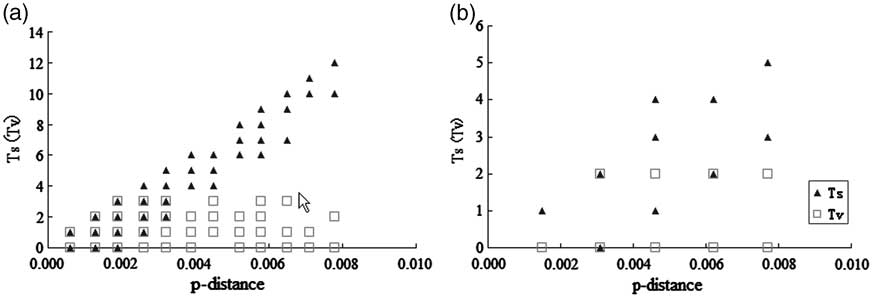
Saturation analysis of base substitutions (made with the scattergram p-distance as the abscissa and the base transition and transversion as the vertical coordinate; Figure 1) revealed that the COI gene and COI barcoding of domestic dogs shows a strong transition preference. The phylogenetic trees of the Tibetan Mastiff and domestic dogs were constructed by the NJ method based on the COI sequence (Figure 2a). The Tibetan Mastiff and domestic dogs were clustered with the grey wolf (bootstrap percentages (BP) = 99%), and coyotes were clustered alone (BP = 99%). The Tibetan Mastiff and domestic dogs were obviously divided into four groups: D01 to D017 were clustered initially (BP = 74%; Clade A); D18 to D19 were clustered into one group (BP = 57%; Clade B); D20 to D22 were clustered into one group (BP = 71%; Clade C); and D23 was alone (Clade D). The two haplotypes of the Tibetan Mastiff (D10 and D11) belonged to Clade A. The network technique is the most effective method to study the phylogenetic relationships among domestic animals. In this study, the genetic relationships among domestic dogs were analyzed using the network technique (Figure 3a). From Figure 3a, we found that the network relationship among domestic dogs was consistent with that of the phylogenetic tree (Figure 2a); that 23 haplotypes were divided into four clades; and that D05 was the most important and primordial haplotype in domestic dogs. The phylogenetic trees (Figure 2b) and haplotype network (Figure 3b) of the Tibetan Mastiff and domestic dogs constructed on the basis of COI barcoding were consistent with the COI gene. According to the NJ tree and network constructed by the COI gene sequence, we found 23 haplotypes clustered into four clades; the numbers of haplotypes (17, 73.91%) and individuals (66, 64.71%) of Clade A were more than those of Clades B and C, which is consistent with previous reports (Vilà et al., Reference Vilà, Savolainen, Maldonado, Amorim, Rice, Honeycutt, Crandall, Lundeberg and Wayne1997; Savolainen et al., Reference Savolainen, Zhang, Luo, Lundeberg and Leitner2002). These results support the view of the East Asian origin of domestic dogs and the Clade A origin of the Tibetan Mastiff, which are consistent with the results according to the complete sequence of the mitochondrial genome (Li et al., Reference Li, Li, Zhao, Xie and Xu2011).
Saturation analysis of nucleotide substitution based on cytochrome c oxidase subunit I gene (a) and DNA barcoding (b) among 77 domestic dog breeds. The abscissa is the proportion of distance and the vertical coordinate is the base transition and transversion.
Phylogenetic tree of domestic dogs and grey wolves was constructed based on cytochrome c oxidase subunit I gene (a) and DNA barcoding (b) by Neighbor-Joining methods. D and DD represent domestic dogs, W and WD represent grey wolf, C and CD represent coyote. The nodal parameters support the 1000 times repetition analysis on sampling examination.

Minimum-spanning Networks based on cytochrome c oxidase subunit I gene (a) and DNA barcoding (b) among domestic dogs. Grey circles represent haplotypes; the digitals on the line between yellow circles represent mutation times.

Phylogenetic relationship between the Tibetan Mastiff and other large breed dogs
On the basis of the historical data, the closest ancestor of the Tibetan Mastiff may be the Qiang dog. Following the Mongolian army (Tibetan Mastiff corps; it is said that this corps owned 30 000 Tibetan Mastiffs) of Genghis Khan, the Tibetan Mastiff came into Europe and played an important role in the breed formation of large breed dogs, such as the Saint Bernard and English Shepherd, which are close to the Tibetan Mastiff in blood lineage. In this study, the NJ tree and minimum-spanning network constructed by the COI gene and COI barcoding showed that, in large breed dogs, the Tibetan Mastiff clustered with the Old English Shepherd, Rottweiler and Saint Bernard, and possessed the least sequence divergence. Therefore, we considered that there was one closest relative between the Tibetan Mastiff and Old English Shepherd, Rottweiler and Saint Bernard, and that these large breed dogs probably had the blood lineage of the Tibetan Mastiff in species form, which was consistent with the results reported by Luo (Reference Luo2003), Li et al. (Reference Li, Liu, Li, Zhao, Dong, Pan, Sun, Li, Xu and Xie2008), and Li et al. (Reference Li, Li, Zhao, Xie and Xu2011).