Introduction
In general, women are under-represented in politics worldwide, and women's representation in cabinets is no exception to the rule. In 2010, on average, only 17.20% of the ministers in 191 countries' national cabinets were women.Footnote 1 However, variation in the level of female representation in cabinets differs greatly between countries. For example, in 2010 countries such as Belize, Nauru, Saudi Arabia, Solomon Islands, and Tuvalu did not have any female representation in their cabinets, whereas it exceeded 40% in countries such as Cape Verde, Chile, Finland, Spain, and Sweden. There is an extensive literature that examines the causes of the variation in female representation in parliaments; however, literature that examines the issue of female representation in cabinets is much rarer, and more research is needed.Footnote 2 Therefore, in this article the focus is on women's representation in cabinets.
It has been argued that economic development and democracy would create new opportunities and resources for women to access political power, which should increase gender equality in politics. However, empirical evidence from previous research that supports this argument is mixed. The contribution of this study is to expand the research through an in-depth examination of the role of development and democracy on gender equality in cabinets. The research question posed is: do development and democracy positively affect gender equality in cabinets? To answer the research question, I will test existing theories that explain the variation in women's representation in cabinets through separate analyses across three levels of development and across different types of political regimes. The study is a worldwide cross-national comparative study which includes most of the countries in the world. To my knowledge, this is the first attempt to examine women's representation in cabinets in different levels of development and in different political regimes across the globe.
Theoretical framework
Socio-economic development
I will now discuss previous findings concerning socio-economic development and gender equality, and democracy and gender equality. Because research on the effect of socio-economic development and democracy on women's representation in cabinets is scarce, I will also review previous research that has examined the effect of socio-economic development and democracy on gender equality in societies in general, and in gender equality in political areas other than cabinets; this will mainly be on women's representation in parliaments.
Several scholars have found that socio-economic development has a positive relationship with higher levels of gender equality (e.g. Fish, Reference Fish2002; Gray et al., Reference Gray, Miki Caul and Sandholtz2006; Inglehart and Norris, Reference Inglehart and Norris2003; Richards and Gelleny, Reference Richards and Gelleny2007; Semyonov, Reference Semyonov1980). Some scholars have demonstrated that development affects women's representation in parliaments positively (Gray et al., Reference Gray, Miki Caul and Sandholtz2006; Rosen, Reference Rosen2013; Studlar and McAllister, Reference Studlar and McAllister2002). For example Rosen (Reference Rosen2013) found that the female labour force participation level, and women's literacy level have a positive effect on female representation in parliaments in developed countries, developing countries, and in the least-developed countries, too; however, the positive effect was more than double in developed countries. Some studies have found that development has a positive effect on women's representation in cabinets. Escobar-Lemmon and Taylor-Robinson (Reference Escobar Lemmon and Taylor Robinson2005) and Bego (Reference Bego2014) demonstrated that socio-economic development measured with the human development index was positively related to women's representation in cabinets. Högström (Reference Högström2013) demonstrated that socio-economic developments measured with GDP per capita have a positive statistically significant effect on women's representation in cabinets when controlling for several political institutional variables. There are also studies that have not found any empirical evidence to support the effect of economic development on gender equality in politics. Kenworthy and Malami (Reference Kenworthy and Malami1999) and Yoon (Reference Yoon2004) found that the level of economic development does not affect women's representation in parliaments. Several scholars have examined women's representation in parliaments in developed and developing countries separately (Hughes, Reference Hughes2009; Krook, Reference Krook2010; Matland, Reference Matland1998; Rosen, Reference Rosen2013; Viterna et al., Reference Viterna, Fallon and Beckfield2008). For example Matland (Reference Matland1998) included 24 industrialized democracies and 16 less-developed democracies in his study, and he demonstrated that the same factors have different levels of impact on women's representation in parliaments in the two samples of democracies.
A theoretical link between economic development and women's political representation is that economic development will lead to a weakening of traditional values and attitudes, which will then lead to an increase in women's political representation (Högström, Reference Högström2013; Inglehart and Norris, Reference Inglehart and Norris2003; Matland, Reference Matland1998). Another suggested theoretical link is that developed economies can create more opportunities for females to acquire qualifications that are needed to serve in top political posts, which will affect women's political representation positively in more developed countries (Rosen, Reference Rosen2013). Accordingly, a weakening of traditional values and attitudes, and the fact that there is a larger pool of women who are considered to be qualified to become ministers in cabinets in more developed countries, will lead to women being more likely to become cabinet ministers in developed countries.
Democracy
Much of the previous research has focused on whether the level of democracy affects gender equality, rather than whether different types of political regimes, such as democracies and non-democracies, affect gender equality differently. Several scholars have presented theoretical assumptions as to why democracy should affect gender equality (e.g. Beer, Reference Beer2009; Krook and O'Brien, Reference Krook and O'Brien2012; Paxton, Reference Paxton1997; Paxton et al., Reference Paxton, Hughes and Painter2010). Beer (Reference Beer2009) argued that democracy will provide new opportunities for women to promote their interests through mobilization and elections, and that in democracies there should be more opportunities for women to participate in politics. Democracies allow women to form groups and lobby for their interests; accordingly, in democracies women can organize and mobilize to apply pressure for the inclusion of more women in politics, such as having a higher level of female cabinet ministers. That pressure should shape the principles behind appointments of cabinet ministers, which should increase the number of female ministers in cabinets. Paxton (Reference Paxton1997) suggested that democratic processes decrease the likelihood that artificial and arbitrary constraints can act as barriers to women's political representation. In democracies, there is competition between political parties to achieve political power, and women have the right to vote in elections and participate in politics. To attract female voters, political leaders and political parties nominate female candidates for parliamentary and cabinet positions. That should create more opportunities for women to access political power, which in turn should increase the number of female ministers in cabinets.
In relation to empirical evidence, Richards and Gelleny (Reference Richards and Gelleny2007) demonstrated that a higher level of democracy affects the level of women's status positively. Arriola and Johnson (Reference Arriola and Johnson2014) demonstrated that the level of democracy has a significant positive effect on women's representation in cabinets, while Bego (Reference Bego2014) found that the level of democracy has no statistically significant effect on women's representation in cabinets. Hughes (Reference Hughes2009) found a small democratic effect on women's representation in parliaments in low income countries. Other studies have demonstrated that the level of democracy has no statistically significant relationship with the level of women's representation in parliaments (e.g. Paxton and Kunovich, Reference Paxton and Kunovich2003; Reynolds, Reference Reynolds1999). Some studies have found that democratization/democracy affects women's representation in parliaments negatively (Paxton, Reference Paxton1997; Yoon, Reference Yoon2001). As the review of previous findings shows, the empirical evidence supporting the suggestion that development and democracy affect gender equality is mixed.
Other determinants of female representation in cabinets Political institutional factors
The literature on women's representation in politics has identified several factors that affect the varying levels of female representation. Numerous studies have demonstrated that proportional electoral systems affect women's representation in parliaments positively (e.g. Caul, Reference Caul1999; Högström, Reference Högström2013; Kenworthy and Malami, Reference Kenworthy and Malami1999; Krook, Reference Krook2010; Matland and Studlar, Reference Matland and Studlar1996; Paxton, Reference Paxton1997; Paxton et al., Reference Paxton, Hughes and Painter2010; Paxton and Kunovich, Reference Paxton and Kunovich2003; Reynolds, Reference Reynolds1999; Rule, Reference Rule1981; Studlar and McAllister, Reference Studlar and McAllister2002). Some studies have found that proportional electoral systems affect women's representation in cabinets positively. Whitford et al. (Reference Whitford, Wilkins and Ball2007) found that the proportion of women in ministerial positions was higher under open-list PR systems than in closed-list PR systems and SMP systems (single-member plurality). One suggestion to explain the causal mechanism between the form of the electoral system and women's representation in cabinets is that coalition cabinets are more common in countries that use proportional systems, and when each of the parties that belongs to a coalition cabinet wants women from its party to have ministerial positions, this leads to an increase in the number of women in the cabinet (e.g. Högström, Reference Högström2013: 157).Footnote 3
Historical factors
Several studies have demonstrated that the earlier women gained political rights, the higher women's share of parliamentary seats are (Hughes, Reference Hughes2009; Högström, Reference Högström2013; Kenworthy and Malami, Reference Kenworthy and Malami1999; Reynolds, Reference Reynolds1999; Rosen, Reference Rosen2013; Siaroff, Reference Siaroff2000; Studlar and McAllister, Reference Studlar and McAllister2002). Studlar and McAllister (Reference Studlar and McAllister2002) found that for each additional year during which women have possessed voting rights, their representation increases by 0.24% when controlling for other factors. Hughes (Reference Hughes2009), who applied separate analysis for three different income levels, found that women's suffrage was statistically significant and has a positive effect on women's representation in parliaments in the model for all income levels and in the model for high income countries, but for middle income countries and low income countries the effect was insignificant. Rosen (Reference Rosen2013) demonstrated that establishing women's suffrage early affects women's representation in parliaments positively. However, when she split the full sample into three different levels of development and ran separate analyses, she found that women's suffrage has a positive effect in developed countries but a negative effect in developing countries and in the least-developed countries. The length of time for which it has been the norm for women to be included and visible in politics can also affect the proportion of female ministers in cabinets. For example Högström (Reference Högström2013) found that early women's suffrage affects both women's representation in parliaments and women's representation in cabinets positively. One theoretical link that is proposed between the length of time that a country has had women's suffrage and women's representation in cabinets is that if the norm has been that women have had the right to vote in countries for a long time, and accordingly have been included and visible in politics for a long time, the likelihood that presidents/premier ministers will appoint a higher proportion of women to the cabinet will increase, compared with countries in which women have had the right to vote for only a short time, and accordingly have been included and visible in politics for only a short time.
The Convention on the Elimination of All Forms of Discrimination against Women (CEDAW) is the main international legal document on women's rights. Ratification of CEDAW can shape national attitudes to the promotion of gender equality, and can also be seen as a proxy for a country having an ideology of gender equality (e.g. Gray et al., Reference Gray, Miki Caul and Sandholtz2006; Paxton, Reference Paxton1997). Some studies have included ratification of CEDAW as an independent variable in gender equality research. Gray et al. (Reference Gray, Miki Caul and Sandholtz2006) found that countries that have signed and ratified CEDAW have higher levels of female life expectancy, lower levels of female illiteracy, higher levels of female participation in the labour force, and higher proportions of females in parliaments. However, when they (Gray et al., Reference Gray, Miki Caul and Sandholtz2006) split the sample for women's representation in parliaments and employed a model that only included democracies, the CEDAW variable was insignificant. Kenworthy and Malami (Reference Kenworthy and Malami1999) demonstrated that ratification of CEDAW has a positive effect on women's representation in parliaments. Hughes (Reference Hughes2009), however, found that CEDAW ratification had no statistically significant effect on women's representation in parliaments, and she (Hughes, Reference Hughes2009: 195) stated that: ‘CEDAW ratification is a highly politicized decision that may have little practical impact on women's lives.’
Cultural factors
Some studies have demonstrated that religious factors affect gender equality in politics. Paxton and Kunovich (Reference Paxton and Kunovich2003) found that countries with a larger Muslim population have lower levels of female representation in their parliaments. Kenworthy and Malami (Reference Kenworthy and Malami1999) found that Muslim and Catholic countries have lower proportions of women in politics than Protestant countries. Inglehart et al. (Reference Inglehart, Norris and Welzel2002) found that, historically, Protestant societies have higher proportions of women in parliaments compared with other societies. Reynolds (Reference Reynolds1999) demonstrated that female representation in cabinets is higher in countries in which Catholicism is the dominating religion compared with countries that have Buddhism or Eastern Orthodox Christianity as the dominating religion. Fish (Reference Fish2002) found that Muslim countries, compared with Catholic countries, have lower proportions of women in cabinets. Rizzo et al. (Reference Rizzo, Abdel-Latif and Meyer2007) found that there is more support for women's rights in non-Arab Muslim societies compared with Arab Muslim societies. A causal link relating religious tradition and women's political representation is that Catholic and Muslim countries have more conservative and restrictive gender ideologies that affect women's political representation negatively. Correspondingly, Protestant countries have a more liberal and less restrictive gender ideology that affects women's political representation positively (e.g. Högström, Reference Högström2013: 137).
Physical factors
In earlier research relating to gender equality, it has not been standard to examine whether physical variables affect gender equality. However, Högström (Reference Högström2013) examined physical variables' effect on women's representation in politics, and he demonstrated that physical factors such as countries area size and population size affect gender equality positively both in parliaments and in cabinets. The findings suggested that larger countries have higher levels of gender equality in politics compared with smaller countries. Högström (Reference Högström2013: 229–30) suggested the following causal mechanism between country size and gender equality in politics. In countries with a larger population and/or a larger area, there is more specialization and differentiation among the population, which leads to more political diversity. A higher level of political diversity leads to more requests for political equality, which increases the pressure on political parties and political leaders to increase the level of political equality. In response to the requests, political parties and political leaders work towards a higher level of political equality, which leads to an increased level of political equality, for example an increase in women's representation in cabinets. I will now discuss the data and the measures for the study.
Data and measures
Dependent variable
The dependent variable in this study is the share (percentage) of female ministers in the cabinet. I assembled data on cabinet composition globally, and the observations are taken at five-yearly intervals in the first decade of the twenty-first century: 2000, 2005, and 2010. The total number of cases (countries) included in the study is 191, and in total 521 observations of women's representation in cabinets are included in the data set.Footnote 4 The following analysis uses a cross-national panel-series data set.
Main independent variables
A standard measure of economic development is gross domestic product (GDP) per capita (e.g. Fish, Reference Fish2002). And to measure economic development in this study, I will also use GDP per capita, and it is measured in US$1,000. It is expected that a higher level of GDP per capita affects women's representation in cabinets positively.
I will include the Freedom House index (political rights and civil liberties added) as a measure of democracy.Footnote 5 In the Freedom House index, low figures indicate high levels of democracy, but in this study I inverse the scale so that high values indicate high levels of democracy. The inverse scale ranges between 2 and 14, where 14 indicates the highest level of democracy and 2 indicates the lowest level of democracy.Footnote 6 It is expected that a higher level of democracy affects women's representation in cabinets positively.Footnote 7
Control variables
A number of control variables will be included in the study. I will control whether the type of electoral system affects women's political representation in cabinets. The control variable electoral system is divided into three categories: proportional systems, mixed systems, and majority systems (first-past-the-post, alternative vote, two-round systems). In the analyses, electoral systems are measured with three dummy variables, and the category proportional systems is used as the baseline variable. It is expected that countries that use a proportional electoral system will have a higher level of female representation in cabinets.
I will include two historical control variables. The first historical variable is the timing of women's suffrage, and the variable captures how many years have passed since women gained voting rights in national elections. It is expected that countries in which women have had voting rights for longer will have a higher level of female representation in cabinets. I also include the ratification of the Convention on the Elimination of All Forms of Discrimination against Women (CEDAW) as a control variable. Previous research (e.g. Kenworthy and Malami, Reference Kenworthy and Malami1999; Paxton, Reference Paxton1997) has operationalized CEDAW ratification as a dummy variable (countries that had ratified/countries that had not ratified). However, I suggest that the longer it has been since a country ratified CEDAW, the higher level of gender equality it should have. Therefore, in this study the variable is operationalized as the number of years since countries have ratified CEDAW. Countries that have not ratified CEDAW are coded as 0 (years).
Two religious control variables will be employed to examine whether religion has any effect on women's representation in cabinets. And the two religious variables that are included are the percentage of Protestants in each country and the percentage of Muslims in each country. It is expected that countries that have a higher proportion of Protestants in their population will have a higher level of female representation in cabinets. And it is expected that countries with a higher proportion of Muslims in their population will have a lower level of female representation in cabinets.
One physical variable, area of the country, will be included as a control variable.Footnote 8 The size of the country's territory is measured in square kilometres (km2). To reduce the skewed distribution of area this is transformed to logarithms. It is expected that larger countries will have a higher proportion of female representation in cabinets. According to the suggested causal mechanism between area and women's representation in cabinets, the effect of the pressure on political parties and political leaders to increase the level of political equality is expected to be more effective in democracies compared with in non-democracies.
Income categories and political regimes categories
Classification of income categories
There are several techniques to categorize countries by level of development. Hughes (Reference Hughes2009) placed countries into income categories according to the World Bank's 2000 designation. In this study, I follow a similar strategy in which I categorize countries by level of development. The World Bank's main criterion for classifying economies is gross national income (GNI) per capita, and every economy is classified as low income, middle income (subdivided into lower middle and upper middle), or high income. The World Bank, using the World Bank Atlas method when it categorizes countries and the 2011 GNI per capita, finds that the income groups are as follows: low income is $1,025 or less; lower middle income is $1,026–$4,035; upper middle income is $4,036–$12,475; and high income is $12,476 or more. I diverge from those thresholds when I place countries into categories, but I use the measure GDP per capita when I categorize countries into income groups. In this study, the categories lower middle income and upper middle income are included in the same category, which is called the middle income category. Consequently, three development categories are applied in this study: least-developed countries (low income: GDP per capita $1,025 or less), developing countries (middle income: GDP per capita $1,026–$12,475), and developed countries (high income: GDP per capita $12,476 or more).
Classifications of political regimes categories
In this study, I will not limit the examination by only considering the level of democracy as a measure of democracy, I will also examine whether the type of political regime matters for the level of female representation in cabinets, and in some multivariate models I will include political regimes as an independent variable. I will also run separate analysis of different political regimes and examine whether the causes of the variation in female representation in cabinets differs in different types of political regimes.
In political science, a classic differentiation of political regimes is that between democracies and autocracies. Political scientists have also developed classification of the differentiation between types of democracies, and for example Lijphart (Reference Lijphart1999) categorized two different types of democracies: majoritarian democracies and consensus democracies. Recently several scholars have classified autocratic regimes into different types, and there are now several classifications of types of autocratic regimes. There are at least three existing data sets on types of autocratic regimes available: those of Geddes (Reference Geddes1999) (expanded and updated by Geddes et al., Reference Geddes, Wright and Frantz2012), Hadenius and Teorell (Reference Hadenius and Teorell2007) (modified and updated by Wahman et al., Reference Wahman, Teorell and Hadenius2013), and Cheibub et al. (Reference Cheibub, Gandhi and Vreeland2010).Footnote 9 Roller (Reference Roller2013) compared the three data sets mentioned above, and she concluded that if scholars prefer to study three main types of autocratic regimes and are content with simple, easily observable measures, they should use the Cheibub et al. (Reference Cheibub, Gandhi and Vreeland2010) data set. The Cheibub et al. (Reference Cheibub, Gandhi and Vreeland2010) data set also covers more countries than the other two data sets on autocratic regimes. Consequently, I find that the Cheibub et al. (Reference Cheibub, Gandhi and Vreeland2010) data set is the data set on political regimes that is preferable for this study. Thus, in this study I use Cheibub et al.'s (Reference Cheibub, Gandhi and Vreeland2010) regime classification and their data set on political regimes.
Cheibub et al. (Reference Cheibub, Gandhi and Vreeland2010) use the ACLP dichotomous regime classification for distinguishing between democracies and autocratic regimes (e.g. Alvarez et al., Reference Alvarez, Cheibub, Limongi and Przeworski1996; Przeworski et al., Reference Przeworski, Alvarez, Antonio Cheibub and Limongi2000). They proceed by differentiating different types of democratic regimes and different types of autocratic regimes. They classify democracies into three types: parliamentary democracies, semi-presidential democracies, and presidential democracies. However, to avoid making the concept political regime too complex, in this study I will not separate democracies into the three different categories; instead, I keep democracies as one category called democracies. Cheibub et al. (Reference Cheibub, Gandhi and Vreeland2010) classify autocratic regimes into three types: royal, military, and civilian dictatorships. They (Cheibub et al., Reference Cheibub, Gandhi and Vreeland2010) distinguish the three types of autocratic regimes in terms of the nature of their executive office, and the operational rules they use are as follows: (1) The autocratic regime is a royal dictatorship if the effective head of cabinet: (a) bears the title of ‘king’ and (b) has a hereditary successor and/or predecessor. (2) The autocratic regime is a military dictatorship if the effective head of cabinet is a current or past member of the armed forces. (3) The autocratic regime is a civilian dictatorship if the effective head of cabinet is neither monarchic nor military.
The independent variable political regime is divided into four categories: democracies, royal dictatorships, military dictatorships, and civilian dictatorships. In the analyses, political regimes are measured with four dummy variables, and the category democracies is used as the baseline variable. When only autocracies are included in the analysis, civilian dictatorships is used as the baseline variable. It is expected that democracies will have a higher level of female representation in cabinets.
Estimation strategy and robustness tests
In this study, OLS regressions are applied, and when the analysis uses a cross-national panel-series data set I follow Beck and Katz's (Reference Beck and Katz1995) recommendation to replace OLS standard errors with panel-corrected standard errors. However, using OLS regressions with a proportion as the dependent variable violates assumptions of OLS and can therefore be an inappropriate method for analysing the share (percentage) of cabinet seats held by women. Therefore, to ensure that OLS with panel-corrected standard errors is an adequate method for this study, I considered several alternative specifications. I applied a generalized linear model (GLM) (using the logit link function and the binomial family distribution); I also transformed the dependent variable to logit, and applied OLS regressions by using the transformed dependent variable. However, the results did not change significantly in the alternative specifications compared with the results in the original specifications, and therefore it is reasonable to assume that OLS with panel-corrected standard errors is an adequate method for this study. Several other controls were also applied to control the robustness of the results. For example, I checked for multicollinearity, outliers, and influential cases. I found no evidence of problems with multicollinearity in the models. To control the unusual cases' impact on the regressions, the most unusual (influential) cases were removed. Nevertheless, this did not change the results in any considerable way. It is now time to turn to the analysis and results section.
Analysis and results
Mapping the dependent variable and the main independent variables
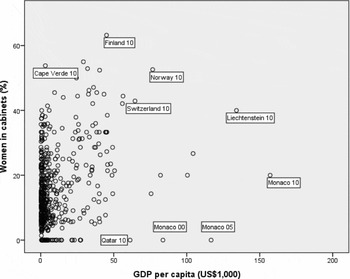
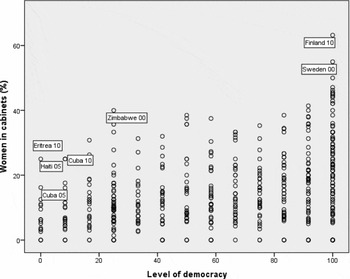
To get a general view of the relationship between women's representation in cabinets and socio-economic development (GDP per capita), and the relationship between women's representation in cabinets and level of democracy (Freedom House), two scatterplots will be employed. Figure 1 shows a scatterplot with women's representation in cabinets on the Y-axis and GDP per capita on the X-axis.
Scatterplot women's representation in cabinets and socio-economic development

The correlation between women's representation in cabinets and GDP per capita is 0.306 (Pearson's), and is significant at the 0.01 level. Accordingly, there is a positive relationship between the two variables. As Figure 1 indicates, many cases have a low level of female representation in cabinets and a low level of socio-economic development; and there are several cases such as in Finland 2010, Liechtenstein 2010, Switzerland 2010, and Norway 2010 that have both a high level of female representation in cabinets and a high level of socio-economic development. The scatterplot (Figure 1) also shows that there are several cases that are outliers, and the most influential cases are the three cases of Monaco (2000, 2010, and 2005); when these three cases are removed the correlation increases to 0.370 (significant at the 0.01 level).
When controlling the relationship with different statistical equations by transforming GDP per capita, the results indicate that the relationship fits best with a quadric model (R2 12.3) and a cubic model (R2 12.2), but the difference in fit is low compared with the linear model (R2 9.7), and, for example, the linear model fits better than a logarithmic model (R2 6.4).Footnote 10Figure 2 shows a scatterplot with women's representation in cabinets on the Y-axis and level of democracy on the X-axis.Footnote 11
Scatterplot women's representation in cabinets and level of democracy

The correlation between women's representation in cabinets and level of democracy is 0.366 (Pearson's) and is significant at the 0.01 level. Accordingly, there is also a positive relationship between women's representation in cabinets and democracy. The scatterplot indicates that Finland 2010 and Sweden 2000 have both the highest level of female representation in cabinets and the highest level of democracy. However, there are as many as 14 cases that have the highest level of democracy but no female representation in cabinets. Three cases (Libya 2010, Saudi Arabia 2005, and Iraq 2000) have both the lowest level of democracy and no female representation in cabinets. There is only one case (Eritrea 2010) that has the lowest level of democracy and a female representation in its cabinet higher than 20%. Examples of other cases that have a very low level of democracy but have higher proportions of females in their cabinets than one would expect are Cuba (2005, 2010), Haiti (2005), and Zimbabwe (2000). Next, I will map the dependent variable and the main independent variables; Table 1 shows women's representation in cabinets by level of development.
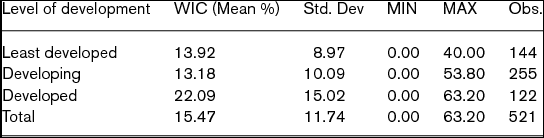
Women's representation in cabinets by level of development
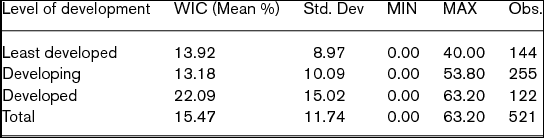
The descriptive statistics in Table 1 demonstrate that the percentage of women's representation in cabinets ranges between 0.00 and 63.20, with a mean of 15.47. The statistics also show that the developed countries have higher levels of female representation compared with the developing countries and the least-developed countries (8.91 and 8.17 percentage units respectively). Accordingly, the developing and least-developed countries have similar levels of female representation in cabinets. The minimum value is 0.00 in all three levels of development. Table 2 shows descriptive statistics for women's representation in different political regimes.Footnote 12
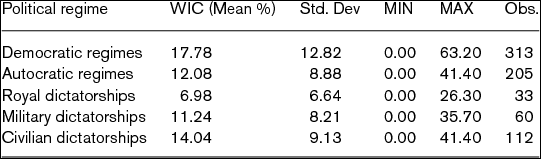
Women's representation in cabinets by political regimes
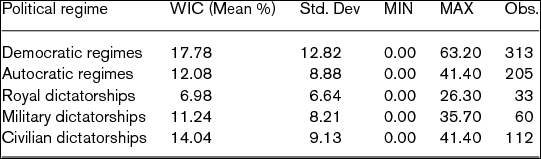
The findings show that in democracies the proportion of women in cabinets is 5.70 percentage units higher than in autocracies. The maximum value in democracies is 63.20, while the maximum value in autocracies is 41.40. The minimum value is 0.00 in both democracies and autocracies. Comparing women's representation in different autocratic regimes, the findings show that civilian dictatorships (14.04) have the highest level of the three regime types, followed by military dictatorships (11.24). Royal dictatorships is the autocratic regime type that has the lowest level of female representation, and on average in royal dictatorships only 6.98% of the ministers in cabinets are female. Comparing the maximum values shows that civilian dictatorships (41.40) have the highest maximum value of the three types of dictatorships, followed by military dictatorships (35.70) and then royal dictatorships (26.30). The minimum value is 0.00 in all three types of dictatorships. Next, I will proceed with the multivariate regressions, and I present the results of the analysis in two tables.
Multivariate regressions with a focus on development
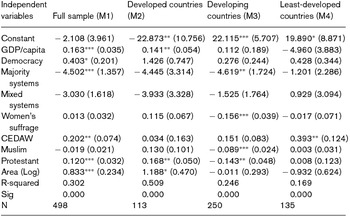
In the first four multivariate regressions (Models 1–4), the focus will be on economic development. The first model includes the full sample, the second includes the developed countries, the third includes the developing countries, and the fourth model includes the least-developed countries. Table 3 presents the results.
Multivariate regressions on women's representation in cabinets with a focus on development

Notes: In each row, the unstandardized regression coefficients are listed first, followed by panel-corrected standard errors in brackets: ***significant at the 0.001 level, **significant at the 0.01 level, *significant at the 0.05 level.
Turning first to the independent variable GDP per capita, the results indicate that it has a positive effect on women's representation in cabinets in the full sample group and in the developed countries. Accordingly, in the developing countries and in the least-developed countries, GDP per capita has no statistically significant effect. The level of democracy only has a positive effect in the full sample group, and is insignificant in the other three models. Turning to the control variables, and first looking at the dummies for electoral systems, majority systems has a negative effect in the full sample model and in the model for developing countries with similar sizes of the coefficients. Mixed systems does not reach a statistically significant effect in any of the four models. Women's suffrage has a negative effect in the developing countries; accordingly, the sign of the coefficient is unexpected. CEDAW has a positive significant effect in the full sample group and in the least-developed countries. The Muslim population variable has a negative effect in the developing countries, while the Protestant population variable has a positive effect in the full sample group and in developed countries, but a negative effect in the developing countries. Finally, area size has a positive effect in the full sample group and in the developed countries. I turn next to the multivariate regressions with a focus on democracy and political regimes.
Multivariate regressions with a focus on democracy and political regimes
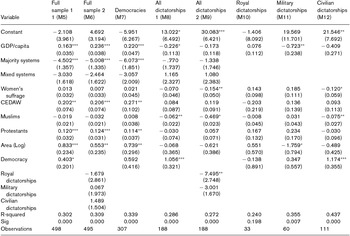
In Table 4, eight multivariate models (Models 5–12) with a focus on democracy and political regimes are presented. Due to multicollinearity between the level of democracy variable and the dummy variables for political regimes, I do not include them in the same regression models. Therefore, two models of the full sample (Models 5–6) and two models of the sample with all dictatorships (Models 8–9) are presented. In Model 7, democracies are included, and Models 10–12 include each category of dictatorship (royal dictatorships, military dictatorships, and civilian dictatorships). The categories of dictatorships consist of few observations (especially the category royal dictatorships), and therefore only a limited number of control variables can be included in the regressions. Accordingly, I'm unable to control for all variables in the same multivariate model, and to preserves degrees of freedom in the regressions I removed the dummy variables for electoral systems in the models where the different categories of dictatorships are examined separately. However, I controlled both with simple regressions and a range of alternative multivariate regressions, and none of the electoral system dummies reach statistical significance in any of the regressions where the different categories of dictatorships were examined separately.
Multivariate regressions on women's representation in cabinets with a focus on democracy and political regimes

Notes: The unstandardized regression coefficients are listed first, and the panel-corrected standard errors are in brackets: ***significant at the 0.001 level, **significant at the 0.01 level, *significant at the 0.05 level.
Turning first to the variable democracy, it has a significant and positive effect on women's representation in three models: full sample, all dictatorships, and civilian dictatorships. Concerning the dummies for dictatorships, the dummy for royal dictatorships is highly statistically significant and negative in the model for all dictatorships (Model 9), and the results indicate that in royal dictatorships the proportion of women in cabinets is 7.50 percentage units lower than in civilian dictatorships (baseline) when controlling for other variables. In the model for the full sample (Model 6), where the political regimes dummies are included, all regimes dummies are insignificant. Thus, the findings indicate that democracies do not have a statistically significant higher share of women in cabinets compared with the three categories of dictatorships when controlling for other factors included in the model.
The variable GDP per capita has a statistically positive effect in the two models of the full sample and in the model for democracies. However, in Model 8, which includes all dictatorships, the coefficient for GDP per capita turned out to be negative and statistically significant. Accordingly, a higher GDP per capita in dictatorships has a negative effect on women's representation in cabinets. In the models where the dictatorships are split into different categories, GDP per capita is also significant and negative in the model for military dictatorships, but insignificant in the models for royal dictatorships and for civilian dictatorships.
Turning to the control variables, the dummy for majority systems is negative and statistically significant in the two models for the full sample and in the model for democracies. The electoral system dummy for majority systems is insignificant in the models for all dictatorships (Models 8–9). Accordingly, majority electoral systems have a negative effect on women's representation in cabinets in democracies but not in dictatorships. The results indicate that in democracies that use majority electoral systems, the proportion of female representation in cabinets is 6 percentage points less than in democracies that use proportional electoral systems. Mixed systems does not reach a statistically significant effect in any of the models.
Women's suffrage is statistically significant in two models: the second model (Model 9) for all dictatorships and the model for civilian dictatorships, but, surprisingly, the direction for the coefficients for women's suffrage is negative in both models, which is unexpected. Accordingly, an early women's suffrage has a negative effect on women's representation in cabinets in these two models when controlling for other factors. The CEDAW variable is statistically significant in the two models for the full sample and in the model for democracies, and is insignificant in all models for dictatorships. Accordingly, an early ratification of the CEDAW has a positive effect in democracies but no effect in dictatorships.
Turning to the two religious control variables, the share of Muslims in the population has a negative effect in the two models for all dictatorships and in the model for civilian dictatorship. In the other five models, the Muslim variable is insignificant. The other religious variable, share of Protestants in the population, is positive and statistically significant in the two models with the full sample and in the model for democracies. Accordingly, a higher share of Protestants in the population has a positive effect on women's representation in cabinets in democracies. And a higher share of Muslims in the population has a negative impact in dictatorships, but when the dictatorships are split into different categories the negative effect is only statistically significant in civilian dictatorships. Finally, turning to the physical control variable area size, it is significant in four of the eight models. Area affects female representation in cabinets positively in the two models for the full sample and for the model for democracies, and in military dictatorships area size affects female representation negatively, which is unexpected.
Discussion
Let's start to discuss the findings for the main independent variables. In the models where the focus is on development, GDP per capita has a positive effect on women's representation in cabinets when all countries are included in the model. However, when the sample is subset, the effect is only statistically significant in developed countries and is insignificant in both developing countries and least-developed countries. Accordingly, there seems to be a threshold for the level of development before GDP per capita has a statistically significant positive effect on women's representation in cabinets.
In the models where the focus is on democracy and political regimes, the variable GDP per capita has a statistically positive effect on women's representation in cabinets in the two models where all countries are included and in the model for democracies. In the model that consists of all dictatorships, the coefficient for GDP per capita has turned to be negative and statistically significant. Accordingly, a higher GDP per capita in dictatorships has a negative effect on women's representation in cabinets. In the models where the dictatorships are split into different categories, GDP per capita is also significant and negative in the model for military dictatorships. The relationship is also negative in civilian dictatorships and in royal dictatorships, but is statistically insignificant. Examining this pattern in more detail shows that in democracies the relationship between GDP per capita and women's representation in cabinets is 0.446 (significant at the 0.01 level). When looking at the relationship in autocracies, the direction of the relationship changes to negative (−0.231, significant at the 0.01 level). In military dictatorships, the negative relationship is stronger (−0.281, significant at the 0.05 level), and the negative relationship also holds when the most influential case (outlier), Singapore 2010, is removed from the correlation analysis.
Turning to the results for the level of democracy variable, the findings show that it has a positive effect when all countries are included in the model. However, its significance disappears in the models where countries are analysed separately according to their level of development. When the sample is subset to democracies and autocracies, the positive effect of the level of democracy is statistically significant in autocracies, but insignificant in democracies. When autocracies are analysed separately, the level of democracy is statistically significant only in civilian dictatorships. The findings suggest that there is a threshold between autocracies and democracies where the level of democracy has a positive effect.
The results for some of the control variables also show some interesting patterns. For example, CEDAW ratification has a positive significant effect in the model with the full sample, but when the samples are analysed separately according to their level of development, the effect is only statistically significant in the least-developed countries. And when the sample is analysed separately according to the type of political regime, the effect is only significant in democracies. Accordingly, an early ratification of the CEDAW affects women's representation in cabinets positively in least-developed countries and in democracies. The findings for the other historical variable women's suffrage show that women's suffrage affects women's representation in cabinets negatively in developing countries and in autocracies. However, when autocracies are analysed separately, the negative effect is significant only in civilian dictatorships. Still, the negative effect is unexpected.
Area size has a positive effect in the model with the full sample, and in the separate analysis the positive effect is statistically significant in developed countries and in democracies. In military dictatorships, area size has a statistically negative effect. That area size affects women's representation positively in democracies and not in autocracies supports the suggested causal mechanism that the effect of the pressure on political parties and political leaders to increase the level of political equality is more effective in democracies than in non-democracies. Regarding electoral systems, majority systems have a negative effect on women's representation in cabinets in the full sample model, and in separate analysis the negative effect is statistically significant in developed countries and democracies. The fact that majority systems have an effect in democracies but not in autocracies is also in line with the suggested causal mechanism because coalition cabinets occur more often in democracies than in autocracies. Finally, regarding women's representation in different political regimes, the findings show that royal dictatorships are the type of regime that has the lowest level of female representation in cabinets.
Conclusion
The contribution of this study is to expand the research on gender equality in politics through an in-depth examination of the effect of development and democracy on gender equality in cabinets. This has been completed through separate analyses across three levels of development and across different types of political regimes. The results demonstrate that economic development and democracy only affect gender equality in cabinets positively in a few environments. Accordingly, the context is important. The findings suggest that there is a threshold for the level of development before GDP per capita affects women's representation in cabinets positively. The findings also demonstrate that GDP per capita has a positive effect in democracies, but in autocracies, and in military dictatorships especially, the effect is negative.
In general, it seems that democracy affects women's representation in cabinets positively, but the findings indicate that the level of democracy does not affect the level of women's representation in cabinets when developed, developing, and least-developed countries are analysed separately. The findings suggest that the level of democracy only has a positive effect in autocracies, in civilian dictatorships in particular, and there appears to be a threshold between autocracies and democracies at which the level of democracy has a positive effect. Accordingly, the level of democracy does not matter in relation to the level of female cabinet ministers in democratic regimes, and dictatorships that are less authoritarian have more women in cabinet positions than dictatorships that are more authoritarian.
To conclude, this study demonstrates that different mechanisms affect the variation in women's representation in cabinets in different environments and that the importance of several factors shifts when the full sample is subset into separate analysis. In some environments, some factors even change the direction of their effect on women's representation in cabinets compared with their effect when the full sample is analysed. Thus, this study has demonstrated the importance of subsetting samples to increase the understanding of what affects women's representation in cabinets, and I ask scholars to subset samples and run separate analysis more often in comparative studies.
About the author
John Högström has a Ph.D. in political science and is currently working at Mid Sweden University in Östersund, Sweden. His research interests are democracy and the quality of democracy.
Appendix A
Sources for the dependent variable: women's representation in cabinets
Main sources
Inter-Parliamentary Union: Parline database
Women's representation in cabinets 2010, http://www.ipu.org/pdf/publications/wmnmap10_en.pdf (accessed 2 June 2010)
Figures for Mauritius and Suriname are from 2008, http://www.ipu.org/pdf/publications/wmnmap08_en.pdf (accessed 2 June 2010)
Women's representation in cabinets 2005, http://www.ipu.org/pdf/publications/wmnmap05_en.pdf (accessed 29 November 2011)
Women's representation in cabinets 2000, http://www.ipu.org/pdf/publications/wmnmap00_en.pdf (accessed 29 November 2011)
Due to missing data for women's representation in cabinets in the year 2000, data for the year 1998 are used for some countries.
Other sources that have been used for women's representation in cabinets:
Bauer, Gretchen and Manon Tremblay (eds.) (2011), Women in Executive Power: A Global Overview, New York, Routledge
World Bank: World database, http://databank.worldbank.org/ddp/home.do?Step=1&id=4 (accessed 2 December 2011)
Data for Taiwan 2000 and 2005 (2004) have been collected from Wei-Sun, Tsai, ‘Gender Representation in Politics and Public Administration: Taiwan and Asian Countries’, unpublished paper, http://www.rchss.sinica.edu.tw/capas/publication/newsletter/N28/28_02_02.pdf (accessed 2 December 2011)
And from Clark, Cal, Phyllis Mei-lien Lu. and Janet Clark (2009), ‘The Improvement of Women's Status in Taiwan: A Theoretical Model’, Paper presented at the Annual Meeting of the American Association for Chinese Studies, Rollins Collage, Orlando, 16–18 October 2009
Sources for the independent variables and the control variables
Area
CIA World Factbook, https://www.cia.gov/library/publications/the-world-factbook/fields/2147.html?countryName=World&countryCode=XX®ionCode=oc&#XX (accessed 26 June 2012)
CEDAW
United Nations Treaty Collection http://treaties.un.org/Pages/ViewDetails.aspx?src=TREATY&mtdsg_no=IV-8&chapter=4&lang=en (accessed 6 August 2013)
Degree of democracy
Freedom House: Freedom in the World, http://www.freedomhouse.org (accessed 6 August 2013)
Electoral systems
Lundell, Krister and Karvonen, Lauri (2010), A Comparative Data Set on Political Institutions, Åbo, Finland: Department of Political Science, Åbo Akademi University.
Reynolds, Andrew, Ben Reilly, and Andrew Ellis (eds.) (2005), Electoral System Design: The New International IDEA Handbook, Stockholm, Sweden: IDEA.
Inter-Parliamentary Union: Parline database on national parliaments, http://www.ipu.org/parline-e/parlinesearch.asp (accessed 19 September 2011)
GDP/capita
National Accounts Main Aggregates Database, http://unstats.un.org/unsd/snaama/selbasicFast.asp (accessed 5 October 2011)
Due to missing data for Taiwan, I have calculated GDP/capita for Taiwan by using data from the Economic Research Service, which include data for Taiwan, www.ers.usda.gov/data/. . ./HistoricalRealPerCapitaIncomeValues.xls
Political regimes
Dataset Cheibub et al. (Reference Cheibub, Gandhi and Vreeland2010), https://sites.google.com/site/joseantoniocheibub/datasets/democracy-and-dictatorship-revisited (accessed 6 August 2013)
Religion
Muslim population
Pew Research Center (The Pew Forum on Religion and Public Life), http://pewforum.org/Muslim/Mapping-the-Global-Muslim-Population(3).aspx (accessed 8 November 2011)
Protestant population
Barrett, David B., George T. Kurian, and Todd M. Johnson (2001), World Christian Encyclopedia: A Comparative Survey of Churches and Religions in the Modern World, 2nd edn, Oxford, England and New York, NY: Oxford University Press.
Women's suffrage
Inter-Parliamentary Union (IPU), http://www.ipu.org/wmn-e/suffrage.htm (accessed November 29, 2011)
In the study, the independent variables and the control variables are lagged by one year. There are two exceptions to this rule: the data for the two religious independent variables, percentage of Protestants and percentage of Muslims, are not available for all countries for the years this study covers. Therefore data for the two religious control variables are collected from one time period in the 2000s.