Introduction
There are numerous theories of property that have influenced the understanding of notions of property ownership. This paper will explore some of the cultural concepts that revolve around the possession of property and examine how Canadian land settlement policies assist in shaping local Deh Cho Dene notions of ownership. The Deh Cho Dene are settled in ten communities across the Northwest Territories (NWT) in the circumpolar Canadian north. This area is abundant in non-renewable resources such as oil, gas and precious minerals and contains the Mackenzie Valley watershed. The Deh Cho Dene are one of the North American indigenous groups that comprise the Athabaskan speaking family of peoples. The population is currently 3500 in an area of 70,000 km2. There are three official languages in the region, the indigenous Slavey, French and English. Slavey is the first official language in the region, which is used alongside English in political meetings and negotiation sessions. Amongst the varied definitions of property that will be presented, is an examination of the concept of the ‘claim to use’ and how it relates to property ownership. The focus will be on the cultural perceptions that represent ‘claim to use’ or ‘own’, such as the historical connection to traditional territories. Oral narratives and ethnographic fieldwork are used to demonstrate the Deh Cho Dene perceptions of land ownership and claims to territory. The land settlement negotiations with the Canadian government on issues of land ownership, sovereignty and jurisdiction will be used to illustrate this point. In short, I argue that Deh Cho Dene values on property have shifted with the development of negotiations for land. Land and negotiation cannot be separated.
Contemporary approaches to property will be examined in an exploration of how Deh Cho Dene concepts of property may have developed in the course of negotiations with the federal government and the government of the Northwest Territories (GNWT). In particular I examine how concepts such as private and common property relate to the changing needs of Deh Cho Dene society, drawing on Macpherson (1980), John Locke (Reference Locke1721 [1632–1704]) and Karl Marx (Reference Marx1968 [1818–1883]) to construct an analysis. The aim is to illustrate how at least some Deh Cho Dene concepts of land have transformed with the progress towards self-government and land ownership. This will be conducted by focusing on the many types of property relations that exist. By using European models of property, I will demonstrate how Deh Cho Dene concepts of property both overlap with, and diverge from, models of property found in Canadian/European culture and law. Essentially, the paper aims to clarify the defining aspects of different forms of property and the range of responsibilities associated with ownership.
Constructing models of property relations
Macpherson's (1980) ‘Property as means or end’ provides an excellent example of how the changing needs of society transformed the definition of property in Europe at given points in time. Changes in the notion of property can also be traced in Deh Cho Dene society. For instance, oral narratives reveal that land tenure systems existed before the arrival of Europeans. In this context the claim to property such as game and other renewable resources was shared as common property in the community. While this attitude remains, new concepts of property have developed with the emergence of land settlement negotiations. Nadasdy (2002: 248) argues that property is the fundamental concept on which the Canadian state has based its relationship with indigenous peoples. Indeed, western notions of ownership and property are separate from those of indigenous people, who see themselves as part of the land. Thus far, a Deh Cho Dene elders’ discourse reveals that the utilisation of renewable resources is central in traditional relationships with the land. However, increased technology and European education and culture have affected the needs and perspectives of Deh Cho Dene society. Consequently, the traditional way of subsistence in its purest form as survival slowly continues to decline in favour of the European way of life, which has an emphasis on the value of private property. The development of ideas that accommodate transitions in society is demonstrated as early as the seventeenth century.
John Locke's (1632–1704) (Reference Locke1721) political philosophy on the right to possess private property was a response to the individual and his social relationship with the state. Locke supported the right to human liberty and property and he believed that ‘private property’ and the act of ownership is embodied in the principles of labour. His philosophy outlined human physical actions validating a personal right to the profits of one's own labour. Consequently, ownership was justified by the time and effort taken to cultivate the resource, which asserted the individual right to claim it within set constraints. According to Macpherson (1980), the insistence that accumulation was a natural right of the individual came close to making accumulation the ultimate goal as early as Locke. Writing two centuries later, Karl Marx (1818–1883) (Reference Marx1968) was concerned with capitalist society and the relationship between the proletariat and the bourgeoisie. His critique of capitalism illustrated to some extent how property relations are a consequence of historical conditions. Although his comments on the future of property relations are limited, it is clear that while Marx did not believe in the absolute abolition of property, he argued for the transformation of private property, which alienated one person from another as property was no longer a collective and unifying bond. Macpherson (1980) emphasises the multiple forms of property that are available in society. In his analysis he describes how property is perceived as an individual notion. On this occasion, property is understood as the final outcome: for instance, individual freedom and a high-quality of life for the citizen. These are embodied in human free will, in which people are free to act at their own discretion. Macpherson argues how the state exists to assist the citizen to live at the highest standard and how property ownership functions to maintain social order. Corporate markets, on the other hand, benefit investors by the increase in capital and the accumulation of property. As we shall see, these theories are helpful in constructing a model to understand the property relations that exist in contemporary Deh Cho society.
Traditional boundaries and property relations
The Horn Plateau is important to the Deh Cho Dene for many reasons. Located 100 km north-east of Liidlii Kue (Fort Simpson), the Horn Plateau covers 25,000 km2 in the south-central part of the NWT. The area is abundant in natural resources, boreal forest, uplands and wetlands. It is also the home to endangered species and provides important migratory bird habitat and contains the Mackenzie valley watershed, all of which are included in the Deh Cho Dene definition of ‘the land’. It also has significant cultural sites and traditional trails referred to in the Yamoria legend, the traditional Deh Cho Dene oral narrative that has been passed down through many generations. The Deh Cho Dene invited the WWF in March 1998 to assist in finding a solution to protect the Horn Plateau as a site of natural and cultural heritage. Despite no third-party subsurface rights to the Horn Plateau region in 2000, the Dene Cho Dene, in particular, the members of Liidlii Kue first nation, called for its protection against further development. The plateau was covered by interim protection on surface and subsurface development from 2002 until recently, when the federal government authorised exploration for minerals in the area. This decision has been challenged by legal action taken by the Deh Cho first nation and the environmental organisations, that wish to retain the ban on resource development.
The plateau had already experienced some resource exploration and development since 1966. However, Deh Cho Dene protection of the Horn Plateau, which they maintain as their inherent right to protect their territorial lands, highlights some of the ways in which the Canadian nation state and the Deh Cho Dene differ in their approaches to ownership. The Deh Cho Dene's claim to territorial lands also prompts questions about the concepts of private and common property, in particular how Deh Cho Dene view the utilisation of land for its inhabitants. Consequently, it is important to examine Deh Cho Dene perceptions of both private and common property. This paper uses excerpts from ethnographic interviews from fieldwork conducted in the NWT over a period of 17 months to support the discussions presented in this paper. Elder Leo Norwegian, formerly a prominent figure in Liidlii Kue, was frequently called upon to represent the elders’ perspectives in Deh Cho political meetings. In an interview with elder Norwegian, I asked him how traditional boundaries were defined before the implementation of the official boundaries by the federal government. He answered:
In the old days you're born with it; from the time you're born until you become a man, you hear that every day, everybody knows the system; everything is working like a clock even the boundary that we're talking about. You know the different tribes; we know who they are and where they are respected. It never was any problems, not this part of the country anyway. But now, until back in the well, 70s, late–70s the early mid-70s the government said. OK, this is the South Slave region, this is the North Slave region, this is the Deh Cho region, this is the Sahtu and this is the Gwich'in. That's when all the problems start and then there just was a controlled part, so this is our boundary. [. . .] Before Europeans there's no such thing like that, people just go where they really think, they move on, but let the other tribe know. They know that people are going to be over there; and that they won't interfere with one another (L. Norwegian, personal communication, September 2001).
Elder Leo Norwegian's narrative gives one example of how Deh Cho Dene recognised their territorial boundaries before the advent of Canadian law. He describes how boundaries were respected and how a particular system of local utilisation was established. He indicates that some indigenous groups based their claim to land on inhabitation. This suggests that although the concept of collective property was not openly defined, Deh Cho Dene had a concept of territory, which indicates a notion of possession or ownership. This is an acknowledgement of genealogical and social inhabitation of specific areas of land, which was established, known, overlapping and respected. These are complex relations, which deserve further investigation. Elder Leo Norwegian's narrative also showed that neighbouring tribes respected each other's boundaries and had implicit rules about crossing over boundaries and passing through neighbouring territories, ‘let the other tribe know’. This evidence can be compared to and supported by Brody's work (Reference Brody1981) in Maps and dreams, which discusses the subsistence lifestyle of the Beaver first nation through an explanation of their dreams of hunting trails. In his work he describes mapping the reserve and argues that the maps show the extent of indigenous land use throughout the region. Although he does not demonstrate the population density of the group involved, he shows how each individual has an area, which he/she utilises exclusively for hunting. He states that because everyone has meat, there is a widespread feeling of dependence upon lands that lie beyond any single individual's area of land use (Brody Reference Brody1981: 153). Oral narratives demonstrate how the indigenous people become aware of their territorial boundaries. Elder Leo Norwegian's narrative showed the social etiquette involved when travelling through neighbouring territories, and that their use of land resource was acknowledged and maintained. Similarities are found in Northwest Alaskan Inupiat territorial relations. According to Burch (1998: 98), in the nineteenth century society's borders were not demarcated at all, but were known and defended; many followed natural boundaries, such as the divide of a range of hills or mountains. Inupiat could cross peacefully, not at specific places, but at certain times of the year or under specific circumstances. Although this demonstrates the lack of exclusiveness between the indigenous groups, it also illustrates how the Deh Cho Dene and the Inupiat had organised boundaries, which were defined as clear geographical features. Elder Leo Norwegian reinforces this in his narrative. ‘In the old days . . . everybody knows the system; everything is working like a clock even the boundary that we're talking about.’ Elder Norwegian's narrative illustrates the priority given to respecting neighbours’ boundaries. This shows how customary practices of ownership and sharing generated peaceful relationships over boundaries between existing neighbours. Indeed it could be argued that the interaction between the tribes maintained the existing boundaries.
The interpretation of land ownership and boundaries is both salient and problematic in Deh Cho Dene history. The Constitution Act of 1867, section 91(24) was the first document to state the federal government's responsibility for the indigenous peoples and the lands they inhabited. In 1870 the Northwest Territories (NWT) were created, and in 1875 the NWT Act was passed to implement constitutional and legislative status in the NWT. Fumoleau's (Reference Fumoleau1975) work illustrates how Deh Cho Dene contested the final version of Treaty 11, which was brought to public attention in the mid–70’s. Controversy over Treaty 11 remains prominent in contemporary land claims negotiations; an important contributing factor is the Deh Cho Dene and European different notions of land and boundaries. The Deh Cho Dene notion of being part of the land and protecting the traditional land from industrial development is fundamental in their assertion for not signing Treaty 11. They argued that there was no mention of a surrender of rights to land and minerals and instead that the agreement revolved around peace, friendship and mutual respect. In the Deh Cho Dene version of Treaty 11, European settlers were permitted to move across the land and Deh Cho Dene boundaries in search of minerals without interfering with their lifestyle. The Deh Cho Dene state that the treaty agreement from their perspective is a symbolic document that underlined a nation to nation relationship between the state (referred to as the ‘Crown’) and Deh Cho Dene. Thus Deh Cho Dene argue that neither they, nor the land were subjected to the Crown. They argue that it is inconceivable that the leadership of 1921, who held the same beliefs as they do, would knowingly have given up the land (GNWT 1994). To date, arguments concerning the official version of the treaty of 1921 remains contested amongst Deh Cho Dene. The political discussions show how some Deh Cho Dene intend to use a negotiated settlement to solve the issues concerning the indigenous rights to territorial lands. The focal point of the Deh Cho Dene process is discovering a compromise between industrial development and social and environmental concerns. The purpose of the negotiation process is to clarify Deh Cho Dene ownership and governance of the territorial lands in relation to aboriginal title. In the Deh Cho Dene land settlement negotiations, boundary settlements between the indigenous peoples are negotiated as part of the land claim process. According to Dickerson (Reference Dickerson1992), in the 1970s the indigenous peoples in the NWT argued that they saw their land as an integral part of their economic and cultural survival. For this reason, they needed to settle the claims and acquire self-government in order to be able to control the land. It seems possible therefore, to identify the local concept of property as an institution. Macpherson (1980: 7) describes property as a set of enforceable claims; enforceable by the state or by a self-acting community.
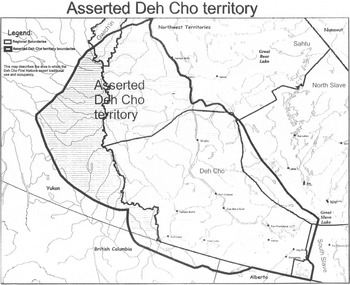
In November 2002 the Dogrib and Deh Cho Dene settled on a boundary agreement between their regions. The Dogrib first nation has roughly 3000 people who inhabit four communities in the North Slave region. In the negotiation for territorial land the Dogrib claimed exclusive rights or priority rights to hunt, trap and fish in this area (Dogrib Agreement 2002). Based on information from the political meetings and literature, it seems that the members of Deh Cho Dene society base their claims to the boundary between their own lands and those of the Dogrib on the criterion of constant use. The area is important to Deh Cho Dene because of its historical use by their forefathers. The contested area is about 300 km long and 100 km wide and is oblong in shape on the eastern side of the Horn Plateau. Some Deh Cho Dene believe that the entire upper watersheds of the Horn Plateau and the Willow River belong to them. Conversely, the Dogrib argue that the settlement area is one-fifth of the east side of the Horn Plateau. The Deh Cho communities most affected by the boundary issues, where the land was constantly used and claimed by both the Dogrib and the Deh Cho Dene are Pehdezeh Ku (Wrigley), Liidlii Kue (Fort Simpson), Zhanhti Kue (Fort Providence) and Tthek'edeli (Jean-Marie River). It was important for the Dogrib to map out the area before they signed the land settlement agreement-in-principle with the Canadian government. Four possible ways of solving the issues were suggested: 1) that the watershed and upper watershed of both the Willow and Horn River remain with the Deh Cho Dene; 2) that the overlap area be divided down the middle and equally awarded to both first nations; 3) that there should be a co-management zone, where both sides have equal control; and (4) that the Lefoine line (named after the late chief of Fort Providence) stays in place (Fig. 1).
Map of asserted Deh Cho territory.

The Deh Cho Dene offer consisted of a boundary line, which would include all of the Horn Plateau and Birch Lake area within the Deh Cho territory, and would allow the Dogrib to continue traditional harvesting up to the so-called ‘Monfwi line’. It was important for the Deh Cho Dene to clarify and protect the overlapping boundaries with the Dogrib because of the historical significance and potential protection against industrial development. The Deh Cho Dene elders asserted that the land belongs to them and that the original boundary has been established for many centuries. In 1921 when the treaty party arrived in the Deh Cho Dene territory Chief Paul Lefoine was the chief in Fort Providence. In the Deh Cho Dene region he is most remembered for marking out the established territorial boundaries in the region. The Lefoine line is said to have visibly marked the existing Deh Cho Dene traditional borders. The implicit nature of the Lefoine line narrative emphasises some Deh Cho Dene claims to land by marking the traditional boundaries as described below by Herb Norwegian. An example of how some Deh Cho Dene defined their boundaries is shown in the political narrative of the former assistant negotiator and Deh Cho Dene boundary co-ordinator, Herb Norwegian. He is the nephew of Elder Leo Norwegian and both individuals have vast experience in Deh Cho Dene politics. The narrative was given at the Kakisa annual assembly in 2000 as part of the Deh Cho Dene/Dogrib nation boundary meeting. The participants included the Deh Cho Dene leadership and visiting members of the Deh Cho Dene and general public and Canadian government officials.
After that is, we went to Fort Providence and we looked at some of the things that Chief Paul Lefoine did from Providence at that time, he was Chief. He was doing his thing, by going around in the bush, checking out these things. And he didn't like what he seen. So at that time, him too, to protect the Deh Cho land, he put four stakes in the ground, and you see what that person was carrying. It's something like that, he had four of them and actually, that's when we claimed our first land. [. . .] Up until then there, we're not going to let go of any of that land, that's the way we said it, so that's one of the options that we brought to them (H.Norwegian, personal communication, September 2001).
This narrative explains the emphasis on traditional boundaries, in addition to the sense of Deh Cho Dene heritage. Chief Lefoine's actions were taken in 1920, when the Canadian government and industrial developers were showing increased political and economic interest in the land. His decision to drive four stakes into the four chosen areas of the territory was aimed at leaving the land undivided. The stake that was driven in at the site of the Deh Cho Dene/Dogrib boundary (which was being negotiated) is at Willow River and Lac la Martre, a watershed area of the Horn Plateau. The boundary negotiation between the Deh Cho Dene and Dogrib was an important issue for both indigenous peoples before the signing of the Dogrib first nation comprehensive land claim agreed in August 2003 and any potential Deh Cho Dene land settlement agreements. It was particularly significant because the boundary negotiations excluded all government officials of the federal government or GNWT. In fact the federal Government transferred the negotiation and decision making over these boundaries to indigenous control. Subsequently, the sense of historical ownership contributed significantly to the territorial ownership claims of both sides. This was a unique demonstration of a statement of claim through historical use. It is evident that the political culture of the Deh Cho Dene derives from a variety of interrelated factors. Elder Norwegian's narrative on the customary respect for traditional boundaries illustrates how old attitudes merge with modern political thinking. In this instance, his narrative suggests that possession or ownership of land should be based on the collective property of one group. Even though indigenous members may move across recognised boundaries, territory or property in part rests on recognition, respect and non- interference. Today, some Deh Cho Dene political discourse reinforces this concept in contemporary Canadian politics (which is successful in conserving ethnic group identities). Although the concept of ‘ownership’ is problematic in Deh Cho Dene history and tradition, customary land use has an essential role in their political language. This is seen in the elder's discourse, which uses the land to focus on Deh Cho Dene values and principles, in addition to keeping the land undeveloped for traditional use.
Conclusion
The paper addresses the concepts of Deh Cho Dene boundaries and the notion that Deh Cho Dene values of property have shifted and continue to shift as the negotiation for land settlement has developed. It argues that there is not an all-encompassing single notion of property, but a more complex concept as a consequence of specific interests in Deh Cho Dene territorial lands. Proposals of non-renewable resource development and business ventures have determined the relationships and social interactions that have restructured Deh Cho Dene values. Deh Cho Dene negotiation of territorial land is concerned with the maintenance of subsistence lifestyles and other customary practices. The efforts to protect territorial lands have been visible Deh Cho Dene initiatives to invite non-governmental organisations to act against further industrial development. Additional constraints in the protection of land have become subject to the negotiation with other first nations for principled claims to territory. The Deh Cho Dene compromise to accommodate non-renewable resource development supports a policy of sustaining customary livelihoods. The progress in negotiation with federal government has witnessed Deh Cho Dene assertion of cultural identity in the political process. Cultural elements such as customary principles and concept of the land have provided clarity in an agenda for land management. The Deh Cho Dene involvement in economic development gives some guarantee of limited monitoring and control over their customary and environmental welfare. The change in politics, which has emphasised self-determination, has assisted Deh Cho Dene to evaluate and engage in implementing change. This has challenged their concept of property, which has evolved to be culturally and ecologically responsible in response to the industrial development in the region.