Adolescence is marked by the targeting of learning by young people (Illeris, Reference ILLERIS2004). Resistance to adult-controlled learning and prescribed competence within self-selected secondary school programmes (such as music) can manifest rejection behaviours of disengagement and discontinuation (Illeris, Reference ILLERIS2003). The congruency of learning environments with adolescents’ need for continued and varied mediation of competence is a central consideration in the uptake and sustained participation of a greater percentage of students in elective secondary school music courses. In student-selected course settings, the idea of competence is not only the acquisition of skills and knowledge (Illeris, Reference ILLERIS2003) or a pattern of effective adaptation to the environment (Masten et al., Reference MASTEN, COATSWORTH, NEEMAN, GEST, TELLEGEN and GARMEZY1995). Underlying the concept of ‘competence’ is an internal and emotional psychological process of acquisition coupled with direct and mediated interaction with the material and social environment (Illeris, Reference ILLERIS2004). How do secondary school music teachers conceive and design the learning climate to engage a diverse range of learners in comprehensive interaction for sustained motivation and engagement? What are students’ experiences of mediation, acquisition and appropriation within the secondary school music learning environment? These concepts are elaborated in the sections ‘broadening conceptions of competence’ and ‘informal learning practices’. This paper explores issues raised in recent music education literature concerning these concepts. As well, it details findings from the author's dissertation study (Carlisle, Reference CARLISLE2008) exploring teacher formative influence upon and student experience of learning process (described by Illeris, Reference ILLERIS2003, Reference ILLERIS2004) within three Canadian secondary school learning settings integrating informal learning practices. Finally, it provides the context of the study and approach to method, and presents findings, discussion and implications for music education.
The General Certificate of Secondary Education (GCSE) is an academic qualification. Music is elective at the GCSE level.
Development of theoretical context
This section will develop a theoretical context for singular and broadening conceptions of ‘competence’. As well, it will develop the conception of ‘locus of control’.
Singular conceptions of ‘competence’
Music education studies focused upon adolescents’ perceptions and beliefs of competence regarding selection of and achievement within secondary school music courses indicate binary perceptions of competence in terms of prerequisite skill attainment. Wright (Reference WRIGHT2002) found the majority of students in her study perceived the subject of music, an elective subject in the British GCSE taken by upper-year secondary students, to be designed for those who had already attained proficient instrumental performance skills. Likewise, in a study of secondary school pupils’ level of engagement and attitudes to music in and out of school, Lamont et al. (Reference LAMONT, HARGREAVES, MARSHALL and TARRANT2003) found adolescents viewed the GCSE curriculum requiring a specialised and unattainable performance skill set. McPherson and O'Neill's (Reference MCPHERSON and O'NEILL2010) comparative study of eight countries regarding students’ competence beliefs about their expectation to achieve in school music courses found an overall decline in students’ competence beliefs across school levels for seven of the countries. These studies indicate adolescents’ likelihood for selecting secondary school music courses decreases as a result of perceived inability to attain specific skills. When competency is viewed as a singular dimension such as the attainment of skills which adolescents perceive they cannot effectively adapt, they will not target secondary school music courses, as evidenced by low uptake rates in the UK (Bray, Reference BRAY2000; QCA, 2002) and estimated in the USA (Cutietta, Reference CUTIETTA2000; Edwards, Reference EDWARDS2006).
Broadening conceptions of competence
Conceptions of competence shape possibility for developing congruence for students’ learning needs in school music environments. The studies previously cited speak to adolescents’ perception of formally institutionalised competence to be attained for participation. Competence in terms of finite or specialised attainment becomes an isolated and alienated part of one's lived experience, suggesting competence needs to encompass further dimensions of lived experience for the purpose of psychological congruency (Han, Reference HAN2008). Illeris (Reference ILLERIS2004) proposes the process of learning unites ‘a cognitive, an emotional, and a social dimension into one whole’ (p. 227) and, in particular with adolescents, corresponds with a modern conception of competence that ‘comprises the totality of capacities that can be mobilised and developed’ (2003, p. 358). The mobilisation and development of capacities reflects White's (Reference WHITE1959) conception of competency motivation, defined as an intrinsic need which urges humans to be effective within their environment. Competence development in music in particular benefits from congruency with adolescents’ developing and personalised experience since music is of central importance to their lives and fulfils cognitive, social and emotional needs (North et al., Reference NORTH, HARGREAVES and O'NEILL2000).
Learning, and correspondingly the development of competence, ‘combines a direct or mediated interaction between the individual and its material and social environment’ (Illeris, Reference ILLERIS2004, p. 227). The individual simultaneously acts upon and is acted upon by the environment, which is an underlying premise of White's (Reference WHITE1959) conception of competence motivation. Adolescents experience necessary mental and capacity development, readjustment and tension due to maintained direct interaction with primary adults and mediating secondary influences that initiate adult processes of selection and rejection, psychological acquisition and self-direction (Illeris, Reference ILLERIS2003). These processes lead to adolescents mediating and influencing the learning material and social environment while interacting with adults trusted by students.
Illeris’ process of learning contains elements of formal and informal learning practices since his concept refers to both (1) student interaction with teachers shaping the environment and (2) multi-mediation of students’ interaction with music and the social environment. The continuous readjustment and tension that occur within Illeris’ conception speaks to Folkestad's (Reference FOLKESTAD2006) assertion that there is dialectic interaction between formal and informal learning.
Informal learning practices
The integration of informal learning practices in formal school settings is a newer and developing field within music education (Allsup, Reference ALLSUP2008). While definitions of informal practices encompass varied and contradictory stances (please refer to Garrick, Reference GARRICK1998), the following framing points speak to Illeris’ identification of mediating processes within learning.
First, informal learning practices can be boundary-less (Garrick, Reference GARRICK1998) meaning informal practices do not occur solely outside of formal contexts. Targeted informal learning practices such as Green's (Reference GREEN2008) study can occur within a formal school setting. However, Mans (Reference MANS2009) argues that the school context is bounded and the integration of informal approaches does not render the formal school context informal. Second, informal learning practices involve the selection of learning material. Green (Reference GREEN2008) argues that informal practices involve students selecting musical material for interaction. However, through mediated processes the musical material may take on different versions (Väkevä, Reference VÄKEVÄ2010) or emerge as a new entity. Third, informal practices can involve peer and/or self-directed learning (Green, Reference GREEN2008). While peer- and self-mediating processes can have strong influence, Rodriguez (Reference RODRIGUEZ2009) reminds music educators that there needs to be a plan of instruction negotiated by teacher and students. Finally, informal learning practices can be intentional (Marsick & Watkins, Reference MARSICK and WATKINS1990) although ongoing mediating influences prompt incidental learning.
An encompassing element of informal learning practices is appropriation (Andresen et al., Reference ANDRESEN, BOUD, COHEN and Foley1995; Finney & Philpott, Reference FINNEY and PHILPOTT2010). Appropriation involves: (1) further elaboration of materials and influences for learners’ own use and (2) the personal valuation of this process. Illeris (Reference ILLERIS2004) argues that the mediation process between the learner, material and environment is closely integrated with inner mental acquisition and elaboration processes (p. 359). In processes of mediation, students continually target, acquire, consider and potentially reject material and influences stimulating the environment.
Locus of control
Locus of control underpins the above framing points and tensions in music education literature concerning the integration of informal approaches and practices in formal school music settings. Traditional understanding of formal learning is that the locus of control over curricular content and conduct is institutionally mediated (Mocker & Spear, Reference MOCKER and SPEAR1982). Recent music education studies focusing on informal approaches indicate control lies in the hands of the student. The studies account for a lack of formative (or shaping) teacher influence and teachers’ potential to create learning environments whereby adolescents can mediate their developing musical interaction, communication, decision-making and artistry. Green's approach has been described by Lines (Reference LINES2009) as a ‘hands-off music education practice’ (p. 2) whereby students have control over what and how they learn when they aurally transcribe a recording. In the second stage of Green's study (Reference GREEN2008), students then compose their own song. It is within a structured songwriting format and does not allow for the burgeoning possibility for mediated artistry, described by Väkevä (Reference VÄKEVÄ2010). The ‘hands-off’ teacher approach is disconcerting for pre-service teachers (Rodriguez, Reference RODRIGUEZ2009) while Finney and Philpott (Reference FINNEY and PHILPOTT2010) describe issues concerning locus of control in this field as ‘productive dissonance’ (p. 18) in need of further exploration. Georgii-Hemming and Westvall (Reference GEORGII-HEMMING and WESTVALL2010) and Lindgren and Ericsson (Reference LINDGREN and ERICSSON2010) identify an overemphasis in Swedish music education in schools on social and emotional development at the expense of students targeting their learning. They describe extended and static focus over past decades on adolescents replicating current popular music. Georgii-Hemming and Westvall (Reference GEORGII-HEMMING and WESTVALL2010) describe music teachers not being a formative influence for initiating creativity. Lindgren and Ericsson (Reference LINDGREN and ERICSSON2010) describe music teachers’ lack of goal structure for developing students’ musical interaction, communication and decision-making skills needed for successful creative group work.
Possibilities exist for richer roles for music teachers in the process of integrating informal approaches and practices in formal school music settings. Teachers can and need to exert formative and shaping influence, without overtly controlling students’ learning, by the ways in which they design learning environments and tactfully interact within them.
I argue a nested locus of control needs to occur whereby the teacher ultimately is responsible for the design of the environment and students’ success within it and students exert control through multiple opportunities for mediation, acquisition and appropriation of learning.
Refining the research focus
This section will detail the research problem and questions. As well, it will detail the development of the construct of ‘social–emotional learning climate’.
Research problem
The integration of informal learning practices in formal music education settings has occurred in some countries to the point where it is self-evident (Lindgren & Ericsson, Reference LINDGREN and ERICSSON2010) and in other countries is in its infancy (Allsup, Reference ALLSUP2008). The role of the school music teacher and subsequent design of the learning climate for comprehensive interaction is not keeping pace with students’ expanded possibility for processes of mediation, acquisition and appropriation. Adolescents’ inability to target their learning and their varied expression of rejection of secondary school music environments are common in the literature (Bray, Reference BRAY2000; Lamont et al., Reference LAMONT, HARGREAVES, MARSHALL and TARRANT2003; Kratus, Reference KRATUS2007; Georgii-Hemming & Westvall, Reference GEORGII-HEMMING and WESTVALL2010; Williams, Reference WILLIAMS2011).
Construct identification
This paper derives from my dissertation study on the construct of ‘social–emotional climate’ of public secondary school music performance settings. Social–emotional climate has been defined as ‘the emotional tone, which is a concomitant of interpersonal interaction. It is a general emotional factor which appears to be present in interactions occurring between individuals in face-to-face groups’ (Withall, Reference WITHALL1949, p. 49). Social–emotional climate was hypothesised to be an indicator of student engagement in elective music courses in public secondary school settings. The dissertation articulates the research problem in terms of secondary school music environments not addressing a diversity of cognitive, social and emotional learning needs in music. It presented the construct of social–emotional climate in terms of ‘macro’ social–societal and ‘micro’ interpersonal–emotional interactions that are: (1) mediated and influenced by teachers and (2) perceived and additionally mediated by students.
This paper makes explicit the integration of these domains and presents the study in accordance with Illeris’ (Reference ILLERIS2003) conception of learning that includes integrated cognitive, emotional and social–societal dimensions. The construct social–emotional learning climate addresses and integrates these dimensions.
Research questions
I have argued that the teacher is a primary formative and shaping influence upon the design of the learning environment's competence motivation structures and the interactions that occur within them. In addition, the readjustment and tensions adolescents experience as a result of mediating both primary and secondary influences in school settings is an additional focus worthy of exploration.
The dissertation (Carlisle, Reference CARLISLE2008) asked: What are the formative and experiential dimensions of the social–emotional climate in three secondary school music programmes integrating informal learning practices? The theoretical framework I have developed in this paper integrates recent music education literature. The study is situated within what can be thought of as a movement and stasis dialectic concerning the integration of informal learning practices in formal school settings: Recent music education literature indicates both movement and anticipated development (Allsup, Reference ALLSUP2008; Allsup & Olson, Reference ALLSUP, OLSON, Karlsen and Väkevä2012) and also static informal pedagogic practice in music classroom settings (Georgii-Hemming & Westvall, Reference GEORGII-HEMMING and WESTVALL2010; Lindgren & Ericsson, Reference LINDGREN and ERICSSON2010). As a result, the research problem and questions take on sharper focus. This paper asks: How do the secondary school music teachers conceive and design the social–emotional learning climate to engage a diverse range of learners in comprehensive interaction for sustained motivation and engagement?
What are the students’ experiences of mediation, acquisition and appropriation within the secondary school music learning environment?
Context of the study
The majority of the data collection took place at three public secondary schools from two school boards districts in urban centres in south-eastern Canada. The music programmes were selected for the following characteristics: the music teachers had taught at their school for at least 5 years; each programme had at least 150 students; and teachers taught large ensemble classes at their school in addition to small group work or individualised classes employing informal learning practices. I did not personally know the teachers at the outset of the study. Interview data revealed: (1) each teacher had been trained in classical music and had extensive informal training and performance experience in either popular, jazz or world music and (2) each teacher had been hired in 1999 to bring a new focus to the school music programme. School A is a large technical and collegiate school serving students with a wide range of learning needs. The principal at School A remarked how the music programme ‘almost died’. Teacher A refers to the music teacher at School A. Teacher A was hired to develop a programme to meet the needs of the student population. School B is a large technical multi-building school campus serving students with a wide range of learning needs. Teacher B refers to the music teacher at School B. Teacher B was hired to develop a music programme that would help to build community in the school. School C transitioned from a normal delivery system to an entirely self-paced secondary school. Teacher C refers to the music teacher at School C. Teacher C was hired to develop a music programme focused on a self-paced approach.
In addition to large ensemble performance classes, the music teachers employ informal learning practices in separate classes for upper year students (grades 11–12; ages 16–18) in the following ways: School A focuses on small group interaction whereby students engage in creative composition tasks. As well, students perform and arrange self-selected music primarily in world music and popular music genres. School B has a recording studio focus through which students compose, record and produce their own music. School C's self-paced approach allows students to openly mediate the provincial curriculum to expand their inquiries of interest.
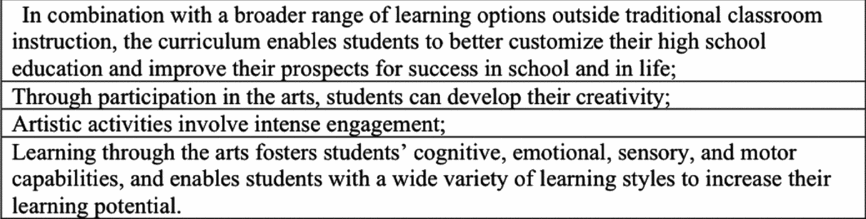
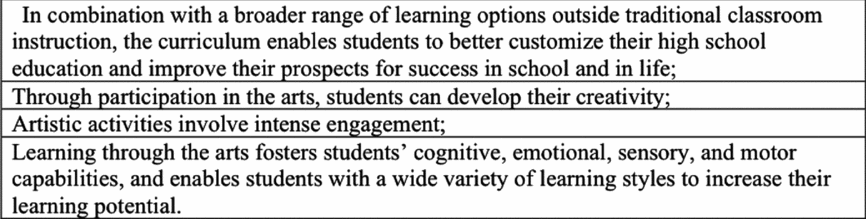
Canadian public education lies within provincial jurisdiction and the curriculum is overseen by the province (Queens Printer, 1956). The provincial curriculum for grades 11–12 for the province where this study took place is shown in Fig. 1 (Queens Printer, 2010, p. 4).
Curriculum framework points.
The combination of the: (1) diversity of course offerings addressing the provincial curriculum within these secondary school music programmes, (2) music teachers’ formal and informal education and performance experience and (3) diversity of student learning needs qualified these environments as worthy of study. The following section will describe the study's methodology.
Method
The study uses an overall qualitative approach to inquiry, while employing multiple research methodologies. The study is characteristic of qualitative studies because it takes a holistic view of emergent social phenomena in a natural, non-experimental setting, uses multiple methods that are interactive and humanistic, and is fundamentally interpretive (Cresswell, Reference CRESWELL2003). The three schools were selected for in-depth study where the researcher engaged in participant-observation. The schools were studied intensively for 6 weeks each. Methods of data collection included: observation, field notes, phenomenological description, semi-structured dyadic interviews with music teachers and school principals, semi-structured student focus group interviews and informal student focus group interviews through the recording of student small group work interaction. Interviews took place in the first and last week of the study of each school.
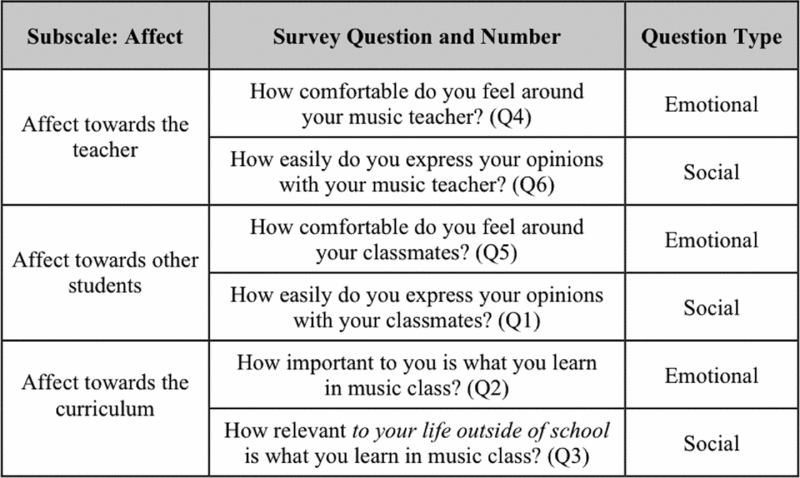
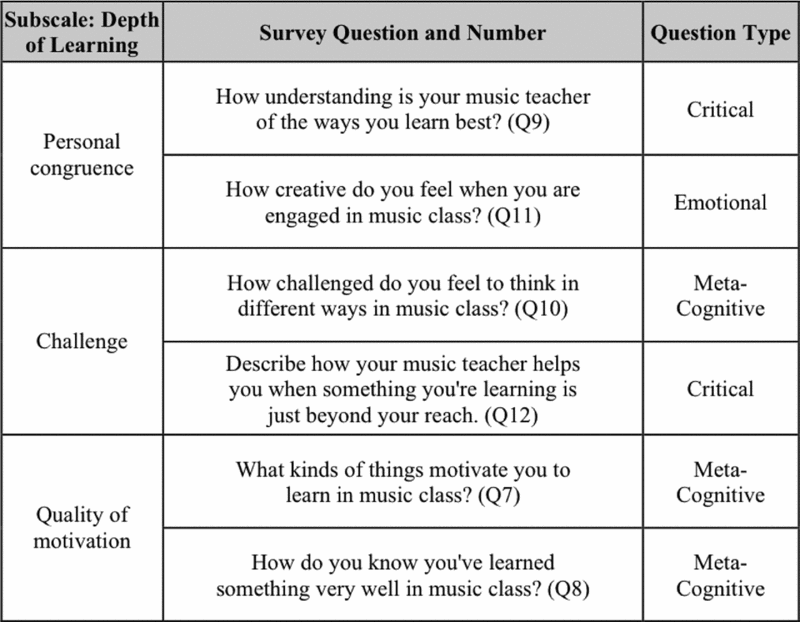
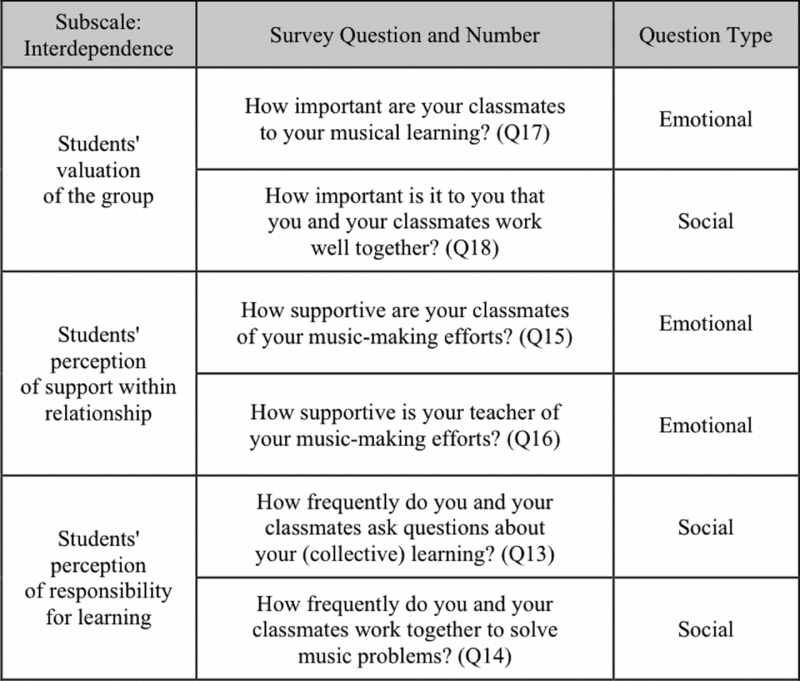
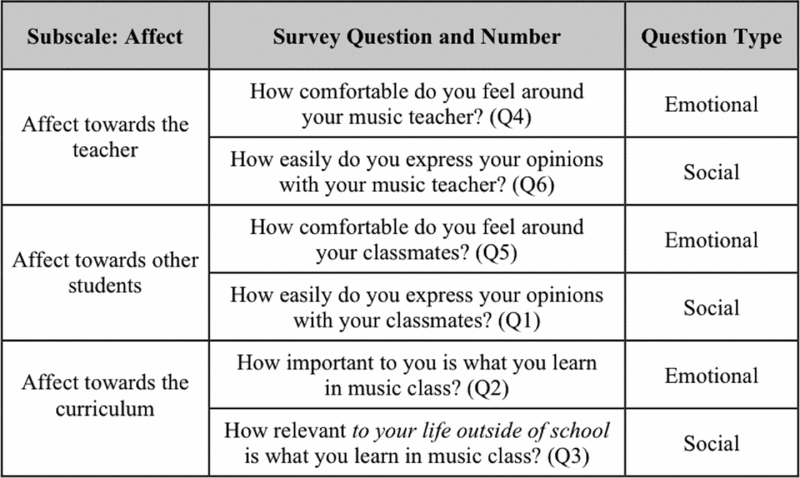
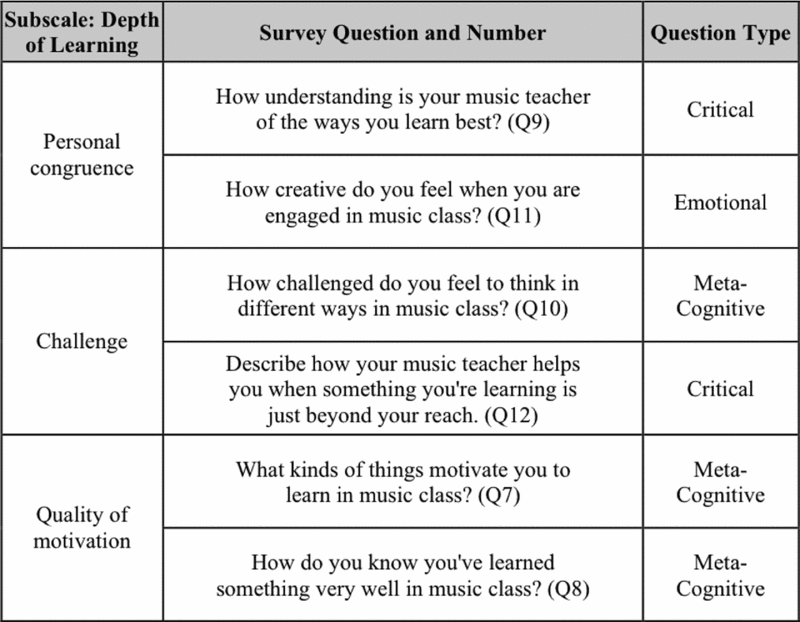
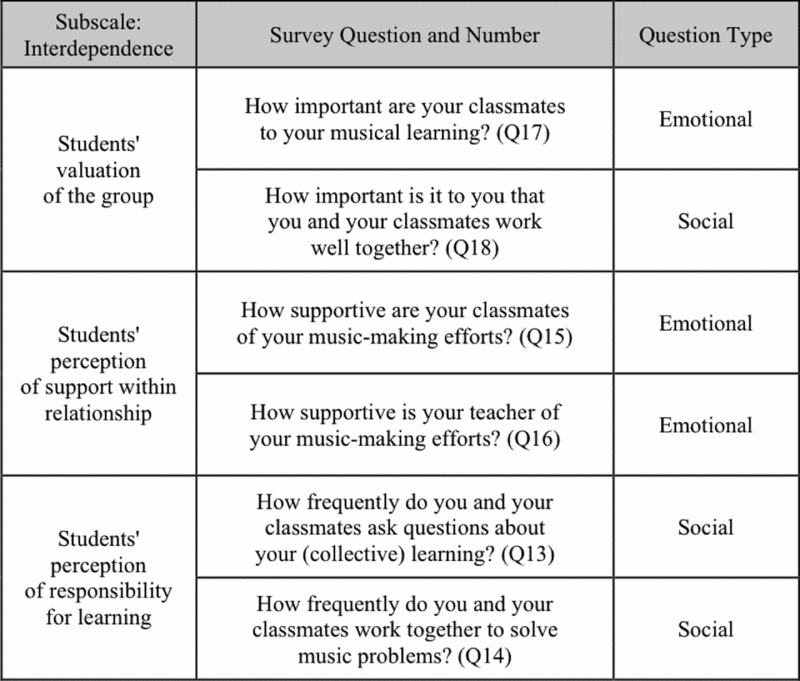
In addition, I developed a survey entitled Study of Social-Emotional Climate of Secondary School Music Classes. The survey was designed to elicit student perspective regarding their experience of their school music classes. Eliciting student perspectives to understand classroom social environments is supported by Anderson and Walberg (Reference ANDERSON, WALBERG and Walberg1974) and Moos (Reference MOOS1979). The survey examined the social environment through dimensions, as practiced by Moos (Reference MOOS1979). I adapted the scales Moos (Reference MOOS1979) used for his Classroom Environment Scale and developed the following scales for my survey: affect, depth of learning and interdependence. Three subscales were developed for each scale. Survey questions were classified by the categories of social, emotional, critical and metacognitive. The social and emotional categories reflect the construct of study, namely, social–emotional climate. Eliciting student response would generate critical reflection about the environment and metacognitive reflection about their own learning. I developed a seven-point semantic differential scale with descriptors at the ends for 15 of the 18 questions. Three questions were for qualitative response only.
The survey was pilot tested with a senior secondary school music class in an urban centre in south-eastern Canada. The school was selected because the music programme enrolled over 150 students and served students from diverse cultural backgrounds. The pilot test feedback indicated students wanted to respond qualitatively to each question. Therefore, the survey was modified so that each survey question allowed for qualitative response.
Out of a possible 311 students from eight schools, 281 completed the survey. The sample included the three schools detailed in this article, two arts magnet schools, and three additional schools. The arts magnet and three additional schools were selected because they had music programmes in excess of 150 students and focused upon large ensemble performance.
Figures 2–4 detail the survey scales, subscales, survey questions asked within the subscales, question type and question number within the survey.
Affect.
Depth of learning.
Interdependence.
This paper delimits the reporting of qualitative data findings to the three schools selected for in-depth study. In accordance with the questions posed in this paper, I focus upon teacher and student interview data. Emergent themes from the dissertation's theoretical basis informed the design of the interview questions. The themes the researcher employed were: description of climate, ‘macro’ social–societal elements, community, empowerment/agency and non-traditional (informal) school learning practices. (See Appendix for the teacher and student interview questions.)
Focus group students were chosen based upon regular class attendance, time management skills and their general comfort with my role as participant-observer. Two male and two female students were chosen from each of the three schools. All institutional ethics review board policies and procedures for the university and four public school boards were followed.
Data analyses
The dissertation research question and approach to data collection inferred a grounded theory approach to the qualitative data analysis. Analysis involved: reading, rereading, constant comparison, and open coding of all the qualitative data. Data were coded by hand and organised in computer word processing files. I found the data separated itself whereby: (1) teacher interview data gave insight into formative and shaping influences on the environment; and (2) student interview and survey data gave insight into their experiences of learning processes. The open coding conceptualised and broke down the data into incidents, which yielded core categories (Glaser, Reference GLASER1992). The core categories that emerged represent theoretical saturation of the data.
The dissertation proposed a visualisation of the data, whereby layers of formative and shaping influences are a supporting structure encompassing student experience of learning processes. The innermost formative layer yielded the core categories of Motivational Climate and Teachers Knowing Students. A secondary analysis was conducted on these core categories. Motivational Climate yielded the properties: teachers’ conception and teachers’ design of competence motivation structures. Teachers Knowing Students yielded the properties: teachers’ initiation and teachers’ understanding of student interactions within motivational structures. The dominant core category of student experience was Connection to Learning. Secondary analysis of this category yielded the properties of students’ experience of: mediation, acquisition and appropriation.
The findings section will present qualitative data findings from the three schools selected for in-depth study and data from the secondary analyses. The discussion of the data findings will extend key concepts and issues raised in the theoretical development of this paper.
Findings
Adolescents’ experience of maintained direct interaction with primary adults, and secondary influences that initiate processes of mediation, acquisition and appropriation, are found to be key to the process of learning. First, this section will present each music teacher's conception and design of the competence motivation structures for their music class and students’ resulting experience of motivation and engagement. Then, students’ experiences of mediation, acquisition and appropriation within secondary school music learning environments will be described.
To recap, School A focuses on small group interaction whereby students engage in creative composition tasks, as well as performing and arranging self-selected music primarily in world music and popular music genres. School B has a recording studio focus through which students compose, record and produce their own music. School C's self-paced approach allows students to openly mediate the provincial curriculum to expand their inquiries of interest.
Conception of competence motivation structures: personal locus of control?
Data that informed music teachers’ conception of competence motivation structures provided insight into students’ experience of personal locus of control.
Teacher A conceived the learning environment as ‘symbiotic’ whereby ‘everything is benefitting and exchanging from each other’. S/he focused on small group structures so each student would be given more responsibility for their learning. In this environment, Teacher A is learning alongside students and students are teaching and evaluating each other. S/he stated, ‘I really do try to go where they want to go. I feel it is their programme in a sense . . . but it's not a democracy’. I observed there was not an opportunity for students to develop personal locus of control. While Teacher A offered a wide variety of learning opportunities in both small and large group structures, none were sustained and supported long enough for mediation, acquisition and appropriation of learning to occur.
Teacher C described the self-paced programme at School C in terms of a competence motivation structure that provided opportunity for students to gain control over and learn about themselves. S/he viewed the structure in terms of a private music lesson focus at a post-secondary level where self-directed learning of repertoire and theory might occur on a one-to-one basis with the teacher. Teacher C also described how students experienced difficulty within this approach:
They end up getting into these feast and famine times. If they have been following along on track and are working on them [the learning units], then my role is more of an educator and we take a little more time with things and are able to discuss in greater detail their work . . . If their time management skills come off track . . . as they have kind of painted themselves into a corner . . . their work becomes more centred around completion and just trying to finish the course . . . My role at the end of the semester moves from . . . almost at times it seems of educator to just evaluator.
Student focus group and survey data from School B indicated some students were uncomfortable with the one-to-one focus and found the teacher to be intimidating concerning evaluation.
Similar to Teacher C, personal locus of control is concomitant with Teacher B's conception of the competence motivation structure of the class. However, Teacher C views performance as the dominant curricular activity, whereas Teacher B conceived of the class as one that ‘puts creativity first’. Teacher B asserts:
The teacher's [primary] responsibility is to create the environment where learning can occur . . . and then get out of the way. By making the creation of the environment the number one priority and then assuming, rightly I think, that young people, everybody, young and old, wants to be the best that they can be at what they like and want to be happy and successful in life. When the programme is created and the students . . . self-select themselves to concentrate in that [programme] . . . we can trust them to develop and grow as best as they can . . . That's where the ‘getting out of the way’ aspect I think is kind of important . . . presenting a broad set of expectations and, at the end of the day, allowing the students to excel.
Concerning evaluation, Teacher B identified that instruction in this environment needs to take ‘a holistic approach to outcomes’ and the importance of building this approach into the curriculum design and student evaluation to satisfy the provincial government's music curriculum expectations. Teacher B described how rigid approaches to student evaluation ‘creates conflicts’, ‘interferes with the student–teacher relationship’, and ‘stifles the creative process’.
Survey data from School B describe how Teacher B's approach contributes to students’ perception of their own competence and provide insight into their developing personal locus of control: ‘S/he gives you ways to [learning something beyond your reach] so that you would feel empowered. S/he makes you feel like you can do anything, nothing's beyond your reach. In fact, s/he tells us all the time.’ ‘S/he has a good way. S/he gives you the chance to get it then s/he comes in. S/he gives you the space to do what you know.’
The three music teachers’ conceptions of competence motivation structures are unique. While all three teachers provided ample curricular choice to students, Teacher B conceives the competence motivation structure in terms of empowerment of students through a curriculum focused on creativity, whereas Teachers A and C conceive the competence motivation structure solely in terms of the curriculum they have developed. The curriculum keeps moving along for Teachers A and C: students in Teachers A's class assumed more responsibility through many small group work tasks, but not through sustained projects. School C students ‘paint themselves into a corner’ if they cannot keep up with the curriculum. Teacher B described how s/he needed to continually develop individualised evaluation approaches for students, in order to meet the diversity of students’ learning needs and projects they were producing.
Design of competence motivation structures: targeting of learning?
Data that informed the music teachers’ design of competence motivation structures provided insight into students’ experience of targeting of learning.
Teacher A designed the music class so that students had multiple opportunities to learn about music from different cultures and genres. S/he described the music class as ‘eclectic and busy’. I observed over the 6-week period short and focused creative activities throughout each lesson. Students usually had choice within the activities. Students did not articulate experience of mediation, acquisition or appropriation in the focus group or survey data, which may be attributed to a lack of direct and sustained focus on creative music-making. Focus group students described the environment as ‘a bit too relaxed’ and ‘focused if necessary’.
Teacher C described how students in the self-paced programme have the choice to direct learning units, especially if they are preparing for post-secondary music performance auditions, and design creative projects if they wish. Teacher C did not model creative projects or encourage group work beyond pairing students for performance of duet repertoire. Focus group students perceived that there was little to no composing in the curriculum, but indicated ‘you can choose to do it if you want’, meaning students could choose to integrate composition in the design of their learning unit. Over the 6 weeks, I observed two students preparing for post-secondary music performance studies auditions. As well, I observed the one larger student group of four students experience friction with Teacher C regarding evaluation as they developed their composition. The remainder of the students followed the learning units developed by the teacher. A focus group student described her classmates: ‘Some people are very driven, like wanna get this course done. Really wanna finish it. But some people are just like, ‘Oh yeah, I suppose I should do some work’ and just sort of sit around and for most of the class.’
Teacher B described how student choice over the learning environment and peer modelling comprised the design of competence motivation structures. Teacher B explained how the class enables students to ‘as much as possible choose their own educational path and process’ while encouraging the development of musical, technological and collaborative skills. In the large computer laboratory, students complete teacher-designed assignments focused on developing the skills of learning Cubase, such as arranging a cover for a student-selected song and creating increasingly longer compositions. When students complete these assignments, they can move on to the mixing suites, which allow for small group collaborations or individual composition work. When students garner experience in the mixing suites, they are permitted to work in the recording studios, where they will develop further understanding of hardware and software technology for recording live and virtual instruments and their compositions. Teacher B describes the environment as accommodating ‘all the different styles of learning including whether students prefer to work alone, in a structured environment, or to work alone in an unstructured environment, or like to work in a group. So, it's all there and the students select on their own.’
Each semester, a compact disk compilation of student compositions is created. During the first class, students listened to the compositions judged by last semester's students to be the most successful. Teacher B described how students were ‘raring to go and are motivated because they've seen what's come before. The music we've created before has been very high calibre.’
When students select their preferred learning environment and have strong peer modelling, I observed goal setting became a priority. A focus group student's comment confirms this observation: ‘What I'm saying is that we [students] have a goal within the class. And in order to achieve it, we have to learn things. So we are learning. The class [competence motivation structure] is making us learn things, too, so we can achieve something in the class. So in that way, the class is teaching us.’
I observed the majority of Teacher B's interactions with students were for the purpose of developing motivation and competence. Direct teacher interaction occurred at the beginning of each class. With the whole class, Teacher B focused on building community and providing opportunity for students to share in-progress compositions in a supportive environment. S/he described the remainder of instructional time as ‘informal time’ for the purpose of helping students to develop ‘quality, mature musical moments’ in their compositions. The students and teacher often continued collaborating on projects after school until late afternoon. Indirect teacher interaction also occurred. I observed Teacher B encouraged individual time management for goal realisation through indirect means. For example, a question posted by Teacher B in the mixing suites and recording studios read, ‘What are you doing today to meet your goals for tomorrow?’ Teacher B described the importance of developing ‘an atmosphere that is stable and conducive to focusing on doing something meaningful’.
Focus group students described the resulting impact on their class work (all students’ names have been changed):
Amir: It's all within ourself. It's not like a mad thing [it's not conflict with the teacher over student evaluation or within a rushed environment] It's more like [Teacher B saying:] ‘Whatever you've done, I want to see that by this date.’ And it's kind of like an internal thing. ‘Well, I've done five pieces so far. That's what I can hand in.’ Or, ‘I've done one piece so far and I'm satisfied with it.’ That's what I'd like, you know. As much as it is pressure, it isn't at the same time . . .
Jasmine: Right and of course it's all what we love to do, what we're doing here, right?
The three music teachers’ designs of competence motivation structures also are unique. Teacher A wants students to experience the diversity of music. Students might target their learning within short-term activities. However, they do not exert control over their learning through longer projects. Students at Schools B and C engaged in longer-term projects over which they could choose to exert control. External motivation factors influenced students’ learning at Schools B and C. Students at School C needed to finish their units by the end of the semester. A couple of students were motivated by university and college music entrance audition dates. Students at School B were motivated to develop their skills and competencies so that they could progress to the recording studio with their group and individual compositions. As well, Teacher B developed a learning culture where sharing in-progress compositions with the whole class was a positive experience to further their work. Therefore, students processed external motivation factors such as teacher due dates and peer approval as internally motivating. Teacher B's design of the competence motivation structure enabled students to experience Illeris’ (Reference ILLERIS2003) conception of learning, whereby necessary mental and capacity development, readjustment and tension occurs due to maintained direct interaction with primary adults (the teacher) and mediating secondary influences, which included peers.
Mediating influence
Only students from School B articulated experiencing processes of mediation, acquisition and appropriation. It could be because Teacher B designed the learning environment to include direct interaction with the teacher and ample time for students to interact with mediating secondary influences.
I observed Teacher B encouraging students to investigate a wide variety of music genres, develop ‘their own personal music from within’, and to collaborate with students who have musical preferences different from their own. Student survey data confirm this: ‘My teacher shows me that there are a lot of different types of music and that forces me to expand and open my mind’ and ‘I learned all kinds of music that I didn't touch or study before. Then I learned a lot.’ The following focus group dialogue demonstrates how the diversity of students’ cultural experience and preferences are a mediating influence upon students’ compositions:
Jasmine: I feel creative in a different sort of perspective, because in this class we have different . . . I mean we have some people in the class like him [indicating Liam]. He's in a rock band, he plays rock music and whatnot. And then we have some rappers. Like I know Danielle writes.
Danielle: Yeah
J: rap lyrics, kind of.
D: Un-huh.
J: I've read some of her stuff. Like there's this one guy, this semester, like he's a singer, but the way he sings is kind of like opera-like and he sings like, he writes his music like in a different language.
Researcher: Ohhh.
D: Oh Emilio? He's Cuban, yeah.
J: Yeah.
D: He did one of my pieces . . . the piano piece.
J: You have the opportunity to be versatile. You can work with all different kinds of people. And that gives you more creative thoughts, because it's just like, ‘This guy plays the guitar. Maybe I should get him to kind of, you know, do a freestyle on my song.’ Or, like you know, it's not one set of people that like listen to the same music, write the same kind of music, do the same kind of thing. Like everybody's so different. So like you have . . .
D: This class is very . . . Well in my opinion, this class is very, like, mixed.
J: Un-huh.
D: Cultural as well.
Amir: Diverse.
The students valued creating original music. Peers interacted with each other as a intermediary influence between popular music and the student's work, as Amir and Jasmine explained:
Amir: If I think something of mine sounds good, someone else will listen to it and be like, ‘Well actually it sounds more like an actual song that's out there.’ I didn't catch it, because I was in my own world, right? . . . I think it helps a lot.
Jasmine: So it kind of starts here, you know, like with your peers.
We see from these exchanges two main points: first, the teacher is a primary influence upon students in terms of developing their openness to explore a wide variety of musical sounds and genres. Second, student peers are a primary mediating force upon the creative material and the social environment within which it is being created.
Students’ experience of acquisition
The design of the class encouraged the mobilisation and development of a broad set of competencies resulting in the process of acquisition. Teacher B argued this process is the impetus for student collaboration and realisation of musical goals. Focus student Amir described how ‘It's a good thing that we lack some skills’ because it encouraged students to collaborate. Danielle stated, ‘You learn something new every day in this class . . . you honestly do.’ Data emerged indicating students valued the skills they acquired in music class and ‘took’ those skills with them to their lives outside of school. Responding to the survey question on the level of relevance of what students learn in music class to their lives outside of school, survey data included: ‘Very relevant. I take what I learn from music [class] everywhere with me’ and ‘Pretty much everything I learn in music class I use as a warm-up or exercise to practice or write my own music.’ When asked what motivated the student in music class, survey data included: ‘Learning more to put towards my music outside of class.’ Speaking of the mates in her band outside of school, focus group student Jasmine described, ‘Everything I learn in here, and everything I do here, I try to teach them ‘cause they're not here to learn it with me.’ I observed one student group who had formed a successful music production company together outside of school. Students were motivated by the process of acquisition, taking acquired skills with them to develop further outside of school, and demonstrating acquired skills to music peers both within and outside of music class.
Students’ experience of appropriation
To recap, appropriation involves: (1) further elaboration of materials and influences for learners’ own use and (2) the personal valuation of this process. The student data revealed two approaches for engaging with appropriation. The first approach involves selection and reproduction of a familiar musical motif followed by changing it for the purpose of making it the student's own. A survey respondent gives an example: ‘What motivates me most is being able to make something, say a normal beat, and then completely change it into what I want it to sound like. The music, being able, motivates me.’
The second approach is the student further elaborating their own work until they come to value the creation. Danielle explains: ‘Say I make something and it's done. Then I think, ‘Oh, okay, I can do that in another version. And I could do that in another version. So it's more like expand that until I can't expand it any more . . . Just to get the best out of it, I would say.’ Amir concurs: ‘No matter how finished you think you are there's always something that you can do to make it better . . . I'm not just making stuff [makes a throwing away sound] and throw it away.’ I observed a student recording multiple takes of his improvised guitar solo on his peer's composition. He described both the process of elaborating on his original solo improvisation and the personal pressure he placed on himself ‘especially to get it right.’
Discussion
This paper has reported on social–emotional learning climate findings from three schools selected for in-depth study. The music teachers at these schools taught large ensemble classes at their school in addition to small group work or individualised classes employing informal learning practices. The findings focused on the competence motivation structures conceived and developed by the teachers, nested locus of control and targeting of learning, and students’ experience of mediation, acquisition and appropriation processes. Each teacher had a well-developed conception and design of the competence motivation structure of their music class. This is a finding that has not previously been documented in the literature on informal music learning in school settings.
Each teacher's conception and design of the competence motivation structure integrated practices associated with informal learning in music. First, student selection of musical material for the purpose of interaction with the material (Green, Reference GREEN2008) occurred at each school. However, Teacher A did not allow time for students to engage in extended creative work and processes of mediation and appropriation did not occur. Students at School C focused on reproduction of music and not additional processes. Data from School B indicated adolescents worked in peer groups to create original music or used existing musical material for the purpose of appropriation. This data finding is unique to the field.
Second, peer and/or self-directed learning is an informal learning practice in music (Green, Reference GREEN2008). Students from School A engaged in this practice, but on a limited basis. School C was a self-paced school. The music teacher and student negotiated a plan of instruction for the semester. However, evaluation issues clouded the experience. It could be that adolescents can handle planning only one project at a time and not a semester's worth of learning at once. Teacher B designed for a nested locus of control: S/he was responsible for the design of the environment and students’ success within it, while students exerted control through multiple opportunities for mediation, acquisition and appropriation of learning.
The need for the music teacher to be a formative influence for initiating creativity (Georgii-Hemming & Westvall, Reference GEORGII-HEMMING and WESTVALL2010) was a factor in the findings. While Teacher A initiated creative activities, none were sustained over a period of time. Teacher C did not model creative activities, although s/he had much experience with improvisation and composition. Through direct and indirect means, Teacher B was a formative influence for sustaining creativity. These findings suggest the music teacher needs to be a formative influence throughout the creative process.
Literature asserts there has been overemphasis on social and emotional development within informal school music learning environments (Georgii-Heming & Westvall, Reference GEORGII-HEMMING and WESTVALL2010). The conception of learning as a process that unites cognitive, emotional and social elements into a single dimension (Illeris, Reference ILLERIS2004) whereby adolescents experience necessary readjustment and tension from interactions with primary adults and mediating processes might be preferred. Teacher B was successful in realising this conception through a comprehensive competence motivation design and an individualised approach to student evaluation.
Implications for music education
The targeting of music learning by adolescents is a complex process. The findings of this study indicate adolescents in secondary school music classes are capable of mobilising diverse competencies and engage in complex mediating processes when the music teacher is a sustained formative influence and develops with students a nested locus of control. This study is situated within the developing ‘second wave’ literature (Allsup, Reference ALLSUP2008; Allsup & Olson, Reference ALLSUP, OLSON, Karlsen and Väkevä2012) whereby informal music learning practices are integrated within formal school music settings. The study indicates the creation of original music was a successful means for students to target learning and engage in processes of mediation, acquisition and appropriation. Perhaps what is most intriguing to consider and develop is the student viewpoint from the survey data that school music is an effective ‘warm-up’ for sustained musical engagement outside of and beyond school.
Appendix: Interview Questions
Questions for Music Teachers: Week One
1. How would you describe your music programme?
2. Your music programme allows students more choice over how, what, and when they learn. How then, do you perceive your role in relation to your students?
3. How has your teaching changed since coming to teach at this school?
a. How has this impacted on how your students learn?
4. From what you see, how does the curriculum approach (music technology, self-paced, small ensemble) influence how students interact with each other?
5. How would you describe your students’ relationship to the curriculum? How does the curriculum change as you engage in music class? How comfortable are you with this?
6. How important is it to you that students help each other to learn?
a. What do you think they get out of this kind of experience?
7. How do your professional peers (other public school music teachers) perceive the progressive aspects of your music programme? Do you have opportunities to share experiences?
8. How do your fellow music teachers in the community influence your teaching?
9. How do your fellow teachers in this school influence your teaching?
10. What kind of role does the administration play in this music programme?
How important is it for you to have the administration's ongoing support?
Questions for Music Teachers: Week Six
1. Have you observed any changes to the music programme over the term?
2. How has your role in relation to your students changed over the term?
3. What different approaches have you tried in the classroom this term?
a. How have they impacted on students’ learning?
4. How well do you feel you know your students?
5. Do you think your students feel they have ownership over what they learn?
6. How responsible do you feel your students are for their own learning?
a. How responsible do you feel your students are for each other's learning?
7. To what degree are your students dependent on each other for their learning?
a. To what degree are they dependent on you for their learning?
8. Our conversation has included interdependence within a progressive music education environment. Are these ideas reflected in other departments in the school? Are they reflected in the administration? Does interdependence need to occur within an entire school environment in order for it to be truly effective within a single classroom/subject?
Questions for Student Focus Group: Week One
1. Describe the atmosphere of your music class. How is it changing over the term?
2. How well do you know your classmates?
3. Do you think you learn better by yourselves or with other people?
4. Do you think it's important to express your opinions in music class?
Does it help you to learn? What else does it do?
5. In class, do you have conversations as a class or small group or does your teacher do most of the talking?
6. Do you ask questions about your learning in music class? If you don't understand something, how well do you help each other to learn?
7. How do you work together to find and solve musical problems? What happens when you disagree with each other? How do you work through it?
8. What are you working towards in music class? How much input do you students have? How important is this project to you? How does it impact on your life outside of school?
9. How creative do you feel when you are in music class? What helps you to reach your creative potential?
Questions for Student Focus Group: Week Six
1. How has the atmosphere of your music class changed as a group over the past term? What made these changes happen?
2. How well do you feel you know your classmates? What's made you become closer?
3. Does your class function better as a group since the beginning of the term? What has accounted for the changes?
4. How well do you express yourselves in class?
5. How much have you learned from your classmates over the term?
6. How well has this class met your learning needs?
7. Have you become better at finding and solving musical problems? How have you helped each other to do this? How has your teacher helped you to do this?
8. Are you feeling a sense of completion with your classroom project? Describe the journey it has been.
9. How have you changed as individuals over the term?
Katie Carlisle is an Assistant Professor of general music education at Georgia State University, School of Music in Atlanta, Georgia, USA. She has published in journals such as Music Education Research; Arts Education Policy Review; Gender, Education, Music, and Society; and The Canadian Music Educators Journal. She has book chapters in Volumes 2 and 4 of the Canadian Music Educator Association Biennial Series: Research to Practice.