On October 29, 2012, Hurricane Sandy hit the East Coast of the United States. New York City was heavily impacted with over 370,000 people evacuated and almost 3 million left without power. Reference Schwartz, Liu and Sison1 Sandy was one of the costliest storms in US history, with damage exceeding $70 billion and resulting in a least 162 deaths along with numerous storm- and evacuation-related injuries. Reference Brackbill, Caramanica and Maliniak2,Reference Blatchford3 Over 650,000 homes or businesses were damaged or destroyed, and a significant number of residents went without power for extended periods of time. Reference Blake, Kimberlain and Berg4-Reference Subaiya, Moussavi and Velasquez6
There is a growing body of evidence that natural disasters, such as hurricanes, have short- and long-term mental health consequences. It has also been demonstrated in the United States and internationally that higher exposure to disaster-related traumas is associated with negative mental health outcomes, posttraumatic stress disorder (PTSD) being the most studied, but also depression and anxiety. For instance, a study conducted after the 2004 tsunami in Indonesia and Thailand found elevated anxiety, depression, and PTSD among those displaced compared with nondisplaced. Reference Van Griensven, Chakkraband and Thienkrua7,Reference Irmansyah, Dharmono and Maramis8 Another study conducted at an International Committee of the Red Cross hospital found that, while less than 2% of patients were diagnosed with a mental health problem, 24% of those hospitalized presented with significant depression/PTSD symptoms. Reference Redwood-Campbell9 A longitudinal study found that 1 y after the tsunami, participants who suffered a personal injury, the loss of a business, or the loss of a family member reported poorer mental health than those who were unaffected, while, 2 y later, participants who experienced the loss of a family member reported poorer mental health than those who were unaffected. Reference Isaranuwatchai, Coyte and McKenzie10
A population-based study conducted during the year following Hurricane Katrina found that individuals who had lived in the affected Gulf Coast area had elevated levels of psychological distress. Reference Kessler, Galea and Jones11 A study of Alabama, Mississippi, and Louisiana residents affected by Katrina found a PTSD prevalence of 16.3%, with the estimate in the New Orleans metropolitan area being significantly higher (30.3%) than in the remainder of the sample (12.5%). Reference Galea, Brewin and Gruber12 Similar trends were observed for nonspecific psychological distress: 31.2% overall with 49.1% among residents of New Orleans, and 26.4% in the remainder of the sample. Several other studies also found that higher traumatic stress exposure was associated with greater increases in psychological distress after Katrina. Reference Galea, Brewin and Gruber12,Reference Green, Lowe and Rhodes13 A study conducted 6 mo post-Katrina found high levels of perceived stress among adults in New Orleans and a direct association between higher stress scores and symptoms of PTSD. Reference Leon, Hyre and Ompad14
Studies conducted on the mental health symptoms that arose after Sandy reported findings similar to those for other hurricanes. Reference Schwartz, Liu and Sison1,Reference Boscarino, Hoffman and Kirchner15-Reference Schwartz, Rothenberg and Kerath21 For instance, several studies have found a high prevalence of PTSD (range, 7-48%), depression (3-52%), and anxiety (41-48%) in populations exposed to Sandy, Reference Schwartz, Liu and Sison1,Reference Boscarino, Hoffman and Kirchner15-Reference Schwartz, Rothenberg and Kerath21 and research showed that the number and type of exposure were associated with poor mental health outcomes. Findings from other studies revealed a dose response relationship between the number of Sandy exposures and PTSD, depression, and anxiety. Reference Caramanica, Brackbill and Stellman18,Reference Schwartz, Sison and Kerath20 Property loss, including damage to home and the financial cost of damage, has also been shown to be associated with PTSD after Sandy. Reference Caramanica, Brackbill and Stellman18,Reference Schwartz, Gillezeau and Liu19,Reference Schwartz, Rothenberg and Kerath21 Schwartz et al. (2016) found that those exposed to Sandy reported higher perceived stress scores than the general population, with over 30% categorized as “high stress.” Reference Schwartz, Liu and Sison1 This post-Sandy stress score was predicted most strongly by loss of property after Sandy.
Similar to previous disaster research, studies on mental health outcomes post-Sandy have focused primarily on PTSD symptoms. Reference Galea, Brewin and Gruber12,Reference Caramanica, Brackbill and Stellman18-Reference Schwartz, Rothenberg and Kerath21 However, a more intricate understanding of postdisaster psychology warrants further study on mental health outcomes that are more broadly disaster-related and specifically among directly exposed populations. Research on mental health after Sandy has also been almost exclusively quantitative. Reference Galea, Brewin and Gruber12,Reference Caramanica, Brackbill and Stellman18-Reference Schwartz, Rothenberg and Kerath21 Although such literature has provided valuable insight, the findings of quantitative studies may be limited to the collection of information of interest to researchers. Few mixed-methods studies have been conducted on mental health in relation to hurricanes, including research on Sandy, and previous research on mental health in the context of hurricanes has used quantitative or qualitative methods alone.
Mixed-methods studies have the unique advantage of providing a broader spectrum of insights and perspectives than do either quantitative or qualitative methods alone. Reference Pluye and Nha Hong22 A mixed-methods study examining the impact of the September 11th World Trade Center attacks found that specific risk and protective factors predicted the level of PTSD symptoms. Reference Gargano, Hosakote and Zhi23 Another mixed-methods study provided new insights into satisfaction with justice and desire for revenge among 9/11-exposed individuals along with a finding of a significant association between the quantitative category of revenge and the qualitative theme of desire for revenge. In addition, the quantitative revenge category was positively associated with the qualitative justice through safety theme. Reference Ayvaci, Pollio and Sonis24 These studies further demonstrate the benefit of a mixed-methods approach.
In the present study, we used a mixed-methods approach to investigate perceptions of Sandy-related stress in a unique sample of individuals who were dually exposed to Hurricane Sandy and the September 11th (9/11) disaster. The data for this study were collected with a quantitative 10-point stress scale and complemented by a qualitative exploration of open-ended, free-response comments to address the complexities of individual perceptions of Sandy experiences. The use of a mixed-method approach will allow for the expansion of previous findings in the literature that a predetermined set of exposures is associated with increases in stress postdisaster by looking at those experiences outside that list of exposures that exposed populations believed were important.
Methods
World Trade Center Health Registry and Sandy Survey
The World Trade Center Health Registry (WTCHR) is a cohort study of over 71,000 individuals exposed to the September 11, 2001 (9/11) terrorist attacks on the World Trade Center in NYC. Reference Farfel, DiGrande and Brackbill25 Before Sandy, 3 surveys had been administered that were used to collect data on the physical and mental health effects of 9/11: the baseline survey, Wave 1 (W1; 2003-2004), and 2 follow-up surveys, Wave 2 (W2; 2006-2007), and Wave 3 (W3; 2011-2012). As Sandy occurred shortly after the end of W3 data collection, the 43,134 enrollees who completed Wave 3 served as the sampling pool for the Sandy survey sub-study. Based on the location of their residences within the NYC tri-state metropolitan area (NYC, Long Island, and parts of New Jersey, and Connecticut), 2 groups were selected: (1) those who lived in the inundation zone (n = 4435) and (2) an equal size randomly selected comparison group outside the inundation zone (n = 4435). Reference Caramanica, Brackbill and Stellman18 Inundation zone designation was based on Federal Emergency Management Agency (FEMA) designations of flood zones. 26 Data collection for the Sandy survey took place from March to November, 2013 by means of paper and Web surveys with both email and paper reminders being sent. At the end of data collection, 4558 surveys were completed for a 51.4% overall response rate (55.1% of were in the inundation zone and 47.7% were outside of the inundation zone). The study protocol for the WTCHR and Sandy survey was approved by the NYC Department of Health and Mental Hygiene’s Institutional Review Board.
Quantitative Data
In this study, the main quantitative item used on the Sandy survey, and the primary outcome of interest, was perceived stress as measured by the following question: “How stressful overall would you say your experiences with Sandy and its aftermath have been?” Response values were from 0 (not at all stressful) to 10 (most stressful thing imaginable). This question and corresponding rating criteria were taken from the Hurricane Katrina Community Advisory Group study. 27
Qualitative Data
On the final page of the Sandy survey, participants were provided a free-response section where they were asked the following question: “Is there anything else you would like to tell us about your experiences during Sandy and its aftermath?” This gave participants the space to provide any additional comments, thoughts, feelings, or observations about their Sandy experiences. There was no text limit for this area.
Study Sample
The sample in this study was limited to participants who (1) completed the free-response section of the Sandy survey (n = 1235), and (2) had answered the perceived stress question on the Sandy survey. The final sample size was 1202.
Mixed-Methods Analysis
For the qualitative data, content analysis, Trinh et al. (2014) served as the analytic framework and was used to identify themes relevant to participants’ Sandy experiences. Reference Trinh, Nadler and Shie28 The data were stored in Microsoft Excel. Two team members (A.A.O. and L.M.G.) independently reviewed the responses for themes and sub-themes to understand participants’ experiences. Comments were inductively open-coded. Once the initial 14 themes were determined, remaining codes that did not fit any of these themes were categorized into a temporary “mixed theme” category. After collapsing the initial themes into 7 distinct categories, the quotes in the “mixed theme” category were reevaluated by each reviewed and placed into the most appropriate collapsed theme. To establish intercoder reliability, the independent coders coded the comments, discussed discrepancies until consensus was reached, and refined codes accordingly. A high level of interrater reliability was achieved (κ > 0.90; P < 0.01). The initial content review resulted in 14 codes, which were further categorized into 7 themes. The quotations included in the Results section of this study were selected because they characterize the opinions and succinctly capture revealing issues among participants.
SAS 9.4 (Cary, NC) was used for statistical analysis of the qualitative relationships. Quantitative dichotomous variables were created to represent presence or absence of rater coding in each of the 7 qualitative themes from the free-text responses. Thus, for each free-text response, a qualitative rater code for 1 of the 7 themes was assigned a status of present, and corresponding value of 1, if the free-text response had been rated as representing that theme and absent (0) if it had not. The final 7 dichotomous thematic coding variables were merged with the quantitative data. The dichotomous thematic coding variables were then compared with the quantitative Sandy stress score to examine relationships between qualitative and quantitative findings within the 7 themes. This was determined by significant associations between the themes represented by the qualitative text generated by the comments and the quantitative stress scores.
One-way analysis of variance (ANOVA) tests were performed for bivariate comparisons of (1) dichotomous quantitative items and stress scale score, and (2) the mean stress score between each of the 7 qualitative themes. Chi-squared tests were used to compare the distribution of the dichotomous qualitative items by inundation zone status. An α level was set as ≤ 0.05 for statistical significance.
Results
Characteristics of Study Population
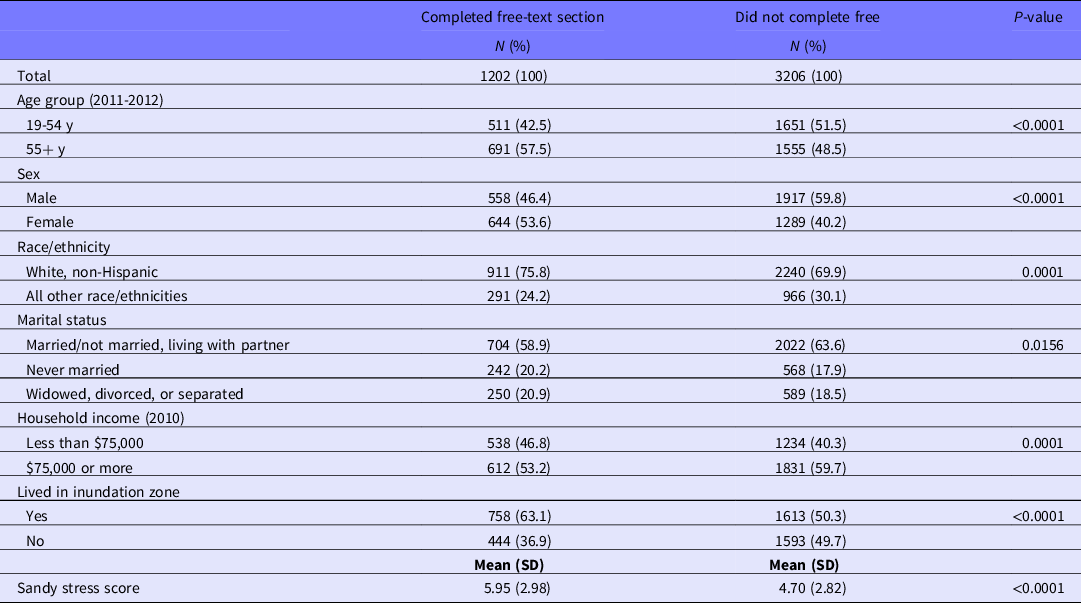
The majority of the participants were female, white, non-Hispanic, and aged 55 y or older (Table 1). There were 58.9% (n = 704) who reported being married or not married, but living with a partner, and 53.2% (n = 612) with a reported household income of $75,000 or more in 2010, and 63.1% lived in the inundation zone. The overall mean Sandy stress score for the sample was 5.95 (SD = 2.98). Participants who contributed to the free-response section were significantly more likely to be female, white race, 55 y or older, have an income of under $75,000, and divorced, separated, or widowed, living in the inundation zone, as well as have a higher mean Sandy stress score compared with those who did not (Table 1).
Sociodemographic characteristics and chi-squared differences between those who did and did not complete the free-text section of the Sandy survey

Abbreviation: SD, standard deviation.
Qualitative Themes
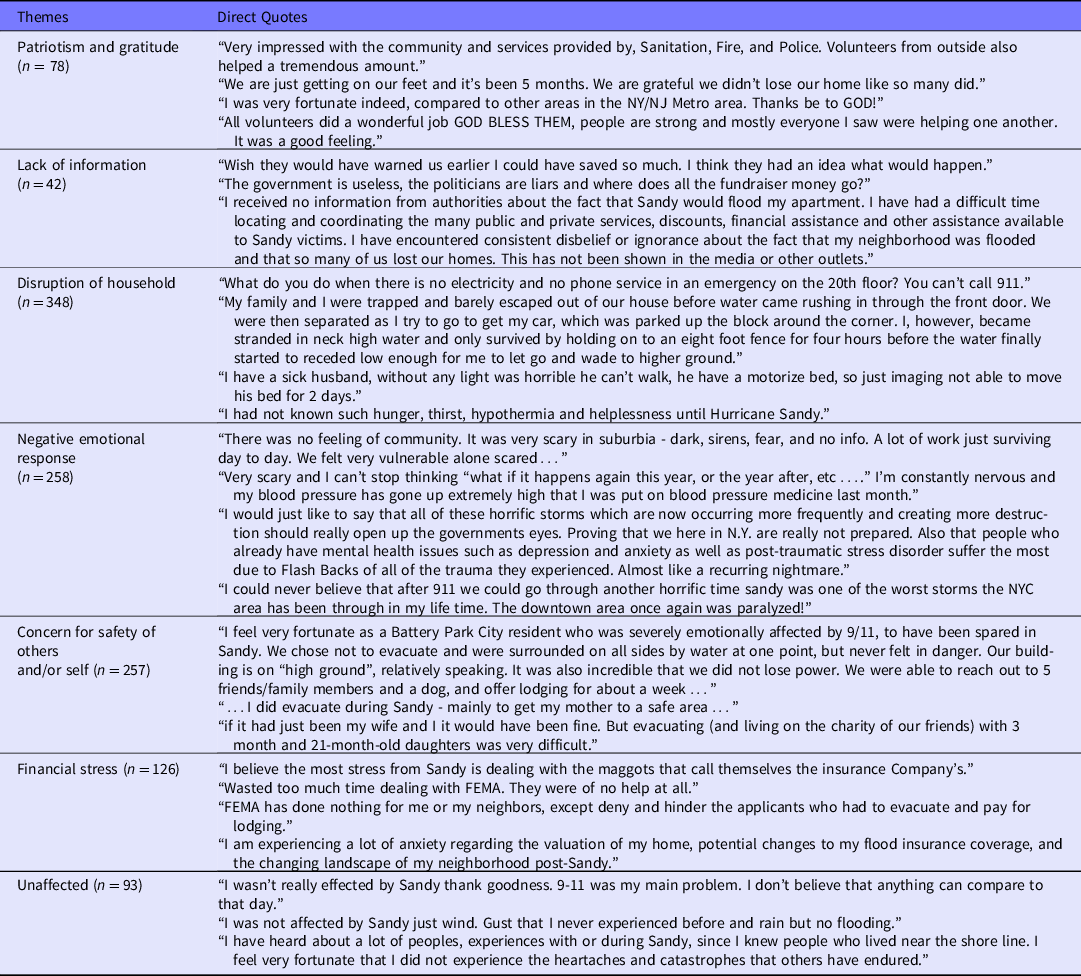
All codes were reviewed to identify repeated patterns of meaning and categorized into 1 of 7 themes: patriotism and gratitude, lack of information, disruption of household function, negative emotional response, concern for safety of others and/or self, financial stress, and unaffected. Sample quotations and number of participants within each theme are provided in Table 2.
Free-text response themes and corresponding quotes (n = 1,202)

There were a significant number of participants (n = 78) who wrote of on the theme of patriotism and gratitude to rescue workers, volunteers, and neighbors after Sandy. Some participants wrote about receiving direct help from their neighbors/community, “I received a surprising amount of aid that was totally unexpected and has given me a more positive overview of people in general.” Some reflected on their experience in their communities during the aftermath of Sandy, “I liked how New Yorkers came together.” Others wrote of feeling fortunate that they were minimally impacted, “[I] feel very blessed to have [had] such an easy time during Sandy.”
Fewer participants left comments that fit within the theme of lack of information (n = 42). Participants wrote of issues around coordination of relief efforts, “Too much mis-information within the city agencies [made it] very hard to get cooperation.” Some respondents also reported on the lack of information that was disseminated. One participant stated they were frustrated by, “The lack of information from local government agencies in the Jersey City area,” while another stated, “I would have liked to have had better, more, and faster updates from authorities on what was going on and what was being done.”
Numerous respondents left comments that were considered to fit within the theme of household disruption (n = 348). Written elements in this theme included loss of food, work and housing concerns, and missing utilities. Many participants spoke of a how the missing utilities led to a loss of food, “…lost electricity, food spoiled, no water.” Another quote within this theme stated, “I lost electricity, elevator use, water, frozen food, cell phone use,” and “I never want to experience it again. No water, no electricity and no heat. I was so cold.” Several respondents wrote about the damage to their or a loved one’s home either from flood water or winds from the storm. One participant wrote of “…major damage from trees falling and major expense from getting trees removed…” While others wrote of flooding and the damage, 1 participant stated that, “My apartment is not harmed but my building is—floor has to be replaced, there is a moldy smell.” Another participant expressed concern over her child’s school, “I am concerned about mold in my son’s school basement, which flooded during Sandy, and [I] cannot get any clear answers from the school.”
Many participants also left remarks that were within the theme of negative emotions experienced during and after Sandy (n = 258). Participants commented that they “felt isolated, scared, depressed,” and that, “it was very scary- would not want to go thru this again and my mind is not right.” Several expressed stress over housing issues, “It was an extremely stressful time as we had to stay with various friends throughout the city. Although our apartment was not damaged during Hurricane Sandy, our building suffered extensive damage.” Others expressed fear of future hurricanes, “I am concerned that this may happen again in the near future,” and, “Sandy will be a first but not necessarily a last.” Several participants commented on how Sandy affected their mental health, “My experiences with Sandy made my PTSD symptoms return.” Many wrote of how their experiences around Sandy triggered thoughts of their experiences on 9/11 with comments like, “I wish it never happened. It brought me back to 9/11,” “It felt too much like 9/11 [and] re-traumatized me,” and “I have never been such a nervous person. Even worse than after 9/11 because I don’t think 9/11 will happen to me again, but Sandy could happen anytime.” Some respondents wrote about how their 9/11 experience colored their experiences of Sandy, “…Being affected by 9/11 seemed to play an important role in my reaction to Sandy…”
Other participants wrote comments within the theme of concern for personal safety or safety of others (n = 257). Within this theme, comments that addressed evacuation, being hospitalized or needing medical assistance, and working as a first responder were considered. One participant left a comment about their elderly mother, “…I did evacuate during Sandy - mainly to get my mother to a safe area…” and another stated “if it had just been my wife and I it would have been fine. But evacuating (and living on the charity of our friends) with 3-mo and 21-mo-old daughters was very difficult.”
Participants also left comments that were considered to fit within the theme of financial stress (n = 126). Some elaborated on the problems they were experiencing in getting insurance claims, “It was and still is very devastating. We are still trying to clean up and dealing with the insurance companies.” Another participant stated, “All’s good on the personal side, but I’m a small business owner and received NOTHING although we had no power/internet for 5 days and lost real income…” Other participants wrote specifically about their experiences with the FEMA writing, “Getting help from FEMA has been stressful and maddening.” To a lesser extent, some participants reported being unaffected by Sandy (n = 93), “I was not affected by Sandy at all.”
Sandy Stress Score by Theme
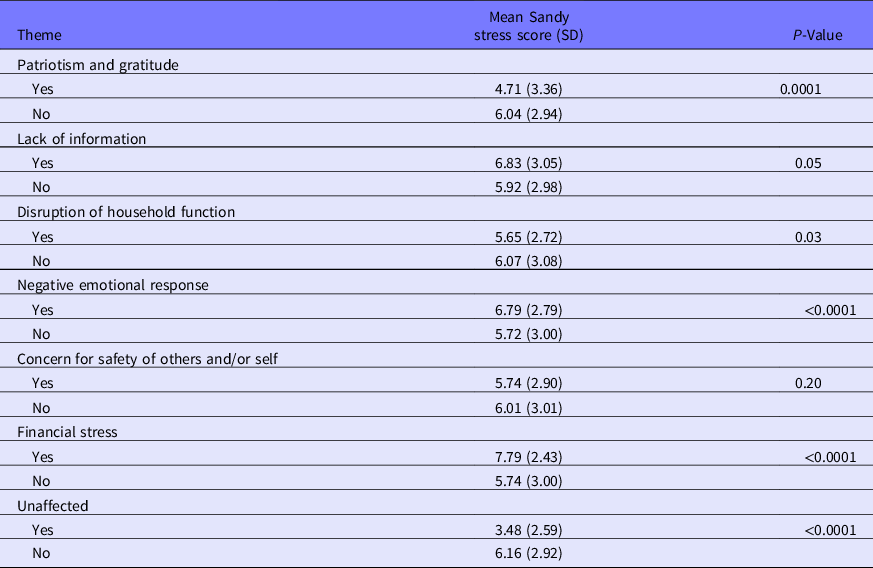
The mean stress score within each of the themes in described in Table 3. There were 3 themes where the respondent reported significantly higher Sandy stress scores compared with those whose comments did not fall into those themes: financial stress (7.79 vs 5.74; P < 0.0001), negative emotions (6.79 vs 5.72; P < 0.0001), and lack of information (6.83 vs 5.92; P = 0.05). In contrast, there were 3 themes where respondents reported significantly lower Sandy stress scores compared with those whose comments did not fall into those themes: patriotism and gratitude (4.71 vs 6.04; P = 0.0001), disruption of household function (5.65 vs 6.07; P = 0.03), and unaffected (3.48 vs 6.16; P < 0.0001). There was no statistically significant difference in the mean Sandy stress score between those who commented on being concerned for safety of others and/or self.
Mean Sandy stress score by qualitative theme (n=1,202)

Relationship Between Qualitative Themes and Sandy Stress Score
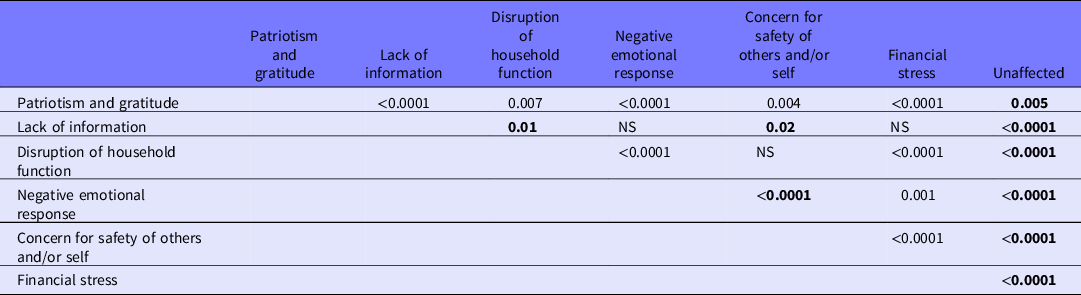
Table 4 compares the mean Sandy stress score among each of the 7 qualitative themes. Bolded P-values indicate that the theme in the row had a higher mean Sandy stress score compared with the theme in the column, whereas un-bolded scores indicate that the theme in the row has a lower mean Sandy stress score compared with the theme in the column. Those who wrote about patriotism and gratitude had significantly lower mean Sandy stress scores compared with all the other themes, except for the unaffected theme. Those who wrote about lack of information had significantly higher mean Sandy stress scores compared with those who wrote about disruption of household function, concern for safety of others and/or self, and being unaffected. The themes of negative emotional response and financial stress both had significantly higher mean Sandy stress scores compared with the theme of disruption of household function, but disruption of household function had a higher mean score than unaffected. The negative emotional response theme had higher mean scores than concern for safety of others and/or self and unaffected, but lower scores than financial stress. Those who wrote about financial stress had higher mean Sandy stress scores than those who wrote of concern for safety of others and/or self. Both the concern for safety of others and/or self and financial stress themes had higher mean Sandy stress scores compared with the unaffected theme.
Comparisons between mean Sandy stress score across qualitative themes (n = 1202)a

Abbreviation: NS, not statistically significant
a Boldface type: row theme higher mean Sandy stress score. Not boldface type: row theme lower mean Sandy stress score.
Distribution of Qualitative Theme by Inundation Zone Status
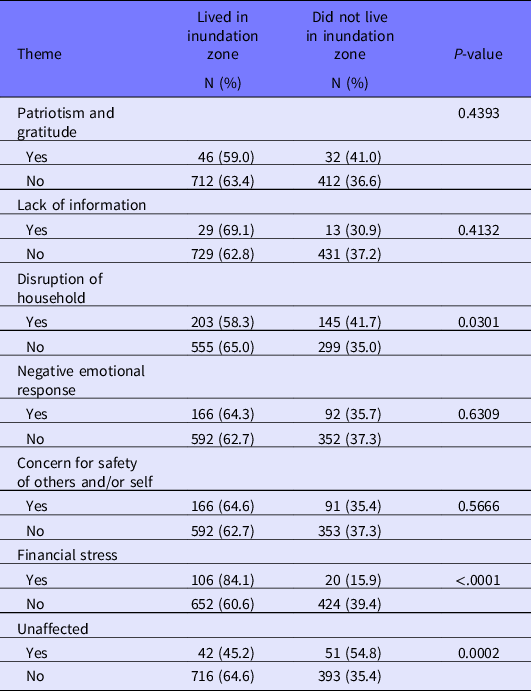
There was a significantly higher number of individuals who wrote of disruption of household and financial stress who lived in the inundation zone compared with those who did not live in the inundation zone (Table 5). Of those who wrote of being unaffected, 54.8% lived in the noninundation zone, compared with 45.2% who lived in the inundation zone (P = 0.0002). There was no statistically significant difference in the distribution of themes between inundation zone status for patriotism and gratitude, lack of information, negative emotional response, and concern for safety of others and/or self.
Comparison of themes between enrollees in the inundation and non-inundation zone (n = 1202)

Discussion
This mixed-methods study of persons dually exposed to Sandy and 9/11 examined a quantitative measure of perceived stress due to Sandy and qualitative item responses derived from an open-ended free-response section. Seven themes were identified, and many were associated with stress due to Sandy. In addition, comparing the mean stress scores of the themes allowed for the identification of themes that could reasonably be categorized into “positive” themes (patriotism/gratitude and being unaffected), which had overall lower mean stress scores, compared with “negative” themes (lack of information, negative emotional response, concern for safety of loved ones/self, and financial stress), which had higher mean stress scores.
Sandy exposures that had been associated with poor mental health outcomes in previous studies emerged as qualitative themes in the current study. One theme that was associated with post-Sandy stress was financial stress. Several studies after Katrina and Sandy found that income loss, property loss, and cost of damages to house were associated with poor mental health outcomes. Reference Schwartz, Liu and Sison1,Reference Caramanica, Brackbill and Stellman18 A study conducted a year after the 2004 tsunami in Thailand found that loss of a business was associated with PTSD. Reference Isaranuwatchai, Coyte and McKenzie10
The current study did not find an association between concern for safety of loved ones/self and mean Sandy stress score. Other studies have found an association between experiences such as a friend missing, family member injured or killed, and fearing for personal safety to be associated with a variety of outcomes, including perceived stress, PTSD, depression, and anxiety. Reference Schwartz, Liu and Sison1,Reference Isaranuwatchai, Coyte and McKenzie10,Reference Galea, Brewin and Gruber12,Reference Caramanica, Brackbill and Stellman18 A reason for the differing results in our study may be that, while the participants wrote of being concerned for their loved ones’ safety, they also expressed a level of gratitude toward first responders who assisted them and that those feelings of gratitude might mitigate the concern they felt for their loved one.
This study population is unique in that it was exposed to 2 disasters: the events of 9/11 and Sandy. Some of the comments left in the theme of negative emotional response reflect this dual disaster exposure. Many of the participants wrote of how their experiences around Sandy triggered thoughts of their experiences on 9/11. This is consistent with a recent study that found an association between Sandy exposure and re-experiencing 9/11. Reference Li, Alper and Gargano29
Participants who wrote about the theme of disruption of household function, which included comments on evacuation and damage to home, had a lower mean stress than those who did not write of this theme. Previous studies show that exposures, such as evacuation, damage to home, and home adversity, were associated with PTSD and perceived stress after the 2004 Indonesian tsunami, Reference Van Griensven, Chakkraband and Thienkrua7,Reference Irmansyah, Dharmono and Maramis8 Katrina, Reference Galea, Brewin and Gruber12 and Sandy. Reference Schwartz, Liu and Sison1,Reference Caramanica, Brackbill and Stellman18 One potential explanation for our observation is that those who did not write of disruption of household function, instead, wrote about other, more “negative” themes such as negative emotional response, lack of information, and financial stress.
Another finding of note is that while the theme of patriotism/gratitude had an overall lower mean stress score than most of the other themes, it had a higher stress score compared with those who wrote that they were unaffected by Sandy. One explanation for this could be that those who felt patriotism/gratitude may have had some negative experiences or higher Sandy-related exposures that caused higher stress but were able to find some sense of meaning from their experience. This ability to find benefit from stressful events has been shown to be associated with posttraumatic growth after 9/11 and among cancer survivors. Reference Jones, Ziebell and Walker30,Reference Richardson31 The theme of lack of information around Sandy and the association with higher mean stress scores compare with most of the other themes speaks to the importance of clear, timely, and frequent communication from government officials during a disaster, particularly in circumstances which can change rapidly.
Among those who lived in the inundation zone compared with those who did not live in the inundations zone, there was a significantly higher number of participants who wrote on the themes of disruption of household and financial stress. This aligns with previous Sandy literature that showed that those in the inundation zone had higher prevalence of evacuation from home and home damage. Reference Brackbill, Caramanica and Maliniak2 On the other hand, there was no difference in the number of participants who wrote of negative emotional response between those who lived and did not live in the inundation zone. This was surprising as a previous report using data from this same survey found a higher prevalence of probable PTSD in those who lived in the inundation zone compared with those who did not. Reference Caramanica, Brackbill and Stellman18
Strengths and Limitations
The findings from this study are subject to several limitations. First, the response rate achieved for the Sandy survey was moderate and may not be representative of the study population. Second, the free-response section was located at the end of the survey and the preceding quantitative questions may have influenced their qualitative responses. Third, responder analysis showed that participants who contributed to the free-response section were significantly different on a variety of demographic variables, which may affect the generalizability of the findings. Fourth, the quantitative stress question did not have any published data on its reliability or validity. Finally, the responses left in the free-text section may have only captured the participants most stressful experiences and may not represent their full range of Sandy-related experiences.
Despite these limitations, this study also has several strengths. The first is that data collection for the survey was conducted within a year after Sandy, potentially minimizing recall bias and capturing participants’ perceptions in a more acute postdisaster period. Second, this study population had a large sample coming from a diverse, dually exposed cohort. Third, the unprompted free-response section allowed for themes to emerge that may not have been assessed in a quantitative manner.
Conclusions
This study adds to the literature on risk factors for disaster-related stress. Qualitative methods allowed for participants to discuss their Sandy experience in a way that was relevant to them as opposed to being framed by the researchers’ interests. In addition, the use of a mixed-methods approach allowed for a more in-depth assessment than with quantitative or qualitative methods alone. Identification of modifiable factors, such as improving communication during a disaster, may confer better mental health outcomes after a disaster. Future researchers should consider using an in-depth mixed-methods approach to evaluate those exposed to 9/11 using interviews to fully capture the data as opposed to offering self-report qualitative response.
Acknowledgement
The authors thank the participants for their time to complete the survey as well as Drs. Robert Brackbill, Mark Farfel, Charon Gwynn, and James Hadler for their helpful comments.
Author Contributions
L.M.G. conceived and designed the study. L.M.G. and A.A.O. conducted the qualitative analysis. L.M.G. and S.K.G. conducted the quantitative analysis. L.M.G. drafted the manuscript. All authors provided critical feedback on the manuscript and approval of the final version.
Funding Statement
This publication was supported by Cooperative Agreement Numbers 2U50/OH009739 and 5U50/OH009739 from the National Institute for Occupational Safety and Health (NIOSH) of the Centers for Disease Control and Prevention (CDC); U50/ATU272750 from the Agency for Toxic Substances and Disease Registry (ATSDR), CDC, which included support from the National Center for Environmental Health, CDC; and by the New York City Department of Health and Mental Hygiene (NYC DOHMH).
Conflict of Interest
The contents of this study are solely the responsibility of the authors and do not necessarily represent the official views of NIOSH, CDC, or the Department of Health and Human Services.