Introduction
Each day, government officials make a multitude of decisions that are unfavourable to those affected by them: welfare state officials decide that support-seekers do not meet entitlement conditions; tax authorities determine that claims for tax deduction are invalid; officials at the local housing committee deny requests for building permits; police officers hand out fines for speeding and running red lights. Opinion-policy research demonstrates that direct encounters like these provide citizens with important information about how governments exercise power (Rothstein, Reference Rothstein1991, Reference Rothstein2009; Skocpol, Reference Skocpol1994; Mutz, Reference Mutz1998; Soss, Reference Soss1999; Kumlin, Reference Kumlin2004). Clearly, democratic legitimacy will improve if affected individuals find unfavourable decisions to be acceptable. This paper asks whether the conduct of individual officials can help achieve this goal.
According to several parallel but distinct lines of research, performance of government agencies matters a lot for legitimacy beliefs among citizens. Procedural fairness theory argues that fair decision-making procedures are of crucial importance for people’s reactions to authoritative decisions (see Ambrose, Reference Ambrose2002; Tyler, Reference Tyler2006; MacCoun, Reference MacCoun2006 for reviews). Policy feedback theory claims that empowering government institutions is beneficial for citizens’ belief in the democratic system (Mettler and Soss, Reference Mettler and Soss2004). Representative bureaucracy theory suggests that shared social characteristics between officials and affected citizens will enhance the likelihood of constructive encounters between the two groups (see Keiser et al., Reference Keiser, Wilkins, Meier and Holland2002 for a review). Quality of government theory maintains that impartiality in the implementation of public policies is of prime importance for citizens’ social and political trust (Rothstein and Eek, Reference Rothstein and Eek2009).
Based on the findings of these important bodies of literature, it would appear demonstrated beyond doubt that government officials can help improve citizens’ willingness to accept unfavourable decisions. However, I will argue here that we still know surprisingly little about the extent to which the conduct of individual officials can specifically enhance acceptance of decisions. To answer this question with greater confidence, we need to study the actual conduct of individual officials in isolation from confounding factors, and to fully recognize that decision acceptance is a special kind of legitimacy belief.
First, for theoretical reasons to be developed below, and for the practical reason that it is difficult to manipulate objective conditions in real-world settings, much research in the area relies on subjective perceptions about the conduct of decision-making authorities. How citizens feel treated by government officials is an important question per se, but it is not satisfactory to infer directly from subjective perceptions to objective conditions. Studies that do take objective conditions into account are based on either comparisons between aggregated government units (citizen contact with one agency or another) or on laboratory experiments that are artificial to participants. While helpful, the former approach is open for self-selection effects, whereas the latter raises question of external validity.
Second, with some noteable exceptions (e.g. Tyler, Reference Tyler1990), empirical studies focus on legitimacy beliefs associated with citizens’ right to remain free from state coercion, rather than their obligation to accept legitimate authoritative decisions. Simply put, scholars have shown greater interest in citizens’ grievances than in their willingness to comply with unfavourable decisions.
To begin filling in these gaps a scenario experiment was designed which allows the conduct of an individual official to vary systematically while keeping an unfavourable decision constant in a setting that approaches the real world. To ensure experimental manipulation scenarios were created in which a government official decides against the preference of support-seeking citizens but treats them more or less fairly; professional actors were recruited to take on the roles of government official and support-seekers; and a professional film-maker was hired to record the encounters. Finally, following their exposure to a randomly distributed recording of more or less fair treatment, participants in the experiment were asked about their willingness to accept the decision. Importantly, while the unfavourable decisions in the experiment are in accordance with current laws and rules and thus formally legitimate, they are nevertheless costly to the affected citizens. More precisely, the basic scenario is that an official at the Swedish Public Employment Service decides that a support-seeker must take on a job that s/he deems unacceptable or risk losing his/her unemployment benefits.
In the following sections, I first discuss a series of theoretical matters of relevance for the current research: Why may people care about their treatment by government officials? Why may actual treatment matter less than the perceived fairness of treatment? Why may some individuals care less than others about the conduct of officials? How does decision acceptance differ from other forms of legitimacy beliefs? What can we reasonably mean by fair treatment from government officials? Following a discussion of the experimental design, empirical findings are presented. Results confirm that the conduct of officials matters, but with important qualifications. In particular, the relationship between actual conduct and perceived fairness of treatment is conditioned by citizens’ moral beliefs about their right to a favourable outcome.
Actual conduct vs. perceived fairness of treatment
Of the relevant lines of research, procedural fairness theory is the most explicit about the conduct of individual decision-makers. According to the theory, which has been developed within psychological social justice research, people care about how decisions are made for a number of reasons. One is that fair treatment is considered a moral right (Folger, Reference Folger1998; Miller, Reference Miller2001). Another is that fair procedures provide reasons to trust decision-makers (Brockner, Reference Brockner2002). The third reason is that fair procedures signal that one is respected by the party enacting the procedure (Tyler and Lind, Reference Tyler and Lind1992; Tyler et al., Reference Tyler, Degoey and Smith1996). A further reason is that procedural judgements provide a means of evaluating outcomes in situations of uncertainty about the fairness of outcomes themselves (Lind, Reference Lind2001; Van den Bos and Lind, Reference Van den Bos and Lind2002). Instrumental reasons may also be part of the picture. Fair procedures can be expected to lead to fair outcomes, and possibly increase chances for individuals to receive a favourable outcome (Thibaut and Walker, Reference Thibaut and Walker1975).
Scholars in a broad array of domains, from family life to organizations and business management, have collected an impressive amount of evidence in support of the fair process effect. Within the political domain, the theory is supported in studies of citizens’ compliance to laws (Tyler et al., Reference Tyler, Casper and Fisher1989; Tyler, Reference Tyler1990), the legitimacy of political institutions (Tyler, Reference Tyler1994; Gangl, Reference Gangl2003; Gibson, Reference Gibson2008), land-use policies such as localization of controversial railroads (Grimes, Reference Grimes2005), tax-compliance (Murphy, Reference Murphy2004), citizens’ reactions to contact with the police (Tyler and Folger, Reference Tyler and Folger1980), and welfare state institutions (Kumlin, Reference Kumlin2004). Moreover, support for the theory appears to be universal across cultures; comparative studies confirm that values about fair treatment are shared by people from different parts of the world (Cohn et al., Reference Cohn, White and Sanders2000; Price et al., Reference Price, Hall, Van den Bos, Hunton, Lovett and Tippett2001).
Considering its undisputed success, procedural fairness theory would seem to speak directly to this research. However, before generalizing to the conduct of government officials, it is important to note the subjective character of the theory – it is people’s perceptions of procedural fairness that affect legitimacy beliefs (Tyler et al., Reference Tyler, Boeckmann, Smith and Huo1997: 4–5). Actual decision-making procedures are deemed important, but mainly as determinants of perceptions about procedural fairness themselves (Van den Bos, Reference Van den Bos2005). Moreover, procedural fairness theory covers a broad array of legitimacy beliefs, only some of which are related specifically to decision acceptance.
Accordingly, a close reading of empirical work in the field shows that most studies that document procedural effects on decision acceptance specifically depart from perceived procedural fairness and not from actual decision-making processes. Empirical work that takes actual conditions into account – often by means of laboratory experiments – typically focuses on types of reactions other than decision-acceptance (such as self-esteem ratings, in addition to procedural fairness judgements).Footnote 1
Subjectivity is not a problem for the psychology of social justice. In this line of research, justice is an idea that exists within the minds of individuals (e.g. Lind and Tyler, Reference Lind and Tyler1988: 3; Van den Bos, Reference Van den Bos2005: 278–279). However, when addressing practical problems of government decision-making, actual conduct must be placed in the forefront. The actual conduct of government officials is crucial because democratic decision-making must uphold certain objective standards. It is neither feasible nor desirable that government officials adjust to individual’s subjective definitions of fair treatment (e.g. Brewer, Reference Brewer2007).
To the extent that citizens’ perceptions about fairness are unrelated to the treatment they actually receive (to the extent that their definition of ‘fair treatment’ includes factors that are beyond the control of government officials), actual conduct will matter less for decision acceptance. As it stands today, we do not know with certainty how the actual conduct of government officials relates to the perceived fairness of treatment. As is indicative of the magnitude of such translation problems, studies of peoples’ spontaneous definitions of fair outcomes suggest that boundaries between procedures and outcomes are far from given (Lupfer et al., Reference Lupfer, Kelly, Weeks, Doan and Houston2000).
Why some citizens may care less than others about how officials treat them
In addition, the effects of actual conduct may be conditioned by individual characteristics of affected citizens. An important approach in the search for boundary conditions of procedural effects is ‘fairness heuristic theory’ and its companion ‘uncertainty management theory’ (Lind, Reference Lind2001; Van den Bos and Lind, Reference Van den Bos and Lind2002; Van den Bos, Reference Van den Bos2005). This approach argues that the strength of the fair process effect is contingent upon the individual’s feelings of certainty in the decision-making situation. Individuals turn to procedural considerations only in situations where they are uncertain about how to judge the fairness of the outcome in itself.
How this idea plays out in specific situations is exemplified by the ‘morale mandate effect’, identified by Skitka and her associates (Skitka and Houston, Reference Skitka and Houston2001; Skitka, Reference Skitka2002; Skitka and Mullen, Reference Skitka and Mullen2002; Mullen and Skitka, Reference Mullen and Skitka2006, Reference Mullen and Skitka2008). In both experimental and panel survey studies, they find that the effects of procedural judgements vary by levels of moral conviction regarding the issue at hand. For those with a strong feeling of what is right and wrong on a given issue, reactions are predominantly determined by the obtained outcome (‘right’ or ‘wrong’), whereas those with a neutral view on the issue, who are, hence, uncertain about how to judge the outcome, pay more attention to perceptions about the procedure.
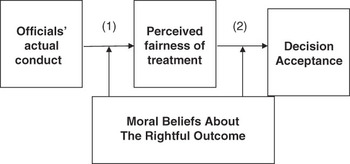
Extending these ideas to the situations of interest in this study works as follows: affected citizens look first to the outcome itself. Is it morally acceptable for the government official to make an unfavourable decision? Provided that the answer is yes, perceptions about treatment are taken into consideration. From this reasoning, it follows that citizens’ moral beliefs about their right to a favourable outcome may condition effects in two different ways (see Figure 1 for an illustration).
Two ways for moral beliefs about the outcome to condition effects of treatment by government officials

The first possibility is that moral beliefs about the outcome come into play at an early stage of opinion formation. Following an unfavourable outcome, morally disappointed citizens may find it hard to agree that they have been fairly treated, irrespective of the actual conduct of the official (arrow ‘1’). According to this process, actual conduct will matter less for morally disappointed individuals because they apply a different standard for fair treatment. Alternatively, perceived fairness of treatment may matter less for citizens who believe that they have a moral right to a favourable outcome (arrow ‘2’). According to this process, actual conduct will matter less for morally disappointed citizens because they do not care as much about how they feel they were treated.
While procedural justice scholars have been debating the latter conditional effect (see Napier and Tyler, Reference Napier and Tyler2008 vs. Mullen and Skitka, Reference Mullen and Skitka2008), the former potential effect has remained unexplored.
What’s special about decision acceptance?
The situations of interest here demonstrate the coercive power of the state. Given the unavoidable shortcomings of democratic decision-making processes, affected citizens will likely find a legitimate reason to question either the rules, their application, or both. Mansbridge (Reference Mansbridge1997) observes that many political theorists shy away from these types of practically important situations, which she calls ‘contestedly legitimate coercion’. She points out that theorists are much more attracted to ‘non-coercive exercise of power’, that is, various forms of voluntary acceptance of authoritative decisions.
In a similar vein, many empirical studies on government decision-making highlight legitimacy beliefs associated with citizens’ right to remain sceptical about authoritative decisions. Willingness to raise grievances about unfavourable treatment is a typical example, and beliefs about the legitimacy of a powerful institution is another. In contrast, this study focuses on willingness to accept an unfavourable decision in and of itself. The question asked is empirical; it is not assumed that citizens are morally obliged to comply with the official’s decision. However, it is maintained that the prospects for long-term stability of democratic polities might be negatively affected by low levels of decision-acceptance.
Acceptance can be voluntary or semi-voluntary, which would imply that the exercise of power is non-coercive (Levi, Reference Levi1997). However, decision acceptance may also express obedience to state coercion, which would indicate a ‘contestedly legitimate’ exercise of power.
What can we reasonably mean by ‘fair treatment’?
Government officials are responsible for two matters of importance for affected citizens: to decide how laws and rules apply, and how to communicate their decisions. Given these responsibilities, several bodies of research provide relevant discussions on the criteria for fair treatment by officials. While terminology and specifics obviously differ, I argue that most theoretical perspectives agree on two basic components: careful handling of cases, and respectful behaviour.Footnote 2
As regards ‘careful handling of cases’, the pioneering procedural justice scholars Thibaut and Walker (Reference Thibaut and Walker1975) emphasize ‘decision control’. Those affected by a decision will agree to the outcome because it is predictable and hence controllable. For outcomes to be predictable decisions, they must be based on explicit rules that are consistently applied by neutral decision-makers (see also Leventhal, Reference Leventhal1980; Klosko, Reference Klosko2000: 218–227; Tyler, Reference Tyler2000). Policy feedback theory makes a similar case for bureaucratic rationality and transparency (Soss, Reference Soss1999; Campbell, Reference Campbell2003), and quality of government theory argues that equal treatment from government officials is of key importance (Rothstein and Teorell, Reference Rothstein and Teorell2008). Correspondingly, political theorists emphasize explicit rules and regulations, consistent application of these rules over time and among individuals, and opportunities for appealing unwelcome decisions (e.g. Bayles, Reference Bayles1990). Public administration researchers have long acknowledged that standardized routines and the equal treatment of citizens are essential requirements for the legitimate exercise of authority.
‘Respectful behaviour’ emphasizes the need for balanced interaction between decision-makers and those affected by the decisions. The importance of ‘voice’ – that affected persons are given an opportunity to argue their case – has been documented in a large number of procedural justice studies (e.g. Van den Bos and Spruijt, Reference Van den Bos and Spruijt2002), and is also central to policy feedback theory (Schneider and Ingram, Reference Schneider and Ingram1997; Kumlin, Reference Kumlin2004). Later procedural justice studies have noticed that the exchange of information should run both ways; it is important that decision-makers explain their reasons to affected persons (Tyler, Reference Tyler2000). Moreover, research on relational justice emphasizes that decision-makers must treat affected persons as their equals on a personal basis (Bies and Moag, Reference Bies and Moag1986; Brockner and Greenberg, Reference Brockner and Greenberg1990; Tyler and Lind, Reference Tyler and Lind1992; Colquitt, Reference Colquitt2001).
Political theorists express similar lines of thought. One example is Miller’s work on morally just societies, in which ‘dignity’ is a defining component of a fair procedure (Miller, Reference Miller1999: 99–102). Within public administration research, similar ideas are present in the paradigm of ‘New Public Management’. That government officials shall strive to ‘satisfy customers’ and be ‘flexible’ is recognition of the need for balanced interaction with the public (Hood, Reference Hood1991; Rhodes, Reference Rhodes1999; Clark, Reference Clark2000).
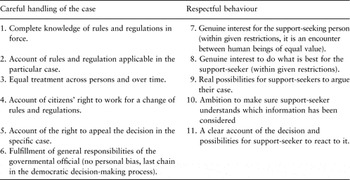
When moving down the ladder of abstraction to the specific actions that constitute fair treatment, differences between theoretical approaches increase. However, with regard to ‘careful handling of cases’ it seems uncontroversial, for example, to stress the need for governmental officials to be knowledgeable about laws and rules that might apply, to treat all cases equally, to avoid having a personal interest in a case, and to inform affected citizens about their right to appeal decisions. With regard to ‘respectful behaviour’ there is agreement on the need for officials to show genuine interest for the affected individual, to provide real opportunities for individuals to argue their cases, to be careful in communicating the decision that is made, and to acknowledge the equal human value of affected individuals. Table 1 shows a total of 11 concrete criteria of relevance for government officials.
Criteria for the fair conduct of government officials

Based on the two components and their specifications, I have defined four types of conduct of governmental officials:
• Fully correct (criteria 1–11 fulfilled): This is the correct conduct where the official handles formalities carefully and, within the limits of official laws and rules, treats affected citizens respectfully.
• Careful only (criteria 1–6 fulfilled): This is the conduct of the caricature bureaucrat. It is formally correct, but the communication is one-way and impersonal.
• Respectful only (criteria 7–11 fulfilled): This is the conduct of an official who only wants to befriend or be nice to the support-seeker. The communication is genuinely two-way, but the official fails to handle the formalities of the case (for instance, the official lacks factual knowledge and does not refer to laws, rules, and regulations).
• Neither careful nor respectful (no criteria fulfilled): This is the conduct of an official who bullies support-seeking citizens.
These four types of treatment constitute an ordinal scale, reaching from absolutely terrible conduct (‘neither careful nor respectful’) to the best possible type of conduct (‘fully correct’), with the ‘careful only’ and ‘respectful only’ types of conduct falling in-between. My operationalization of these types of treatment constitutes the experimental manipulation of the study.
Data
The study was designed as a scenario-based experiment. Participants were exposed to randomly distributed video recordings of encounters between an official with the Swedish Employment Service and a support-seeking citizen. The videos were identically constructed, except that the official treats the support-seeker more or less fairly according to the standards established in the previous section. Professional actors took on the relevant roles and they followed a script written by myself in co-operation with practitioners from the Employment Service. Each video lasts approximately 20 minutes.
During the encounter, the official informs an unemployed person that she or he will have to accept a job offer or else risk having her or his unemployment benefit reduced or withdrawn completely. This theme is repeated in two scenarios. In one scenario, hereafter called the ‘Photographer’, the unemployed person is a young woman (‘Karin’) who is offered a job at a nursing home for the elderly. Her own strong preference is to continue to seek job opportunities as a professional photographer. In the other scenario, ‘the Restaurateur’, the unemployed person (‘Carlos’) is a 30-year-old man and immigrant from Latin America who is offered a job in the manufacturing industry. His own strong preference is to start a small restaurant together with a friend.Footnote 3
Both scenarios have been constructed to create a controversial situation. According to current laws and rules the official makes the correct decision, but the unemployed person has a strong preference against accepting it.
To operationalize the respective types of actual conduct, the manuscript varied the 11 specific criteria displayed in Table 1. The absence or presence of criteria for correct treatment was manifested both orally and subtly. For example, under the condition ‘respectful only’, the official encouraged the support-seeker to skip a queue of support-seekers waiting for their turn, whereas, under the conduct type ‘neither careful nor respectful’, the official angrily ordered the support-seeker to get a queue ticket and wait in line. Validity checks show that the videos were well-received among participants. The average score on a four-point scale of believability was 3.0. Moreover, participants perceived the encounter as expected. For example, those who were exposed to ‘careful only’ conduct (the caricature bureaucrat) gave the official high marks on her knowledge, but low marks on her ability to act respectfully. A further sign of quality is that the Swedish Employment Agency asked for permission to use the videos for training new recruits.
To maximize realism, participants were recruited from groups who share key social characteristics with the respective support-seekers. Those exposed to the Photographer were recruited among undergraduates studying design, music, and theatre. Like the photographer in the video, these students ran the risk of having to choose between a strong professional identity and the requirements of the unemployment insurance system. Those exposed to the Restaurateur were recruited from local job-training programs. Like the restaurateur in the video, all of them were currently unemployed, and most were immigrants. Moreover, a clear majority of participants (78%) reported that they had personal experiences with the Employment Service. The total number for the study is 341, of which 210 participants were exposed to the Photographer scenario and 131 to the Restaurateur scenario.
The experiment was conducted in the localities of the participants (in university buildings and at job training centres, respectively). Most participants watched the video in groups of two to four persons; the highest number watching at any single occasion was seven.
For practical reasons, randomization was done on the basis of the showing schedule and not on the basis of individual participants. Each video was randomly assigned to a number of pre-defined showings. Participants were then allowed to pick a showing at their convenience. Overall, the randomization process worked well. However, for each of the scenarios, 2 of 11 test variables demonstrated significant differences at the 0.10 level. These variables – self-reported political interest (both scenarios), gender (the Restaurateur), and prior personal experience with the unemployment agency (the Photographer) – are used as technical controls in the empirical analysis but they will not be commented on further.
The cover story was that the study dealt with the conduct of officials at the employment service. At the start of each showing, participants filled in a questionnaire with background questions. Thereafter, they were given a short text that introduced them to the scenario at hand, which was followed by questions about their pre-decision views on the situation. The video was then shown, and afterwards participants filled in the remaining part of the questionnaire. Finally, participants were debriefed, and rewarded with a gift certificate from a movie theatre.
Measurements
In addition to the four types of actual conduct, a key independent variable is perceived fairness of treatment. This was measured with a straightforward seven-point scale with designated endpoints. The question was: ‘On the whole, how fair did the official treat Karin/Carlos?’. For a validity check, participants were probed to provide written comments to their response. Importantly, no participant explicitly mentioned factors that went beyond the control of the official. Indicating that outcome-related concerns were nevertheless taken into account, the average score was below the midpoint of the scale (mean = 3.4).
To be valid, the measure of moral disappointment – the individual level modifying factor – shall identify those who believe that ‘Karin’ and ‘Carlos’ have a moral right to a favourable outcome. For this purpose, participants were asked the following question before their exposure to the video: ‘Would you hope that the official decides that Karin/Carlos must accept the job offer, or would you prefer that Karin/Carlos doesn’t need to accept the job offer?’ Participants who indicated that Karin/Carlos should not be forced to accept the job offer (a majority of 69%) were classified as ‘morally disappointed’.
As expected, moral disappointment was predicted by both left-right self-placement (self-identified leftists were more disappointed), and beliefs about government neutrality (those who believe that government is biased against them were more disappointed). Furthermore, when asked open-ended questions about the fairness of the decision post-exposure, morally disappointed participants typically answered that it was unfair, inhumane, and/or unproductive to force human beings to take on jobs they regard as unacceptable. Those who initially indicated support for a less generous decision typically acknowledged the official norm that everyone who is capable of supporting themselves should do so.
As regards decision acceptance, I used measures of outcome satisfaction, outcome fairness, and behavioural compliance. The former two, which are standard indicators of social justice research, are conceptually close to ‘consent’ and ‘voluntary compliance’. Participants were asked to rate their satisfaction with the decision (satisfaction) and perceived fairness of the decision (fairness), on seven-point scales with designated endpoints. As could be expected in a study of unfavourable decisions, average scores were below the midpoint of the scale (3.5 and 3.3, respectively).
Behavioural compliance may indicate voluntary compliance, but may also express obedience to state coercion. To measure accept, participants were asked whether Karin/Carlos – based on the assumption that they had enough money to get for the next few weeks – should accept the job offer or whether they should wait and see if the Unemployment Insurance Fund (a higher authority that makes the final call on the payment of benefits) would arrive at a different decision. Only a minority of participants (41%) recommended that the support-seeker accept the job offer, indicating that state coercion was not overwhelmingly strong.
Results
The first stage of analysis will evaluate the importance of perceived fairness of treatment and of pre-decision moral beliefs about the rightful outcome. This analysis will establish whether subjective feelings of treatment are associated with decision acceptance in the particular situations of interest in this study. It will also provide a baseline evaluating the effects that follow from variations in the actual conduct of officials. Since I follow the standard logic of procedural fairness research, I do not control for actual conduct (treatment perceptions are exogenous in the typical survey-based study on decision acceptance).
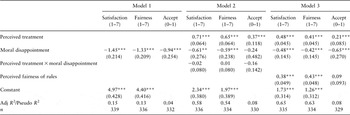
To begin, the results for Model 1 (Table 2) show that moral disappointment exerts a strong total negative effect on all three indicators of decision acceptance.Footnote 4 From the standpoint of government authorities in search of legitimacy for unfavourable decisions, results indicate that officials face a more difficult situation when they meet citizens who believe that they have a moral right to a favourable outcome.
Estimates of the effects of perceived fairness of treatment and moral disappointment (OLS and Logit, SE in parentheses)

Note: In addition to technical control variables (see the section ‘Data’), a variable for type of scenario (Photographer) has been included in the analyses.
***P ⩽ 0.01, **P ⩽ 0.05.
Model 2 introduces perceived fairness of treatment along with its interaction with moral disappointment. As evidenced by statistically and substantially significant coefficients, the first observation is that participants who feel that the support-seeker was fairly treated by the official are much more likely than other participants to be satisfied about the outcome, to judge it as fair, and to recommend her or him to accept the job offer. This is precisely what procedural fairness theory predicts will happen: provided that government officials make affected citizens feel that they have been fairly treated, there will be an increased acceptance of unfavourable decisions.
Second, there is no evidence of an interaction effect between perceived treatment and pre-decision moral belief about the outcome (arrow ‘2’ in Figure 1 above). It can therefore be inferred that morally disappointed participants care just as much about perceived treatment as do participants who find an unfavourable outcome morally acceptable. This result runs against the predictions of a moral mandate effect (which states that moral convictions about outcomes override the influence of perceived procedural fairness), and provides support for a conventional understanding of procedural fairness theory (see Napier and Tyler, Reference Napier and Tyler2008).
Third, the size of the coefficients for moral disappointment are reduced by more than half in comparison to the total effects reported in Model 1, and for the behavioural measure ‘accept’ it is statistically non-significant. This indicates that much of the effect of pre-decision moral beliefs is mediated through perceived fairness of treatment (morally disappointed participants are less likely to feel that the official treated the support-seeker fairly).
To provide a further statistical control within this subjective understanding of the decision-making situation, Model 3 includes a measure of perceived fairness of rules.Footnote 5 The official makes her unfavourable decision because politically decided laws and rules oblige her to. Clearly, these rules and regulations are exogenous, and their influence on decision acceptance should be taken into account. Results confirm that participants care about the perceived treatment from the official even when the fairness of laws and rules is taken into account. Indeed, treatment perception exerts a significant effect on all three indicators of decision acceptance, whereas perceptions about the fairness of rules only affect ‘satisfaction’ and ‘fairness’.
Overall, the data speaks to the importance of perceived fairness of treatment: willingness to accept an unfavourable decision is strongly associated with the feeling that the support-seeker has been fairly treated by the official.
Actual conduct
The second stage of analysis will evaluate the effects of the actual conduct of the official. The analysis will regress dependent variables on three dummy variables representing conduct that is fully correct, careful only and respectful only, with treatment of the type neither careful nor respectful (the completely unacceptable type of conduct) serving as a reference category.Footnote 6
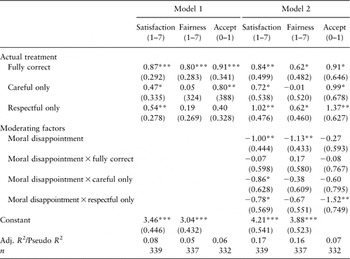
Model 1 in Table 3 reports the main effect of the respective types of conduct. The first observation is that all three types of actual conduct exert a positive influence on at least one indicator of decision acceptance. Second, only the fully correct conduct has a consistent effect on all indicators of decision acceptance. Careful only, the caricature bureaucrat, affects ‘satisfaction’ and ‘accept’ but not ‘fairness’, whereas respectful only (the official who wants to befriend or be nice to the support-seeker but fails to be formally correct) only affects ‘satisfaction’. From the perspective of government officials, it appears as though the likelihood that their conduct will influence decision acceptance increases with their ability to perform according to the highest standards.
Estimates of effects of actual treatment and moral disappointment (OLS and Logit, SE in parentheses)

Note: In addition to technical control variables (see the section ‘Data’), a variable for type of scenario (Photographer) has been included in the analyses.
***P ≤ 0.01, **P ≤ 0.05, *P ≤ 0.10, one tailed.
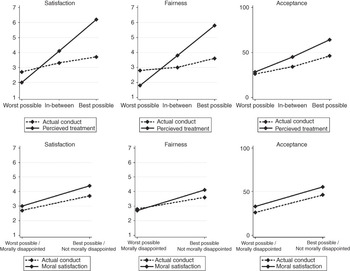
Third, actual conduct is much less consequential for decision acceptance than perceived fairness of treatment. For illustration, the upper half of Figure 2 reports the predicted level of decision acceptance for each dependent variable by three categories of actual treatment and perceived treatment, respectively: worst possible treatment, in between treatment, and best possible treatment. Thus, by moving along the horizontal axis the relative impact of actual conduct (dotted line) and perceived fairness of treatment (solid line) can be compared. The worst possible actual conduct is represented by ‘neither careful nor respectful’, the in between type of conduct by ‘respectful only’, and the best possible conduct by ‘fully correct’. For perceived fairness of treatment, corresponding categories are represented by response categories ‘1’, ‘4’, and ‘7’, respectively.Footnote 7
Predicted levels of decision acceptance

For both ‘satisfaction’ and ‘fairness’, the level of decision acceptance changes much more as we move along the perceived fairness variable than along the variable representing actual conduct. For the behavioural measure ‘accept’, the difference is smaller but still substantial.
To further contextualize the impact of actual conduct, the lower half of Figure 1 presents a corresponding analysis that compares its effect with the effect of pre-decision moral beliefs about the outcome. In this analysis, the horizontal axis represents the extreme categories ‘worst possible conduct’ and ‘best possible conduct’, and ‘morally disappointed’ and ‘not morally disappointed’, respectively. By moving along the horizontal axis it can be seen that actual treatment (dotted line) exerts a slightly weaker influence than pre-decision moral beliefs (solid line) on ‘satisfaction’ and ‘fairness’, and a roughly equally strong influence on ‘acceptance’.
Overall, the results suggest that there is a translation problem between actual conduct and perceived fairness of treatment. Apparently, the effect of actual conduct on decision acceptance is relatively small because individuals base their perceptions of the fairness of treatment on factors that are largely outside the control of officials.
Finally, to evaluate whether conduct matters less for some individuals than for others, Model 2 (Table 3) includes an interaction term for type of conduct and pre-decision moral beliefs about the outcome. Technically, this means that coefficients for the three types of actual conduct represent effects among participants who are morally prepared to accept an unfavourable outcome.
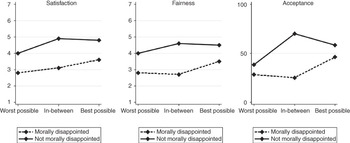
Results add further insights into the importance of moral beliefs about the outcome. As evidenced by the statistics (eight of nine coefficients for actual treatment reach a standard level of statistical significance), morally satisfied participants demand less than fully correct treatment from the official. Indeed, as the predicted level of decision acceptance reported in Figure 3 illustrates, respectful only (the official who is friendly but uncaring) is just as effective as the fully correct treatment. This can be seen by moving along the horizontal axis from the worst possible conduct to the best possible conduct (solid line).
Predicted levels of decision acceptance by moral disappointment about the outcome

However, as evidenced by substantially large and negative coefficients for interaction terms, morally disappointed participants are not at all affected by conduct of the types respectful only and careful only. For these individuals, only the fully correct treatment makes a systematic difference for decision acceptance. In Figure 3, this interaction effect is illustrated by an essentially flat line as we move along the horizontal axis from the worst possible treatment to the in-between treatment, and by a statistically significant (albeit substantially small) peak as we reach the category ‘best possible treatment’ (dotted line). It can thus be concluded that morally disappointed participants apply a stricter standard of fair treatment than others. This implies that government officials are particularly pressured to live up to high standards of conduct when interacting with morally disappointed citizens.
Furthermore, results show that pre-decision moral beliefs about the outcome exert a direct and negative effect, irrespective of the actual conduct of the official. As illustrated in Figure 3 by a persistent gap in decision acceptance between ‘morally disappointed’ and ‘not morally disappointed’, this negative effect is at least as strong as the positive effect of receiving fully correct treatment. This makes for a dramatic illustration of the conditioning effect of moral disposition: morally disappointed citizens who receive the best possible treatment from government officials are not more willing to accept the decision than citizens who are treated in an absolutely terrible way but who are morally prepared to accept the outcome.
Conclusions and discussion
Procedural fairness theory and several other lines of research maintain that the conduct of government officials is consequential for citizens’ legitimacy beliefs. On a general level, the findings reported in this study confirm this view. However, through its design it adds new knowledge to the field.
First, it is demonstrated that both actual conduct and the perceived fairness of treatment affect decision acceptance. Second, it is shown that the actual conduct matters much less than perceived fairness of treatment. This, in turn, indicates that there is a translation problem in the relationship between government officials and the citizens that are affected by their decisions. When assessing the fairness of the treatment they have received, affected citizens are strongly influenced by factors that are beyond the control of officials. Third, it is found that citizens’ beliefs about the moral right to a favourable outcome condition the encounter with government officials. In particular, morally disappointed citizens seem to demand more regarding the conduct of officials, and are less likely to accept the decision, irrespective of how they are actually treated.
Given my case-oriented approach we cannot know with certainty how far the findings generalize (or indeed whether they are replicable with other methods). For instance, it would be relevant to conduct corresponding studies concerning citizens’ reactions to authoritative decisions with regard to the financing of government actions (e.g. invalid claims for tax deduction), the regulation of public life (e.g. denied requests for building permits), and law enforcement (e.g. fines for speeding and running red lights). However, while awaiting further empirical evidence, I argue that my findings are theoretically anchored and that they have face validity.
The presented findings give a new perspective on one of the intuitively most impressive findings of procedural justice research – that persons who are sentenced to severe punishment from the state will increase their trust in government if they are treated fairly by the court (Tyler et al., Reference Tyler, Casper and Fisher1989). Presumably, most convicted persons accept that they are judged according to fair rules and regulations (e.g. ‘thou shall not steal’). If they regarded themselves as victims of an unfair system, as morally disappointed citizens tend to do, it is less likely that their treatment by the court would have any noticeable impact.
Moreover, the findings speak to the practical relevance of procedural fairness theory. Following a thorough review of the literature, MacCoun (Reference MacCoun2006) concludes that procedural concerns are so powerful that citizens might be manipulated into accepting outcomes that are clearly unfair and biased. Based on the findings of this study, such warnings are exaggerated. The most likely outcome of procedurally correct encounters between officials and citizens is that citizens who receive an unfavourable outcome will end up believing that they have been treated unfairly by the official. Those most susceptible to procedural persuasion are citizens who accept the moral foundation of a particular public policy.
Regarding policy implications, there appear to be two principled strategies for the state to increase citizens’ willingness to accept unfavourable authoritative decisions. The first departs from the conduct of government officials. The state should ensure that the conduct of officials is procedurally flawless, and then focus on convincing moral critics of public policies to care more about the treatment they actually receive. As the findings of this paper indicate that citizens in general do not uphold a clear distinction between procedures and outcomes, this strategy is probably difficult to realize. Moreover, it is questionable from a normative point of view. Political philosophers that are instrumentalists argue that procedures alone cannot create a just society; even fair procedures may lead to distributively unfair outcomes (e.g. van Parijs, Reference Van Parijs1996; Miller, Reference Miller1999: 93–110).
The second strategy ascribes a key role to the policy makers that decided the rules and regulations that guide the decisions of government officials. Precisely, they should convince moral critics that current policies are actually based on fair principles of distribution. In the case of a restrictive unemployment insurance system, policy makers need to explain why they have created a system that forces individuals with strongly held career plans to take on less satisfactory jobs. This is the business of public deliberation: political leaders need to continuously express support for the decisions of government officials or, alternately, change rules and regulations. Elections should be used to seek mandates for current practices or for changes. Journalists should confront politicians, who shy away from the difficult questions that will undoubtedly arise.
One prediction is clear from this study – that attempts to address problems of legitimate decision-making by reforming the conduct of government officials are likely to be only partially successful. The issue of citizens’ willingness to accept unfavourable authoritative decisions is political in the narrow sense of the word.
Acknowledgements
A large number of persons have provided valuable comments during various phases of this project. I wish to extend special thanks to Daniel Eek, Mikael Gilljam, Marcia Grimes, Staffan Kumlin, Johannes Lindvall, Daniel Naurin, Mikael Persson, Maria Petersson, Jon Pierre, and Bo Rothstein. Christina Ribbhagen has contributed with creative suggestions as well as with research assistance. The study was funded by grants from The Swedish Council for Working Life and Social Research and The Bank of Sweden Tercentenary Foundation. Earlier versions of the paper were presented at the 2005 ECPR General Conference, Budapest September 2005, and at the Robert Schuman Centre for Advanced Studies, European University Institute, May 2006.