INTRODUCTION
Mechanical ventilation (MV) is the most common form of advanced life support treatment in the intensive care unit (ICU) setting, ordered for one out of three patients (Esteban et al., Reference Esteban, Anzueto and Frutos2002). For patients at the end-of-life, medical professionals often regard MV as “death delaying” rather than “life prolonging,” requiring considerable medical resources without clear benefit (Combes et al., Reference Combes, Costa and Trouillet2003; Cox et al., Reference Cox, Carson and Lindquist2007; Schönhofer et al., Reference Schönhofer, Euteneuer and Nava2002). In fact, MV is often the last life-sustaining intervention that is discontinued, resulting in death within 24 hours (Cooke et al., Reference Cooke, Hotchkin and Engelberg2010; Epker et al., Reference Epker, Bakker and Kompanje2011; Gerstel et al., Reference Gerstel, Engelberg and Koepsell2008).
The exponential increase in the number of older adults with chronic illnesses has resulted in increased use of the ICU as a default setting for dying patients (Angus et al., Reference Angus, Barnato and Linde-Zwirble2004). Patients receiving MV typically have multiple critical healthcare needs, poor long-term outcomes, and substantial healthcare costs (Esteban, et al., Reference Esteban, Anzueto and Frutos2002; Unroe et al., Reference Unroe, Kahn and Carson2010; Zilberberg & Shorr, Reference Zilberberg and Shorr2008). Treatment for patients in their last year of life accounts for more than one quarter of Medicare spending (Riley & Lubitz, Reference Riley and Lubitz2010). Forty percent of Medicare expenditures in the last year of life occur during the very last month (Chochinov & Kristjanson, Reference Chochinov and Kristjanson1998; Lubitz & Prihoda, Reference Lubitz and Prihoda1984; Lubitz & Riley, Reference Lubitz and Riley1993). The majority of these costs are attributable to such life-sustaining treatments as mechanical ventilation (Yu, Reference Yu2006). For prolonged MV alone, ICU costs in the United States exceed $50 to $60 billion per year (Zilberberg & Shorr, Reference Zilberberg and Shorr2008).
Palliative care is now emerging as an important area of expertise in the ICU, leading to better pain management, higher family and patient satisfaction, and more appropriate allocation of resources (Mularski et al., Reference Mularski, Heine and Osborne2005; Reference Mularski, Puntillo and Varkey2009; Selecky et al., Reference Selecky, Eliasson and Hall2005; Truog et al., Reference Truog, Campbell and Curtis2008).
Given the size of the aging population facing end-of-life issues and the challenges of critical care delivery, there has been emerging evidence supporting the benefit of palliative care in the ICU. Hospital charges have been found to significantly decrease after palliative care consults (PCC) in mechanically ventilated patients (O'Mahony et al., Reference O'Mahony, Blank and Zallman2005). In a study focusing specifically on the financial impact of the PCC in a public hospital, the researchers found that the median charge for patients receiving a PCC was significantly less than for those who did not receive it ($35,824 vs. 42,731, respectively), despite a longer average length of stay (LOS) for the group that received a PCC (14.4 vs. 12.2 days) (Bendaly et al., Reference Bendaly, Groves and Juliar2008).
In another study, a proactive PCC resulted in a lower medical intensive care unit (MICU) LOS (Norton et al., Reference Norton, Hogan and Holloway2007). The investigators utilized a prospective nonequivalent control group design and compared a proactive palliative care approach that included using a screening tool that identified patients at high risk of dying during their hospital stay to usual care. They found that the use of this tool resulted in a significantly shorter LOS in the MICU (8.96 vs. 16.28 days, p = .0001) (Norton, et al., Reference Norton, Hogan and Holloway2007).
There has not, however, been a systematic attempt to identify individual components of the PCC. We sought to explore a potentially crucial component of palliative care provision in critical care — the relationship between the timing of the PCC and two utilization outcomes, namely, LOS and pharmacy costs —in ventilator-assisted patients in the ICU.
METHODS
A retrospective chart review, performed by a team of physicians, health-service researchers, and pharmacists, was conducted after IRB approval, on all ventilator-assisted ICU patients between August 2010 and March 2012 at a large academic tertiary care hospital in the New York metropolitan area (N = 90).
The intervention of the PCC team consisted of at least one face-to-face meeting with the patient and/or healthcare proxy to discuss goals of care. The goal of the intervention was to reach agreement among the patient, the proxy, and the clinical team to withdraw mechanical ventilation.
The primary outcome variables examined in relation to timing of the PCC were: total LOS, total days on ventilator, days on ventilator before the PCC, days on ventilator following the PCC, days to death following discontinuation of the ventilator, and pharmacy costs. Age, gender, patient residence prior to admission, presence of advance directives, and admitting diagnoses were collected. Pharmacy costs pre- and post-PCC were calculated within each medication category for patients who received any medication within the category, either before or after, or both before and after the PCC. Patients who did not receive any agents within a given medication category, either before or after the PCC, were excluded from the medication analyses. For each patient, all pre-PCC costs within each medication category were added to produce a total pre-PCC medication cost sum. This same method was employed to calculate post-PCC costs. These pharmacy costs were compared using a paired t test. Spearman correlations were performed among the number of days to the PCC and the following variables: total LOS, total days on ventilator, days on ventilator after the PCC, number of days until death after the ventilator was withdrawn, pre-PCC pharmacy costs, and post-PCC pharmacy costs.
RESULTS
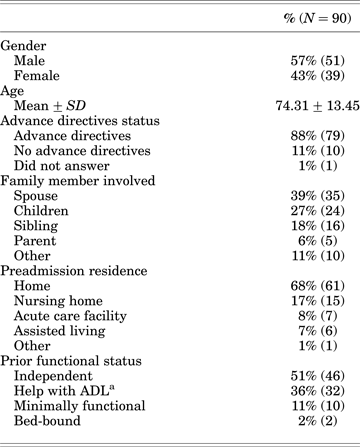
More than half of the 90 patients were men (57%) with a mean age of 74.3 years (SD = 13.45) (Table 1). Most patients (68%) were admitted from the community; 88% had documentation of advance directives in their chart, though the actual timing of the execution of advance directives was not collected. The family member most involved with the patient's care was the spouse (39%), followed by their children (27%). With regard to functional status, 51% of patients were assessed as “independent” at admission.
Patient demographic characteristics

aADL refers to activities of daily living
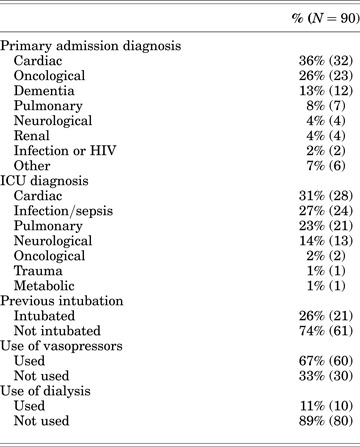
Table 2 presents patients' medical information. Principal admission diagnoses were: cardiac (36%), cancer (26%), and dementia (13%). The most frequent ICU diagnoses were cardiac (31%), infection/sepsis (27%), and pulmonary disease (23%). Vasopressors were used in 67% of patients and dialysis in only 11%.
Patient medical information
On average, patient LOS in the ICU was 8.19 (SD = 7.29) days, with a mean number of days to PCC of 3.86 (SD = 5.15). With regard to days spent on the ventilator, the mean was 7.4 (SD = 7.26), with a mean number of days on the ventilator after the PCC of 3.62 (SD = 5.14).
The number of days from admission to PCC was positively correlated with both total days on the ventilator (ρ = 0.685, p < 0.001) and total ICU LOS (ρ = 0.654, p < 0.001), but not with days on ventilator following the PCC (ρ = 0.04, p = 0.730) or with days to death following ventilator withdrawal (ρ = 0.09, p = 0.410). The number of days to PCC was positively correlated with pre-PCC total medication costs (ρ = 0.539, p < 0.001) but not with post-PCC total medication costs (ρ = 0.16, p = 0.130).
Summing across all medication categories and all patients, pharmacy costs were significantly reduced after the PCC consult (t = 5.77, df = 89, p < 0.001): from a pre-PCC median of $230.96 per day (IQR = $684.32, mean = $493.97, SD = $657.42, range 0–$4,020.28) to a post-PCC median of $30.62 per day (IQR = $59.82, mean = $112.33. SD = $371.55, range 0–$3,403.66).
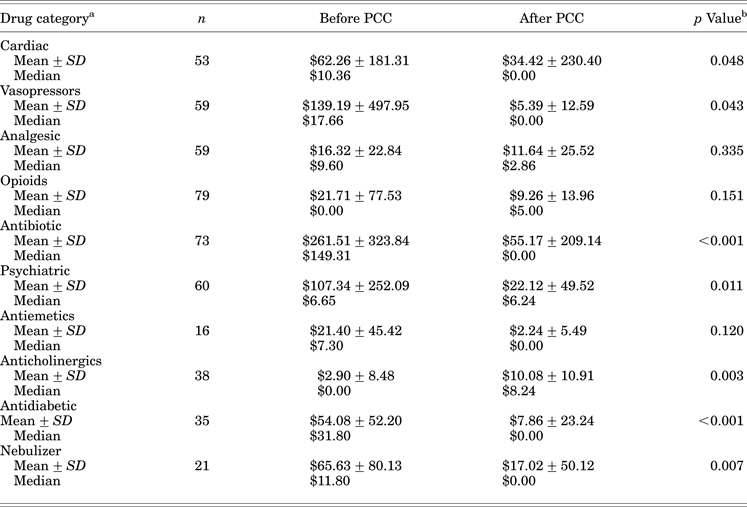
The pharmacy cost data by specific medication type before and after the PCC are presented in Table 3. There was a significant decrease in medication costs following the PCC for cardiac medications, vasopressors, antibiotics, neurological or psychiatric medications, hypoglycemic medications, and orally inhaled medications. In contrast, there was a significant increase following the PCC in the use of such anticholinergic medications as glycopyrolate and scopolamine. The other medication categories did not show a significant change after the PCC. However, there was a significant change in the number of patients receiving opioids: before the PCC, 37% (30/79) of patients were receiving continuous opioid infusion; after the PCC, 90% (71/79) were receiving continuous opioid infusion (χ2 = 46.13, p < 0.0001).
Medication costs within drug category before and after palliative care consultations
aWithin each drug category, data were included only for patients who received a medication within the category either before or after the consultation.
bThe p values are considered significant at p<0.05 and refer to mean drug costs before versus after a palliative care consultation.
DISCUSSION
There is a growing need and interest in examining the role of critical care for a dying patient in the ICU setting. The geographic variation in end-of-life Medicare spending is driven by physician practice style rather than by differences in patient preferences for aggressive treatment (Dartmouth Atlas of Health Care, 2012). The current healthcare climate is conducive for the development of innovative opportunities to improve care delivery in the ICU in a cost-efficient manner. Our study, which explored the crucial component of the timing of the palliative care consult in the ICU setting, is one such opportunity.
Our data support that, in the ICU, earlier timing of the palliative care consult is associated with lower LOS through quicker withdrawal of mechanical ventilation. Clearly, the palliative care consult is one well-defined way to impact physician practice patterns in the ICU. Very rarely in healthcare are we presented with the opportunity to decrease costs and improve care simultaneously. Early palliative consultation and intervention in the ICU helps both patients and families in establishing and accepting timely goals of care when faced with terminal illness.
With regard to medication costs, the PCC was found to be crucial not only in reducing overall medication costs by 87%, but, specifically, in ensuring that pain and symptom control were appropriately managed. In the process of transitioning patient care from cure to comfort, the observed trend was medication discontinuation, with the exception of those medications initiated specifically to target the management of symptoms such as pain and dyspnea, and clearing/reduction of excessive secretions. Indeed, anticholinergics, commonly administered to dry pharyngeal secretions, were the only medications that showed a significant increase in costs after the PCC. Opioid costs tended to decrease after the PCC; however, the number of patients given opioids actually increased from 37 to 90% after the palliative care consult. The drop in opioid cost following PCC may be explained by the change in delivery from oral to inexpensive intravenous, short-acting opioids (morphine, hydromorphone) after the PCC.
The strength of this study relies on the interdisciplinary approach to the research process, namely, a team consisting of physicians and pharmacists who provided expert review in ICU end-of-life care. Furthermore, the absence of protocols, throughout this health system, with regard to mandatory timing of formal palliative consults in the ICU setting, allowed the investigators to report on the natural course of the end-of-life for mechanically assisted ICU patients.
The ethical considerations in this critically ill population limited the causal inferences attributed to the data presented: the study design utilized a retrospective chart review rather than a randomized approach. Replication through larger multicenter studies should be implemented in order to further assess the clinical and financial impact of the PCC in ICU settings.
CONCLUSIONS
Our findings clearly demonstrate that the timing of the palliative care consult is critical in facilitating positive critical outcomes in the ICU setting for ventilator-assisted patients. We found strong evidence that palliative care consults are associated with reduced patient days on the ventilator, shorter LOS in the ICU, and lower total pharmacy costs. Palliative care consults should be requested and implemented as early as possible in intensive care settings to facilitate cost-effective end-of-life care that ultimately benefits the patient and their family.