Introduction
Plants emit variable amounts of a complex of volatiles from their foliage, especially after attack or egg deposition by herbivores (Unsicker et al., Reference Unsicker, Kunert and Gershenzon2009; Dicke & Baldwin, Reference Dicke and Baldwin2010; Kigathi et al., Reference Kigathi, Weisser, Veit, Gershenzon and Unsicker2013). Plants maximize fitness by using plant volatiles to regulate the behaviors of various community members around them, such as pollinators, herbivores, carnivorous arthropods, conspecific neighboring plants, or even parasitic plants, especially by using herbivore-associated plant volatiles (HAPVs) (Baldwin et al., Reference Baldwin, Halitschke, Paschold, von Dahl and Preston2006; Soler et al., Reference Soler, Harvey, Kamp, Vet, van der Putten and van Dam2007; Bruinsma et al., Reference Bruinsma, IJdema, Van Loon and Dicke2008, Reference Bruinsma, Posthumus, Mumm, Mueller, Van Loon and Dicke2009; Runyon et al., Reference Runyon, Mescher and De Moraes2010). Among the main classes of compounds, green leaf volatiles (GLVs) – C6 aldehydes, alcohols, and their esters are the first chemicals to be released by damaged cell membranes (Hatanaka et al., Reference Hatanaka, Kajiwara and Sekiya1987); these chemicals are usually biosynthesized from linolenic and linoleic acids via the hydroperoxide lyase (HPL) pathway (Kallenbach et al., Reference Kallenbach, Gilardoni, Allmann, Baldwin and Bonaventure2011). The quantity of GLVs is variable among different varieties or cultivars (Loughrin et al., Reference Loughrin, Manukian, Heath and Tumlinson1995; Hoballah et al., Reference Hoballah, Tamo and Turlings2002; Degen et al., Reference Degen, Dillmann, Marion-Poll and Turlings2004; Gols et al., Reference Gols, Bullock, Dicke, Bukovinszky and Harvey2011), and GLVs are known to serve as important foraging cues for herbivores and their natural enemies (Campbell et al., Reference Campbell, Pettersson, Pickett, Wadhams and Woodcock1993; Zhang & Schlyter, Reference Zhang and Schlyter2004; Heil, Reference Heil2008; Sun et al., Reference Sun, Wang, Gao, Zhang, Xin and Chen2014). For example, GLVs interfere with attraction of several species of conifer-inhabiting bark beetles to host volatiles (Wilson et al., Reference Wilson, Borden, Gries and Gries1996; Zhang & Schlyter, Reference Zhang and Schlyter2004), but several folivores feeding on angiosperms use GLVs to help locate their hosts (Campbell et al., Reference Campbell, Pettersson, Pickett, Wadhams and Woodcock1993; Sun et al., Reference Sun, Wang, Gao and Chen2012, Reference Sun, Wang, Gao, Zhang, Xin and Chen2014). Moreover, a susceptible wheat variety was found to release greater amounts of (Z)-3-hexenyl acetate than a resistant variety and to be more attractive to wheat stem sawfly, Cephus cinctus Norton (Weaver et al., Reference Weaver, Buteler, Hofland, Runyon, Nansen, Talbert, Lamb and Carlson2009). However, how genetically determined emission levels of (Z)-3-hexenyl acetate influenced other plants’ resistance and whether there is any other GLV component that herbivorous pests use to distinguish resistant and susceptible varieties are still unknown.
The tea green leafhopper, Empoasca vitis Göthe (Hemiptera: Cicadellidae), is an extremely harmful sap-sucking pest of the tea plant (Camellia sinensis (L.) O. Kuntze). This insect, which seriously reduces tea yield and quality in East Asia (Yukio, Reference Yukio2000; Zeiss & Braber, Reference Zeiss and Braber2001; Guo, Reference Guo2011), usually has ten generations per year and overwinters as an adult. Both nymphs and adults of E. vitis attack tea buds and the tender leaves and stems of tea plants, and adult females lay eggs in the tender stems. Though chemical controls are effective against this pest, they pose health and environmental risks. Alternative strategies for controlling this pest are urgently needed. Since the screening and development of resistant plant varieties is considered to be one of the foundations of integrated pest management, it is important to identify and develop resistant tea varieties. Currently, the development of tea varieties that are resistant to insects has lagged far behind the development of resistant varieties of other crops, partly due to the lack of effective detection indices. Analysis of the chemical cues released by different varieties that herbivores could use to locate a suitable host plant is crucial.
Our previous research showed that the densities of E. vitis on Enbiao (EB) and Banzhuyuan (BZY) varieties in the field were significantly higher than the densities of E. vitis on Changxingzisun (CX) and Juyan (JY) varieties (Jin et al., Reference Jin, Sun, Chen and Xiao2012). Moreover, mated E. vitis female adults preferred to lay eggs on EB and BZY varieties rather than on JY and CX varieties, and the duration of one generation of E. Vitis reared on JY and CX varieties was significantly longer than the duration of one generation reared on EB and BZY varieties (Jin et al., Reference Jin, Sun, Chen and Xiao2012). Six hydrocarbon aldehydes, alcohols, and acetates are produced in large amounts by damaged tea plants (Cai et al., Reference Cai, Sun, Dong, Wang and Chen2014; Xin et al., Reference Xin, Zhang, Zhang, Chen and Sun2014a ), and C6 alcohols and their esters help the tea weevil, Myllocerinus aurolineatus (Voss) (Sun et al., Reference Sun, Wang, Cai, Jin, Gao and Chen2010), and the tea looper, Ectropis obliqua, Prout (Sun et al., Reference Sun, Wang, Gao, Zhang, Xin and Chen2014), to locate their hosts. Furthermore, we also found that the relative expression levels of the 13-HPL gene CsiHPL1 were significantly different among the four varieties investigated in our primary experiment; the overexpression of CsiHPL1 caused tomato plants to release more constitutive and wound-induced GLVs [including (Z)-3-hexenal and (Z)-3-hexen-1-ol], and CsiHPL1 transgenic lines exhibited lower levels of resistance to the larvae of the tomato-chewing herbivore, Prodenia litura (Fabricius) (Xin et al., Reference Xin, Zhang, Zhang, Chen and Sun2014a ). We therefore infer that GLVs emitted from the four varieties probably influence foraging by E. vitis to locate its host and/or oviposition site. To test this hypothesis, we first re-examined the transcript expression levels of CsiHPL1 in the first leaves and the tender stems of varieties of EB, BZY, CX and JY. We also used the zNose™ to analyze the emission levels of (Z)-3-hexenyl acetate, (Z)-3-hexenol and (E)-2-hexenal from the first leaves and the tender stems of these four varieties. Then we tested the effect of the three compounds on the host-searching behavior of E. vitis. Finally, the role of the single compound in the process of guiding oviposition preference was also tested.
Methods and materials
Tea varieties
Clonal cuttings of Enbiao (EB) and Banzhuyuan (BZY) (two varieties susceptible to E. vitis), and Changxingzisun (CX) and Juyan (JY) (two varieties resistant to E. vitis) (Jin et al., Reference Jin, Sun, Chen and Xiao2012) were individually planted in plastic pots (14 cm diameter × 15 cm height), irrigated once every other day, and fertilized once a month. Plants were kept in a controlled climate room that was maintained at 26 ± 2°C, 70–80% r.h., and 12-h photophase. The light intensity for plants was about 450 µM photons m−2 s−1 during the photophase. After 2 years, the plants were used for the experiment.
Insects
E. vitis nymphs of 3–4 instars were collected from damaged plants at the Tea Research Institute of the Chinese Academy of Agricultural Sciences (TRI, CAAS, N30°10′, E120°5′), Hangzhou, China. The insects were reared on tea seedlings in a controlled climate chamber programmed at 25 ± 2°C, 70 ± 5% r.h., and a photoperiod of 13:11 h (L: D). The newly emerged adults were separated by sex according to morphological characteristics and maintained in separate plastic tubes (1.5 cm wide × 9 cm high) with fresh tea leaves. Mated 2-day-old adults were used for olfactometer and oviposition assay experiments. To obtain mated females, one newly molted adult female and two males were confined in a plastic container (12 cm high × 7 cm diameter) for 24 h. Mated females that had not yet laid eggs were used for the oviposition experiment. To obtain mated males, one newly molted adult male and two females were confined in a plastic container (12 cm high × 7 cm diameter) for 24 h.
Quantitative real-time polymerase chain reaction (qRT–PCR)
Total RNA was isolated using an SV Total RNA Isolation System (Promega) following the manufacturer's instructions. One μg of each total RNA sample was reverse-transcribed by using a PrimeScriptTM RT–PCR Kit (TaKaRa). TACCTCGTCCCGATACAACA (forward primers (5′–3′), and ATCTTGACGGTGGGTAGGAG (reverse primer (5′–3′) were used for mRNA detection of CsiHPL1 (HM440156) by qRT–PCR. The qRT–PCR assay was performed on a CFX96TM Real-Time System (Bio-RAD) using a Premix Ex TaqTM Kit (TaKaRa). The expression level of CsiHPL1 was normalized to the tea GAPDH gene (Liu & Han, Reference Liu and Han2010) and calculated using the 2−ΔΔCt method. For each plant, the first leaf and tender stem were harvested separately; for each variety, six independent biological replications (six different individual plants) were performed.
GLV analysis
Emissions of GLVs ((Z)-3-hexenyl acetate, (Z)-3-hexenol and (E)-2-hexenal) were measured with a zNose™ Model 4200 vapor analysis system (electronic sensor technology-EST, Newbury Park, CA, USA) fitted with a Tenax® trap (1 mg), a miniature DB-5 fused silica capillary column (1 m × 0.25 mm i.d., 0.25 µm film thickness, EST), and a sensitive surface acoustic wave (SAW) quartz microbalance detector. The headspace volatiles were swept into the trap for 10 s. Then the trap was heated to 250°C to desorb and transfer the volatiles to the analytical column. The inlet temperature was 200°C, the valve temperature was 165°C, and the initial column temperature was 40°C. The column temperature was ramped up at 10°C s−1 to 180°C and held for a further 6 s. The SAW sensor was operated at 60°C, and helium flow was set at 3.00 ccm. After each data sampling, the system needed to be baked for 30 s. At least one blank was run between each sample measurement to ensure the system was clean and to obtain a stable baseline. Data were analyzed by using Microsense software (version 5.44 EST, Microsense Software Pvt. Ltd., Bangalore, India).
Potted plants were washed under running water and then air dried. The most apical unfolded but not yet fully expanded leaf was designated as leaf position one, and the other leaves were numbered sequentially down the stem. The green stem between the first leaf and the fourth leaf was designed as the tender stem. The first leaf was damaged with a needle patch (a rubber septum holding 80 pricks, made by our lab), avoiding the major veins; the tender stem was cut into ten uniform segments using surgical scissors then sealed in a 50 ml glass vial with a PTFE/silicone septum for 3 min. The period from harvesting the sample to sealing it in the vial was less than 30 s. The zNose™ analysis was performed by directly aspirating the sample headspace. All the analysis was done between 8:00 and 11:00 h on the same day. After aspiration, the samples were weighed on an analytical balance. The concentrations of GLVs were expressed as peak area per gram of fresh leaves. Due to their similar molecular weights, (Z)-3-hexenol and (E)-2-hexenal cannot be simultaneously differentiated by zNose™ analysis. Thus, the concentration of these two chemicals was calculated in total. The experiment was replicated five times (from different individual plants) with each variety.
Olfactometer test
The behavioral responses of the E. vitis adults (2 days-old, mated, never laid eggs) to odors released from synthetic compounds were tested in a Y-tube olfactometer (20 × 20 × 20 cm3 arm length, 2 cm diameter, 75° Y angle). The bioassay was conducted in a box with 25-W fluorescent lamps on each top edge. All bioassays were conducted between 15:00 and 20:00 h. Chambers containing odor sources and controls were connected to the ends of the Y-tube by Teflon tubes. Charcoal-filtered air was pushed into each of the chambers at 0.8 l min−1 by a vacuum pump. Individual leafhoppers were placed at the downwind end of the main tube and were considered to have made a choice when they crossed a line 8 cm after the division of the base tube and remained there for at least 1 min. If a leafhopper did not make a choice within 5 min, it was deemed unresponsive and its action was recorded as ‘no choice.’ After 2 leafhoppers were tested, the olfactometer tube was washed with 98% acetone and then heated at 100°C for 5 min. The position of odor source containers in relation to each arm was reversed after each replication. To avoid contamination, the connections of the odor chamber to the flow meter were rinsed with 98% acetone and then heated at 100°C for 5 min after each replication. For each bioassay, at least 32 replicates were performed.
Silicon rubber septa were used as odor dispensers. Ten μl of one chemical was added to a septum and aired for 5 h; the loaded septum was stored at −20°C until it was individually placed in an odor container. Each septum was used for experiments for less than 3:00 h. Within that time, the various chemicals were released at rates of 320–600 ng h−1, which is approximately the rates at which volatiles are released by tea plants (Sun et al., Reference Sun, Wang, Cai, Jin, Gao and Chen2010). The behavioral responses of the leafhoppers to purified air v.s. (Z)-3-hexenyl acetate, (Z)-3-hexenol or (E)-2-hexenal were tested in the olfactometer. The chemicals, (Z)-3-hexenyl acetate (97%), (Z)-3-hexenol (97%) and (E)-2-hexenal (97%), were obtained from Fluka (Buchs, Switzerland).
Oviposition assay
We used a choice test to determine the oviposition preference of E. vitis females (2 days-old, mated, never laid eggs) for (Z)-3-hexenol and (Z)-3-hexenyl acetate (both of which are attractive to E. vitis females). Oviposition assays were conducted in 75 × 75 × 75 cm3 net cages (Supplemental fig. 1). Ten intact tender shoots from 1-year-old tea plants of variety Longjin 43, incubated in a controlled climate room with the same conditions of different varieties, and contained in a piece of flower soil were used as an oviposition substrate (Supplemental fig. 1). Each silicon rubber septum loaded with 10 µl of one chemical was prepared as above and suspended over the treatment shoots; shoots suspended over empty septa served as controls. Tea green leafhopper females were allowed to choose between two oviposition substrates confined in cages at a distance of 30 cm. A 2-day-old mated female was released into the center of each cage. After 72 h, the leafhopper was removed and the number of eggs deposited was counted. For each assay, five replicates were performed.
Statistical analysis
All statistical analyses were performed using the Statistica program (Statistica, SAS, Institute Inc., Cary, NC, USA). The differences between the number of the leafhopper males and females entering each baited flask for each paired treatment were analyzed by the Kruskal-Wallis test (χ2 approximation). Differences in relative expression levels of CsiHPL1 and emission amounts of GLVs were analyzed by one-way ANOVA. Differences in oviposition preference were analyzed for significance by t-test.
Results
Relative expression levels of CsiHPL1
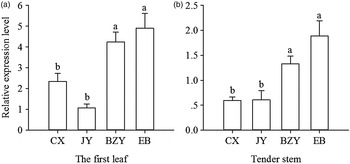
Results of the expression level of CsiHPL1 showed that in both the first leaves and the tender stems, the constitutive expression levels of CsiHPL1 in susceptible varieties, BZY and EB, were much higher than those in resistant varieties, CX and JY (fig. 1).
Mean transcript relative level of CsiHPL1 in the first leaves (a) and tender stems (b) of four different tea varieties. Each value represents the mean ± SE (n = 5). Letters indicate significant differences among different varieties (P < 0.05; Duncan's multiple-range test).

GLVs emissions
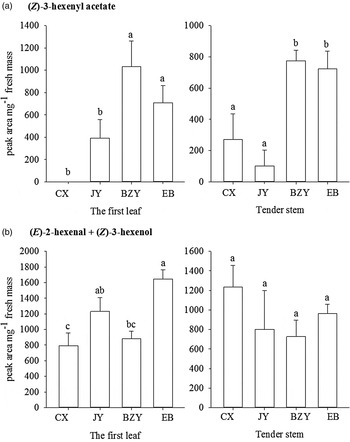
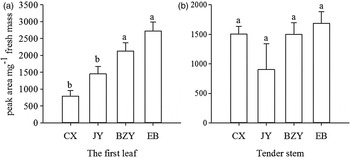
Both the first leaves and the tender stems of the two susceptible varieties (BZY and EB) emitted significantly more (Z)-3-hexenyl acetate than did the first leaves and the tender stems of the two resistant varieties (CX and JY) (fig. 2a). Moreover, the levels of emissions of (Z)-3-hexenyl acetate did not differ significantly between CX and JY, or between BZY and EB, in either of the two samples (fig. 2a). Although the total amounts of (Z)-3-hexenol and (E)-2-hexenal in the tender stems did not differ significantly among the four varieties, the first leaves of the resistant variety JY and of the susceptible variety EB emitted significantly more (Z)-3-hexenol and (E)-2-hexenal than did the first leaves of the other two varieties, CX and BZY (fig. 2a). The total amount of the three GLVs from the two susceptible varieties, BZY and EB, was significantly higher than that from the resistant varieties, CX and JY, in the first leaves, whereas there were no significant differences among the amounts emitted by the tender stems of the four varieties (fig. 3).
Mean levels of (Z)-hexenyl acetate (a) and (Z)-hexenol plus (E)-2-hexenal (b) (peak area mg−1 fresh mass) in the first leaves and tender stems of different tea varieties. Bars indicate the mean ± SE (n = 5). Letters indicate significant differences among different varieties (P < 0.05; Duncan's multiple-range test).

Mean levels of total amounts of the three green leaf volatile (GLV) compounds (peak area mg−1 fresh mass) in the first leaves (a) and tender stems (b) of different varieties. Bars indicate the mean ± SE (n = 5). Letters indicate significant differences among different varieties (P < 0.05; Duncan's multiple-range test).

Behavioral responses of E. vitis adults to the three GLVs
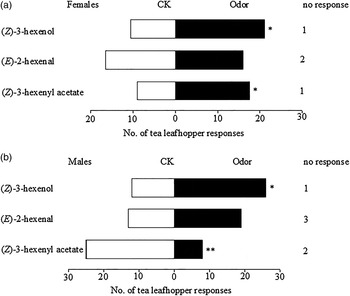
Compared with clean air, (Z)-3-hexenol attracted both males and females, (Z)-3-hexenyl acetate attracted females but repelled males, and (E)-2-hexenal attracted neither males nor females (fig. 4).
Behavioral responses of E. vitis mated females (a) and mated males (b) to three synthetic green leaf volatile (GLV) compounds compared with clean air, evaluated in a Y-tube olfactometer. Numbers refer to the number of E. vitis adults choosing an odor source. N > 32 per treatment. χ2-test: *P < 0.05; **P < 0.001; ns, P > 0.05.

Oviposition preference
Female E. vitis clearly preferred to oviposit more often on tea shoots over which (Z)-3-hexenyl acetate-loaded rubber septa were suspended (13.60 ± 1.33 eggs) than on tea shoots over which blank septa were suspended (2.20 ± 0.73 eggs) (t = 7.52, df = 8, P < 0.001), and more often on tea shoots over which (Z)-3-hexenol-loaded rubber septa were suspended (11.00 ± 0.71 eggs) than on tea shoots over which blank septa were suspended (4.20 ± 0.73 eggs) (t = 6.67, df = 8, P < 0.001).
Discussion
GLVs play an important role in the host-searching behavior of herbivores (Xin et al., Reference Xin, Zhang, Zhang, Chen and Sun2014a ). (Z)-3-hexenyl acetate and (Z)-3-hexenol, for example, provide host location cues to many herbivorous insects, such as the damson-hop aphid, Phorodon humuli (Schrank) (Campbell et al., Reference Campbell, Pettersson, Pickett, Wadhams and Woodcock1993), the curculionid beetle, Diaprepes abbreviatus (Linnaeus) (Otálora-Luna et al., Reference Otálora-Luna, Hammock, Alessandro, Lapointe and Dickens2009), the tea weevil, Myllocerinus aurolineatus (Voss) (Sun et al., Reference Sun, Wang, Cai, Jin, Gao and Chen2010), and the tea looper, Ectropis obliqua Prout (Sun et al., Reference Sun, Wang, Gao, Zhang, Xin and Chen2014). In tea plants, three main components of GLVs, (Z)-3-hexenyl acetate, (Z)-3-hexenol and (E)-2-hexenal, were emitted from mechanically damaged or herbivore-infested leaves (Han & Chen, Reference Han and Chen2002; Sun et al., Reference Sun, Wang, Cai, Jin, Gao and Chen2010, Reference Sun, Wang, Gao, Zhang, Xin and Chen2014; Xin et al., Reference Xin, Zhang, Zhang, Chen and Sun2014a ). Our results confirmed this finding and found that mated E. vitis female adults were also attracted by (Z)-3-hexenyl acetate and (Z)-3-hexenol, and mated male adults were attracted by (Z)-3-hexenol. Moreover, mated E. vitis female adults preferred to oviposit on tea shoots baited with septa containing either (Z)-3-hexenyl acetate or (Z)-3-hexenol. The results suggest that these two compounds offer E. vitis female adult cues to locate suitable hosts for oviposition. Interestingly, mated E. vitis males were repelled by (Z)-3-hexenyl acetate, which might be a synchronous trait that has evolved to enhance the probability of mating. Through this manner, females could decrease the frequency of mating with already mated males, which may in turn enhance the performance of their offspring (Proffit et al., Reference Proffit, Birgersson, Bengtsson, Reis, Witzgall and Lima2011; Sun et al., Reference Sun, Wang, Gao, Zhang, Xin and Chen2014). Further research of mating characteristics should be carried out to confirm this speculation.
Research has verified that plant variety is one of the main factors that affect the composition of the volatile organic compound (VOC) blend released by plants (Lou et al., Reference Lou, Hua, Turlings, Cheng, Chen and Ye2006; Kollner et al., Reference Kollner, Held, Lenk, Hiltpold, Turlings, Gershenzon and Degenhardt2008; Delphia et al., Reference Delphia, Rohr, Stephenson, De Moraes and Mescher2009; Kariyat et al., Reference Kariyat, Mauck, De Moraes, Stephenson and Mescher2012). The genetic variation among VOCs results in the differential attraction of natural enemies, thereby enhancing the fitness for a group of plants, such as the resistant varieties of rice (Oryza sativa Linn), maize (Zea mays L.) and soybean (Glycine max Merri L.) (Hoballah et al., Reference Hoballah, Tamo and Turlings2002; Lou et al., Reference Lou, Hua, Turlings, Cheng, Chen and Ye2006; Kappers et al., Reference Kappers, Verstappen, Luckerhoff, Bouwmeester and Dicke2010; Michereff et al., Reference Michereff, Laumann, Borges, Michereff-Filho, Diniz, Neto and Moraes2011). Our study showed that there were significant differences in the constitutive transcriptional expression levels of CsiHPL1 and the levels of (Z)-3-hexenyl acetate between susceptible (BZY and EB) and resistant (JY and CX) tea varieties in both the first leaves and the tender stems. Due to their similar molecular weight, (Z)-3-hexenol and (E)-2-hexenal cannot be simultaneously differentiated by zNose™ analysis. Thus, we do not know whether there are differences in the levels of (Z)-3-hexenol or (E)-2-hexenal among different varieties. Further research should elucidate this question. Given that (Z)-3-hexenyl acetate and (Z)-3-hexenol provide host and oviposition cues for E. vitis females, we predict that (Z)-3-hexenyl acetate and (Z)-3-hexenol emitted from different tea varieties influence host selection and/or the location of the oviposition site chosen by E. vitis adult females. Thus the two GLV components, especially (Z)-3-hexenyl acetate, provide a plausible mechanism by which tea green leafhoppers may distinguish between resistant and susceptible varieties. A similar phenomenon was found in the wheat stem sawfly, which was able to distinguish between two tested wheat cultivars by detecting the amounts of (Z)-3-hexenyl acetate (Weaver et al., Reference Weaver, Buteler, Hofland, Runyon, Nansen, Talbert, Lamb and Carlson2009). This ability is probably related to the jasmonic acid (JA)-mediated defense responses in plants. The JA signaling pathway has been reported to play an important role in regulating herbivore resistance in many plant species, including tea (Wang et al., Reference Wang, Li, Hu, Zhang, Zhang and Lou2013; Yang et al., Reference Yang, Duan, Jin, Li, Chen, Ren and Sun2013; Koramutla et al., Reference Koramutla, Kaur, Negi, Venkatachalam and Bhattacharya2014; Xin et al., Reference Xin, Zhang, Chen and Sun2014b ). JA and GLVs are biosynthesized from linolenic acid via the allene oxide synthase (AOS) pathway and the hydroperoxidelyase (HPL) pathway, respectively, both of which share the common substrate hydroperoxy polyunsaturated fatty acid (Feussner & Wasternack, Reference Feussner and Wasternack2002). Thus, a high GLV level may result in a low JA level, and a low JA level may weaken the JA-mediated defense response. Further research should verify this hypothesis.
In summary, emission levels of GLVs and the relative transcriptional expression levels of CsiHPL1 are significantly different between resistant and susceptible tea varieties. Two GLV components, (Z)-3-hexenyl acetate and (Z)-3-hexenol, offer E. vitis female adults cues to locate the host and oviposition sites they need. The findings presented here support the notion that herbivores have evolved the ability to use the genetic traits of VOCs to distinguish the most appropriate host over the course of evolution. Future research should be carried out to determine the threshold of the above indices and then assess the usefulness of the indices. The development of practical detection indices would greatly improve our ability to screen and develop tea varieties that are resistant to E. vitis.
Supplementary Material
The supplementary material for this article can be found at http://dx.doi.org/ 10.1017/S000748531600064X.
Acknowledgements
We thank Emily Wheeler for editorial assistance. We thank Fanfan Xu, Na Zhang and Shuangshuang Cao for collecting and rearing tea green leafhoppers. The study was sponsored by Special Fund for Agro-scientific Research in the Public Interest (201403030, 201303012), National Natural Science Foundation of China (31272053, 31471784), and the Division of Science and Technology of Zhejiang Province (2015C32081).