1. Introduction.
Throughout the history of ecology, many different views have been held about the nature of communities and ecosystems. Some ecologists have argued that they exist mind-independently with discrete boundaries and others have contended they are merely ephemeral collections of species and their abiotic environment. In this essay, I first provide an analysis of the concept of ecological community; or better yet, community concepts. Second, I consider two of the most serious challenges to the reality of ecological communities: what is called ‘gradient analysis’, pioneered by Whittaker (Reference Whittaker1975), and ‘paleoecological analysis’, by Davis (Reference Davis, West, Shugart and Botkin1981). I argue that many have misinterpreted the results of both analyses, and that properly construed they are compatible with the robust existence of communities. Finally, I extend my analysis to ecosystems, arguing that the same interactive approach can be successfully applied there too.
2. Controversy and Concepts.
Ecologists Frederic Clements and Henry Gleason disagreed vigorously over primary and secondary plant succession and the nature of ecological communities (Clements Reference Clements1916; Gleason Reference Gleason1917, Reference Gleason1926). Suppose a set of species in a particular place and time is disturbed by some exogenous process like a forest fire from a lightening strike. Clements argued that communities in response to such disturbances follow a very specific sequence of stages called “seres” and that there is a single self-perpetuating and tightly integrated climax community. Clements considered communities to be “superorganisms”;Footnote 1 he writes:
The developmental study of vegetation necessarily rests upon the assumption that the unit or climax formation is an organic entity. As an organism the formation arises, grows, matures, and dies. … The life-history of a formation is a complex but definite process, comparable in its chief features with the life-history of an individual plant. (Reference Clements1916, 16)Footnote 2
Gleason considered Clements’ views to be without empirical support and argued that succession results from individual species’ physiological requirements and local meteorological conditions. He writes:
[I]t may be said that every species of plant is a law unto itself, the distribution of which in space depends upon its individual peculiarities of migration and environmental requirements. (Reference Gleason1917, 26)
Likewise, he did not think that there is a final climax community; communities are continually changing. Hence, Gleason's views are considered ‘individualistic’. In effect, for Gleason there is no system, but only individual species reacting to disturbances relatively independently of the others.
Throughout the history of ecology, ecologists have conceived of communities in roughly three different ways:
• Communities are groups of species at particular places and times and nothing more.
• Communities are functionally interrelated groups of species.
• Communities are groups of species that are organismic.
In the next section, I consider a framework for thinking about the nature of ecological communities and for clarifying different community concepts.
3. Metaphysics and Ecological Communities.
Material objects, except possibly the simplest as described by current or future particle physics, are composed of parts that potentially interact. Since they are particulars as opposed to natural kinds, they have no instances and, being concrete, are such that their parts are spatiotemporally related. Moreover, they persist over time in virtue of the relations between their parts.Footnote 3 Objects can be classified by the type and intensity of the relations that exist between their parts. I will distinguish between objects as aggregates, wholes, and individuals.
If an object is an aggregate, then its parts bear insignificant causal relations to one another at a time and over time.Footnote 4 If an object is a whole, then certain causal relations exist between its parts such that it is causally structured at a time and through time. Finally, an individual is an object whose parts bear causal relations to one another such that the object is highly structured and integrated. The differences between aggregates, wholes, and individuals concern the causal relations amongst their parts and the strength of those relations and as such, there is a continuum between them.Footnote 5
Now consider the sort of community that Gleason had in mind:
Are we not justified in coming to the general conclusion, far removed from the prevailing opinion, that an association [i.e., community] is not an organism, scarcely even a vegetation unit, but merely a coincidence? (Reference Gleason1926, 16).
Communities, according to Gleason, are composed of whatever species coexist in space and time. This we might call a Gleasonian Community. A Gleasonian community is a group of species in a particular area and time. In effect, this type of community consists of aggregates.
Consider a group of n species at a particular place and time. If the group is a Gleasonian community, then we can properly ask why some other (n+1)th species is not a member of the community. If we were taking one of the other approaches, the answer would be supplied by the causal interactions. The (n+1)th species would be excluded from such interactions. Thus, membership in the community is not secured by mindindependent causal interactions but rather by the ecologist's choice about spatial and temporal boundaries.
Given this supposition, and assuming Gleason is correct, it follows that community membership is based on scientists’ possibly nonarbitrary conventions or decisions.Footnote 6 Nevertheless, one might suppose that there are noncausal mind independent properties which are the basis of community membership. For example, consider the following property—the Shannon Diversity Index. Let S be the total number of species and p i is the proportion of species i in S. The Shannon Diversity Index is then
 $H=-\sum_{i=1}^{S}p_{i}\mathrm{ln}\,p_{i}$
. This index combines the richness and evenness of a collection of species into a single number. However, this need not be a genuine community-level property since any collection of species as separated in space and time as you like can possess have a Shannon Index. As such, it is not a mind independent property had by, and only by, a causally interactive group of species.Footnote 7
Thus, we are left with the following argument:
• If Gleasonian communities objectively exist (i.e., are real), they must exist mind independently.
• These communities depend on ecologists’ decisions—arbitrary or not—as to what species to consider members of the community.
• Hence, they do not objectively exist.
This view is offered by ecologist Robert MacArthur:
Irrespective of how other ecologists use the term “community”—and there are almost as many uses as there are ecologists—I use it here to mean any set of organisms currently living near each other and about which it is interesting to talk. (Reference MacArthur, Farner, King and Parkes1962, 189–190)
However, as we noted, the ‘(n+1)th problem’ might not be a problem if groups of organisms can be distinguished in virtue of the causal interactions between their respective species populations. As Levins and Lewontin write, “The question of boundaries of communities is really secondary to the issues of interaction among species” (Reference Levins and Lewontin1993, 54). Hence, the (n+1)th problem need not be a particular problem for what I will call ‘Hutchinsonian’ and ‘Clementsian’ approaches.
A whole is a set of species’ populations that exist as a structured entity—there are causal relations that at least weakly integrate the species at a time and through time. This type of community concept is sometimes associated with George Evelyn Hutchinson (Reference Hutchinson1948). He thought of communities as having feedback loops that assure their self-regulation and persistence. What sorts of causal relations or ‘feedback loops’ might bind species in a community?
One candidate is the various interspecific interactions that exist amongst organisms and populations. Between any two species, we can classify these interactions as either positive (+), negative (−), or non-existent (0) depending on how they affect the growth or abundance of the respective species. These relations include competition [−, −], predator-prey [−, +], mutualism [+, +], amensalism [−, 0], and commensalism [0, +]. Between any three or more species, we can similarly distinguish between various indirect effects such as apparent competition and trophic cascades. If there are interspecific interactions between species that integrates the species into something more than an aggregate—a whole—then this community will be called a Hutchinsonian community. A Hutchinsonian community is a group of species that at least weakly interact with one another and not others at a time and through time.
Finally, a Clementsian community is a tightly integrated group of species that bear various causal relations between its component species. The community forms an individual like that of a multi-cellular organism. So, a Clementsian community is a group of species that strongly interact with one another at a time and through time. Communities can exist as aggregates, wholes, or individuals.
It is certainly an empirical issue whether any of these community concepts applies to any group of species. Nonetheless, some progress has been made in understanding what ecological communities might be. Next, I want to consider arguments for the nonexistence of Hutchinsonian and Clementsian communities.
4. Community Boundaries.
Here is an argument against the existence of ecological communities both in the Hutchinsonian and Clementsian senses:
• Communities are real only if they have boundaries.
• However, many purported communities do not have boundaries.
• Hence, many purported communities are not real.
I will now turn to two empirical studies which have been interpreted as supporting the second premise of this argument.
Empirically, one can portray changes in community structure by plotting species abundances along some continuous gradient of an abiotic variable (see Figure 1). The gradient may concern moisture, temperature, salinity, exposure, etc. One samples the species’ populations along the continua noting both the exact conditions and the abundance of the species. Cornell ecologist Robert Whittaker performed such gradient analyses in the 1950s and 1960s in mountainous areas including: the Santa Catalina Mountains in Southern Arizona, the Siskyou Mountains in Oregon, and the Great Smoky Mountains in Tennessee. In mountainous regions, moisture and temperature will vary with elevation, slope, and exposure. Whittaker reasoned that if a group of species forms a Clementsian community, then it should have a “closed structure.” Similarly, if a group of species forms a Gleasonian community, then it should have an “open structure.” These possible structures are depicted in (a) and (b), respectively.
A diagram of ‘closed’ and ‘open’ community structure (Ricklefs Reference Rickelfs2001).

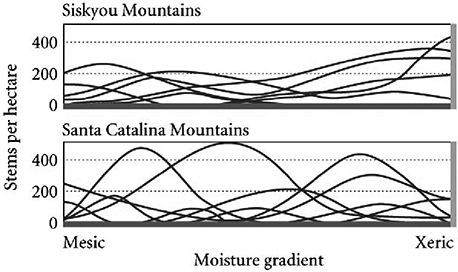
Whittaker's results suggested that there are no community boundaries—the species vary continuously along the environmental gradients. He examined the distribution of plant species along moisture gradients with elevation held constant at 460 m – 470 m in Oregon and 1,830 m – 2,140 m in Arizona (see Figure 2).
A diagram of the distributions of species along a moisture gradient in Oregon and California (Ricklefs Reference Rickelfs2001).

Whittaker's results have been interpreted in many ways, but there is a very common interpretation, as found in the following:
If plants really did form tightly knit communities—“nation states of trees,” is the ecologist Paul Colinvaux's felicitous phrase—then the distribution should fall into clusters. Instead, Whittaker found, each species behaved totally independently. … What all this means is that there is no such thing, really, as a pine forest, or a mixed-hardwood forest or a tall-grass prairie or a tundra. These are human categories, not biological ones. They are simply names that we have applied in a rough attempt to impose intellectual order on the infinite diversity of landscapes that exist. (Budiansky Reference Budiansky1995, 86)Footnote 8
There are no discrete communities of plants. The reality is endless blending as each individual Darwinian species finds its own range, jostling its neighbors, living in its own individual niche. (Colinvaux Reference Colinvaux1979, 72)
However, there are several problems with these interpretations.
First, ecologists and botanists using Whittaker's results have committed a fallacy of ‘hasty generalization’. Given the continuum of causal interactions, there will be species’ populations which do not belong to communities and some that do. Moreover, given the importance of habitat fragmentation and patchiness of landscapes, we should expect the existence of at least some Hutchinsonian communities. Thus, even if Whittaker's studies show that these specific collections of species do not form communities, this is insufficient to show that there are no such communities.
Second, Whittaker's data are correlative and his argument contains implicit interactive assumptions:
• Interactions among species should be similar at all points along environmental continua. Thus, if two or more species interact in a certain way at a point, then if they interact at other points it is in the same way.
• Groups of species should be associated at all points on a gradient if interdependence is to be accepted. Thus, if two or more species interact at a point on a gradient, then they interact at all points on that gradient.
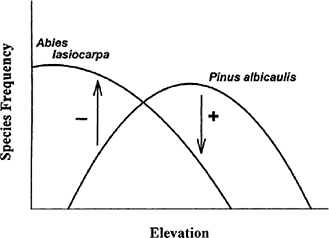
However, we know these assumptions to be false. Species’ populations may be interdependent at some points on a gradient and not at others, and the type of interaction between them may change along a gradient. In the Northern Rockies, Pinus albicaulis increases the mortality rate of Abies lasiocarpa at lower elevations. At timberlines in xeric areas, A. lasiocarpa ‘clumps’ around P. albicaulis and has decreased growth rates as the latter's mortality rate increases (Callaway Reference Callaway1997). Thus, fully overlapping discrete groups of species is not necessary for demonstrating interdependence. (See Figure 3.)
Schematic continuum of Pinus albicaulis and Abies lasiocarpa in the northern Rocky Mountains (Callaway Reference Callaway1997).

Third, when we consider Whittaker's own explanation of the patterns, he argues that it is niche differentiation that leads to ‘no boundaries’. He writes,
It is of interest to ask why species do not evolve to form groups with parallel distributions. … The two species are in close competition (in the same or closely related niches) within the same range of a habitat gradient, such as elevation or topographic moisture. Selection will increase the difference in mean adaptive positions along the habitat gradient. As competing species evolve toward differences in niche, so they evolve also toward difference in habitat. (Reference Whittaker1975, 116)
In order to clarify Whittaker's considered view let us say that a community-level property is any causal biotic relation between two or more species.
Note that the relevant causal interactions are between two or more species. Intraspecific competition is an interaction between individuals of the same species that affects is rate of growth. As such, it is not a community-level property.Footnote 9 So, on Whittaker's view, competitive interactions between adjacent species spread the species apart along the gradient. Thus, community-level properties themselves bring out an ‘open structure’, which gives the illusion that there are no communities.
To put my view then more precisely, species populations form an ecological community just in case they exhibit community interactions, or put differently, they possess a community-level property. This then implies that a group of species’ populations possess such a property just in case they interact qua community. For example, if w and x interact as predator and prey and x and y interact as interspecific competitors, and there is no z such that it interacts qua community with either w, x, or y, then x, y, w form a community excluding z. However, given considerations discussed above, this suggests that communities may be much smaller and more ephemeral than ecologists have typically considered. Let me now consider another study that purports to show that communities do not exist.
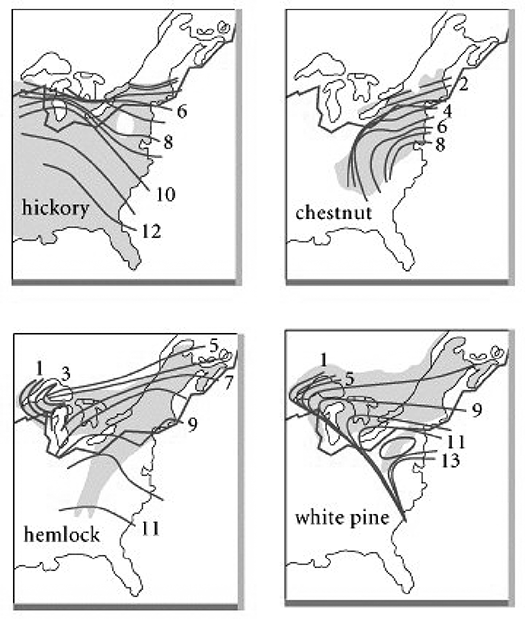
Another important set of studies was conducted by Margaret Davis (Reference Davis, West, Shugart and Botkin1981), an ecologist at the University of Minnesota. By radiocarbon dating fossilized tree pollen in lakes and bogs, she could characterize how North American vegetation has changed since the glaciers retreated. Based on her findings, she argued that each tree species migrated from different initial locations and with differing dispersal rates (see Figure 4).
Migration of hickory, chestnut, hemlock, and white pine in the northeastern United States after the last glaciation (Ricklefs Reference Rickelfs2001).

For example, hemlock and hickory expanded their ranges in a northerly direction and chestnut and white pine did so in a westerly direction; moreover, they each did so at different speeds. The partial co-occurrence of species in the present hides the individual migratory history. Thus, one can argue that if Clements was correct, then tree species should have occurred together and have migrated together as a unit. These empirical results suggest that Clements got it wrong and Gleason right. Here is an example of the usual interpretation given to Davis’ studies. Stephen Budiansky writes,
Within the last twenty years or so, further studies have hammered the final nails in the coffin of the idea that though climates may come and go, a boreal forest is still a boreal forest. Pollen analyses have proved that forests do not simply pick up and migrate en masse. As the glaciers retreated, bands of vegetation did not simply shift northward, keeping their character unchanged. Rather, individual species responded at radically different rates to a changing climate. A boreal forest ten thousand years ago had a composition very different from that of a boreal forest today. (Reference Budiansky1995, 87)
Here we see some of the same mistakes made in connection with Whittaker's work. There is a hasty generalization from one study on forests in the northeastern United States to conclusions about all communities. More importantly, there is a running together of correlative data and causal interaction. We can grant that the individual tree species migrated differentially as the glaciers receded; however, this does not imply that they were not causally interacting prior to the glacial retreat. As we noted above, communities may be ephemeral and the parts change over time. It is simply incorrect to assume that communities either do not exist or are structured like superorganisms.
By way of summary, first, not every species or every collection of species occurring in a place at a time is a part of a community or forms a community. Even if species or their populations form communities, they may be mereologically smaller and more shortlived than ecologists have appreciated. So, after some conceptual clarification, we are left with the questions of community ecology:
• Do sets of species or their populations exhibit any interdependence, and if so, how interdependent are they?
• Do sets of species exhibit such interdependence that they are systemic?
These are empirical questions and as such must be left to the empirical investigations of ecologists.
5. Ecosystems.
I now turn to issues concerning the nature and existence of ecosystems. The concept of ecosystem has a rich history, which I can only gesture at here. However, in ecosystem ecology we find a similar conceptual pluralism as we did in community ecology.
One of the major reasons for the existence of ecosystem ecology was dissatisfaction with the concept of an ecological community in favor of the ‘total’ abiotic and biotic system. Communities were thought of being incomplete in some sense. Ecologist A. G. Tansley writes:
The more fundamental conception is, as it seems to me, the whole system (in the sense of physics), including not only the organism-complex, but also the whole complex of physical factors forming what we call the environment of the biome—the habitat factors in the widest sense. Though the organisms may claim our primary interest, when we are trying to think fundamentally we cannot separate them from their special environment, with which they form one physical system. (Reference Tansley1935, 299)
This focus on systems that include organisms and their environment was manifest in the work of Raymond Lindeman, an aquatic ecologist at the University of Minnesota. Following Charles Elton and Tansley, he offered a ‘trophic-dynamic’ notion of an ecosystem. Ecosystems are systems in virtue of the energy transformations that occur via their inputs, outputs and components, understood through trophic levels (primary producers, herbivores, carnivores, etc). Thus, organisms and populations of them are categorized into natural kinds and the movement and flow of energy through them is studied.
By the 1950s, there was a conceptual framework for studying energy flow and the cycling of nutrients in ecosystems. Interestingly, we see a divergence in approaches. The Eltonian-Lindeman account of ecosystems considers kinds of organisms and studies the movement and flow of energy between them. However, Eugene Odum construed ecosystems in the terms of their ‘energetics’. Here organisms simply drop out and we have nothing but energetics. Organisms are transducers of energy and nutrients. We can thus articulate several ecosystem concepts through various interactions or flows—Lindeman-Elton ecosystems, Odum ecosystems, etc. in a manner similar to our discussion of community concepts.
Just as there has been skepticism concerning the existence of communities so has there been with respect to ecosystems. The Department of Interior's Fuel Coordinator Allan Fitzsimmons has in fact written an entire book (Reference Fitzsimmons1999a) criticizing the ecosystem concept and ecosystem management. He writes:
The problem starts with the idea of an ecosystem itself. The term was coined by Arthur Tansley in Reference Tansley1935, who described them as physical systems encompassing living and nonliving things and their interactions. Ask the Forest Service, the Environmental Protection Agency, the Fish and Wildlife Service, and the Sierra Club to show you their maps of the ecosystems of the United States. They differ greatly. The so-called Greater Yellowstone Ecosystem can cover anywhere from 5 to 19 million acres, depending on who is defining it. These discrepancies occur because the human mind fabricates ecosystems. Nature does not put ecosystems on the land for researchers to discover. Ecosystems are only mental constructs, not real, discrete, or living things on the landscape. (Reference Fitzsimmons1999b, 3)
There are several problems with the above passage. First, Fitzsimmons supposes that there is one and only one ecosystem present in a given region, which is false; ecosystems exist at different scales and may be embedded in one another as parts to wholes. Of course, not all ecosystems may be particularly interesting from various points of view, but that is simply beside the point as to their existence. Second, he also assumes that each group is attempting to map the same ecosystem in the same way, and that is false. For any collection of objects, we can map them in a variety of different ways, and that also says nothing about the existence of the object in question. Mapmakers select features and relationships of interest and as such they are perspectival representations.
Following our discussion of communities, in order to demonstrate the nature and existence of ecosystems, we must specify the relevant ecosystemic interactions and flows and construe ecosystems interactively. Thus, one such concept would look as follows: An ecosystem is a group of abiotic and biotic components that interact through the nutrients and energy that are cycled through them. Moreover, one way to ‘operationalize’ our understanding ecosystemic boundaries is through watersheds. A watershed is an area of land that drains downslope to the lowest point. Watershed boundaries follow major ridgelines around channels and meet at the bottom, where water flows out of the watershed into streams, rivers, or lakes. The nutrient and energetic flows have differential rates inside and outside the drainage basin.Footnote 10 Given the existence of watersheds, I would argue that at some ecosystems have objective boundaries.
6. Conclusion.
In this essay, I first provide an analysis of community concepts. Second, I argue that the individualistic hypothesis is not shown to be true by Whittaker's gradient analysis or Davis's paleoecological analysis and is suggested false by empirical evidence on species interactions. Third, I contend that the same interactive approach can be fruitfully applied to ecosystems as well.