Surgical site infections (SSIs) are associated with increased length of hospital stay, morbidity, readmissions, and healthcare costs.Reference Mahmoud, Turpin, Yang and Saunders1 Colorectal surgery poses a particular challenge for SSI prevention given the high endogenous bacterial inoculum, need for wound care after open colectomies, and poor functional and nutritional status in patients with underlying colon malignancies. Following colorectal surgery, up to 30% of patients may develop an SSI.Reference Zywot, Lau, Stephen Fletcher and Paul2 Prevention of colorectal SSIs is thus a high priority.
Current SSI prevention guidelines recommend multiple interventions in the pre-, intra-, and postoperative care phases,Reference Keenan, Speicher, Thacker, Walter, Kuchibhatla and Mantyh3 incorporated into “bundles.” With new evidence-based interventions being added to clinical guideline recommendations, colorectal SSI prevention bundles have grown increasingly complex. The efficacy of complex bundles in preventing colorectal SSI has been mixed.Reference Zywot, Lau, Stephen Fletcher and Paul2 These results may be explained by gaps in the implementation of SSI prevention recommendations in clinical practice. For example, the actual use of all 5 elements of a colorectal bundle (ie, appropriate preoperative antibiotic prophylaxis; adequate oxygen supplementation; normothermia; normoglycemia; and blood pressure) was achieved for only 21% of patients in one study.Reference Bull, Wilson and Worth4 Although the optimal compliance threshold for achieving a maximal effect in SSI reduction remains unknown, several studies have shown a strong positive association between bundle implementation and SSI reduction.Reference Waits, Fritze and Banerjee5
These data highlight the need to close the gap between evidence (ie, clinical guideline recommendations) and practice (ie, implementation of all bundle elements) to effectively prevent SSIs and improve patient outcomes after colorectal surgery. Implementation of bundles appears to be a key driver in reducing SSIs; thus, research is critically needed to identify barriers and facilitators to bundle implementation across the healthcare work system and to develop effective implementation strategies that increase the implementation of colorectal SSI prevention bundles.
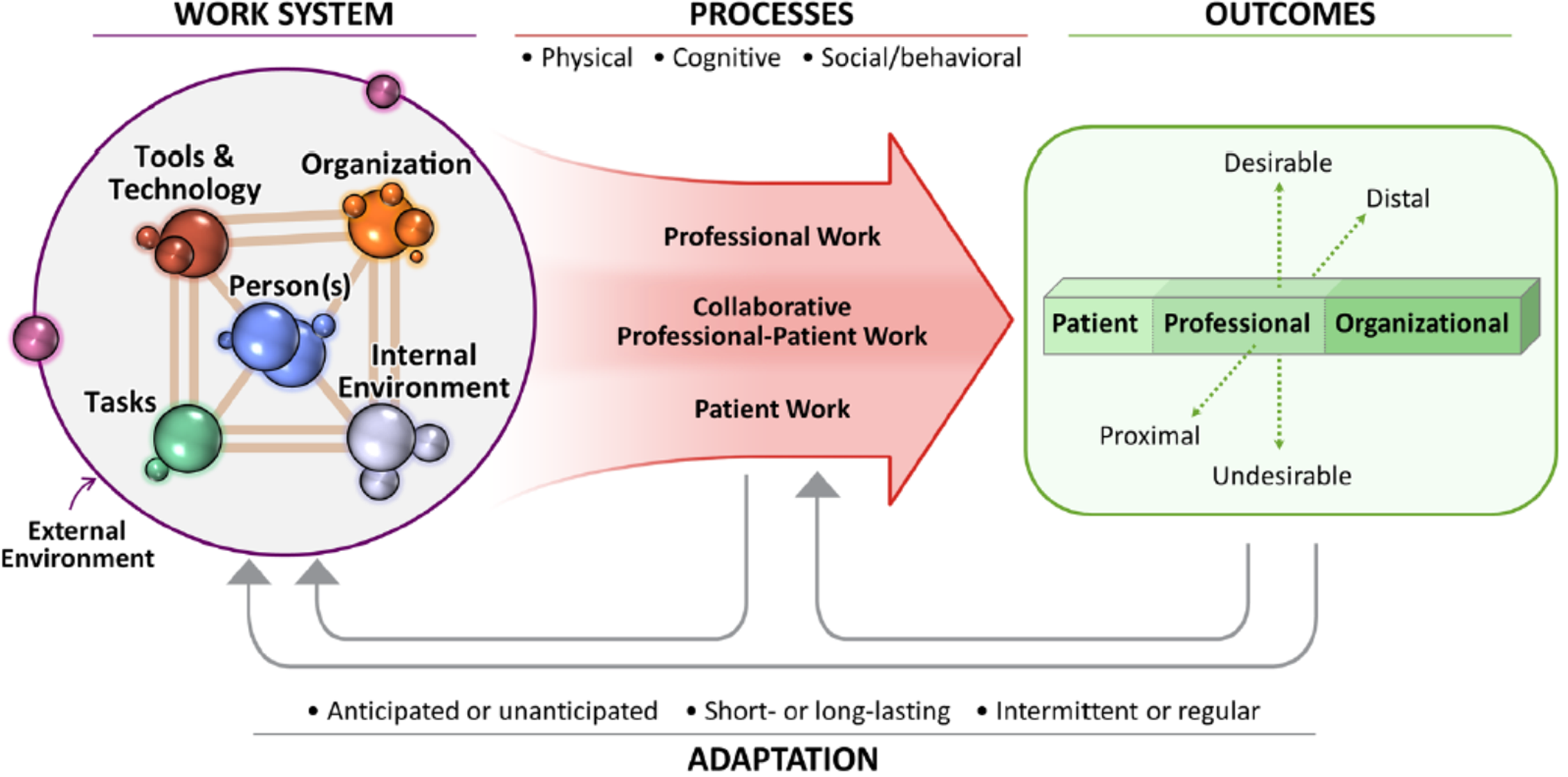
Given the complex, multidisciplinary nature of SSI prevention within the context of a fast-paced healthcare system, a human-factors engineering approach may be useful to provide a systems perspective to evaluate and optimize bundle implementation within the clinical setting.Reference Holden, Carayon and Gurses6 Human-factors engineering studies interactions between humans and other elements of the work system, with the goal of enhancing well-being while improving overall system performance.Reference Holden, Carayon and Gurses6 An example of a human-factors framework is the Systems Engineering Initiative for Patient Safety (SEIPS) model, initially developed by Carayon et al,Reference Carayon, Schoofs Hundt and Karsh7 with subsequent modifications by Holden et alReference Holden, Carayon and Gurses6 (SEIPS 2.0). In this model, healthcare outcomes result from the clinical work processes generated from the interactions within the sociotechnical work system (Fig. 1). The work system focuses on persons delivering and receiving care (patients and clinicians) who perform a variety of tasks using tools and technologies within a specific physical environment associated with a given organization, which in turn functions under the regulatory pressures or influences of an external environment. To obtain the desired organizational or professional health outcomes, patients and clinicians must successfully collaborate as they engage in the work processes required for care, which should all be regularly evaluated and adapted to best fit the persons’ needs.Reference Holden, Carayon and Gurses6
Systems Engineering Initiative for Pateint Safety (SEIPS 2.0) model.
Reproduced with permission from Holden RJ, Carayn P, Gurses AP, et al. SEIPS 2.0: a human factors framework for studying and improving the work of healthcare professionals and patients. Ergonomics. 2013; 56: 1669-1686.

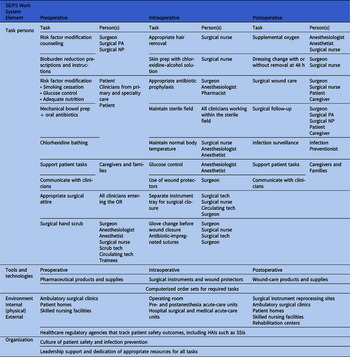
The SEIPS 2.0 framework can be applied to evaluate complex prevention bundles, to identify system barriers and facilitators, and to help design strategies to optimize the implementation of complex interventions and prevent SSI. For example, in colorectal surgery, various people (eg, clinicians, patients, and caregivers and/or families) are involved in enacting prevention practices during the pre-, intra-, and postoperative phases. Multiple tasks must be undertaken individually or in collaboration during each phase, such as use of surgical scrub (clinician task), mechanical and oral antibiotic bowel prep (patient task with guidance from clinicians), intraoperative skin prep (clinician task), maintaining intraoperative normothermia and normoglycemia (clinician task), performing appropriate postoperative surgical wound care (patient task with guidance and support from clinicians) and postoperative infection surveillance (clinician task). Various tools and technologies are used to enact these tasks, such as pharmaceuticals, wound care supplies, surgical instruments, and digital or electronic software packages. The access to and usability of tools and technologies to support patient and clinician tasks vary depending on the physical internal environment (eg, hospital, home, or skilled nursing facility). These elements all take place under an organizational umbrella; for example, the existing local organizational culture and expectations around SSI prevention must be considered when developing, enacting, and evaluating SSI prevention practices. The pressures applied from the external environment (eg, healthcare regulatory agencies auditing or tracking various patient safety metrics related to hospital care, including SSI events) may influence the extent to which institutions dedicate resources to support clinical work flows and processes necessary for SSI prevention. Table 1 illustrates how the SEIPS 2.0 framework can be applied to the implementation of a colorectal SSI prevention bundle across a healthcare system, linking each task within the bundle to the individual SEIPS work systems elements for each process stage (pre-, intra-, and postoperative).
Proposed Application of SEIPS 2.0 Model to the Implementation of a Complex SSI Prevention Bundle

Note. SSI, surgical site infection; SEIPS, Systems Engineering Initiative for Patient Safety; PA, physician assistant; NP, nurse practitioner; HAI, healthcare-associated infection. Highlighted cells show collaborative work between patients/caregivers and clinicians.
A robust evaluation of individual and bundled SSI prevention interventions from a human-factors engineering perspective provides a key opportunity to identify novel approaches to improve implementation. Evaluating interventions in the context of interactions between work system elements can highlight previously unidentified barriers and facilitators, which can then be mitigated or eliminated to enhance the implementation of SSI prevention practices and, ultimately, to improve outcomes by reducing SSIs. SEIPS 2.0 framework-structured interviews, focus groups, and surveys, using open-ended questions targeting all work system elements, as well as the interactions between these elements, can elicit rich data from both clinicians and patients. For example, gathering perspectives on the work system from healthcare workers in a variety of positions (eg, surgeons, anesthesiologists, nurses) and from patients and/or their caregivers may illuminate variances in training on bundle elements, differences in understanding appropriate product or procedural instructions, or varying comfort levels with raising concerns about infection prevention practices. Thus, a human-factors approach to evaluating individual and bundled interventions within the work system produces recommendations that are more easily adaptable to a wider range of clinical settings and positions, rather than a “one size fits all” recommendation that may be difficult to implement in practice.
Human-factors engineering approaches have been used to evaluate the implementation of other complex healthcare bundles (eg, Clostridioides difficile infection preventionReference Musuuza, Hundt and Carayon8) to identify key barriers and facilitators to implementation and to develop recommendations to improve implementation of evidence-based practices. Research focused on the systematic evaluation of SSI prevention bundle implementation in colorectal surgery through the lens of human-factors engineering and the SEIPS 2.0 framework could identify novel approaches to reducing the evidence-practice gap in the clinical setting to reduce SSIs and to improve both patient- and organization-level outcomes.
Acknowledgments
Financial support
Research reported in this publication was supported by the National Institute of Allergy And Infectious Diseases of the National Institutes of Health (grant no. DP2AI144244). The content is solely the responsibility of the authors and does not necessarily represent the official views of the National Institutes of Health.
Conflicts of interest
The authors report no potential conflicts of interest.