Introduction
Borderline personality disorder (BPD) is a severe personality disorder whose features include impulsivity, affective instability, relationship problems and identity problems (APA, 2000). BPD is associated with interpersonal and occupational impairment, increased risk for suicide and higher rates of treatment in both medical and psychiatric settings (Skodol et al. Reference Skodol, Gunderson, Pfohl, Widiger, Livesley and Siever2002). In addition, BPD is frequently co-morbid with Axis I disorders, especially substance use disorders in males, eating disorders in females, anxiety disorders and mood disorders (Zanarini et al. Reference Zanarini, Frankenburg, Dubo, Sickel, Trikha, Levin and Reynolds1998; Zimmerman & Mattia, Reference Zimmerman and Mattia1999), and this co-morbidity predicts poorer short- and long-term outcome (Skodol et al. Reference Skodol, Gunderson, Pfohl, Widiger, Livesley and Siever2002).
Most of our knowledge about BPD has been obtained through the study of clinical samples. Clinical samples are important for characterizing the syndrome as it typically is presented for treatment, assessing the longitudinal course of the disorder, and evaluating the disorder's response to forms of treatment. However, clinical samples are limited in their ability to address certain important epidemiological and aetiological questions as they are likely to contain more severe cases and may therefore not be representative of the disorder as it appears in the general population. Also, these clinical cases often exhibit more co-morbidity than cases from the community (Skodol et al. Reference Skodol, Gunderson, Pfohl, Widiger, Livesley and Siever2002), thereby further clouding the aetiological picture. In addition to clinical studies, it is therefore informative to identify BPD features in the general population to gain a full understanding of the nature of BPD and the developmental pathways leading to BPD.
One important aetiological issue for which community samples are essential is the degree to which there is a genetic influence on the manifestation of BPD symptoms. Increased rates of BPD have been found in the relatives of individuals with BPD (e.g. Loranger et al. Reference Loranger, Oldham and Tulis1982; Baron et al. Reference Baron, Gruen, Asnis and Lord1985; Johnson et al. Reference Johnson, Brent, Connolly, Bridge, Matta, Constantine, Rather and White1995; Zanarini et al. Reference Zanarini, Frankenburg, Yong, Raviola, Reich, Hennen, Hudson and Gunderson2004), and the heritability of traits that are highly associated with BPD (e.g. neuroticism, negative emotionality) is well documented (Nigg & Goldsmith, Reference Nigg and Goldsmith1994). However, our knowledge of the genetic influence on BPD symptoms and features is rather limited.
Only two twin studies so far have provided data on BPD diagnoses and features. Torgersen (Reference Torgersen1984) reported a monozygotic (MZ) concordance rate of 0.0% and a dizygotic (DZ) concordance rate of 11.1% for BPD, suggesting that shared environmental factors influence the variance in BPD. However, methodological problems of that study limit any conclusions. More recently, Torgersen et al. (Reference Torgersen, Lygren, Oien, Skre, Onstad, Edvardsen, Tambs and Kringlen2000) reported on the largest twin study to date (n=221 twin pairs) that examined BPD. Results suggested a genetic liability for BPD of 69%, though this heritability estimate must be considered approximate due to the small number of twins, the ascertainment method (sampling those who were treated for mental disorder) and the fact that the zygosity and diagnostic status of co-twins was not hidden from the interviewers.
To extend the work of Torgersen et al. (Reference Torgersen, Lygren, Oien, Skre, Onstad, Edvardsen, Tambs and Kringlen2000), we initiated a twin study of BPD features in the general population. Specifically, we sought to assess a large number of community-based adult twins from a wide age range and from multiple countries. In this way, we were able to provide precise estimates of the genetic influence on BPD features, to test for quantitative and qualitative sex differences and to determine whether our estimates were consistent across The Netherlands, Belgium and Australia.
Method
Participants
Data were collected as part of an international project on BPD features in Dutch, Belgian and Australian twin cohorts. Protocols in all three countries were approved by their respective ethics committees.
The Netherlands
In The Netherlands, this study is part of an ongoing study on health and lifestyle in twin families registered with The Netherlands Twin Register (Boomsma et al. Reference Boomsma, Vink, van Beijsterveldt, de Geus, Beem, Mulder, Derks, Riese, Willemsen, Bartels, van den Berg, Kupper, Polderman, Posthuma, Rietveld, Stubbe, Knol, Stroet and van Baal2002b, Reference Boomsma, de Geus, Vink, Stubbe, Distel, Hottenga, Posthuma, van Beijsterveld, Hudziak, Bartels and Willemsen2006; Vink et al. Reference Vink, Willemsen, Stubbe, Middeldorp, Ligthart, Baas, Dirkzwager, de Geus and Boomsma2004; Stubbe et al. Reference Stubbe, Posthuma, Boomsma and de Geus2005). Surveys on health and lifestyle were sent to the twin families every 2–3 years. For this study, data from the seventh survey were used which was sent in 2004–2005. A total of 12 785 twins from 6764 families were approached, of whom some individuals had participated before (n=7712) and some had never participated (n=5073). In total, 4017 (31%) twins returned the survey. To examine reasons for not participating, we performed a non-response study by contacting by telephone two subgroups of non-respondents; non-respondents who had participated before and non-respondents who had never participated. Addresses proved incorrect in 23.8% and 42.0% of the two groups, respectively; thus a substantial group of targeted participants never received the questionnaire. After subtracting the estimated number of incorrect addresses from the number of sent questionnaires, the estimated ‘true’ response rates for the two groups were 52.2% and 13.6%, respectively. The pair-wise response rate of the targeted twins who had and had not participated before was 33.6% and 6.2%, respectively. Details on response rates and demographic characteristics of the sample can be found elsewhere (Distel et al. Reference Distel, Ligthart, Willemsen, Nyholt, Trull and Boomsma2007). For a subsample of the Dutch participants retest data were available. At 6 months after the first questionnaire was sent, the retest survey was sent to 240 twins, siblings and parents (one per family), of whom 199 (83%) completed the questionnaire a second time.
Belgium
Dutch-speaking twins in Belgium were asked to take part in the Dutch health and lifestyle study. Belgian participants were recruited through the East Flanders Prospective Twin Survey (EFPTS), a population-based register of multiple births in the Belgian province of East Flanders which was started in 1964. Multiples are ascertained at birth. Basic perinatal data, chorion type and zygosity have been established (Loos et al. Reference Loos, Derom, Vlietinck and Derom1998; Derom et al. Reference Derom, Vlietinck, Thiery, Leroy, Fryns and Derom2006). Young adult twins were contacted by mail and invited to complete a survey which was enclosed with the letter. A total of 3979 twins were approached, of whom 932 (23%) twins returned the survey. As most targeted Belgian participants had not participated in a study of the EFPTS before, it is unknown to what extent addresses were correct. The pair-wise response rate was 15.7%.
Australia
Australian subjects were drawn from the Australian Twin Register (ATR) founded in 1978 (Jardine et al. Reference Jardine, Martin and Henderson1984), as well as from a twin group previously recruited by the Queensland Institute of Medical Research (QIMR). Twins approached by the ATR were asked to participate in the Personality Features in Adulthood study; this was renamed Health, Lifestyle and Personality study for the QIMR approach. Targeted participants included Australian twins born between 1972 and 1987 and were invited by mail to participate in the study. A total of 155 complete ATR twin pairs' (310 twin individuals) contact details were forwarded to QIMR for approach with details for completing the survey either online or on paper; 268 of the 310 twins (86.4%) completed the survey. Of the 808 twins approached directly by QIMR, 431 (53.3%) completed the survey, resulting in a total of 699 completed surveys (493 online, 206 paper). The pair-wise response rate was 50.6%.
Demographics
The mean age of the Dutch twins was 34.9 years (s.d.=11.6, range 19–86 years), of the Belgian twins 28.4 years (s.d.=6.9, range 18–67 years) and of the Australian twins 23.1 years (s.d.=3.74, range 18–33 years). Triplets (n=51), twins with unknown zygosity (n=55) or age (n=9) and twins without a valid score on the Personality Assessment Inventory-Borderline Features scale (PAI-BOR) (n=37) were excluded. This resulted in a total sample for analysis of 5496 participants from 3644 families.
Zygosity
In The Netherlands, the zygosity of 3135 same-sex twins was determined either from DNA polymorphism (n=1203) or from self-report answers to survey questions on physical twin resemblance and confusion of the twins by family members and strangers (n=1932). Based on the answers to these items from all available surveys, zygosity was assigned. When there were inconsistencies over time or persons reporting, the majority of the zygosity judgements determined the final outcome. A total of 783 twins were of opposite sex and therefore classified as DZ (see Willemsen et al. Reference Willemsen, Posthuma and Boomsma2005).
In Belgium, twin zygosity was determined through sequential analysis based on sex, fetal membranes, umbilical cord blood groups and placental alkaline phosphatase until 1985. After that time, DNA fingerprinting was used. In case of missing or insufficient DNA information, the zygosity of the same-sex DZ twins was based on survey items on physical twin resemblance and confusion of the twins (see Derom & Derom, Reference Derom, Derom and Blickstein2005).
In Australia, the zygosity of 674 twins was determined either from self-report answers to standard questions (n=299), because the twins were of opposite sex (n=91) or from DNA testing (n=284) (see Nyholt, Reference Nyholt2006).
Measures
Borderline personality features were measured by the Personality Assessment Inventory – Borderline Features scale (PAI-BOR; Morey, Reference Morey1991). PAI-BOR items tap features of severe personality pathology that are clinically associated with BPD. Based on a review of the historical conceptualizations of BPD, as well as on empirical studies of borderline patients, potential PAI-BOR items were generated to reflect core factors of the construct (affective instability, identity problems, negative relationships and self-harm/impulsivity) (Morey, Reference Morey1991). Final selection of items was guided by both the conceptual nature of the items as well as the items’ psychometric properties. The final version of the PAI-BOR consists of 24 items that are rated on a four-point scale (0 to 3: false; slightly true; mainly true; very true). Preliminary studies have supported the reliability and the validity of total PAI-BOR scores in indexing the degree to which borderline personality features are present (Morey, Reference Morey1988, Reference Morey1991; Trull, Reference Trull1995, Reference Trull2001). Kurtz & Morey (Reference Kurtz and Morey2001) for example showed that PAI-BOR scores correlated 0.78 with a structured interview-based assessment of BPD, indicating high convergent validity. Morey (Reference Morey1991) also presented data supporting the validity of the four PAI-BOR subscales, and the PAI-BOR has been used in a number of studies of non-clinical participants as well (Trull, Reference Trull1995, Reference Trull2001). The PAI-BOR was scored according to Morey's test manual (Morey, Reference Morey1991), which states that at least 80% of the items must be answered to calculate a sum score and that missing and ambiguous answers should be substituted by a zero score. In The Netherlands and Belgium, the Dutch adaptation of the PAI-BOR was used. The English PAI-BOR was translated into Dutch and translated back into English by a native English-speaking translator. The Dutch translation of the PAI-BOR was reviewed and approved by the test author and publishing company (Psychological Assessment Resources).
Statistical analysis
Twin studies make use of the genetic relatedness of twins and their family members. MZ twins are genetically identical while DZ twins share on average 50% of their segregating genes, like other siblings (Boomsma et al. Reference Boomsma, Busjahn and Peltonen2002a). Comparing the resemblance in BPD features within MZ twin pairs with the resemblance in BPD features within DZ twin pairs provides information of how to explain individual differences in BPD features.
Additive genetic effects (A) are suggested if the correlation in MZ twins is larger than the correlation in DZ twins. When the DZ correlation is more than half the MZ correlation, there is evidence for environmental effects shared by twins from the same family (C) but when the DZ correlation is less than half the MZ correlation, there is evidence for non-additive genetic effects (dominance; D). Differences in BPD feature scores within MZ twin pairs are due to unique environmental influences (E), which also include measurement error. The observed variance in BPD features can thus be decomposed in four possible sources of variance; A, D, C and E (Neale & Cardon, Reference Neale and Cardon1992) but the observed variances and covariances only provide enough information to model either an ACE model or an ADE model. Based on the pattern of twin correlations (see Results section), A, D and E were modelled in this study.
Statistical analyses were performed using structural equation modelling as implemented in the software package Mx (Virginia Commonwealth University, Richmond, VA; Neale et al. Reference Neale, Boker, Xie and Maes2003). The raw data full information maximum likelihood approach in Mx was used to fit different models to the data. Testing of submodels was done by means of likelihood-ratio tests, by subtracting the negative log-likelihood (−2LL) for the more restricted model from the −2LL for the more general model. This yields a statistic that is distributed as χ2 with degrees of freedom (df) equal to the difference in the number of parameters in the two models. If the χ2 test yields a p value higher than 0.01, the constrained model is deemed not significantly worse than the previous model and is kept as the most parsimonious model to which the next model will be compared. In addition, Akaike's Information Criterion (AIC; Akaike, Reference Akaike1987) (χ2−2df) was evaluated because it reflects both the goodness of fit and the parsimony of the model. The lower the AIC value, the better the fit of the model relative to the number of parameters estimated.
We first fitted a saturated model for each country separately in which variances, covariances and means were estimated. Zygosity groups were separated by sex and both age and sex were included in the means model as a covariate. We tested for homogeneity of means and variances for MZ twins and DZ twins and for fixed effects of age and sex on BPD features. Finally we tested for quantitative sex differences by constraining the correlations between men and women within zygosity to be equal, and for qualitative sex differences by constraining the DZ same-sex correlation to equal the DZ opposite-sex twin correlations, which implies that the genetic correlation for both DZ same-sex and DZ opposite-sex twins is 0.5. For each country the most parsimonious model was retained for simultaneous analysis of data from the three countries. We tested for differences in means, standard deviations and correlation structure between the three countries.
To obtain the estimated proportion of variance explained by A, D and E, simultaneous genetic analyses of the data from the three countries were carried out. The first model decomposed the variance of BPD features into A, D and E with different parameter estimates for each country. Next, we tested the significance of A and D separately by constraining these parameters to zero in each country. Finally, we constrained the standardized estimates to be equal across the countries to obtain pooled estimates of the variance components explaining individual differences in BPD features.
Results
The 6-month test–retest correlation of the Dutch PAI-BOR was 0.78 and the internal consistencies (Cronbach's α) of the PAI-BOR items in the Dutch and Belgium samples were both 0.84, suggesting that the Dutch translation of the PAI-BOR is a reliable measure. The internal consistency of the PAI-BOR items in the Australian sample was 0.87.
According to Morey, a total PAI-BOR score of 38 or more indicates the presence of significant BPD features, whereas a score of 60 or more indicates a likely Diagnostic and Statistical Manual of Mental Disorders (DSM)-IV BPD diagnosis. The sample prevalence of significant borderline features was 2.2% in The Netherlands, 4.0% in Belgium and 5.3% in Australia, while a BPD diagnosis was suggested for 0.03% in The Netherlands, 0.1% in Belgium and 0.7% in Australia. The somewhat higher prevalence in Australia could be due to the younger age range of the Australian sample as the prevalence rates of BPD are known to be highest among young adults (Paris et al. Reference Paris, Brown and Nowlis1987; Stone, Reference Stone1990; Bernstein et al. Reference Bernstein, Cohen, Skodol, Bezirganian and Brook1996; APA, 2000; Johnson et al. Reference Johnson, Cohen, Kasen, Skodol, Hamagami and Brook2000; Samuels et al. Reference Samuels, Eaton, Bienvenu, Brown, Costa and Nestadt2002; Coid et al. Reference Coid, Yang, Tyrer, Roberts and Ullrich2006).
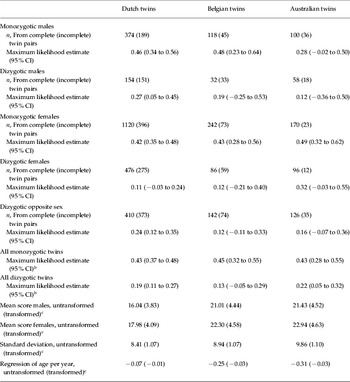
Because the data showed a somewhat skewed distribution, a square root data transformation was performed. Table 1 displays the twin correlations using the transformed data. The mean borderline scores for males and females (corrected for age), the standard deviations and age regression effects in Table 1 were based on the raw, untransformed data.
Number of participants from complete and incomplete twin pairs in each zygosity group, the maximum likelihood estimates of twin correlationsFootnote a (95% CIs) and estimates for mean borderline scores for males and females, standard deviations and age regression

CI, Confidence interval.
a Correlations were estimated from the square root-transformed data.
b After constraining these correlations to be equal.
c Estimates are given for the untransformed data and using square root-transformed data.
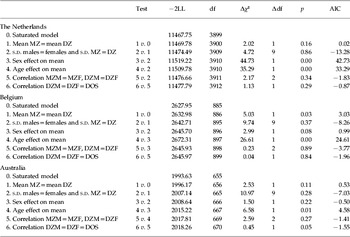
Results of the tests performed in the saturated models for each country are shown in Table 2. In each country mean borderline scores did not differ significantly between MZ and DZ twins. Standard deviations were equal between males and females and DZ and MZ twins. Sex effects on the means were significant in the Dutch sample, where women scored on average 1.94 points higher than men. The same direction of effect was observed in the other two samples, but due to the smaller sample size these effects were not significant. The age regression coefficients on the means were negative in all samples, indicating that BPD features decrease with age. The age effect was significant in The Netherlands and in Belgium but not in Australia. For all three countries, the twin correlations for MZ males and MZ females were equal as were the twin correlations for DZ males, DZ females and DZ opposite-sex twins. This indicates that there is no sex difference in the heritability of BPD features and that the same genes influence BPD features in males and females.
Saturated model-fitting results for borderline personality disorder features in the Dutch, Belgian and Australian twin data

−2LL, −2 log-likelihood; df, degrees of freedom; AIC, Akaike's Information Criterion; s.d., standard deviation; MZ, monozygotic; DZ, dizygotic; MZM, monozygotic male; MZF, monozygotic female; DZM, dizygotic male; DZF, dizygotic female; DOS, dizygotic opposite sex.
Table 3 shows the results of the simultaneous modelling of the data from the three countries. Mean scores differed between the three countries, but standard deviations could be equated. The lowest mean score (corrected for age) was found in The Netherlands (16.04 for males and 17.98 for females). The correlations for MZ twins were equal for The Netherlands, Belgium and Australia and the same was true for DZ twins.
Saturated model-fitting results including the data from three countriesFootnote a

−2LL, −2 log-likelihood; df, degrees of freedom; AIC, Akaike's Information Criterion; NL, The Netherlands; BE, Belgium; AU, Australia; s.d., standard deviation.
a Effects of sex and age are modelled for each country separately.
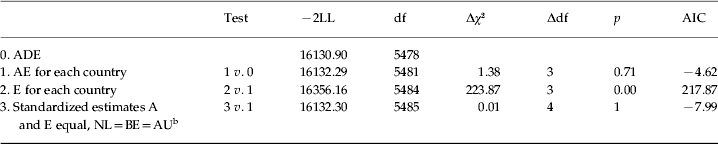
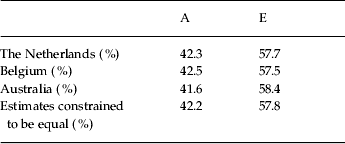
In the full genetic model without sex differences the variance components A, D and E were estimated for the three countries, explaining 34.3, 8.4 and 57.3% of the variance in BPD features in the Dutch sample, 6.7, 37.8 and 55.5% in the Belgium sample and 33.6, 5.3 and 58.1% in the Australian sample, respectively. Model-fitting results are shown in Table 4. Removing D from the full model did not give a significant worsening of the goodness of fit (p=0.71) of the model but removing A did (p=0.00), resulting in model 3 as the best-fitting model. In addition, the AIC of model 3 was lower than the AIC of models 0, 1 and 2, indicating that model 3 was the most parsimonious model. Table 5 shows the estimates of the proportion of variance explained by A and E for each country and the three countries pooled.
Genetic model-fitting results including the data from three countriesFootnote a
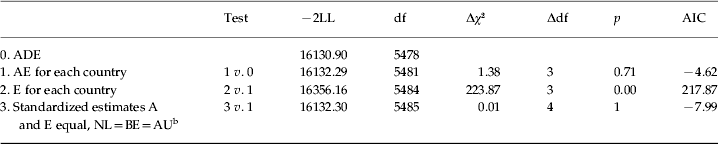
−2LL, −2 log-likelihood; df, degrees of freedom; AIC, Akaike's Information Criterion; A, additive genetic factors; D, non-additive genetic factors (dominance); E, unique environmental factors; NL, The Netherlands; BE, Belgium; AU, Australia.
a Effects of sex and age are modelled for each country separately.
b Best-fitting model.
Maximum likelihood estimates of proportions of variance explained by additive genetic and unique environmental effects
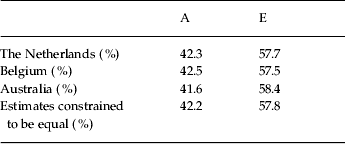
A, Additive genetic effects; E, unique environmental effects.
Discussion
The present study is a large-scale multinational twin study specifically focusing on BPD symptoms and features in community samples. The aim of this study was to examine the genetic liability to BPD features in a large sample drawn from general populations, to test quantitative and qualitative sex differences, and for differences between The Netherlands, Belgium and Australia.
We found that BPD features are genetically influenced (42%) and that this genetic influence, similar across the three countries, does not differ between men and women and acts in an additive manner. Environmental factors unique to an individual accounted for the remaining 58% of the variance in BPD features. Torgersen et al. (Reference Torgersen, Lygren, Oien, Skre, Onstad, Edvardsen, Tambs and Kringlen2000) reported a higher heritability estimate (69%), though this estimate is probably too high due to methodological limitations.
Although BPD is more often diagnosed in women than in men (Gunderson & Zanarini, Reference Gunderson and Zanarini1987; Widiger & Weissman, Reference Widiger and Weissman1991; APA, 2000), research findings about the sex difference in the prevalence of BPD are inconclusive. Several clinical studies have tested for sex differences in DSM personality disorders (Jackson et al. Reference Jackson, Whiteside, Bates, Bell, Rudd and Edwards1991; Golomb et al. Reference Golomb, Fava, Abraham and Rosenbaum1995; Grilo et al. Reference Grilo, Becker, Walker, Edell and McGlashan1996; Carter et al. Reference Carter, Joyce, Mulder, Sullivan and Luty1999; Grilo, Reference Grilo2002) but only one (Carter et al. Reference Carter, Joyce, Mulder, Sullivan and Luty1999) found a sex difference, the prevalence being unexpectedly higher in men. Results from non-clinical studies are also inconsistent; some reported higher prevalence rates in women (Zimmerman & Coryell, Reference Zimmerman and Coryell1989), others in men (Samuels et al. Reference Samuels, Eaton, Bienvenu, Brown, Costa and Nestadt2002; Coid et al. Reference Coid, Yang, Tyrer, Roberts and Ullrich2006), while the only large representative population-based study (Torgersen et al. Reference Torgersen, Kringlen and Cramer2001) did not find sex differences. In our study, mean scores on the PAI-BOR did not significantly differ between men and women in Belgium and Australia while in The Netherlands women scored higher than men. However, this sex difference was relatively small with a mean difference of 1.97 points (on a scale ranging from 0 to 72).
Generally BPD symptoms appear by early adulthood, and the disorder occurs less frequently with increasing age (Paris et al. Reference Paris, Brown and Nowlis1987; Stone, Reference Stone1990; Bernstein et al. Reference Bernstein, Cohen, Skodol, Bezirganian and Brook1996; APA, 2000; Johnson et al. Reference Johnson, Cohen, Kasen, Skodol, Hamagami and Brook2000; Samuels et al. Reference Samuels, Eaton, Bienvenu, Brown, Costa and Nestadt2002; Coid et al. Reference Coid, Yang, Tyrer, Roberts and Ullrich2006). In the present study, all age regression coefficients on the mean borderline features score were negative, indicating that BPD features decrease with increasing age, although the effects were small. In the Australian cohort this age effect was not significant, probably due to the narrow age range in the Australian sample (18 to 33 years) and the smaller sample size. The young age of the Australian cohort may also explain why the number of subjects scoring >60 is higher in the Australian sample than in the Dutch and Belgian sample.
Recently, the nature of personality disorders and its relationship to normal personality has received extensive attention (Widiger & Trull, Reference Widiger and Trull2007). The DSM-IV-R defines personality disorders within a categorical system, but the inclusion of a dimensional model of personality is increasingly recommended (Trull et al. Reference Trull, Widiger and Guthrie1990, Reference Trull, Tragesser, Solhan and Schwartz-Mette2007; Livesley, Reference Livesley2007; Widiger & Trull, Reference Widiger and Trull2007). Three proposed dimensional models of personality are Livesley's 18-factor model of personality pathology (Livesley, Reference Livesley1986, Reference Livesley1987), which distinguishes four higher-order factors (emotional dysregulation, dissocial behaviour, inhibitedness, compulsivity), Cloninger's psychobiological model (Cloninger et al. Reference Cloninger, Svrakic and Przybeck1993), which distinguishes four dimensions of temperament (novelty seeking, harm avoidance, reward dependence and persistence) and three dimensions of character (self-directedness, cooperativeness and self-transcendence), and the Five Factor Model (FFM) of personality (Costa & McCrae, Reference Costa and McCrae1992), which distinguishes five personality traits (neuroticism, extraversion, openness to experience, agreeableness and conscientiousness).
Livesley's trait model of personality pathology is operationalized through a self-report questionnaire, the Dimensional Assessment of Personality Pathology – Basic Questionnaire (DAPP-BQ; Livesley, Reference Livesley and Strack2006). A series of small-sample twin studies (Livesley et al. Reference Livesley, Jang, Jackson and Vernon1993, Reference Livesley, Jang and Vernon1998; Jang et al. Reference Jang, Livesley and Vernon1996b, Reference Jang, Livesley, Vernon and Jacksonc), provided support for the heritability of most of the 18 lower-order DAPP-BQ traits and of all of the four higher-order factors. According to Livesley, the emotional dysregulation factor and its first-order traits resemble, but are broader than, the diagnostic construct of BPD. For example, the correlation between DAPP-BQ emotional dysregulation scores and the number of BPD symptoms has been estimated to be 0.47 in clinical (Pukrop et al. Reference Pukrop, Gentil, Steinbring and Steinmeyer2001) and 0.62 in non-clinical (Bagge & Trull, Reference Bagge and Trull2003) samples. The heritability for emotional dysregulation has been reported at 53% and for the primary traits making up emotional dysregulation at 44% to 53% (Jang et al. Reference Jang, Livesley, Vernon and Jackson1996c; Livesley et al. Reference Livesley, Jang and Vernon1998).
Concerning traits from the FFM and Cloninger's psychobiological model, heritability estimates between 41% and 55% have been reported for the big five factor neuroticism (Jang et al. Reference Jang, Livesley and Vernon1996a; Johnson et al. Reference Johnson, Vernon, Harris and Jang2004), and for Cloninger's novelty-seeking scale (Keller et al. Reference Keller, Coventry, Heath and Martin2005), both higher-order personality traits believed to be associated with BPD (Morey, Reference Morey1991; Saulsman & Page, Reference Saulsman and Page2004; Korner et al. Reference Korner, Gerull, Stevenson and Meares2007). These findings support the present finding of moderate genetic effects on the manifestation of traits related to BPD features.
In the present study, the PAI-BOR questionnaire was used to measure BPD features. The PAI-BOR does not diagnose BPD per se, but assesses features related to the BPD syndrome which are also common to other personality disorders (Morey, Reference Morey1991). In addition, a high score on the PAI-BOR is associated with higher prevalence rates for several Axis I disorders (Trull, Reference Trull1995). The co-morbidity between BPD and other personality disorders as well as Axis I disorders is also well documented by studies using clinical samples (Zanarini et al. Reference Zanarini, Frankenburg, Dubo, Sickel, Trikha, Levin and Reynolds1998; Zimmerman & Mattia, Reference Zimmerman and Mattia1999; Becker et al. Reference Becker, Grilo, Edell and McGlashan2000; McGlashan et al. Reference McGlashan, Grilo, Skodol, Gunderson, Shea, Morey, Zanarini and Stout2000; Grilo et al. Reference Grilo, Anez and McGlashan2002). Several prior studies have shown the PAI-BOR to be a reliable and valid measure of BPD features, and support the usefulness of the PAI-BOR in assessing BPD features in the general population as well as BPD in the clinical setting (Kurtz et al. Reference Kurtz, Morey and Tomarken1993; Trull, Reference Trull1995). BellPringle et al. (Reference BellPringle, Pate and Brown1997) and Stein et al. (Reference Stein, Pinkster-Aspen and Hilsenroth2007), for example, showed that the PAI-BOR differentiates between patients diagnosed with BPD and patients without borderline personality pathology or unscreened controls with 75% to 80% accuracy. In addition, Jacobo et al. (Reference Jacobo, Blais, Baity and Harley2007) administered the PAI-BOR to patients diagnosed with BPD and found a significant correlation of 0.58 between the total number of BPD SCID-II criteria and the PAI-BOR scale.
Several issues should be kept in mind when interpreting the results of this study. First, when non-response influences the data collected in survey research, this may seriously limit the validity of the findings. While clinical studies tend to sample the most severe cases, non-response bias might cause affected individuals to be under-represented in population studies. Because BPD has a familial component, twin-family studies can study this possible non-response bias by using data from respondents as a proxy for the data of their non-responding family members. Distel et al. (Reference Distel, Ligthart, Willemsen, Nyholt, Trull and Boomsma2007) compared borderline personality scores from highly cooperative families (i.e. many of invited family members participate) with data provided by the participating members of less cooperative families (i.e. few invited family members participate). As expected, the participating members of less cooperative families showed somewhat higher scores on the PAI-BOR scale, suggesting non-response will be higher among subjects with more BPD features. However, the difference between participants from less cooperative and highly cooperative families was relatively small, with a mean difference of less than 1 point on a scale ranging from 0 to 72. This suggests that although there is a difference, questionnaire data on BPD features are relatively unbiased, at least in the Dutch sample, which constituted the largest sample in the present study. Second, we did not find evidence for non-additive genetic effects though the twin correlations suggested a contribution of non-additive genetic influence. The heritability estimate of 42% may include some non-additive effects, but these are unlikely to be large. In the future we will collect and include data of siblings and parents of twins in the model to increase statistical power, needed to address this issue more thoroughly.
In addition, several other lines of future research on BPD are suggested. First, although our findings were consistent across three samples, suggesting no significant cultural role in BPD features, it will be important to try to replicate these findings in other samples and with other measures of BPD. Second, further phenotypic and genetic analyses of PAI-BOR items may be informative as these analyses may point to cohesive, genetically influenced, factors that could be used in future aetiological studies. Finally, our results and future studies using the PAI-BOR may aid in the evaluation of endophenotypes that have been proposed for this disorder, including laboratory tasks, neuroimaging findings and psychophysiological indicators.
Acknowledgements
The present study was supported by: Borderline Personality Disorder Research Foundation; Spinozapremie (NWO/SPI 56-464-14192); Center for Neurogenomics and Cognitive Research; Center for Medical Systems Biology (NWO Genomics); Twin-family database for behavior genetics and genomics studies (NWO 480-04-004); Genome-wide analyses of European twin and population cohorts to identify genes predisposing to common diseases (EU/QLRT-2001-01254).
Declaration of Interest
None.