Introduction
Identifying the sources of heterogeneity of performance among companies is a central issue in industrial organisation and strategic management research. Attempts to explain the determinants of efficiency are made over several decades. The main question is whether company or industry characteristics are the most important influential factors. A major stream of research that has borrowed its framework from the efficiency structure paradigm (Structure-Conduit-Performance) and is popular in industrial organisation economics, states that the efficiency advantage comes from industry structure (Bain, Reference BAIN1956; Porter, Reference PORTER1985). In this line of research, external variables, including industry concentration, product differentiation, entry and exit barriers, and growth of demand, are linked to company performance. Another related stream of research, based on the resources-based view (RBV) of the company, suggests that the different levels of resources available between companies explains why some are more efficient than others (Penrose, Reference PENROSE1959; Nelson and Winder, 1982; Wernerfelt, Reference WERNERFELT1984; Barney, Reference BARNEY1991; Rumelt, Reference RUMELT1991; Amit and Schoemaker, Reference AMIT and SCHOEMAKER1993; Newbert, Reference NEWBERT2008). In RBV theory, companies that possesses valuable, rare, imperfectly mobile, and non-substitutable resources and have an organisation in place that enable them to absorb and apply them, will attain a competitive advantage, which, in turn, may improve performance. This central proposition of RBV theory is adopted by several related analyses: core competences (Prahalad and Hamel, Reference PRAHALAD and HAMEL1990), dynamic capabilities (Teece et al., Reference TEECE, PISANO and SHUEN1997; Helfat and Peteraf, 2003), and the knowledge-based view (Grant, Reference GRANT2002). Thus, business researchers are interested in any differences among companies that could be a source of efficiency gains. Factors, such as size, age, group ownership and vertical integration have received attention in the literature and the question is whether these characteristics may provide a competitive advantage, based on lower cost. The debate also focuses to whether differences in technology and human resources can explain part of the variation in efficiency. Another issue that has attracted the interest of academic and political cycles over the recent years is whether flexibility practices and innovativeness of the company plays a key role in achieving a better performance. Despite the vast body of empirical work, the results are ambiguous and require more research.
This paper aims to provide new evidence on effects of industry and company characteristics on performance. Although a large body of literature in this field has evolved applying usually a two-stage data enveloped analysis (DEA), evidence for the drivers of efficiency for poultry industry are scarce (Yusuf and Malomo, Reference YUSUF and MALOMO2007; Begum et al., Reference BEGUM, BUYSSE, ALAM and HUYLENBROECK2010), and there are no similar studies for the Greek situation. This paper assesses technical efficiencies of Greek poultry companies over the period 1994−2007 and investigates the determinants of inefficiency. It aims to verify the explorative strength of a model that captures the characteristics of the sample, and uncover the effect of Greece integration into EMU and the size of the domestic poultry meat market on company performance, as external factors reflecting important macroeconomic conditions and market characteristics. Simultaneously it investigates the Greek poultry companies' competitive strategies as a mediator between internal factors and company performance. In this model, the age and size of the company, the capital intensity and the skills of employees are included. Some of the aforementioned variables like the company size have been used in poultry literature (Yusuf and Malomo, Reference YUSUF and MALOMO2007; Begum et al., Reference BEGUM, BUYSSE, ALAM and HUYLENBROECK2010). However, the few existing empirical works on the efficiency of poultry sector used a small number of explorative variables related to industry and companies characteristics such as market concentration, years of experience and education level of the farmer, hence this offers only a partial explanation of the determinants of poultry production efficiency. In the present study, it is important to identify links of the company efficiency with untapped poultry company characteristics like vertical investigation, productive flexibility, group ownership and company research activities, not only because this question is often addressed in the literature over several decades, but also these characteristics appear to be sources of competitive advantage for several Greek poultry units.
Additionally this study used the Simar and Wilson's (1998, 2007) double-bootstrap procedure to overcome the inherent shortcomings of previous two-stage DEA empirical work in the poultry sector. The key advantage of the adopted methodology is that it permits us to determine statistical properties of non-parametric frontier estimators and address the serial correlation problem between efficiency measures and explanatory variables.
Institutional setting
Greece's poultry industry is one of the most significant sectors of the domestic meat industry, producing 168,000 tonnes of poultry in 2006 or 33.5% of the total meat production in that country, covering 79.6% of domestic demand for poultry and 46-62% of Greece's total exports of meat during the period 1996-2006 (ICAP, 2007). The poultry sector is characterised by high concentration, with the six largest companies accounting for 68.9% of the market and 45% of the production, while small, family-owned companies also contribute to local demand (ICAP, 2007).
Significant changes took place during the integration of Greece into the EMU in the 1990's, which generated an environment of increased competition along with lower interest rates and inflation. In this context, domestic poultry production recorded an average annual growth rate of 0.91% as a response to the weak rise of the domestic market, with an average annual growth rate of 1.34% over the period 1994-2006 (ICAP, 2007). At the same time the main foreign trade indicators indicated a loss of competitiveness. Greece became increasingly more dependent on poultry imports to meet its domestic consumption needs, so poultry self-sufficiency rates declined for 2006 to 78.3% from 89.2% in 1994 (ICAP, 2007), while the export rate of domestic production ranged from 1.9% to 6.9% over the same period.
Greek poultry companies followed different competitive strategies, which were partly responsible for differences in their efficiency. Few companies which control the sector provided products with strong brands, and entered other high-growth food markets (sausage, prepared meat products), resulting in the majority of them becoming vertically integrated (ICAP, 2007). As large companies seem to exploit scale and scope economies; additionally there are several companies of different sizes that achieved additional cost economies by applying productive flexibility practices, while few companies achieved an advantage thanks to innovativeness or improved quality of their products (Fotinopoulou and Keramidou, Reference FOTINOPOULOU and KERAMIDOU2006).
Methodology for estimation of efficiency scores
Technical efficiency represents the capacity of a company to produce the maximum output quantities from the same level of input, or several output quantities utilising minimal input. It is common practice to measure the performance of a company relative to a best-practice frontier. Two methods have been widely used to calculate best practice: the non-parametric DEA method and the parametric stochastic frontier analysis (SFA). This paper adopts a non-parametric linear programming frontier approach compared to parametric statistical methods. There are two reasons why this method is selected. Firstly, the DEA method avoids the problem of incorrect specification of the production function. Secondly, the combination of the DEA model with the bootstrapping technique proposed by Simar and Wilson (Reference SIMAR and WILSON1998, Reference SIMAR and WILSON2000) enables the determination of statistical properties for non-parametric frontier estimators.
In DEA literature, the best frontier is estimated by either an input-orientation (minimising input level for a given output) or output-orientation (maximising output given the level of the input). In this survey, an input orientation was chosen and variable returns to scale (VRS) assumption used (Banker et al., Reference BANKER, CHARNES and COOPER1984), considering that our sample companies are not operating at optimal scale due to imperfect competition (Coelli et al., Reference COELLI, RAO, O' DONNELL and BATTESSE2005).
Under these assumptions, efficiency score of each company 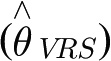 is calculated by solving the following linear programming problem:

In equation 1 yi is a vector of outputs, xi is a vector of inputs, while  is a non-negative vector of constants specifying the optimal weights of inputs/outputs. The efficient level of input is defined by
 , which is the projection of an observed poultry company
 on to the efficient frontier, while
 is a scalar (see Simar and Wilson, Reference SIMAR and WILSON2007). This linear programming problem must be solved n times, once for each company in the sample. The value of
 obtained is the technical efficiency score for the ith poultry company. In the case,
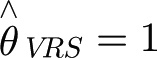 , the company is considered fully technical efficient.
However, the standard DEA approach has come under criticism owing to the potential bias of efficiency estimates. The accuracy of DEA results may be affected by sampling variation of the estimated frontier and the non-measurement of random error. This survey addresses the shortcoming of DEA and applies the bootstrap approach of Simar and Wilson (Reference SIMAR and WILSON1998, Reference SIMAR and WILSON2000) that combines the DEA model with bootstrapping techniques, in order to provide bias-corrected measures of efficiency and confidence intervals. The complete bootstrap algorithm applied in this study is extensively described in Simar and Wilson (Reference SIMAR and WILSON1998).
Data on input and output were collected for 27 companies composed of both poultry meat farms and processing facilities, for the period of 1994-2007. The survey includes five out of six of the largest companies in the Greek industry which control 69% of the domestic poultry meat production. Companies with 1-49 employees or 50-149 employees were included as a random sample that can be assumed as being representative for these size categories as a whole. Following previous studies, three inputs and one output were chosen for inclusion (Kravtsova, Reference KRAVTSOVA2008; Goncharuk, Reference GONCHARUK2009; Badunenko, Reference BADUNENKO2010). Input variables are the cost of capital, estimated as the sum of depreciation and interest, the cost of raw and auxiliary materials and the number of full-time employees. Thus, the panel data set was unbalanced, including 328 observations, owning to late entries and early exits from the market. It is worth noticing that the sample size ensures adherence to the DEA convention that the minimum number of companies should be greater or equal to three times the number of inputs plus outputs, and thus the sample size was deemed adequate for the approach. A questionnaire survey was conducted from January 2010 to March 2010 by Panteion University of Athens, to obtain information that wasn't otherwise readily available, such as the cost of raw and auxiliary materials and the number of employees. Further data was drawn in from the Ministry of Development's industrial bulletin statistics, as well as from the annual balance sheets of companies reported in the Greek Government Gazette.
The determinants of technical efficiency
The pure technical efficiency scores 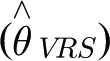 derived from the first-stage bootstrapped DEA analysis were regressed using a set of hypothesised explanatory factors. The following regression model was used:

In equation 2, a is the constant term, εi is statistical noise, and Zi is a vector of specific variables for poultry company that is expected to be related to the poultry company's efficiency score. These include capital to labour ratio, real average wages, age and size of the company, vertical integration, productive flexibility, group ownership, and innovation activities of a company, integration of Greece into EMU, domestic poultry meat market size and yearly trends. Finally δ is a vector of the estimated coefficients of the explanatory factors. For estimating equation 2, the bootstrapped truncated regression, proposed by Simar and Wilson (Reference SIMAR and WILSON2007), was implemented. The traditional procedures of regression (Tobit estimator, OLS, etc) cannot be used, because DEA efficiency estimates are serially correlated with error and explicative variables and basic model assumption required by regression analysis, that is independence within the sample, is violated. To overcome this problem algorithm two of Simar and Wilson (Reference SIMAR and WILSON2007) is applied. The cautioner connection that it is expected to exist between bias-corrected VRS orientation efficiency estimates and each of the explorative variables is presented in the following sections.
technology resources
The capital intensity indicates the level of technology of a company. Theory on the relationship between performance and technology resources are ambivalent. The literature trends to support the theory that a company's technology, embodied in physical resources possessed by a company, such as plant, machinery and equipment, can positively influence its performance, due to the strong positive effect on reduction of cost and/or the possibility for differentiation (Porter, Reference PORTER1985). However, high investment in technology was also found to worse a company's relative costs and performance (Porter, Reference PORTER1985; Kravtsova, Reference KRAVTSOVA2008; Latruffe et al., Reference LATRUFFE, DAVIDOVA and BALCOMBE2008). The hypothesis seem appropriate as a high level of capital intensity can contribute to the better performance of a company (H1).
human resources capabilities
The productive services provided by individuals to the company in the form of knowledge and skills represent human resources capabilities of a company which may play a crucial role for improvement of productivity and company performance (Penrose, Reference PENROSE1959; Grant, Reference GRANT2002; Kravtsova, Reference KRAVTSOVA2008). As effective organisational activities of any company are achieved through human resources capabilities, measured usually by the difference in wages, it can be concluded that the stock of knowledge and skills of employees increases the productivity labour and performance of companies.
vertical integration
According to transaction cost economics and traditional theories of market power, vertical integration may provide economic efficiency advantages, because of a greater ability of companies involved to decrease transaction costs (Williamson, Reference WILLIAMSON1975) or achieve market power and hence influence the terms of a transaction, such as price, quality standards and/or delivery dates. However, vertical integrated companies were also found to have inferior performance (Assaf et al., Reference ASSAF, BARROS and DIEKE2011). Consequently, it is assumed that the dummy variable of vertical integration that is used in this study will link positively with technical efficiency of a company.
company age
Theory on the precise relationship between company age and performance is equivocal. Company age is usually considered one of the main components of a company's experience and learning curve (Assaf et al., Reference ASSAF, BARROS and DIEKE2011), which increases the capacity for efficiency. According to RVB theory, older companies have a greater opportunity to create a valuable intangible asset, such as a good reputation with customers through the ownerships of brands and trademarks, with suppliers or financial institutions, as well as government and communities (Grant, Reference GRANT2002). However, older companies may also have inferior performance, because of inertia and less adaptive capacity to changing circumstances (Balcombe et al., Reference BALCOMBE, FRASER, LATRUFFE, RAHMAN and SMITH2008; Kravtsova, Reference KRAVTSOVA2008; Lin et al., 2009; Odeck, Reference ODECK2009). Therefore, it is assumed that company age should have an influence on its performance.
size of company
Company size, measured by the logarithm of total fixed assets, is a popular variable in efficiency researches, but the findings seem ambiguous. Company size is usually conceptualised as a primary source of competitive advantage because of the diverse capabilities of a larger company (Yusuf and Malomo, Reference YUSUF and MALOMO2007; Lin et al., 2009). These include the ability to exploit economies of scale and scope, to have greater funds, to achieve better market penetration or to employ more educated managers (Kumar, Reference KUMAR2003). On the other hand, larger companies were found to have inferior performance compared to smaller ones (Latruffe et al., Reference LATRUFFE, DAVIDOVA and BALCOMBE2008; Vasiliev et al., Reference VASILIEV, ASTOVER, MOTTE, NOORMETS, REINTAM and ROOSTALU2008; Ceyhan and Hazneci, Reference CEYHAN and HAZNECI2010), because of scale diseconomies. Consequently, the hypothesis that is recommended suitable is that the size of a company is an important determinant of company technical efficiency.
innovative activities of company
Innovativeness of the company, measured by R&D intensity, was usually found to relate positively to efficiency (Ornaghi, Reference ORNAGHI2006; Thornhill, Reference THORNHILL2006). However, a negative relationship between innovative activity and company performance has also been reported (Simpson et al., Reference SIMPSON, SIGUAW and ENZ2006), while others found innovation to have a poor explorative power (Balteiro et al., Reference BALTEIRO, HERRUZO, MARTINEZ and PACHON2006). Although the empirical findings are ambiguous, the present research assumes that R&D spending is important in explaining improvements in technical efficiencies.
productive flexibility
The relationship between efficiency and level of productive flexibility are complex. On the one hand, productive flexibility indicates company competences which may be strategically beneficial and provide a positive influential factor in performance (Boyer and Freyssenet, Reference BOYER and FREYSSENET2000). To test the possible benefits of flexibility in this study, an index was devised which denotes a value larger than one when a company is deemed productively flexible (Boyer and Freyssenet, Reference BOYER and FREYSSENET2000). Consequently, the hypothesis that be more appropriate to adopt is that flexible companies are more efficient.
group ownership
Theory states that companies forming a group gain additional benefits in terms of efficiency, by exploitation of economies of scope, attainment of market power, using the same brand name to promote multiple products, or by transfer of knowledge between companies and applying internal benchmarking (Barros et al., Reference BARROS, BOTTI, PEYPOCH and SOLONANDRASANA2009; Assaf et al., Reference ASSAF, BARROS and DIEKE2011). Therefore, a positive correlation between the dummy variable of group ownership and technical efficiency of poultry companies is expected to be confirmed (H8).
market size
The growing domestic demand for poultry meat, measured by the logarithm of the apparent consumption of poultry, over the period 1994-2007 in Greece gave rise to an increase in production, which in turn could be associated with economies of scale, resulting in a performance increase. It is assumed, therefore, that domestic demand for poultry is positively linked to technical efficiency.
Greece integration into EMU
According to previous studies, the accession of a country into the European Union relates to the characteristics of the macro-economic environment, and may be one of the explanatory factors of efficiency (Vasiliev et al., Reference VASILIEV, ASTOVER, MOTTE, NOORMETS, REINTAM and ROOSTALU2008). In this study, a dummy variable for Greece integration into the EMU period was applied as a proxy for the higher degree of competition companies faced along with lower interest rates and inflation. In an environment with high competition it can be hypothesised that average efficiency is higher, as inefficient companies, by competitive pressure, are forced to leave the market or to adopt new methods for maintaining market share. Simultaneously it was assumed that lower interest rates and inflation have a positive effect on the cost of capital and hence on performance. Consequently, integration of Greece into EMU was expected to be positively related to performance.
year trend variable
The efficiency of an ‘average’ Greek poultry company was expected to be increased over time. The increased competition, which characterises the production process of poultry in Greece, motivated some companies to update their technology. Due to financial difficulties certain companies could not install new technology, so they would be operating with less productive technology for a short period, but in the long term they were forced to close or to leave the market, resulting in an average efficiency increase. Therefore, the year trend variable and efficiencies of poultry companies was expected to display a positive relationship.
pure technical efficiency measurement
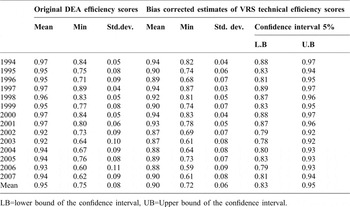
Table 1 presents the original and bootstrapped VRS technical efficiency scores. The original DEA average efficiency score for the entire period amounted to 0.95, indicating that there was small potential for increasing the average poultry meat company efficiency over the period of 1994−2007. A similar situation was concluded by bias-correcting pure technical efficiency scores of each sample company. Specifically, it showed that the productive performance of an ‘average’ poultry company ranged from 0.87 to 0.94 during the period 1994-2007, indicating that the same output, for different years of the study, could have been produced by using 6%-13% less than the observed inputs, if the existing level of inputs and recourses were used more efficiently.
Summary results of original DEA and bootstrapped efficiency estimated for the period 1994−2007.

LB=lower bound of the confidence interval, UB=Upper bound of the confidence interval.
Identifying the pure technical efficiency determinants
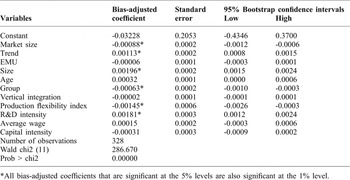
The results of the bootstrapped truncated regression are presented in Table 2. A positive sign in the coefficient indicated a negative influence on efficiency, while a negative sign indicated a positive influence. Since the dependent variable is the inverse of the efficiency score, it is larger or equal to one. According to the results, the adopted model had a Wald chi-squared of 286.67 with an associated p-value of <0.001. These statistics suggest that the model was a good fit. Overall, the model suggested a statistically significant decrease in technical efficiency over the study period. Taking into account the average efficiency of poultry companies, this finding should not come at the surprise. Indeed, a clear trend of decreasing efficiency was presented over the study period, when looking at both original efficiency and bias-corrected estimates (Table 1). These findings give grounds to reject the hypothesis. Consequentially, the logical question which arises is how performance can be increased in the Greek poultry industry. One of the alternatives may be to identify what factors drive variations in efficiency.
Looking at external variables, the integration of Greece into the EMU was found to contribute positively to efficiency. However, this estimate was insignificant. Hence, the hypothesis holds only with respect to the direction of effects of this variable, but not the significance. Similar evidence was reported by Vasiliev et al. (Reference VASILIEV, ASTOVER, MOTTE, NOORMETS, REINTAM and ROOSTALU2008) who found that the Estonian accession to the European Union did not influence grain farmers' performance. It is not clear why this should be the case as it was expected that the decrease of interest rates and lower inflation, hence the reduced cost of use of capital that comes along with integration to EMU, should have had a strong impact on investments and on performance of poultry production. One might speculate that lower cost of capital might imply the presence of investments which tend to increase the rate of sub-utilisation of existing capital resources. Another interesting finding is that the domestic market of poultry has a strong positive impact on efficiency, indicating that Greek poultry companies perform better with a greater demand and a higher level of poultry consumption. As expected, this result supports the hypothesis that some external variables, such as the growth of demand, moderate the trend to decrease in poultry company technical efficiency.
Sources of VRS technical efficiency scores, using a bootstrapped truncated regression (number of bootstrap iterations 2000).

*All bias-adjusted coefficients that are significant at the 5% levels are also significant at the 1% level.
Investigating the effect of internal factors, the study found that group ownership, flexible practices, size and innovative activities of the company have a significant explanatory power. Especially, companies joining a group appear to be more efficient, confirming the hypothesis. This is supportive of the view that group ownership is associated with additional benefits in terms of efficiency, derived from the evidence of economies of scales achieved by sharing common resources to different products, as well as from the usage of common brand names to promote multiple products, the transfer of knowledge and the application of internal benchmarking between companies. This verifies the results of previous studies in other areas that showed a significant positive effect of group ownership on company performance (Barros et al., Reference BARROS, BOTTI, PEYPOCH and SOLONANDRASANA2009; Assaf et al., Reference ASSAF, BARROS and DIEKE2011). Similarly, flexible capability was found to have a significant impact on efficiency. This can be interpreted as suggesting that the various cost-economies together with a quick response to market changes or the production of unstandardised goods with a high rate of capital utilisation, can promote performance of flexible companies.
Surprisingly, our findings suggest that the innovation activities of a company have negative and statistically significant influence on technical efficiency. This may indicate that R&D is a risky undertaking, which does not always lead to improved products or cost reductions, and consequently to higher returns, as only a few projects succeed (Simpson et al., Reference SIMPSON, SIGUAW and ENZ2006). If this is the case, R&D represents additional costs that will worsen the competitive position of a company and its performance. Another possible explanation is that R&D may under-estimate the level of innovation in a company, because of the low priority of R&D in Greek companies, as their innovation strategy is geared more to the acquisition of embodied technology available in international markets. A similar argument was developed by Balteiro et al. (Reference BALTEIRO, HERRUZO, MARTINEZ and PACHON2006) in their effort to explain the insignificant link between innovation activities and performance of Spanish wood-based companies.
Furthermore, company size contributes negatively to efficiency, supporting our hypothesis. A similar relationship was revealed in the Bangladesh and Nigerian poultry industry (Yusuf and Malomo, Reference YUSUF and MALOMO2007; Begum et al., Reference BEGUM, BUYSSE, ALAM and HUYLENBROECK2010) and in other areas in developing countries (Latruffe et al., Reference LATRUFFE, DAVIDOVA and BALCOMBE2008; Vasiliev et al., Reference VASILIEV, ASTOVER, MOTTE, NOORMETS, REINTAM and ROOSTALU2008; Ceyhan and Hazneci, Reference CEYHAN and HAZNECI2010). A possible explanation for this is that there is evidence of scale diseconomies contingently driven by diminishing returns to management (Coase, Reference COASE1937), bureaucratic failure (Williamson, Reference WILLIAMSON1975), increase of agency costs (Jensen, Reference JENSEN1986) or less capacity to respond to changes in the market (Boyer and Freyssenet, Reference BOYER and FREYSSENET2000), and that inefficiencies developed along with market power (Leibenstein, Reference LEIBENSTEIN1966). The most important finding is that small poultry farms in Greece could be efficient too. This might appear to lend support to the theory that smaller companies manage to gain a competitive advantage in narrow market segments (Fotinopoulou and Keramidou, Reference FOTINOPOULOU and KERAMIDOU2006), offering lower prices and enjoying the advantages of low costs, through the use of family labour, various forms of flexibility and other, often illegal, practices of cost economies (tax evasion etc.).
Another important result is that experience of a poultry company, as measured by company age, vertical integration and technological and human resources, are not important in explaining the development of efficiency. A change in efficiency appears to be independent of the age of the company, indicating that older ones cannot benefit from experience or a good reputation (Grant, Reference GRANT2002). It is probably that inertia and less adaptive capacity to changing circumstances that go along with age lead to a negative impact on performance, but this is statically insignificant. This result is not consistent with our hypothesis, and the findings of previous studies have suggested a significant negative impact of company age on efficiency (Balcombe et al., Reference BALCOMBE, FRASER, LATRUFFE, RAHMAN and SMITH2008; Kravtsova, Reference KRAVTSOVA2008; Lin et al., 2009; Odeck, Reference ODECK2009). Furthermore, it was discovered that the average wage, as a reflection of the quality of personnel, is an unfavourable but insignificant factor, a finding mentioned in Kravtsova (Reference KRAVTSOVA2008). This outcome leads to rejection of this hypothesis, while it is not broadly consistent to human capital theory and RBV theory, whereby human recourses are considered to play a crucial role in the improvement of performance. It is not at all clear why an insignificant effect of human resources capabilities on Greek poultry industry was found. The most, we can say that higher wages represent additional cost that is offset by higher level of productivity originating from the quality of labour. Additionally, it was discovered that vertical integrated companies are operating more efficiently. However, this estimate is statistically insignificant. From this outcome we can infer that vertical integrated companies cannot benefit from significant cost economies arising from a better coordination of adopted technologies, or decreasing the transaction cost, as several authors have previously argued (Williamson, Reference WILLIAMSON1975). A similar argument was developed by Assaf et al. (Reference ASSAF, BARROS and DIEKE2011) in their effort to explore the negative link between vertical integration and technical efficiency of Spanish retail stores. Similarly, capital intensity, as an index of technological resources in a company, appears to improve the company performance, but these estimates were not statistically significant. Consequently, this holds only with respect to direction of the technological resources hypothesis, but not the significance. This is not consistent to the finding of previous studies in other areas which found capital intensity to be a significantly negative influential factor (Kravtsova, Reference KRAVTSOVA2008; Latruffe et al., Reference LATRUFFE, DAVIDOVA and BALCOMBE2008). To understand why high investments in technology are not a strong positive influential factor in Greek poultry sector requires knowing the rate of capital utilisation. Despite that, the effect that was identified may be partly related to poultry managerial practices regarding the use of subsidies provided by the European Union for purchasing machinery, irrespective of the size and needs of companies.
Conclusions
This analysis provides the first application of the double-bootstrapping DEA procedure to the poultry meat industry. Specifically, it measured the bias-corrected efficiency scores for a sample of Greek poultry companies during the period 1994−2007. The analysis of pure technical efficiency scores showed an increase trend of technical inefficiencies over the study period. In order to determine the inefficiency sources, technical efficiency scores were related to different managerial practices and some elements of the industrial environment. For this purpose, a bootstrap truncated regression model was implemented. From this analysis it was concluded that being a member of a company group and adopting flexible practices are associated with a company being technically efficient, and that a higher demand for poultry meat promotes the company's performance. The variables that are significantly negative related to technical efficiency, and hence restrict company performance, include company size and innovation activity. Furthermore the businesses age and vertical integration do not have a significant impact on performance. This is also the case for the level of average wage, capital intensity, and Greek integration into the EMU.