INTRODUCTION
A well-documented trend related to hospice utilization is the prevalence of short lengths-of-stay, indicating underutilization of care. The National Hospice and Palliative Care Organization (NHPCO, 2015) reports that more than 1 in 3 patients who are admitted to hospice dies (or is discharged) within the first week of service, and 1 in 2 die within 14 days. Longer lengths-of-stay in hospice provide patients and families a greater opportunity to receive the full scope of benefits that hospice care has to offer. Families of patients with longer lengths-of-stay “reported receiving more hospice services and reported that those services were more helpful” than families of patients with shorter lengths-of-stay (Rickerson et al., Reference Rickerson, Harrold and Kapo2005). Family members' perceptions of being referred “too late” are associated with unmet needs for both patients and family members, in addition to greater dissatisfaction with quality of care (Teno et al., Reference Teno, Shu and Casarett2007). Though chronic illnesses are the leading cause of death in the United States (Xu et al., Reference Xu, Murphy and Kochanek2016), hospice care policies are not structured in such a way to provide ongoing end-of-life care for chronic illnesses (Wallace, Reference Wallace2015). And while the number of those accessing hospice in the United States continues to increase (NHPCO, 2015), a number of persisting barriers remain, resulting in delayed or absent hospice care for many Americans (Vig et al., Reference Vig, Starks and Taylor2010).
Little is known about the decision-making process for hospice (Chen et al., Reference Chen, Haley and Robinson2003), and no prior studies have captured information about the amount of time between when a patient or family first learns of hospice as a potential option for care and the time that they actually enroll in hospice services. This study sought to measure decision time for hospice and how this relates to recognized barriers, allowing for a unique perspective on the time just prior to hospice enrollment. Understanding decision time for hospice may also provide useful information about overcoming current barriers that prevent earlier and longer utilization of hospice.
METHODS
This was an exploratory cross-sectional study examining decision time for hospice care. Data analysis was conducted using the Statistical Package for Social Sciences (SPSS, v. 23.0). After running descriptive statistics to gain a descriptive understanding of the sample, Pearson's r was employed to identify bivariate relationships, and then independent-sample t tests and ANOVA were used to consider differences in decision time across key variables.
Sampling
Availability sampling was used due to the time-sensitive nature of and turnover rate in hospice care. Though probability sampling is a preferred method, obtaining a randomized sample based upon hospice's ever-changing population is problematic. For inclusion, potential subjects had to be a legal adult, conversant in English, and enrolled in a partnering hospice agency in a Southern U.S. state. Prior to any data collection, hospice nurses, social workers, and chaplains from each collection site were trained on the referral procedures for the study. Hospice staff introduced the study to potential participants during their regularly scheduled hospice visits. If a patient was incapacitated because of illness (as documented within the normal procedures of hospice care), the legal decision maker was able to provide assent and participate on their behalf. This subset of the hospice population was included because of how common short lengths-of-stay are due to advanced illness. Regardless of study participation, hospice services were administered as usual, and the study was approved by a university institutional review board.
Variables and Measurement
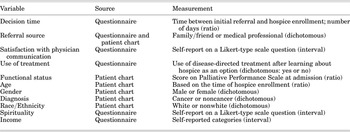
A research questionnaire was developed to collect data for the study. After initial development, clinical directors at the partnering agency reviewed the questionnaire and provided feedback along with two other researchers, one of whom has extensive clinical practice and knowledge in end-of-life care. Prior to use in this study, the questionnaire was piloted among 28 individuals (a combination of hospice patients and family members) during a qualitative study on hospice decision making (Wallace & Adorno, 2014). Questions were revised based upon those needing further clarification from piloted participants. In addition to the research questionnaire, participants in the study gave the author permission to obtain regularly collected data from patients' hospice charts. All variables can be reviewed in Table 1 and are described below.
Description of variables

Decision Time
“Decision time” was defined as the amount of time between initial referral for hospice (when a patient or family member becomes aware that hospice is an option for the patient's current care or condition) and enrollment in hospice care (the date when care begins). Though a hospice records the date that an official referral is made (the day someone contacts the hospice about interest in enrolling), this date does not capture how much time has passed since first learning about hospice care as an option. This variable was measured using the following question on the research questionnaire: “How long before enrolling in hospice did you FIRST learn about hospice as a potential option for your [the patient's] care/current illness?” Participants' responses were translated into a number of days, where each reported week was equal to 7 days and each reported month 30 days. Though the exact date one learns about hospice as an option is difficult to pinpoint, asking participants to recall and report the information was the most accurate source available. It was unlikely that the hospice had access to medical records of the initial hospice conversation, which would not have captured the incidences when patients first learned about hospice care from friends or family.
Referral Source
The referral source was assessed using the following question on the research questionnaire: “How did you learn about hospice as a potential option for your [the patient's] care/current illness?” Respondents chose “family/friend,” “medical professional,” or “other.” The answer to a second question assessing referral source—“Who FIRST contacted hospice about patient referral?”—was pulled from the patient's chart. If family/friend was checked on either of the two questions, the referral source was coded as a family referral.
Satisfaction with Physician Communication
In this study, satisfaction with physician communication was measured using the following Likert-type scale question on the research questionnaire: “Rate your level of satisfaction with how your [the patient's] physician communicated with you about your [the patient's] illness, diagnosis, and prognosis prior to hospice care.” Available responses ranged from greatly unsatisfied (0) to greatly satisfied (4).
Use of Disease-Directed Treatment
Use of disease-directed treatment is a dichotomous variable, identified through the following question on the research questionnaire: “After recognizing hospice as a potential option for your [the patient's] current illness, did seeking additional treatment delay your [the patient's] decision to start hospice care?” Responses were coded 0 for “no” (nontreatment) and one for “yes” (treatment).
Functional Status
Functional status was measured using the Palliative Performance Scale (PPS; Wilner & Arnold, Reference Wilner and Arnold2006), the results of which were recorded upon hospice admission for each patient. This score can range from 0 to 100, with 0 representing death and 100 representing full and normal functioning across five observer-rated domains: ambulation, activity level evidence of disease, self-care, intake, and level of consciousness. (Anderson et al., Reference Anderson, Downing and Hill1996). The PPS is a useful tool for predicting length of survival in hospice programs (Head et al., Reference Head, Ritchie and Smoot2005) and is correlated to the Karnofsky Performance Scale and to survival time for cancer patients (Wilner & Arnold, Reference Wilner and Arnold2006), while demonstrating strong criterion validity.
Demographic Variables
The demographic variables collected for this study included a patient's age, gender, race/ethnicity, diagnosis, spirituality, and household income. Due to the lack of ethnic diversity in the sample, race was collapsed into two categories: white and nonwhite. The location of care and number of participating patients versus their designated decision makers (along with their relationship to the patient) were also reported. These demographics were employed to describe the overall sample as well as to examine differences between different subpopulations. Demographics were collected from the hospice chart, or from additional questions on the research questionnaire.
RESULTS
Characteristics of the Sample
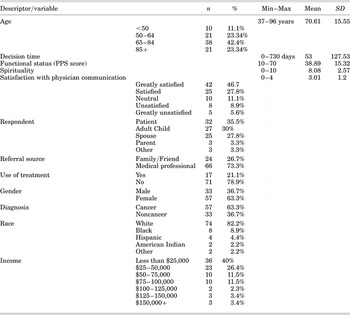
The sample of this study (N = 90) consisted of primarily Caucasian patients (n = 74, 82.2%) with both high levels of self-reported spirituality (mean = 8.08 on a scale of 0 to 10) and satisfaction with physician communication (mean = 3.01 on a scale of 0 to 4). Though 14 different diagnoses were represented, 63% of the sample had cancer. Patient ages ranged from 37 to 96 years, with an average age of 71. Patients were admitted to hospice during stages of advanced illness, as 86.7% scored 50 or below on the PPS, meaning that they needed considerable assistance and mainly sat or stayed in bed. Some 40% were completely bedbound and in need of total care at the time of admission. A total of 32 of the 90 patients were able to participate independently (35.6%), while the remaining 58 required a legal decision maker to participate and consent on their behalf. The information collected was the same regardless of respondent type (patient or proxy), with the patient as the focus of the response (i.e., patient age, diagnosis, race, household income, use of disease-directed treatment, etc). See Table 2 for a full description of participant characteristics.
Sample characteristics

Decision Time Correlations
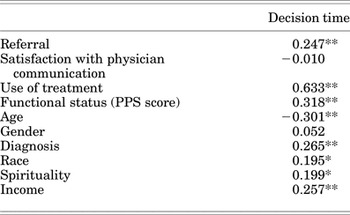
Utilizing Pearson's r, decision time was correlated (at the 0.01 level) with referral source (0.247), use of disease-directed treatment (0.633), functional status (PPS, 0.318), age (–0.301), diagnosis (cancer/noncancer, 0.265), and income (0.257; see Table 3). Race (white/nonwhite, 0.195) and spirituality (0.199) were also correlated with decision time at the 0.05 level. A one-tailed test of significance was utilized, as this is an exploratory study considering these relationships for the first time.
Decision time correlations

* Correlation significant at the 0.05 level (one-tailed).
** Correlation significant at the 0.01 level (one-tailed).
Differences in Decision Time
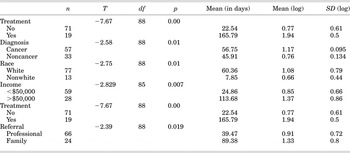
There were no statistically significant differences in decision time for hospice across gender, age, spirituality, or satisfaction with physician communication. There was a significant difference in decision time for those with cancer (log mean = 0.756, SD = 0.77) and those with noncancer diagnoses (log mean = 1.17, SD = 0.72), suggesting that persons with cancer diagnoses take longer (56.75 days) than those with non-cancer diagnoses (45.91 days) before deciding to enroll in hospice care (t[88] = –2.58, p < 0.01). See Table 4 for significant t test results.
Decision time t test results

Other differences were found in decision time across race (t[88] = –2.75, p < 0.01) and income (t[85] = –2.83, p < 0.01). Though income was an ordinal variable with multiple categories, more than half the sample (n = 59) fell into the two lowest income categories (<$25,000 and $25,000–50,000). These two categories were collapsed (<$50,000), as were higher income categories (>$50,000), due to the low number of participants who fell into each of the original higher categories. Patients with higher incomes took significantly longer to enroll in hospice than those with lower incomes (114 days on average compared to 25 days). With regard to race, the results suggested that white patients take significantly longer to make the decision to enroll in hospice care (60.36 days) than minority patients (7.85 days).
Patients who chose to seek disease-directed treatment and delay hospice care (log mean = 1.94, SD = 0.5) made the hospice decision after an average of 165 days compared to 22.5 days for those who did not seek additional disease-directed treatment (log mean = 0.77, SD = 0.61; t[88] = –2.83, p < 0.01). Using a one-way ANOVA (F[6,83] = 3.078, p = 0.009), there was also a statistically significant difference between groups based upon their functional status (i.e., their PPS scores). A Bonferroni post-hoc test revealed a statistically significant difference in decision time between patients with a PPS of 10 (6 ± 10.2 days, p = 0.025) versus those with a score of 70 (240 ± 327.7 days). Patients with a PPS score of 10, indicating closeness to death, made the decision for hospice in an average of 6 days, while those with a PPS score of 70 on average made the decision within 240 days.
A final demographic variable where differences were found was in referral to hospice care. There was a statistically significant difference in decision time between patients who were referred by a family member or friend and those referred by a medical professional alone (t[88] = –2.39, p = 0.019). Those referred by family or friend had a mean decision time of 89.38 days (log mean = 1.33, SD = 0.8) compared to 39.47 days for those referred only by a medical professional (log mean = 0.91, SD = 0.72).
DISCUSSION
This study provides a number of implications for policy and practice, particularly for clinicians faced with initial conversations about hospice care. Though late referrals to hospice are often characterized as a reflection of short lengths-of-stay due to advanced illness and imminent death at the time of admission (Rickerson et al., Reference Rickerson, Harrold and Kapo2005; Quill, Reference Quill2007) or based upon family perception of referral timing (Teno et al., Reference Teno, Shu and Casarett2007), this study contributes an additional perspective related to decision time. Patients who were closer to death (based on lower PPS scores) at the time of hospice admission had much shorter decision times than those with higher levels of functioning. Many high-acuity patients in this study did not even learn about hospice until just prior to their admission. Even when hospice was introduced earlier on in the illness process, seeking disease-directed treatment delayed the hospice decision. This reinforces the role that policy plays in the decision to enroll in hospice care, forcing people to choose between hospice and disease-directed treatments. However, research continues to suggest better outcomes for patients in hospice care compared to those accessing disease-directed treatment toward the end of their lives (Teno et al., Reference Teno, Shu and Casarett2007; Higgins & Prigerson, Reference Higgins and Prigerson2013; Zhang et al., Reference Zhang, Wright and Huskamp2009; Gozalo et al., Reference Gozalo, Miller and Intrator2008; Kelley et al., Reference Kelley, Deb and Du2013).
Though not all diagnoses afford the luxury of a discussion about hospice in an earlier timeframe (e.g., strokes or accidental injuries), many other diagnoses provide long periods of chronic illness and decline, where earlier discussion about hospice care as a potential option would be appropriate. Decision time was correlated with age, income, referral source, diagnosis, functional status, and utilization of disease-directed treatment (p < 0.01), in addition to race and spirituality (p < 0.05). Consideration about how these variables interact and potentially predict decision time is an important topic for further exploration.
In addition to recognizing the need for earlier conversations, clinicians need to be aware of differences in decision time across diagnoses, race, and income, along with acknowledging the important role of family. Cancer patients in this study had a slightly longer decision time than those with noncancer diagnoses, supporting the literature that reports differences in the decision-making process across diagnoses (Waldrop & Meeker, Reference Waldrop and Meeker2012), potentially calling for different approaches to the hospice discussion. For example, for patients with noncancer diagnoses, decisions are tied to ongoing hospitalizations and turning points (Waldrop & Meeker, Reference Waldrop and Meeker2012; Wallace & Adorno, 2014), and discussion about how hospice can help avoid repeat hospitalizations is important.
As highlighted in “Healthy People 2020,” ongoing health disparities remain a problem of national interest (Office of Disease Prevention and Health Promotion, 2014). The results from the present study show significant differences in hospice decision time by both race and income. Though early hospice utilization is encouraged, short decision times likely reflect delays in learning about hospice as an option for care until periods of advanced illness or imminent decline. This difference suggests that minority or lower-income patients may either seek services or receive information later during their illness process based on cultural or systemic barriers, such as religious/spiritual value conflicts, distrust of the healthcare system (Bullock, Reference Bullock2011; Schmid et al., Reference Schmid, Allen and Haley2010), language differences, lack of insurance, and discrimination (Smith et al., Reference Smith, Sudore and Perez-Stable2009). Income may also be a factor in the decision about employing cutting-edge treatments that may be too expensive for lower-income patients.
Finally, clinicians must recognize the important role of family in making the decision about hospice care. Involvement of family members in the referral for hospice care indicated decision times more than twice that of those referred by a medical professional alone. It is possible that the presence of family involvement allowed for longer decision times because familial conversations about hospice as a potential option for care had begun much earlier during the illness process. Within the United States, 31.2% of households report having a family member serving as an unpaid caregiver (National Alliance for Caregiving, 2009), making them an integral part of the healthcare decision-making process. Additionally, family influence plays a dominant role in a person's development of values, health attitudes, and behaviors (Pecchioni et al., Reference Pecchioni, Thompson, Anderson, Turner and West2006)—all of which are key decision-making variables (Shrank et al., Reference Shrank, Kutner and Richardson2005). Prior research also suggests that the influence of family communication has greater significance for patients than communication with physicians (Meeker & Jezewski, Reference Meeker and Jezewski2005). Clinicians should provide assistance to patients and families related to discussions on hospice care and end-of-life wishes, as many families find these conversations difficult to initiate on their own.
LIMITATIONS
There are several limitations that must be considered in the findings of the present study. First, due to the rate of turnover within the sampling frame, probability sampling was not practical. Since many patients were on a hospice service for only a short time, it was important to access them (or their family members) when they were available and willing to participate. Since adequate sample size was also an important consideration, it was helpful to draw from the largest number of patients available to participate, rather than limiting numbers based on a probability sampling method. An additional challenge related to the sample was a lack of ethnic diversity. Though the sample was similar to the national demographics of hospice care, there was not enough minority representation to make comparisons across multiple culture groups.
Another limitation of the study was that the data were collected from either the patient or the decision maker, based upon the patient's physical and cognitive ability to participate. While perceptions may vary from one family member to another, this study targeted the person who facilitated the decision for hospice based upon the signing of legal paperwork upon enrollment. This allowed the data to be comparable across all cases. It was also a limitation that several variables relied on participant self-report and/or an estimation rather than a precise or exact response. Due to the nature of the information being recorded, the time restrictions, and access to records, these were the best available measures.
CONCLUSION
The pressure to make a decision due to the imminence of death does not allow patients and families the time to process or prepare to make any other decision. Even in the absence of a decision for hospice care, the patient often faces imminent death. The pervasive death-denying culture that leads patients to cling to disease-directed treatment also overshadows thoughtful discussion about end-of-life choices within the current structure of hospice as separate from ongoing or disease-directed treatment. Though hospice utilization has been well studied, decision time has not been included elsewhere. The results from the present study provide useful connections between decision time for hospice and a number of barriers within the literature and prior research, suggesting that decision time is a pertinent variable within the discussion of hospice utilization.
Differences in decision time across race and income highlight the needs involved in overcoming healthcare disparities. Differences related to diagnoses support the notion that there may be a need for different approaches in talking about hospice care based upon diagnosis. Shorter decision times among high-acuity patients reinforce existing delays in timely hospice referrals. Obtaining access to end-of-life care is important for improving quality of death (Teno et al., Reference Teno, Shu and Casarett2007), symptom management (NHPCO, 2015), and quality of bereavement for family members (Higgins & Prigerson, Reference Higgins and Prigerson2013). The overwhelming role of disease-directed treatment in delaying decisions for hospice care strongly implies that the time to revisit the policies on concurrent care is now. Inquiry about hospice utilization remains important due to the continuing growth of an aging population that will likely need services in the near future. The challenge of talking about end-of-life matters within a death-denying society must continue to be at the forefront of our cultural discourse.
ACKNOWLEDGMENTS
The author would like to acknowledge the Community Hospice of Texas, along with the numerous hospice patients and families who shared their stories for the purposes of this research.