Most disasters are defined by the need for external assistance. The Center for Research on the Epidemiology of Disasters defines a disaster as a “situation (incident) or event which overwhelms local capacity, necessitating a request to a national or international level for external assistance.”1 Disasters identified by common definitions lend themselves to epidemiological analysis. Traditional disaster classifications drawn from common agreement identify the major categories of natural and human-made (or technological) disasters. This taxonomy, failing to be sensitive to the range of potential disaster events, prompted Green and McGinnes to identify a higher order range of disaster events as natural disasters, human systems failures, and conflict-based disasters.2 The role of taxonomy in disaster classification is to describe both diversity and distinguishing characteristics as well as relations naturally common to all of the groups within the discipline.2, 3 We emphasize the need to evaluate, describe, and monitor health consequences in modern disasters in terms of their public health impact, specifically on measurable direct and indirect mortality and morbidity, including injury or illness or a combination of the 2. The systematic capture of these markers would identify how disasters are related in ways not immediately obvious and add considerably to the integrity of existing disaster-related health information systems while ensuring a timely and accurate response.
Despite the common use of public health emergencies as a term, especially in the developing world, it is rarely specifically defined in public health law or administrative regulations in states within the US. When used, it indicates a high probability of a large number of deaths in the affected population, a large number of serious or long-term disabilities in the affected population, and/or a widespread exposure with significant risk for substantial future harm to a large number of people in the affected population.4
In preparing for public health emergencies, the RAND Corporation proposes that the focus be on “the capabilities of the public health and health systems, communities and individuals to prevent, protect against, quickly respond to and recover from health emergencies, particularly those whose scale, timing or unpredictability threaten to overwhelm routine capabilities.”Reference Nelson, Lurie and Wasserman5 Burkle inclusively defines public health emergencies as those “that adversely impact the public health system and/or its protective infrastructure (ie, water, sanitation, shelter, food, fuel, and health), resulting in both direct and indirect consequences to the health of a population, and occur when this protective threshold is absent, destroyed, overwhelmed, not recovered or maintained, or denied to populations.”Reference Burkle6, 7 Operationally, the recognition of this common thread in public health structural capacity identifies the basic relation applicable to health consequences of natural, human systems failure, and conflict-based disasters, and defines within each what potentially constitutes a public health emergency.Reference Burkle6 Certainly not all disasters qualify as public health emergencies, but the timely and accurate recognition of the public health impact is critical for proper prevention, preparedness, planning, and response.
DIRECT AND INDIRECT CONSEQUENCES OF DISASTERS
Disasters are most commonly measured in terms of direct consequences related to the impact of the disaster itself: Deaths, injury, psychological stress, and disabilities are measured in varying degrees of rigor and substance. However, the great majority of losses (as high as 70%–90%)Reference Roberts and Despines8, Reference Ghobarah, Huth and Russett9 are secondary to indirect deaths that would not have occurred without the breakdown of health and social services and the health information systems that inform them, the mass displacement of populations and overcrowded conditions, and the impossibility of continuing local livelihoods. Indirect deaths are rarely the subject of disaster planning or political attention and for the most part remain undetected, unmeasured, and underevaluated.10 The authors contend that public health emergencies are more apt to occur and dominate human systems failures and conflict-based disasters and potentially large-scale natural disasters where public health infrastructure and systems are broadly compromised. Disaster and urban planners must recognize that in future disasters more indirect consequences will be unmasked as public health infrastructure and systems decline in capacity and capability worldwide.
The major factors that promote, accelerate, or move a disaster event toward becoming a public health emergency in regards to potential injury-creating events,Reference Koenig, Dinerman and Kuehl11 potential illness-creating events,Reference Burkle12 or a combination of the 2 are as follows:
• Developing country where public health infrastructure and systems are lacking or absent
• Deficient and/or disabled preexisting capacity of public health infrastructure and/or systems to respond to crises
• Whether public health capacity and capability has been compromised (destroyed, overwhelmed, poorly maintained or denied to a population) as a result of the disaster
• Geographically widespread disaster
• Population size, distribution, and density
• Prolonged time/exposure of the disaster
• Existing ecological and environmental decay, or an environment that becomes adversely altered by the disaster
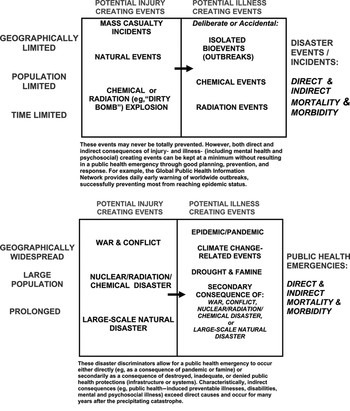
Public health emergencies arise due to a lack of protection from the critical public health infrastructures or systems, which results in a predictable increase in indirect morbidity and mortality. Recommended taxonomic-inclusive health-related possibilities and relations between disaster classifications and factors leading to public health emergencies are illustrated in Figure 1. This public health framework reconstructs the manner in which modern disasters are perceived and alerts disaster managers to actively seek, measure, and procure the means to mitigate preventable indirect consequences. In general, disaster managers view well-resourced developed-world indirect health consequences as preventable if they are considered and planned for. Ultimately, disasters keep governments honest by “defining the public health and exposing its vulnerabilities.”13
Range of potential disaster events/incidents with potential for public health emergencies under discriminators of time, scale, and health outcomes important to a disaster taxonomy

NATURAL DISASTERS
Natural disasters result from natural forces; human intervention is not the primary cause of these forces.2 Much of the world is preoccupied with planning for and responding to natural disasters that result in mass casualty incidents (MCIs), which usually garner major media attention. MCIs represent the prototype of injury-creating events and are referred to as “incidents” or “local disasters” in that their impact is immediate and direct and time, population, and geographically limited. Hundreds of countrywide MCIs occur annually, but the majority do not generate hundreds or thousands of injured people.Reference Mallonee, Shariat and Stennies14, Reference Schultz, Koenig and Noji15 Most MCIs are dominated by direct traumatic injuries, and the majority are not critically injured. The individuals affected receive care in existing local or regional facilities or receive supplemental services from outside humanitarian agencies and organizations.
Most natural disasters are similar in that worldwide most are limited in scale and time and managed by local, regional, or national resources. Rarely in the developed world do natural disasters result in a public health emergency unless it has an adverse impact on the public health infrastructure and/or system as it did in Hurricane Katrina and the Indian Ocean tsunami. Public health emergencies following natural disasters are more commonly seen in developing countries where essential public health and health care services are already deficient or absent.Reference Burkle16, Reference Salama, Spiegel and Talley17 However, all countries are at risk, especially where the population density in disaster-prone urban zones has increased; urban and periurban infrastructure has either aged or not kept pace with a rapidly urbanizing population and as a result created vulnerability; or widespread ecological and environmental degradation have limited the ability of the ecosystem to absorb the shock. The vast deforestation of Haiti is an example; here, loss of natural tree root water absorption resulted in unchecked flooding after Hurricane Jeanne and led to thousands of indirect and preventable deaths.18
Earthquakes have a sudden direct impact (injury, death) and health response; after 1 to 2 weeks, however, limited-scale indirect health effects may need to be addressed.19 Bissell suggests that there is an inherent tendency to deemphasize potential postdisaster infectious disease consequences.Reference Bissell20 Rather, natural disasters frequently alter both the macro- and microbiotic environments, either introducing new pathogens or increasing the opportunity for existing pathogens to infect humans. The landslides and aftershocks generated from the 1994 Northridge, California, earthquake created dust clouds that led to an increased incidence of infections from coccidioidomycosis, an endemic but generally quiescent fungal infection.Reference Schneider, Hajjeh and Spiegel21 If sufficient efforts are not made to protect or recover essential public health infrastructure or systems, then a public health emergency may surface. Posited reasons following natural disasters are overcrowding of camps and shelters for displaced people, insufficient sanitary facilities, and flooding and hurricane-related damage contributing to limited water- or vectorborne illnesses.Reference Bissell20
Again, not all natural disasters generate public health emergencies; those crises that do are geographically widespread and prolonged and often occur in densely populated areas that adversely affect the protective public health and agricultural infrastructure. Large-scale natural disasters have the potential to cause considerable direct and indirect mortality, especially in the 21st century, in rapidly growing dense urban populations living in disaster prone zones (coastal and lowland, active fault and volcanic zones) of Asia, Africa, and the Americas. Secondary public health emergencies may quietly smolder and go undetected, arising from the magnitude of impact of the disaster on even the best public health systems. One year post–Hurricane Katrina, the New Orleans citizenry alerted a fragile public health system that newspaper obituary reports seemed uncommonly high. A subsequent study confirmed that New Orleans had experienced a 47% increase in mortality over its prehurricane demographic baseline rates. That a nontraditional source identified the excess mortality was attributable to an antiquated and hurricane-disabled health information system in which disease and mortality surveillance went undetected, emphasizing the critical nature of surveillance systems as an essential public health infrastructure.Reference Stephens, Grew and Chin22 The excess mortality resulted from a dysfunctional health delivery system, with notable gaps in primary care and specialty therapies (ie, cancer).Reference Edwards, Young and Lowe23, Reference Joseph, Wingo and King24 Similarly, 3 years after the 2004 Indian Ocean tsunami, despite unprecedented robust relief funding, large gaps remained in shelter, sanitation, potable water, health facilities, and number of health care workers.Reference Harris-Cheng25
Epidemics and pandemics are always public health emergencies. They easily elude a compromised health information system and rapidly stress already overwhelmed or poorly resourced public health infrastructures and systems. Before the events of September 11, 2001, few state departments of health in the US had adequate outbreak investigation and control resources or surveillance systems that were sensitive to emerging and reemerging diseases. Pandemic management requires unprecedented collaboration of medical and public health expertise and World Health Organization (WHO) authority under their International Health Regulations to ensure a functioning global surveillance system, which is crucial for identifying and tracking any outbreak and for assisting countries in containment strategies, monitoring of secondary transmission rates, and mitigating strategies such as quarantine.26 Unfortunately, global surveillance resources and capacity is uneven and focuses more on developed countries in Europe and North America than in public health resource–poor systems of southeast Asia, Africa, and China, where potential pandemic viruses are endemic.Reference Boyce27
HUMAN SYSTEMS OR TECHNOLOGICAL FAILURES
These disasters result “from significant human failure in any portion of a systems definition of the event, including input (eg, human design failure), process (eg, material failure), and output (eg, release of toxic fumes) and would result in physical destruction, direct mortality and morbidity, population displacement, and contamination of the environment.”2 The inequity of health surveillance and response system capacity for biological, chemical, and radiation disasters worldwide is a human systems failure. The success of management in developed countries, both accidental and deliberate, are dependent on an adequate surveillance system and response capacity and have to date proven to be handled well by local and national authorities, with some requiring short-term international and technically specialized agency assistance. However, a deliberate or accidental bioevent outbreak is at risk for becoming an epidemic in developing countries with inadequate outbreak investigation, surveillance, and control capacities.Reference Burkle12 To date, national resources in partnership with WHO-fielded emergency response teams have contained H5N1 outbreaks, but the spread continues worldwide, especially in developing countries such as Indonesia, China, Vietnam, and Egypt where culture, poverty, and politics clash with limited and fragile public health protection. Too often international assistance from advantaged countries is ad hoc, inconsistent, and politically motivated, all of which represent behaviors defined as human systems failures.Reference Burkle28
Barring unusual circumstances, a similar response capacity is expected in developed countries where chemical and radiation spills occur. The 1986 Chernobyl nuclear plant explosion was a unique human systems failure disaster resulting from a flawed reactor design and compromised response due to inadequately trained personnel without proper regard for safety—another example of the importance of an existent adequate public health system and educational infrastructure.29 Five percent of the radioactive reactor core was released into the atmosphere with 47 direct deaths from radiation or thermal burns and an additional 9 indirect deaths from thyroid cancer. Twenty years after the disaster, 2 United Nations (UN) reports (2000, 2005–2006) concluded that “the public health effects were not as substantial as had first been feared”; however, that up to 4000 people could eventually die from indirect effects contradicts this statement and demonstrates how indirect deaths remain unnoticed or avoided.29 In the 1984 Bhopal, India, industrial disaster 3000 direct deaths occurred immediately, with 15,000 to 20,000 indirect deaths occurring during the next 2 decades.Reference Broughton30 In many public health emergencies, such as the geographically limited Goiania, Brazil, 137C radiation accident, the greatest unleashed public health problems arise from the mental health effects Reference Barnett, Parker and Blodgett29,31,32 and the “indirect effects on the many social, economic, and legal consequences that follow months to years afterward.”Reference Hyams, Murphy and Wessley33 Any of these events can adversely influence an entire nation and by their nature become geographically widespread.
Human systems failures in public health infrastructure and systems greatly contribute to the indirect effects of natural disasters. In the latter part of the 20th century, natural disasters in Africa and Asia (eg, drought, locusts) initially catalyzed the famine process, but war and deliberate, misguided economic and political policies were clearly responsible for exacerbating and continuing widespread food shortages and the indirect severe poverty, hunger, and preventable diseases that predictably followed (eg, Cambodia in the 1970s, Ethiopia in the 1980s, North Korea in the 1990s).Reference Burkle16 The unheeded levee structure warnings pre-Katrina, or the lack of tsunami-sensing and early-warning devices in underwater earthquake-prone areas of the world illustrate failures to take preventive action. Although globalization has made economic improvements in the developing world, it has also led to greater gaps in health, education, and economic benefits among the “have and have not” populations in the same countries. These effects are often not demonstrable until inequities in predisaster protections and postdisaster health care are exposed.Reference Burkle28 Climate change, arguably the ultimate example of a multifactorial human systems failure, is predicted to result in more subtle direct and indirect consequences on disaster-prone populations, in part because missteps and failures are tied to multiple complex interactions between a population’s health, behavior, socioeconomic and sociopolitical demographic (its human ecology) and its environmental ecology. Cyclone Nargis typifies the human systems failure “perfect storm”: the expansive delta area of Myanmar that had been deforested of its protective mangrove forests to give way to shrimp farms and rice paddies; an increasingly warming Indian Ocean precipitating a soaring storm intensity, heavier rainfall, and low vertical wind shear that easily surged 25 mi inland, engulfing a population already greatly impoverished with little or no public health buffer capacity; a population living in a politically repressed system with restricted early warning or prevention mechanisms that at baseline had limited access to safe water and sanitation; high under-5 mortality (106/1000 live births) and infant mortality rates (IMRs; 76/1000 live births); and chronic malnutrition rates ranging from 31% to 61%.34
Some public health emergencies straddle multiple taxonomies (ie, natural disasters and human systems failures). By compartmentalizing disasters into current taxonomies, disaster planners fail to recognize these complex, multidisciplinary elements and as a consequence, their direct and indirect health effects.
CONFLICT-BASED DISASTERS
What separates conflict-based from human systems failures–based disasters is intent.2 Conflict generates human insecurity—that condition defined by a population threatened by actual or apprehended terrorism (including CBRNE, the acronym for chemical, biological, radiological/nuclear, explosive incidents); politically, racially, or economically based civil disorder2; large-scale loss of life, ethnic cleansing, or genocide from deliberate state action, neglect, or its inability to protect; war crimes and crimes against humanity; or any combination of these events.35 The 2005 UN World Summit authorized the international community to protect populations from these disasters through the collective action of the UN Security Council, but nation-state sovereignty rights remain unclear and, when challenged, result in inaction, delayed action, or inadequate action to protect vulnerable populations.36
War is the prototype by which public health emergencies are studied and researched. Reference Burkle16,17,37 Direct deaths from war-related political violence rarely exceed 10% (range <2%–29%) of the total mortality; the more dominant figures of indirect health consequences occur from population displacement, disrupted food supply and food security, destroyed health facilities and public health infrastructure, and destroyed livelihoods. Reference Roberts and Hoffman8,10,38 These mortality rates are rarely measured or receive political attention. Most mortality in war zones occurs where eyewitnesses and enumerators are least likely to go. The media, often the only source of data, are able to gather reports about 30% of all direct deaths through research of mass graves, missing persons, and Ministry of Health morgue and health facility reports. In extremely violent wars, media reports may not pick up more than 5% of the direct deaths. 39–Reference Burnham, Lafta and Doocy41
Internal wars, one type of complex emergency, are politically motivated disasters that result in high levels of violence, civilian deaths, ethnic cleansing and genocide, and public health catastrophes. They dominated the last third of the 20th century, when more people were killed by forces from within their own country than from outside. Deaths resulting from genocide and ethnic cleansing came primarily from direct violent acts in Rwanda, Cambodia, Sudan, Bosnia, and Kosovo. However, in prolonged lower level conflicts, in which religious and ethnic minorities were consistently denied public health protections in food, water, health, and shelter, an increasing pattern of indirect mortality and morbidity resulted (eg, the former Yugoslavia, Iraq, Gaza, Democratic Republic of Congo). Conflicts with fleeing refugees or internally displaced populations result in primarily public health–related deaths (eg, enormous numbers of deaths from cholera and dysentery among Rwandan refugees in the former republic of Zaire).Reference Burkle16 Indirect deaths from war-exacerbated malnutrition and disease exceeded battle deaths by a huge margin among the civilian population, especially internally displaced people and refugees.10
Unfortunately, it is battlefield deaths that drive outside political and/or humanitarian intervention. As acute mortality declines so does outside interest and relief aid.10 After the shooting stops, direct deaths decline rapidly, yet indirect mortality and morbidity continue to increase from lack of access and availability of health care and other essential services and may not return to baseline for more than a decade.Reference Ghobarah, Huth and Russett9 Suicide, depression, alcohol and drug abuse, and gender-based violence are common markers of ongoing community breakdown and economic and physical insecurity.Reference Oosterhoff, Zwanikken and Ketting42–Reference Rice, Graff and Lewis48 Premature childhood deaths, especially among girls, occur when families are unable to afford education and health protection; preventable infectious diseases (HIV, tuberculosis, malaria) often reemerge or worsen due to governance and economic failures.10 Dengue fever outbreaks have emerged from inadequate trash removal tied to postconflict-induced urban decay.49 In prolonged wars, conflicts, and their aftermath, women and children are the most common long-term victims.Reference Burkle16, Reference Burkle37
Although the number of direct and indirect deaths from declared internal wars has declined markedly in the 21st century, the number of “serious hotspots” within the developing and developed world remains high.50 Deaths from slowly escalating political violence and state repression, diminished access to health care, and degraded public health protections in these internal hotspots will likely remain unnoticed unless the conflict widens or mass population displacements occur. Civil wars during the past 40 years have not brought about positive social change but have left terrible legacies of high economic and social costs that are suffered not by combatants but by civilians, and that accrue long after the wars are over (eg, Sierra Leone, Liberia, Angola, Uganda, Cambodia).47 For instance, the health care worker crisis represents a major public health infrastructure loss that will not be easily reversed and becomes most evident following any conflict.51 The burden of surgical disease, a consequence of severe shortage or surgical and anesthetic resources has approached 50% of overall mortality in some countries, yet it has not routinely been considered a part of existing public health models.Reference Ozgediz, Roayaie and Wang52
Another contributor to conflict and postconflict indirect morbidity and mortality is the pervasive lack of food for basic health—that level of macro- and micronutrient intake necessary to ward off vulnerability—during natural and human-generated crises in developing countries. Of the more than 850 million people who are food insecure, food aid either does not reach the affected region early enough to avert widespread hunger or recipients fail to receive full rations.53, 54 Humanitarian assistance has moved increasingly to urban enclaves as African and Asian populations move from rural to urban areas.Reference Burkle16, Reference Burkle37
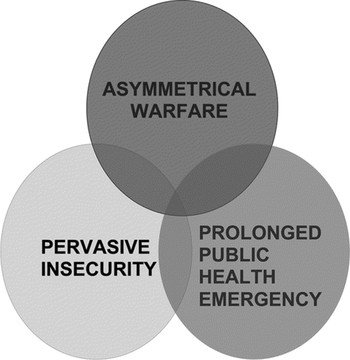
Prolonged war predictably increases destruction and deterioration of the public health infrastructure and its system protections, especially basic disease surveillance, public health personnel, sanitation, and potable water systems. Both Iraq and Afghanistan are illustrative of the pervasive insecurity from modern asymmetrical or nonconventional warfare that prevents effective and efficient humanitarian aid from being delivered (Fig. 2). In Iraq, excess direct deaths from violence reached 60% by 2004.Reference Roberts, Lafta and Garfield55 Over time, indirect deaths began to accumulate, intensify, and grow as the public health catastrophe penetrated the fragile Iraqi society, yet remained below the threshold of public awareness. In less than 5 years, Iraq, considered to have had a developed-country health system before the deposition of Saddam Hussain, has experienced declining health indices consistent with those found in most undeveloped countries. In October 2004 the Iraqi Ministry of Health alerted the world that more deaths were occurring from inadequate health services than from violence.56 The marked increase in Iraq’s chronic malnutrition rate57 and the 2006 IMR—a sensitive composite indicator and measure of effectiveness reflecting essential functioning of health services and governance—was rated as 1 of the top 4 IMRs worldwide with Liberia, Sierra Leone, and Afghanistan.58 The March 2008 International Committee of the Red Cross report on Iraq confirms that the “current level of health services is far below the minimum required”; resources “are scarce and security poor.” Millions have insufficient access to clean water, sanitation, and health care and the water supply continues to deteriorate, with some areas having no functioning water and sanitation facilities. Hospital bed capacity is 50,000 short of what is needed, and of the 34,000 registered physicians in 1990, 20,000 have left the country.59 Afghanistan’s both direct and indirect mortality and morbidity rates will never be accurately measured, but with half the country not secure and without benefit of outside aid, a public health catastrophe is certain and inescapable. Attacks against nongovernmental organizations’ providing humanitarian aid in this protracted conflict have doubled from 8 in the first quarter of 2007 to 16 in the same period this year.60
Current asymmetrical warfare and conflicts have 3 major interdependent and inseparable components that require equal and unprecedented attention and resources. Reprinted with permission fromThe Lancet, Vol 371, Burkle FM, Measuring humanitarian assistance in conflicts, pp 189–190, Copyright 2008, with permission from Elsevier

During war, the historically mandated Geneva Conventions, written with conventional war in mind, address an occupier’s responsibility for recovery and rehabilitation of essential health and public health in Articles 55 and 56.61, Reference Burkle62 Does the language of these long-standing international humanitarian law protections adequately apply to the current asymmetric wars and conflicts in which insecurity is pervasive? The objective of insurgents is to control a population, not necessarily territory or resources. To mitigate the unavoidable slippage into a public health catastrophe, the challenge for disaster managers, the humanitarian community, and parties to asymmetrical war and conflict is to ensure that equal effort, attention, and resources be placed against all 3 interdependent and inseparable major components of current wars and conflicts (Fig. 2).Reference Burkle63
Terrorism in general intends direct health effects when used in isolation or in declared and undeclared warfare: combatants detonating roadside devices (eg, Iraq, Afghanistan) or suicide bombs (eg, Pakistan, Israel) target a mass population. However, biological, chemical, and radiological terrorism could be used as much to generate indirect effects, ranging from delayed and protracted illness to severe and prolonged mental health consequences. “Dirty bombs” initially present as an explosive injury-creating event; however, the terrorist intent is to cause unrecognized radiation illness in a larger population and create panic. Nuclear blasts include both low- and high-yield nuclear explosion scenarios. The latter have the potential to generate massive numbers of direct casualties in which limited medical resources will have little therapeutic effect.Reference Burkle12, 64 Casualty numbers in high-yield disasters will greatly exceed surviving hospital resources and personnel (eg, 1 surviving physician available for every 400–900 casualties). Organized lifesaving operations and essential public health and agricultural infrastructure will not be available in such incidents. The goal of preselected triage criteria established during the Cold War was to identify the direct “survival possible” victims among those with minor injury or acute radiation exposure.64, Reference Campbell65 Long-term triage was designed to save a culture and its recoverable public health and agricultural infrastructure and to stabilize a fragile government to further mitigate indirect mortality and morbidity.Reference Campbell65
CONCLUSIONS
The concept of public health emergencies is an essential “operational element” of modern disaster classification. The fact that indirect morbidity and mortality is rarely the subject of planning and political attention and mostly remain undetected, unmeasured, and underevaluated strongly suggests that taxonomists, planners, and managers have not fully recognized its critical importance in decision making. Until proven otherwise, all developed and developing countries risk experiencing increased disaster-induced indirect mortality and morbidity in excess of direct deaths if any of the factors listed at the beginning of the article occur. Public health consequences, although significant, are preventable and therefore potentially manageable. The status of the health consequences of postdisaster public health infrastructure and systems must be universally assessed and acted upon in a timely manner to mitigate indirect consequences. Planners must use a disaster taxonomy that both is sensitive to direct and indirect health effects and has the capacity to include natural, human failure, and conflict-based elements alone or in combination, to describe and manage different phases of the events.
Public health infrastructure and systems in developed and developing countries must be recognized as strategic and security issues that deserve international public health resource monitoring attention from disaster managers, urban planners, the global humanitarian community, World Health Organization authorities, and participating parties to war and conflict. Formally recognizing the public health impact of health consequences in the taxonomy and management of disasters is a critical first step in this process.
Authors' Disclosures
The authors report no conflicts of interest.
Acknowledgment
This study was supported in part by National Health and Medical Research Council grant 409973, University of Queensland, and Monash University, Brisbane and Melbourne, Australia.