


INTRODUCTION
Many parasite taxa have complex life cycles, with different host species harbouring different parasite developmental stages. Adult parasites typically mate and reproduce inside a definitive host, from which eggs or larvae are released into the external environment. Parasites can then infect the intermediate host(s), where they generally grow through several developmental stages before becoming infective to the definitive host. Completion of the parasite's life cycle often occurs trophically, through predation of the intermediate host by the definitive one. Complex life-cycles are supposed to induce strong selective pressures for parasites to optimize their transmission from one host to the other. Indeed, many parasites induce various alterations in the phenotype of their intermediate hosts, some of them appearing to increase parasites’ fitness at the expense of that of their hosts. Such phenomena are regularly interpreted in the framework of the ‘parasite manipulation’ hypothesis (Moore, Reference Moore2002; Thomas et al. Reference Thomas, Adamo and Moore2005; but see Cézilly et al. Reference Cézilly, Thomas, Médoc and Perrot-Minnot2010). In particular, numerous parasites induce phenotypic alterations (hereafter PIPA for Parasite-Induced Phenotypic Alterations), including changes in the anti-predatory behaviour of their intermediate hosts, thereby possibly increasing trophic transmission (Moore, Reference Moore2002; Thomas et al. Reference Thomas, Adamo and Moore2005; Poulin, Reference Poulin, Brockmann, Roper, Naguib, WynneEdwards, Mitani and Simmons2010; see however Perrot-Minnot et al. Reference Perrot-Minnot, Madaleno, Balourdet and Cézilly2012).
Most often, numerous physiological and behavioural traits are simultaneously modified, including some with no obvious consequences in terms of trophic transmission (Thomas et al. Reference Thomas, Poulin and Brodeur2010), generating a parasite-induced infection syndrome (Cézilly and Perrot-Minnot, Reference Cézilly and Perrot-Minnot2010; Cézilly et al. Reference Cézilly, Favrat and Perrot-Minnot2013). Among the traits belonging to such syndromes is parasitic castration (Baudoin, Reference Baudoin1975). The reduction or suppression of host reproduction by a parasitic infection is generally considered an evolutionary strategy by which the parasite increases its own fitness at the expense of that of its host (Baudoin, Reference Baudoin1975; Jensen et al. Reference Jensen, Little, Skorping and Ebert2006; Lafferty and Kuris, Reference Lafferty and Kuris2009; but see Hurd, Reference Hurd2001 for other interpretations).
Both behavioural and reproductive PIPA may then be constitutive of an infection syndrome. Indeed, Cézilly and Perrot-Minnot (Reference Cézilly and Perrot-Minnot2010) highlighted that numerous parasite taxa inducing behavioural alterations also induce castration. However, because these different PIPAs have been studied independently, it is still unclear whether such a syndrome is due to the progressive accumulation of several independent PIPAs during evolutionary time (Thomas et al. Reference Thomas, Poulin and Brodeur2010), or results from a cascade of effects following disruption of a major physiological mechanism (Cézilly and Perrot-Minnot, Reference Cézilly and Perrot-Minnot2010). As suggested by Cézilly and Perrot-Minnot (Reference Cézilly and Perrot-Minnot2010), evidence for a positive correlation between the intensities of two distinct PIPA could be suggestive of some common underlying mechanism (even if an absence of correlation would not be sufficient to conclude to the absence of such a link).
Another way to provide evidence for associations between various PIPAs could be to examine the temporal coincidence in the manifestations of various dimensions of an infection syndrome. In addition to rare cases of direct reproductive organ consumption by parasites, castration can be achieved through two main different ways, with different outcomes in their link with other PIPA. Castration can result from a large neuroendocrine disorder including the perturbation of the endocrine glands regulating gonadic development. In that case, links between parasites and neuroendocrine modulators may play a crucial role in linking behavioural alterations and castration (Hurd, Reference Hurd2009), and castration may coincide with behavioural alterations (Cézilly and Perrot-Minnot, Reference Cézilly and Perrot-Minnot2010). Alternatively, an ‘energy-draining’ castration can be achieved through the uptake of essential host resources by the parasite, independently of other effects of the parasite (Hall et al. Reference Hall, Becker and Cáceres2007). Therefore, under the energy-drain hypothesis, castration should occur early in the course of infection (Hall et al. Reference Hall, Becker and Cáceres2007) and should not coincide with behavioural modifications. However, as discussed by Hall et al. (Reference Hall, Becker and Cáceres2007), the feeding rate of parasites may not be constant, as it may vary as parasites grow larger, or increase hyperbolically with food density, depending on the type of feeding functional response. In addition, recent findings on parasite behavioural manipulation showed that this phenomenon is dynamic. While parasite stages infective to the next host generally induce alterations that seem to increase trophic transmission, the reverse might be observed in intermediate hosts infected by parasites at an early developmental stage, still unable to infect the definitive host (Dianne et al. Reference Dianne, Perrot-Minnot, Bauer, Elsa and Rigaud2011; Weinreich et al. Reference Weinreich, Benesh and Milinski2013). This phenomenon might have been selected because trophic transmission occurring before the parasite has reached the infective stage would result in zero fitness (Parker et al. Reference Parker, Ball, Chubb, Hammerschmidt and Milinski2009). Ideally, then, an optimal temporal sequence of manipulations could consist of a ‘protection-then-increased exposure’ strategy.
The purpose of the present study was to test the time course and correlations between behavioural alteration and castration, two PIPAs occurring during the infection of the crustacean amphipod Gammarus pulex by the acanthocephalan parasite Polymorphus minutus. Adult P. minutus are intestinal parasites of various waterbird species, and rely on freshwater amphipods as intermediate hosts (Kennedy, Reference Kennedy2006). Cystacanths (the developmental stage at which the parasite is able to infect its avian hosts) of P. minutus are known to alter the behaviour of G. pulex through reversing geotaxis (infected animals are attracted to the top of the water column, while uninfected ones tend to stay at the bottom of the water column), and increasing clinging behaviour (Cézilly et al. Reference Cézilly, Grégoire and Bertin2000; Bauer et al. Reference Bauer, Haine, Perrot-Minnot and Rigaud2005). Infected animals thus spend more time at the water surface where they cling on any material available, while uninfected ones spend most of their time at the bottom of the water column. Infected hosts exhibiting such altered behaviour have been shown to be more exposed to predation by mallards, one of the P. minutus definitive host, than unifected ones (Hindsbo, Reference Hindsbo1972; Jacquin et al. Reference Jacquin, Mori, Pause, Steffen and Médoc2014). Parallel to this, Bollache et al. (Reference Bollache, Gambade and Cézilly2001, Reference Bollache, Rigaud and Cézilly2002) evidenced a strong parasitic castration in G. pulex associated with the presence of P. minutus cystacanths. Infected males and females are almost never found in pre-copulatory mate guarding, and infected females lay no egg, following disruption of oocyte maturation. Little is known, however, on the time course of behavioural and reproductive PIPAs. Bethel and Holmes (Reference Bethel and Holmes1973) reported that G. lacustris infected by acanthellae (early developmental stage) of P. paradoxus did not express the behavioural alterations shown when they are infected by cystacanths of the same species. On the other hand, Rauque and Semenas (Reference Rauque and Semenas2009) found that infection with acanthellae of two acanthocephalan parasite species has no effect on the fecundity of their amphipod intermediate host, while Sparkes et al. (Reference Sparkes, Weil, Renwick and Talkington2006) found that behavioural reproductive suppression in freshwater isopod males infected with Acanthocephalus dirus did not occur until the parasite had reached the cystacanth stage. Taken together, these observations suggest that reproductive and behavioural PIPAs might be synchronous, but, to the best of our knowledge, this has not yet been assessed within a single study.
MATERIAL AND METHODS
Gammarid sampling and maintenance
Gammarids were sampled between February and April 2016 in a tributary of the Suzon River, near Val-Suzon (Côte d'Or). Individuals were randomly collected using a hand net at all depths of the river (between ca 30 cm, the maximum depth and the surface). Gammarids were sampled every 3 weeks and individuals from each sample spent the same amount of time in the laboratory. Within 3 days after sampling, gammarids were separated according to their infection status (uninfected, infected by an acanthellae, or infected by a cystacanth) and sex. These traits were determined through observations with a stereoscopic microscope, P. minutus infection and stage being easily detected through the translucent cuticle of the intermediate host. Sex of gammarids is easily distinguishable by examination of the second pair of gnathopods and, often, the presence of eggs in the female's external broodpouch (Sutcliffe, Reference Sutcliffe1992). Gammarids were maintained in separate tanks (30 × 20 × 10 cm3) in a mix of river water and tap water (dechlorinated and oxygenated, renewed each week). Rocks and plants were added to the tank to approximate river conditions, and conditioned elm leaves were used regularly to feed gammarids. Room temperature was 15 ± 1 °C, and photoperiod was 13:11 h light:dark. Behavioural tests and reproductive traits were measured between day 4 and day 13 post-sampling. Each day, groups of 6–8 infected individuals and 6–8 uninfected ones were tested simultaneously.
Behavioural tests
Geotaxis
Based on the procedure described in Bauer et al. (Reference Bauer, Haine, Perrot-Minnot and Rigaud2005), we tested the vertical distribution of infected and uninfected gammarids. To that end, animals were placed individually in transparent vertical glass columns (35 cm height, 6 cm diameter) filled with stock water and covered by a net to allow gammarids to grasp at the water surface. This setup was placed in a large box, black inside, with one side open for observation. Columns were vertically divided in six equal parts, numbered from 0 (lower part) to 5 (upper part). Following an acclimatization period of 10 min, a score was attributed to the individual depending on its vertical position in the column, every 30 s during the next 10 min. The overall score for each individual was then calculated as the sum of each score, such that a gammarid staying at the bottom of the column for 10 min scored 0 (strong positive geotaxis), whereas one staying at the top for the same amount of time scored 100 (strong negative geotaxis). The water column was emptied and filled again after each test. Data were analysed using non-parametric Wilcoxon or Kruskal–Wallis tests, followed by a Steel-Dwass non-parametric post-hoc test.
Inclination of males to pair
During precopulatory mate guarding (or amplexus), male gammarids carry the females underneath their own ventral surface, for several days before egg laying. We used a protocol similar to that of Bollache et al. (Reference Bollache, Gambade and Cézilly2001) to assess the motivation of males to pair. After having been tested for geotaxis, control and infected males were individually placed in small cups (3 cm height, 6 cm diameter), filled with stock water, during 30 min of acclimatization. During this time, uninfected females receptive to mating (i.e. paired female taken from the stock tank, carrying eggs at similar and advanced development), were separated from their males and isolated. At the end of the acclimatization time, a single receptive and uninfected female was added to each cup containing a focal male. Cups were the checked every 5 min over 1 hour, to see if individuals had entered in amplexus. The experiment ended if amplexus did not occur after 1 hour, since, after such a time period, males rarely engage in pairing (Bollache et al. Reference Bollache, Gambade and Cézilly2001). Data were analysed with a Generalized Linear Model (GLM), using a binomial distribution and a Logit link function, and using Firth Bias-adjusted Estimates, allowing the analysis of rare events.
At the end of the behavioural tests, each individual was kept separately in a small cup (3 cm height, 6 cm diameter) until dissection and measurement of reproductive parameters.
Reproductive traits
Dissections were made in Ringer, using a stereoscopic microscope (Nikon SMZ-10A) and a video measurement system (Nikon NIS – Elements D, v4.10). Gammarids were first anesthetized in carbonated water and their size determined by the distance from the fourth coxal plate basis to the dorsal limit of the individual (Bollache et al. Reference Bollache, Rigaud and Cézilly2002). They were then dissected, and the parasite developmental stage was confirmed in infected animals.
Reproductive traits in males
The second pair of gnathopods is used by males to grasp females during amplexus (Conlan, Reference Conlan1991). We therefore investigated whether parasitism affected this morphological trait associated with reproduction. The maximum length and maximum width of the right second gnathopod were measured to the nearest 0·01 mm, and their product was used as a proxy of gnathopod size. Since gnathopod size shows an allometric relationship with body size (see Cothran and Jeyasingh, Reference Cothran and Jeyasingh2010), a linear regression was calculated between gnathopod size and the size of the fourth coxal plate, after log transformation. The residuals of the regression were used to compare infection groups using an analysis of variance. Sperm reserves were estimated by a method modified from Lemaître et al. (Reference Lemaître, Rigaud, Cornet and Bollache2009). One intact testis (including seminal vesicle) was isolated, and placed into 1000 µL of demineralized water. The gonad was fragmented in small pieces, and creation of sperm heaps was avoided by gently stirring the solution with forceps, to obtain a homogenous dilution of sperm in 1000 µL. Four sample of 10 µL were placed on a slide, and dried during 10–20 min at 37 °C. Using a microscope (‘Nikon Eclipse E400’, objective ×100), the total number of spermatozoids for each sample was counted, to obtain a total number of spermatozoids in 40 µL, after having verified the repeatability between samples. Since spermatozoid number may depend on male body size, we used a GLM using a Poisson distribution and a Log link function, corrected for overdispersion, to estimate the link between spermatozoid count and the size of the fourth coxal plate after its log transformation. The residuals of this model were used to compare infection groups using an analysis of variance.
Reproductive traits in females
The total number of eggs or embryos present in the ventral brood pouch was counted to estimate female fecundity. To determine the effect of infection on oocyte maturation, gonads were dissected, and the number of developed oocytes and white (non-developing) oocytes were counted in one ovary, following Bollache et al. (Reference Bollache, Rigaud and Cézilly2002). The number of ‘blue oocytes’ (developing but altered), which only occurred in P. minutus-infected individuals, was also counted (see Bollache et al. Reference Bollache, Rigaud and Cézilly2002). The proportion of females carrying eggs or embryos was analysed with a GLM, using a binomial distribution and a Logit link function and using Firth Bias-adjusted Estimates. Oocyte counts were analysed using non-parametric Kruskal–Wallis tests, followed by a Steel-Dwass post-hoc test.
Correlations between geotaxis scores and reproductive traits were analysed using non-parametric Spearman's rho, followed by a Bonferroni correction. All statistical tests were made using JMP v. 10.0.0 (©SAS Institute 2012).
RESULTS
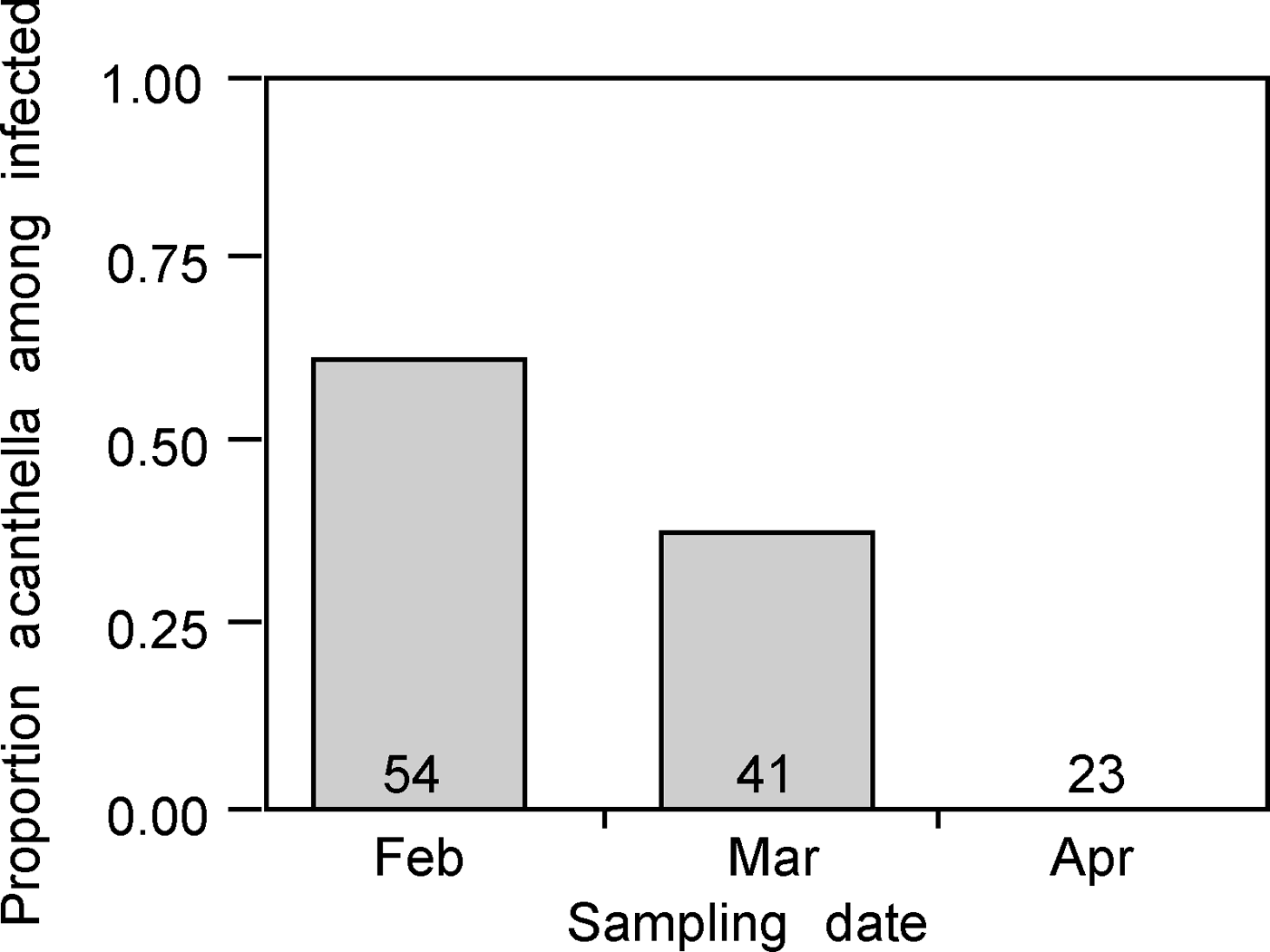
During the three field sampling periods, the prevalence of infection with acanthellae progressively decreased from 63·0% in February to 0% in April (Fig. 1). From this observation, as well as considering results from other longitudinal field studies of acanthocephalans (e.g. Kennedy, Reference Kennedy2006; Sparkes et al. Reference Sparkes, Weil, Renwick and Talkington2006), we inferred that parasites were maturing progressively from acanthella to cystacanth stages in the population. For measurements of geotaxis, we therefore compared similar parasite developmental stages among sampling dates.
Proportion of acanthella developmental stage of Polymorphus minutus in their infected G. pulex hosts, according to sampling date. Other developmental stages were cystacanths.

Geotaxis measurements
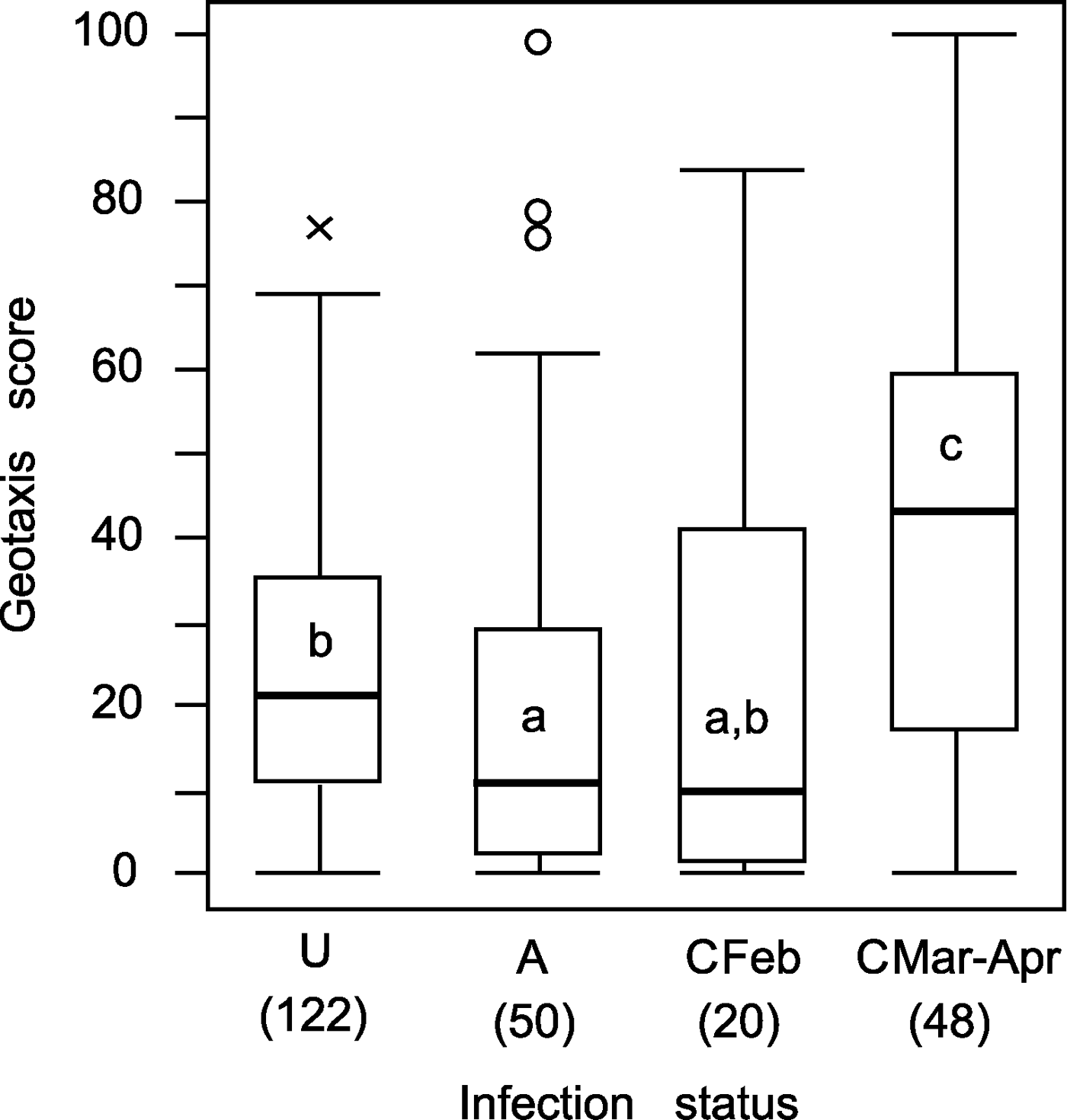
At any date and within each infection status, geotaxis scores did not differ significantly between G. pulex males and females (Wilcoxon tests, all P > 0·09). Data were therefore pooled for further analyses. There was no significant variation in geotaxis score between sampling dates for both uninfected individuals (three sampling dates, n = 60, 49 and 13, respectively, Kruskal–Wallis: χ 2 = 2·29; 2 d.f., P = 0·32) and individuals infected by acanthellae (two sampling dates, n = 34 and 16, respectively, Wilcoxon: χ 2 = 2·07; 1 d.f., P = 0·15). Samples from different dates were therefore pooled for further analyses. However, geotaxis score varied according to sampling date for individuals infected with a cystacanth (three sampling dates, n = 20, 25 and 23, respectively, Kruskal–Wallis: χ 2 = 8·31; 2 d.f., P = 0·016). Infection with a cystacanth was associated with a lower score in February than in March and April (Steel-Dwass post-hoc test, P = 0·04 and P = 0·03, respectively), while the scores did not differ significantly between March and April (P = 0·98). Owing to the variation in cyctacanth prevalence through time reported above, we distinguished two cystacanth categories, depending on whether they had been sampled in February or in March–April, for further analyses.
The geotaxis score of G. pulex varied significantly according to their infection status (Fig. 2, Kruskal–Wallis: χ 2 = 30·19; 3 d.f., P < 0·0001). Infections with cystacanths sampled in March–April were associated with geotaxis scores higher than those of uninfected gammarids, while infections by acanthellae were associated with geotaxis scores lower than those of uninfected individuals (Fig. 2). Scores of individuals infected by cyctscanths sampled in February were significantly lower than those recorded in March–April, but not significantly different from those of individuals infected by acantheallae and those of uninfected ones (Fig. 2).
Scores of geotaxis in Gammarus pulex according to their infection status, with categories as defined in the text. U, uninfected animals, A, infected with acanthellae, Cfeb, infected with cyctacanths sampled in February, CMar-Apr, infected with cyctacanths sampled in March and April (see text). Sample sizes are provided. Box-plots are median, interquartile and interdecile (and outliers). Boxed labelled with different letters denotes scores significantly different after a Steel-Dwass non-parametric post-hoc test (α = 0·05).

Male reproductive traits
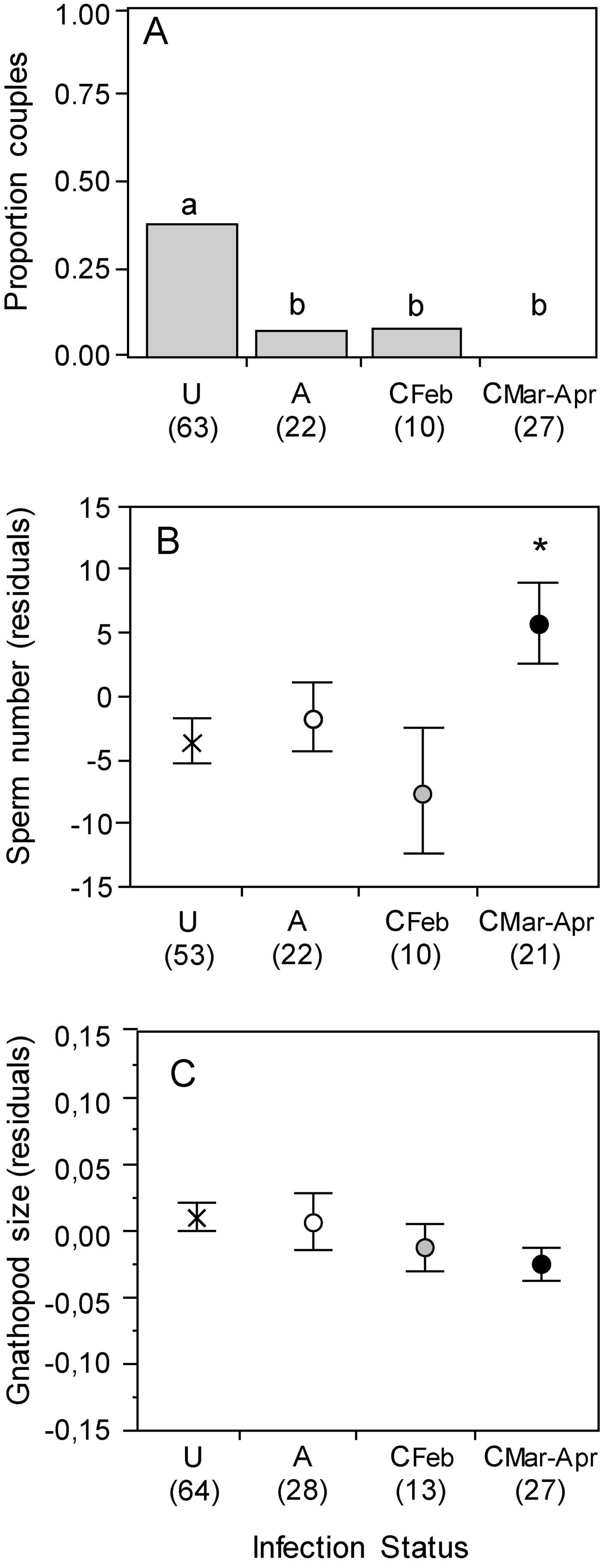
About 40% of uninfected males initiated pairing with receptive females. This proportion significantly differed from the proportions of infected males initiating a pair (maximum 10%), irrespective of the parasite developmental stage (GLM: χ 2 = 25·73, 3 d.f., P < 0·0001) (Fig. 3A).
Reproductive traits in Gammarus pulex males, according to their infection status (U: uninfected animals, A: infected with acanthellae, Cfeb: infected with cyctacanths sampled in February, CMar-Apr: infected with cyctacanths sampled in March and April). (a) Proportion of males initiating pairing in one hour. Bars surrounded by different letters denotes proportions significantly different after Odd-ratios tests; (b) Sperm reserve in testis. Dots are means, bars are standard errors on the mean; Bar surrounded by a star denotes a mean significantly different for the uninfected control group after Dunnett post-hoc test (P = 0·03) (c) Size of second pair of gnathopods as a function of gammarid size and infection status. Sample sizes are provided within brackets below the x-axes.

Sperm count, corrected for gammarid body size, was different among groups (ANOVA F3,105 = 3·00, P = 0·03). Males infected with cyctacanths from the March to April sample had more sperm reserves than uninfected males, but not males of other infection categories (Fig. 3B).
The size of the second gnathopod, corrected for gammarid body size, did not differ according to the infection status (ANOVA F3,131 = 1·12, P = 0·34; Fig. 3C).
Female reproductive traits
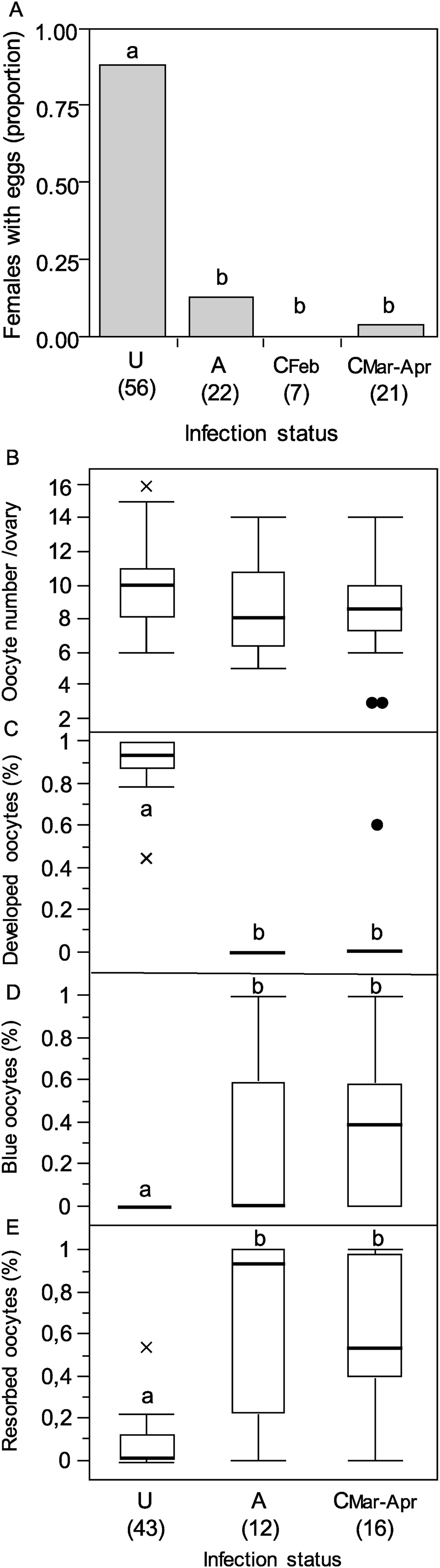
The proportion of females carrying eggs or embryos in their ventral incubating pouch (i.e. reproductive females) was 89·29% in uninfected individuals. This proportion significantly differed from that of reproductive infected females (maximum 13·6%), irrespective of the parasite developmental stage (GLM: χ 2 = 82·08, 3 d.f., P < 0·0001) (Fig. 4A).
Reproductive traits in Gammarus pulex females, according to their infection status (U, uninfected animals, A, infected with acanthellae, Cfeb, infected with cyctacanths sampled in February, CMar-Apr, infected with cyctacanths sampled in March and April). Sample sizes are provided below the x-axes. (a) Proportion of females with eggs in the brood pouch. Bars surrounded by different letters denotes proportions significantly different after Odd-ratios tests; (b) Number of oocytes counted in one ovary; (c) Proportion of developing oocytes (d) Proportion of blue oocytes, (e) Proportion of white oocytes. From (b) to (e), box-plots are median, interquartile and interdecile (and outliers). Bars surrounded by different letters denotes significant differences after a Steel-Dwass non-parametric post-hoc test (α = 0·05).

Oocyte count was not analysed in females infected with cystacanths sampled in February, because of the small sample size of successful dissections (n = 4). In other categories, the number of oocytes per ovary did not differ significantly among uninfected and infected females (Kruskal–Wallis: χ 2 = 3·74, 2 d.f., P = 0·15) (Fig. 4B). However, the proportion of developing oocytes was much higher in uninfected females than in infected ones, irrespective of the developmental stage of parasites, in which this proportion was virtually zero, with one single exception (Kruskal–Wallis: χ 2 = 54·44, 2 d.f., P < 0·0001; Fig. 4C). Indeed, the proportion of blue oocytes (i.e. showing abnormal development), as well as the proportion of white oocytes (i.e. not developing oocytes) were higher in infected females than in uninfected ones, irrespective of the developing stage of the parasite (Kruskal–Wallis: χ 2 = 37·15, 2 d.f., P < 0·0001, Fig. 4D, and χ 2 = 34·75, 2 d.f., P < 0·0001, Fig. 4E, respectively).
Correlations between geotaxis and reproductive traits
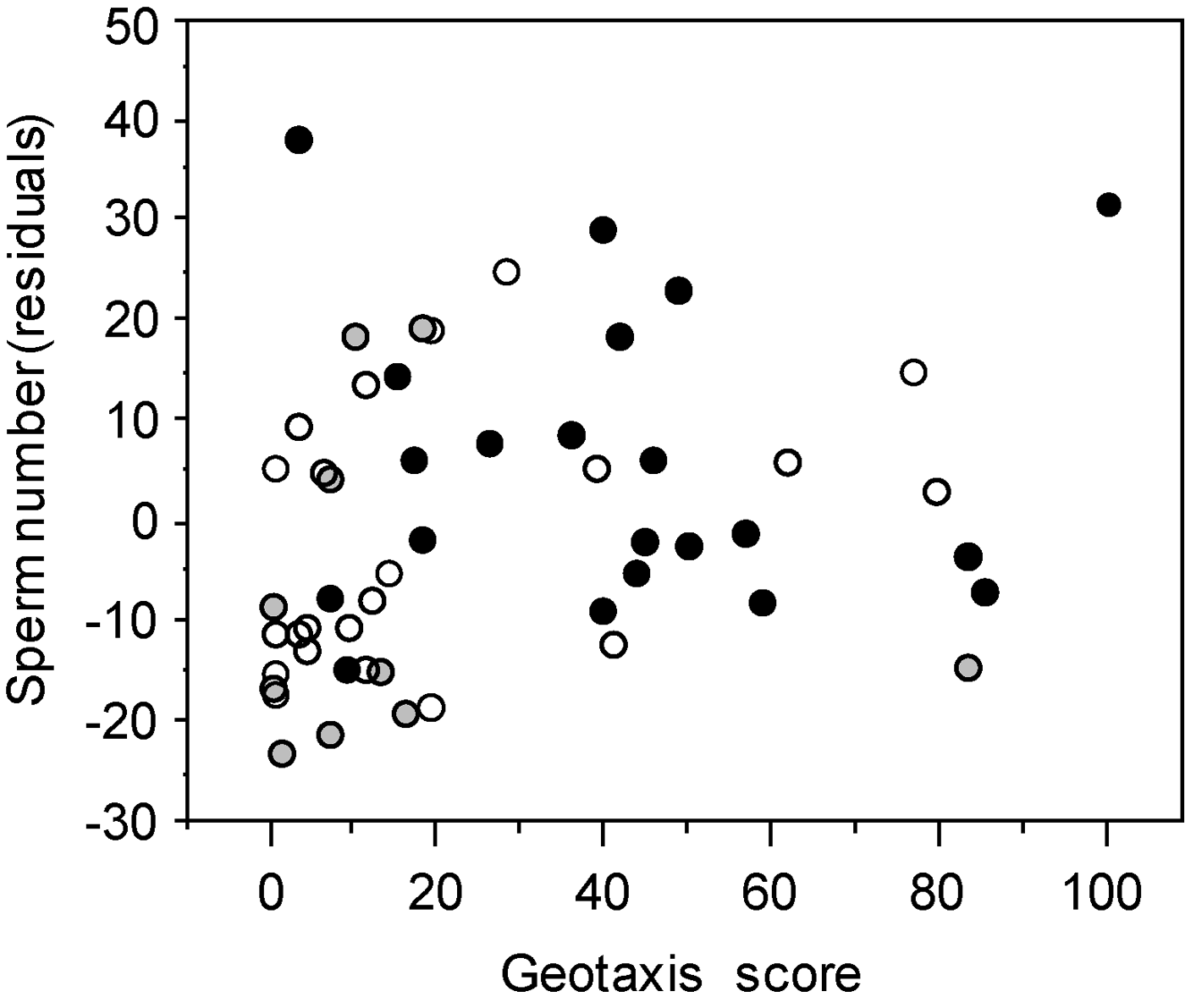
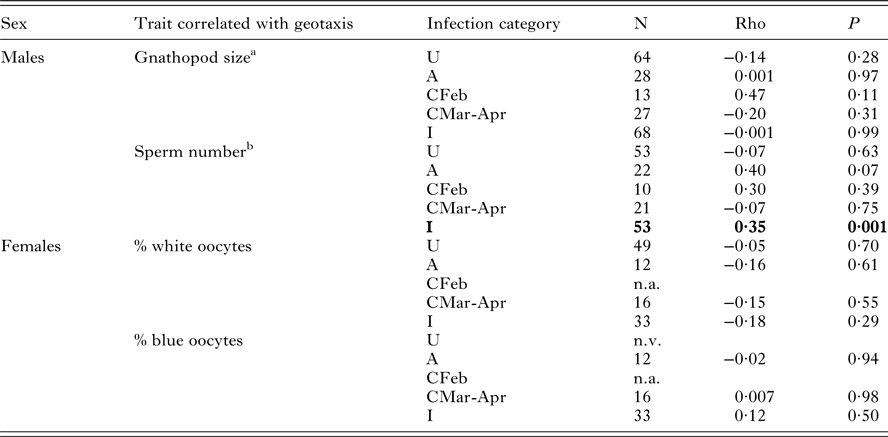
We considered categories of infections in two different ways. First, we distinguished acanthellae and the two cystacanths categories, as described above. Second, we grouped all the developmental stages into a single, ‘infected’ category. Such a grouping was made to take into account a potential correlation between the time course of behavioural changes (as described before) and parasite castration. Only one of these correlations was found to be significant (Table 1): there was a positive correlation between geotaxis score and sperm number in infected males, after pooling data from all developmental stages (Fig. 5).
Correlation between geotaxis scores and sperm number in Gammarus pulex males infected with different stages of Polymorphus minutus. White dots: infected with acanthellae; grey dots infected with cyctacanths sampled in February; black dots; infected with cyctacanths sample in March–April.

Correlations (Spearman's rho) between geotaxis scores and major reproductive traits of Gammarus pulex males and females, according to their infection status

U, uninfected animals; A, infected with acanthellae; Cfeb, infected with cyctacanths sampled in February; CMar-Apr, infected with cyctacanths sampled in March and April; C, infected with cyctacanths (all date grouped); I, infected animals (all developmental stages grouped).
a Corrected for body size (residuals of the regression).
b Corrected for body size (residuals of the Quasi-Poisson GLM).
n.a. sample size too low to be analysed.
n.v. no variation on this trait.
Correlation in bold was significant even after Bonferroni correction.
DISCUSSION
We found that both the direction and extent of modification of geotaxis in G. pulex were highly dependent on the developmental stage of P. minutus, whereas castration was not. Whereas the cystacanth stage induced a reversion of geotaxis (negative geotaxis, compared with positive geotaxis in uninfected animals), confirming previous observations (e.g. Cézilly et al. Reference Cézilly, Grégoire and Bertin2000; Bauer et al. Reference Bauer, Haine, Perrot-Minnot and Rigaud2005; Jacquin et al. Reference Jacquin, Mori, Pause, Steffen and Médoc2014), the acanthella stage, not infective yet for the definitive host (Bethel and Holmes, Reference Bethel and Holmes1974), induced a stronger, positive geotaxis than that observed in uninfected gammarids. A previous study on the congeneric acanthocephalan P. paradoxus concluded that acanthellae induce no change in behaviour in gammarids (Bethel and Holmes, Reference Bethel and Holmes1974). However, that study examined evasive behaviour and not geotaxis, such that further investigations are necessary to have a better appreciation of the time course of multidimensionality in manipulation in relation to parasite development. The present observations are however consistent with others showing that immature stages of parasites may induce behavioural alterations opposite to those induced by the parasite stages infective for the next host (Hammerschmidt et al. Reference Hammerschmidt, Koch, Milinski, Chubb and Parker2009; Dianne et al. Reference Dianne, Perrot-Minnot, Bauer, Elsa and Rigaud2011; Gopko et al. Reference Gopko, Mikheev and Taskinen2015), or, at a finer scale, that parasites may alter host behaviour in a time-specific manner throughout the day, resulting in a protection from predation by non-suitable definitive hosts (Levri, Reference Levri1998). Such a phenomenon has been predicted by Parker et al. (Reference Parker, Ball, Chubb, Hammerschmidt and Milinski2009) as an optimal ‘protection-then-increased exposure to predation’ strategy for trophically-transmitted parasites, and experiments have indeed revealed that such opposite behavioural alterations are associated with lower predation rates (Dianne et al. Reference Dianne, Perrot-Minnot, Bauer, Elsa and Rigaud2011; Weinreich et al. Reference Weinreich, Benesh and Milinski2013). Whether infection with acanthellas of P. minutus is associated with lower vulnerability to predation by definitive hosts remains to be tested in the present case.
Our results further suggest that the transition between positive and negative geotaxis is progressive. Indeed, cystacanths sampled in February were associated with geotaxis scores intermediate between those of acanthellae and those of cystacanths that were sampled 1 month later. February cyctacanths being on average younger than March–April cyctacanths, we evidenced here a progressive shift in a parasite-induced behavioural change – ‘progressive’ meaning here that the change occurred over several days. This observation is consistent with the results obtained by Bethel and Holmes (Reference Bethel and Holmes1974) on P. paradoxus, for which 17 days, on average, separate the invagination of the acanthellae (defining the cystacanth stage) from the onset of altered behaviour in the intermediate host. This confirms that the intensity of behavioural changes increases with the course of acanthocephalan maturation after cystacanth stage (Franceschi et al. Reference Franceschi, Bauer, Bollache and Rigaud2008).
Contrasting with what was observed for behavioural changes, we observed no variation in the intensity of castration as a function of parasite maturation. In both males and females the extent of castration at the acanthellae stage, did not differ from that observed at the cystacanth stage of infection. Even if acanthellae in this study were rather old (they were coloured and visible through the host's cuticle), this result contrasts with those of Sparkes et al. (Reference Sparkes, Weil, Renwick and Talkington2006) and Rauque and Semenas (Reference Rauque and Semenas2009) who observed, in three other acanthocephalan species inducing total or partial castration, that castration did not occur before parasites had reached the cystacanth stage. Therefore, castration induced by P. minutus seems to be triggered earlier during parasite development than in other castrating acanthocephalans.
As reported in Bollache et al. (Reference Bollache, Gambade and Cézilly2001), infected males paired at lower rates compared with uninfected ones. We further explored this phenomenon by considering whether this lower pairing success was due to gonadal dysfunction or morphological alteration. We found no evidence for an alteration of sperm reserves associated with infection by P. minutus, nor did we observe any alteration of gonadal structure. This is consistent with another study on acanthocephalans (Bierbower and Sparkes, Reference Bierbower and Sparkes2007). Actually, G. pulex males infected with older cystacanths had higher sperm reserves. Since sperm tends to accumulate if males do not inseminate females (Lemaître et al. Reference Lemaître, Rigaud, Cornet and Bollache2009), sperm accumulation after a longer period of sexual abstinence, due to a longer infection time, could explain this result. This is corroborated by the positive correlation between geotaxis score and sperm reserve when taking into account all stages of the P. minutus development (Fig. 5): the older the parasites, the more they altered their host's geotaxis and the more the hosts accumulated sperm, probably as a consequence of behavioural castration. Due to our experimental procedure, we were unable to assess whether the sperm accumulated in infected males was functional or not. Such an assessment would not be straightforward, however, because sperm is not motile in gammarids, such that a comparison of insemination success between infected and uninfected males would be necessary to address the question. However, during our dissections, we did not observe any abnormal sperm structure. In addition, infection status had no influence on the size of the second gnathopod, the appendage used to grasp females during mate guarding. Therefore, alterations of reproductive function or morphology are unlikely to explain reduced male mating success in G. pulex infected with P. minutus. One possibility, then, is that infection with P. minutus has an effect on the nervous system of male G. pulex that disrupts their normal reaction towards sexually receptive females. Such a possibility has been observed in an insect infected by another acanthocephalan species, where males cannot perceive normally sex pheromones (Carmichael et al. Reference Carmichael, Moore, Louis and Bjostad1993).
No significant correlation was found between the intensity of behavioural changes and the intensity of castration, either when considering acanthellae- and cystacanth-induced behavioural changes as separated phenomena (i.e. correlations analysed separately for the different developmental stages), or as two components of the same phenomenon (analyses made after grouping all parasite stages). This lack of correlation, as well as the differences in temporal dynamics between castration and geotaxis changes, does not argue in favour of a mechanistic link between these two PIPAs (Cézilly and Perrot-Minnot, Reference Cézilly and Perrot-Minnot2010; Thomas et al. Reference Thomas, Poulin and Brodeur2010). However, this result is, of course, not sufficient to conclude to the absence of such a link. Over the course of infection, products excreted by the parasite may accumulate in its host. In the same time, several by-products of the immune response of the host may accumulate too. However, the dose-response of castration and that of reversed geotaxis in relation to the concentration of a single or several key substances may not be the same. For instance, a behavioural or physiological dose-response may not be linear but sigmoid (Lau et al. Reference Lau, Sun, Wang, Simpao and Falk2000; Byers, Reference Byers2013). It has recently been proposed that reversed geotaxis could be a behavioural response to hypoxia signalling, resulting either from the sustained hypoxic-like conditions induced by P. minutus cystacanths, or the release, from the excretion/secretion products of parasites, of lactate and succinate in the host brain (Perrot-Minnot et al. Reference Perrot-Minnot, Maddaleno and Cézilly2016). The problem remains that the two opposite geotaxis disruptions induced by the two parasite developmental stages may hardly been explained by such a phenomenon. Interestingly, however, some dose-responses can show bi-phasic shape, corresponding to a hormetic-like effect. In such cases, the exposition to a low dose of a substance may induce in an organism the opposite response to a very high dose (see for instance Rabhi et al. Reference Rabhi, Esancy, Voisin, Crespin, Le Corre, Tricoire-Leignel, Anton and Gadenne2014). This could explain, from a mechanistic point of view, the contrasted effect of the developmental stages of P. minutus on the geotaxis of G. pulex. Independently, some studies have showed that natural or experimentally-induced hypoxia down-regulates the expression of vitellogenin, the major egg-yolk protein, in a number of crustacean and fish (Brown-Peterson et al. Reference Brown-Peterson, Manning, Denslow and Brouwer2011; Li and Brouwer, Reference Li and Brouwer2013; Lai et al. Reference Lai, Li, Chan, Chan, Yuen and Chiu2016 and references therein). Therefore, under the hypothesis that hypoxia has an early and strong effect on reproduction but that phototaxis behaviour shows a bi-phasic response to hypoxia, these two traits might actually be synchronous. Now that the timing of expression of castration and geotaxis changes has been clarified in G. pulex infected by P. minutus, unravelling the shape of hypoxia signalling dose-response on both geotaxis and castration would be a promising avenue for testing the link between these different PIPAs.
ACKNOWLEDGEMENTS
We thank the reviewers for their very helpful comments.
FINANCIAL SUPPORT
This study was supported by the Agence Nationale de la Recherche (ANR)(grant number ANR-13-BSV7-0004-01).