I. INTRODUCTION
With continuous consumption of natural resources and energy sources apace, lightweight becomes increasingly valued and attractive to all aspects of human society.Reference Rohatgi, Weiss and Gupta1 Accordingly, light metals and alloys including aluminum, magnesium, titanium etc. are incrementally used as structural materials instead of ferrous alloys and other heavy metals in automotive, aerospace, and military industries.Reference Yu, Balog, Yan, Schaffer and Qian2 However, these unreinforced light metals and alloys often failed to meet the requirements of components assembly. Therefore, some reinforcements and fillers in fiber and particulate forms are incorporated into these metals to obtain composite materials for improving the microstructure and properties. It is reported that the most efficient improvement in strength and stiffness properties is obtained with incorporation of fiber fillers,Reference Shen, Yin, Wei, Li, Liu and An3 while anisotropy seriously hinders the widespread usage of this series of composites. The most usually considered particulate reinforcements such as SiC, A2O3, Si2O3, and graphite enable composites to overcome anisotropy. Yet, these composites are still in limited application in general industries due to the high production cost. Among the particulate reinforcements, the inexpensive fly ash (approximately 1/30 of SiC particles),Reference Rohatgi, Weiss and Gupta1 a by-product generated during combustion of coal in thermal power plants, has been successfully incorporated into aluminum alloys as discontinuous dispersoids.Reference Rajan, Pillai, Pai, Satyanarayana and Rohatgi4–Reference Rohatgi, Daoud, Schultz and Puri6 There are two types of fly ash, namely, solid particle (precipitator) and hollow (cenosphere) which accounts for up to 85% of all fly ash. Furthermore, the hollow particles have lower density (0.4–0.6 g/cm3) than particulate and fibrous reinforcements, which permit the design of lightweight and stiff components.Reference Rohatgi, Kim, Gupta, Alaraj and Daoud7
In view of the specific properties and much lower production cost, aluminum matrix fly ash (AMFA) cenosphere composites are possible to overcome the cost obstacle for wide applications. The properties of AMFA cenosphere composites are influenced by the chemical composition of the base metal, the manufacturing technique, and the nature of fly ash (constituents, size, etc.). A group of investigators made attempts to synthesize this kind of composites through several techniquesReference Rams, Campo and Ureña8–Reference Uju and Oguocha12 with pure aluminum and aluminum alloys in different compositions. Powder metallurgy (P/M) is a special manufacturing method that successfully fabricated metal matrix composites (MMCs).Reference Miracle13,Reference Hrairi, Ahmed and Nimir14 The main advantage of P/M in comparison with other methods is that it is conducted on a relatively lower temperature, which would not cause undesired interfacial reactions. Stir casting technique can fabricate AMFA containing up to 30%Reference Mondal, Das, Ramakrishnan and Uday Bhasker5 particles by volume and is at advantage compared to the pressure infiltration technique that allows a variety of sizes and shapes. Obviously, the fabrication technique for complex parts with low production costs is always the key in academia and industry for developing high performance composite materials with desired attributes.
It is well known that the decrease of reinforcement dimension will effectively improve the properties of MMC materials. The advanced technology which is available to separate hollow from solid spheres and to choose them of desired chemical composition and size enables us to use enough narrow and small size cenospheres in the current experiment. The purpose of the current paper is to document the effects of narrow and small size fly ash cenosopheres on the microstructure and properties of aluminum matrix composites. At the same time, optimal technological parameters of the stir casting technique involved in fabricating AMFA cenosphere composites were obtained.
II. EXPERIMENTAL PROCEDURE
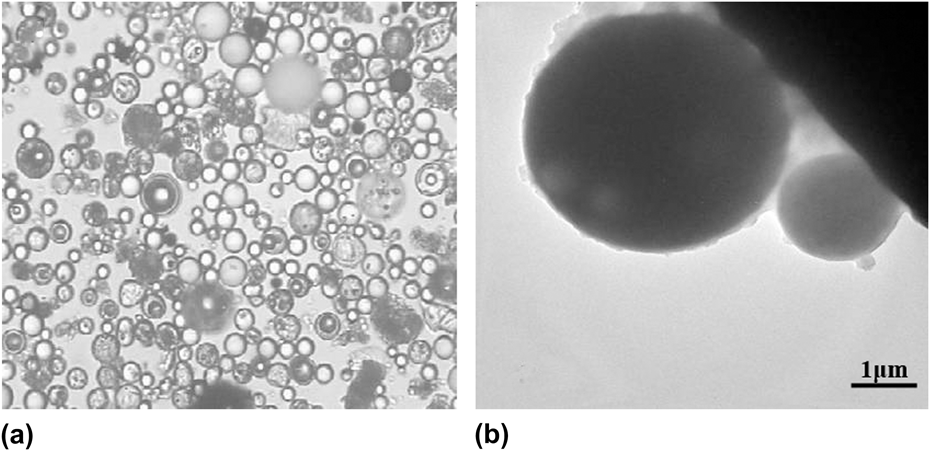
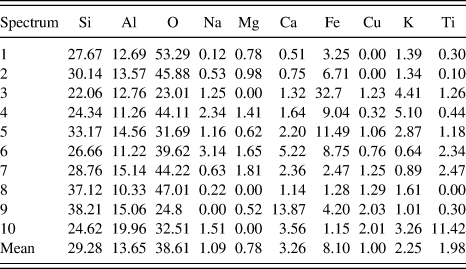
Pure aluminum (99.9%) was used as a base metal in the current work, with sieved fly ash cenospheres collected from Duck River Power Company (DRPC) in Henan state. An energy-dispersive x-ray (EDX) detector was used to identify the major components of the sieved fly ash cenospheres, and the result is shown in Table I. Figure 1 shows the typical polarizing optical micrograph (POM) and transmission electron micrograph (TEM) of sieved fly ash cenospheres. It is shown in Fig. 1(a) that most of the fly ash particles are spherical and hollow, whereas others in a very small scale are in irregular shapes. Furthermore, the diameters of these spherical fly ash cenospheres are in a pretty narrow and small size (approximately 2–30 μm), which is clearly shown in Fig. 1(b).
Chemical composition of sieved fly ash.

(a) POM morphology of sieved fly ash cenospheres and (b) TEM morphology of spherical fly ash cenospheres.

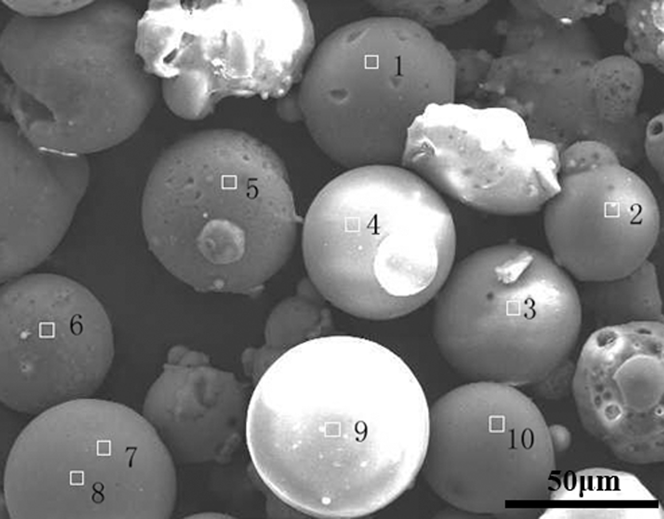
The morphology of the sieved fly ash cenospheres observed using a scanning electron microscope (SEM) showed the usual fly ash morphology which consisted of spherical particles (Fig. 2). Subsequent EDX analysis on different areas in Fig. 2 is shown in Table II and demonstrates that the cenospheres are mostly composed of alumina–silica and a small amount of other oxides due to the fact that no other anions were detected except oxygen.
Scanning electron micrograph (SEM) of sieved fly ash cenosphere surface.
EDX analysis of sieved fly ash cenosphere surface (wt%).
Pretreatment is proved be beneficial to the wettability and the dispersed diffusion of fly ash cenospheres into the melt.Reference Parvaiz, Mohanty, Nayak and Mahanwar15,Reference Xu, Ma, Yan, Yang and Du16 Therefore, after cogitation of production cost, the fly ash cenospheres were pretreated in a solution of 1% Na2CO3 and continuously soaked for 3 h to ensure sufficient modification. Then the modified fly ash cenospheres were dried at 100 °C in an oven until a constant weight was obtained. After the pretreatment, the modified fly ash cenospheres were preheated to 800 °C for 2 h and stir-mixed into the aluminum melt with a stirrer designed for creating a vortex, which helps to effectively incorporate the light fly ash into the melt.
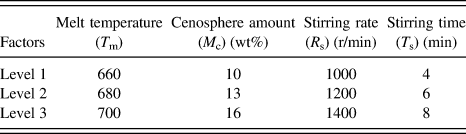
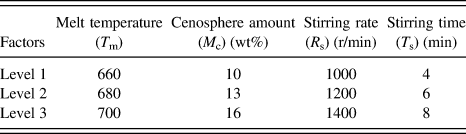
In the process of synthesizing the AMFA composites by the stir casting technique, several technological parameters including melt temperature, cenosphere amount, stirring rate, and stirring time would vitally influence the microstructure and properties of the obtained composites. Although a lot of researchers successfully synthesized AMFA composites by the stir casting technique and discussed systematically the microstructure and different properties,Reference Rohatgi, Kim, Guo, Robertson and Gajdardziska-Josifovska17–Reference Uju and Oguocha19 to the best of the authors' knowledge, there are rare reports discussing the influence of technological parameters in fabricating AMFA composites. Therefore, orthogonal experimental design (OED) was introduced to indicate the effect of above key technological parameters on microstructure and properties of AMFA cenosphere composites, and the test project contains 4 factors and 3 levels which are shown in Table III.
The factors and levels of orthogonal test.
The test samples experiencing different technological routes were cast using a permanent mold and subsequently cut for density measurements, microstructural analysis, tensile test, and wear resistance measurements. A Philips-quanta-2000 SEM equipped with an EDX spectrometer was used to systematically describe the microstructural evolution so that the change in properties could be sufficiently explained. Densities of different samples were measured in accordance with Archimedean principle. Prior to the microhardness measurements, specimens were metallographically polished using 0.25-μm diamond paste. The opposite surfaces of the samples were machined to be parallel to the measured surface to ensure accurate results. A HV-1000 microhardness tester was used to determine the microhardness of different samples at 25 °C, and 10 readings were taken on each sample in a random way. A tensile test was conducted according to GB/T 228.1-2010 metallic materials tensile testing. Part 1: method of test at room temperature. Finally, the wear behavior of the samples was investigated on a ML-100 wear resistance machine in ambient environment. The wear test is a pin-to-disc system, and the opposite surface is 100-μm Al2O3 abrasive paper. The dimensions of the sample are Φ5 × 15 mm, and the wear load is 18 N. After the relative move for 120 m, the wear loss was measured by an AB204-N electronic balance (accuracy ± 0.1 mg).
III. RESULTS AND DISCUSSION
A. Density and microhardness
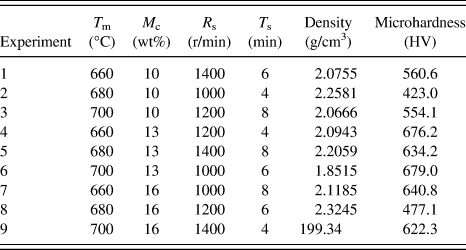
The final results of OED are presented in Table IV, and the subsequent range analysis showed that the influence sequence of the four technological parameters is: melt temperature > cenosphere amount > stirring rate > stirring time. In view of the dominant effects of melt temperature and cenosphere amount, their functions on density and microhardness of pure aluminum fly ash cenosphere composites are plotted in Figs. 3 and 4. It can be seen from Fig. 3 that the measured densities first increase as the melt temperature increases from 660 to 680 °C and then decreases largely with follow up increment of melt temperature. This substantial drop of density could lead to a significant lightweight of component assembly. Furthermore, addition of different amounts of fly ash cenospheres also resulted in a change in density. At different melt temperatures, aluminum matrix–13% fly ash cenosphere composites showed an obvious lower density compared with pure aluminum matrix composites containing 10% and 16% fly ash cenospheres. It can be read from Fig. 4 that a fluctuation of microhardness is observed, as increase in melt temperature and pure aluminum matrix composites containing 13% fly ash cenospheres stayed at a quite high level of microhardness (more than 640 HV) in comparison with composites containing 10% and 16% fly ash cenospheres. The microhardness of pure aluminum under the same experimental conditions is 466.4 HV. Thus, the incorporation of fly ash cenospheres considerably reinforced the aluminum matrix composites whose microhardness increased by up to 46%.
Arrangements and results of the orthogonal experiment with L9 (34).
Alteration of density of samples as a function of melt temperature and cenosphere amount.
Alteration of microhardness of samples as a function of melt temperature and cenosphere amount.
B. Microstructure
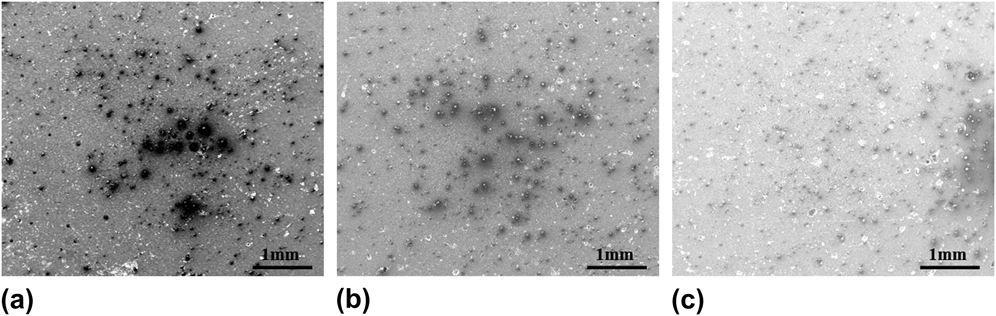
As shown in Fig. 5, the reason which caused a change in the density can be seen on the microstructure of the aluminum matrix–13% fly ash composites casted under different melt temperatures. The graphs demonstrate that the composite materials casted under 660 and 680 °C resulted in evident agglomerations of fly ash cenospheres, some of which adhered to the surface of the composites, whereas the composites casted under 700 °C exhibited more individual and homogeneous dispersion and distribution of fly ash cenospheres with much less numbers of agglomerates. The main reason for this phenomenon is that the melt under 700 °C displayed low viscosity and high wettability, which ensured smooth incorporation of fly ash cenospheres into the melt and prevented the formation of large agglomerates. It is reported previously that higher viscosity of the aluminum melt imparts more sufficient shear force over the agglomerates and encourages better separation of the cenospheres.Reference Shen, Yin, Wei, Li, Liu and An3,Reference Flemings, Riek and Young20 However, the positivity of high viscosity did not make enough contribution to the dispersion of cenospheres in the current research. Furthermore, enough processing temperature reduced the susceptibility of the fly ash cenospheres to the gravity-aided segregation and enhanced the scatters, which promoted interfacial reaction between cenospheres and aluminum melt. In addition, once the processing temperature reaches approximately 1000 K (720 °C), according to previous research studies,Reference Gikunoo, Omotoso and Oguocha18,Reference Guo and Rohatgi21 the compounds in fly ash cenospheres would react with pure aluminum matrix and release metallic or nonmetallic elements due to the negative Gibbs free energy. For example, a large amount of SiO2 in the current fly ash cenospheres would easily react with pure Al and release Si and Al2O3, and the freshly produced Si may combine with dissociative Mg to form Mg2Si and other Si-rich compounds. As we know, Mg2Si is a main strengthening phase in Al–Si–Mg alloys, which could largely reinforce the strength, compressive properties, and corrosion resistance. The amount of similar compounds will increase with increment of fly ash amount and reaction temperature, which could also explain that the microhardness of aluminum matrix–13% fly ash composites is higher than that of composites containing 10% fly ash cenospheres.
Scanning electron micrographs of aluminum matrix–13% fly ash cenosphere composites casted under different melt temperatures of: (a) 660 °C, (b) 680 °C, and (c) 700 °C.
C. Wear tests
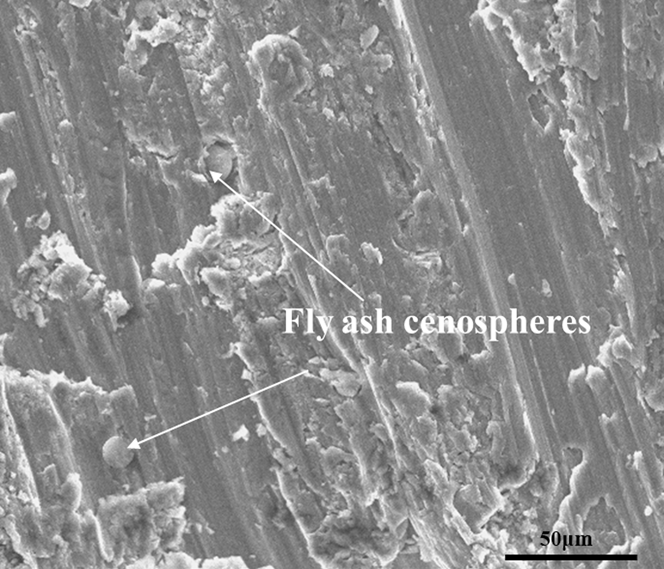
Figure 6 reveals the alterations of wear loss as a function of cenosphere amount and melt temperature at an applied load of 30 N. It can be seen that when the molten aluminum–fly ash composites were casted at 700 °C, the weight loss decreases as the cenosphere amount increases, which is in accordance with some previous reports.Reference Uju and Oguocha12,Reference Rohatgi, Guo, Huang and Ray22 The improvement in wear resistance of the composites could be initially attributed to the improvement of hardness, which is similar to the results reported by Ramesh et al.Reference Ramesh, Anwar Khan, Ravikumar and Savanprabhu23,Reference Ramesh and Seshadri24 Further, it is well known that the interaction between precipitates and matrix plays an important role in protecting the materials from wear loads.Reference Finnie25,Reference Lv, Sun, Zhao, Yu, Shen and Hu26 Thanks to the dispersed distribution and increasing amount of fly ash cenospheres, which have very high hardness and thermal stability, as shown in Fig. 7, wear load on the samples declined reasonably. However, wear resistance of samples casted under 660 and 680 °C containing 16% fly ash cenospheres showed a reduction compared with the samples containing 13% cenospheres, due to the oversize cenospheres and their less uniform distribution in the aluminum matrix (which is clearly observed in Fig. 5).
Alteration of weight loss of samples containing different amount of fly ash cenospheres as a function of melt temperature.
Fly ash cenospheres on the worn surface of composites.
Regarding the stirring time and rate, insufficient time (4 min) and rate (1000 r/min) failed to enable the melt and fly ash cenospheres to adequately mix, and excess stirring time (8 min) and rate (1400 r/min) probably led to spatter and left secondary precipitation of fly ash which formed a mass of agglomerates. Therefore, the appropriate stirring time is 6 min. And the optimal technological route is confirmed to be: melt temperature of 700 °C + stirring rate of 1200 r/min + stirring time of 6 min. The maximum amount of fly ash cenospheres is 13 wt%.
D. Tensile property
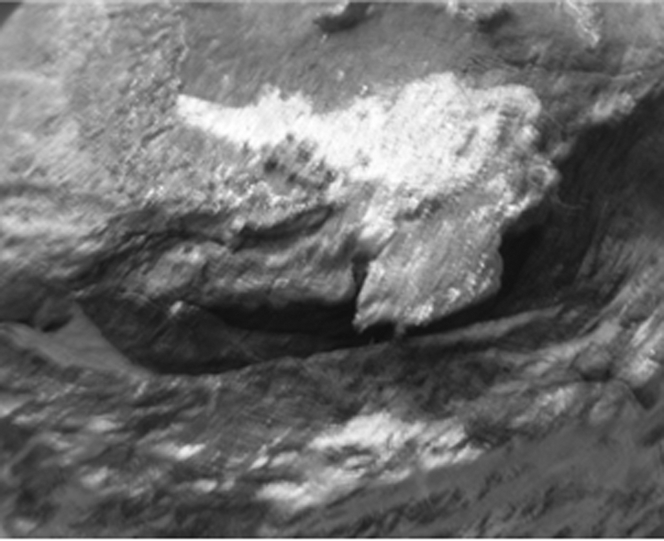
Afterward, the obtained optimal manufacturing technology was used to fabricate tensile samples with different fly ash cenospheres from 0 to 16 wt%. Both of the as-cast and free forged composites under 480 °C were measured, and the results are shown in Fig. 8. It is clear that all the forged samples presented higher tensile strengths than as-cast samples containing the same fly ash cenospheres. And the tensile strength experienced a gradual increment as the fly ash cenospheres increased from 0 to 13 wt%, then declined when the cenosphere amount reached 16 wt%. The results are similar to the report of Esawi et al.,Reference Esawi, Morsi, Sayed, Taher and Lanka27 and the reason is that the dispersedly distributed fly ash cenospheres played as the second phases to reinforce the aluminum matrix. The slight decrease of the tensile strength at 16 wt% cenosphere amount mainly resulted from the overnumbered agglomeration of cenospheres and formation of ladle slags as shown in Fig. 9. These ladle slags came from the excessive incorporation of fly ash cenospheres which failed to dispersedly distribute into the aluminum matrix during the stirring process and gathered together as a oversize slag inclusion in the samples.
As-cast and forged tensile strength of as-cast and forged samples as a function of cenosphere amount through the optimal technological route.
Micrograph of the ladle slag in samples containing 16 wt% cenospheres.
IV. CONCLUSIONS
The following conclusions are drawn from the experimental results:
(1) several technological parameters, especially the melt temperature and fly ash amount, largely influence the final microstructure and properties of AMFA cenosphere composites.
(2) The optimal technological route is confirmed to be: melt temperature of 700 °C + stirring rate of 1200 r/min + stirring time of 6 min + fly ash cenosphere amount of 13 wt%. And through such a technological route, the lightweight rate of composites is 31.5%.
(3) Both of the as-cast and forged composites are strengthened through the optimal technological route and the strength improves maximally by 50% when the cenosphere amount is 13 wt%.
(4) This kind of narrow and small size fly ash cenospheres is concluded to be significantly beneficial to the improvement of AMFA cenosphere composites, and the optimal technological route is recommended to be introduced into the production process of this kind of composites for the purpose of lightweight and lower cost.
ACKNOWLEDGMENTS
This work is supported by the Natural Science Foundation of China (Grant No. 50472030). The views expressed in the article are of the authors and not of the funding agencies. The authors specially thank Prof. Chenxing Ren for his support in SEM-EDX observation. Prof. Jiujun Yang is also acknowledged for constructive comments.