This study evaluates the relative associations between religious characteristics, political resources, social structures, and political awareness post 9/11 with American Muslim residents' political participation.Footnote 1 Recent research has demonstrated the importance of religious groups within politics. However, much of this research focuses on Protestants and Catholics, and largely excludes religious minorities, except Jews, and racial minorities within dominant religious groups (Layman and Green Reference Layman and Green1998; Layman Reference Layman2001; Kotler-Berkowitz Reference Kotler-Berkowitz2001).Footnote 2
Scholars have made numerous suggestions for the absence of research concerning American Muslims (Peek Reference Peek2005; Leonard Reference Leonard2003; Ghayur Reference Ghayur1981).Footnote 3 Muslims have been excluded from recent studies because researchers assume that they do not constitute a critical mass of the population. Second, as a diverse pan-ethnic and pan-national group, measurement is complex. Third, researchers assume American Muslims are a politically backward group, characterized by fundamentalism and political intolerance. Fourth, in most cases, researchers assume American Muslims do not live in large population clusters and as such do not have an effect on election outcomes that require grouping in winner-take-all races, and also that American Muslims do not participate politically. Our study suggests that these views are incorrect.
AMERICAN MUSLIMS AS A POLITICAL GROUP
With an estimated following between two and five million, Islam is the fastest growing religion in the United States, poised to displace Judaism, and become second only to Christianity in number of adherents (Jamal Reference Jamal2005; Leonard Reference Leonard2003; Bagby, Perl, and Froehle Reference Bagby, Perl and Froehle2001; Smith Reference Smith1999). In addition, the number of American Mosques has increased 62% since 1980, to over 1,200 (Jamal Reference Jamal2005), demonstrating an amplified potential for continued growth through converts.
During the 2000 Republican and Democratic nomination conventions, Muslim prayers were offered for the first time, a reflection of political relevance (Leonard Reference Leonard2003). However, Muslims have traditionally been disconnected from American politics (Ramadan Reference Ramadan2005). Like other ethnic minority groups, American Muslims are assumed to have low levels of political participation, but some have well developed political ideologies, and are becoming more integrated into political life under the leadership of Muslim professionals. Many Muslim doctors, lawyers, engineers, and software developers publish short religious texts (in English) that relate traditional Islam with modern society and democracy (Leonard Reference Leonard2003). Some Islamic texts propose a strong political effort by Muslims that should follow, “the example of the Jews in the United States … As an extremely well-organized lobby, very active and extremely influential in the corridors of powers in Washington” (Ramadan Reference Ramadan2005, 169).
American elites suddenly became interested in Muslims as a political group on September 11, 2001. Post 9/11 Muslims worldwide felt the brunt of American superpower as they became a target of religious profiling and some American radicals targeted Muslims with acts of violence in retribution. American Muslims also face discrimination along a number of fronts by government such as the U.S. Patriot Act (Cho et al. 2006) and extra legal acts by individuals and groups. The immediate week following 9/11 resulted in seven anti-Muslim murders and 49 related assaults. One year removed from 9/11, Arab and Muslim groups reported a total of 2000 hate crime incidents in the U.S. (Human rights Watch 2002).
American Muslims have been perceived as an “other” and radically different from Judeo-Christian groups. Kalkan et al. (Reference Kalkan, Layman and Uslaner2006) demonstrate that opinion about American Muslims is far more negative than opinion about other religious minorities and ethnic groups. Early political development and 9/11 provide American Muslims mixed emotions of grief, fear, and a catalyst for political mobilization. For instance, Ayers (Reference Ayers2007) found religious motivations were significant determinants of American Muslims' changing preferences from Bush to Kerry across the 2000 and 2004 presidential election cycles. As part of his analysis, he suggests anxiety and fear post 9/11 may be the probable cause. However, studies have failed to place Muslims within a complete theoretical framework of participation.
THE INFLUENCES OF POLITICAL PARTICIPATION
In general, researchers assume political participation is a costly enterprise for the individual. Given the costly barriers, theories of political participation generally focus on resources, or social structures that enable individuals with the skills to participate politically (Brady, Verba, and Schlozman Reference Brady, Verba and Schlozman1995; Nie, Prewitt, and Powell Reference Nie, Prewitt and Powell1993). Other research has identified factors beyond traditional rational paradigms like religious beliefs and political awareness, including transient dispositions, as influencing political participation (Djupe and Grant Reference Djupe and Gilbert2001; Tate Reference Tate1993; Marcus, Nueman, and Mackuen Reference Marcus, Neuman and MacKuen2000).
Religiosity primarily influences political participation in two ways: (1) Religious belief, by which a sense of group identification is the motivation to engage in political behavior, because religious groups create a context for and filter political information (McCormick Reference McCormick1986; Kleppner Reference Kleppner1987; Djupe and Grant Reference Djupe and Grant2001); and (2) resource development, by which religious practice develops civic skills that are the resources necessary for political participation (Djupe and Gilbert Reference Djupe and Gilbert2006; Peterson Reference Peterson1992; Brady et al. Reference Brady, Verba and Schlozman1995).
Djupe and Grant (Reference Djupe and Grant2001) investigated the direct cognitive effects of their religiosity on political behavior. Rooted in ethnoreligious tradition, research suggests that dissimilar religious faiths are associated with varying levels of political participation. Beliefs influence participation as the religiously devout actively lobby for their ideology in political affairs.
Believing has also been assumed to be a motivation for religious behavior (Layman and Green Reference Layman and Green1998), and religious behavior plays a role in developing civic skills, particularly for faiths that require or encourage behaviors within congregations (Hougland and Christenson Reference Hougland and Christenson1983; Brady et al. Reference Brady, Verba and Schlozman1995; Peterson Reference Peterson1992). And the effect of religiosity as a political resource developer is accentuated by its consistent effects on all members regardless of education or social background (Brady et al. Reference Brady, Verba and Schlozman1995). Thus, the transferring of Mosque skills into civic skills may result in increased political participation. However, religiopolitical studies typically fail simultaneously to take into account direct ideological motivation and indirect influence of religious resource development as predictors of political participation.
For the case of religious indicators, we assume that religious believing and behaving facilitate political participation through separate mechanisms. The assumption is that religiously devout members will act politically as an extension of their ideological connection to faith. Religious behaviors will allow members to develop civic resources through experience, which can be transferred to political participation. Given the personal and private nature of religious beliefs and that religious belief is a motive for overt behavior, we hypothesize that religious beliefs are a more important influence on political participation than religious resources.
Hypothesis 1a
Religious beliefs and religious resources positively influence participation.
Hypothesis 1b
Religious beliefs more strongly affect participation than resources.
Narrowly defined resource models of participation argue that civic skills are necessary for political participation. an increase in civic skills is positively associated with increased levels of political participation (Peterson Reference Peterson1992). Resources include education, money, job skills, and citizenship which provide skills and opportunities for participation, that is, these resources lead to organizational participation, and participation in organizations leads to political participation (Brady et al. Reference Brady, Verba and Schlozman1995, 277). Thus, we expect a positive relationship between resources and political participation, similar to that found among other populations. Education, income, job skills, organizational experience, and citizenship should positively correspond to political participation.
HYPOTHESIS 2
Political resources positively influence participation.
While recent resource models of participation have garnered much of the attention in the study of political participation, historically social structures have been prominent. Aspects of social structure, like ethnicities, have long been identified as predictors of political participation (Nie, Prewitt, and Powell Reference Nie, Powell and Prewitt1969a, Reference Nie, Powell and Prewitt1969b, Reference Nie, Prewitt and Powell1993, Verba and Nie Reference Verba and Nie1972). Gender, age, and years since immigration have also been identified (Verba and Nie Reference Verba and Nie1972; Uhlaner, Cain, and Kiewiet Reference Uhlaner and Kiewiet1989). For ethnic minorities, the assumption is racism and structural disadvantages limits political participation. For instance, Uhlaner and Kiewiet (Reference Uhlaner and Kiewiet1989) demonstrate in the case of Asian Americans, that lower levels of participation are explained by ethnicity. Gender operates similarly with women who have been historically disadvantaged in terms of political participation given their exclusion from politics (Zinn Reference Zinn2003), although empirical evidence suggests gender no longer influences political participation (Uhlaner and Kiewiet Reference Uhlaner and Kiewiet1989). Older individuals have been identified as more politically active than younger individuals once infirmity is taken into account. Immigration tenure has been used as a proxy to represent assimilation of recent immigrants into American political participation (Uhlaner and Kiewiet Reference Uhlaner and Kiewiet1989), the assumption being that longer tenure in the United States is positively associated with political participation.
For social structural indicators, we hypothesize that African-Americans who are Muslim will participate at lower levels than other groups that are Muslim. Similarly, we hypothesize lower levels of participation among Muslim women than among Muslim men, higher levels of participation among older Muslims than younger Muslims, and lower levels of participation for recent immigrants.
HYPOTHESIS 3
Promoting social structures, male gender, Non-African American ethnicity, old age, and longer terms of American residence will positively influence participation.
Psychological factors such as political interest have long been reported to be associated with political participation (Nie, Powell, and Prewitt 1969a, 1969b). Those with higher levels of political interest and attention to politics are more participatory (Miller et al. Reference Miller, Gurin, Gurin and Malanch1981; Rosenstone and Hansen Reference Rosenstone and Hansen1993). It is likely in the current climate of “guilty until proven innocent” that anxiety may motivate American Muslims' political action (Ayers Reference Ayers2006, Reference Ayers2007). Marcus et al. (Reference Marcus, Neuman and MacKuen2000) argue that awareness is necessary for deliberative political behavior like political participation and identify that moods, like anxiety, can heighten political awareness. For political participation, Marcus et al. (Reference Marcus, Neuman and MacKuen2000) propose a three stage process in which: Affective or emotive responses trigger political interest resulting in higher levels of political participation. In addition, the authors allow for a direct relationship between moods, like anxiety, and political participation. Thus, we hypothesize that American Muslims' post 9/11 anxiety and alienation will induce increased political interest (Brader Reference Brader2005) and higher levels of political participation (Marcus et al. Reference Marcus, Neuman and MacKuen2000). We also hypothesize that political interest, habitual attentiveness, and reported attentiveness will be positively associated with political participation.
HYPOTHESIS 4A
Muslim anxiety and alienation post 9/11 positively influences participation.
HYPOTHESIS 4B
General political awareness, specifically political interest, habitual attentiveness, and reported attentiveness, positively influences participation.
The analysis will proceed in three steps. In step one, aspects of American Muslim political participation that have not yet been addressed systematically are described. In step two, aspects of religiosity that may influence American Muslims' political participation are explored. In step three, the influences of religious characteristics, political resources, social structures, and psychological states on political participation in a fully specified model are formally tested.
METHOD
The data for this study were drawn from a large survey of 1,846 American Muslims commissioned by project Muslim Americans in the Public Square (MAPS), funded by the Pew Charitable Trusts, and conducted by Zogby International. The survey represents the most recent study of American Muslims' political behavior. Self identified Muslims, were surveyed by telephone or personal contact in August and September 2004.
The MAPS survey's sampling procedure began by identifying a random selection of Islamic centers, matching their zip codes to local telephone exchanges, and calling individuals within these areas with common Muslim surnames (MAPS 2004). Because many converts and African-Americans do not have common Muslim surnames, in-person interviews were conducted in and around four cities: Atlanta, Detroit, New York, and Washington, D.C. The degree to which the sample corresponds to the larger Muslim population in America is unknown since there are no data with which to compare the survey; however, Zogby International reports the margin of error as ±2.3 percentage points. The use of these data does entail limitations but they do provide insight into American Muslim political participation. As one previous investigation notes, “the General Social Survey randomly sampled 46,000 individuals across 32 years and found an unimpressive grand total of 54 respondents who self-identified their religion as Moslem/Islam” (Djupe and Green Reference Djupe, Green and Wilson2007). The 2004 data were used instead of a similar Zogby poll conducted in 2001 in the immediate aftermath of 9/11 in order to assess contemporary behavior in the longer term rather than the immediate response to terrifying events.
Variable Specification
The dependent variable, political participation, was measured by responses to “Have you ever: … given a contribution or volunteered your time or services to a political candidate, … called or written the media or politician on a given issue, … signed a petition, …attended a rally in support of a politician or a cause, … participated in a boycott of a product or a business, … visited a political web site, …been an active member of a political party.” Yes responses were coded 1, and no responses were coded 0. Voting was measured by responses to “In the 2000 presidential election, the candidates were Democrat Al Gore, Republican George W. Bush, Reform Party's Pat Buchanan, and the Green Party's Ralph Nader. For whom did you vote?” Voting was coded 1, not voting was coded 0. Following Brady et al. (Reference Brady, Verba and Schlozman1995), responses to each item were summed to form an additive composite measure of political participation (Kuder-Richardson 20 = 0.69).
Religious values models identify three dimensions of religion: Belonging, behaving, and believing (Wald, Kellstedt, and Leege Reference Wald, Kellstedt, Leege, Leege and Kellstedt1993; Layman et al. Reference Layman and Green1998; Kotler-Berkowitz Reference Kotler-Berkowitz2001; Leege et al. Reference Leege and Kellstedt1993; Kellstedt et al. Reference Kellstedt, Green, Guth, Schmidt, Green, Guth, Smidt and Kellstedt1996). Belonging measures religious tradition, ascription to faith. Behaving captures the actual practice of faith or religious commitment, a combination of ritual and devotional practices. Believing is defined by religious salience. In addition, a fourth component, religious context, was measured as family religious characteristics assumed to summarize religiously linked social reinforcers (Kotler-Berkowitz Reference Kotler-Berkowitz2001). Consolidating a body of research, this analysis utilizes four concepts of religiosity; to capture the two theoretical frameworks of religion as ideology and resource. Religious tradition was measured by responses to “Were you raised as a Muslim or did you convert?” (Coded as 1 if raised as a Muslim, 0 otherwise). Religious context was measured by responses to “Is your husband or wife a Muslim?” (Coded 1 if yes, 0 otherwise). Religious salience was measured by responses to “Would you say the role of Islam in your life is very important, somewhat important, or not very important?” Responses of “very important” were coded 1, 0 otherwise. Religious resources are denoted as religious commitment summarizing the actual practice of faith; frequency of mosque attendance, prayer, and volunteerism. Responses to each item were first standardized (mean = 0.0, S = 1.0) so that each item in the composite weighed the same in the final index and then summed to form the composite measure, mean 0.0 and standard deviation 2.4 (Cronbach's α = 0.76).
Variables theoretically associated with political resource models and civic skill developments are also measured: Job skills, organizational experience, education, income, and citizenship. Job skills were measured by responses to “which of the following best describes your occupation?” coded 1 for low skill jobs or retired, (e.g., manufacturing), to 3 for high skill jobs, (e.g., medical or legal practices). Organizational experience was measured by responses to “I am now going to read a list of community activities, please tell me if you have ever donated time, money or been an officer of any?… school or youth program like parent-teacher-association (PTA)…, arts or cultural organization…, neighborhood or community group like a book club…, any organization to help the poor, sick, elderly, or homeless…, any professional organization…, trade or labor union…, veterans or military service…, or ethnic organization.” A composite was formed by adding 1 for reports of participation in each item (3.29, S = 1.94; Kuder-Richardson 20 = 0.719). Education and family income were measured by self report. The American Muslim population is relatively highly educated and affluent with 62.1% of respondents reported having received at least a four year college degree and 37.6% reported family income greater than $75,000 annually.
Measures of social structure follow procedures used by Uhlaner and Kiewiet (Reference Uhlaner and Kiewiet1989), measuring ethnicity, gender, age, and years since immigration. Responses for ethnicity were grouped following methods of Jamal (Reference Jamal2005) into three categories: Asian, Arab, and African-American. Asian represents a composite of respondents reporting Asian, Indian, Bangladeshi, or Pakistani backgrounds. Arabs and African-Americans were coded according to self report. Gender, age, and years since immigration are derived from self reports with males coded 1, females 0, with age and years since immigration coded as years.
Measures of political awareness follow methods used by Marcus et al. (Reference Marcus, Neuman and MacKuen2000) and Brady et al. (Reference Brady, Verba and Schlozman1995). Political interest was measured by responses to “How often do you discuss politics with family and friends?” with “always” coded 3 for high interest, “sometimes” coded 2, and “hardly ever or never” coded 1 for low interest. About 10.4% reported low interest, 47.8% intermediate values, and 41.8% high values of political interest. Measures of political attentiveness included: (1) Habitual attentiveness, coded 1 for very liberal or very conservative all else coded 0, and is assumed to indicate heightened attentiveness among strong political ideologues; and (2) reported attentiveness from responses to “Which of the following best describes how often you watch, read, or listen to information about international affairs?” and coded 1 for “daily,” and 0 for other responses.
Anxiety and alienation were measured following Marcus et al. (Reference Marcus, Neuman and MacKuen2000, 122). Anxiety was measured by responses to “Is this a good time [coded 0] or a bad time [coded 1] to be Muslim in America,” and alienation was measured by responses to “I will now read you several statements about American's attitudes toward Muslims that you have encountered in your own personal experience and the attitudes of Americans toward Muslims overall — in the society as a whole. Please tell me which statement best reflects Americans' attitudes toward Muslims since the 9/11 attacks: (1) In my experience and overall, Americans have been respectful and tolerant of Muslims [coded 0]; (2) In my experience, Americans have been respectful and tolerant of Muslims, but American society overall is disrespectful and intolerant of Muslims [coded 0]; (3) In my experience and overall, Americans have been disrespectful and intolerant of Muslims [coded 1]; and (4) In my experience, Americans have been disrespectful and intolerant of Muslims, but American society overall is respectful and tolerant of Muslims [coded 0].”Footnote 4
Findings
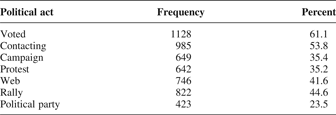
According to data in Table 1, American Muslims engaged in a mean of 3.12 (S = 2.11) political acts suggesting that the average American Muslim votes and participates in slightly more than two other political acts, compared to mean 1.63 (S = 1.33) participation among the American public (Brady et al. Reference Brady, Verba and Schlozman1995). American Muslims are also nearly evenly distributed in levels of participation with 13.2% performing no acts, 15.3% one act, 13.3% two acts, 14.6% three acts, 13.7% four acts, 14.2% five acts, 9.8% six acts, and 6.0% seven acts. In contrast, Brady et al. (Reference Brady, Verba and Schlozman1995) reported that slightly more that 10% of Americans participated in four or more acts, compared to 43.7% of American Muslims.
Political acts among American Muslim adults, 2004a
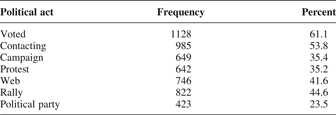
a Numbers in cells are percent of sample reporting participation in political acts. Voted was based on responses to “In the 2000 presidential election, the candidates were Democrat Al Gore, Republican George W. Bush, Reform Party's Pat Buchanan, and the Green Party's Ralph Nader. For whom did you vote?” positive candidate response coded 1, “did not vote” coded 0. Contacting, derived from “Have you ever? Called or written the media or politician on a given issue, or signed a petition.” Campaign, “Have you ever? Given a contribution or volunteered your time or services to a political candidate.” Protest, “Have you ever? Participated in a boycott of a product or a business.” Web, “Have you ever? Visited a political web site.” Rally, “Have you ever? Attended a rally in support of a politician or a cause” All responses “yes” coded 1 “no” coded 0 among all American Muslims (citizens and non-citizens). N = 1846, missing cases are deleted.
Voting was the most frequent act with 61.1% of all Muslim residents voting in the 2000 presidential election while 80.4% of Muslim citizens reported voting in that election. Muslims were less likely to be involved with a political party (23.5%) or to be involved in a political protest (37.0%), or in volunteering or donating to a political campaign (37.2%). The fact that Muslims spread participation across the participatory spectrum may indicate Muslim sensitivity and anxiety to the winds of post 9/11 politics, and/or Muslims' religiosity, political resources, and social status.Footnote 5
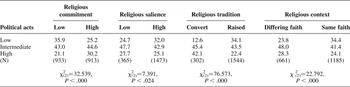
The most immediate method for addressing the role of religious beliefs and religious resources on political participation is bivariate analysis between selected predictors and reported political participation, reported in Table 2. Political participation was trichotomized for this purpose with 0 or 1 act coded low, 2 to 4 acts intermediate, and 5 or more acts high.
Cross tabulation of political participation and religious characteristics among American Muslim adults, 2004a
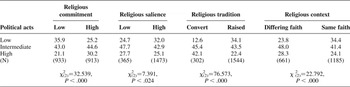
a Numbers in cells are percentages indicating frequencies of responses to political acts questions. Independent variables were religious commitment, composite of frequency of prayer, mosque attendance, and general religious volunteerism; coded low, below the mean and high, above the mean, religious salience, “Would you say the role of Islam in your life is very important, somewhat important, or not very important?” respondents' reporting “very important” coded as high, else coded as low, religious tradition, “Were you raised as a Muslim or did you convert?” and, religious context, “Is your husband or wife a Muslim?”
Among respondents with higher religious commitment (when dichotomized at the mean), 30.2% engaged in five or more political acts compared to 21.1% with lower religious commitment. About 25.2% of those with higher religious commitment reported low political participation, increasing to 35.9% for those with low religious commitment. Thus, higher religious commitment was associated with higher political participation (χ2(2) = 32.539, P < .000).
Measures of religious salience, tradition, and context are associated with diminished levels of political participation. Respondents' with lower religious salience reported higher political participation, 27.2%, than those with higher religious salience, 25.1% (χ2(2) = 7.391, P < .024). Being raised Muslim was also associated negatively with political participation: About 22.4% of those raised Muslim were high on political participation compared to 42.1% of those not raised Muslim (χ2(2) = 76.573, P < .000). About 24.1% of American Muslims living in a Muslim only family were high on political participation while 28.3% of Muslims who had non-Muslim spouses were high on participation (χ2(2) = 22.792, P < .000).
Measures of religious belief (religious salience, tradition, and context) were associated with Muslim political participation but, unlike with other religious groups, increased religiosity among these concepts was negatively associated with political participation contrary to our initial hypothesis. But religious commitment was positively associated with political participation, consistent with our hypothesized expectations. Using percentage differences, measures of religious beliefs influenced political participation more than religious resources. This finding tentatively supports the view that religious beliefs are more influential in shaping participation than religious resources. Plausible alternative explanations are available that might render these findings spurious. The next step is to estimate the influence of religious characteristics, political resources, social structures, and political awareness on Muslims' political participation.
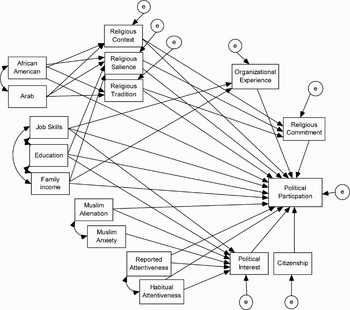
Recursive path analysis was used decompose the direct and indirect effects of religious characteristics, political resources, social structures, and political awareness measures on political participation post 9/11 (Asher Reference Asher1976; Byrne Reference Byrne2001; Kaplan Reference Kaplan2000). Religious believing is assumed to influence political participation (Kotler-Berkowitz 2001; Layman and Green Reference Layman and Green1998; Layman Reference Layman2001) and to motivate religious civic skills (Peterson 1992), which in turn is assumed to influence political participation. Among political resources income, education, job skills are assumed to influence organizational experience, and all are assumed to influence political participation (Brady et al. Reference Brady, Verba and Schlozman1995). In addition, basic resources, such as job skills, education, and income are assumed to influence organizational experience and political interest. Measures of political awareness (reported attentiveness, habitual attentiveness, Muslim anxiety, and Muslim alienation) representing a general taste for politics, are assumed to influence political participation (Brady et al. Reference Brady, Verba and Schlozman1995; Marcus et al. Reference Marcus, Neuman and MacKuen2000) directly and also by influencing political interest, which in turn influences participation. Our initial model is formally expressed below:

Following standard procedures (AsherReference Asher1976), a priori paths that were insignificant (P > .05) were deleted. Contrary to our hypothesis, for example, gender, age, and years since initial immigration had no independent influence on political participation in the path model. It may be that within the American Muslim political community, women are not the second gender. Nor did Arab ethnicity have a direct influence on participation. We also note Muslim anxiety did not directly influence participation, and education did not influence organizational experience. Adapting this analysis, we present a revised model of political participation in Figure 1.
Identified path model of American Muslim political participation.

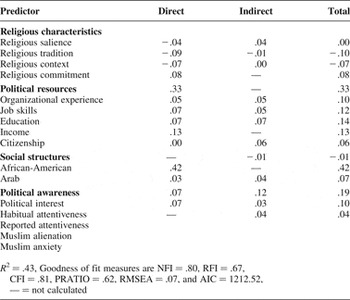
The path coefficients for the model are displayed in Table 3 as standardized estimates. Because of diverse variable coding, it is difficult to interpret the findings in their original metric. Using standardized estimates, we can evaluate the relative strength of the predictor variables on the dependent variable in universal term. Based on our model, it appears political resources and measures of political awareness were powerful predictors of political participation, not religious characteristics or social structures reported in Table 3. and below.Footnote 6
Standardized direct, indirect, and total effects on political participation by religious characteristic, political resources, social structures, political awareness and selected predictors among American Muslim adults, 2004a

a Numbers in cells are standardized regression weights using simultaneous equations procedure for path analysis. The principal dependent variable was a composite based upon respondents' reported political activities, coded 0–6. All variables specified are statistical significance (P < .05); other indicators are omitted from final calculation. Missing values among observations were imputed using full-information maximum likelihood estimation (FIML), N = 1846.
The model Chi-Square is 1069.61 with 97 degrees of freedom and is significant. Consequently, we reject the null hypothesis that the data are a perfect fit to the model. Goodness of fit values were NFI = .80, RFI = .67, CFI = .81, PRATIO = .62, RMSEA = .07, and AIC = 1212.52. For predictors of political participation, the R2 = .43. This suggests current theories of political participation do not fully capture the casual relationships among predictors of political participation for American Muslims. However, we are hesitant to argue existing theories should be wholly abandoned, in part because, the poor fit of the model may be explained by the number of indicators used, large sample size, and measurement error associated with survey responses which inflate the model Chi-Square. Even though the model does not satisfy commonly accepted norms of fit, it is used for this analysis since it follows directly from systematic theory on correlates of political participation. Additional analysis, demonstrated that all paths theoretically constrained to zero in the model, did not statistically differ from zero. The general fit of the model does not bias the estimates for path coefficients.
Among religious characteristics, religious commitment has a small, positive association with participation, while religious tradition and religious context have negative associations with participation. Religious salience has small, offsetting associations so that the net influence is 0. Our initial findings for religious characteristics are confirmed, resources and beliefs each influence political participation weakly, but in opposing directions. Increased religious commitment was positively associated with increased political participation (β = .08) other variables controlled. The effect of religious commitment, while diminutive, suggests that religious resources can operate as an equalizing additive for political participation for respondents working in lower class jobs (Brady et al. Reference Brady, Verba and Schlozman1995). However, our findings do not support the hypothesis that religious beliefs are the dominant motivation for participation (Djupe and Grant Reference Djupe and Grant2001); religious resources, not belief, influenced increased political participation.
Religious beliefs consistently offset the positive influence of religious resources. Religious salience, the “importance” of being Muslim (β = −.04), religious tradition, being raised or socialized Muslim (β = −.09), and religious context, being married to a partner who shares the Muslim faith (β = −.07) all directly reduce political participation. However, the indirect influence of religious beliefs on participation as the motivation for religious behaviors could mitigate some of the negative direct effects. This assumption is true for religious salience which indirectly influenced higher levels of political participation (β = .04), but false for religious tradition and context which indirectly reduce the opportunity for developing religious resources, and reduced political participation (β = −.01) and (β = .00), respectively. The total effects of religious beliefs on political participation are consistently zero or a negative. Coefficients for religious salience (β = .00), religious tradition (β = −.10), and religious context (β = −.07) are negative to zero.
Evidence does not support our first hypothesis, as religious beliefs and resources influence participation in different ways. We also reject the hypothesis, that beliefs and resources equally motivate political participation, as findings indicate religious beliefs are more significant factors for political participation than religious resources, offsetting the positive effects of religious resources.
Among political resources, organizational experience (β = .33) has large, direct associations with political participation, and as hypothesized, job skills (β = .10), education (β = .12), income (β = .14), and citizenship (β = .13) have total positive effects on political participation. Job skills, education, and income have indirect effects on participation mediated by political interest in addition to direct effects on participation. Job skills and income also influence organizational experience, which in turn, influences participation.
Political resources powerfully influenced participation consistent with hypothesized expectations that civic skills are necessary for political participation. The largest effects for prior organizational experience may represent a gateway to participation that calms the fear of novel situations, which restrict first time involvement in politics. In addition, our model suggests that material resources are channeled through organizational membership, which further contributes to participation. American Muslims' political participation may be characterized by resources not Islam.
Among social structures, only race played a significant factor in Muslim political participation. In comparison to Asians (a reference group in the model), African-American Muslims were more likely (β = .06) and Arab Americans (β = −.01) less likely to participate. In comparison to other Muslims, being an African-American is positively associated with participation, through its influence on religious tradition and context (Tate Reference Tate1991). Being African-American also directly influenced participation only slightly but significantly (β = .001), while being Arab had no direct effect on participation. Arabs lower levels of participation was a result of increased likelihood of identifying with religious characteristics associated with lower levels of political participation. While some research suggests that race and gender are strong contributors to participation and possible moderators of political resources for American Muslims (Djupe, Sokhey, and Gilbert Reference Djupe, Sokhey and Gilbert2007; Uhlaner and Kiewiet Reference Uhlaner and Kiewiet1989), these variables did not appear to influence participation in these data.
Among indicators for political awareness, as in other studies, political interest has the largest effect among all variables included in the model (β = .42). Political interest is a result of political resources, political attentiveness, and Muslim anxiety/alienation in the final model. Some scholars have claimed educations' influence on participation is intermediated by political interest (Brady et al. Reference Brady, Verba and Schlozman1995); we find this relationship can be extended to many other indicators. For instance, education is a powerful source of political interest (β = .11), but anxiety (β = .10) and alienation (β = .06) following 9/11 are nearly critical.
Habitual attentiveness (β = .07) and reported attentiveness (β = .19) have direct affects on political participation and indirect effects on participation mediated by political interest. Consistent with our hypothesis rooted in affective intelligence theory (Marcus et al. Reference Marcus, Neuman and MacKuen2000), Muslim alienation (β = .10) has direct and indirect effects mediated by political interest on participation. Anxiety (β = .04) has a small indirect effect on participation mediated by political interest but no direct effect. It appears 9/11 and the war on terror, in part, fueled American Muslims' political participation.
Specifically, these findings test the numerous suggestions that Muslims have been alienated from American politics (Steven T. Zech, personal communication; Jamal Reference Jamal2005; Wuthnow and Hackett Reference Wuthnow and Hackett2003); or anxiety and political threat motivated Muslims' political behavior (Ayers Reference Ayers2007; Cho et al. Reference Cho, Gimpel and Wu2006), that until now have been untested. We use the common term “Muslim alienation” but Muslims have not been alienated and withdrawn from the polity. On the contrary, Muslims have become more anxious, which positively influenced political interest, and consequently, political participation. In effect 9/11 and the U.S. Patriot Act, via Muslim anxiety and alienation, heightened American Muslims' political interest and increased political participation. That is to say, 9/11 may represent the transition of Muslims' cognitive processes from autopilot to alert attention, and attention turned into political behavior.
American Muslims appear to be just like other Americans in terms of the correlates of their political participation. Socioeconomic status is highly related to participation just as it is for other Americans. Some but by no means all, aspects of religion are associated with participation for this group even when socioeconomic variables are taken into account. Social structures, traditionally associated with participation like gender, appear to not influence American Muslims reinforcing the perception that Muslims are politically progressive in this regard. American Muslims also appear to be model citizens, even in the aftermath of 9/11 and American involvement in Iraq, as participation rates are very high compared to the rest of the American public.Footnote 7
DISCUSSION
Analyzing a multidimensional model of political participation allows us to tell a quite complex story of American Muslims political participation. First religious variables are associated with political participation but in varying ways depending on which aspects of religion are measured. In contrast to research that treats religiosity and religious behavior as one and the same concept, we found mixed results for American Muslims: (1) Religious resources, like mosque attendance, increased participation; but (2) religious beliefs, like religious salience, were negatively associated with political participation. The total effect for religious characteristics was negative (β = −.09) among American Muslims. Researchers should not assume religious practice acts as an extension of belief. Religious behaviors may be a result of belief, but the political resources developed through religious practice should be treated as distinct from ideological or contextual aspects of faith.
As with other Americans, high levels of education, political interest (especially for immigrants from restrictive societies), and income are critical factors for American Muslim political participation, not Islam. While Muslims represent an immigrant population — for instance 34.1% of American Muslims reported being “born outside the U.S.” — they are not a resource deficient population. American Muslims represent a relatively well educated and affluent segment of American society and these resources have translated into higher levels of political participation.
Unlike general findings in political science, we find that African-American Muslims tend to have higher levels of political participation. This result may be better understood when we consider the sampled population is a religious group. Research has recognized a heightened effect of church leadership for racial minorities, particularly black Protestants, as the church is a bastion for racial minority leadership, communication, and community (Harris Reference Harris1994; Alex-Assensoh and Assensoh Reference Alex-Assensoh and Assensoh2001). Islam may provide the context in which African-Americans can participate outside the realm of American racism. Thus, African-American Muslims' higher levels of participation.
Last we provide empirical results which evaluate the role of 9/11 and the following political climate on American Muslims' political participation. The Patriot Act and the “war on terror” have been identified as significant threats among American Muslims (Ayers Reference Ayers2007; Cho et al. Reference Cho, Gimpel and Wu2006). Most of the threat has been viewed as alienating American Muslims, although we found not evidence of it. Rather than alienating Muslims, the Patriot Act and the “war on terror” may have promoted participation possibly for protection from outside agents of government. These findings reinforce a developing theoretical approach, “affective intelligence” that utilizes measures of reported anxiety within political science (see Marcus et al. Reference Marcus, Neuman and MacKuen2000). Pragmatically our results are positive. As we demonstrate in democracies that depend upon political participation, negative events can encourage groups, like Muslims post 9/11, to participate politically rather than abstaining from the process that may benefit their concerns.
LIMITATIONS AND FUTURE RESEARCH
While our analysis did not meet the thresholds of good fit that some recommend, we used path modeling to capture a more complete theoretical perspective of the many variables influencing participation, and the direct and indirect influences of these variables as hypothesized in the participation literature. We have no reason to believe that the model biases estimates for path coefficients. In part, the poor fit of the model may be explained by the large number and complexity of variables derived from theory concerning participation in America that were used, and measurement error generally associated with survey responses. It is also possible that the model has been misspecified, although, again, the original model was derived from research on American participation to represent a priori expectations and additional paths tested were consistently indistinguishable from zero. Finally, conducting secondary analysis of data collected for other purposes did not permit us to design measures as sensitive and specific to concept measurement as we would have liked. However, on the whole, this research represents a test of theoretical expectations for political participation and how these apply to American Muslims. In this regard, our findings demonstrate current theoretical models do not completely explain Muslims' political participation but specific theoretical expectations for religious characteristics, political resources, social structures, and political awareness were generally confirmed with some interesting exceptions.
Future research should investigate the effect of religion as a belief system and resource developer for political participation and test the effects of each separately using nationally representative samples of religious groups and refined measures developed for these purposes. Religion may provide offsetting participatory effects for all religious groups that only become apparent when researchers fully operationalize religious measures. In addition, future research should investigate what specific participatory acts are influenced by religious characteristics, political resources, social structures, and political awareness, which is beyond the scope of this paper. Religious influences may differ as they promote various forms of political action, e.g., contacting or protesting, where political awareness promotes voting or other less costly actions. Last, while some research has identified the mobilization of contextual threats for Protestant religious groups (Campbell Reference Campbell2006), we focused on reported levels of anxiety and alienation among American Muslims. Scholars should continue this research by identifying sources of threat for political action among religious groups, particularly when religious groups are generally defined by divisions between right and wrong or good and evil (Bernstein Reference Bernstein2006).