INTRODUCTION
With the complexity of the modern business world, developing a corporate brand continues to be a major challenge (Melewar & Nguyen, Reference Melewar and Nguyen2015). Companies today are expected to deliver more value as well as behave responsibly and ethically toward their stakeholders (Martin & Johnson, Reference Martin and Johnson2010; Olins, Reference Olins2014). Both consumers and investors are increasingly aware of socially irresponsible behavior by some companies (Mulki & Jaramillo, Reference Mulki and Jaramillo2011), which constitutes an emerging issue that must be addressed (Balmer, Powell, & Greyser, Reference Balmer, Powell and Greyser2011). In response to these developments, several scholars (Balmer et al., Reference Balmer, Powell and Greyser2011; Okoye, Reference Okoye2009; Powell, Reference Powell2011; van de Ven, Reference van de Ven2008) have proposed that organizations must balance their relationship between making money and doing the right thing via an “ethical brand identity.”
The ethical brand identity is a concept in which the corporation is a citizen of a society with rights and responsibilities (Andriof & McIntosh, Reference Andriof and McIntosh2001; Okoye, Reference Okoye2009). It is an approach to positioning and differentiating a brand that starts from the root of the company and is heavily influenced by ethical principles and the concept of corporate social responsibility (CSR) (Biraghi & Gambetti, Reference Biraghi and Gambetti2015), which has been variously described as “corporate self-regulation integrated into a business model” (e.g., Lin, Lyau, Tsai, Chen, & Chiu, Reference Lin, Lyau, Tsai, Chen and Chiu2010: 357). The key notion of ethical brand identity is that managers must comprehend that branding should be addressed from the root or essence of the organization (i.e., getting it right from the beginning), starting with its values, mission, and vision, which, in turn, shape its corporate strategy (Balmer et al., Reference Balmer, Powell and Greyser2011; Biraghi & Gambetti, Reference Biraghi and Gambetti2015; Hur, Kim, & Woo, Reference Hur, Kim and Woo2014; McWilliams & Siegel, Reference McWilliams and Siegel2001; Olins, Reference Olins2014; Okoye, Reference Okoye2009; Powell, Reference Powell2011; Urde, Baumgarth, & Merrilees, Reference Urde, Baumgarth and Merrilees2013; Votaw, Reference Votaw1972). Hence, it can be appropriate to define the ethical brand identity using both ethical principles and CSR values and dimensions (e.g., economic, environment, and social responsibility) (Fan, Reference Fan2005; van de Ven, Reference van de Ven2008). Footnote 1 Once an ethical brand identity is established, it will help to remind the organization of its essence and stance, its promises and agreements and, thus, subsequent marketing activities will be created according to these values. Therefore, ensuring an ethical focus from the beginning with the roots driven into CSR-influenced values is important to every organization. By incorporating an ethical philosophy through CSR elements in its strategic corporate marketing approach, such as when designing mission and vision, an organization can enhance its identity (Balmer et al., Reference Balmer, Powell and Greyser2011). This CSR approach thus fuels the ethical brand identity concept in the way that a firm can use CSR elements to shape its identity and place importance on an identity-driven approach in which the identity is formed from the inside out (Balmer, Reference Balmer2013; Urde, Reference Urde2009; Urde et al., Reference Urde, Baumgarth and Merrilees2013). Thus, the “CSR-identity” approach serves as the starting point of an organization’s positioning concerning what it stands for, and thereby defines the essence of the corporation (Urde et al., Reference Urde, Baumgarth and Merrilees2013). This marks a new approach to projecting a corporate identity (Singh, Iglesias, & Batista-Foguet, Reference Singh, Iglesias and Batista-Foguet2012; van Rekom, Go, & Calter, Reference van Rekom, Go and Calter2014) and how an organization can potentially sustain its brand for a long-term competitive advantage (Carroll & Buchholtz, Reference Carroll and Buchholtz2014; Mulki & Jaramillo, Reference Mulki and Jaramillo2011).
This kind of conceptual and empirical understanding of how a company can utilize corporate marketing/branding and CSR, as well as be considered an ethical brand, and the company’s relationship with marketing strategy or corporate marketing outcomes (such as corporate reputation, brand loyalty, and brand equity), however, is still rare (Balmer et al., Reference Balmer, Powell and Greyser2011; Brunk, Reference Brunk2010a; Hur et al., Reference Hur, Kim and Woo2014; Mulki & Jaramillo, Reference Mulki and Jaramillo2011; Powell, Reference Powell2011; Singh et al., Reference Singh, Iglesias and Batista-Foguet2012). The theoretical gaps comprise four different points. First, although CSR is not new in the business ethics literature and is widely researched, its empirical relationship in shaping corporate brand identity and linkage to marketing strategy is still uncommon (Hur et al., Reference Hur, Kim and Woo2014; Loe, Ferrell, & Mansfield, Reference Loe, Ferrell and Mansfield2000; Mulki & Jaramillo, Reference Mulki and Jaramillo2011). Second, most CSR research centers on the topic of its effectiveness and its outcome rather than its empirical relationship with (corporate) marketing outcomes (e.g., brand equity, consumer attitudes, and consumer loyalty) (Brunk, Reference Brunk2012; Hur et al., Reference Hur, Kim and Woo2014). Third, a new stream of research has emerged that links CSR to marketing outcomes; however, this research predominantly examines the product level (e.g., Brunk, Reference Brunk2010a; 2011; Singh et al., Reference Singh, Iglesias and Batista-Foguet2012) with the exception of Hur et al. (Reference Hur, Kim and Woo2014), whose research focuses on the corporate brand level. As argued, addressing CSR at the product level cannot address a company’s ethical stance through its corporate philosophy and identity, and thus, countless stakeholders, who must be the focus when communicating CSR, cannot be reached. Finally, most of the research focused on the relationship between CSR and brand equity targets consumers (rather than the industrial buyer) (Brunk, Reference Brunk2010b; Palazzo & Basu, Reference Palazzo and Basu2007; van de Ven, Reference van de Ven2008), with the exception of Chi-Shiun, Chih-Jen, Chin-Fang, and Da-Chang (Reference Chi-Shiun, Chih-Jen, Chin-Fang and Da-Chang2010). Hence, the effect of CSR on corporate branding outcomes among industrial buyers is underemphasized since previous research concerning the purchase decision making of organizations primarily focuses on the individual factors of employees or organizational factors (Loe et al., Reference Loe, Ferrell and Mansfield2000; van de Ven, Reference van de Ven2008).
To fill the above gaps, this study investigates what makes a company’s identity visible as an “ethical brand” through positioning its identity in a more strategic manner. While previous studies provide useful reasons for why marketing strategies should explicitly incorporate CSR dimensions to ensure that the company is considered an ethical brand, as well as why CSR should be the main focus of the company’s brand positioning, how this is to be achieved (guidelines) is not discussed as the previous works are largely conceptual (van de Ven, Reference van de Ven2008) and at the rhetoric level (Parguel, Benoit-Moreau, & Larceneux, Reference Parguel, Benoît-Moreau and Larceneux2011). These perspectives limit the understanding of how a company can enhance its position as an ethical brand and whether this condition then influences its company reputation, and, consequently, brand loyalty. Additionally, understanding how customers form the concept of an ethical brand allows deeper insights into their responses to corporate ethics, CSR, or corporate reputation (Brunk, Reference Brunk2010b).
We therefore approach this question by extending these conceptual papers through an empirical validation of how a company can enhance its identity through ethical branding (incorporating the CSR elements) with a different stakeholder approach: business buyers. In particular, the earlier research lacks empirical guidance regarding 1) how one should define and measure ethical branding at the corporate level; 2) what makes a company visible as ethical; and 3) its impact among business buyers on corporate marketing outcomes, such as company reputation and brand loyalty. The study combines several business domains to express its originality, that is, by incorporating CSR from the business ethics literature into the corporate brand and the corporate marketing domain. In particular, we empirically investigate how an ethical brand is formed, how to operationalize and measure the concept, and its relationship (as a mediator construct) with corporate marketing outcomes (corporate or company reputation and brand loyalty) among business buyers. Studying industrial buyers of electronic products (the focus of this study) is particularly important in that the increasing awareness of environmental issues has stimulated concern about the disposal of products containing hazardous waste and the associated deleterious effects on the quality of the environment (Nnorom & Osibanjo, Reference Nnorom and Osibanjo2008). These ethical issues affect every type of business, enterprise, organization, and person (Sharp, Reference Sharp2003), thus making our research into the ethical brand concept both timely and crucial.
The remainder of the paper is organized as follows. First, we elaborate on the research background in relation to the marketing and brand ethics literature, and develop a series of hypotheses. Subsequently, we present our method in detail, followed by our study results. We then discuss our findings and contributions. Finally, we consider the study’s implications for management and offer suggestions for future research.
LITERATURE REVIEW AND HYPOTHESES DEVELOPMENT
Ethical Branding Defined
We approach our ethical branding definition by examining the literature pertaining to two domains: 1) business ethics and CSR, and 2) marketing ethics (in particular, societal marketing, ethical corporate marketing, and branding). Ethics in marketing and branding is a difficult concept to define, as, to date, how best to conceptualize, operationalize, and measure ethics has been a challenge (Brunk, Reference Brunk2012; Fan, Reference Fan2005; Maignan, Ferrell, & Ferrell, Reference Maignan, Ferrell and Ferrell2005; Singh et al., Reference Singh, Iglesias and Batista-Foguet2012). Our definition of an ethical brand is guided by the following three bases: 1) ethics in marketing and branding (through CSR dimensions); 2) the chosen stakeholders – industrial buyers; and 3) the context under study – electrical and electronic products.
A firm’s corporate image is vital for businesses to elicit a stronger positive emotional response from its stakeholders/society, and to help enhance its business performance, corporate brand equity (Hur et al., Reference Hur, Kim and Woo2014; Stanaland, Lwin, & Murphy, Reference Stanaland, Lwin and Murphy2011), and corporate sustainability (Carroll, Reference Carroll2000; Powell, Reference Powell2011). Incorporating CSR elements at the early stages of designing a company’s corporate strategy not only contributes to how the mission and vision of the company could be written around this philosophy but also encourages companies to exert effort to achieve a positive image and reputation built around sincerity, integrity, and honesty (Balmer et al., Reference Balmer, Powell and Greyser2011; Hur et al., Reference Hur, Kim and Woo2014; van de Ven, Reference van de Ven2008). Additionally, since the corporate marketing era, ethics and CSR have been emphasized in shaping the philosophy, as provided in the following definition:
Corporate marketing is a customer, stakeholder, societal and CSR focused philosophy enacted via an organization-wide orientation and culture. A corporate marketing rationale complements the goods and services logic. It is informed by identity-based views of the firm: this is a perspective which accords importance to corporate identities and corporate brands. The latter provide distinctive platforms from which multi-lateral, organizational and stakeholder/societal relationship are fostered to all-round advantage. The corporate marketing orientations are also mindful of its corporate responsibilities in societal, ethical, and CSR terms (Balmer, Reference Balmer2011: 1350).
The marketing domain, having begun with a production and selling orientation, later progressed to a marketing, brand, and societal orientation in which consumers constitute the focal point. Firms address not only consumers but also other stakeholders by building corporate brand identity, corporate image, and corporate reputation. In addition, addressing these issues to multiple stakeholders has become more important, which product values alone cannot address. These elements – corporate identity, corporate image, corporate brand, corporate communication, and corporate reputation – are the main mix of corporate marketing, and addressing the higher or corporate level extends the elements of the previous orientation of marketing (the marketing mix/4Ps), which pertain only to the product level (Balmer & Greyser, Reference Balmer and Greyser2006). Corporate brand thus represents the total brand promise of the company, includes both product and company values, and represents not only the values from within the company (philosophy, culture, identity) but also what it communicates externally to its stakeholders (image and reputation) (Balmer, Reference Balmer2011). Thus, in line with earlier studies (Balmer, Reference Balmer1995; Balmer, Reference Balmer2001; Balmer, 2013; Beren, van Riel, & van Bruggen, 2005; Biraghi & Gambetti, Reference Biraghi and Gambetti2015; Olins, Reference Olins2014; Powell, Reference Powell2011; Urde et al., Reference Urde, Baumgarth and Merrilees2013; Urde, Reference Urde2003; Urde, Reference Urde2009; van de Ven, Reference van de Ven2008; Xie & Boggs, Reference Xie and Boggs2006), this study adopts the corporate marketing approach in developing a conceptual model and testing it empirically.
Hence, to manage the complexity of addressing other stakeholders, such as at the industrial level, seeing that a corporation behaves morally and undertakes its social responsibility encourages stakeholders to enhance a firm’s positive image and reputation among its suppliers (Brunk, Reference Brunk2010a; Palazzo & Basu, Reference Palazzo and Basu2007), as well as the commitment to the corporation (Balmer, Reference Balmer2013; Davies, Chun, da Silva, & Roper, Reference Davies, Chun, da Silva and Roper2004; Olins, Reference Olins2014; van de Ven, Reference van de Ven2008).
Additionally, the core element of a corporate brand, which is shaped through corporate identity, includes products, services, its citizenship program, and its corporate social responsibility program (Abratt & Kleyn, Reference Abratt and Kleyn2012). In addition, corporate brand is formed through what Brown and Dacin (Reference Brown and Dacin1997) and Dacin and Brown (Reference Dacin and Brown2002) refer to as corporate associations. These associations include the company’s products and services, which represent an important characteristic when relating to the consequences or marketing outcomes, such as product responses (e.g., product perceptions or evaluations, purchase intentions, purchase behaviors) and responses to the company (e.g., trust and commitment) (Brown, Reference Brown1998).
From a stakeholder’s perspective, ethical branding is about delivering the company’s responsibility and its moral obligation to them/society (Maignan et al., Reference Maignan, Ferrell and Ferrell2005). Maignan et al. (Reference Maignan, Ferrell and Ferrell2005) explain that practitioners and marketers struggle with the notion of corporate social responsibilities and the meaning of the word society as it is a very abstract concept that is more ambiguous than a corporation (Clarkson, Reference Clarkson1995). Hence, researchers must be more specific regarding which stakeholders corporations currently interact with, and then define corporations’ ethical branding based on the moral responsibilities the companies have toward their stakeholders (Maignan et al., Reference Maignan, Ferrell and Ferrell2005). Therefore, the organization’s CSR efforts are issue-specific, and the organization could focus on improving its exemplary behavior with respect to one context and/or stakeholder (Maignan et al., Reference Maignan, Ferrell and Ferrell2005).
Additionally, organizations employ several means to form the core values or philosophy behind the corporate ethical branding, such as values derived from: 1) the organization; 2) the product/service brand; and 3) added value experienced by customers (Urde, Reference Urde2003), particularly among industrial buyers (Beverland, Napoli, & Yakimova, Reference Beverland, Napoli and Yakimova2007).
Balmer et al. (Reference Balmer, Powell and Greyser2011) explain that ethical identity from a corporate marketing perspective should have explicit CSR dimensions that address such moral obligations. In particular, these moral obligations include such attributes as “honesty, integrity, diversity, quality, respect, responsibility, and accountability” (Fan, Reference Fan2005: 347), and not harming the public good. Instead, corporations should contribute to or help promote public good (Fan, Reference Fan2005). In a similar vein, Singh et al. (Reference Singh, Iglesias and Batista-Foguet2012) define ethical brand as the perception of a brand that reflects honesty, responsibility, and accountability toward various stakeholders. Bhattacharya and Sen (2004: 13), citing the global nonprofit BSR, add that the main objective of CSR is to achieve business success through means that “embody ethical values and respect people, communities, and the natural environment.” Several scholars in marketing and branding (Brunk, Reference Brunk2010a; Reference Brunk2012; Enderle & Tavis, Reference Enderle and Tavis1998; Hur et al., Reference Hur, Kim and Woo2014; Singh et al., Reference Singh, Iglesias and Batista-Foguet2012) propose that a firm could address its responsibility through economic, social, and environmental dimensions to achieve corporate sustainability. For example, economic responsibility refers to activities that are intended to maximize the company’s profit and economic impact, (maximization of share value), while simultaneously improving employees’ morale/productivity and respecting suppliers (Enderle & Tavis, Reference Enderle and Tavis1998; Schwartz & Carroll, Reference Schwartz and Carroll2003). Hence, addressing CSR at the corporate marketing level enhances its integrity, which underpins the ethical brand concept (Powell, Reference Powell2011). Thus, in this study, ethical branding:
-
• is conceptualized as the sum of core values of the corporate brand (an emotional concept) (Singh et al., Reference Singh, Iglesias and Batista-Foguet2012; Urde, Reference Urde2003; van de Ven, Reference van de Ven2008);
-
• is derived from three levels: organizational, product, and/or service/added value (Abratt & Kleyn, Reference Abratt and Kleyn2012; Balmer et al., Reference Balmer, Powell and Greyser2011; Balmer, Reference Balmer2013; Beverland et al., Reference Beverland, Napoli and Yakimova2007; Brown & Dacin, Reference Brown and Dacin1997; Brunk, Reference Brunk2010a; Dacin & Brown, Reference Dacin and Brown2002; Urde, Reference Urde2003; Urde, Reference Urde2009; Urde et al., Reference Urde, Baumgarth and Merrilees2013; van de Ven, Reference van de Ven2008);
-
• has moral obligations (through economic, environmental, and social responsibility) (Enderle & Tavis, Reference Enderle and Tavis1998; Balmer et al., Reference Balmer, Powell and Greyser2011; Brunk, Reference Brunk2010a; Hur et al., Reference Hur, Kim and Woo2014; Singh et al., Reference Singh, Iglesias and Batista-Foguet2012; van de Ven, Reference van de Ven2008);
-
• interacts with specific stakeholders/society (Maignan et al., Reference Maignan, Ferrell and Ferrell2005), e.g., the industrial buyer (the focus of this study) operating in an area such as electronics carrying a greater degree of environmental responsibility through pollution, recycling, and product safety, etc.
Here, the brand is not treated simply as brand elements (e.g., logo, character, symbol, color, design, or slogan) or functional values (de Chernatony, 2002) targeted at the customers, but also as brand values (that encompass functional, emotional, and societal values) representing both product/services and company/corporation (Balmer et al., Reference Balmer, Powell and Greyser2011; Brunk, Reference Brunk2010a; Fan, Reference Fan2005; Urde, Reference Urde2003; van de Ven, Reference van de Ven2008). In other words, the term brand also refers to the company/organization (i.e., the corporate brand), and by being an ethical brand, the brand: (1) acts morally; (2) considers economic, social, and environmental responsibilities; (3) has integrity, honesty, accountability, and commitment to doing the right thing; and (4) creates added value for the firm, customers, and its stakeholders. Adopting this behavior will be seen as doing the right thing and gaining integrity, honesty, and accountability, which, in turn, could enhance a company’s reputation and brand loyalty (Fan, Reference Fan2005).
Theoretical Underpinning: Antecedents and Consequences of Ethical Branding
The theoretical underpinnings of the antecedents and consequences of ethical branding are developed from the perspectives of corporate marketing (Balmer et al., Reference Balmer, Powell and Greyser2011; Beverland et al., Reference Beverland, Napoli and Yakimova2007), branding (de Chernatony, 2002; Urde, Reference Urde2003; van de Ven, Reference van de Ven2008), and stakeholder perceptions (Clarkson, Reference Clarkson1995; Maignan et al., Reference Maignan, Ferrell and Ferrell2005). Since ethical branding is defined as part of the corporate brand’s sum of values which derive from the organization’s philosophy, its members, its product or services, and added value (Beverland et al., Reference Beverland, Napoli and Yakimova2007; de Chernatony, 2002; Urde, Reference Urde2003), these values can be categorized as functional and emotional. Functional values are represented by the product, service quality, and price, while the emotional or affective values of the organization are represented by ethical branding (Brunk, Reference Brunk2010a; van de Ven, Reference van de Ven2008). According to de Chernatony (2002), buyers take into account the corporate brand’s functional consideration first, and then the emotional consideration. In other words, ethical branding is an affective outcome that results from the industrial buyer’s experience of the functional values. This notion is used to underpin our conceptual model.
As long as the supplier conveys its responsibility, a customer may develop a positive evaluation (affect) and view the company as an ethical brand. The experience offered by the company may be that of providing added value through innovative, quality products and services, and being seen as a good corporate citizen, which subsequently improves its corporate reputation (Hur et al., Reference Hur, Kim and Woo2014; Mulki & Jaramillo, Reference Mulki and Jaramillo2011; Schwartz & Carroll, Reference Schwartz and Carroll2003; Singh et al., Reference Singh, Iglesias and Batista-Foguet2012). Price, considered another important functional aspect, is seen as helping to convince the buyer that the company produces a high-quality product, thereby encouraging the industrial buyer to spend more (Story & Hess, Reference Story and Hess2010). Hence, in our study, perceived price, product quality, and service quality (functional aspects) are considered the important antecedents of the ethical brand (an affective aspect), which, in turn, lead to favorable outcomes, such as improved reputation and brand loyalty. These relationships form a company’s competitive advantage. In the next section, we discuss these variables in more detail and develop the research model and corresponding hypotheses.
Direct Effects Hypothesis
The hypothesis development for the current study has two parts: (a) direct effects, and (b) indirect or mediator effects. We discuss direct effects before developing mediation predictions in the subsequent section. The consequences of the ethical brand are company reputation and industrial brand loyalty (Hur et al., Reference Hur, Kim and Woo2014; Mulki & Jaramillo, Reference Mulki and Jaramillo2011). Examples of the functional values are product quality, service quality, and perceived price, which we consider to have important relationships with company reputation and brand loyalty. Consistently, the tangible attributes, including product, service quality, and cost/price, are important antecedents of customer perceived value (Cretu & Brodie, Reference Cretu and Brodie2007) and the ethical brand (Parguel et al., Reference Parguel, Benoît-Moreau and Larceneux2011).
Because customer value is also a form of ethical branding (Singh et al., Reference Singh, Iglesias and Batista-Foguet2012; Urde, Reference Urde2003), the inclusion of product and service quality is justified due to their value-added capabilities (Paluszek, Reference Paluszek2005). The quality of a product includes its capability to perform to the customers’ needs and expectations (Crosby, DeVito, & Pearson, Reference Crosby, DeVito and Pearson2003). Product quality aims to fulfill the minimum requirement specifications that are consistent with the customers’ needs, such as product safety and health standards (Nnorom & Osibanjo, Reference Nnorom and Osibanjo2008), and the environment (Whysall, Reference Whysall2000). Additionally, through an ethically oriented brand’s services and products, the societal needs are met (Biraghi & Gambetti, Reference Biraghi and Gambetti2015), and the product and service qualities that conform to ethical standards differentiate themselves on the basis of an environmental or social quality (Parguel et al., Reference Parguel, Benoît-Moreau and Larceneux2011). To be ethical, a company must incorporate ethics into all aspects of its business practices, including the product development processes. Within high-quality products, buyers may select a brand that is deemed to deliver ethical values and behave responsibly (Wartick, Reference Wartick2002).
With respect to service quality, companies that deliver superior service quality will be highly valued by their partners (Paluzsek, Reference Paluszek2005). Story and Hess (Reference Story and Hess2010) highlight that service quality results in good customer relationships and profitability. From a relational exchange perspective, relationship benefits include security, consistency, and overall improved service quality (Payne & Frow, Reference Payne and Frow2013). For example, after-sales service is particularly important for electronic products (e.g., electronic office equipment, such as computer servers, notebooks, desktops, printers, and photocopiers). If a brand provides a better quality of service than its competitors, it may be perceived that the brand is credible and reliable, which are aspects of ethical value.
Finally, in this study, the perceived price refers to the price being charged to the buyer to cover the costs relating to enhancing the quality of the product and service. Lowengart, Mizrahi, and Yosef (Reference Lowengart, Mizrahi and Yosef2003) explain that reasonable or premium pricing relates to the quality offered by the brand. This is because the quality enhancement efforts (such as training of workers, new technology and equipment, cost of recruitment of new labor, and maintenance cost of new equipment) increase the average price of production (Story & Hess, Reference Story and Hess2010). Therefore, a brand offering a high-quality product or service may charge a higher price (Story & Hess, Reference Story and Hess2010).
Buyers also judge the brand through its ethical responsibility (e.g., economic, social, and environmental) (Balmer et al., Reference Balmer, Powell and Greyser2011; Story & Hess, Reference Story and Hess2010; van de Ven, Reference van de Ven2008). For example, if manufacturers use high-quality products, they will enjoy a strong brand name (economic responsibility). In addition, as the current study focuses on electrical and electronic products, a manufacturer might also fulfill its moral responsibility concerning disposal of hazardous waste deriving from electrical and electronic assemblies containing chemical elements (Ernst & Young LLP, 2014). Reducing the negative effect of this waste on the environment requires a comprehensive program for recycling, recovery, and disposal (Nnorom & Osibanjo, Reference Nnorom and Osibanjo2008), for which investment is needed. This of course affects the average cost of production, and, consequently, increases the price. Hence, a higher price may affect the buyer’s perception that the company offers an ethical brand in relation to its environmental, social, and economic responsibilities, and affect brand loyalty (Story & Hess, Reference Story and Hess2010). Consequently, there is a correlation between price perception and ethical branding. The following hypotheses are tested:
-
H1a: Product quality will have a direct positive effect on ethical branding.
-
H1b: Service quality will have a direct positive effect on ethical branding.
-
H1c: Perceived price will have a direct positive effect on ethical branding.
Company reputation is defined as “a particular type of feedback, received by an organization from its stakeholders, concerning the credibility of the organization’s identity claims” (Whetten & Mackey, Reference Whetten and Mackey2002: 401). Company reputation is enhanced when customers feel secure about purchasing the company’s products and services; thus, positive product or service performance brings many benefits to a company, while poor performance produces negative reactions (Cretu & Brodie, Reference Cretu and Brodie2007). Cretu and Brodie (Reference Cretu and Brodie2007) conceptualize credibility as the link between company behavior and public confidence. Thus, the better the product quality, the higher the perceived ethical branding value; consequently, when higher value is apparent (Wartick, Reference Wartick2002), the ethical brand is recognized as enhancing the company reputation (Fan, Reference Fan2005). Additionally, in terms of social responsibility, a company that respects laws and regulations, prevents discrimination, and respects social customs and cultural heritage (Brunk, Reference Brunk2010a; Enderle & Tavis, Reference Enderle and Tavis1998), may enhance its reputation as a good corporate citizen (Cretu & Brodie, Reference Cretu and Brodie2007). Moreover, Mazzanti and Zoboli (Reference Mazzanti and Zoboli2006) explain that a responsible waste and recycling policy influences innovation, especially when manufacturing industries are involved. A company that has a recycling program may be perceived as being environmentally responsible and innovation oriented, thus enhancing its reputation (Cretu & Brodie, Reference Cretu and Brodie2007). Furthermore, the overall level of service offered by an organization is indicated by the customer’s assessment of its service quality (Farrell, Souchon, & Durden, Reference Farrell, Souchon and Durden2001). This, in turn, is related to the responsible behavior of the company to its buyers, that is, offering excellent service quality, which is itself related to ethical branding (Brunk, Reference Brunk2010a).
Cretu and Brodie (Reference Cretu and Brodie2007) ascertain that market responses concerning how the company image and reputation are perceived (e.g., good or bad image) are influenced not only by product, service or branding attributes, but also by price. As customers may perceive that a strong brand can enhance the trust or reduce the risk (Balmer & Gray, Reference Balmer and Gray2003), especially for high-technology products (e.g., computer servers, notebook computers, electronic whiteboards, and similar products), a higher price will enhance the credibility of the company (Ambler, Kokkinaki, Puntoni, & Riley, Reference Ambler, Kokkinaki, Puntoni and Riley2001). We thus hypothesize:
-
H2a: Product quality will have a direct positive effect on company reputation.
-
H2b: Service quality will have a direct positive effect on company reputation.
-
H2c: Perceived price will have a direct positive effect on company reputation.
Brand loyalty refers to the commitment of buyers to sustain a long-term relationship with the brand manufacturer (Lam, Shankar, Erramili, & Murthy, Reference Lam, Shankar, Erramili and Murthy2004). According to Lam et al. (Reference Lam, Shankar, Erramili and Murthy2004), using a sensitivity analysis, the perception of price changes the level of influence of loyalty, sensitivity to quality, and the level of competition in a given industry. Buyers are ready to pay a higher price for a good quality product/brand with high-engineering design that offers superior value compared to its competitors (Cretu & Brodie, Reference Cretu and Brodie2007). Given high quality, industrial buyers are willing to pay a premium price, intend or continue to use the brand, and will recommend it to their business counterparts (van Riel, Mortanges, & Streukens, Reference van Riel, de Mortanges and Streukens2005). Therefore, maintaining product and service quality is crucial to maintaining brand equity and a relationship with industrial buyers (Bendixen, Bukasa, & Abratt, Reference Bendixen, Bukasa and Abratt2004). In addition, Jayawardhena, Souchon, Farrell, and Glanville (Reference Jayawardhena, Souchon, Farrell and Glanville2007) conclude that service quality has important managerial implications for customer loyalty. Thus, the higher the perception of the overall service quality, the more customers will engage with the brand as an expression of brand loyalty in the business-to-business context (Bendapudi & Leone, Reference Bendapudi and Leone2002). Additionally, Story and Hess (2010), and Stanaland et al. (Reference Stanaland, Lwin and Murphy2011) show that industrial customers are willing to pay a premium price for brands that exhibit strong brand equity, with the buyer choosing products/services from famous brands. Thus, industrial buyers also consider higher price to be an indicator of ethical branding in their purchasing decisions (Wood, Reference Wood2000). Therefore, having a strong, differentiated brand will help maintain and sustain the relationships with its customers, thereby earning buyers’ loyalty in a highly competitive market (Lynch & Chernatony, Reference Lynch and de Chernatony2004). Thus,
-
H3a: Product quality will have a direct positive effect on brand loyalty.
-
H3b: Service quality will have a direct positive effect on brand loyalty.
-
H3c: Perceived price will have a direct positive effect on brand loyalty.
Mediation Hypotheses
Product quality is the overall excellence or superiority of a product, which can be described according to its performance, features, reliability, conformance, durability, and aesthetics (Crosby et al., Reference Crosby, DeVito and Pearson2003). Service quality refers to the ability to advise customers on technical and commercial enquiries (Beverland et al., Reference Beverland, Napoli and Yakimova2007). In the electronic office equipment industry, the quality of the product and service can enhance the confidence of customers in their purchase decision making. With enhanced confidence, risk is reduced, and the company’s reputation and brand loyalty are increased (van Riel et al., Reference van Riel, de Mortanges and Streukens2005). As argued previously, one of the main research gaps is our understanding of the effect of CSR brand on marketing outcomes (such as brand equity, corporate credibility, and corporate reputation) (Hur et al., Reference Hur, Kim and Woo2014). However, the credibility of and the trust in the corporate brand depend on how well a company is able to use and communicate its CSR marketing strategies to its various stakeholders, which, in turn, may enhance both the corporate brand’s reputation and the brand equity (Hur et al., Reference Hur, Kim and Woo2014).
We posit that an ethical brand invokes strong emotions that, ultimately, lead to favorable outcomes, such as improved company reputation and increased brand loyalty. An ethically conscious brand creates superior value as an emotional component that may affect company reputation and brand loyalty (Brunk, Reference Brunk2012). Additionally, with the creation of value, the emotional aspect expressed in the ethical brand may also affect the responses of industrial buyers, namely company reputation and brand loyalty. Thus, we posit that the benefits of product and service quality, and perceived price, determine the overall perceptions of the ethical brand (core value added), which influence the responses of industrial buyers, particularly their perception of the company’s reputation and subsequent brand loyalty. In addition, business buyers are willing to pay a higher price for brands provided by companies with a high reputation due to the higher price of a brand being equivalent to quality (Lowengart et al., Reference Lowengart, Mizrahi and Yosef2003). A company producing high-quality products and services has a strong brand, which enables it to charge a premium price (Lynch & Chernatony, Reference Lynch and de Chernatony2004) as customers may perceive that a strong brand enhances the trust or reduces the risk, especially for high-technology products that may suffer certain set identities due to their association with a specific industry (as highlighted by Melewar & Karaosmanoglu, Reference Melewar and Karaosmanoglu2006). Reputation is thus a key factor for achieving success and competitiveness (Cretu & Brodie, Reference Cretu and Brodie2007). Based on the above discussion, we investigate the effects of product quality, service quality, and perceived price through ethical branding on company reputation and brand loyalty, as hypothesized below:
-
H4a: Ethical branding mediates the effect of product quality on company reputation.
-
H4b: Ethical branding mediates the effect of service quality on company reputation.
-
H4c: Ethical branding mediates the effect of perceived price on company reputation.
-
H5a: Ethical branding mediates the effect of product quality on brand loyalty.
-
H5b: Ethical branding mediates the effect of service quality on brand loyalty.
-
H5c: Ethical branding mediates the effect of perceived price on brand loyalty.
Olins (2004: 228) noted that the crucial issue companies face is that consumers who do not like the way a company behaves are likely to go elsewhere. Many pressure groups will punish companies based on the way they behave publicly, and good behavior will be rewarded with higher profits (Olins, Reference Olins2014). Although being seen as ethical may not necessarily have an immediate effect (it is not guaranteed that consumers will buy the product, even after the spending activities of the company), most scholars agree that incorporating ethical marketing (Balmer et al., Reference Balmer, Powell and Greyser2011) (or being seen to be an ethical brand; Fan, Reference Fan2005) helps long-term business performance by enhancing company reputation; increasing sales, profit, and market shares (van de Ven, Reference van de Ven2008); and improving the company’s strategic competitive advantage (Martin & Johnson, Reference Martin and Johnson2010). Fombrun, Gardberg, and Barnett (Reference Fombrun, Gardberg and Barnett2000) note that corporate reputation (built through responsible behavior) may explain buyers’ decisions and commitment to a company’s products. Indeed, van Rekom et al. (Reference van Rekom, Go and Calter2014) explain that to be successful in today’s environment, a company must enhance the level of perceived authenticity of its brand through genuine societal engagement, which improves firm reputation and ethical branding. This marks a new way for brands to potentially become sustainable (Balmer et al., Reference Balmer, Powell and Greyser2011).
Engaging in CSR is no longer window dressing or lip service (Balmer et al., Reference Balmer, Powell and Greyser2011), but a vital corporate activity to the extent that companies are under pressure to behave (or be seen to behave) in a manner that benefits society and is acceptable to the public (van de Ven, Reference van de Ven2008). Therefore, managing reputation is essential for a company to maintain long-term buyer commitment and achieve sustainability (Balmer et al., Reference Balmer, Powell and Greyser2011). In other words, an ethical brand that acts responsibly is instrumental to business success to express a company’s reputation, and the long-term success of the company depends on its integrity, and tradition of honesty and fair dealing as its ethical responsibility toward its stakeholders. Reputation is vital in the business-to-business market, and, hence, a key factor for competitive success (Cretu & Brodie, Reference Cretu and Brodie2007). By incorporating CSR or other ethical aspects into its strategic corporate marketing, a company can enhance buyers’ loyalty and commitment (Balmer et al., Reference Balmer, Powell and Greyser2011). Through this strategic approach, the brand is able to build confidence among various stakeholders regarding their relationship with the company. Accordingly, we propose the following hypothesis:
-
H6: Company reputation mediates the effect of ethical branding on brand loyalty.
The model in Figure 1 illustrates the above hypothesized relationships.
Proposed Conceptual Model

METHODOLOGY
Research Context, Sampling and Data Collection
We test our model with a sample of industrial buyers of electronic office equipment in Malaysia. This context is of interest for several reasons. First, CSR activity in Malaysia is increasing and has gained national interest. Malaysia established companies (from the private sector – small to large multinational corporations) to assist and accelerate the Government Transformation Programs (GTP) as part of a New Economic Model (NEM) at the beginning of 2010 to achieve a sustainable society (National Economic Advisory Council, 2010). It is the government’s aspiration to create a united country with strong moral values and a caring and economically just society (UNICEF Malaysia, 2009). Therefore, because the acceptance of CSR is an emerging notion within the region, this research is timely, especially to guide businesses that wish to operate within this market. Second, most of the empirical research has been conducted in the Western context (van de Ven, Reference van de Ven2008), and our understanding of the empirical relationship between CSR and corporate branding in Asian markets remains limited (Chi-Shiun et al., Reference Chi-Shiun, Chih-Jen, Chin-Fang and Da-Chang2010; Nguyen, Melewar, & Schultz, Reference Nguyen, Melewar and Schultz2016). However, as the relative importance of branding varies as much across national boundaries as it does across institutions, branding should be considered geographically (Balmer & Liao, Reference Balmer and Liao2007). Furthermore, emerging markets offer growth potential for firms in more advanced economies, and it is therefore important to determine branding strategies that are preferred or acceptable to these markets (Xie & Bogg, Reference Xie and Boggs2006). Third, the product and identity of the industry type selected in our study—electronic equipment—is considered relevant and of concern to environmentalists (Melewar & Karaosmanoglu, Reference Melewar and Karaosmanoglu2006). Finally, empirical research offering a definition from the ethical brand perspective at the company or corporate level in the business-to-business context remains an under-researched area (Chi-Shiun et al., Reference Chi-Shiun, Chih-Jen, Chin-Fang and Da-Chang2010).
We focus on the ethical brand construct and its effects in the context of electronic office equipment purchases. Our study population consists of companies that use electronic office equipment in Peninsular Malaysia. We conducted both mail and online surveys. We obtained the companies’ data, including their mailing and e-mail addresses, from the Companies Commission of Malaysia (CCM) and the Malaysian Industrial Development Authority (MIDA). Footnote 2 The sampling frame is industrial buyers with the respondents consisting of CEOs, general managers, or appointed representatives (at the managerial level) with sufficient experience in buying decisions, such as those who are directly responsible for buying electronic office equipment for their companies. Another criterion of the selection is that their companies must be legally registered with the CCM. Footnote 3
Prior to the distribution of the questionnaires, the respondents were screened and selected and those who did not match the above criteria were omitted. The study’s approach is compatible with that used by Cretu and Brodie (Reference Cretu and Brodie2007) and van Riel et al. (Reference van Riel, de Mortanges and Streukens2005). In total, we distributed 1,356 questionnaires through the Internet and mail across twelve districts in Peninsular Malaysia. There were 291 returns (21.4% response rate). Specifically, of the 291 questionnaires returned, 186 were completed via mail, and the remaining 105 questionnaires were completed online. The final total usable sample was 272, as 19 were removed due to inadequate responses. We thus achieved a response rate of 20%, which is comparable to the response rates of previous studies. Footnote 4 Among the respondents, the majority was male (63.2%), aged between 30 and 44 (86.8%), with an average working experience of 11 to 15 years, (63.2%) and having at least an undergraduate/bachelor level of education (67.3%). These respondents included CEOs (4.4%), general managers (25.7%), production managers (15.4%), financial managers (35.7%), and marketing managers (18.0%). On average, their income level was RM 7,000.00–7,999.00 per month. Footnote 5
Measures and Instrument Development
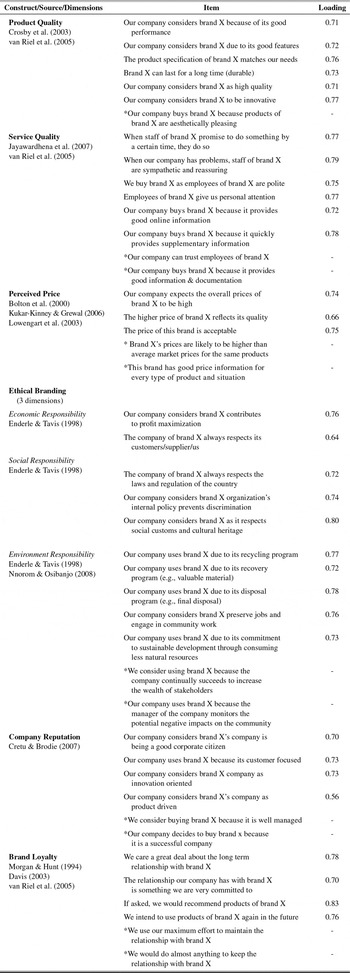
To generate measures for all six constructs, the existing literature served as our starting point. Items were evaluated for the closest match to and suitability for our study’s objectives with minimum adjustment to our context, namely, business buyers and electronic office equipment. In total, 44 items were generated. Table 1 shows details for each construct, including appropriate dimensions, sources, and individual items.
Constructs, Items, and Confirmatory Factor Analysis Loadings

Note. Loadings are standardized; all are significant at p < .01. The * identifies items that were removed during refinement of the measurement model. In total, 11 items were dropped from further analyses, as they were either cross-loaded with high modification indexes (MI) and/or have large standardized residuals (SR) (>2.58), (Byrne, Reference Byrne2001; Long, Reference Long1983).
The first construct, product quality, measured through seven items, was adapted from van Riel et al. (Reference van Riel, de Mortanges and Streukens2005) and Crosby et al. (Reference Crosby, DeVito and Pearson2003). It captured the overall excellence or superior quality of the product, innovation (van Riel et al., Reference van Riel, de Mortanges and Streukens2005) and durability (Crosby et al., Reference Crosby, DeVito and Pearson2003). For service quality, eight items were adapted from Jayawardhena et al. (Reference Jayawardhena, Souchon, Farrell and Glanville2007) and van Riel et al. (Reference van Riel, de Mortanges and Streukens2005). Examples included items that expressed “information service” and “excellent personnel service.” For perceived price, we generated five items to capture several aspects considered important in the branding and business buyer context, such as comparative and competitor pricing (Kukar-Kinney & Grewal, Reference Kukar-Kinney and Grewal2006), clear and good price information (Bolton, Kannan, & Bramlett, Reference Bolton, Kannan and Bramlett2000), and high pricing as an indicator of product quality (Kukar-Kinney & Grewal, Reference Kukar-Kinney and Grewal2006; Lowengart, Mizrahi, & Yosef, Reference Lowengart, Mizrahi and Yosef2003).
We operationalized the ethical branding construct in accordance with the corporate marketing approach, which defines it as a moral obligation delivered through economic, social, and environmental responsibilities (Enderle & Tavis, Reference Enderle and Tavis1998; Fan, Reference Fan2005; Schwartz & Carroll, Reference Schwartz and Carroll2003; van de Ven, Reference van de Ven2008). In total, the ethical branding concept was represented by twelve items, capturing three dimensions: economic responsibility, social responsibility, and environmental responsibility. The economic responsibility dimension includes items addressing profit maximization and respect for supplies/customers (Enderle & Tavis, Reference Enderle and Tavis1998). For the attributes of social responsibility, we measured perceptions of responsibility toward political and socio-cultural systems (Enderle & Tavis, Reference Enderle and Tavis1998). For the final dimension, environmental responsibility, items refer to the company policy regarding natural resources, such as raw materials and energy, or its recycling and disposal program for handling waste and pollution outputs. We utilized items concerning environmental responsibility from Enderle and Tavis (Reference Enderle and Tavis1998), and Nnorom and Osibanjo (Reference Nnorom and Osibanjo2008).
Company reputation, as noted earlier, captures stakeholder feedback about the legitimacy of the firm’s identity claims (Whetten & Mackey, Reference Whetten and Mackey2002: 401) and the association that the buyer has with the company (Brown & Dacin, Reference Brown and Dacin1997). The items we used were derived from Cretu and Brodie (Reference Cretu and Brodie2007). Finally, brand loyalty was measured with eight items from Morgan and Hunt (Reference Morgan and Hunt1994), van Riel et al. (Reference van Riel, de Mortanges and Streukens2005), and Davis (Reference Davis2003), and refers to loyalty and commitment in the business-to-business context (Morgan & Hunt, Reference Morgan and Hunt1994; Singh & Sirdeshmukh, Reference Singh and Sirdeshmukh2000).
In the questionnaire, we asked the respondents to select one brand from a given list of common brands of electronic office equipment (such as Canon, Hewlett-Packard, etc.). If the brand was not listed, the respondent was given an option to indicate the brand they currently used/owned in their office. Once a brand was selected, respondents were then directed to respond to the remaining statements in the questionnaire, indicating their agreement or disagreement based on their chosen focal brand (referred to as “brand X” in the questionnaire and in Table 1). All responses were given on 7-point Likert scales (from 1 = strongly disagree to 7 = strongly agree).
Pre-Test and Pilot Study
For content validation purposes (before the main data collection was carried out), we conducted a pre-test to examine the adopted items and study measures, which was followed by a pilot study. We involved five experts and practitioners as the participants in the pre-testing process to improve the content and face validity, and, upon their satisfaction with the content and readability of the measures, we proceeded to test the internal consistency of the measures by conducting a pilot study. This pilot was conducted with industrial buyers of electronic office equipment using an e-mail survey sent to the three main locations of electronic office equipment factories and service offices (Kuala Lumpur, Selangor, and Negeri Sembilan). Out of 300 questionnaires administered to a convenience sample of industrial buyers, we received 50 useable questionnaires. The results of the pilot study indicated that the six constructs have a high level of internal consistency (Cronbach’s alpha > 0.70): product quality (0.86), service quality (0.87), perceived price (0.78), ethical branding (0.88), company reputation (0.74), and brand loyalty (0.85). These results appear to be consistent with previous studies, including van Riel et al. (Reference van Riel, de Mortanges and Streukens2005), and Cretu and Brodie (Reference Cretu and Brodie2007). We then proceeded with the main data collection to which 272 industrial buyers responded.
RESULTS
Confirmatory Factor Analysis (CFA)
To analyze the data from the main study (272 responses), structural equation modelling (SEM) was implemented via AMOS 20 and the default method—maximum likelihood. A two-step approach to test the measurement model’s validity and reliability (in step one CFA), and nomological validity (in step two the full structural model), as proposed by Anderson and Gerbing (Reference Anderson and Gerbing1988), was carried out on all of the study’s constructs (product quality, service quality, perceived price, ethical branding, company reputation, and brand loyalty).
Thus, all 44 items were subjected to CFA, the measurement model, where a refinement process was conducted to establish the construct validity and reliability of all the items generated. The initial results of the CFA measurement analysis (in step one) showed a poor fit and had to be re-specified (Hair, Anderson, Tatham, & Black, Reference Hair, Anderson, Tatham and Black2008). Statistics (χ2 [272] = 2112.89; p < .01; χ2/df = 2; GFI = 0.76; TLI = 0.85; CFI = 0.86; and RMSEA = 0.06) indicated a marginal fit. Items that were cross-loaded with high modification indexes (MI) and large standardized residuals (SR) (>2.58) were dropped from further analysis (Byrne, Reference Byrne2001; Long, Reference Long1983). A total of 11 items were dropped (see Table 1). The final measurement model incorporated 33 items, representing the six constructs under study with an acceptable fit (χ2 [272] = 524.06, p < .01; χ2/df = 1.68; GFI = 0.87 [marginal fit]; TLI = 0.92; CFI = 0.93; RMSEA = 0.05) (Hair et al., Reference Hair, Anderson, Tatham and Black2008). The CFA provided evidence of convergent validity, with parameter estimates all above 0.5 (Kline, Reference Kline1998) and significant at p < .01 (Anderson & Gerbing, Reference Anderson and Gerbing1988).
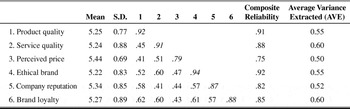
Table 2 shows descriptive statistics, correlations, and reliability estimates. Levels of Cronbach’s alpha, composite reliability are above recommended levels. Estimates of average variance extracted (AVE) are above 0.5 (Fornell & Larcker, Reference Fornell and Larcker1981), and the square root of each AVE exceeds the bivariate correlation coefficients, which ranged from 0.41 to 0.62 (see Table 2). There are no substantial cross-loadings between the measured and error terms, with standardized residuals all < 2.58 (Garver & Mentzer, Reference Garver and Mentzer1999). Thus, the measurement model has adequate discriminant validity.
Descriptive Statistics, Correlations, and Reliability Estimates

Note. All correlations are significant at p < .01. Cronbach’s alpha coefficients are shown in italics along the diagonal.
Structural Model – Direct Effects
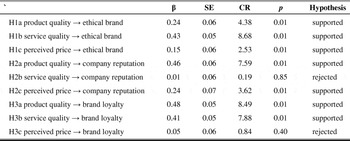
We tested direct effects via AMOS, with the full structural model showing good fit (χ2 [272] = 882.27, p < .01; χ2/df = 1.83; GFI = 0.86 [marginal fit]; TLI = 0.91; CFI = 0.92; RMSEA = 0.05) (Hair et al., Reference Hair, Anderson, Tatham and Black2008). See Table 3 for the detailed results of our tests of direct effects.
Hypothesis Results and Summary for Direct Effects

Note. β = Standardized regression weights; SE = Standard error; CR = Critical Ratio
We found direct effects as hypothesized for all three predictors of ethical branding, supporting H1a, H1b, and H1c. These three predictors (product quality, service quality, and perceived price) explain 42% of the variance in the ethical branding, with service quality having the greatest effect. We found significant direct effects of product quality and perceived price on company reputation, supporting H2a and H2c. Lastly, we found direct effects of product quality and service quality on brand loyalty, supporting H3a and H3b. We did not find support for two hypotheses, H2b (service quality → company reputation) and H3c (perceived price → brand loyalty).
Mediation Results
To examine mediation effects (H4a, H4b, H4c, H5a, H5b, H5c, and H6), we used the PROCESS macro, version 2.16 (Hayes, Reference Hayes2013; Preacher & Hayes, Reference Preacher and Hayes2004; Reference Preacher and Hayes2008). Footnote 6 The PROCESS method allows researchers to determine whether the mediator variable is significant and important (Hayes, Reference Hayes2013; Preacher & Hayes, Reference Preacher and Hayes2004), particularly when using a small sample size (Shrout & Bolger, Reference Shrout and Bolger2002). Specifically, we established mediation using guidelines proposed by Preacher and Hayes (Reference Preacher and Hayes2008), Preacher and Kelley (Reference Preacher and Kelley2011), and Zhao, Lynch, and Chen (Reference Zhao, Lynch and Chen2010), as set out below:
-
(1) If the introduction of a mediator variable (M) into the X → Y relationship (known as the c’ path) reduces the effect sizes (β) of the original direct effect, it indicates mediation;
-
(2) A confidence interval (CI) that excludes zero indicates that mediation has occurred (Preacher & Hayes, Reference Preacher and Hayes2008);
-
(3) An X → Y direct effect with an nonsignificant result (p > .05) after M is introduced (the c’ path), indicates full mediation, while a significant result demonstrates a partial case (Baron & Kenny, Reference Baron and Kenny1986; Preacher & Kelley, Reference Preacher and Kelley2011; Zhao et al., Reference Zhao, Lynch and Chen2010);
-
(4) In the event of a partial case, effect sizes are examined as they could strengthen the justification for full or partial mediation (Preacher & Kelley, Reference Preacher and Kelley2011). Two effect sizes were chosen for the current study: the completely standardized indirect effect (abcs) and percent mediation (PM). Effect sizes must fulfill all three general criteria: (1) interpretable scaling, (2) confidence interval available, and (3) independence of sample size, as in the case of abcs.
Table 4 shows detailed results of our application of the PROCESS method.
Hypothesis Results and Summary for Mediation Effects

Note. β = Standardized regression weights for a, b, c and c’; where, path a - IV (X) to mediator (M), path b - M to DV (Y); path c is the total effect; path c’ is the direct effect X to Y after controlling for M; SE = standard error; BCa = bias corrected and accelerated; 5000 bootstrap samples, CI = confidence interval, LL = lower limit, UL = upper limit (PROCESS macro, Preacher & Hayes, Reference Preacher and Hayes2004; Reference Preacher and Hayes2008). Further test on mediation is examined through effect sizes: PM = percent mediation; abcs = completely standardized indirect effect on X to Y) (Preacher & Kelly, Reference Preacher and Kelley2011, see p. 97 and p. 99, respectively, for formula and calculations). ** p < .01
The results of our analyses indicate support for stronger or full mediation with respect to two hypotheses; namely H4b (service quality → ethical branding → company reputation), and H5c (perceived price → ethical branding → brand loyalty). Specifically, for H4b, for the a path, β = 0.57 (p < .01), and for the b path β = 0.50 (p < .01), while the direct path of service quality → company reputation after the [M, c’ path] was controlled was found to be nonsignificant. This result indicates a case for full mediation (β = 0.11, p = 0.08, 95% CI [0.20, 0.39]). As for H5c, a similar result favoring a stronger mediation case is present. Although the result as shown in Table 4 indicates both paths (direct and indirect) are significant for H5c (a partial mediation case), both effect sizes, PM and abcs, indicate that the mediator accounts for more than half of the total effect (the c path). Specifically, PM = 0.61 (or 61%) and abcs = 0.30, (β = 0.23, p < .01, 95% CI [0.17, 0.31]); thus supporting stronger mediation via ethical branding.
When both direct and indirect paths are significant, a further examination through additional techniques provides justification for full or partial mediation (Preacher & Kelley, Reference Preacher and Kelley2011). H4b’s mediation effect accounts for almost three quarters of the total effect (the c path) (PM = 73%) and abcs = 0.28, (β = .30, p < .01, 95% CI [0.22, 0.40]). The abcs value indicates that Y (company reputation) decreases by 0.28 standard deviations for every 1 standard deviation drop in X (service quality) indirectly via ethical branding. A similar pattern exists for H5c; accordingly there is evidence of full mediation for two hypotheses (H4b and H5c). Finally, for the remaining hypotheses (H4a, H4c, H5a, H5b, and H6), Table 4 results indicate partial mediation since both paths (direct and indirect) are significant and the mediator accounts for less than half of the total effect (the c path) (PM ranged between 0.40 and 0.49).
DISCUSSION
Theoretical Implications
This study contributes to the literature in the following ways. First, we offer insights into how CSR dimensions can be conceptualized and operationalized from a corporate marketing and branding perspective. Second, we develop an integrated consumer response model and offer empirical evidence of the impact of ethical branding on other corporate brand equity variables and marketing outcomes, including corporate reputation brand loyalty. In particular, the study examined the role of ethical branding as a mediator. Finally, as the study focuses on corporate branding, we propose a different stakeholder approach focusing on the industrial buyer rather than on individual buyers, unlike past research. The following section discusses these contributions in more detail.
First, while previous research differentiates and emphasizes a firm’s corporate brand identity to its multiple stakeholders through functional values (e.g., product/service quality, prices) and/or emotional values (corporate credibility or corporate personality traits) separately, this study proposes a new way for a corporate brand to project and differentiate itself via CSR elements through its products, services, and perceived price. In particular, we define the ethical brand at a more abstract/corporate level through a firm’s moral responsibility to its multiple stakeholders, delivered through economic, social, and environmental factors. That is, an organization can express these moral obligations through values derived from functional/tangible attributes (expressed through an ethical orientation of its products or services), for example, a firm’s product program related to recycling, disposal strategy, social quality (Brunk, Reference Brunk2010a), or its economic attributes, maximizing the industrial buyer’s profit by producing an ethically oriented product (Powell, Reference Powell2011). Because previous research investigated the ethical brand individually, only a partial effect of the corporate brand and marketing outcomes was understood in relation to consumer response (Loe et al., Reference Loe, Ferrell and Mansfield2000). However, it is more effective to combine these values as they not only comprise the core values of the corporate brand (Urde, Reference Urde2003), but also establish a more abstract association at the corporate level; hence, the organization could leverage these values across products offered (Beverland et al., Reference Beverland, Napoli and Yakimova2007). Ethical branding is thus an important intangible firm asset that should be embedded in the overall corporate marketing strategy (Olins, Reference Olins2014).
Second, although there is already a stream of research proposing differentiation through ethical dimensions (Balmer et al., Reference Balmer, Powell and Greyser2011; Singh et al., Reference Singh, Iglesias and Batista-Foguet2012; Stanaland et al., Reference Stanaland, Lwin and Murphy2011), its focus is primarily on the product basis (Brunk, Reference Brunk2012); its antecedents and consequences among consumers are still unclear due to a lack of empirical findings (Brunk, Reference Brunk2010b; Hur et al., Reference Hur, Kim and Woo2014). The current study offers an integrated conceptual understanding, whereby ethical branding is proposed to be a mediator variable in relation to its antecedents (product, service quality, and perceived price) and its consequences (corporate reputation and brand loyalty). In particular, this study’s originality lies in the exploration of the mediator role of an ethical brand and its relationships (antecedents and consequences). We develop and empirically test the relationships between the ethical brand concept, its antecedent effects (product quality, service quality, and perceived price), and its outcome effects, which include buyers’ reactions toward the company reputation and loyalty toward the brand. Our study is important for academics and practitioners, who may appreciate the ethical aspects of branding that are more significant in the buyers’ evaluations in the business-to-business context. Likewise, through mediation analyses, the effect of ethical branding perceptions on corporate brand is explained (Hur et al., Reference Hur, Kim and Woo2014; Singh et al., Reference Singh, Iglesias and Batista-Foguet2012). The study shows that corporate credibility (based on consumer trust) enhances corporate reputation when ethical branding is a mediator.
In addition, we found that certain predictors are more important than others in customers’ evaluations of the ethical brand. Past research has illustrated that product quality, service quality (Cretu & Brodie, Reference Cretu and Brodie2007), and perceived price are important factors influencing customer value as an expression of the ethical aspect (Sagar, Singh, & Agrawal, Reference Sagar, Singh and Agrawal2006; Story & Hess, Reference Story and Hess2010). In particular, products differentiated on the basis of environmental and social qualities are seen as ethical (Balmer et al., Reference Balmer, Powell and Greyser2011; van de Ven, Reference van de Ven2008). Between service quality and company reputation, however, the result indicates no relationship. The absence of a finding here can be explained in two ways. First, since the study context is industrial buyers of electronic office equipment, product quality is emphasized over the services aspect. Industrial buyers are concerned about the quality of the electronic product with regard not only to its functional aspects but also to how it adds value, such as recycling or disposal policy (Brunk, Reference Brunk2010a). Second, in the Malaysian context, suppliers must ensure that the quality of the products meet the ethical requirement of being seen as ‘green’ (environmentally friendly), as this is a consideration criterion set not only by most of their industrial buyers before making their purchase decision but also by benefits of producing or going green, which allows firms to win awards and gain accreditation, thus resulting in a better reputation.
Likewise, Sagar et al. (2006) explain that one of the important elements of brand positioning in Asia (Indian context) is to emphasize ethical attributes (which includes product social acceptability, consumer value, ethical issue in pricing, culture, and the geographic relevancy of the product). Ultimately, this forms the brand identity of the company. Because previous research focuses more on the Western context, such as the US, empirical findings from other continents are limited (van de Ven, Reference van de Ven2008).
Nevertheless, service quality has a positive and significant indirect effect on company reputation via the ethical brand. This suggests that service quality can still enhance the company reputation if the company provides an ethical brand, or the brand does not result in any negative effect for its stakeholders as a whole. In other words, a positive response or reaction to company reputation is achieved when the brand is considered ethical through the quality of service offered by the company. This constitutes an ethical foundation in marketing (Balmer et al., Reference Balmer, Powell and Greyser2011; Olins, Reference Olins2014; van de Ven, Reference van de Ven2008) to help the organization successfully communicate its intentions to society while maintaining genuine societal engagement (van Rekom et al., Reference van Rekom, Go and Calter2014). The ethical brand represents the value of trust by offering superior value with high integrity and concern for stakeholders. We thus confirm theoretical frameworks extant in previous literature, in which product quality and service quality are considered important aspects of a brand and seen as ethical by industrial buyers (Cretu & Brodie, Reference Cretu and Brodie2007; Fan, Reference Fan2005; Paluszek, Reference Paluszek2005).
Our final contribution concerns the stakeholder approach. Because previous research has focused on functional and emotional values on a more individual basis, the intangible attributes – the effects of ethical branding on marketing outcomes – are not realized among other stakeholders, such as industrial buyers or suppliers (Brunk, Reference Brunk2010a; Chi-Shiun et al., Reference Chi-Shiun, Chih-Jen, Chin-Fang and Da-Chang2010; Hur et al., Reference Hur, Kim and Woo2014). By providing empirical findings regarding a different stakeholder group (industrial buyers in electronic office equipment), this study adds to current literature concerning how this group of customers behaves in their purchase decision making. While at the individual level the ethical brand (emotional values) is concerned with the issues related to fair pricing, public responsibility, leadership, and brand success (Page & Fearn, Reference Page and Fearn2005), at the industrial buyer level stakeholders may be willing to pay a higher price due to the ethical orientation of a brand (product or services) (Balmer et al., Reference Balmer, Powell and Greyser2011; van de Ven, Reference van de Ven2008). Further, industrial buyers are also keen to associate themselves with ethically oriented brands and suppliers because this will add credibility to their reputation among their own stakeholders (Mulki & Jaramillo, Reference Mulki and Jaramillo2011). Hence, responsibility is a key concept, formulated by a moral statement that can manage risk and uncertainty (Stahl, Reference Stahl2005).
In a similar vein, we found an interesting result with regard to perceived price and the mediator variables: ethical branding and company reputation. That is, perceived price is found to fully mediate ethical branding and partially mediate company reputation to explain industrial buyers’ brand loyalty. Industrial buyers are willing to pay more because they perceive that companies that are selling electronic office equipment fulfill their economic, environmental, and social responsibilities. Earlier, we argued that with certain types of industry, companies must behave responsibly toward the environment; however, this act incurs greater costs, and increased prices are therefore regarded as acceptable (Story & Hess, Reference Story and Hess2010). Industrial buyers in this context thus are somewhat ethically conscious. Zabid and Alsagoff (Reference Zabid and Alsagoff1993) found that Malaysian managers have high perceived ethical values in several sectors, including industrial manufacturing. Industrial buyers are willing to pay the higher price but only if the activity of the company considers the responsibility to its stakeholders as an expression of the ethical brand. Consequently, organizations will prosper by delivering products and services that benefit society (Maas & Liket, Reference Maas and Liket2011). Story and Hess (Reference Story and Hess2010) explain that when customers are committed (through an ethical brand), they become insensitive to price asymmetries, paying more without regard to the objective quality differences.
In summary, the current research’s originality lies within the conceptual and operational aspects of the ethical brand from a corporate marketing and branding perspective, providing an empirical understanding of how the concept works (mediator role) and its relationships (antecedents and consequences) in the context of industrial buyers in an emerging market in Southeast Asia, namely Malaysia. Product quality, service quality, and perceived price are all important criteria for a brand to be perceived as ethical (Brunk, Reference Brunk2012). We demonstrate that a good brand contains an ethical standard and that brand value must be assessed in both financial and ethical terms. Thus, brands must satisfy stakeholders as a whole.
Managerial Implications
This study has several managerial implications. Because ethical consumerism is evidently rising (Parguel et al., Reference Parguel, Benoît-Moreau and Larceneux2011), managers could spend their marketing budget on activities that will portray them as being ethical, especially when addressing multiple stakeholders. Management decisions should be based not only on a single type of customer or shareholder but also on stakeholders, such as the business buyers or suppliers (Chi-Shiun et al., Reference Chi-Shiun, Chih-Jen, Chin-Fang and Da-Chang2010; Palazzo & Basu, Reference Palazzo and Basu2007; Stanaland et al., Reference Stanaland, Lwin and Murphy2011).
Overemphasis on ethical activities in an organization’s marketing communication might be misconstrued by the stakeholders, however, and the stakeholders’ perception of the sincerity of the company will be diminished (van de Ven, Reference van de Ven2008). From the current study’s findings, buyers are willing to pay a higher price in this industry and trust their brands due to their overall perception and evaluation: that the company has done the right thing and behaves responsibly (an ethical brand). Therefore, communicating and engaging with society is vital and should begin in the early stages of corporate strategy planning. With consistent implementation, the brand will develop an authentic communication element and increase the level of its sincerity (van Rekom et al., Reference van Rekom, Go and Calter2014). Such sincerity could then enhance the company’s image and reputation among the stakeholders (Bowen, Reference Bowen2004), and, potentially, may resolve any problems, particularly when companies must address innumerable stakeholders across different countries. Managers must therefore consider the ethical brand cost when producing the products as well as in communicating it to constituents. Likewise, suppliers must consider financial burdens that inevitably are involved with compliance with market conditions; however, ultimately, such compliance will ensure committed customers, long-term profitability, and the management of the supplier-buyer relationship (Story & Hess, Reference Story and Hess2010: 247).
Although, at present, there is no guarantee that consumers will buy a product, even if a company spends time and money on ethical activities (Olins, Reference Olins2004), both the public and pressure groups are watching these companies, and will reward them positively if they behave in an acceptable manner (Olins, Reference Olins2014). Nevertheless, most scholars agree that incorporating ethical marketing (Balmer et al., Reference Balmer, Powell and Greyser2011) or being seen as an ethical brand (Fan, Reference Fan2005) helps long-term business performance, e.g., by enhancing company reputation; increasing sales, profit, and market share (Maas & Liket, Reference Maas and Liket2011; van Rekom et al., Reference van Rekom, Go and Calter2014); and, hopefully, improving the company’s strategic competitive advantage.
Based on the findings of this study, we conclude that ethical business practices, i.e., ethical branding, may be applied by companies to gain a competitive advantage. Gaining increased brand loyalty through an ethical brand is important for business survival and growth. Encouraging ethical decision making is essential in socially responsible branding programs if a firm is to achieve a good image and facilitate “self-reinforcing, positive outcomes” (Caza, Barker, & Cameron, Reference Caza, Barker and Cameron2004: 175) that can help to protect them from their competition.
Limitations and Future Research
Ethical branding is an under-researched concept. The current definition is based on limited conceptual studies (e.g., Balmer et al., Reference Balmer, Powell and Greyser2011; de Chernatony, 2002; Fan, Reference Fan2005; Maignan et al., Reference Maignan, Ferrell and Ferrell2005; Powell, Reference Powell2011; Urde, Reference Urde2003; van de Ven, Reference van de Ven2008), addressing the moral, economic, social, and environmental dimensions of ethical branding (Schwartz & Carroll, Reference Schwartz and Carroll2003). However, recognizing that there may well be other dimensions (such as sales/financial impact), work is required to further develop and validate the concept, consider other dimensions, and explore it in other contexts to increase the generalizability and applicability of the framework. Although the current study sheds light on the value of having an ethical brand, more research is needed to further develop the ethical brand concept to enhance a company’s reputation as well as create loyalty among the company’s buyers. Also, it is important to acknowledge that the present empirical findings should be interpreted within the context under study. Finally, future research could investigate antecedents and ethical branding dimensions separately to address corporate brand positioning more clearly in different contexts/settings and across different stakeholders.