Introduction
The north western part of the Himalayan region of India shows varied climatic and topographic features. This area exhibits an extremely cold and dry climate for most of the year, which hinders the growth and productivity of biomass. Vegetation cover is therefore very scarce in areas like Ladakh, Kargil, Drass and Lahaul-Spiti. In winter, the temperature falls to -35°C and the altitude varies from 3048 to 3658 m from mean sea level (MSL). The atmospheric oxygen pressure is 30% lower than at MSL. These type of cold, arid, desert-like conditions are not suited to the natural habitat of poultry birds.
The term ‘poultry’ includes a number of avian species such as the chicken, duck, turkey, goose, guinea-fowl, quail, ostrich and emus domesticated for economic purposes. However, chicken accounts for more than 90% of the total poultry population of the country. Both chickens and ducks are reared for egg and meat production, while turkeys, guinea fowls, geese, ostriches and emus are used mainly for meat production.
The growth of the poultry industry in India has been phenomenal in the last two decades, and has reached a stage of self-sufficiency and sophistication. However, the picture is far worse in the cold, arid parts of Himalaya, where it is a backyard venture with very small numbers of birds. The non-existence of any commercial hatcheries, problems with transporting day-old chicks and the unavailability of poultry feed continue to be major obstacles to the expansion and popularization of poultry farming in this particular region.
Due to the sustained efforts of the state government, animal husbandry department, non-governmental organizations (NGO'S) and a few agro-animal researchers; the awareness and importance of poultry farming amongst farmers has increased. The presence of army personnel, increased tourism, changing life-styles and eating habits has created a huge demand for poultry meat and eggs. Additionally, as traditional agricultural activities cease in winter, there is an opportunity for farmers to participate in an occupation like poultry farming during this time. Therefore, despite numerous constraints, the poultry industry has good potential for expansion in this region. A few farmers have established small scale broiler farms in cities like Leh and Kargil. At a ‘backyard’ level most of the farmers opt for 15 to 20 egg-laying or dual purpose birds. The poultry population in the Ladakh district is reported to be 8,267 birds (Bhagat, Reference BHAGAT2003) to 0.12 lacs (Phuntsog, Reference PHUNTSOG2003) and in the Kargil district it is reported to be 2,61,171 birds (Gupta, Reference GUPTA2003).
Main constraints
To be successful in popularising poultry farming in cold, arid regions it is essential to understand the constraints and difficulties facing poultry production. Major hurdles include the following:
religious sentiments
The major communities in this region are of Buddhist faith. Therefore they are vegetarian and against killing animals in principal. Their interest in poultry is limited to the keeping of egg-laying birds.
extreme cold and hypoxic environment
Day-old chicks of any poultry species are physiologically prone to the adverse effects of cold stress because of their poor homoeothermic capabilities. The temperature range for optimal production is 17 to 23°C (thermo-neutral zone). Any variation above or below this range affects the growth and production parameters of these birds. In this region, the temperature fluctuates from +35°C in summer (day time) to -35°C in winter (night time), exerting a huge stress on the homoeothermic control system of the bird, as well as requiring huge expenditure maintaining the optimum temperature during the extremes of winter. The altitude in this region varies from 2743 to 3658 m, which directly affects the hatchability percentage of chicks because of the reduced partial pressure of oxygen in the air. This single factor is largely responsible for the absence of any hatchery in this region and in turn the non-popularization of poultry farming. Cold stress coupled with the hypoxic and dry environment (RH =35-45%) reduces the optimum production and liveability potential of poultry birds.
poor availability of day-old chicks (DOC) and poultry feed
Due to the absence of hatcheries and poultry feed mills, it is difficult to procure DOC and ready-made poultry feed in the winter season due to the isolation of this region from the other parts of the country during this time (for at least 6 months). The difficulty of transportation in high altitude mountains and high transportation charges also add to the burden of farmers. Furthermore, local availability of poultry feed ingredients is minimal and there are limited sources to get them from on a regular basis.
suitable breeding stock
Considering the climatic conditions and constraints, selecting an appropriate breeder population for broilers and layers becomes very important. Ideally, the breeders should be able to withstand harsh climatic conditions and produce optimally. Research findings of the Defence Institute of High Altitude Research (DIHAR), Leh and Jammu and Kashmir state Animal Husbandry departments have suggested, commercial strains of White Leghorn (WLH) and Rhode Island Red (RIR) are good enough for egg purposes. These two breeds survive well with good production performance even in backyard farming. F1 strains of slow growing commercial broilers are suitable for backyard farming. In poultry houses with better temperature control, fast growing Venkcobb broilers have been found more economical by virtue of their rapid body weight gain and lesser feed conversion ratio (FCR). But in general, cockerels of slow growing strains (e.g. Chabro, CPBF) and dual purpose Indian varieties, such as Dhanraja and Vanraja, will be more appropriate because of their hardy nature and better survivability at the farmer's level. The average body weights of day-old and 6 week old Vanraja chicks are 37.97 ± 0.60 g and 810.13 ± 29.60 g respectively at an altitude of 1585 m above MSL. The average feed conversion ratio (FCR) is 2.64 ± 0.04 at the 6th week, with 22.63% total mortality during this period. This shows that the growth of broilers at high altitude is less compared to plains and that they consume more feed per unit of body weight gain. Therefore, to encourage poultry farming at the backyard level, there is a need to introduce dual purpose broody native birds.
Housing systems
The housing of poultry birds is difficult in cold, arid climates especially in the winter season. In order to maintain the optimum temperature of 25 to 35°C inside brooder and 15 to 20°C inside grower and layer houses, some special care and modifications to the design of traditional poultry houses are required. The different types of houses which are currently used by local farmers are outlined below:
over ground mud walled poly sheds
These sheds are made of double wall mud bricks, with the inner first third up from the floor consisting of cement. The roof is made up of bamboo, wood, grass and other locally available materials. The middle third of one side of the wall facing the sun is made from a polythene sheet supported by wooden logs and at the centre is a glass window. This whole portion is then covered with another white polythene sheet to trap the sun light and thus maximize the heat inside the house. The inside half of the wall is covered by blankets and plywood to preserve heat. False roofing has been attempted using a thick woollen sheet at half the height of the house. At the centre of the house, there is local bukhari (wood burning stove), fitted with a chimney and wrapped with wire mesh to prevent the birds coming too close. In the peak of winter in the Nubra valley of Ladakh, when the outside temperature falls to -4°C during the day, the temperature inside at the bird's level has been noted to be +8°C without lighting the bukhari.
semi-underground mud /stone walled house
These houses are used to protect the birds from the extreme cold and comprise different types of underground and semi-underground sheds, made of mud, mud brick, stone and concrete are used by poultry farmers. Some of these houses include extra poly-houses as an extension to allow the birds access to direct sunlight during the day-time. These semi-underground sheds are constructed of a double wall of mud or stone up to the ground level, with mud bricks being used to construct the rest of the wall as well as the roof. The roof is double layered with mud bricks and part of ceiling inside is supported with wooden logs and locally available packing materials. False roofing is made by covering the inner aspect of the roof with polythene, cardboard, paper or ply wood. One or two windows are made where the wall interfaces with the ground. These are either fitted with wire mesh or adjustable wooden or glass panels opening outside, or covered with curtains or polythene. The floor, corners and lower one third of the walls are cemented for easy cleaning and protection from rodents. It has been reported that mud bricks are better insulators than stone. These houses are cheap to build and are affordable to farmers. Another type of semi-underground house has been attempted by the Defence Institute of High Altitude Research (DIHAR). In this instance, the walls and floor were made of concrete bricks and asbestos sheets were used for the roof. At the centre of the roof, polycarbonate sheets were used to trap solar radiations. A double door was used to prevent incoming air drafts. In both types of houses, one opening is left in the roof for the chimney of the bukhari.
trombay wall shed
This housing is a scientific adaptation of typical local poultry houses; designed to cater to the needs of farmers by the DIHAR. They are made of a double wall of mud bricks which are plastered with mud on all sides. This above-ground shed has two windows and both the walls and floor are cemented. The lower one third of the walls is covered with galvanized aluminium sheets for easy cleaning. The roof is the same as the farmer's other sheds. An extra door is located at right angles of the first door. Some other modifications have also been attempted, such as including large double layered glass windows on the whole face of the wall facing the sun. The outside of the walls is painted black and a polycarbonate sheet is located at the centre of roof. Many small windows are fitted on the lower part of the walls in order to meet ventilation requirements. As per requirements, window doors open partially or fully to allow ventilation. All of these modifications augment the solar heat trapping capacity of the housing and improve the ventilation of the house. This modified housing can be easily constructed with locally available materials and is cheaper to build. The results of experimental trials conducted by the DIHAR for growth, FCR and mortality of broilers in this type of house, were satisfactory, even in peak winter conditions.
solar poultry house
The solar house has been designed by the DIHAR to provide maximum comfort, maximum protection from the cold, better ventilation and hygienic conditions for the birds. This type of housing is very costly but most efficient in maintaining optimum temperature and ventilation inside.
Points for low cost, ideal housing for poultry in cold, arid regions
• House can be semi-underground to over ground, provided ventilation is optimised
• It should be double walled with some insulating space between the walls
• Mud brick walls are better insulators and cheaper
• The roof should be double layered with space for polycarbonate sheets to trap solar radiation during the day
• The outer surface of the walls facing the sun should be painted black
• Large glass walls or glass windows should be provided to trap heat during day
• Additional coverings of black and white polythene over the walls/windows in day and night time will increase the heat retention capacity of the shed
• Double layered curtains made of bags or sacks can used as double doors to prevent incoming chilled air while opening and closing of the door
• A false ceiling is vital
• House should not be too long, too wide, and too high
• Smaller houses are better for maintaining temperature and humidity
• Ventilators should be constructed to prevent direct entry of draughts
• Packaging materials should be used to fill walls and roofs, e.g. chopped wheat or paddy straw
• Lucerne hay or any cheap dried stacks of herbs or plants mixed in mud can improve insulation
• Inside, the bottom one third of walls should be cemented or covered with tin or aluminium sheet and the corners rounded
• During the night ,curtains can be used to cover glass windows or poly carbonate sheet to avoid chilling or ply wood made folded shutters can be used to cover windows or poly carbonate sheets
• The house should be face south or south-east to get maximum sunlight.
Feeds and feeding
Poultry are monogastric animals and their diet consists mostly of cereals. Grain production is limited in this region, therefore farmers are provided with subsidised human rations. However, for animal rations there is no such system and therefore food grains or poultry feed have to be imported from elsewhere by the farmer. Generally poultry farmers face three major hurdles with feeding their birds.
availability of poultry feed and grain
Wheat, barley, peas and mustard are the few main local food grains, which are produced by farmers in limited quantities. However, very little amounts of surplus grains are available to the farmer and there is little to spare for poultry feeding. Farmers generally import poultry feed ingredients such as maize, soybean and wheat bran, or purchase readymade feeds from other parts of country when the road route remains open i.e. during the summer. Transportation and storage of feed from distant place exerts extra economic pressure on the farming enterprise.
feed formulation
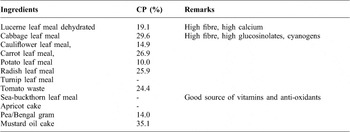
Balanced, readymade feed is not always procured by farmers. To save money, they tend to purchase a few ingredients and supplement them with locally available feeds. Using such unbalanced feed decreases the weight gain in birds and increases the feed conversion ratio. Generally, readymade starter feed is given to chicks, and maize-based, locally prepared, poor quality feed is provided to birds from 4 weeks of age. In winter, at the time of feed scarcity, farmers make their own poultry feed with locally available vegetables and cereals such as those shown in Table 1. This includes spinach, cabbage, onion, garlic, Lucerne leaves, crushed turnip, barley, gram, wheat flour and mustard oil preparation.
Unconventional ingredients used in poultry diets in the Himalayan region.

Source of CP %: Pandaet al. (Reference PANDA, REDDY, SADAGOPAN and SRIVASTAVA1997)
energy and protein levels in feed
Scientific feed formulations optimising metabolisable energy (Kcal) and crude protein (CP), are essential for this region. Because of the added stress of the cold and high altitude, readymade feed available in other markets would not be appropriate for birds in this region. Ascites becomes a major problem in fast growing broilers if the energy and protein levels in the feed are not optimised. Depending on the season (winter or summer), quality and type of day-old chicks (fast or slow growing), scale of feeding (ad-libitum or restricted) and incidence of ascites, feed formulation needs to be adjusted and energy and protein levels, along with the use of feed additives need to be optimised.
Feeding management
In cold and high altitude areas it is not advisable to feed broilers ad-libitum. Broilers can survive in hypoxic and cold stressed conditions only by reducing their rate of body growth, and ad-libitum feeding leads to ascites and other metabolic diseases in these birds. It also predisposes the birds to other diseases. Feed restriction is a simple measure that can be used to curtail mortality in broilers. In broilers feed restriction can be done by:
• Making feed available for only 8 hours per day for 6 weeks growing period
• Limiting feed to 8 hours per day during the first 3 weeks, then on full feed for the remaining 3 weeks
• Giving full feed access for the first week, followed by 3 weeks of 8 hours of feed availability, followed by 2 weeks of full feed
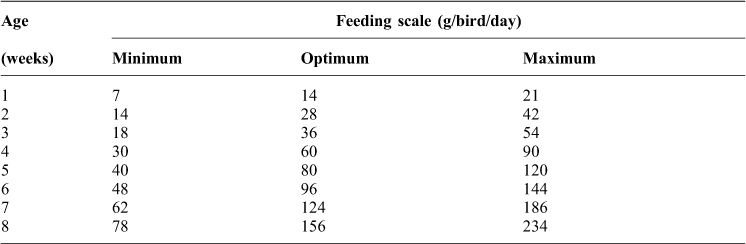
• Providing a calculated quantity of a balanced ration per week as given in a feeding scale table.
It has been shown that all these feed restriction treatments significantly reduced ascites incidence when compared with fully fed controls. Broilers subjected to restricted feeding show lower live weight, weight gain and poorer feed consumption at 28 days. However, no differences are found at 42 days, as a consequence of the compensatory growth during the re-feeding period if fed ad-libitum at later stages. With scaled feeding (minimum, optimum and maximum), broilers attain 1 kg body weight in 8 weeks, 6 weeks and 4 weeks respectively at the altitude of 3048 m from MSL at Ladakh with fast growing chicks. The feeding scale shown in Table 2 has been standardised for slow and fast growing broilers. This restricted feeding greatly reduces the mortality of commercial broilers due to ascites.
Feeding scale for broilers in the cold, arid Himalayan region of India.
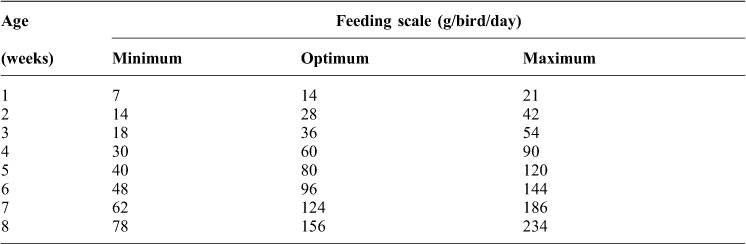
Source: DIHAR research data
In growing pullets (8-20 weeks), feed restriction techniques are most commonly used to delay sexual maturity. This increases egg production, extends the productive life of the animal and allows monitoring of excessive weight gain in broiler pullets. It also reduces feed cost. Recommended methods of feed restriction for growing pullets are:
• Limited feeding time
• Quantitative restriction
• Qualitative restriction
• Nutrient dilution
• Skip-a-day feeding
Mash feeding, dry or wet, is the suitable method of poultry feeding in Himalayan conditions. Pellet feeding in broilers is not suitable for this region as because of their high nutrient density, it leads to ascites.
Ascites syndrome; a major problem in high-altitude broilers
Ascites syndrome refers to the accumulation of fluid in the body cavity and occurs when broilers fail to consume a sufficient amount of oxygen to supply their metabolic demands. The lack of oxygen stimulates red blood cell proliferation to the vascular system, causing an increase in haematocrit. Such an increase leads to higher blood viscosity, pulmonary hypertension, right ventricular hypertrophy, oedema and ascites syndrome (Julian, Reference JULIAN1993; Wideman, Reference WIDEMAN2001). The propensity for broilers to develop ascites increases as ambient temperature decreases, because the broilers need more oxygen to maintain their body temperature (Wideman and Tackett, Reference WIDEMAN and TACKETT2000).
Ascites is more prevalent in rapidly growing broilers (Wideman, Reference WIDEMAN1994) and a decrease in growth rate is sufficient to make birds less susceptible (Jones, Reference JONES1994). Incidence is inversely related to the level of available oxygen for respiration (Odom et al., Reference ODOM, MARTINEZ-LEMUS, HESTER, BECKER, JEFFREY J.S., MEININGER and RAMIREZ2004). A relationship exists between the partial pressure of environmental oxygen (influenced by altitude, cold weather), whereby increasing oxygen consumption in turn decreases ascites in broiler chickens (Cueva et al., Reference CUEVA, SILLAU, VALENZUELA and PLOOG1974). Thus it is clear that factors contributing to the development of ascites syndrome are high altitude, rapid growth, cool temperature and poor ventilation.
The break point for the occurrence of ascites-related changes in the absence of other stress factors (e.g. cold stress) is 19.6% oxygen (Beker et al., Reference BEKER, VANHOOSER, SWARTZLANDER and TEETER2003). In the heart, a right ventricle to total ventricle ratio (RV/ TV) of > 0.27 is considered as an accurate indicator of the onset of ascites (Huchzermeyer and De Ruyck, Reference HUCHZERMEYER and DE RUYCK1986). Apart from environmental and management aspects, ascites also has a genetic aspect. Broiler strains can be much less susceptible to ascites. Via selection experiments, some researchers have developed resistant broiler lines in simulated conditions of altitude and cold stress (Balog et al., Reference BALOG, KIDD, HUFF, HUFF, N.C. and ANTHONY2003). A gene has been identified for making the birds susceptible or resistant to ascites or hypertension syndrome. This Bone Morphogenetic Protein Receptor type II (BMPR 2) gene maps to chromosome 7 of the chicken (Cisar et al., Reference CISAR, BALOG, ANTHONY and DONOGHUE2003).
Possible strategies for controlling ascites in cold stressed (5-15°C) birds at an altitude of >304.8 meters:
• Include less (0.15 -0.3%) common salt in the ration, which potentiates ascites
• Alkalinise the ration by adding NaHCO3
• Add selenium to the diet to increase antioxidant status
• Because drinking water (typically from springs) in this region is rich in salts, it should be kept stored overnight and the following day, and the upper scum layer e removed before supplying to the birds
• Birds on high density nutrients or high energy, high protein are more prone to ascites
• Feed a low protein, low energy diet during the first 14 days (Currie, Reference CURRIE1999)
• Nitric oxide helps to prevent ascites
• L-Arginine supplementation reduces the incidence of ascites by helping in the synthesis of endogenous nitric oxide which causes vasodilation (Odom et al., Reference ODOM, MARTINEZ-LEMUS, HESTER, BECKER, JEFFREY J.S., MEININGER and RAMIREZ2004)
• Coenzyme Q10 has a beneficial effect in reducing ascites mortality, when included at 40 mg / kg of feed
• Frusemide (a diuretic) at 0.001%, 0.005% and 0.01% significantly reduces ascites without lowering the final body weight (Wideman, Reference WIDEMAN1994)
• Increasing dietary bicarbonate and reducing dietary chloride has potential as a low cost and effective method to reduce ascites in broiler chickens
• Naked-neck birds are more competent homeotherms and present superior levels of Hsp70 in the organs that are first affected by Ascites Syndrome (AS). Therefore naked-neck broilers would be less susceptible to ascites
• A combination of ascorbic acid and chromium supplementation can offer a potential way of preventing the detrimental effects of cold stress in laying hens
• A combination of vitamin C, vitamin E and zinc (antioxidant components) can provide protection to the endothelial lining of the lungs and heart and in turn some protection from the onset of ascites
• Restricted feeding helps prevent ascites
• In the daytime, all windows should be kept open and at least two windows during the night, depending on local weather conditions, to provide maximum ventilation. Better ventilation prevents ascites
• All broilers attaining 1 kg of body weight should be sold immediately.
Fertility and hatchability at high altitude
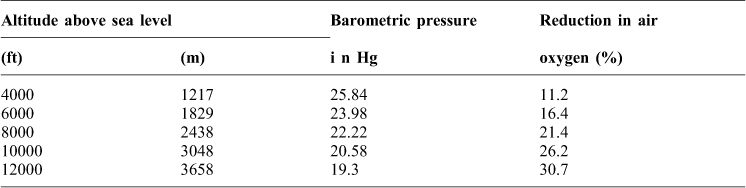
High altitude is associated with reduced barometric pressure and reduced partial pressure of oxygen, as outlined in Table 3.
Relationship between altitude, oxygen content of air and barometric pressure.
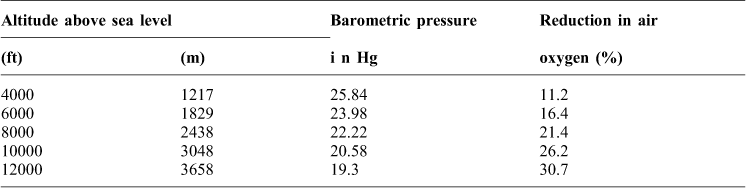
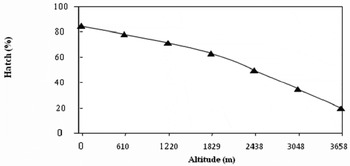
External temperature and absolute humidity are also lower. Thus fresh ventilating air tends to be colder and drier than at sea level. When air expands due to heating at high altitude, a cubic volume of air contains less oxygen. Hatchability per se is adversely affected by hypoxia from the high altitude (Lundy, Reference LUNDY1969). Research has shown that hatchability of chicken eggs is reduced as the altitude at which they are incubated is increased (Figure 1).
The cause of higher embryonic mortality has been reported to be lower haemoglobin levels. The chicken requires an adaptation period for normal fertility and hatchability at high altitudes. The temperature, relative humidity, oxygen and carbon dioxide levels that are required for optimum hatchability are shown in Table 4.
Hatchability percentage at different altitudes.

Temperature, relative humidity, O2 and CO2 concentration required for optimum hatchability.

If chicks are grown from day-old to onset of lay at high altitude, then the survivors will show better hatchability compared to adult hens brought in from sea level. Some factors affecting hatchability are as follows:
• By increasing the air pressure inside the incubator to sea level, it is possible to produce satisfactory results. Some hatcheries do provide pressurised atmosphere within the incubator room (Pressurised Incubation)
• By injecting oxygen directly into the cabinet in which the eggs are to be incubated (oxygen supplementation), at a concentration of 23-23.5%. Oxygen is supplied in to both setter and hatchery compartments by a tube from oxygen cylinders that have a pressure regulator valve and flow meter. A gas analysis apparatus is used to determine the percentage of oxygen in the mixed air within the incubator cabinets
• Hatchability falls by about 5% for each 1% (7.6 mm Hg) reduction in oxygen concentration below 21%. Hatchability falls to 50% at 15% oxygen (114 mm Hg)
• Hatchability falls by 0.5% for each 1% change in relative humidity from optimum
• Temperature reduction of -17.2°C reduces the relative humidity of air by 2.5%
• Supplementation of oxygen into the incubator increases hatchability by the order of 10 to 14% (Sahan et al., 2006)
• Ells and Morris (Reference ELLS and MORRIS1947), at 2195 m above sea level (pO2~ 120 mm Hg), provided supplementary oxygen to eggs in forced draught incubators and reported that increasing pO2 to 146 mm Hg (19% O2) throughout incubation increased hatchability by approx 13%. Increased hatchability at altitude, associated with oxygen supplementation was also obtained by Meshew (Reference MESHEW1949) and Wilgus and Sadler (Reference WILGUS and SADLER1954). Oxygen supplementation increases the haemoglobin concentration in embryos (Meshew, Reference MESHEW1949) and provides evidence of physiological adaptations by embryos to low oxygen partial pressure
• Higher incubation temperature in combination with increased oxygen tension decreased embryonic mortality during the 3rd and 4th week of incubation and resulted in higher hatchability. Hatchery managers at high altitudes should supplement with oxygen and incubate turkey eggs at higher temperatures than at lower altitudes
• At the altitude of 1585 m above MSL in Dirang (Arunachal- Pradesh), hatchability of 17.86 to 76.04% (average 56.73%) was achieved in Vanraja eggs brought from the project directorate on poultry (PDP), Hyderabad, India. The cause of lower hatchability was reported to be transportation losses
• Under hypoxic conditions, strain differences have been noted for hatchability
• Resistance of chick embryos to hypoxia can be increased by selection (Smith and Abott, 1961).