Introduction
Minerals of the series cordierite–sekaninaite (Mg,Fe2+)2Al3(AlSi5O18) (Crd–Skn) are widespread in both metamorphic and granitic igneous rocks. Numerous studies have been undertaken on the crystal structure, microchemistry and spectroscopic properties of both natural and synthetic cordierites; see for example: the Mineralogy Database [https://www.webmineral.com/data/Cordierite.shtml] and Mindat web pages [https://www.mindat.org/min-1128.html] and references therein. Small amounts of H2O, CO2, Fe3+, Na+, K+ and Be have been detected in some examples. Most occurrences are Mg-dominant varieties in the low-temperature series with orthorhombic symmetry, whereas the high-temperature hexagonal analogue of cordierite is indialite (Miyashiro and Iiyama, Reference Miyashiro and Iiyama1954; Meagher and Gibbs, Reference Meagher and Gibbs1977). Thus far, a naturally occurring hexagonal analogue of sekaninaite has not been found.
In igneous rocks, sekaninaite occurs mainly in a few granitic pegmatites, such as at the type locality of Dolní Bory in the Czech Republic (Staněk and Miškovský, Reference Staněk and Miškovský1975); see Mindat for a list of localities. Occurrences in rocks of the rhyolite–dacite series are much less common and restricted to a handful of localities worldwide. Amongst these, the sekaninaite in the Rubicon Rhyolite in central Victoria, Australia, is notable as the most iron-rich known from a volcanic rock (Birch and Gleadow, Reference Birch and Gleadow1974). The Rubicon Rhyolite is a densely welded and recrystallised ignimbritic formation up to 300 m in thickness and is the earliest formation in the collapse phase of the large Late Devonian Cerberean Cauldron complex (Hills, Reference Hills1932; Birch et al., Reference Birch, Gleadow, Nottle, Ross and Whately1978; Clemens and Birch, Reference Clemens and Birch2012). It is overlain by the thicker and less siliceous Lake Mountain Rhyodacite.
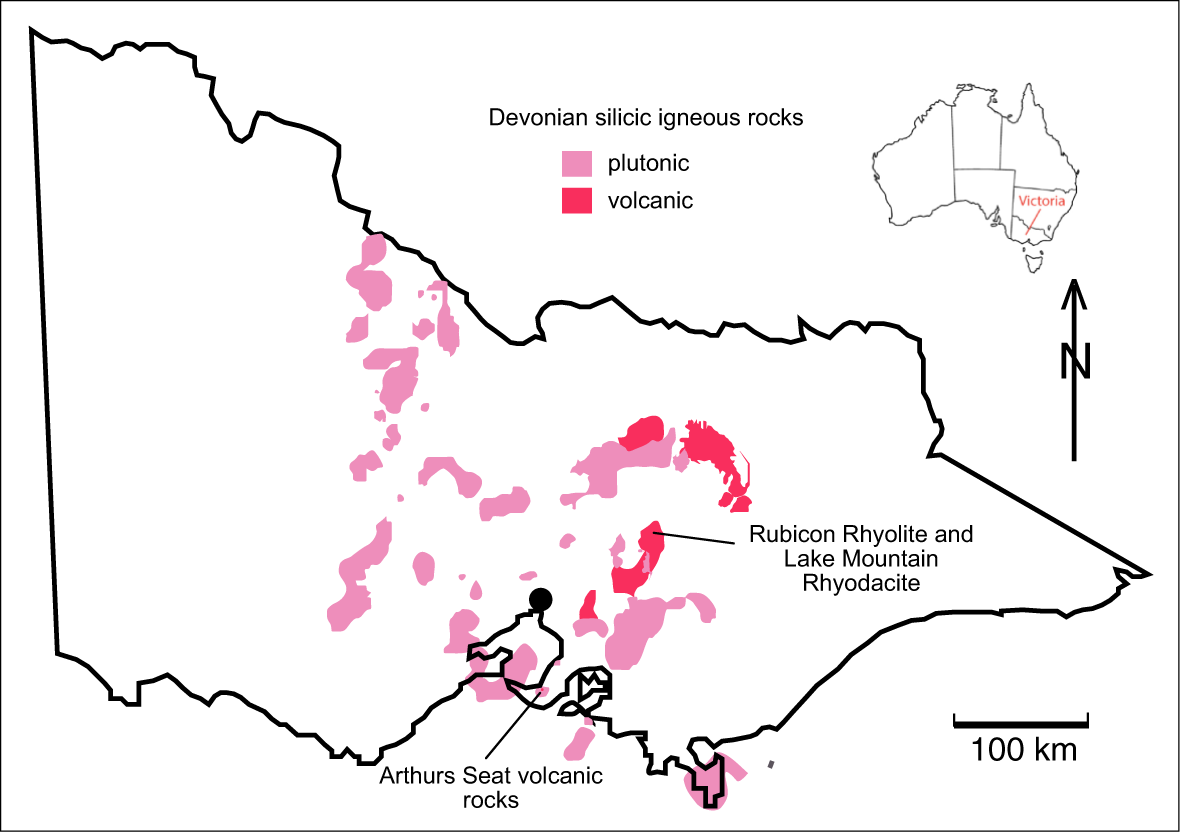
The discovery of similar crystals in a single rhyolitic hand specimen from a little-known Victorian rhyolite–dacite complex, exposed on the summit of Arthurs Seat near Dromana on the Mornington Peninsula (Baker, Reference Baker1938) prompted this review of sekaninaite occurrences and exploration of controls on its formation. The two occurrences lie some 130 km apart in south-east Australia (Fig. 1) and are structurally unrelated. The Cerberean Cauldron was punched through deformed Siluro–Devonian metasedimentary rocks of the Melbourne tectonometamorphic zone (VandenBerg et al., Reference VandenBerg, Willman, Maher, Simons, Cayley, Taylor, Morand, Moore and Radojkovic2000). However, the Arthurs Seat complex is possibly an erosional remnant of a smaller caldera that was intruded by the unrelated and presumed Devonian Dromana Granite (Clemens and Birch, Reference Clemens and Birch2025).
Map showing the distribution of Devonian granitic and volcanic complexes in the central part of Victoria, Australia: the locations of the Rubicon Rhyolite and Lake Mountain Rhyodacite (in the Cerberean Cauldron of the Marysville Igneous Complex) and the outcrops of rhyolitic volcanic rocks at Arthurs Seat on the Mornington Peninsula. The colour coding is as follows: violet = plutonic rocks; red = volcanic rocks. The inner city of Melbourne is indicated with a large black dot.

It is not our intention to review all occurrences of cordierite in igneous rock types (see Clarke, Reference Clarke1995), but only those peraluminous volcanic rocks that contain the phase with values of Mg# (100Mg/[Mg + Fe +Mn]) < 50. Indeed, Clarke (Reference Clarke1995) did not cover sekaninaite (or Fe-cordierite) and his considerations around magmatic cordierite focussed on the magnesian phase in intrusive granitic rocks and pegmatites. However, we should mention iron-rich cordierite, including sekaninaite, occurring in pyrometamorphic rocks, known as buchites. These have been described from a number of localities associated with active volcanism, in particular Stromboli in the Aeolian Islands, Italy (Del Moro et al., Reference Del Moro S Renzulli and Tribaudino2011; Salvioli et al., Reference Salvioli-Mariani, Renzulli, Serri, Holm and Toscani2005). These form under high T–low P conditions when metasedimentary rocks are partially melted by mafic magmas during eruptions. Buchites typically consist of glass containing high-temperature silicate and oxide minerals, with the assemblages governed by the compositions of the protoliths. Buchites will not be discussed in this paper, but for a review of their mineralogy and origin see Grapes (Reference Grapes2006).
Features of the Victorian sekaninaite
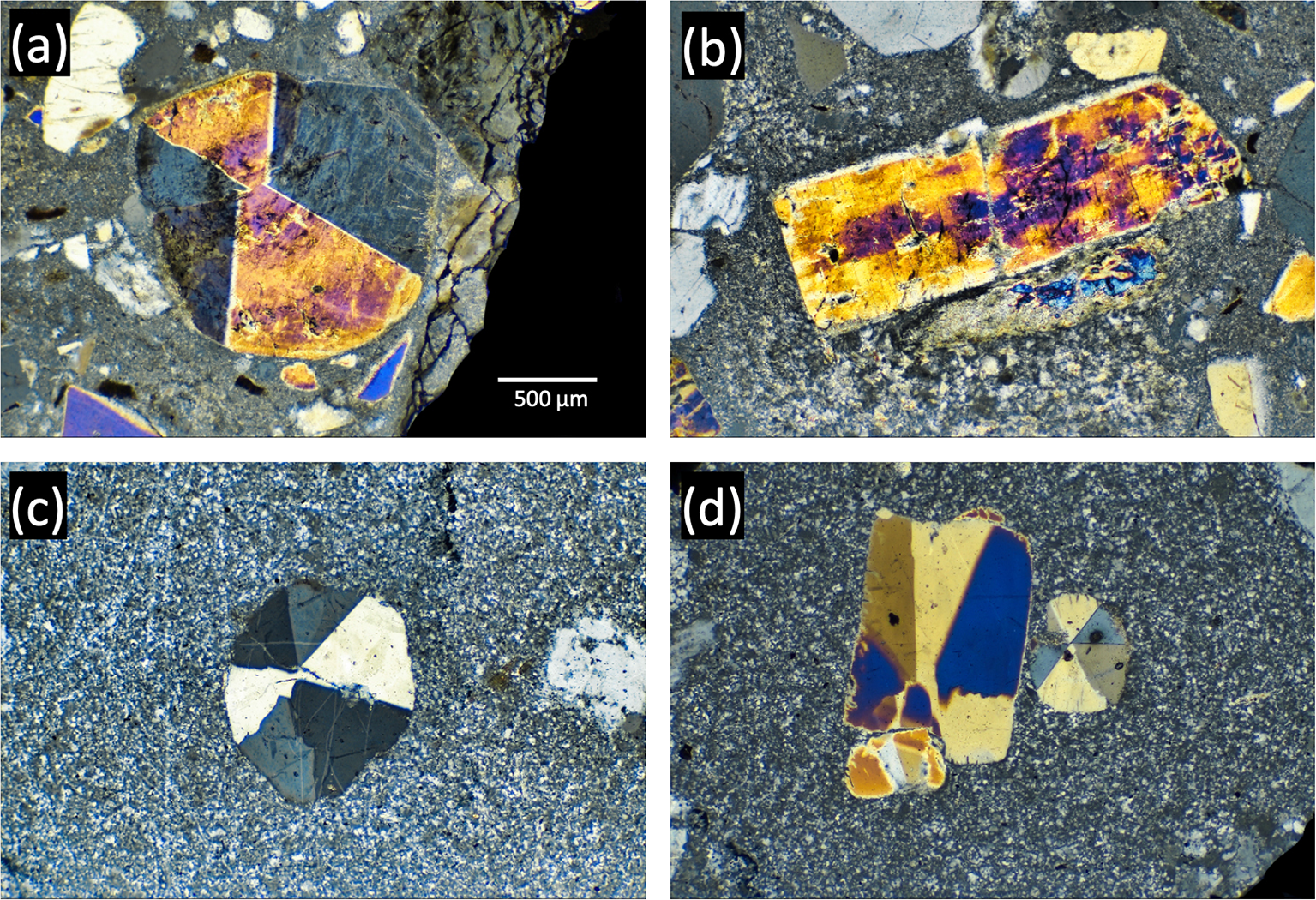
The sekaninaite in the Rubicon Rhyolite resembles a euhedral ‘phenocryst’ phase, with dimensions of up to ∼1 mm across and 2 mm in length, and constituting up to 5% modal volume (Fig. 2). Other phenocrysts include embayed quartz, K-rich feldspar with structural states varying from orthoclase to microcline (Birch, Reference Birch1975, Reference Birch and R.W1989), zoned plagioclase with compositions Ab90An10–Ab48An52, and reddish brown biotite flakes set in a microcrystalline quartzo-feldspathic groundmass. Single crystals and fragments of almandine garnet are common, with two main compositional types present (Birch and Gleadow, Reference Birch and Gleadow1974). Close to the basal zone the groundmass preserves a conspicuous eutaxitic texture, indicative of this being the product an ash-flow eruption, but this texture is gradually obscured by recrystallisation as height above the base increases.
Photomicrographs illustrating the habits of sekaninaite crystals in the Rubicon Rhyolite. The source for crystals (a) and (b) is sample A21 from the centre of the lowermost cooling unit on the Snobs Creek Road exposures; (a) shows the typical sector twinning in a cross-section normal to the c-axis; and (b) is a section parallel to the long axis. Note the variation in birefringence indicating the zoning. (c) and (d) are from a rhyolitic inclusion near the base of the Lake Mountain Rhyodacite. The scale in each image is the same as shown in (a).

The sekaninaite is usually completely altered to a yellowish ‘pinite’, with unaltered crystals restricted to the centre of the lower-most cooling unit in the rhyolite ignimbrite (Birch, Reference Birch1975). Basal sections are rounded and pseudohexagonal, with sector twinning based on trillings. Composition planes between individual sectors are generally straight but sometimes curved or irregular (Fig. 2). These sector trillings are inferred to have formed as a response to strain accompanying Si–Al hexagonal to orthorhombic ordering (Putnis and Holland, Reference Putnis and Holland1986; Armbruster, Reference Armbruster1985; Zeck, Reference Zeck1970).
Optic angles measured on core sections range from 75° to 80° (Birch, Reference Birch1975; Armbruster, Reference Armbruster1985). A distortion index (Δ) reflects deviation from hexagonal towards orthorhombic symmetry. Its value is 0.252 for the average core composition and 0.267 for the rim (Armbruster, Reference Armbruster1985), which is slightly less than the maximum possible value of 0.29–0.31 (Miyashiro, Reference Miyashiro1957) but confirms a high degree of Si–Al ordering.
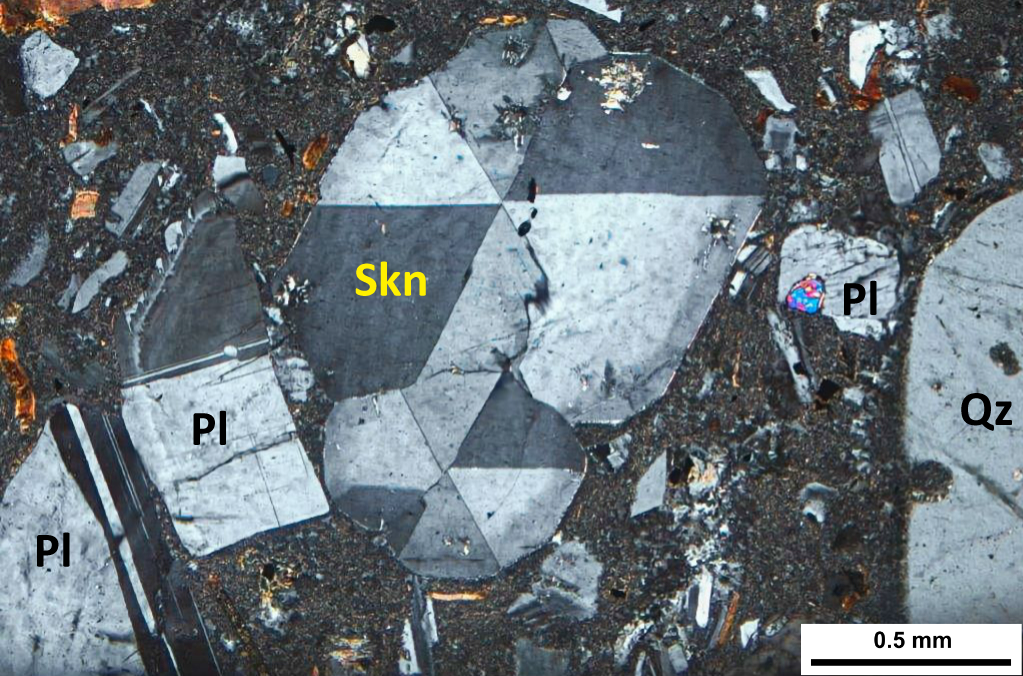
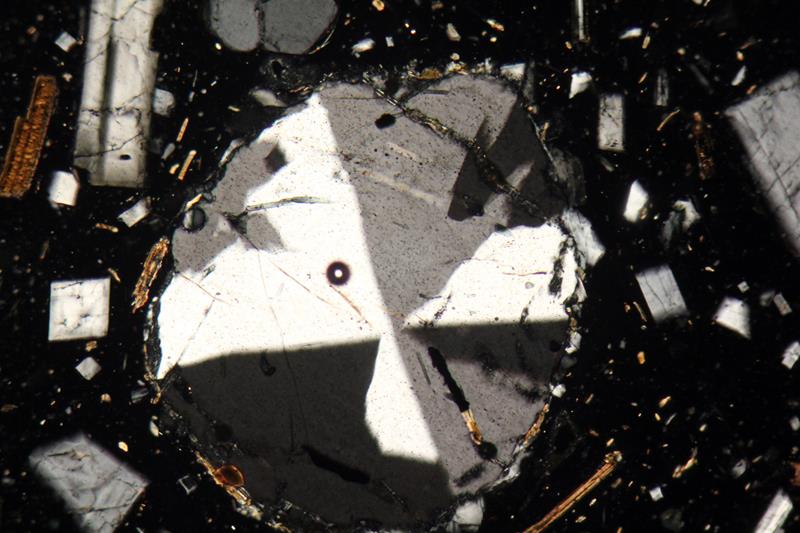
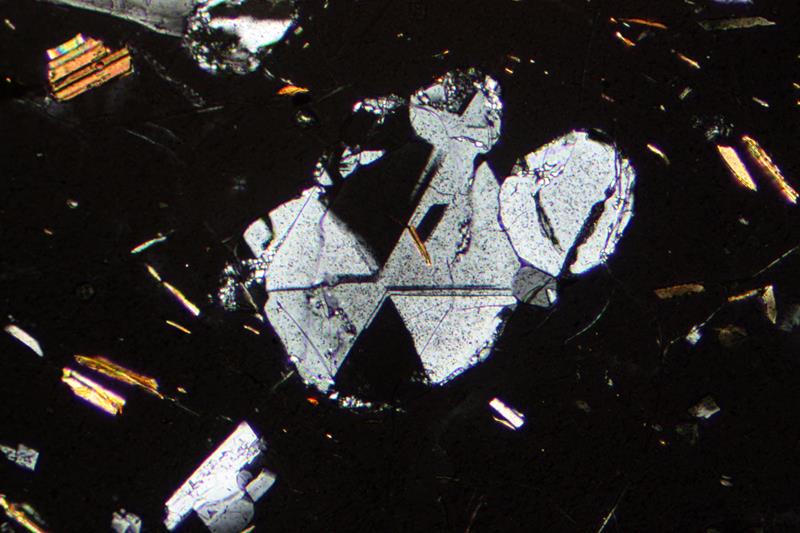
The Arthurs Seat occurrence of sekaninaite occurs in a specimen labelled as ‘biotite rhyodacite’ and was collected ‘near the summit of Arthurs Seat’ in 1947. In thin section it is very similar in appearance to that in the Rubicon Rhyolite but is unaltered in the only specimen available. Figure 3 shows a prominent group of two structurally parallel crystals showing sector twinning based on trillings. An irregular grain of almandine garnet is present in the thin section, together with fragmented phenocrysts of quartz, plagioclase, orthopyroxene and biotite.
Photomicrograph of Arthurs Seat rhyolite ignimbrite sample E1220, showing a group of two euhedral, sector-twinned sekaninaite phenocrysts (Skn), with broken plagioclase (Pl) embayed quartz phenocrysts (Qz). Note the lower-birefringence zone of more magnesian composition on the rim of both sekaninaite crystals, where these are in contact with the microcrystalline groundmass (former melt).

Sekaninaite composition
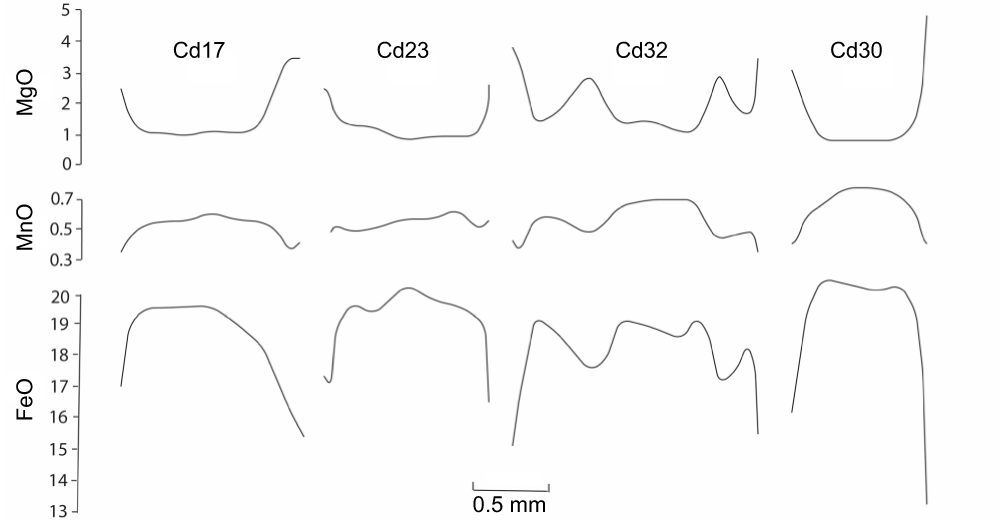
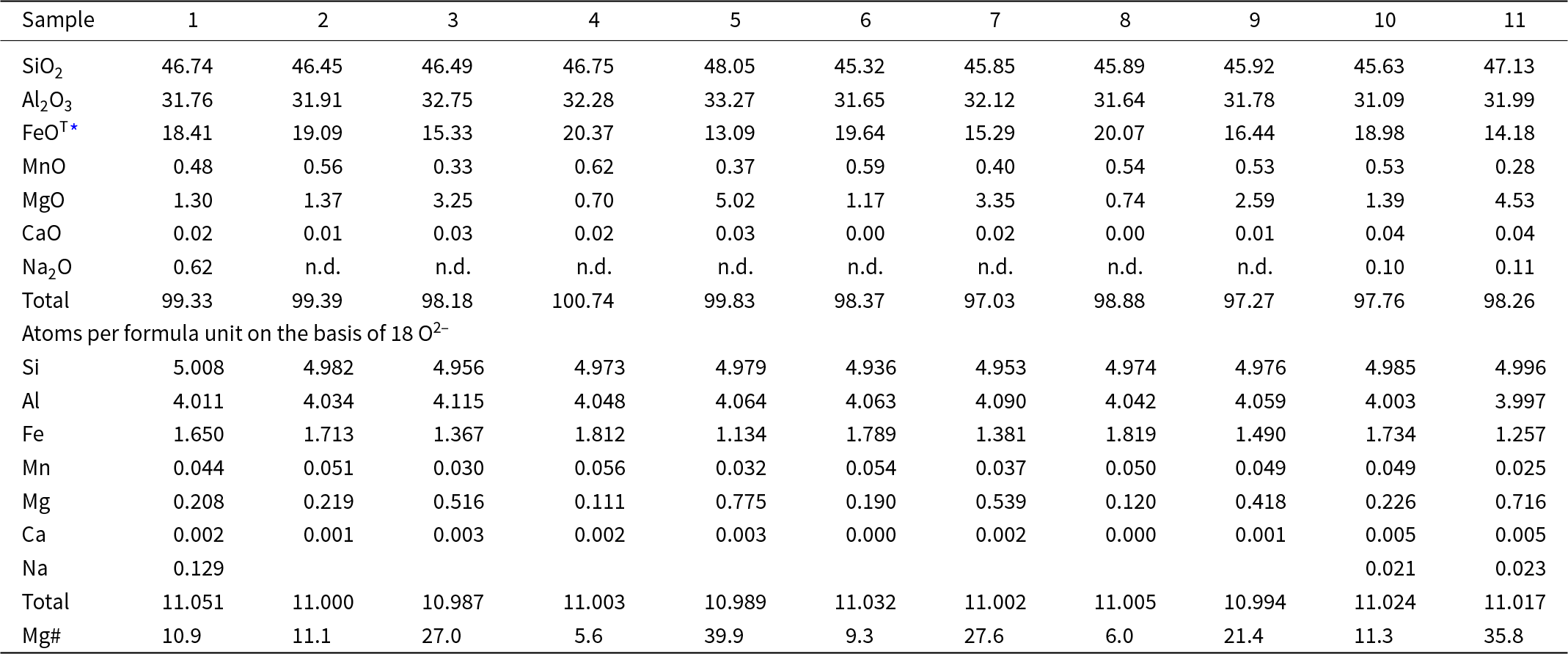
Electron microprobe analyses were undertaken on thirty cordierite crystals from the Rubicon Rhyolite, and step scans undertaken across six suitable basal sections (Birch, Reference Birch1975). These showed that the core compositions are extremely iron-rich, with Mg# = 10–30, likely to be the most iron-rich naturally occurring cordierite mineral ever recorded (Table 1). However, in their outer 0.2 mm, these crystals exhibit a sudden increase in Mg contents, as shown in the zoning patterns for four crystals (Fig. 4), reproduced from figure 3 of Birch and Gleadow, Reference Birch and Gleadow1974). Armbruster (Reference Armbruster1985) determined Na contents in the six-membered rings of Si–Al–O tetrahedra as 0.06 and 0.08 atoms per formula unit (apfu), based on 18 oxygen atoms, whereas the volatile contents (dominantly H2O with minor CO2) in the structural channels were estimated to be the highest recorded at that time (0.96 apfu and 0.70 apfu).
Zoning profiles in sekaninaite phenocrysts from the Rubicon Rhyolite, reproduced from figure 3 of Birch and Gleadow (Reference Birch and Gleadow1974). Note the increases in Mg# (100Mg/[Mg+Fe+Mn]) in the narrow rim zones.

Compositions from microprobe analysis of sekaninaite in the Cerberean Cauldron and Arthurs Seat volcanics, Melbourne, Australia.

* Notes: all Fe as FeOT; n.d. = not determined; Mg# = 100Mg/(Fe+Mn+Mg); analyst: W. Birch (1 – 9 from Birch [Reference Birch1975]; 10 – 11 this study). Analysis details: 1. Cd in sample A30 (Rubicon Rhyolite); 2. Cd32 (core) in sample A21 (Rubicon Rhyolite); 3. Cd32 (rim) in sample A21 (Rubicon Rhyolite); 4. Cd30 (core) in basal Lake Mountain Rhyodacite; 5. Cd30 (rim) in basal Lake Mountain Rhyodacite; 6. Cd17 (core) in sample A22 (Rubicon Rhyolite); 7. Cd17 (rim) in sample A22 (Rubicon Rhyolite); 8. Cd23 (core) in rhyolitic inclusion in basal Lake Mountain Rhyodacite; 9. Cd23 (rim) in rhyolitic inclusion in basal Lake Mountain Rhyodacite; 10. Cd (core) in sample E1220. Arthurs Seat rhyolite; 11. Cd (rim) in sample E1220, Arthurs Seat rhyolite. Analyses 10 and 11 were carried out at Museums Victoria using a Hitachi TM4000 Plus SEM equipped with an Oxford Instruments Ultim Max Energy Dispersive Spectroscopy (EDS) detector. The accelerating voltage was 20 kV.
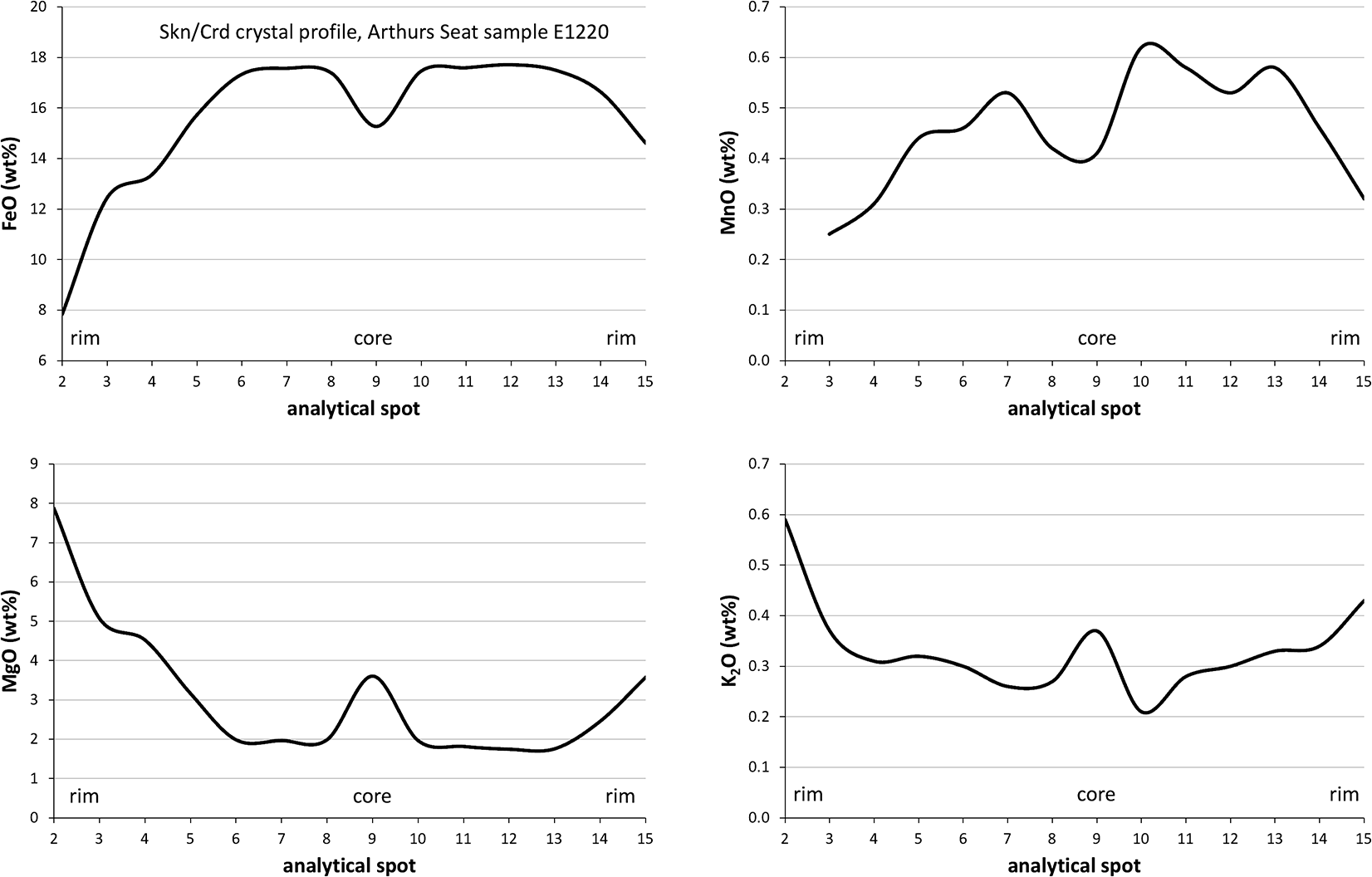
The sekaninaite crystals in the Arthurs Seat ‘biotite rhyodacite’ show similar zoning patterns to those from the Rubicon Rhyolite (Fig. 5). Energy dispersive spectroscopy (EDS) analyses on the twinned crystal cluster yielded core and rim compositions similar to those in the Rubicon Rhyolite (Table 1). No further tests have been undertaken.
Zoning profiles in sekaninaite phenocrysts from the S-type Arthurs Seat rhyolite ignimbrite, sample E1220. Note that the Mg# in the rim extends into cordierite per se.

Other occurrences
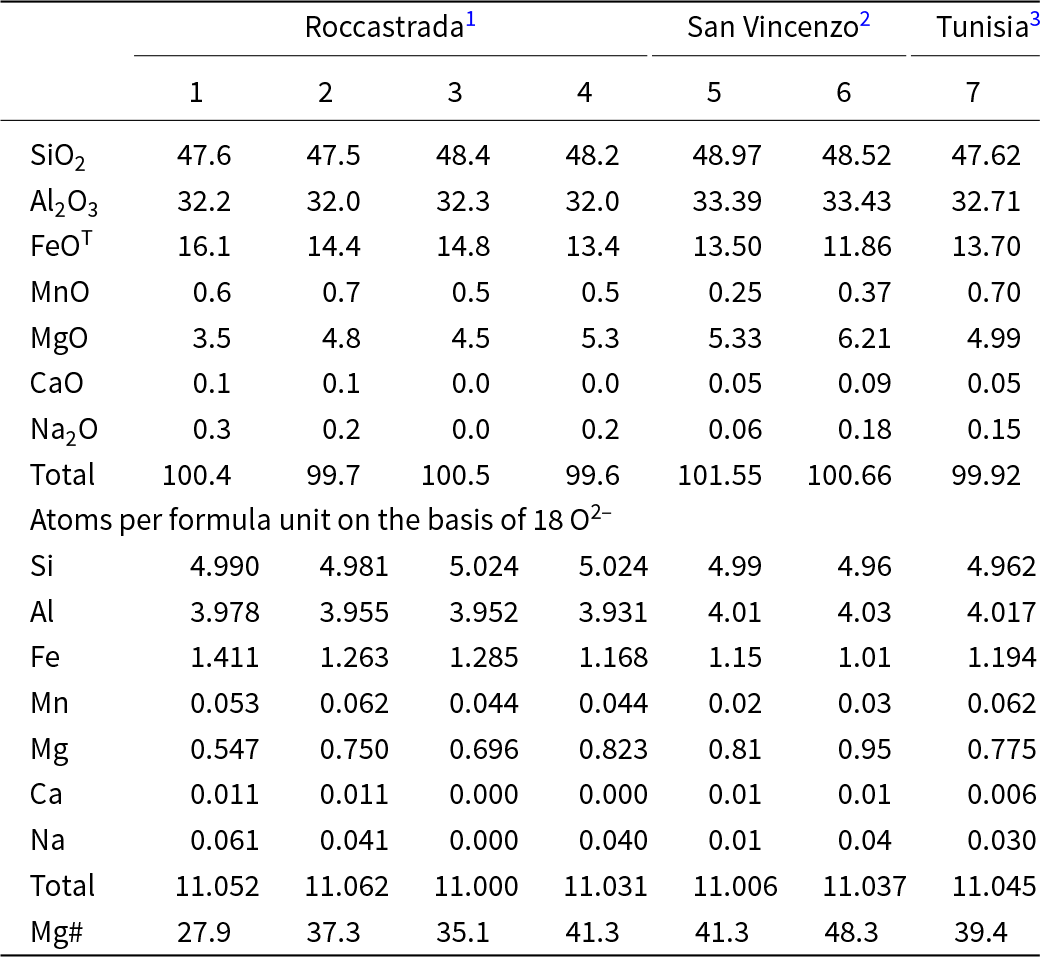
‘Iron-rich’ cordierite, including the iron-dominant mineral sekaninaite, has been recorded in volcanic rocks at several other localities around the world. However, data on the mineral composition (Table 2) and zoning are not always recorded, limiting comparison with the Victorian occurrences. The following subsections describe the various occurrences and, where available, the Mg# values of cores, rims and whole-rock compositions.
Selected compositions of sekaninaite from Italian localities and Tunisia.

1 Notes: analyses 1 – 4: SEM-EDS (Marianelli and Carletti, Reference Marianelli and Carletti1999; table 2); 2analyses 5 – 6: electron microprobe (Feldstein et al., Reference Feldstein, Halliday, Davies and Hall1994; Appendix table 4); 3analysis 7: Laridhi-Ouazaa (Reference Laridhi-Ouazaa1989)
Roccastrada Volcanic Complex, Tuscany, Italy
The Roccastrada Volcanic Complex in southern Tuscany, Italy, lies within the Pliocene Tuscan Magmatic Province and consists entirely of cordierite-bearing lava flows and domes (Poli and Perugini, Reference Poli and Perugini2003; Marianelli and Carletti, Reference Marianelli and Carletti1999). These have been divided into two groups, high- and low-rubidium types, with both interpreted as having been derived through different degrees of partial melting of a crustal source, probably largely garnet-mica-schists (Poli and Perugini, Reference Poli and Perugini2003; Pinarelli et al., Reference Pinarelli, Poli and Santo1989; Innocenti et al., Reference Innocenti, Serri, Ferrara, Manetti and Tonarini1992).
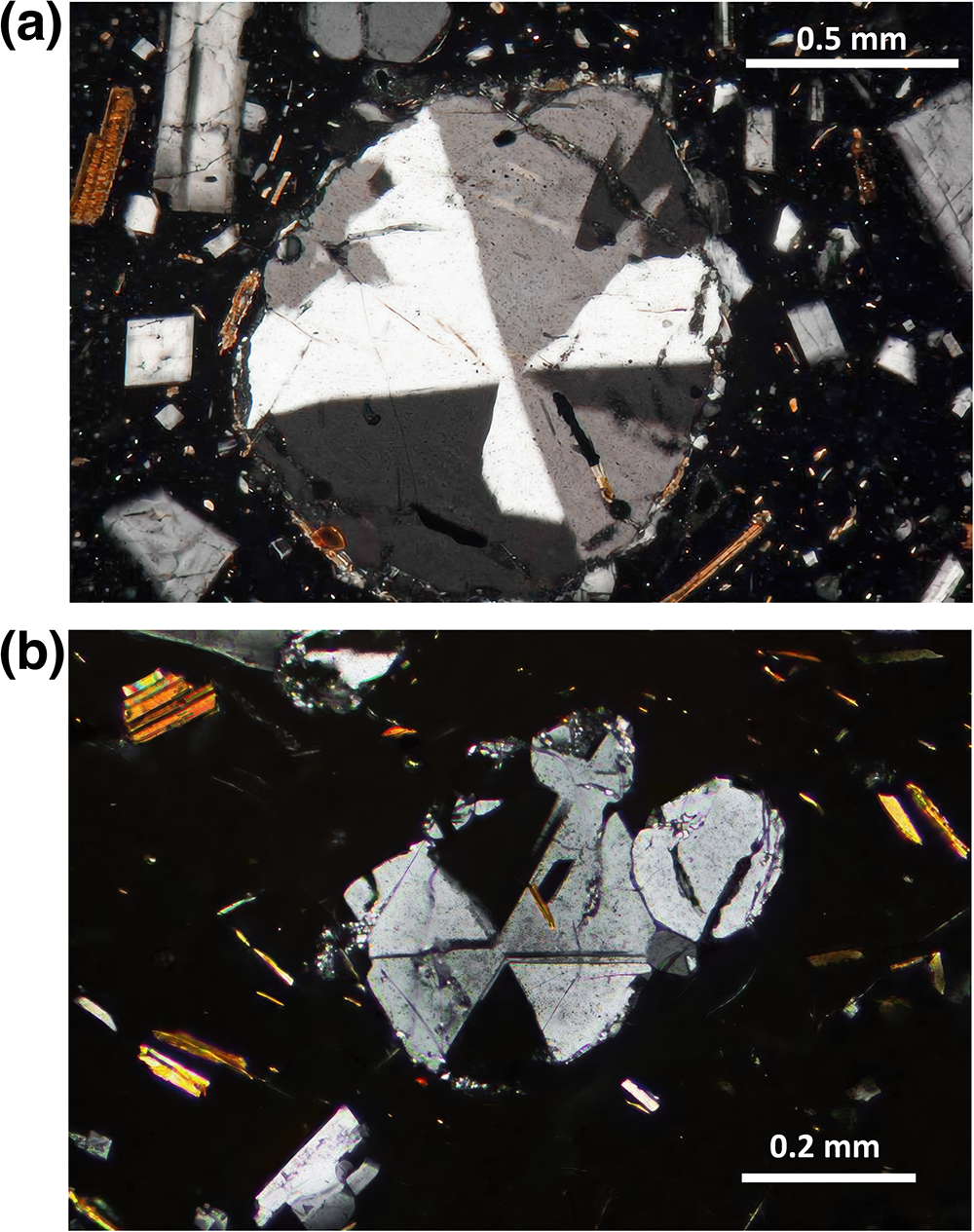
The rhyolites have porphyritic textures with phenocrysts of sanidine, quartz, plagioclase, biotite and cordierite set in glassy-to-microcrystalline groundmasses. Cordierite occurs either as rounded subhedral-to-euhedral crystals with cyclic twinning (Fig. 6a), or as altered turbid fragments (Poli and Perugini, Reference Poli and Perugini2003). The former have Mg-dominant compositions, with Fe contents increasing towards the rims, whereas the turbid fragments have Mg# ≈ 30 (Marianelli and Carletti, Reference Marianelli and Carletti1999). Unaltered phenocrysts usually contain abundant biotite, sillimanite and quartz inclusions, as well as numerous fluid inclusions, while glassy melt inclusions are common in the outer portions (Marianelli and Carletti, Reference Marianelli and Carletti1999).
Photomicrographs showing twinned sekaninaite crystals in the (a) Roccastrada and (b) San Vincenzo volcanics from Italy, adapted from images in the Alex Strekeisen web pages on these volcanic rocks, specifically https://www.alexstrekeisen.it/immagini/vulc/roccastrada2012(4).jpg and https://www.alexstrekeisen.it/immagini/vulc/sanvincenzo2018(9).jpg and used with permission.

Together with other phenocrysts, the unaltered cordierite is inferred to have crystallised from H2O-undersaturated, peraluminous melts. Temperature and pressure estimates range from 700°C and less than 1.0 kbar (Poli and Perugini, Reference Poli and Perugini2003) to 755–820°C and 1.5–1.8 kbar (Marianelli and Carletti, Reference Marianelli and Carletti1999).
San Vincenzo, Tuscany, Italy
The San Vincenzo lavas in the Tuscan Magmatic Province have considerably more complex geology than the Roccastrada volcanics. They consist of several peraluminous S-type rhyolite flows that show large compositional variations. As indicated by the presence of magmatic enclaves and marked 87Sr/86Sr isotopic disequilibrium, this extended compositional spectrum is due to mixing of mantle-derived (shoshonitic) and various crustal, anatectic magmas (Ferrara et al., Reference Ferrara, Petrini, Serri and Tonarini1989; Feldstein et al., Reference Feldstein, Halliday, Davies and Hall1994; Ridolfi et al., Reference Ridolfi, Braga, Cesare, Renzulli, Perugini and Moro2016a, Reference Ridolfi, Renzulli, Perugini, Cesare, Braga and Del Moro2016b). The cordierite-bearing rhyolites contain between 40% and 55% phenocrysts of alkali feldspar, plagioclase and biotite, and host a wide range of magmatic enclaves, metamorphic xenoliths and xenocrysts (Feldstein et al., Reference Feldstein, Halliday, Davies and Hall1994).
Most cordierite crystals examined by Feldstein et al. (Reference Feldstein, Halliday, Davies and Hall1994) are euhedral, inclusion-free and show cyclic twinning, consistent with a magmatic origin (Fig. 6b). Selected analytical data reveal the presence of zoning with Fe enrichment in the crystal rims (Table 2). A small proportion of cordierite crystals are ovoid in shape and have cores containing sillimanite, spinel and/or biotite inclusions; these are probably restitic or xenocrystal (e.g. Clarke, Reference Clarke1981; Clemens and Wall, 1984).
Armbruster (Reference Armbruster1985) undertook a detailed study of fragments of cordierite crystals handpicked from a ‘rhyodacite’ near San Vincenzo, Tuscany. The observed variations in birefringence were attributed to zoning, with Fe greater in the rim than the core, but with no details of the ranges provided. The single analytical data point presented has Mg# = 46; a short way into the sekaninaite field. The reported distortion index (Δ) is 0.279, which is close to the maximum value. The structural channels are largely vacant, with <0.3 wt.% total volatiles. Clocchiatti and Metrich (Reference Clocchiatti and Metrich1977) investigated melt inclusions trapped in cordierite phenocrysts from San Vincenzo ‘rhyodacites’, but the single cordierite analysis presented was not Fe-dominant.
Monte San Angelo, Lipari (Aeolian Islands), Italy
Cordierite in the high-K andesites erupted from Mont San Angelo on Lipari Island at ∼105 ka reveals a complex history of magma origins (Barker, Reference Barker1987; Di Martino et al., Reference Di Martino, Forni, Frezzotti, Palmeri, Webster, Ayuso, Lucchi and Tranne2011). The lavas contain two suites of enclaves (rock inclusions) — a suite of metapelitic gneisses and granulites and a gabbroic suite, with many contributing megacryst phases in the andesites when disaggregated (Barker, Reference Barker1987). Here, cordierite occurs as two main textural varieties —phenocrysts and groundmass microcrystals (Di Martino et al., Reference Di Martino, Forni, Frezzotti, Palmeri, Webster, Ayuso, Lucchi and Tranne2011). The former are usually euhedral to subhedral and up to 4 mm across, with embayed boundaries but without alteration. These are accompanied mainly by plagioclase, orthopyroxene, clinopyroxene and garnet phenocrysts and set in a rhyolitic groundmass. These cordierite phenocrysts contain abundant inclusions of silicate melts, apatite, sillimanite, biotite, quartz and orthopyroxene. Both types of cordierite show variable Mg# in the overall range 49–66. The cordierite is usually zoned and characterised by decreasing Mg contents toward the rims of phenocrysts and the opposite for groundmass microcrystals.
Armbruster (Reference Armbruster1985) studied cordierite crystals collected from an outcrop of ‘rhyodacite’ near Belvedere on Lipari. Bergeat (Reference Bergeat1910) had identified two types of cordierite, analogous to those distinguished by Di Martino et al. (Reference Di Martino, Forni, Frezzotti, Palmeri, Webster, Ayuso, Lucchi and Tranne2011). Microprobe data obtained by Armbruster (Reference Armbruster1985) were summarised and showed that phenocrysts are slightly Mg-dominant, whereas those in a ‘nodule’ (likely to be a xenolithic enclave) are sekaninaite. Distortion indices for both are in the range 0.28 to 0.29, and volatile contents (H2O + CO2) are very low (0.2–0.3 wt.%) (Armbruster, Reference Armbruster1985).
Nefza magmatic province, Northern Tunisia
A wide range of Miocene magmatic rocks and associated polymetallic mineralisation occurs in the Nefza mining district in northern Tunisia (Halloul and Gourgaud, Reference Halloul and Gourgaud2012; Decrée et al., Reference Decrée, Marignac, J-P, Yans, Ben Abdallah and Demaiffe2014; and references therein). Rhyodacite at Ain Deflaia and rhyolite at Zourara contain cordierite. That from Ain Deflaia occurs with plagioclase, biotite, quartz and sanidine phenocrysts in a matrix that exhibits hyaloporphyritic textures. Cordierite crystals up to 3 mm in size make up ∼5 vol.% of the rock. They are distinctively violet in colour and show well-developed sector twinning. According to data published by Laridhi-Ouazaa (Reference Laridhi-Ouazaa1989), Mg# varies between 39 and 66, although the sense of zonation is uncertain.
Based on mineralogical and compositional data, Halloul and Gourgaud (Reference Halloul and Gourgaud2012) defined two groups of calcalkaline rhyolites, together with mafic lavas, in the Neogene bimodal volcanism of northern Tunisia. One rhyolite type contains Crd–Skn with a large compositional range (Mg# 36–66) and was considered by Halloul and Gourgaud (Reference Halloul and Gourgaud2012) to be magmatic and related to localised crustal melting.
Comparisons between occurrences
Bulk-rock composition
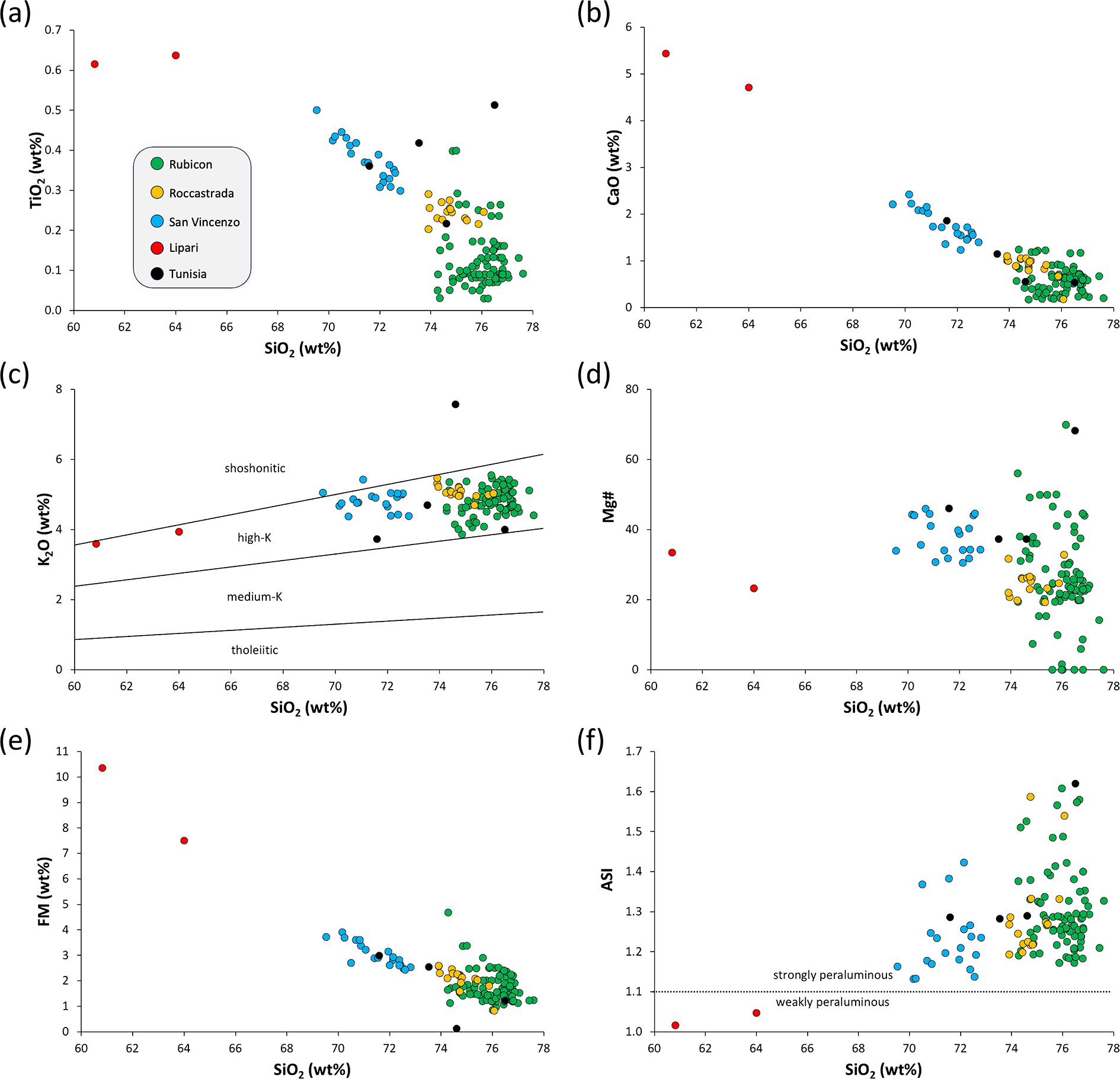
Compositions of the various analysed whole-rock samples from the sekaninaite occurrences in volcanic rocks are shown in Fig. 7, with various major-oxide parameters plotted against SiO2. Data were taken from Birch (Reference Birch1975), Feldstein et al. (Reference Feldstein, Halliday, Davies and Hall1994), Marianelli and Carletti (Reference Marianelli and Carletti1999), Di Martino et al. (Reference Di Martino, Forni, Frezzotti, Palmeri, Webster, Ayuso, Lucchi and Tranne2011) and Halloul and Gourgaud (Reference Halloul and Gourgaud2012). One of the immediately apparent features in this figure is that nearly all the rock samples belong to the high-K series; just three points stray into the shoshonitic field. Another feature is the substantial degree of scatter in the compositional characteristics of the Rubicon Rhyolite, in comparison to the relatively tight distributions for the points from the other localities. This is most apparent in plots of TiO2, CaO and FM (FeOT + MnO + MgO) and suggests a certain degree of similarity in the genetic mechanisms, such as melting reactions with similar stoichiometry (e.g. Clemens and Stevens, Reference Clemens and Stevens2012). Note, however, that there is considerable scatter in Mg# and the apatite-corrected alumina-saturation index (ASI = mol. Al2O3/[CaO – 3.33P2O5 + Na2O + K2O]), for essentially all magma groups. This heterogeneity within the units suggests that magma genesis probably involved heterogeneous source regions and/or elements of mingling and mixing between disparate magma batches.
Compositions of major oxides versus SiO2 for the various occurrences of sekaninaite in volcanic rock: (a) TiO2; (b) CaO; (c) K2O, with fields for different magma series; (d) Mg# (100Mg/[Mg+Fe+Mn]); (e) FM (FeOT+MnO+MgO) wt.%; and (f) ASI (apatite-corrected alumina saturation index = mol. Al2O3/ CaO−3.33P2O5+Na2O+K2O). Localities of the samples analysed are indicated by coloured dots, as per the inset in (a): Rubicon = green; Roccastrada = pale orange; San Vincenzo = pale blue; Lipari = red; and Tunisia = black. Data are from Clemens and Birch (Reference Clemens and Birch2012) for Rubicon; from Marianelli and Carletti (Reference Marianelli and Carletti1999) and Poli and Perugini (Reference Poli and Perugini2003) for Roccastrada; from Ridolfi et al. (Reference Ridolfi, Braga, Cesare, Renzulli, Perugini and Moro2016a, Reference Ridolfi, Renzulli, Perugini, Cesare, Braga and Del Moro2016b) for San Vincenzo; from Di Martino et al. (Reference Di Martino, Forni, Frezzotti, Palmeri, Webster, Ayuso, Lucchi and Tranne2011) for Lipari; and from Marianelli and Carletti (Reference Marianelli and Carletti1999) for Tunisia.

Composition and zonation
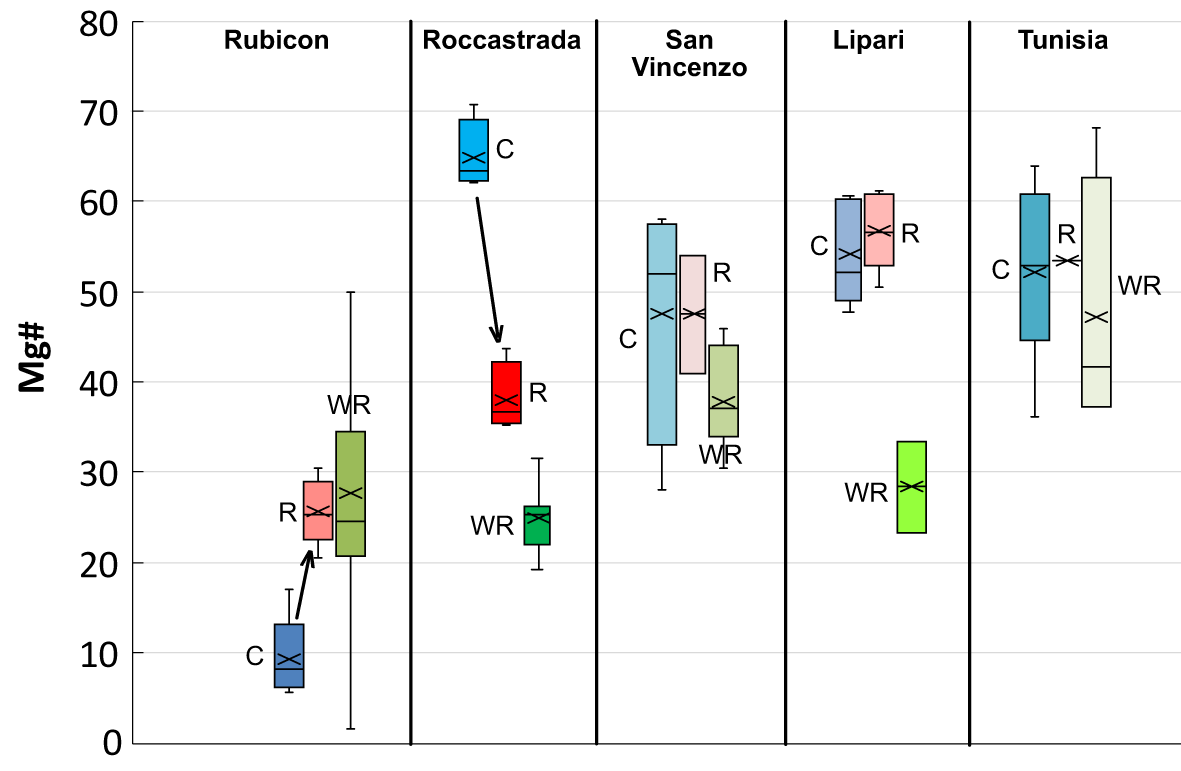
As shown in Fig. 8, relationships between the Mg# of the Crd–Skn crystals and the host rocks in each region vary markedly. For the San Vincenzo and Tunisian rhyolites there is overlap between the whole-rock and Crd–Skn compositions. For Lipari and Roccastrada, the host rocks have considerably lower Mg# than the Crd–Skn, whereas for the Rubicon Rhyolite only the rim compositions of the Crd–Skn match those of the whole rocks and core compositions are the most Fe-rich of any known occurrence. This variability reflects the range of factors that come into play when these magmas are generated, as discussed below.
Box-and-whisker plots showing the Mg# values (100Mg/[Mg+Fe+Mn]) for cores and rims of Crd–Skn crystals in relation to host bulk-rock values for the known occurrences of Fe-dominant cordierite in volcanic rocks. Whiskers indicate the complete data ranges while the coloured boxes display the lower and upper quartile values with the exclusive medians shown as thin bars. The means are shown as crosses. The localities are Rubicon Rhyolite in Australia, Roccastrada, San Vincenzo and Lipari in Italy and the occurrences in Tunisia. See the text for further details and Fig. 7 for plots showing whole-rock major-oxide compositional characteristics of these occurrences.

Despite the quite extreme range, zoning patterns for the Rubicon Rhyolite mineral all lie within the sekaninaite field (with Mg# < 30) and the direction of zoning is towards higher Mg# in the rims — so-called reverse zoning (e.g. Allaby, Reference Allaby2008). This is the opposite of the Roccastrada cordierite, in which only rims reach Mg# < 50. According to Strekeisen (https://www.alexstrekeisen.it/english/vulc/zoning.php) zoning in which the outer portions of the crystals are more magnesian than the cores usually reflects mixing between the host magma and some higher-temperature (less evolved?) magma during crystal growth. The Rubicon Rhyolite grades upwards into the less silicic and higher-temperature Lake Mountain Rhyodacite (Birch et al., Reference Birch, Gleadow, Nottle, Ross and Whately1978; Clemens and Birch, Reference Clemens and Birch2012) and it has been argued that the rhyolite magmas in this region are independent entities, not formed by differentiation of the associated rhyodacites (Clemens, Reference Clemens2023). The transition from rhyolite to rhyodacite occurs most conspicuously through a steady increase in biotite content. Given that biotite is predicted to have very limited or no stability in the more silicic Rubicon Rhyolite magmas (see the section below on thermodynamic modelling), this gradation suggests that the Rubicon Rhyolite magma might have been reheated in its subvolcanic magma chamber when this was recharged from below by the larger volume of Lake Mountain Rhyodacite.
The only other crystals of Crd–Skn that show a degree of reverse zoning are the small crystals in the groundmasses of some Lipari rhyodacites. This is noteworthy because the phenocryst assemblage includes chemically incompatible phases (cordierite and clinopyroxene). Cordierite minerals typify magmas formed through partial melting of metasedimentary materials and clinopyroxene is present in mafic to silicic I-type rocks. Such a mixture of phenocryst phases suggests mixing between magmas derived from different sources, such as an S-type magma and either an I-type or a mantle-derived more mafic magma. The complex history of magma origins here has been noted by Barker (Reference Barker1987) and Di Martino et al. (Reference Di Martino, Forni, Frezzotti, Palmeri, Webster, Ayuso, Lucchi and Tranne2011); the suite contains andesites and ‘xenoliths’ of gabbros. Under these circumstances it seems likely that the Lipari rhyodacites resulted from re-eruptive mixing between andesitic and rhyolitic magmas with mantle and crustal origins, respectively. Reheating of the rhyolite magma through interaction with an andesitic magma would explain the disequilibrium phenocryst assemblage as well as the reverse zoning in the groundmass cordierite crystals. Thus, it seems plausible that both cases of reverse zoning in cordierite–sekaninaite were caused by temperature increases (reheating) in rhyolitic magmas through interaction (recharge and mixing) with higher-temperature magmas.
Thermobarometry
Various methods have been used to estimate the crystallisation temperatures and pressures in sekaninaite-bearing volcanic rocks. As covered in the text, these estimates vary from ∼700 to 950°C for different rock (former magma) units, with pressures in the range of < 1–2 kbar. Ridolfi et al. (Reference Ridolfi, Renzulli and Acosta-Vigil2014) made a partial survey of cordierite-bearing igneous rocks and devised chemically based equations that appeared to reproduce the primary calibration data, for both natural occurrences and experimental results. The equations do not involve analytical data for the cordierite but are based on the major-element composition of silicate liquids inferred to be in equilibrium with a mineral of the cordierite group.
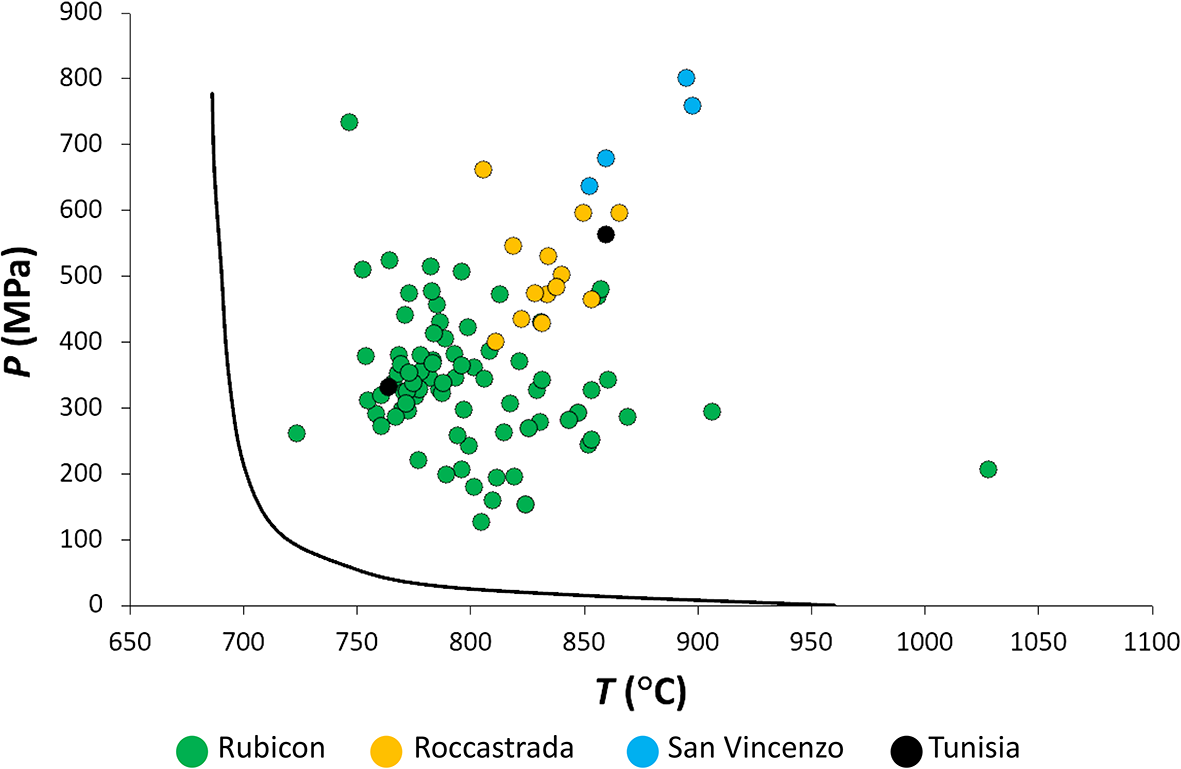
The Ridolfi et al. (Reference Ridolfi, Renzulli and Acosta-Vigil2014) calculation scheme is extremely sensitive to estimates of melt H2O content, particularly affecting the temperature output; higher H2O contents naturally yield lower temperatures. However, for most of the occurrences of volcanic sekaninaite, tightly constrained and reliable values for original melt H2O contents are not available. For example, experimental work on crystallisation phase relations of a Rubicon Rhyolite magma (Clemens and Birch, Reference Clemens and Birch2012) only constrain the initial melt H2O content to have been ≥ 4 wt.%. Thus, for the sake of intercomparison a melt H2O content of 5 wt.% was assumed throughout. Though the equations of Ridolfi et al. (Reference Ridolfi, Renzulli and Acosta-Vigil2014), especially as employed here, might not accurately reflect crystallisation conditions, the calculations should at least indicate some relative differences between the various sekaninaite occurrences. Note that the equations are only valid for liquid compositions in which cationic Al + Si = 4.00 ± 0.03, calculated on an anhydrous, 8 O2– atoms per formula unit basis, and this excludes all the Lipari analyses. For the rest, although there are data from melt inclusions and groundmass glasses for some of the occurrences, we chose to use whole-rock data as approximations to the original magmatic liquids. This permitted us to compare like with like across the various suites of rocks. The results are plotted in Fig. 9. Note that, as we have no whole-rock data for the Arthurs Seat rock that contains sekaninaite, we cannot include this occurrence in the calculations.
Plot devised to illustrate the calculated pressure and temperature conditions at which cordierite-bearing liquids were crystallising, modified from figure 1 of Ridolfi et al. (Reference Ridolfi, Renzulli and Acosta-Vigil2014). Whole-rock data from various occurrences of sekaninaite-bearing volcanic rocks are plotted as coloured dots: Rubicon in green; Roccastrada in pale orange; San Vincenzo in pale blue; and Tunisia in black. The calculations used the ‘Cordierite-saturation ThermoBarometer’ spreadsheet provided as supplementary material associated with Ridolfi et al. (Reference Ridolfi, Renzulli and Acosta-Vigil2014), with all melt H2O contents assumed to be 5 wt.%. The thick, black, bounding curve marks the H2O-saturated solidus in what Ridolfi et al. (Reference Ridolfi, Renzulli and Acosta-Vigil2014) call a generalised peraluminous granitic system. This is essentially the same as the well-documented, experimentally determined solidus in Qz–Ab–Or–H2O. See the text for further information and interpretation.

From this plot, we infer that, broadly speaking, the lowest P–T crystallisation conditions appear to have been in the Rubicon Rhyolite magmas, followed by Roccastrada, with the San Vincenzo magmas plotting at the highest temperatures and pressures. Little can be inferred from the two points for the Tunisian occurrences. Overall, it appears that sekaninaite might be stable in silicic volcanic liquids over a considerable range of melt composition, temperature and pressure. We return to this question in the section on thermodynamic modelling, in which we also explore the influences of magma H2O content and crystal fractionation.
Magma and Crd–Skn origins
Magmas that are peraluminous and S-type, as defined by Chappell and White (Reference Chappell and White1974, Reference Chappell and White2001) have compositional and isotopic characteristics that mark them out as having been formed through partial melting of mainly metasedimentary rocks in the crust. Such S-type magmas can crystallise a wide variety of aluminous minerals that express the chemical legacy of derivation from aluminous metasediments. Common aluminous silicate minerals that form in such volcanic magmas include almandine-rich garnet, cordierite (mostly somewhat magnesian), biotite (mainly annite–siderophyllite solid solutions) and muscovite (in some higher-pressure settings). Clarke (Reference Clarke1981) and Clemens and Wall (Reference Clemens and Wall1988) provide treatments of physicochemical factors that control the occurrence of these minerals. Less-common magmatic silicates in such rocks include andalusite and sillimanite (Pichavant et al., Reference Pichavant, Kontak, Herrera and Clark1988; Clarke et al., Reference Clarke, Dorais, Barbarin, Barker, Cesare, Clarke, El Baghdadi, Erdmann, H-J Gaeta, M, Kontak, Koller, Leal Gomes, London, Morgan, V, Neves, Pattison, Pereira, Pichavant, Rapela, Renno, Richards, Roberts, Rottura, Saavedra, Sial, Toselli, Ugidos, Uher, Villaseca, Visonà, Whitney, Williamson and Woodard2005) as well as tourmaline (Benard et al., Reference Benard, Moutou and Pichavant1985; Drivenes et al., Reference Drivenes, Brownscombe, Larsen, Seltmann, Spratt and B.E2020) and dumortierite (Galliski et al., Reference Galliski, Marquez-Zavalía, Lira, Cempírek and Škoda2012; Garašić et al., Reference Garašić, Lugović, Sekušak, Š, H-P, Schuster and Vrkljan2024). In the present dataset, examples of this mode of formation and mineralogy are the Rubicon and Roccastrada rhyolites, both inferred to have formed by partial melting of metasedimentary sources (Pinarelli et al., Reference Pinarelli, Poli and Santo1989; Innocenti et al., Reference Innocenti, Serri, Ferrara, Manetti and Tonarini1992; Poli and Perugini, Reference Poli and Perugini2003; Clemens and Birch, Reference Clemens and Birch2012; Clemens, Reference Clemens2023).
A second setting in which cordierite minerals can form in silicic to intermediate volcanic rocks involves the formation of hybrid magmas by mixing of more mafic mantle-connected magmas with partial melts of aluminous crustal rocks. In such cases, a well-mixed, hybrid magma might be sufficiently peraluminous to directly crystallise magmatic cordierite, provided that the proportion of metasediment melt is very high (> 80%; Clemens et al., Reference Clemens, Stevens and Farina2011). Alternatively, a cordierite mineral might form only from the crustally derived, silicic portion of a mingled, less well mixed magma. Since the inception of isotope-based mathematical models for such processes (e.g. DePaolo and Wasserburg, Reference DePaolo and Wasserburg1979) assimilation and magma mixing have become almost paradigmatic in igneous petrogenesis. However, although mingling of volcanic magmas is a well-documented phenomenon, apparent from field and petrographic observations (e.g. Andrews and Manga, Reference Andrews and Manga2014), thorough mixing is far less common and indeed has significant thermomechanical limitations (Sparks et al., Reference Sparks and Marshall1986; Vogel et al., Reference Vogel, Ryerson, Noble and Younker1987). In the present dataset, San Vincenzo represents an example of mingling, and some mixing, between crustal melts and mantle-connected shoshonitic magmas. In the case of the Tunisian examples, cordierite-bearing rhyolites co-exist with mafic lavas, which suggests the possibility of some magma mingling. However, it is unclear whether mingling played any role in the formation of the cordierite-hosting rhyolitic magmas. Thus, the Tunisian examples are probably best assigned to the group of rhyolites formed by partial melting of aluminous metasediments (i.e. along with the Rubicon Rhyolite and Roccastrada).
The third mode of origin of aluminous minerals in volcanic rocks is as solid restitic residua entrained into a crustally derived magma, as in the case of the Cerro del Hoyazo (el Hoyazo de Níjar) dacite lava in SE Spain (Zeck, Reference Zeck1970), which hosts both restitic cordierite and sector-twinned magmatic cordierite phenocrysts (e.g. https://www.alexstrekeisen.it/english/vulc/hoyazo.php). For Roccastrada, Poli and Perugini (Reference Poli and Perugini2003) considered Fe-rich, turbid, cordierite fragments to be refractory or restitic phases derived from the magma source region, though this interpretation would probably only be viable if parts of the source terrane were to contain ferroan rock types. Note that during partial melting of the source rocks that gave rise to the rhyolitic magmas, restitic or peritectic ferromagnesian minerals would be expected to become more magnesian than the original subsolidus minerals or the partial melts, as magnesian phases generally have higher thermal stabilities than their more ferroan counterparts (e.g. Puziewicz and Johannes, Reference Puziewicz and Johannes1988).
The clearest criterion for a restitic or xenocrystal origin, at least of the cores of cordierite crystals, would be the presence of numerous inclusions of minerals such as rounded quartz, plagioclase or orthopyroxene, biotite platelets, hercynite and fibrous sillimanite. Such non-magmatic cordierite crystals could well have magmatic overgrowths. On the matter of cordierite zoning and overgrowths, caution is advisable in nominating inclusion-poor crystal cores as restitic or xenocrystal because higher-pressure magmatic crystallisation can lead to formation of relatively magnesian cordierite, which might then be overgrown by lower-pressure, more ferroan cordierite or sekaninaite. Such crystals would be wholly magmatic but the cores could be antecrysts with autocrystic rims. Among the present dataset, the Lipari lavas appear to be clear cases in which inclusion-ridden restitic cores of cordierite crystals have been overgrown by later magmatic cordierite.
Figure 8 presents the interesting observation that the Rubicon Rhyolite magmas had Mg#s generally comparable with the other occurrences, yet the Crd–Skn phenocrysts in the Rubicon Rhyolite are far more ferroan than in any of the other occurrences. Clearly, it is not bulk magma composition that governs this parameter. Instead, an explanation may lie in Fig. 9. This plot shows that the Rubicon Rhyolite magmas were at lower temperatures than any of the other occurrences plotted. As shown, for example, in Fig. 10c, the composition of the cordierite-group mineral in Rubicon Rhyolite B78 is predicted to become more ferroan as T falls during fractional crystallisation, becoming sekaninaite at T < 765°C. Similarly, as Fig. 11 shows for equilibrium crystallisation of SNOB2, the Mg# of the sekaninaite falls as T becomes lower. Since, qualitatively, the Rubicon Rhyolite is the lowest-T occurrence, it is logical that the most ferroan sekaninaite would occur in this unit.
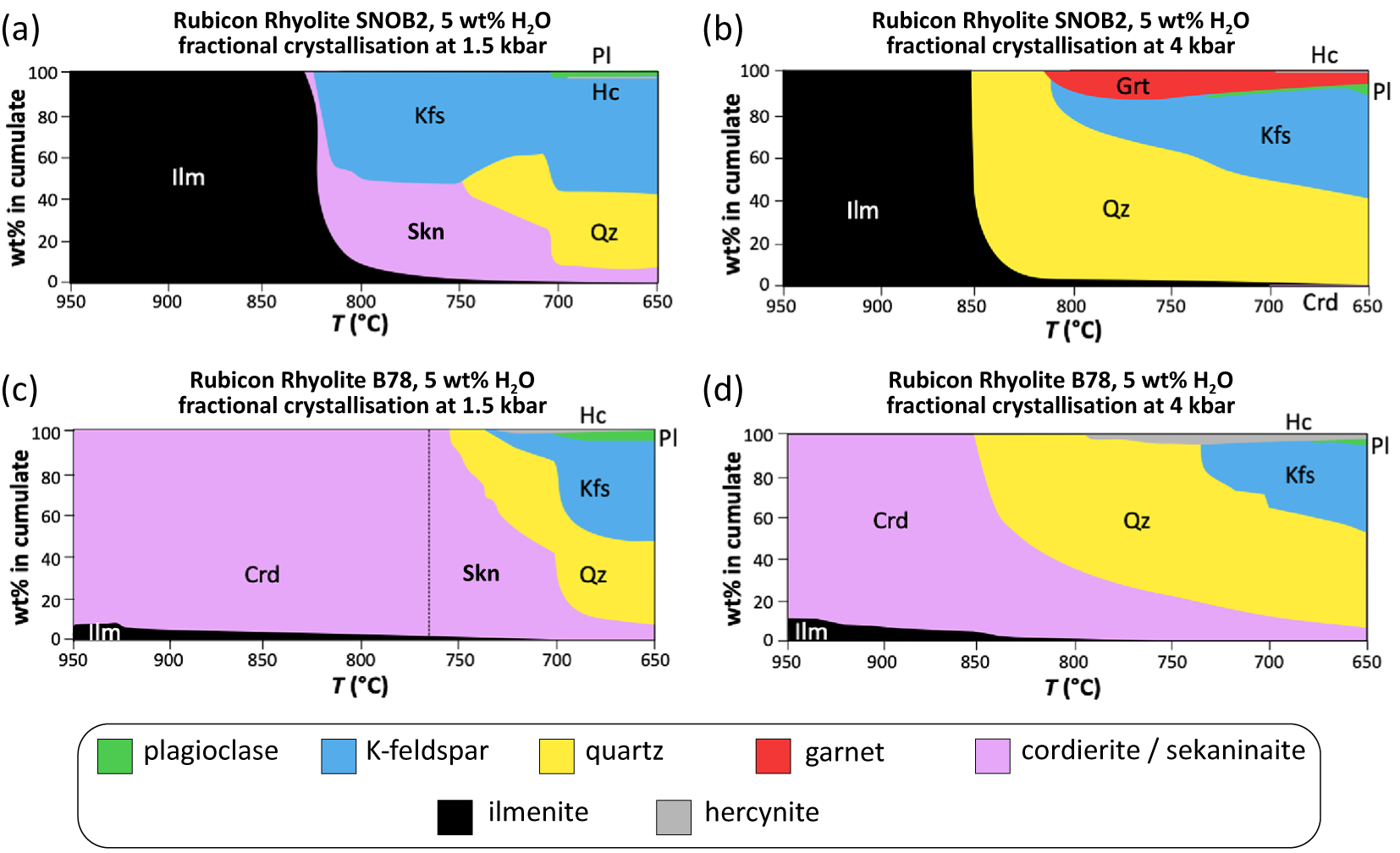
Diagrams showing the calculated phase proportions in the solid (cumulate fraction) formed during near-perfect fractional crystallisation (cumulative extraction of 95 wt.% of all solid crystals every 2°C) of Rubicon Rhyolite magmas with 5 wt.% H2O in the system at 1.5 and 4 kbar, with SNOB2 in (a) and (b) and B78 in (c) and (d). The crystalline phases are shown colour-coded and also labelled according to the abbreviation scheme of Whitney and Evans (Reference Whitney and Evans2010). Note that, at high T (e.g. 850°C), the modal proportion of the cumulate is very low, and dominated by one or two early-formed minerals, so the proportions of these will be very high in the cumulate fraction. Though neither of these magma compositions is predicted to be completely solid at the lowest plotted T of 650°C, some idea of the mode of the final solid rock can be gained by noting the phase proportions at this T. Note that, very small amounts of hercynite (nearly pure Fe end-member) are predicted to be present at low T in (a), (b) and (c) but in larger though still minor proportions in (d), over a wider T range. In (b) only a very small amount of cordierite is predicted to be present at very low T. The very small amounts of these minerals are indicated with thin coloured lines. In addition, in (d), at the lowest temperatures, a trace of biotite is predicted to be present; this is not portrayed in the diagram.

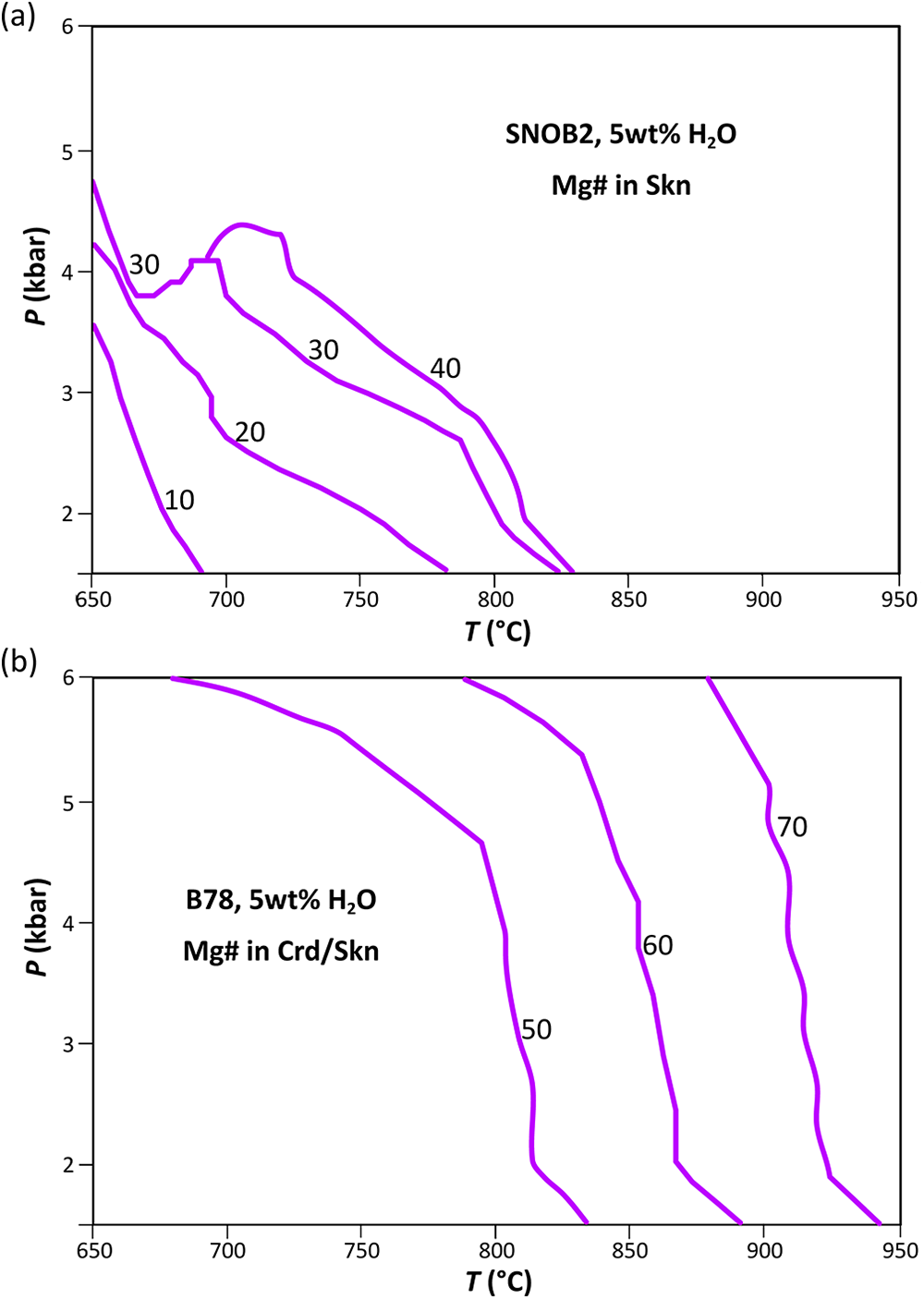
Model P–T diagrams calculated using Rcrust, showing Mg# (100Mg/[Mg+Fe+Mn]) isopleths for cordierite minerals formed during equilibrium crystallisation in magmas of Rubicon Rhyolite compositions: (a) SNOB2 and (b) B78, both with 5 wt.% H2O. Note that in (a), the limit of sekaninaite stability corresponds to the contoured area however in (b) the cordierite mineral is stable throughout the diagram.

Thermodynamic modelling
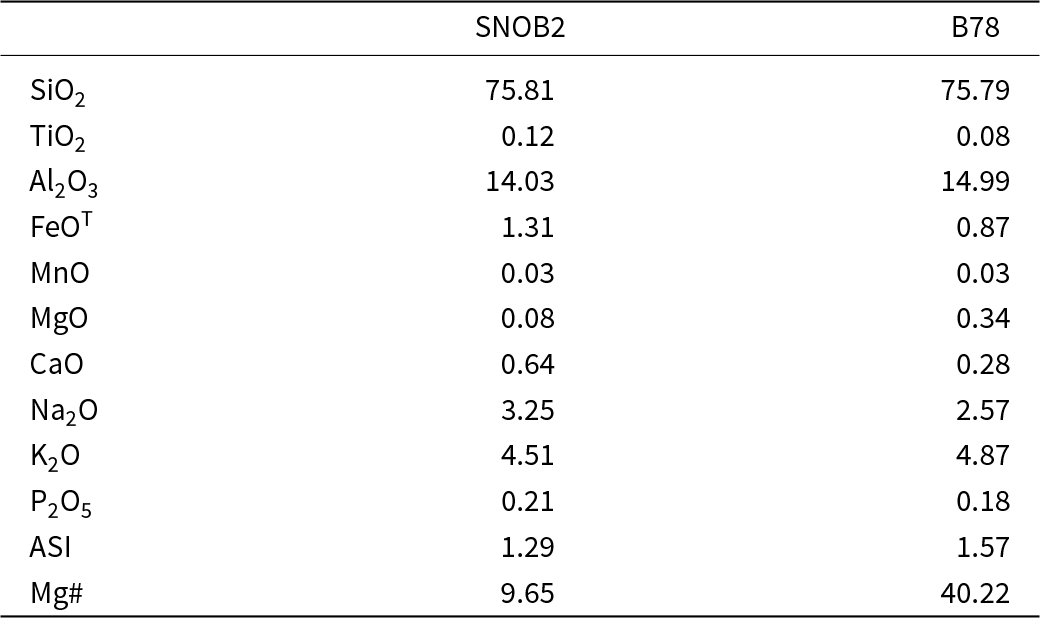
One of the most important questions about the occurrence of sekaninaite in volcanic rocks is whether this mineral phase can have crystallised as true phenocrysts or whether it must have originated as xenocrysts from Fe-rich crustal rocks through which the magmas passed or as restitic grains from the magma source regions. As mentioned above, a variety of situations could exist, but the petrographic data suggest that sekaninaite should be able to crystallise from strongly peraluminous, and particularly S-type, volcanic magmas. To explore this topic, we calculated a series of thermodynamic models with two rock compositions from the Rubicon Rhyolite. These two compositions (SNOB2 and B78) were chosen because they have near-identical SiO2 contents but are quite different in many other parameters, especially in Mg# and ASI values (Table 3). During crystallisation, such differences could potentially affect the stabilities of various mineral phases significantly.
Major-oxide compositions* of Rubicon Rhyolite samples used in thermodynamic modelling of phase relations.

* normalised to 100 wt.% volatile-free and with all Fe as FeOT
The modelling used the software package Rcrust, a tool for calculating path-dependent open-system processes in igneous and metamorphic systems, developed by Mayne et al. (Reference Mayne, Moyen, Stevens and Kaislaniemi2016, Reference Mayne, Stevens, Moyen, Johnson, Janousek, Bonin, Collins, Farina and Bowden2020). Critical modelling details are given in Supplemental Material 1. In accord with the results of experiments on a different Rubicon Rhyolite composition (Clemens, Reference Clemens1981; Clemens and Birch, Reference Clemens and Birch2012), the main calculations assumed that the H2O content of the initial magma system was 5 wt.% and that the relevant pressure range was < 5 kbar. Fractional crystallisation models were therefore calculated for cooling and crystallisation of the two chosen Rubicon Rhyolite compositions, and the results are shown in Fig. 10. Cooling was modelled from the liquidus, and 95% of all solids (crystals) that formed were extracted at each 2°C step. Cumulative extractions progressively changed the starting bulk composition as T decreased toward the solidus.
The composition of SNOB2 is far more ferroan, though also a little more mafic and has higher total alkalis than B78; Mg# is ∼10 for SNOB2 and ∼40 for B78 (Table 3). This set of differences is clearly reflected in the phase relations with the more ferroan SNOB2 having a much larger field for crystallisation of K-feldspar, as well as a field for garnet (at 4 kbar) and a rather smaller field for sekaninaite crystallisation at 1.5 kbar than for the more magnesian B78. Note the absence of cordierite in the phase relations for SNOB2 at 4 kbar. In this magma, garnet is predicted to form in preference to a cordierite mineral. At 1.5 kbar, sekaninaite is stable over a broad range of T but no cordierite forms at 4 kbar. At 4 kbar in B78, sekaninaite is not formed at all, with cordierite being the stable phase throughout the temperature range. In contrast, at the lower P of 1.5 kbar, B78 is predicted to crystallise cordierite until T falls to 765°C and thereafter the composition transitions to sekaninaite at lower temperatures. The variation of Crd–Skn Mg# for both rock compositions, in closed system P–T sections without fractional crystallisation, is illustrated in Fig. 11. Note that the compositions of cordierite/sekaninaite become more ferroan towards both lower P and lower T, with the pressure effect especially pronounced in SNOB2. For equilibrium crystallisation, the proportion of either cordierite or sekaninaite in the fully crystallised B78 would be <10%, at both 1.5 and 4 kbar. The effect of varying the bulk H2O content of the system was investigated to assess the consequences of varying degrees of magma hydration. Changing this parameter by ± 1.5 wt.% would produce negligible changes in either Crd–Skn composition or modal proportion.
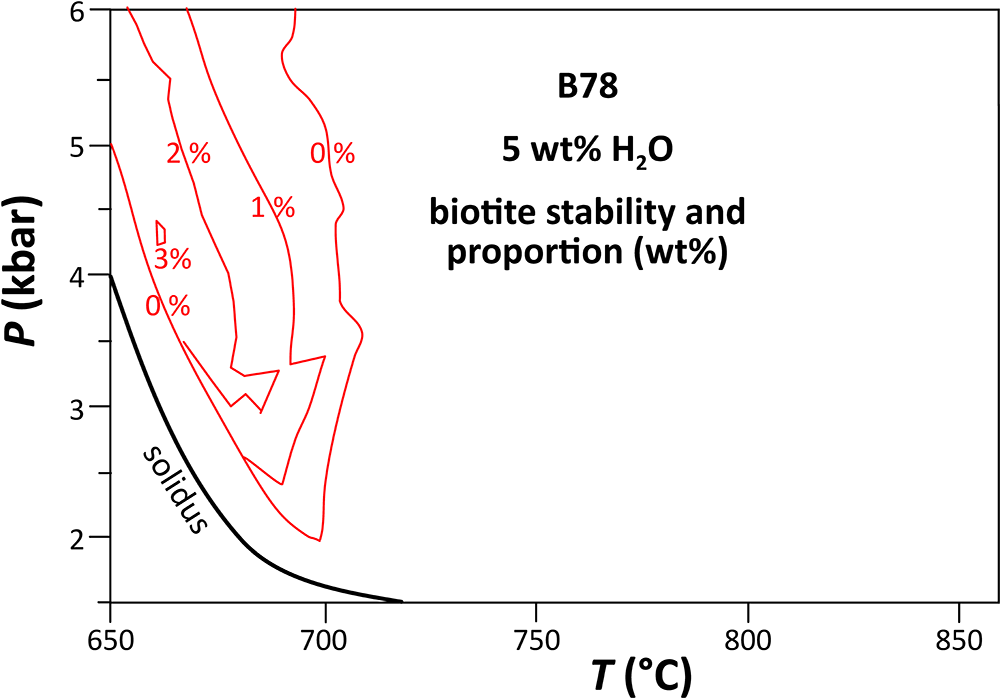
Of the tectosilicate phases, K-feldspar and quartz are predicted to be the modally abundant and earliest-appearing phases, with plagioclase only forming at much lower T and in much smaller quantities. This is in accord with the experimental data from Clemens (Reference Clemens1981) and Clemens and Birch (Reference Clemens and Birch2012), though these experiments approximated equilibrium rather than fractional crystallisation. The calculations imply that biotite has no stability field at the fractional crystallisation conditions portrayed in Fig. 10. Modelling equilibrium crystallisation still produced no stability field for biotite in SNOB2 and only a limited, near-solidus stability field in B78 (P ≥ 2 kbar and T < 710°C); see Fig. 12. Both the reversal in zoning patterns of Rubicon Rhyolite sekaninaite phenocrysts (to narrow, more magnesian rims) and the presence and up-sequence increase in abundance of biotite can be explained by magma–magma interactions. As explained above, the stratigraphy in the Cerberean Cauldron suggests that the initially cooler Rubicon Rhyolite magmas overlay a much larger volume of hotter and more magnesian Lake Mountain Rhyodacite, prior to eruption. According to Clemens and Birch (Reference Clemens and Birch2012) there was sufficient time in the pre-eruption magma chamber for some differentiation to have occurred within the Rubicon Rhyolite magmas. This would have allowed chemical and thermal diffusive exchange with the Lake Mountain Rhyodacite magmas, setting up a gradation in magma Mg# and temperature, resulting in biotite crystallisation in the rhyolite and reversal in the zoning pattern of the sekaninaite (Fig. 3). The presence of some biotite, even in the basal parts of the Rubicon Rhyolite suggests that some crystallisation occurred in these magmas at pressures greater than those of the pre-eruption magma chamber, consistent with the findings of Clemens and Wall (Reference Clemens and Wall1981).
P–T plot of calculated biotite stability under conditions of equilibrium crystallisation in Rubicon Rhyolite composition B78, with 5 wt.% total H2O. The red contours show the proportion of biotite, in wt.%.

Conclusions
Fe-dominant cordierite (sekaninaite) is uncommon in volcanic rocks but there are several localities where it is present as phenocrysts in either lavas or pyroclastic rocks, with compositions ranging from high-silica rhyolite to dacite. It’s igneous origin is supported by its textural features as well as by the results of experiments and thermodynamic calculations. In all known occurrences, the crystals show prominent sector twinning, based on trillings. This is formed as a response to strain induced during cooling, as the mineral undergoes increases in the degree of Al–Si ordering. There is no general correlation between host-rock Mg# and cordierite–sekaninaite composition because crystallisation conditions strongly affect the stability and compositions of these minerals. The most ferroan occurrences (Mg# = 10–30) come from the ignimbritic rocks of the Rubicon Rhyolite and at Arthurs Seat in Victoria, Australia. Modelling has shown that sekaninaite can crystallise from a variety of peraluminous silicic magmas over a range of P–T conditions but that its stability is favoured by crystallisation at low P and T.
Supplementary material
The supplementary material for this article can be found at https://doi.org/10.1180/mgm.2025.10080.
Acknowledgements
Sophie Decree provided information on the composition of Tunisian Crd–Skn. Ashleigh Hood (Melbourne University Earth Sciences) assisted with the Rubicon Rhyolite photography. Oskar Lindenmayer (Museums Victoria) assisted with the SEM/EDS investigation of the Arthurs Seat sekaninaite (Fig. 5). We are grateful for permission from Alessandro da Mommio to use images of Italian sekaninaite (Fig. 6) and we are also grateful for helpful comments from two reviewers.
Competing interests
The authors declare none.
Addendum
After acceptance and first publication of this manuscript, the authors were informed of another occurrence of iron-rich cordierite, in volcanic rocks in the Central Igneous Province of Madagascar. The relevant paper is Melluso, L. et al., 2001. The Cretaceous Igneous Province of Madagascar: geochemistry and petrogenesis of lavas and dykes from the Central-Western sector. Journal of Petrology, 42, 1249–1273.